steering wheel BUICK LESABRE 1993 User Guide
[x] Cancel search | Manufacturer: BUICK, Model Year: 1993, Model line: LESABRE, Model: BUICK LESABRE 1993Pages: 324, PDF Size: 17.02 MB
Page 167 of 324
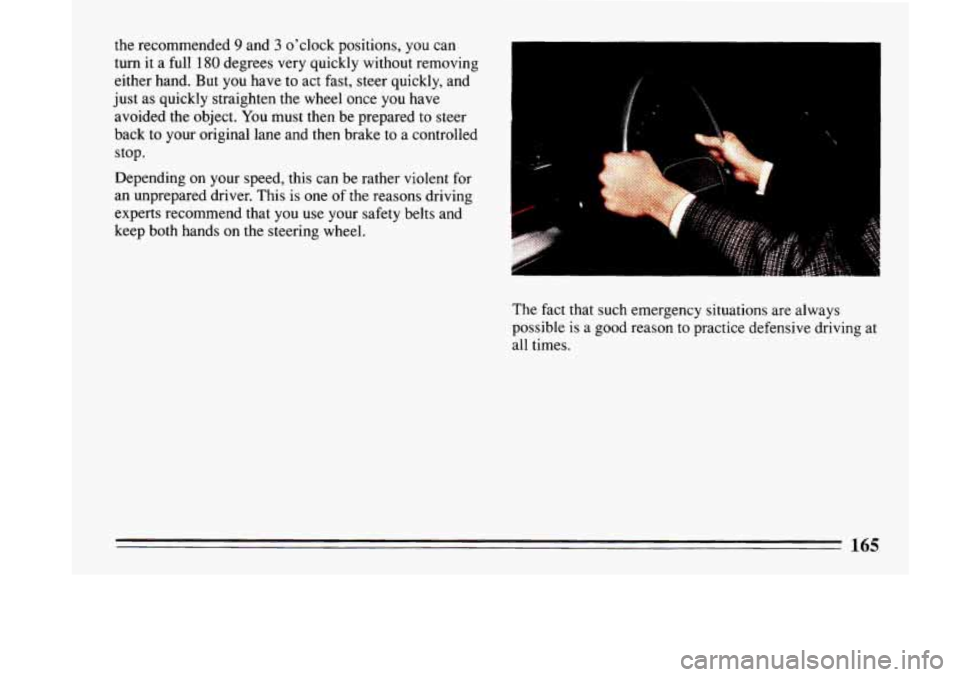
the recommended 9 and 3 o'clock positions, you can
turn
it a full 180 degrees very quickly without removing
either hand. But you have to act fast, steer quickly, and
just as quickly straighten the wheel once
you have
avoided the object. You must then be prepared to steer
back to your original lane and then brake to a controlled
stop.
Depending on your speed, this can be rather violent for
an unprepared driver. This is
one of the reasons driving
experts recommend that
you use your safety belts and
keep both hands on the steering wheel.
The fact that such emergency situations are always
possible
is a good reason to practice defensive driving at
all times.
165
Page 168 of 324
Off-Road Recovery
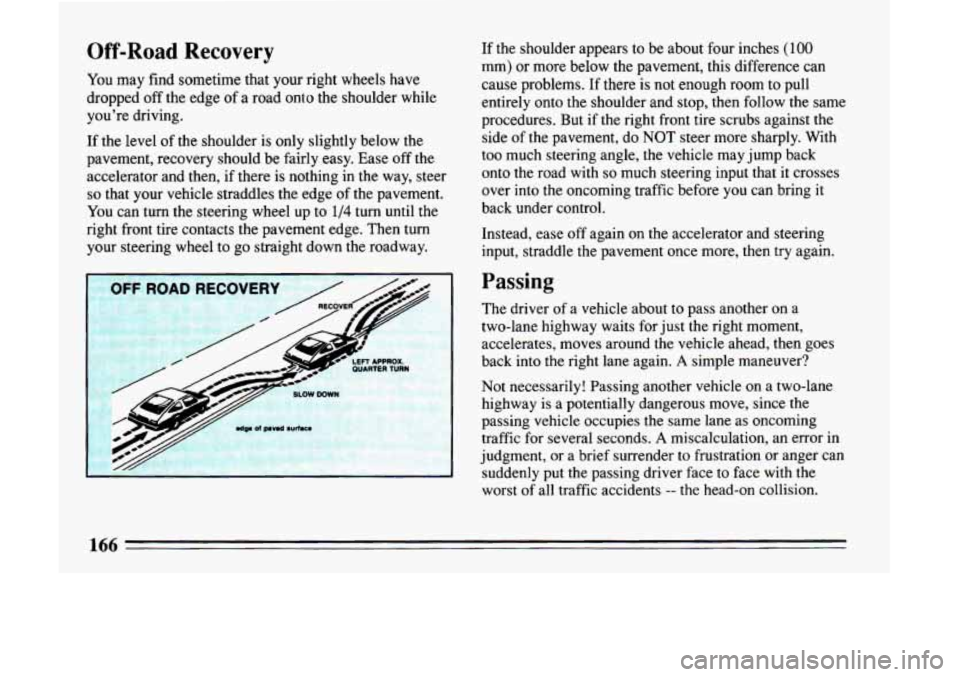
You may find sometime that your right wheels have
dropped off the edge
of a road onto the shoulder while
you’re driving.
If the level of the shoulder is only slightly below the
pavement, recovery should be fairly easy. Ease off the
accelerator and then, if there is nothing in the way, steer
so that your vehicle straddles the edge of the pavement.
You can turn the steering wheel up to 1/4 turn until the
right front tire contacts the pavement edge. Then turn
your steering wheel to go straight down the roadway. If
the shoulder appears to be about four inches
(100
mm) or more below the pavement, this difference can
cause problems.
If there is not enough room to pull
entirely onto the shoulder and stop, then follow the same
procedures. But if the right front tire scrubs against the
side of the pavement, do
NOT steer more sharply. With
too much steering angle, the vehicle may jump back
onto the road with
so much steering input that it crosses
over into the oncoming traffic before you can bring
it
back under control.
Instead, ease off again
on the accelerator and steering
input, straddle the pavement once more, then
try again.
Passing
The driver of a vehicle about to pass another on a
two-lane highway waits for just the right moment,
accelerates, moves around the vehicle ahead, then goes
back into the right lane again.
A simple maneuver?
Not necessarily! Passing another vehicle on a two-lane
highway is a potentially dangerous move, since the
passing vehicle occupies the same lane as oncoming
traffic for several seconds.
A miscalculation, an error in
judgment, or a brief surrender
to frustration or anger can
suddenly put the passing driver face
to face with the
worst
of all traffic accidents -- the head-on collision.
Page 170 of 324
0 Try not to pass more than one vehicle at a time on
two-lane roads. Reconsider before passing the
next
vehicle.
Don’t overtake a slowly moving vehicle too rapidly.
Even though
the brake lights are not flashing, it may
be slowing down or starting to turn.
following driver to get ahead of you. Perhaps
you
can ease a little to the right.
If you’re being passed, make it easy for the
Loss of Control
Let’s review what driving experts say about what
happens when the three control systems (brakes, steering
and acceleration) don’t have enough friction where the
tires meet the road
to do what the driver has asked.
In
any emergency, don’t give up. Keep trying to steer and
constantly seek an escape route or area of less danger.
Skidding
In a skid, a driver can lose control of the vehicle.
Defensive drivers avoid most skids by taking reasonable
care suited to existing conditions, and by
not “over-
driving” those conditions. But skids are always possible. The
three types of skids correspond
to your Buick‘s
three control systems. In
the braking skid your wheels
aren’t rolling. In
the steering or cornering skid, too
much speed or steering in a curve causes tires to slip and
lose cornering force. And in the acceleration skid too
much throttle causes the driving wheels
to spin.
A cornering skid and an acceleration skid are best
handled by easing your
foot off the accelerator pedal.
If your vehicle starts to slide (as when
you turn a comer
on a wet, snow-or icexovered road), ease your foot off
the accelerator pedal as soon as your feel the vehicle start
to slide. Quickly steer the way
you want the vehicle to
go. If you start steering quickly enough, your vehicle will
straighten
out. As it does, straighten the front wheels.
Of course, traction is reduced when water, snow, ice,
gravel, or other material is
on the road. For safety, you’ll
want
to slow down and adjust your driving to these
conditions. It is important to slow down
on slippery
surfaces because stopping distance will be longer and
vehicle control more limited.
While driving
on a surface with reduced traction, try
your best
to avoid sudden steering, acceleration, or
braking (including engine braking by shifting
to a lower
gear). Any sudden changes could cause tires to slide.
You may
not realize the surface is slippery until your
168
Page 195 of 324
Following Distance
Stay at least twice as far behind the vehicle ahead as you
would when driving your vehicle without a trailer. This
can help
you avoid situations that require heavy braking
and sudden turns.
Passing
You’ll need more passing distance up ahead when
you’re towing a trailer. And, because you’re a good deal
longer, you’ll need to go much farther beyond the
passed vehicle before you can return
to your lane.
Backing Up
Hold the bottom of the steering wheel with one hand.
Then,
to move the trailer to the left, just move that hand
to the left. To move the trailer to the right, move your
hand
to the right. Always back up slowly and, if
possible, have someone guide you.
Making nrns
When you’re turning with a trailer, make wider turns
than normal. Do this
so your trailer won’t strike soft
shoulders, curbs, road signs, trees, or other objects.
Avoid jerky or sudden maneuvers. Signal well
in
advance.
Turn Signals When Towing a Trailer
When you tow a trailer, your vehicle has to have a
different turn signal flasher and extra wiring. The green
arrows
on your instrument panel will flash whenever
you signal a turn
or lane change. Properly hooked up,
the trailer lights will also flash, telling other drivers
you’re about to turn, change lanes or stop.
When towing a trailer, the green arrows on your
instrument panel will flash for turns even if the bulbs on
the trailer are burned out.
Thus, you may think drivers
behind you are seeing your signal when they are
not. It’s
important to check occasionally to be sure the trailer
bulbs are still working.
Driving On Grades
Reduce speed and shift to a lower gear before you start
down a long or steep downgrade. If you don’t shift
down,
you might have to use your brakes so much that
they would get hot and no longer work well.
On a long uphill grade, shift down to “D” (Drive) and
reduce your speed to around
45 mph (70 km/h) to
reduce the possibility of engine and transaxle
overheating.
193
Page 207 of 324
When your vehicle is being towed, have the ignition key
off. The steering wheel should be clamped in a
straight-ahead position, with a clamping device designed
for towing service.
Do not use the vehicle’s steering
column lock for this. The transaxle should be in Neutral
and the parking brake released.
Don’t have your vehicle towed on the front wheels,
unless
you must. If the vehicle must be towed on the
front wheels, don’t
go more than 55 mph (88 kph) or
farther than
500 miles (800 km) or your transaxle will
be damaged.
If these limits must be exceeded, then the
front wheels have to be supported on a dolly.
-
A CAUTION:
A vehicle can fall from a car carrier if it isn’t
properly secured, This can cause a collision,
serious personal injury and vehlcle damage. The
vehicle should be tightly secured with chains
or
steel cables before it is transported.
Don’t use substitutes (ropes, leather straps,
canvas webbing, etc.) that can be cut by sharp
zdges underneath the towed vehicle.
Page 218 of 324
If a Tire Goes Flat
It’s unusual for a tire to “blow out” while you’re driving,
especially if you maintain your tires properly.
If air goes
out of a tire, it’s much more likely to leak out slowly.
But if you should ever have a “blowout,” here are a few
tips about what to expect and what to do:
If a front tire fails,
the flat tire will create a drag that
pulls the vehicle toward that side. Take your foot off the
accelerator pedal and grip the steering wheel firmly. Steer to maintain lane position, then gently brake to a
stop well out
of the traffic lane.
A rear blowout, particularly on a curve, acts much like a
skid and may require the same correction you’d use in a
skid. In any rear blowout, remove your foot from the
accelerator pedal. Get the vehicle under control
by
steering the way you want the vehicle to go. It may be
very bumpy and noisy, but you can still steer. Gently
brake to a stop, well
off the road if possible.
If your tire goes flat, the next section shows how to use
your jacking equipment to change a flat tire safely.
Changing a Flat Tire
If a tire goes flat, avoid further tire and wheel damage
by driving slowly to
a level place. Turn on your hazard
warning flashers.
A CAUTION:
Changing 8 tire can cause an injury. The vehicle
can
slip off the jack and roll over you or other
people. You and they could be badly injured. Find
eve1 place to change your tire. To help prevent
the vehicle from moving:
1. Set the parking brake firmly.
2. Put the shift lever In “P” (Park).
3. Turn off the engine.
lo be even more certain the vehicle won’t move,
you can put chocks at the front and rear of the tire
Farthest away from the one being changed. That
would
be the tire on the other side of the vehicle,
at the oppll le end.
216
-
Page 230 of 324
If You’re Stuck: In Sand, Mud, Ice or
Snow
What you don’t want to do when your vehicle is stuck is
to spin your wheels. The method known as “rocking”
can help you get out when you’re stuck, but you must
use caution.
1 LAUTION:
If you let your tires spin at high speed, they can
explode and you or others could be injured. And,
the transaxle or other parts of the vehicle can
overheat. That could cause an engine
compartment fire or other damage. When you’re
stuck, spin the wheels as little as possible. Don’t
spin the wheels above 35 mph (55 km/h) as
own on the speedometer.
I
I AOTICE:
Spinning your troy pal I
vehicle as well as the tires. If you spin the wheels
too fast while shifting your transaxle
forth, you can destroy your transaxle.
Rocking your vehicle to get it out:
First, turn your steering wheel left and right. That will
clear the area around your front wheels. Then shift back
and forth between
“R” (Reverse) and a forward gear ,
spinning the wheels as little as possible. Release the
accelerator pedal while you shift, and press lightly on
the accelerator pedal when the transaxle
is in gear. If
that doesn’t get
you out after a few tries, you may need
to be towed out. If you do need to be towed out, see
“Towing Your Car” in the Index.
Page 288 of 324
Explanation of Scheduled Maintenance
Services
Below are explanations of the services listed in Schedule
I and Schedule 11.
The proper fluids and lubricants to use are listed in
Section
D. Make sure whoever services your vehicle
uses these. All parts should be replaced and all
necessary repairs done before
you or anyone else drives
the vehicle.
1. Engine Oil and Filter Change* -- Always use SG
Energy Conserving I1 oils of proper viscosity. The
“SG” designation may be shown alone or in
combination with others, such as “SG/CC”,
“SG/CD” or “SF, SG, CC,” etc. To determine the
preferred viscosity for your vehicle’s engine (e.g.,
SAE
5W-30 or SAE 10W-30), see “Engine Oil” in
the Index. If your vehicle has an Engine Oil Life
Monitor, the monitor will show
you when to change
the oil. See “Engine Oil Life Monitor” in the Index.
2. Chassis Lubrication -- Lubricate suspension and
steering linkage. Lubricate the transaxle shift linkage, and parking brake
cable guides, underbody
contact points and linkage.
3. Throttle Body Mounting Bolt Torque* -- Check
the torque of the mounting bolts and/or nuts.
4. Tire and Wheel Rotation and Inspection -- For
proper wear and maximum tire life, rotate your tires
following
the instructions in this manual. See “Tires,
Inspection
& Rotation” in the Index. Check the tires
for uneven wear or damage. If you see irregular or
premature wear, check the wheel alignment. Check
for damaged wheels also.
5. Engine Accessory Drive Belt(s) Inspection --
Inspect the belt(s) for cracks, fraying, wear and
proper tension. Replace as needed.
6. Cooling System Service” -- Drain, flush and refill
the system with new or approved recycled coolant
conforming to GM Specification 1825M. Keep
coolant at the proper mixture as specified. See
“Coolant” in
the Index. This provides proper freeze
protection, corrosion inhibitor level
and engine
operating temperature.
* An Emission Control Service.
3‘ The U.S. Environmental Protection Agency has determined that the failure to perfonn this maintenance item will not nullify the emission warranty or limit recall liability prior to thecompletion of vehicle
useful life. General Motors, however, urges that all recommended maintenance services be performed at the indicated intervals and the maintenance be recorded in “Section E:Maintenance Record”.
286
Page 294 of 324
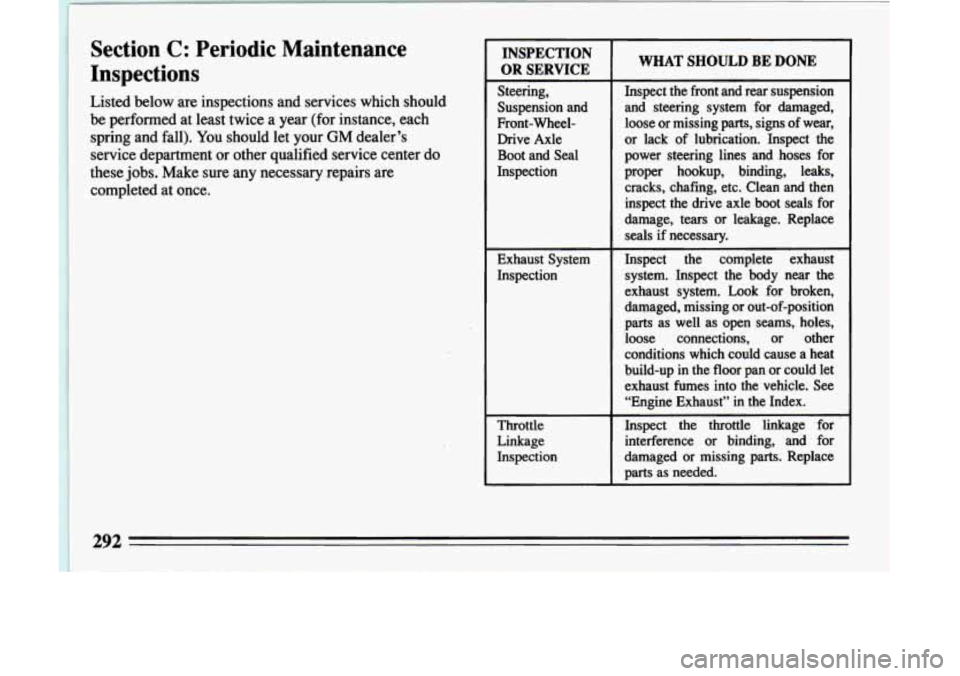
Section C: Periodic Maintenance
Inspections
Listed below are inspections and services which should
be performed at least twice a year (for instance, each
spring and fall). You should let your
GM dealer’s
service department or other qualified service center do
these jobs. Make sure any necessary repairs are completed at once.
INSPECTION
OR SERVICE ______~
Steering,
Suspension and
Front-Wheel-
Drive
Axle
Boot and Seal
Inspection
Exhaust System Inspection
Throttle
Linkage
Inspection
WHAT SHOULD BE DONE
Inspect the front and rear suspension
and steering system for damaged,
loose or missing parts, signs of wear,
or lack of lubrication. Inspect the
power steering lines and hoses for
proper hookup, binding,
leaks,
cracks, chafing, etc. Clean and then inspect the drive axle boot seals for
damage, tears
or leakage. Replace
seals if necessary.
Inspect the complete exhaust system. Inspect the body near the
exhaust system. Look for broken,
damaged, missing or out-of-position
parts as well as open seams, holes,
loose connections, or other
conditions which could cause a heat
build-up in the floor pan or could let
exhaust fumes into the vehicle. See
“Engine Exhaust” in the Index.
Inspect the throttle linkage for
interference or binding, and for
damaged
or missing parts. Replace
parts as needed.
Page 307 of 324
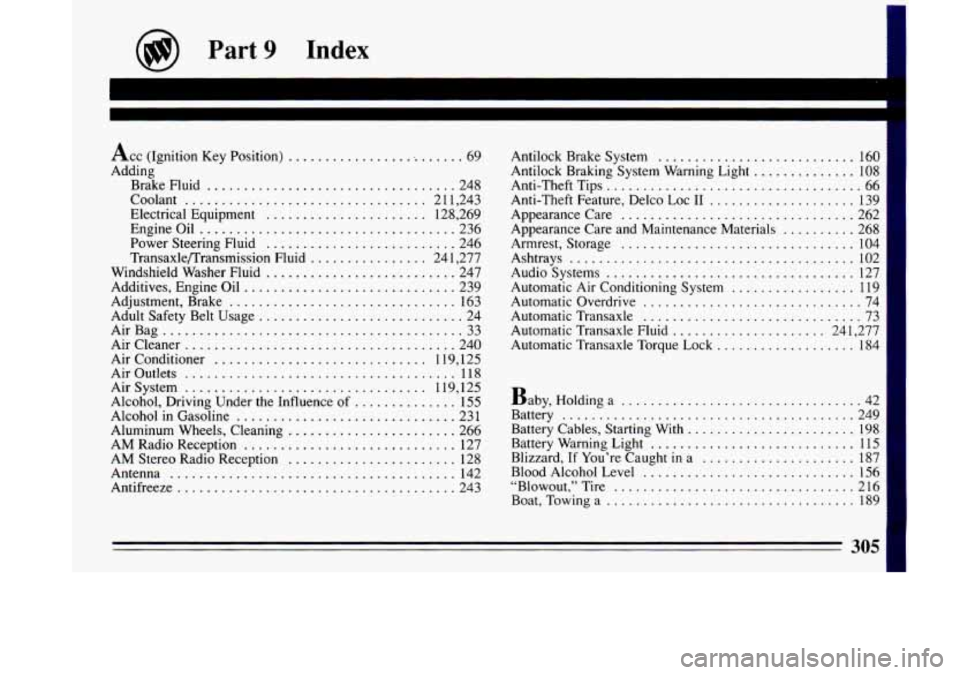
XI Engineoil ..................................
Power Steering Fluid .........................
Transaxle/Transmission Fluid ................ 24
Windshield Washer Fluid
.........................
Additives . Engine Oil ............................
Acc (Ignition Key Position) ......................... 69
Adding Brake Fluid
.................................. 248
Coolant
................................. 211. 243
Electrical Eauiument
...................... 128. 269
. 236
. 246
1. 277
. 247
I” . 239
Adjustment. Brake
............................... 163
Adult Safety Belt Usage
............................ 24
AirBag
......................................... 33
Aircleaner ..................................... 240
Air Conditioner
............................. 1 19. 125
Air Outlets
..................................... 11 8
Air System
................................. 1 19. 125
Alcohol. Driving Under the Influence
of .............. 155
Alcohol in Gasoline .............................. 231
Aluminum Wheels. Cleaning
....................... 266
AM Radio Reception
............................. 127
AM Stereo Radio Reception
....................... 128
Antenna
....................................... 142
Antifreeze
...................................... 243
@) Part 9 Index
Antilock Brake System ........................... 160
Anti-Theft Tips
................................... 66
Anti-Theft Feature. Delco Loc I1 .................... 139
Appearance Care
................................ 262
Armrest. Storage
................................ 104
Ashtrays ....................................... 102
Audio Systems
.................................. 127
Automatic Air Conditioning System
................. 119
Automatic Overdrive
.............................. 74
Automatic Transaxle
.............................. 73
Automatic Transaxle Fluid
..................... 24 1. 277
Automatic Transaxle Torque
Lock ................... 184
Antilock Braking System Warning Light
.............. 108
Appearance Care and Maintenance Materials .......... 268
Baby. Holding
a ................................. 42
Battery
........................................ 249
Battery Cables. Starting With
....................... 198
Battery Warning Light
............................ 115
Blizzard.
If You’re Caught in a ..................... 187
BloodAlcoholLevel
............................. 156
“Blowout. .. Tire ................................. 216
Boat. Towinga .................................. 189
305