oil dipstick BUICK LESABRE 1993 Owners Manual
[x] Cancel search | Manufacturer: BUICK, Model Year: 1993, Model line: LESABRE, Model: BUICK LESABRE 1993Pages: 324, PDF Size: 17.02 MB
Page 115 of 324
2. If you’re “idling” at a stop sign, the light may blink
3. If you make a hard stop, the light may come on for a
on and then off.
moment.
But, when this light comes
on and stays on, it means
oil isn’t going through your engine properly.
You could
be low on oil, or you might have some other oil
problem.
I
A CAUTION:
Don’t keep driving if the 001 pressure is low. If
you do, your engine can become so hot that it
catches fire. You or others could be burned.
Check your oil
as soon as possible and have
your vehicle serviced.
I
I
problems can ed
your warranty. I
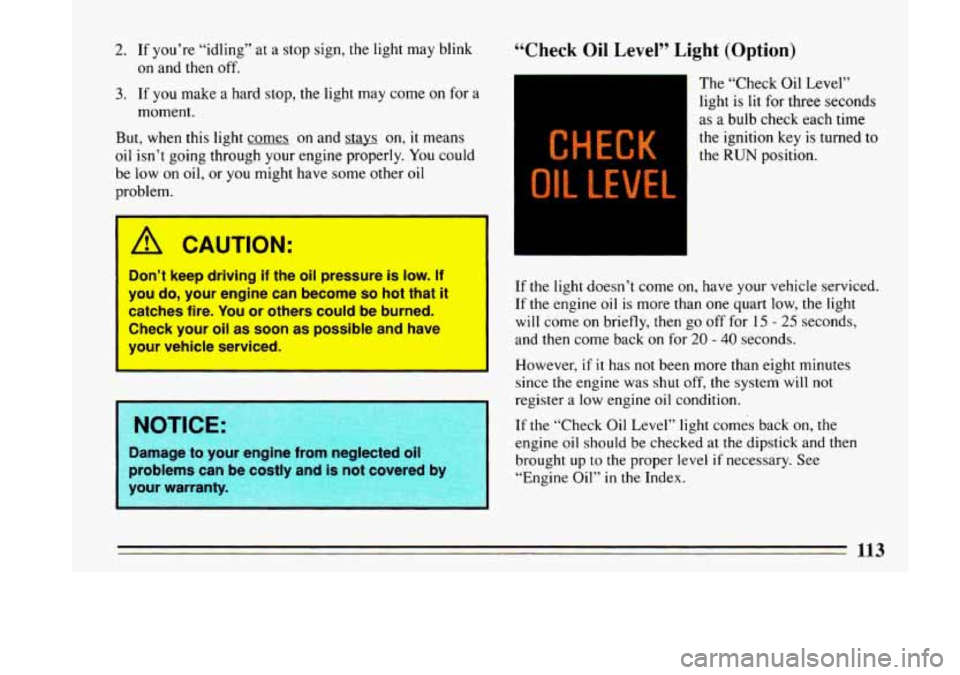
‘‘Check Oil Level” Light (Option)
CHECK
OIL LEVEL.,
The “Check Oil Level”
light is lit for three seconds
as a bulb check each time
the ignition key is turned to
the RUN position.
If
the light doesn’t come on, have your vehicle serviced.
If the engine
oil is more than one quart low, the light
will come
on briefly, then go off for 15 - 25 seconds,
and then come back
on for 20 - 40 seconds.
However,
if it has not been more than eight minutes
since the engine was
shut off, the system will not
register a low engine oil condition.
If the “Check Oil Level” light comes back on, the
engine oil should be checked at the dipstick and then
brought up
to the proper level if necessary. See
“Engine Oil”
in the Index.
Page 238 of 324
A CAUTION:
Things that burn can get on hot engine parts and
start a fire. These include liquids like gasoline,
oil, coolant, brake fluid, windshield washer and
other fluids, and plastic
or rubber. You or others
could
be burned. Be careful not to drop or spill
things that
will burn onto a hot engine.
I
Before closing the hood, be sure all the filler caps are on
properly.
Then just pull the hood down and close it firmly.
Engine Oil
It’s a good idea to check your engine oil every time you
get fuel. In order to get an accurate reading, the oil must
be warm and the vehicle
must be on level ground.
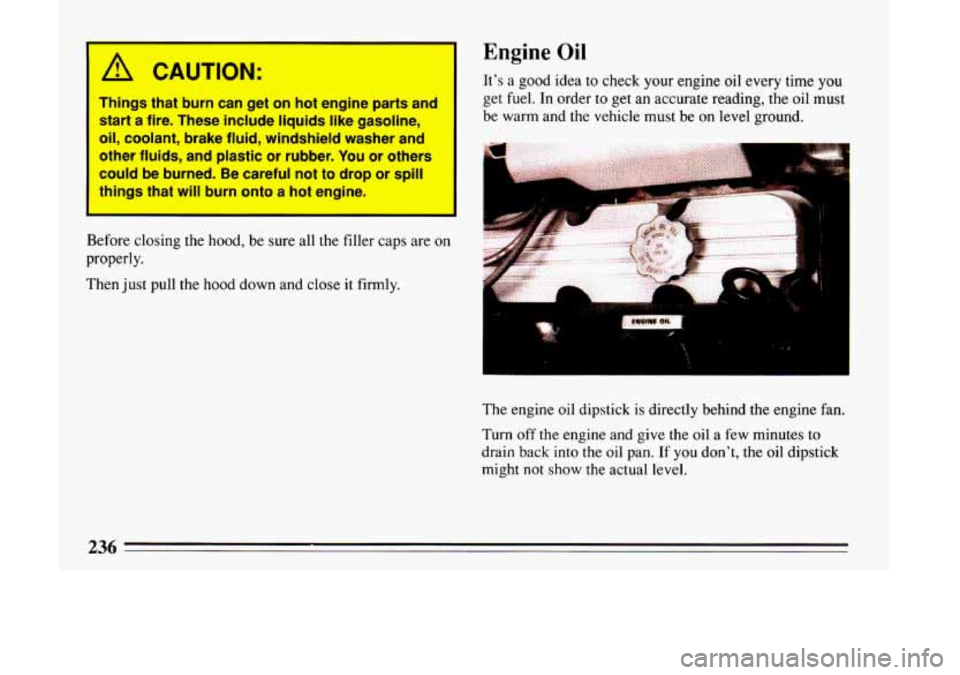
The engine oil dipstick is directly behind the engine fan.
Turn
off the engine and give the oil a few minutes to
drain back into the oil pan. If you don’t, the oil dipstick
might not show the actual level.
236
Page 239 of 324
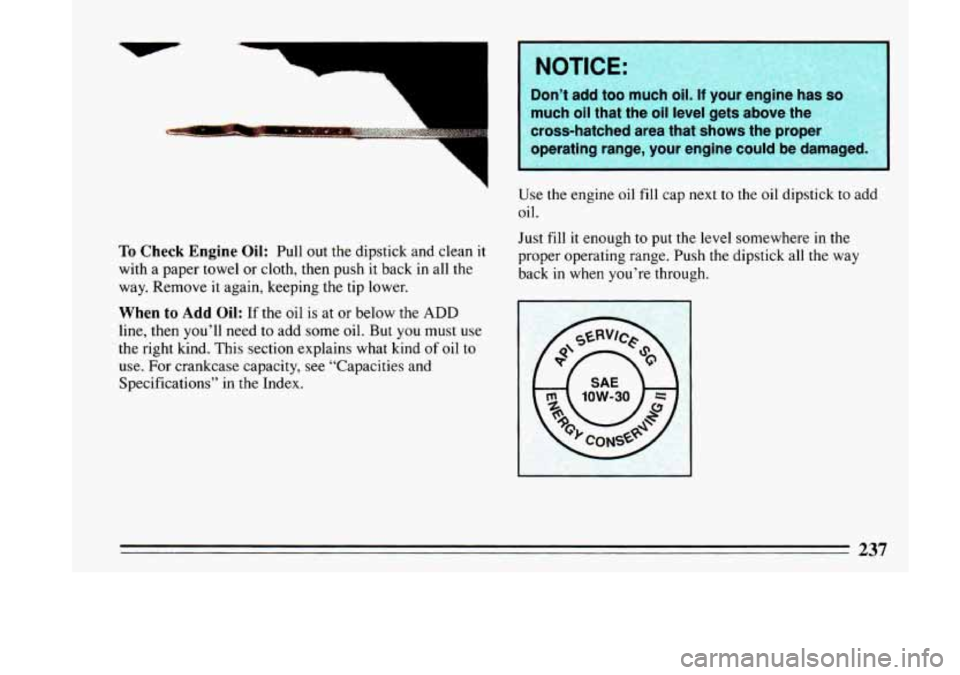
To Check Engine Oil: Pull out the dipstick and clean it
with a paper towel or cloth, then push it back in all the
way. Remove it again, keeping the tip lower.
When to Add Oil: If the oil is at or below the ADD
line, then you’ll need to add some oil. But you must use
the right kind. This section explains what kind of
oil to
use. For crankcase capacity, see “Capacities and
Specifications” in the Index.
1 NOTICE:
Don’t add too much oil. If your engine has so
much oil that the oil level gets above the
cross-hatched area that
shows the proper
operating range, your engine could be damaged.
Use the engine oil fill cap next to the oil dipstick to add
oil.
Just fill it enough to put the level somewhere in the
proper operating range. Push
the dipstick all the way
back
in when you’re through.
I
237
Page 243 of 324
Refer to the Maintenance Schedule to determine when
to replace the air filter.
See “Scheduled Maintenance Services” in the Index.
A CAUTION:
Operating the engine with the air cleaner off can
cause you or others
to be burned. The air cleaner
not only cleans the air, it stops flame if the
engine backfires.
If it isn’t there, and the engine
backfires, you could be burned. Don’t drive with
it off, and be careful working on the engine with
the
air cleaner off.
I
NOTICE:
If the air cleaner is off, a backfire can cause a
damaging engine fire. And, dirt can easily gel
into your engine, which wiil damage
it. Always
have the air cleaner
in place when you’re driving.
Automatic Transaxle Fluid
When to Check and Change:
A good time to check your automatic transaxle fluid
level
is when the engine oil is changed. Refer to the
Maintenance Schedule to determine when to change
your fluid. See “Scheduled Maintenance Services”
in
the Index.
How to Check:
Because this operation can be a little difficult, you may
choose to have this done at a Buick dealership Service
Department.
If you do it yourself, be sure to follow all the
instructions here,
or you could get a false reading on the
dipstick.
241
Page 245 of 324
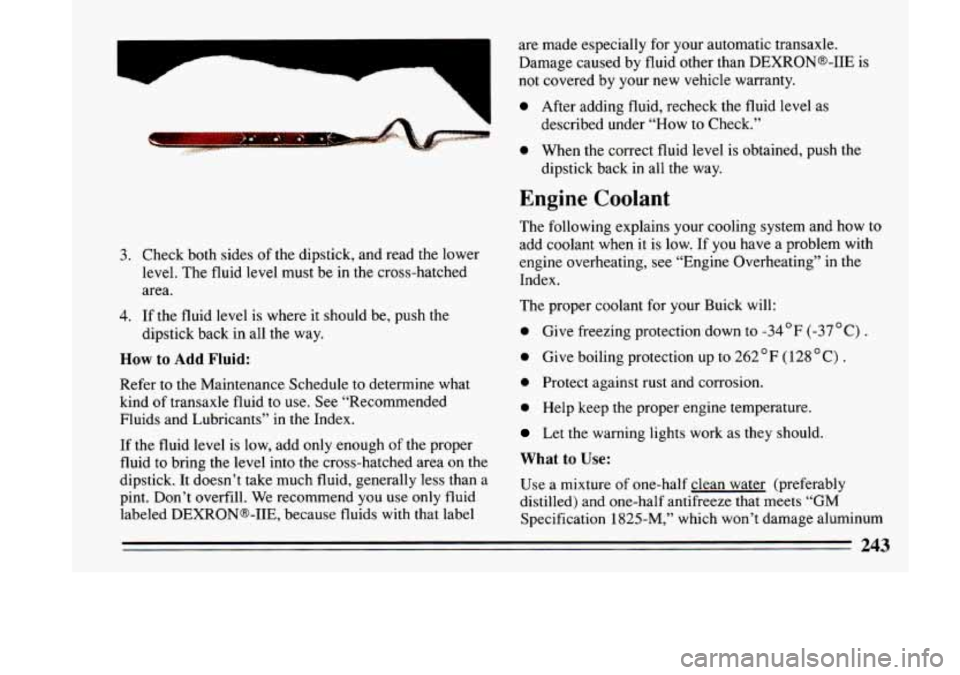
3.
4.
Check both sides of the dipstick, and read the lower
level. The fluid level must be in the cross-hatched
area.
If the fluid level is where it should be, push the
dipstick back in all the way.
How to Add Fluid:
Refer to the Maintenance Schedule to determine what
kind
of transaxle fluid to use. See “Recommended
Fluids and Lubricants” in the Index.
If the fluid level
is low, add only enough of the proper
fluid to bring the level into the cross-hatched area on the
dipstick. It doesn’t take much fluid, generally less than a
pint. Don’t overfill. We recommend you use only fluid
labeled DEXRONa-IIE, because fluids with that label are made especially for your automatic transaxle.
Damage caused by fluid other than DEXRONs-IIE
is
not covered by your new vehicle warranty.
0 After adding fluid, recheck the fluid level as
described under “How to Check.”
0 When the correct fluid level is obtained, push the
dipstick back in all the way.
Engine Coolant
The following explains your cooling system and how to
add coolant when it is low. If you have a problem with
engine overheating, see “Engine Overheating” in the
Index.
The proper coolant for your Buick will:
0 Give freezing protection down to -34OF (-37OC) .
0 Give boiling protection up to 262°F (128 “C) .
0 Protect against rust and corrosion.
0 Help keep the proper engine temperature.
Let the warning lights work as they should.
What to Use:
Use a mixture of one-half clean water (preferably
distilled) and one-half antifreeze that meets
“GM
Specification 1825-M,” which won’t damage aluminum
243