parking brake BUICK LESABRE 1993 Owners Manual
[x] Cancel search | Manufacturer: BUICK, Model Year: 1993, Model line: LESABRE, Model: BUICK LESABRE 1993Pages: 324, PDF Size: 17.02 MB
Page 75 of 324
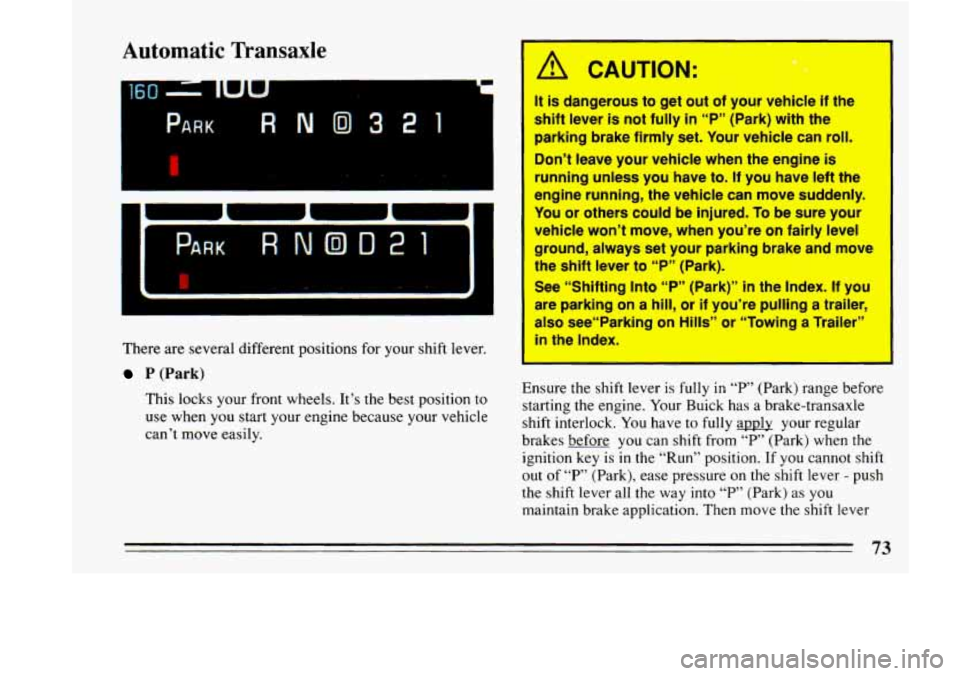
PARK RNO321
Automatic Transaxle
r
There are several different positions for your shift lever.
P (Park)
This locks your front wheels. It’s the best position to
use when you start your engine because your vehicle
can’t move easily.
A CAUTION: .
a -II
It is dangerous to get out of your vehicle If the
shift [ever is not fully in “P” (Park) with the
parking
brake firmly set. Your vehicle can roll.
Don’t leave your vehicle when ihe engine is
running unless you hsve to. If you have left the
engine
running, the vehicle can move suddenly.
You or others could be Injured. To be sure your
vehicle won’t move, when you’re on fairly level
ground, always set your parking brake and move
the shift lever to V“ (Park).
See “Shifting Into “P” (Park)” in the Index. If you
arb parkfng on a hill, or if you’re pulling a trailer,
also see“Parking on Hills” or “Towing a Trailer”
in’ the Index.
- i
Ensure the shift lever is fully in “F‘” (Park) range before
starting the engine. Your Buick has a brake-transaxle
shift interlock.
You have to fully apply your regular
brakes before
you can shift from “P” (Park) when the
ignition key is
in the “Run” position. If you cannot shift
out of “P” (Park), ease pressure on the shift lever - push
the shift lever all
the way into “P” (Park) as you
maintain brake application. Then move the shift lever
73
Page 78 of 324
NOTICE:
If your front wh
drive. This might happen
if you were stuck i
very deep sand or mud or were up agains
object. You could damage your transaxle.
Also, if you stop when going uphill, don't ho
your vehicle there with
only the accelerator
pedal. This could overheat and damage the
transaxle. Use your brakes or shift into
"P'' Park
to hold your vehicle
in position on a hill.
Parking Brake
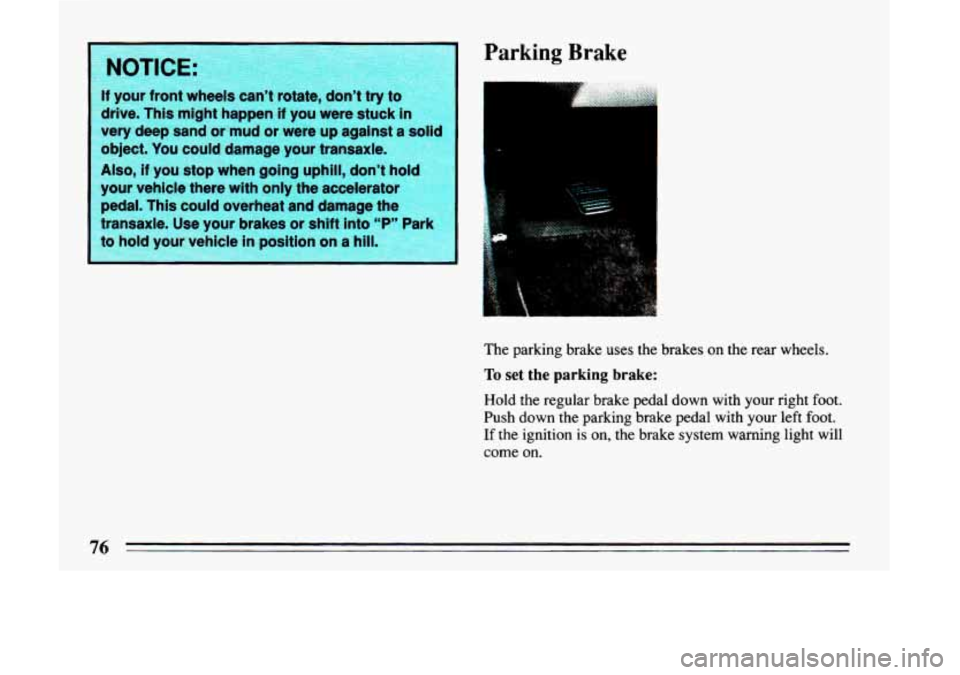
The parking brake uses the brakes on the rear wheels.
To set the parking brake:
Hold the regular brake pedal down with your right foot.
Push down the parking brake pedal with your left foot.
If the ignition
is on, the brake system warning light will
come on.
76
Page 79 of 324
1
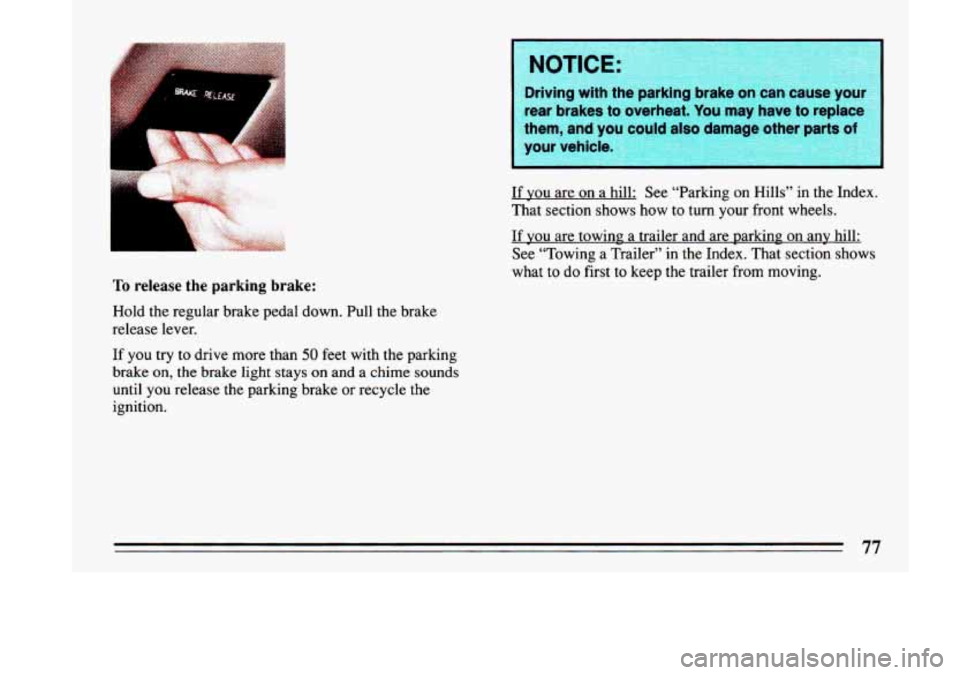
To release the parking brake:
Hold the regular brake pedal down. Pull the brake
release lever.
If you try to drive more than
50 feet with the parking
brake
on, the brake light stays on and a chime sounds
until you release the parking brake or recycle the
ignition.
NOTICE
Driving with t
I
rear brakes to overheat. You may have to replace
them,
and you could also damage other parts
If you are on a hill: See “Parking on Hills” in the Index.
That section shows how to turn your front wheels.
If you are towing a trailer and are parking on any hill:
See “Towing a Trailer” in the Index. That section shows
what
to do first to keep the trailer from moving.
77
Page 80 of 324
Shifting Into cc P 99 (Park)
A CAUTION:
It can be dangerous to get out of your vehicle if
the shift lever is not fully In ‘6P’’ (Park) with the
parking brake firmly set. Your vehicle
can roll.
If you have left the*engine running, the vehicle
can move suddenly.
You or others could be
injured.
To be sure your vehicle won’t move,
when you’re on fairly level ground, use the steps
that
follow. If you are parking on a hill, or if
you’re pulling
a trailer, also see “Parking On
Hills” or “Towing a Trailer” in the Index.
1
1. Hold the brake pedal down with your right foot and
2. Move the shift lever into “P” (Park) position like
set the parking brake.
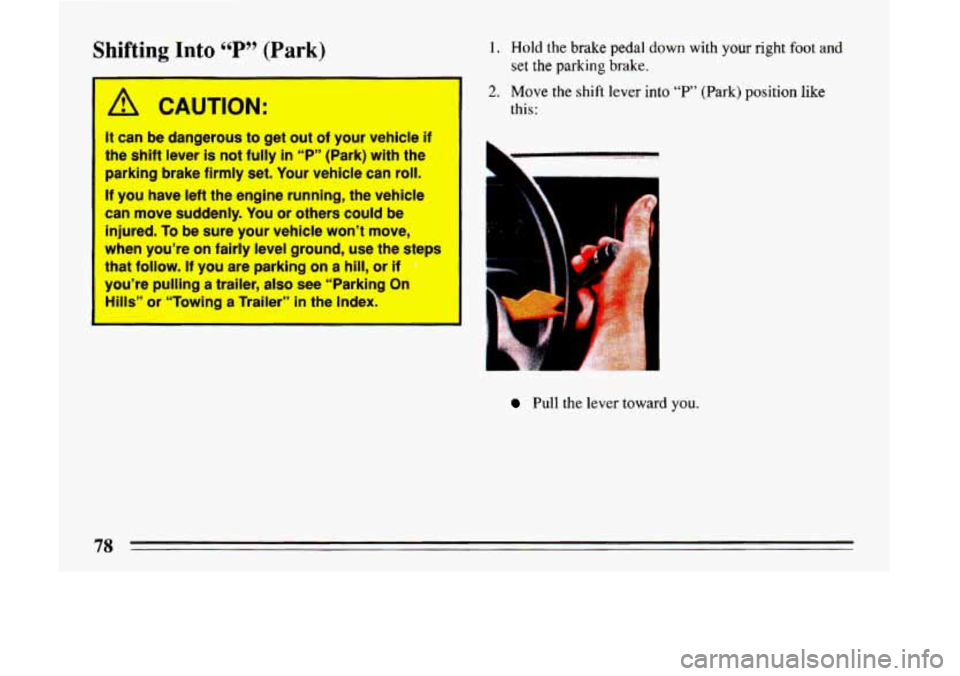
this:
Pull the lever toward you.
Page 81 of 324
Leaving Your Vehicle With the Engine
Running
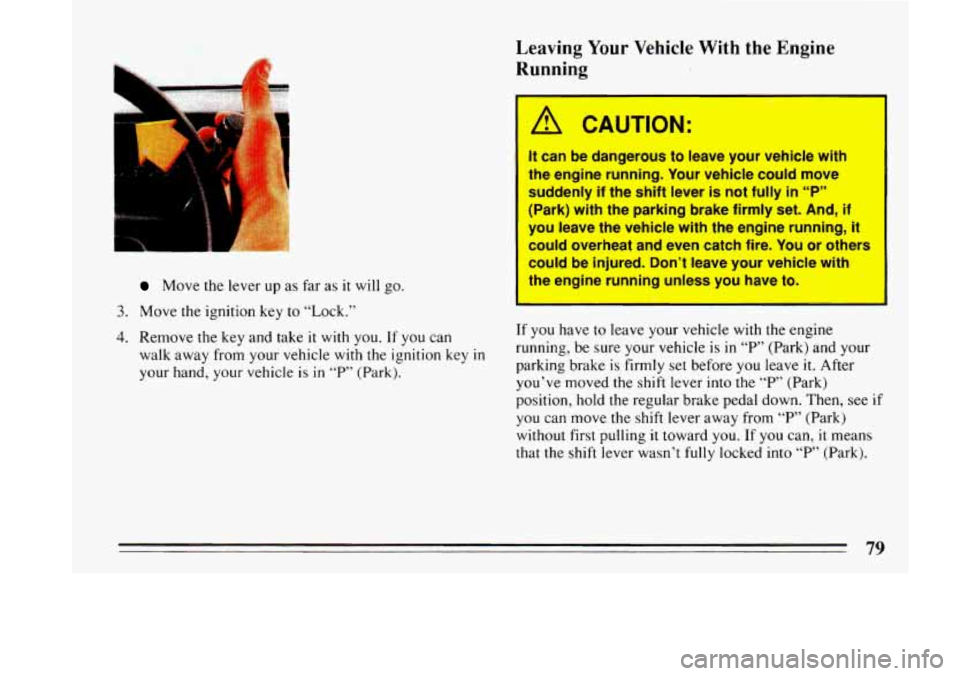
Move the lever up as far as it will go.
3. Move the ignition key to “Lock.”
4. Remove the key and take it with you. If you can
walk away from
your vehicle with the ignition key in
your hand, your vehicle is in “P” (Park).
It can be dangerous to leave your vehicle with
the engine running. Your vehicle could
move
suddenly if the shift lever is not fully in “P”
[Park) with the parking brake firmly set. And, if
you leave the vehicle with the engine running, St
could overheat and even catch fire. You or others
could be injured. Don’t leave your vehicle with
the engine running unless you have to.
If you have to leave your vehicle with the engine
running, be sure your vehicle is
in “P” (Park) and your
parking brake is firmly set before you leave it. After
you’ve moved the shift lever into the “P” (Park)
position, hold the regular brake pedal down. Then,
see if
you can move the shift lever away from
“P” (Park)
without first pulling it toward you. If
you can, it means
that the shift lever wasn’t fully locked into “P” (Park).
79
Page 82 of 324
Shifting Out of ‘‘P” (Park)
Your Buick has a brake-transaxle shift interlock. You
have to fully apply your regular brake before you can
shift from
T“ (Park) when the ignition is in the “Run”
position. See “Automatic Transaxle” in the Index.
If you cannot shift out of “P” (Park), ease pressure on
the shift lever -- push the shift lever all the way into “P”
(Park) as you maintain brake application. Then move the
shift lever into the gear
you wish. If you ever hold the
brake pedal down but still can’t shift out of
“P” (Park),
try this:
1. Turn the key to “Off.”
2. Apply and hold the brake until the end of Step 4.
3. Shift to “N” (Neutral).
4. Start the vehicle and then shift to the drive gear you
want.
5. Have the vehicle fixed as soon as you can.
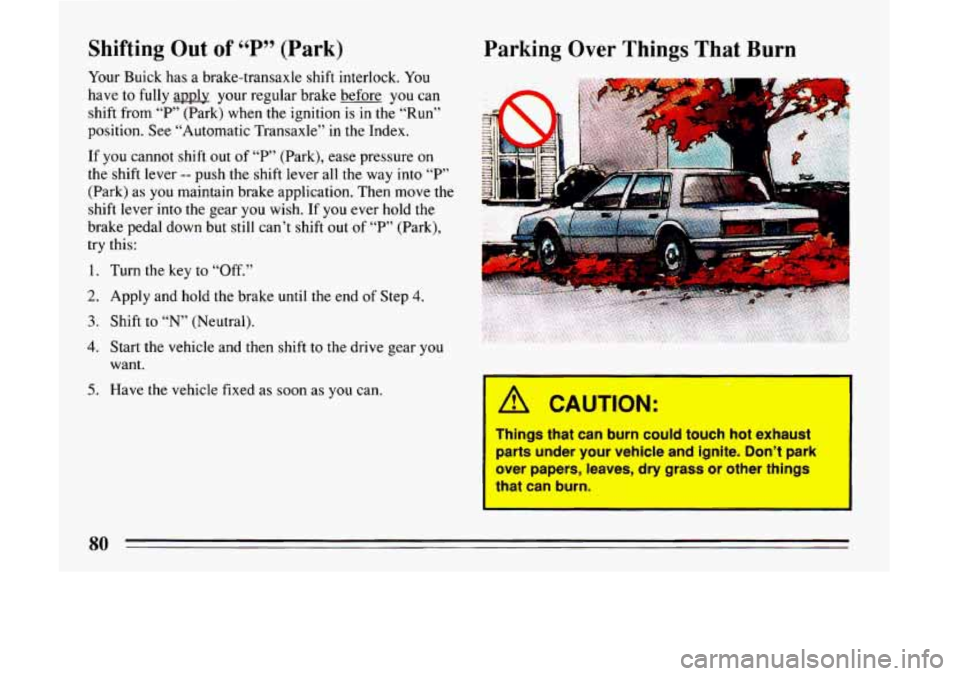
Parking Over Things That Burn
. ”. ..
6& VAU’. ,ON:
I
lings that can burn could touch hot exhaust
parts under your vehicle and ignite. Don’t park
over papers, leaves, dry grass or other things
that can burn.
80
Page 84 of 324
CAUTION: (Continued)
It can be dangerous to get out of your vehicle if
the shift lever
is not fully in “P’ (Park) with the
parking brake firmly
set. Your vehicle can roll.
Don’t leave your vehicle when the engine
is
running unless you have to. If you’ve left the
engine running, the
vehicle can move suddenly.
You or others could be injured. To be sure your
vehicle won’t move, even when you’re
on fairly
level ground, always set your parking brake
and
after you move the shift lever to “P” (Park).&
Follow the proper steps to be sure your vehicle
won’t move. See “Shifting Into ‘P’ (Park)’’ in the’
Index.
If you are parking OR a hill, or if you’re pulling a
trailer, also $&e “Parking on Hills’’ or “Towing a
Trailer” in the Index. , I
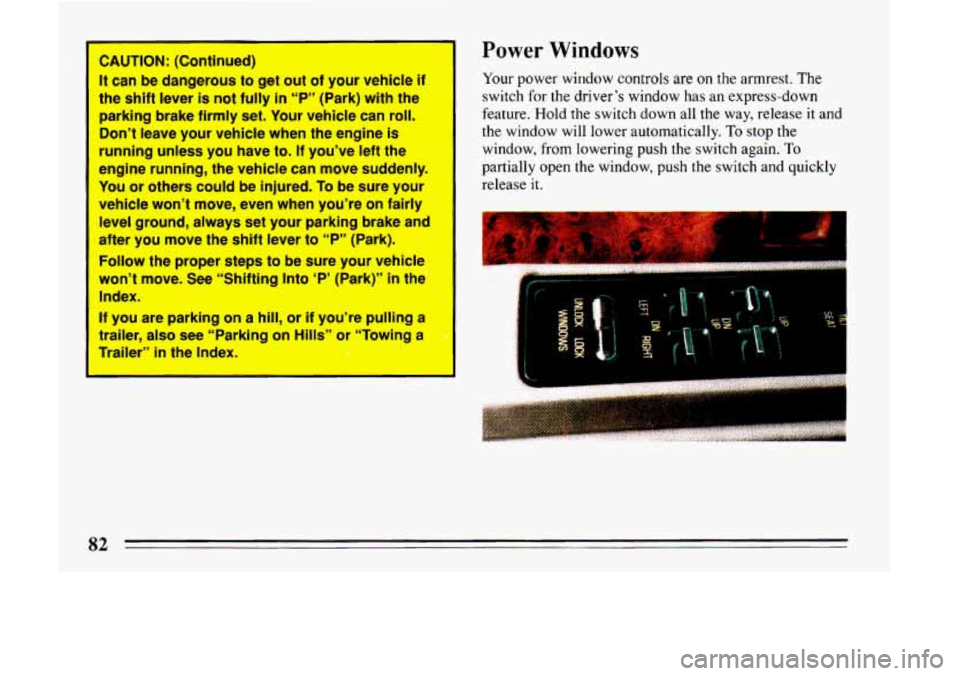
Power Windows
Your power window controls are on the armrest. The
switch for the driver’s window has an express-down
feature. Hold the switch down all the way, release it and
the window will lower automatically.
To stop the
window, from lowering push the switch again.
To
partially open the window, push the switch and quickly
release it.
82
Page 109 of 324
Your fuel gage shows about how much fuel is in your
tank. It works
only when the engine is on. When the
indicator nears
“E,” you still have a little fuel left. You
need to get more
fuel right away.
Here are four concerns some owners have had about the
fuel gage. All these situations are normal and indicate
nothing wrong with the
fuel gage.
0
0
0
0
At the gas station, the gas pump shuts off before the
gage reads
“F’.
It takes more (or less) gas to fill up than the gage
indicated. For example, the gage may have indicated
1/2
full, but it took more (or less) than half of the
tank’s capacity to fill it.
The gage moves a little when you turn a corner,
speed up, or stop your vehicle.
When
you turn the engine off, the gage doesn’t go all
the way back to “E”.
Low Fuel Light
If your Buick has this option, a yellow light near the fuel
gage, will
go on when your vehicle is low on fuel.
You should get more fuel as soon as you can.
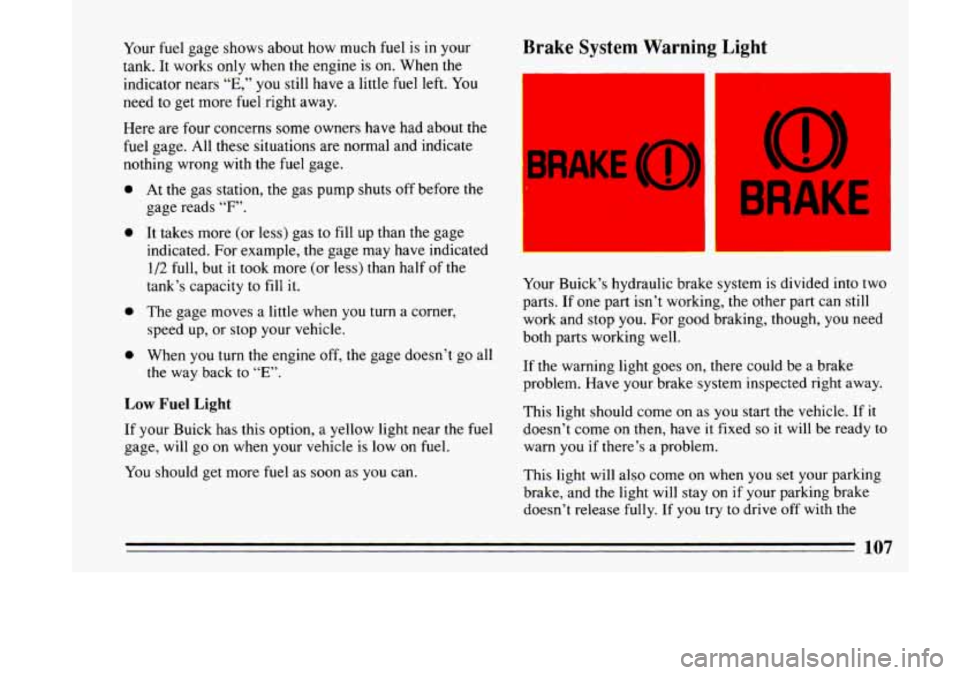
Brake System Warning Light
Your Buick’s hydraulic brake system is divided into two
parts. If one part isn’t working, the other part can still
work and stop
you. For good braking, though, you need
both parts working well.
If the warning light goes on, there could be a brake
problem. Have your brake system inspected right away.
This light should come on as
you start the vehicle. If it
doesn’t come on then, have it fixed so it will be ready to
warn you if there’s a problem.
This light will also come on when you set your parking
brake, and the light will stay on
if your parking brake
doesn’t release
fully. If you try to drive off with the
107
Page 110 of 324
parking brake set, a chime will also come on until you
release the parking brake. If the light and chime stay on
after your parking brake is
fully released, it means you
have a brake problem. If the light and chime come on
while driving, pull
off the road and stop carefully. You
may notice that the pedal is harder to push. Or, the pedal
may go closer to the floor. It may take longer to stop. If
the light is still on, have the vehicle towed for service.
(See “Towing Your Car” in the Index.)
1 &!A CAUTION:
Your brake system may not be working properly
if the brake warning light is on. Rriving with the
brake warning light on can lead to an accident. If
the light is still on after you’ve pulled off the road
and stopped carefully, have the vehicle towed for
service.
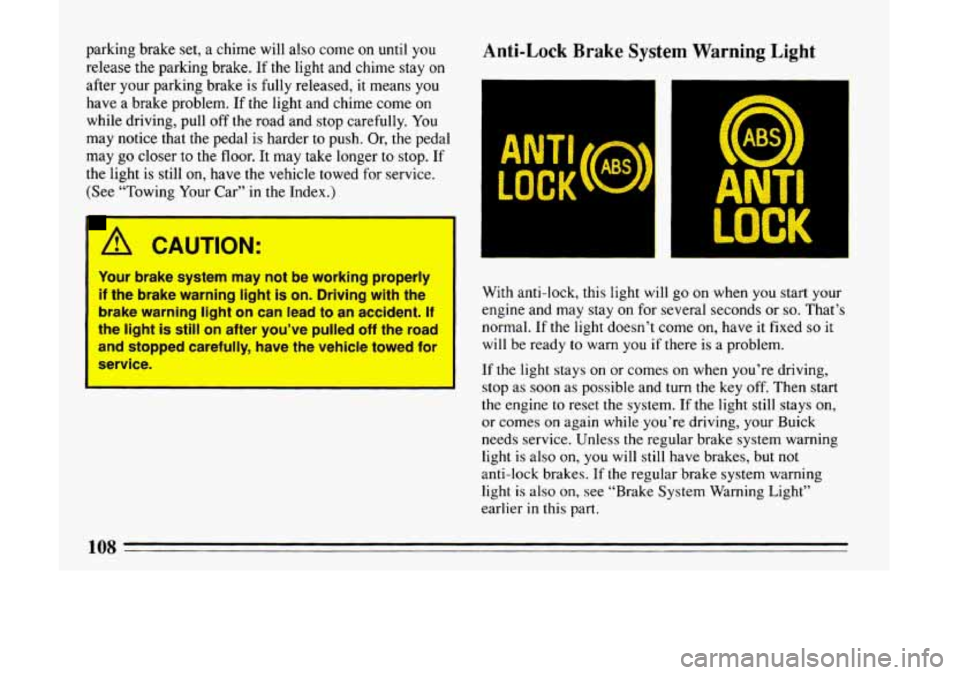
Anti-Lock Brake System Warning Light
1-
ANTI
LOCK
With anti-lock, this light will go on when you start your
engine and may stay on for several seconds or
so. That’s
normal. If the light doesn’t come on, have it fixed
so it
will be ready to warn you if there is a problem.
If the light stays on or comes
on when you’re driving,
stop as soon as possible and turn the key off. Then start
the engine
to reset the system. If the light still stays on,
or comes
on again while you’re driving, your Buick
needs service. Unless
the regular brake system warning
light is also
on, you will still have brakes, but not
anti-lock brakes. If the regular brake system warning
light
is also on, see “Brake System Warning Light”
earlier
in this part.
108
Page 156 of 324
Defensive Driving
The best advice anyone can give about driving is: Drive
defensively.
Please start with a very important safety device in your
Buick: Buckle up. (See “Safety Belts” in the Index.)
Defensive driving really means “be ready for anything.”
On city streets, rural roads, or freeways, it means
“always expect the unexpected.”
Assume that pedestrians or other drivers are going to be
careless and make mistakes. Anticipate what they might
do. Be ready for their mistakes.
Expect children
to dash out from behind parked cars,
often followed by other children. Expect occupants in
parked cars
to open doors into traffic. Watch for
movement in parked cars
-- someone may be about to
open a door.
Expect other drivers to run stop signs when you are
on a
through street. Be ready
to brake if necessary as you go
through intersections. You may not have to use the
brake, but if you do, you will be ready.
If you’re driving through a shopping center parking lot
where there are well-marked lanes, directional arrows,
and designated parking areas, expect some drivers
to
ignore all these markings and dash straight toward one
part of the lot.
Pedestrians can be careless. Watch for them. In general,
you must give way to pedestrians even if you know you
have the right of way.
Rear-end collisions are about the most preventable of
accidents. Yet they are common. Allow enough
following distance. It’s the best defensive driving
maneuver, in both city and rural driving. You never
know when the vehicle in front
of you is going to brake
or turn suddenly.
Here’s a final bit
of information about defensive driving.
The most dangerous time for driving in the
U.S. is very
early
on Sunday morning. In fact, GM Research studies
show that the most and the least dangerous times for
driving, every week, fall on the same day. That day is
Sunday. The most dangerous time is Sunday from
3 a.m.
to
4 a.m. The safest time is Sunday from 10 a.m. to 11
a.m. Driving the same distance on a Sunday at 3 a.m.
isn’t just
a little more dangerous than it is at 10 a.m. It’s
about 134 times more dangerous!
That leads to the next section.