oil pressure BUICK LESABRE 2004 User Guide
[x] Cancel search | Manufacturer: BUICK, Model Year: 2004, Model line: LESABRE, Model: BUICK LESABRE 2004Pages: 392, PDF Size: 4.3 MB
Page 301 of 392
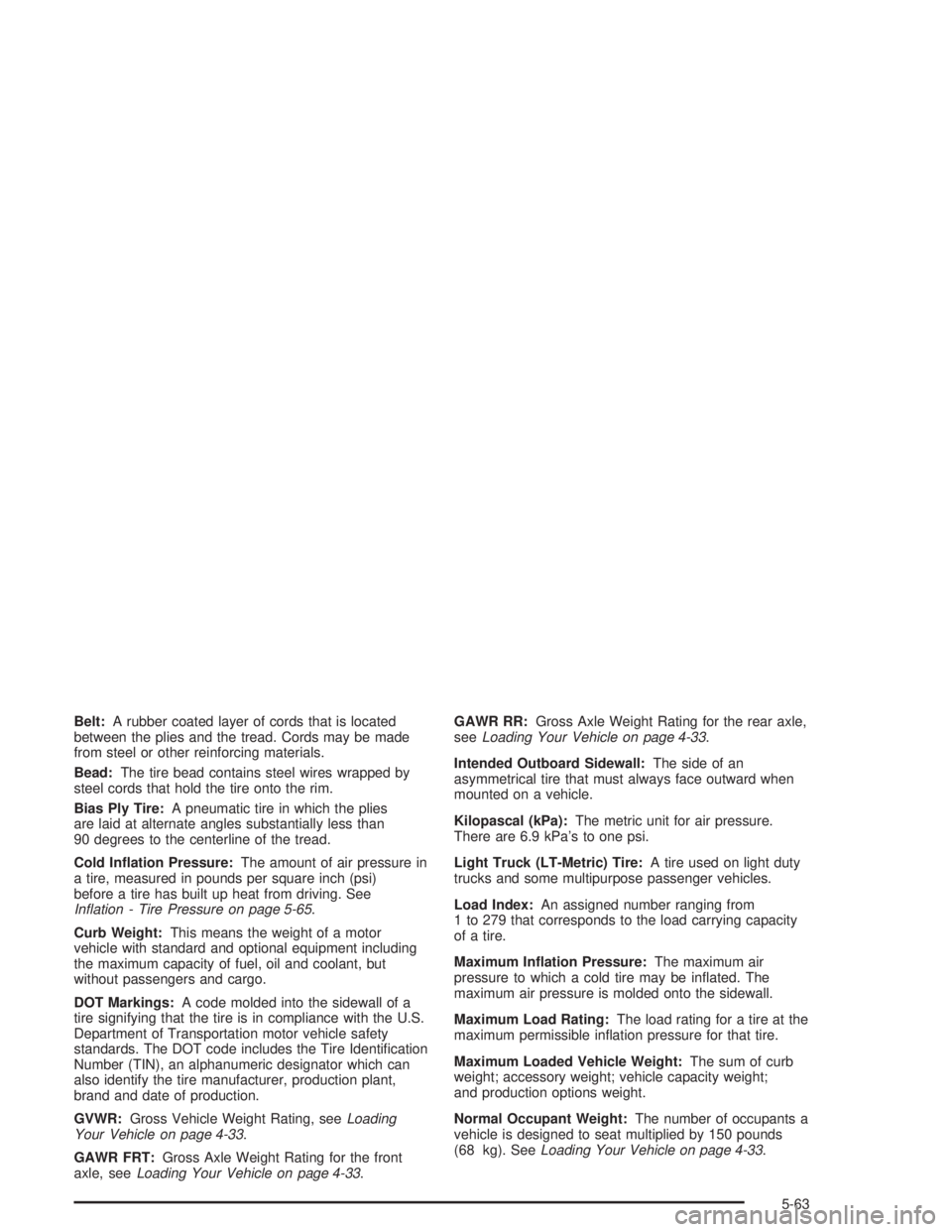
Belt:A rubber coated layer of cords that is located
between the plies and the tread. Cords may be made
from steel or other reinforcing materials.
Bead:The tire bead contains steel wires wrapped by
steel cords that hold the tire onto the rim.
Bias Ply Tire:A pneumatic tire in which the plies
are laid at alternate angles substantially less than
90 degrees to the centerline of the tread.
Cold Ination Pressure:The amount of air pressure in
a tire, measured in pounds per square inch (psi)
before a tire has built up heat from driving. See
Ination - Tire Pressure on page 5-65.
Curb Weight:This means the weight of a motor
vehicle with standard and optional equipment including
the maximum capacity of fuel, oil and coolant, but
without passengers and cargo.
DOT Markings:A code molded into the sidewall of a
tire signifying that the tire is in compliance with the U.S.
Department of Transportation motor vehicle safety
standards. The DOT code includes the Tire Identication
Number (TIN), an alphanumeric designator which can
also identify the tire manufacturer, production plant,
brand and date of production.
GVWR:Gross Vehicle Weight Rating, seeLoading
Your Vehicle on page 4-33.
GAWR FRT:Gross Axle Weight Rating for the front
axle, seeLoading Your Vehicle on page 4-33.GAWR RR:Gross Axle Weight Rating for the rear axle,
seeLoading Your Vehicle on page 4-33.
Intended Outboard Sidewall:The side of an
asymmetrical tire that must always face outward when
mounted on a vehicle.
Kilopascal (kPa):The metric unit for air pressure.
There are 6.9 kPa’s to one psi.
Light Truck (LT-Metric) Tire:A tire used on light duty
trucks and some multipurpose passenger vehicles.
Load Index:An assigned number ranging from
1 to 279 that corresponds to the load carrying capacity
of a tire.
Maximum Ination Pressure:The maximum air
pressure to which a cold tire may be inated. The
maximum air pressure is molded onto the sidewall.
Maximum Load Rating:The load rating for a tire at the
maximum permissible ination pressure for that tire.
Maximum Loaded Vehicle Weight:The sum of curb
weight; accessory weight; vehicle capacity weight;
and production options weight.
Normal Occupant Weight:The number of occupants a
vehicle is designed to seat multiplied by 150 pounds
(68 kg). SeeLoading Your Vehicle on page 4-33.
5-63
Page 345 of 392
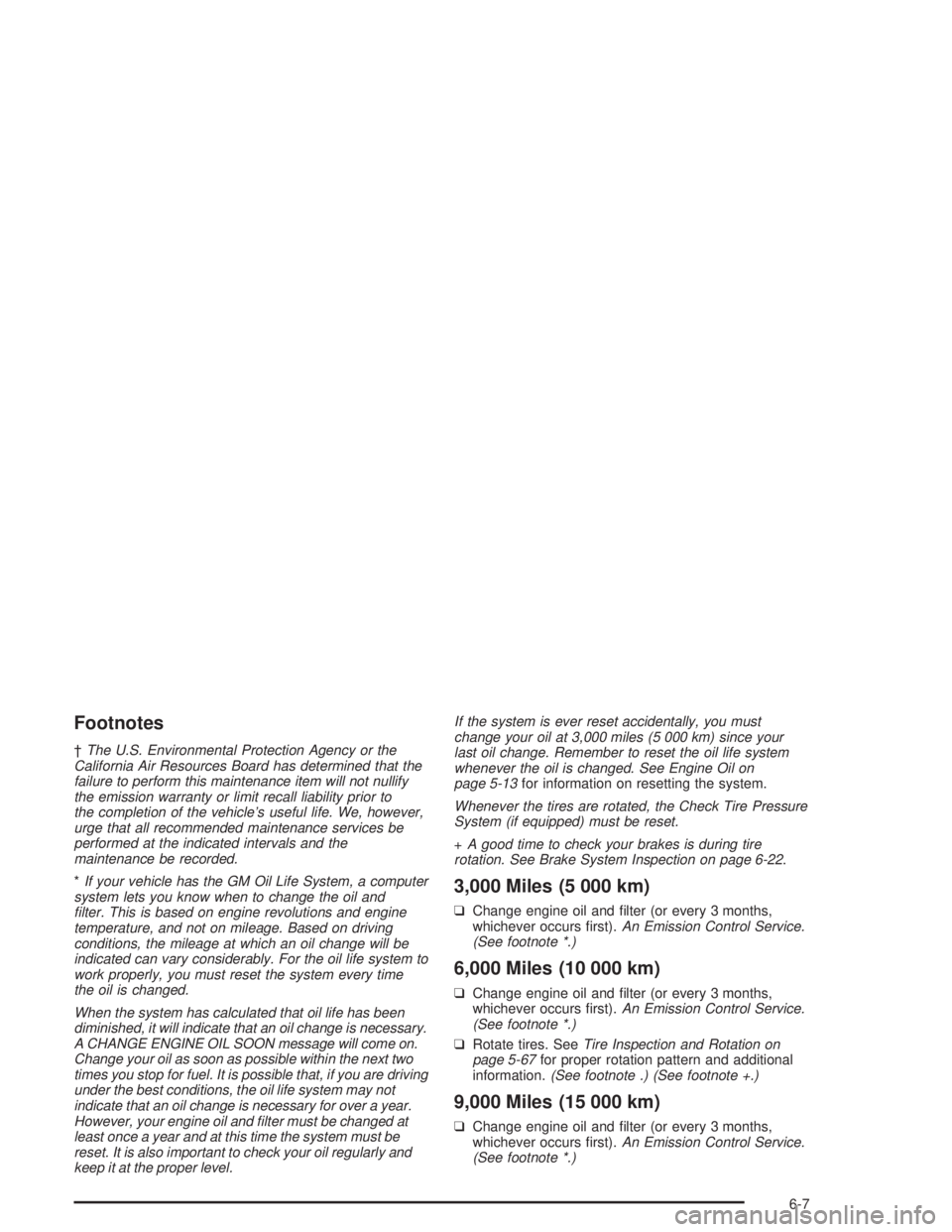
Footnotes
†The U.S. Environmental Protection Agency or the
California Air Resources Board has determined that the
failure to perform this maintenance item will not nullify
the emission warranty or limit recall liability prior to
the completion of the vehicle’s useful life. We, however,
urge that all recommended maintenance services be
performed at the indicated intervals and the
maintenance be recorded.
*If your vehicle has the GM Oil Life System, a computer
system lets you know when to change the oil and
lter. This is based on engine revolutions and engine
temperature, and not on mileage. Based on driving
conditions, the mileage at which an oil change will be
indicated can vary considerably. For the oil life system to
work properly, you must reset the system every time
the oil is changed.
When the system has calculated that oil life has been
diminished, it will indicate that an oil change is necessary.
A CHANGE ENGINE OIL SOON message will come on.
Change your oil as soon as possible within the next two
times you stop for fuel. It is possible that, if you are driving
under the best conditions, the oil life system may not
indicate that an oil change is necessary for over a year.
However, your engine oil and lter must be changed at
least once a year and at this time the system must be
reset. It is also important to check your oil regularly and
keep it at the proper level.If the system is ever reset accidentally, you must
change your oil at 3,000 miles (5 000 km) since your
last oil change. Remember to reset the oil life system
whenever the oil is changed. See Engine Oil on
page 5-13for information on resetting the system.
Whenever the tires are rotated, the Check Tire Pressure
System (if equipped) must be reset.
+A good time to check your brakes is during tire
rotation. See Brake System Inspection on page 6-22.
3,000 Miles (5 000 km)
❑Change engine oil and lter (or every 3 months,
whichever occurs rst).An Emission Control Service.
(See footnote *.)
6,000 Miles (10 000 km)
❑Change engine oil and lter (or every 3 months,
whichever occurs rst).An Emission Control Service.
(See footnote *.)
❑Rotate tires. SeeTire Inspection and Rotation on
page 5-67for proper rotation pattern and additional
information.(See footnote .) (See footnote +.)
9,000 Miles (15 000 km)
❑Change engine oil and lter (or every 3 months,
whichever occurs rst).An Emission Control Service.
(See footnote *.)
6-7
Page 350 of 392
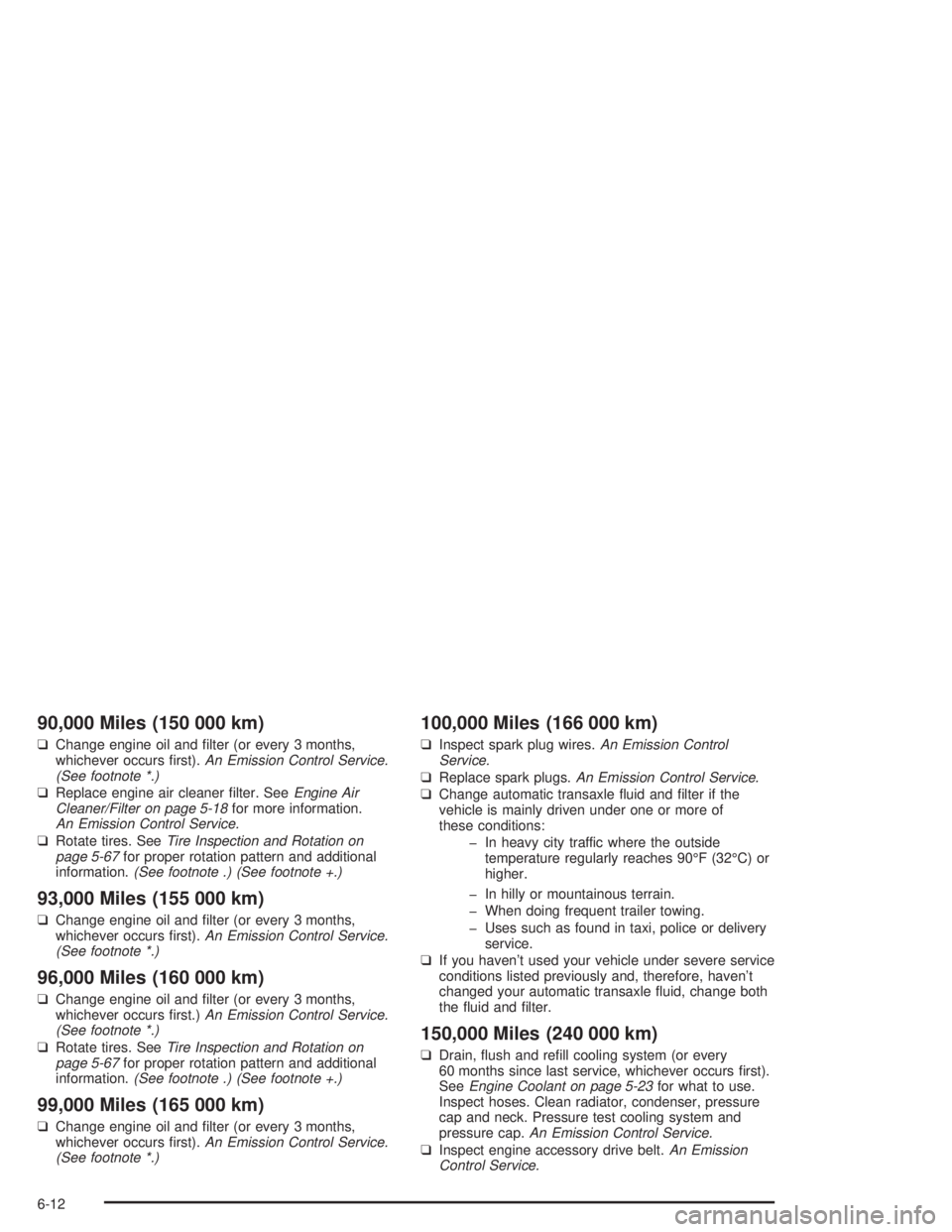
90,000 Miles (150 000 km)
❑Change engine oil and lter (or every 3 months,
whichever occurs rst).An Emission Control Service.
(See footnote *.)
❑Replace engine air cleaner lter. SeeEngine Air
Cleaner/Filter on page 5-18for more information.
An Emission Control Service.
❑Rotate tires. SeeTire Inspection and Rotation on
page 5-67for proper rotation pattern and additional
information.(See footnote .) (See footnote +.)
93,000 Miles (155 000 km)
❑Change engine oil and lter (or every 3 months,
whichever occurs rst).An Emission Control Service.
(See footnote *.)
96,000 Miles (160 000 km)
❑Change engine oil and lter (or every 3 months,
whichever occurs rst.)An Emission Control Service.
(See footnote *.)
❑Rotate tires. SeeTire Inspection and Rotation on
page 5-67for proper rotation pattern and additional
information.(See footnote .) (See footnote +.)
99,000 Miles (165 000 km)
❑Change engine oil and lter (or every 3 months,
whichever occurs rst).An Emission Control Service.
(See footnote *.)
100,000 Miles (166 000 km)
❑Inspect spark plug wires.An Emission Control
Service.
❑Replace spark plugs.An Emission Control Service.
❑Change automatic transaxle uid and lter if the
vehicle is mainly driven under one or more of
these conditions:
In heavy city traffic where the outside
temperature regularly reaches 90°F (32°C) or
higher.
In hilly or mountainous terrain.
When doing frequent trailer towing.
Uses such as found in taxi, police or delivery
service.
❑If you haven’t used your vehicle under severe service
conditions listed previously and, therefore, haven’t
changed your automatic transaxle uid, change both
the uid and lter.
150,000 Miles (240 000 km)
❑Drain, ush and rell cooling system (or every
60 months since last service, whichever occurs rst).
SeeEngine Coolant on page 5-23for what to use.
Inspect hoses. Clean radiator, condenser, pressure
cap and neck. Pressure test cooling system and
pressure cap.An Emission Control Service.
❑Inspect engine accessory drive belt.An Emission
Control Service.
6-12
Page 351 of 392
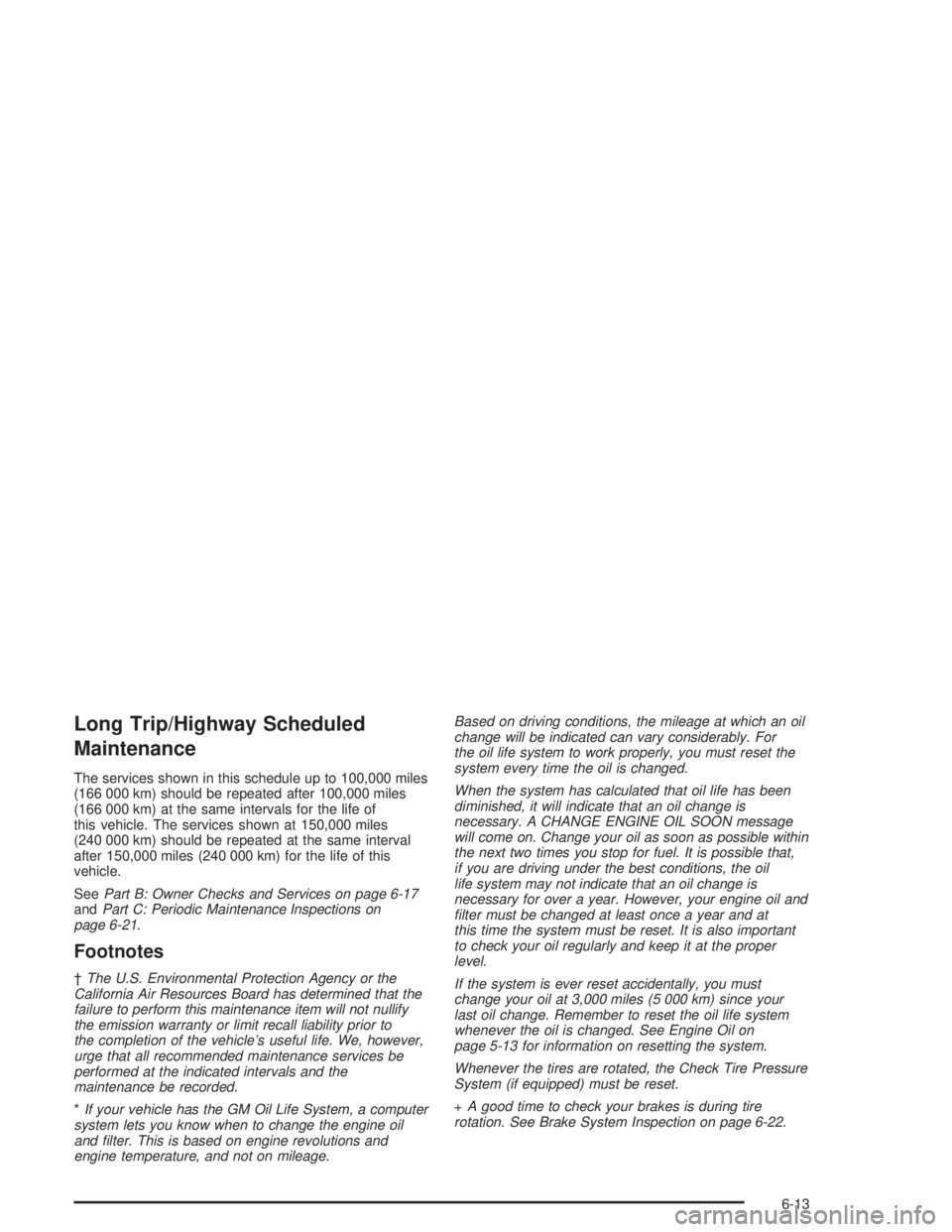
Long Trip/Highway Scheduled
Maintenance
The services shown in this schedule up to 100,000 miles
(166 000 km) should be repeated after 100,000 miles
(166 000 km) at the same intervals for the life of
this vehicle. The services shown at 150,000 miles
(240 000 km) should be repeated at the same interval
after 150,000 miles (240 000 km) for the life of this
vehicle.
SeePart B: Owner Checks and Services on page 6-17
andPart C: Periodic Maintenance Inspections on
page 6-21.
Footnotes
†The U.S. Environmental Protection Agency or the
California Air Resources Board has determined that the
failure to perform this maintenance item will not nullify
the emission warranty or limit recall liability prior to
the completion of the vehicle’s useful life. We, however,
urge that all recommended maintenance services be
performed at the indicated intervals and the
maintenance be recorded.
*If your vehicle has the GM Oil Life System, a computer
system lets you know when to change the engine oil
and lter. This is based on engine revolutions and
engine temperature, and not on mileage.Based on driving conditions, the mileage at which an oil
change will be indicated can vary considerably. For
the oil life system to work properly, you must reset the
system every time the oil is changed.
When the system has calculated that oil life has been
diminished, it will indicate that an oil change is
necessary. A CHANGE ENGINE OIL SOON message
will come on. Change your oil as soon as possible within
the next two times you stop for fuel. It is possible that,
if you are driving under the best conditions, the oil
life system may not indicate that an oil change is
necessary for over a year. However, your engine oil and
lter must be changed at least once a year and at
this time the system must be reset. It is also important
to check your oil regularly and keep it at the proper
level.
If the system is ever reset accidentally, you must
change your oil at 3,000 miles (5 000 km) since your
last oil change. Remember to reset the oil life system
whenever the oil is changed. See Engine Oil on
page 5-13 for information on resetting the system.
Whenever the tires are rotated, the Check Tire Pressure
System (if equipped) must be reset.
+A good time to check your brakes is during tire
rotation. See Brake System Inspection on page 6-22.
6-13
Page 354 of 392
82,500 Miles (137 500 km)
❑Change engine oil and lter (or every 12 months,
whichever occurs rst).An Emission Control
Service. (See footnote *.)
❑Rotate tires. SeeTire Inspection and Rotation on
page 5-67for proper rotation pattern and additional
information.(See footnote .) (See footnote +.)
90,000 Miles (150 000 km)
❑Change engine oil and lter (or every 12 months,
whichever occurs rst).An Emission Control
Service. (See footnote *.)
❑Replace engine air cleaner lter. SeeEngine Air
Cleaner/Filter on page 5-18for more information.
An Emission Control Service.
❑Rotate tires. SeeTire Inspection and Rotation on
page 5-67for proper rotation pattern and additional
information.(See footnote .) (See footnote +.)
97,500 Miles (162 500 km)
❑Change engine oil and lter (or every 12 months,
whichever occurs rst).An Emission Control
Service. (See footnote *.)
❑Rotate tires. SeeTire Inspection and Rotation on
page 5-67for proper rotation pattern and additional
information.(See footnote .) (See footnote +.)
100,000 Miles (166 000 km)
❑Inspect spark plug wires.An Emission Control
Service.
❑Replace spark plugs.An Emission Control Service.
❑Change automatic transaxle uid and lter if the
vehicle is mainly driven under one or more of
these conditions:
In heavy city traffic where the outside
temperature regularly reaches 90°F (32°C) or
higher.
In hilly or mountainous terrain.
When doing frequent trailer towing.
Uses such as found in taxi, police or delivery
service.
❑If you haven’t used your vehicle under severe service
conditions listed previously and, therefore, haven’t
changed your automatic transaxle uid, change both
the uid and lter
150,000 Miles (240 000 km)
❑Drain, ush and rell cooling system (or every
60 months since last service, whichever occurs rst).
SeeEngine Coolant on page 5-23for what to use.
Inspect hoses. Clean radiator, condenser, pressure
cap and neck. Pressure test the cooling system
and pressure cap.An Emission Control Service.
❑Inspect engine accessory drive belt.An Emission
Control Service.
6-16
Page 355 of 392
Part B: Owner Checks and Services
Listed in this part are owner checks and services
which should be performed at the intervals specied to
help ensure the safety, dependability and emission
control performance of your vehicle.
Be sure any necessary repairs are completed at once.
Whenever any uids or lubricants are added to your
vehicle, make sure they are the proper ones, as shown
in Part D.
At Each Fuel Fill
It is important for you or a service station attendant to
perform these underhood checks at each fuel ll.
Engine Oil Level Check
Check the engine oil level and add the proper oil if
necessary. SeeEngine Oil on page 5-13for further
details.
Engine Coolant Level Check
Check the engine coolant level and add DEX-COOL®
coolant mixture if necessary. SeeEngine Coolant
on page 5-23for further details.
Windshield Washer Fluid Level Check
Check the windshield washer uid level in the windshield
washer tank and add the proper uid if necessary.
SeeWindshield Washer Fluid on page 5-36for further
details.
At Least Once a Month
Tire Ination Check
Visually inspect your tires and make sure tires are
inated to the correct pressures. Don’t forget to check
your spare tire. SeeTires on page 5-58for further
details.
Cassette Tape Player Service
Clean cassette tape player. Cleaning should be done
every 50 hours of tape play. SeeAudio System(s)
on page 3-55for further details.
6-17
Page 379 of 392
Check
Engine Light...............................................3-40
Tire Pressure System...................................5-66
Checking Coolant............................................5-25
Checking Engine Oil........................................5-13
Checking Things Under the Hood......................5-10
Checking Your Restraint Systems......................1-56
Chemical Paint Spotting...................................5-89
Child Restraints
Child Restraint Systems...............................1-33
Infants and Young Children...........................1-29
Lower Anchorages and Top Tethers for
Children (LATCH System)..........................1-39
Older Children.............................................1-27
Securing a Child Restraint Designed for
the LATCH System...................................1-41
Securing a Child Restraint in a Rear
Seat Position...........................................1-42
Securing a Child Restraint in the Right
Front Seat Position...................................1-44
Top Strap...................................................1-37
Top Strap Anchor Location............................1-38
Where to Put the Restraint...........................1-36
Chime Level Adjustment..................................3-82
Cigarette Lighter.............................................3-23
Cleaning
Inside of Your Vehicle..................................5-84
Outside of Your Vehicle................................5-87Cleaning (cont.)
Underbody Maintenance...............................5-89
Weatherstrips..............................................5-87
Cleaning Aluminum or Chrome-Plated Wheels.....5-88
Cleaning Exterior Lamps/Lenses.......................5-87
Cleaning Fabric/Carpet....................................5-84
Cleaning Glass Surfaces..................................5-86
Cleaning Interior Plastic Components.................5-86
Cleaning Leather............................................5-86
Cleaning the Top of the Instrument Panel...........5-86
Cleaning Tires................................................5-89
Cleaning Vinyl................................................5-85
Cleaning Windshield and Wiper Blades..............5-88
Climate Control System...................................3-24
Climate Controls Personalization....................3-31
Dual Automatic............................................3-26
Outlet Adjustment........................................3-30
Steering Wheel Controls...............................3-31
Compact Disc Errors.......................................3-77
Compact Disc Messages..........................3-62, 3-73
Compact Spare Tire........................................5-83
Compass Calibration.......................................2-34
Compass Operation.........................................2-34
Compass Variance..........................................2-34
Content Theft-Deferrent....................................2-18
Control of a Vehicle.......................................... 4-5
Convenience Net............................................2-42
3
Page 384 of 392
L
Lamps
Exterior......................................................3-14
Interior.......................................................3-17
Language Selection.........................................3-54
Lap Belt........................................................1-19
Lap-Shoulder Belt...................................1-12, 1-21
LATCH System
Child Restraints...........................................1-39
Securing a Child Restraint Designed for
the LATCH System...................................1-41
Leaving Your Vehicle.......................................2-13
Leaving Your Vehicle With the
Engine Running..........................................2-29
Light
Air Bag Readiness.......................................3-36
Anti-Lock Brake System Warning...................3-38
Battery Warning..........................................3-37
Brake System Warning.................................3-37
Cruise Control.............................................3-44
Malfunction Indicator....................................3-40
Oil Pressure...............................................3-43
Safety Belt Reminder...................................3-36
Security.....................................................3-44
Service Vehicle Soon...................................3-44
TCS Warning Light......................................3-39
Traction Control System (TCS) Warning..........3-39
Lighted Visor Vanity Mirror...............................2-17
Loading Your Vehicle.......................................4-33Lockout Protection..........................................2-13
Locks
Central Door Unlocking System.....................2-10
Delayed Locking..........................................2-11
Door........................................................... 2-9
Leaving Your Vehicle....................................2-13
Lockout Protection.......................................2-13
Power Door................................................2-10
Programmable Automatic Door Locks.............2-12
Rear Door Security Locks.............................2-13
Long Trip/Highway Denition.............................. 6-6
Long Trip/Highway Intervals............................... 6-6
Long Trip/Highway Scheduled Maintenance........6-13
Loss of Control...............................................4-15
Lumbar
Manual Controls............................................ 1-3
Power Controls............................................. 1-3
M
Maintenance Schedule
At Each Fuel Fill.........................................6-17
At Least Once a Month................................6-17
At Least Once a Year..................................6-18
At Least Twice a Year..................................6-18
Brake System Inspection..............................6-22
Engine Cooling System Inspection.................6-22
Exhaust System Inspection...........................6-21
Fuel System Inspection................................6-22
8
Page 386 of 392
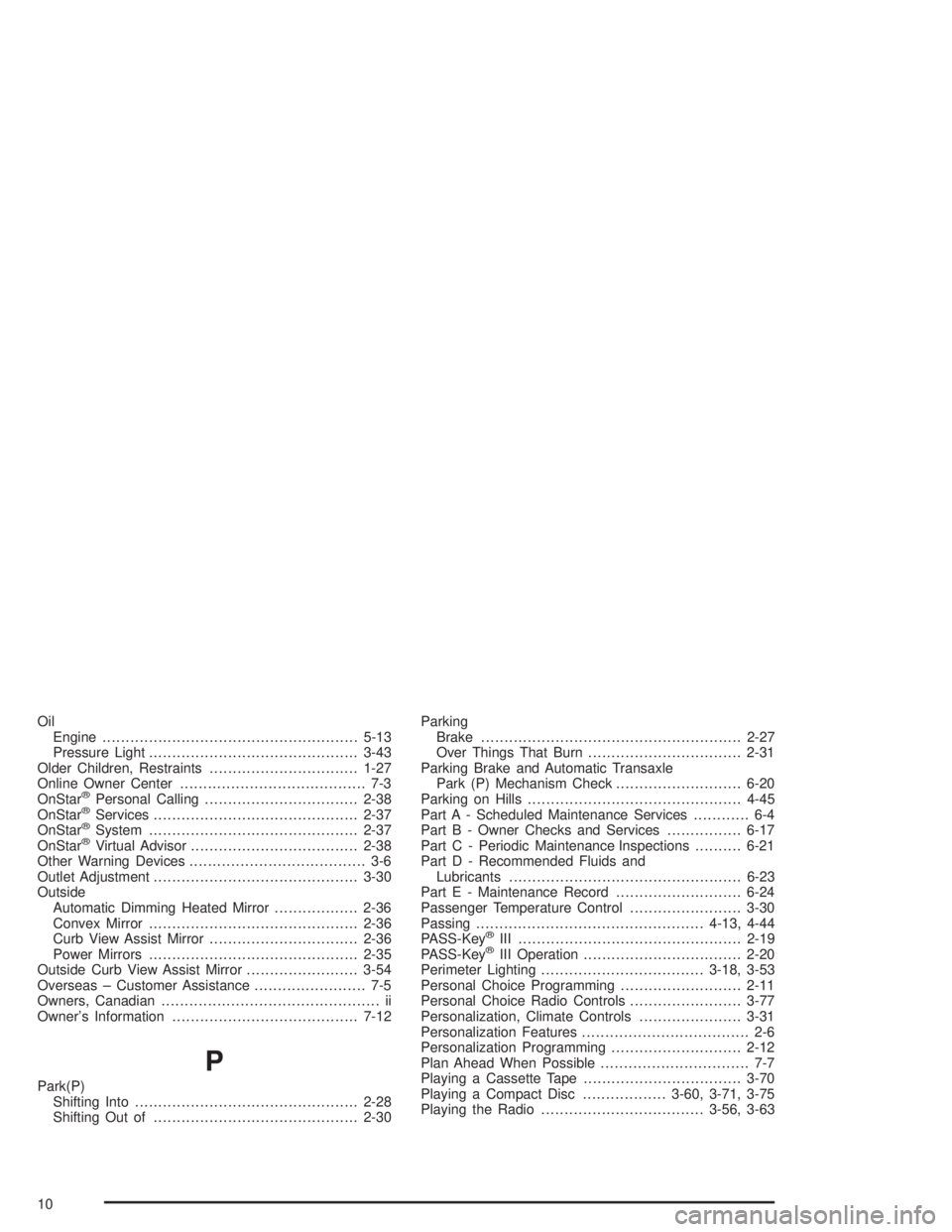
Oil
Engine.......................................................5-13
Pressure Light.............................................3-43
Older Children, Restraints................................1-27
Online Owner Center........................................ 7-3
OnStar
®Personal Calling.................................2-38
OnStar®Services............................................2-37
OnStar®System.............................................2-37
OnStar®Virtual Advisor....................................2-38
Other Warning Devices...................................... 3-6
Outlet Adjustment............................................3-30
Outside
Automatic Dimming Heated Mirror..................2-36
Convex Mirror.............................................2-36
Curb View Assist Mirror................................2-36
Power Mirrors.............................................2-35
Outside Curb View Assist Mirror........................3-54
Overseas – Customer Assistance........................ 7-5
Owners, Canadian............................................... ii
Owner’s Information........................................7-12
P
Park(P)
Shifting Into................................................2-28
Shifting Out of............................................2-30Parking
Brake........................................................2-27
Over Things That Burn.................................2-31
Parking Brake and Automatic Transaxle
Park (P) Mechanism Check...........................6-20
Parking on Hills..............................................4-45
Part A - Scheduled Maintenance Services............ 6-4
Part B - Owner Checks and Services................6-17
Part C - Periodic Maintenance Inspections..........6-21
Part D - Recommended Fluids and
Lubricants..................................................6-23
Part E - Maintenance Record...........................6-24
Passenger Temperature Control........................3-30
Passing.................................................4-13, 4-44
PASS-Key
®III ................................................2-19
PASS-Key®III Operation..................................2-20
Perimeter Lighting...................................3-18, 3-53
Personal Choice Programming..........................2-11
Personal Choice Radio Controls........................3-77
Personalization, Climate Controls......................3-31
Personalization Features.................................... 2-6
Personalization Programming............................2-12
Plan Ahead When Possible................................ 7-7
Playing a Cassette Tape..................................3-70
Playing a Compact Disc..................3-60, 3-71, 3-75
Playing the Radio...................................3-56, 3-63
10