transaxle BUICK LUCERNE 2006 Owner's Guide
[x] Cancel search | Manufacturer: BUICK, Model Year: 2006, Model line: LUCERNE, Model: BUICK LUCERNE 2006Pages: 416, PDF Size: 2.6 MB
Page 378 of 416
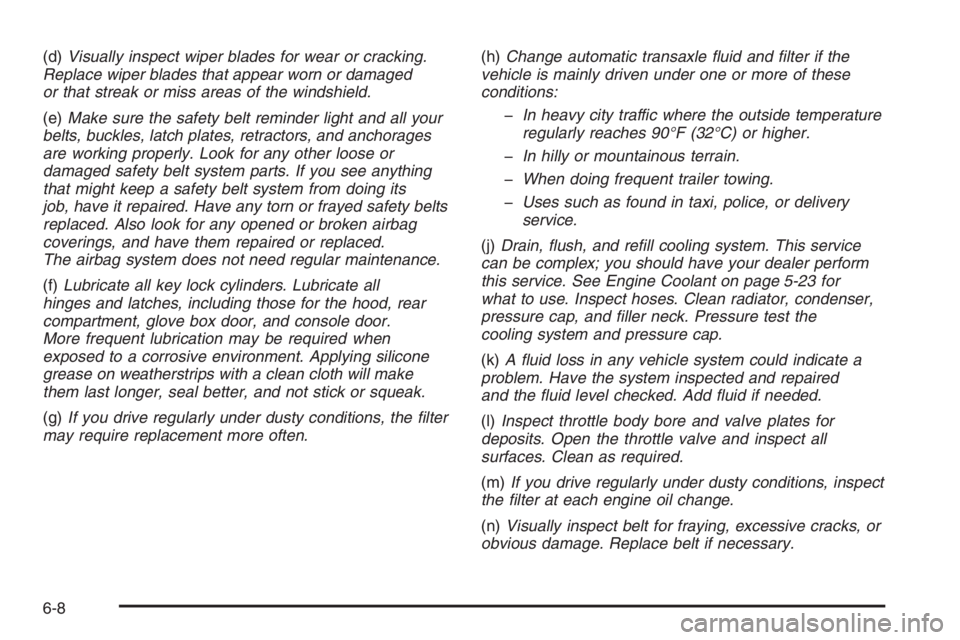
(d)Visually inspect wiper blades for wear or cracking.
Replace wiper blades that appear worn or damaged
or that streak or miss areas of the windshield.
(e)Make sure the safety belt reminder light and all your
belts, buckles, latch plates, retractors, and anchorages
are working properly. Look for any other loose or
damaged safety belt system parts. If you see anything
that might keep a safety belt system from doing its
job, have it repaired. Have any torn or frayed safety belts
replaced. Also look for any opened or broken airbag
coverings, and have them repaired or replaced.
The airbag system does not need regular maintenance.
(f)Lubricate all key lock cylinders. Lubricate all
hinges and latches, including those for the hood, rear
compartment, glove box door, and console door.
More frequent lubrication may be required when
exposed to a corrosive environment. Applying silicone
grease on weatherstrips with a clean cloth will make
them last longer, seal better, and not stick or squeak.
(g)If you drive regularly under dusty conditions, the lter
may require replacement more often.(h)Change automatic transaxle uid and lter if the
vehicle is mainly driven under one or more of these
conditions:
In heavy city traffic where the outside temperature
regularly reaches 90°F (32°C) or higher.
In hilly or mountainous terrain.
When doing frequent trailer towing.
Uses such as found in taxi, police, or delivery
service.
(j)Drain, ush, and rell cooling system. This service
can be complex; you should have your dealer perform
this service. See Engine Coolant on page 5-23 for
what to use. Inspect hoses. Clean radiator, condenser,
pressure cap, and ller neck. Pressure test the
cooling system and pressure cap.
(k)A uid loss in any vehicle system could indicate a
problem. Have the system inspected and repaired
and the uid level checked. Add uid if needed.
(l)Inspect throttle body bore and valve plates for
deposits. Open the throttle valve and inspect all
surfaces. Clean as required.
(m)If you drive regularly under dusty conditions, inspect
the lter at each engine oil change.
(n)Visually inspect belt for fraying, excessive cracks, or
obvious damage. Replace belt if necessary.
6-8
Page 380 of 416

At Least Once a Year
Starter Switch Check
{CAUTION:
When you are doing this inspection, the
vehicle could move suddenly. If the vehicle
moves, you or others could be injured.
1. Before you start, be sure you have enough room
around the vehicle.
2. Firmly apply both the parking brake and the regular
brake. SeeParking Brake on page 2-28.
Do not use the accelerator pedal, and be ready to
turn off the engine immediately if it starts.
3. Try to start the engine in each gear. The vehicle
should start only in PARK (P) or NEUTRAL (N). If
the vehicle starts in any other position, contact your
GM Goodwrench
®dealer for service.
Automatic Transaxle Shift Lock Control
System Check
{CAUTION:
When you are doing this inspection, the
vehicle could move suddenly. If the vehicle
moves, you or others could be injured.
1. Before you start, be sure you have enough room
around the vehicle. It should be parked on a level
surface.
2. Firmly apply the parking brake. SeeParking Brake
on page 2-28.
Be ready to apply the regular brake immediately if
the vehicle begins to move.
3. With the engine off, turn the ignition to RUN, but do
not start the engine. Without applying the regular
brake, try to move the shift lever out of PARK (P)
with normal effort. If the shift lever moves out
of PARK (P), contact your GM Goodwrench
®dealer
for service.
6-10
Page 381 of 416

Ignition Transaxle Lock Check
While parked, and with the parking brake set, try to turn
the ignition to OFF in each shift lever position.
The ignition should turn to OFF only when the shift
lever is in PARK (P).
The key should come out only in OFF.
Contact your GM Goodwrench
®dealer if service is
required.
Parking Brake and Automatic Transaxle
Park (P) Mechanism Check
{CAUTION:
When you are doing this check, your vehicle
could begin to move. You or others could be
injured and property could be damaged. Make
sure there is room in front of your vehicle in
case it begins to roll. Be ready to apply the
regular brake at once should the vehicle begin
to move.Park on a fairly steep hill, with the vehicle facing
downhill. Keeping your foot on the regular brake, set the
parking brake.
To check the parking brake’s holding ability: With
the engine running and transaxle in NEUTRAL (N),
slowly remove foot pressure from the regular
brake pedal. Do this until the vehicle is held by the
parking brake only.
To check the PARK (P) mechanism’s holding ability:
With the engine running, shift to PARK (P). Then
release the parking brake followed by the regular
brake.
Contact your GM Goodwrench
®dealer if service is
required.
Underbody Flushing Service
At least every spring, use plain water to ush any
corrosive materials from the underbody. Take care to
clean thoroughly any areas where mud and other debris
can collect.
6-11
Page 382 of 416
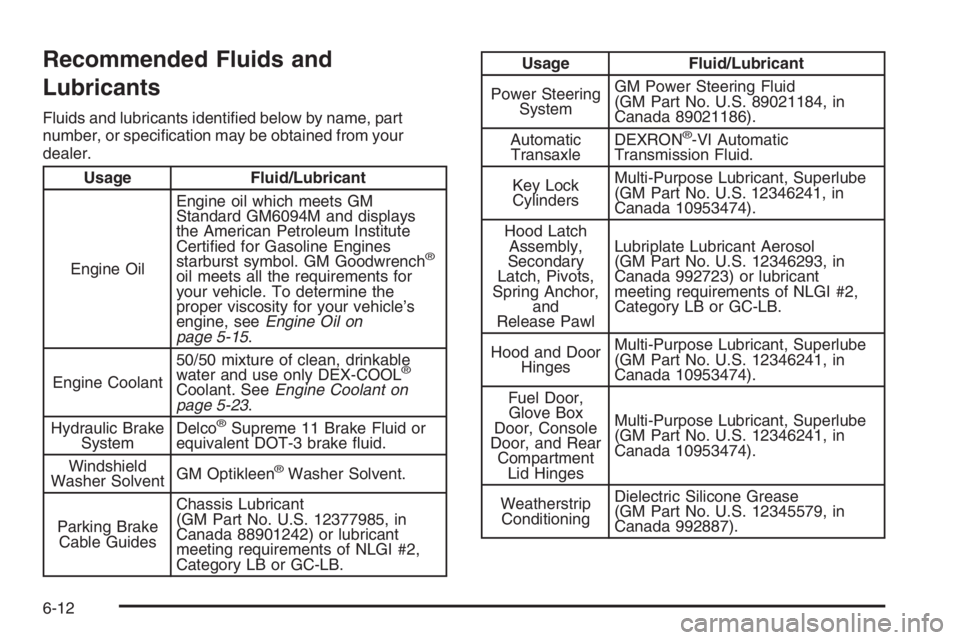
Recommended Fluids and
Lubricants
Fluids and lubricants identied below by name, part
number, or specication may be obtained from your
dealer.
Usage Fluid/Lubricant
Engine OilEngine oil which meets GM
Standard GM6094M and displays
the American Petroleum Institute
Certied for Gasoline Engines
starburst symbol. GM Goodwrench
®
oil meets all the requirements for
your vehicle. To determine the
proper viscosity for your vehicle’s
engine, seeEngine Oil on
page 5-15.
Engine Coolant50/50 mixture of clean, drinkable
water and use only DEX-COOL
®
Coolant. SeeEngine Coolant on
page 5-23.
Hydraulic Brake
SystemDelco
®Supreme 11 Brake Fluid or
equivalent DOT-3 brake uid.
Windshield
Washer SolventGM Optikleen
®Washer Solvent.
Parking Brake
Cable GuidesChassis Lubricant
(GM Part No. U.S. 12377985, in
Canada 88901242) or lubricant
meeting requirements of NLGI #2,
Category LB or GC-LB.
Usage Fluid/Lubricant
Power Steering
SystemGM Power Steering Fluid
(GM Part No. U.S. 89021184, in
Canada 89021186).
Automatic
TransaxleDEXRON
®-VI Automatic
Transmission Fluid.
Key Lock
CylindersMulti-Purpose Lubricant, Superlube
(GM Part No. U.S. 12346241, in
Canada 10953474).
Hood Latch
Assembly,
Secondary
Latch, Pivots,
Spring Anchor,
and
Release PawlLubriplate Lubricant Aerosol
(GM Part No. U.S. 12346293, in
Canada 992723) or lubricant
meeting requirements of NLGI #2,
Category LB or GC-LB.
Hood and Door
HingesMulti-Purpose Lubricant, Superlube
(GM Part No. U.S. 12346241, in
Canada 10953474).
Fuel Door,
Glove Box
Door, Console
Door, and Rear
Compartment
Lid HingesMulti-Purpose Lubricant, Superlube
(GM Part No. U.S. 12346241, in
Canada 10953474).
Weatherstrip
ConditioningDielectric Silicone Grease
(GM Part No. U.S. 12345579, in
Canada 992887).
6-12
Page 383 of 416

Normal Maintenance Replacement Parts
Replacement parts identied below by name, part number, or specication can be obtained from your dealer.
Normal Maintenance Replacement Parts
Part GM Part NumberACDelco®Part
Number
Engine Air Cleaner/Filter 22676970 A1627C
Engine Oil Filter
3.8L V6 Engine 25010792 PF47
4.6L V8 Engine 89017342 PF61
Passenger Compartment Air Filter 15811562 CF138
Spark Plugs
3.8L V6 12568387 41-101
4.6L V8 12571535 41-987
Transaxle Filter Kit 24224522 —
Windshield Wiper Blades
Driver’s Side – 23.6 inches (60.0 cm) 15788730 —
Passenger’s Side – 20.8 inches (53.0 cm) 15788731 —
6-13
Page 400 of 416
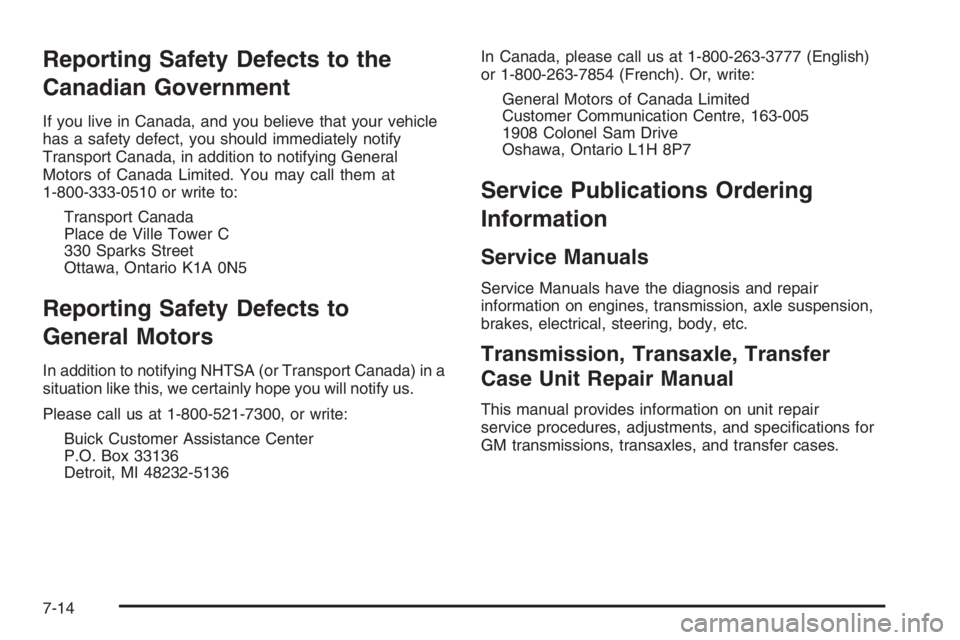
Reporting Safety Defects to the
Canadian Government
If you live in Canada, and you believe that your vehicle
has a safety defect, you should immediately notify
Transport Canada, in addition to notifying General
Motors of Canada Limited. You may call them at
1-800-333-0510 or write to:
Transport Canada
Place de Ville Tower C
330 Sparks Street
Ottawa, Ontario K1A 0N5
Reporting Safety Defects to
General Motors
In addition to notifying NHTSA (or Transport Canada) in a
situation like this, we certainly hope you will notify us.
Please call us at 1-800-521-7300, or write:
Buick Customer Assistance Center
P.O. Box 33136
Detroit, MI 48232-5136In Canada, please call us at 1-800-263-3777 (English)
or 1-800-263-7854 (French). Or, write:
General Motors of Canada Limited
Customer Communication Centre, 163-005
1908 Colonel Sam Drive
Oshawa, Ontario L1H 8P7
Service Publications Ordering
Information
Service Manuals
Service Manuals have the diagnosis and repair
information on engines, transmission, axle suspension,
brakes, electrical, steering, body, etc.
Transmission, Transaxle, Transfer
Case Unit Repair Manual
This manual provides information on unit repair
service procedures, adjustments, and specications for
GM transmissions, transaxles, and transfer cases.
7-14
Page 404 of 416
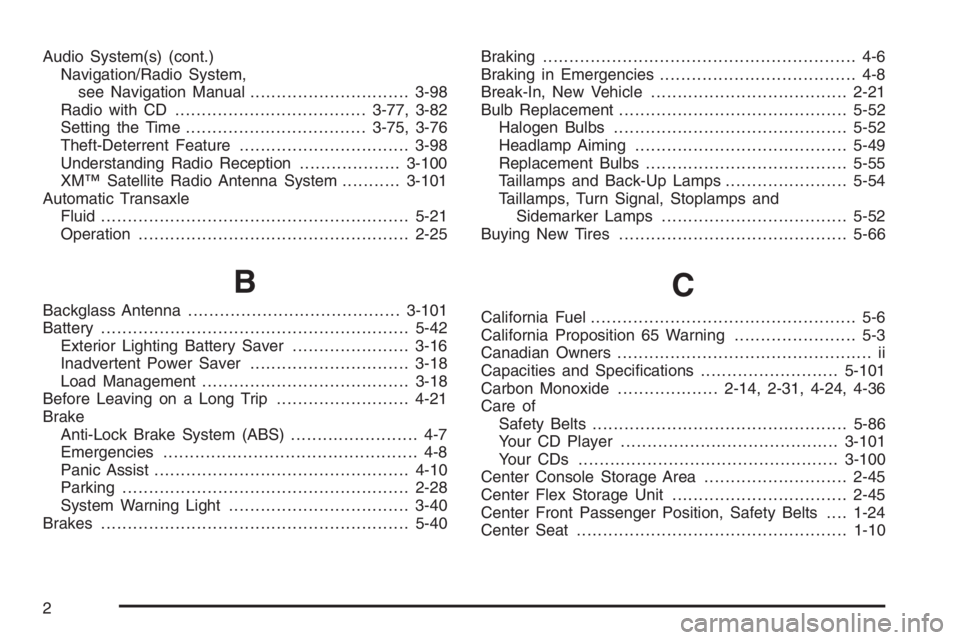
Audio System(s) (cont.)
Navigation/Radio System,
see Navigation Manual..............................3-98
Radio with CD....................................3-77, 3-82
Setting the Time..................................3-75, 3-76
Theft-Deterrent Feature................................3-98
Understanding Radio Reception...................3-100
XM™ Satellite Radio Antenna System...........3-101
Automatic Transaxle
Fluid..........................................................5-21
Operation...................................................2-25
B
Backglass Antenna........................................3-101
Battery..........................................................5-42
Exterior Lighting Battery Saver......................3-16
Inadvertent Power Saver..............................3-18
Load Management.......................................3-18
Before Leaving on a Long Trip.........................4-21
Brake
Anti-Lock Brake System (ABS)........................ 4-7
Emergencies................................................ 4-8
Panic Assist................................................4-10
Parking......................................................2-28
System Warning Light..................................3-40
Brakes..........................................................5-40Braking........................................................... 4-6
Braking in Emergencies..................................... 4-8
Break-In, New Vehicle.....................................2-21
Bulb Replacement...........................................5-52
Halogen Bulbs............................................5-52
Headlamp Aiming........................................5-49
Replacement Bulbs......................................5-55
Taillamps and Back-Up Lamps.......................5-54
Taillamps, Turn Signal, Stoplamps and
Sidemarker Lamps...................................5-52
Buying New Tires...........................................5-66
C
California Fuel.................................................. 5-6
California Proposition 65 Warning....................... 5-3
Canadian Owners................................................ ii
Capacities and Specications..........................5-101
Carbon Monoxide...................2-14, 2-31, 4-24, 4-36
Care of
Safety Belts................................................5-86
Your CD Player.........................................3-101
Your CDs .................................................3-100
Center Console Storage Area...........................2-45
Center Flex Storage Unit.................................2-45
Center Front Passenger Position, Safety Belts....1-24
Center Seat...................................................1-10
2
Page 407 of 416

E
Electrical System
Add-On Equipment......................................5-93
Fuses and Circuit Breakers...........................5-93
Power Windows and Other Power Options......5-93
Rear Underseat Fuse Block..........................5-96
Underhood Fuse Block.................................5-94
Engine
Air Cleaner/Filter.........................................5-19
Battery.......................................................5-42
Check and Service Engine Soon Light............3-44
Coolant......................................................5-23
Coolant Heater............................................2-24
Coolant Temperature Gage...........................3-43
Coolant Temperature Warning Light................3-43
Engine Compartment Overview......................5-12
Exhaust.....................................................2-31
Oil .............................................................5-15
Oil Life System...........................................5-18
Overheated Protection Operating Mode...........5-28
Overheating................................................5-27
Starting......................................................2-23
Entry Lighting.................................................3-17
Event Data Recorders (EDR)............................. 7-9
Extender, Safety Belt.......................................1-30
Exterior Lamps...............................................3-14
Exterior Lighting Battery Saver..........................3-16
F
Filter
Engine Air Cleaner......................................5-19
Finish Damage...............................................5-89
Flashers, Hazard Warning.................................. 3-6
Flash-to-Pass................................................... 3-8
Flat Tire........................................................5-72
Flat Tire, Changing.........................................5-72
Flat Tire, Storing.............................................5-81
Fluid
Automatic Transaxle.....................................5-21
Power Steering...........................................5-38
Windshield Washer......................................5-39
Fog Lamp Light..............................................3-48
Fog Lamps ....................................................3-16
Front Reading Lamps......................................3-18
Front Storage Area.........................................2-44
Fuel............................................................... 5-5
Additives...................................................... 5-6
California Fuel.............................................. 5-6
Filling a Portable Fuel Container....................5-10
Filling Your Tank........................................... 5-8
Fuels in Foreign Countries.............................. 5-7
Gage .........................................................3-49
Gasoline Octane........................................... 5-5
Gasoline Specications.................................. 5-5
5
Page 415 of 416
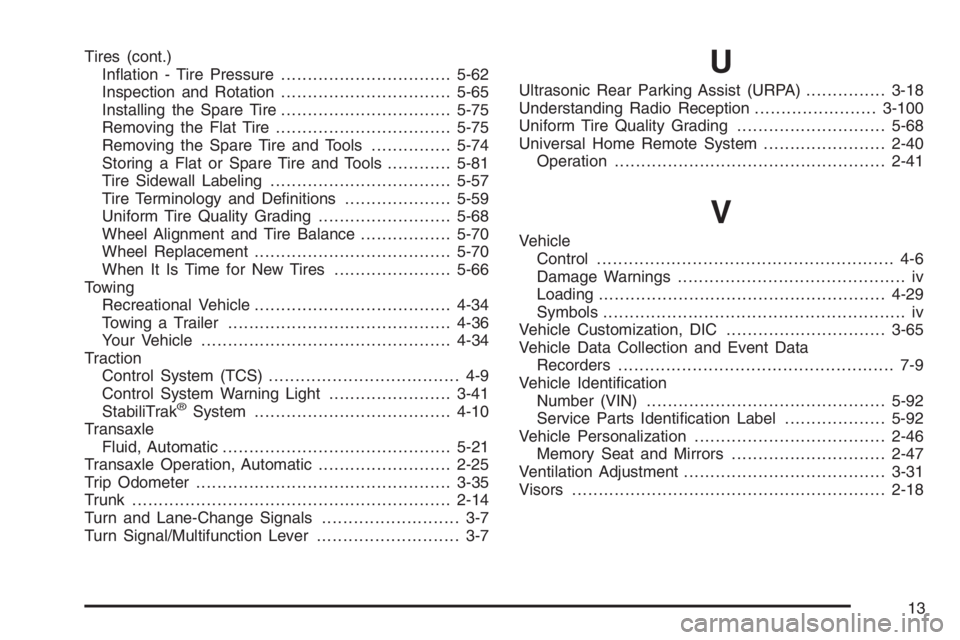
Tires (cont.)
Ination - Tire Pressure................................5-62
Inspection and Rotation................................5-65
Installing the Spare Tire................................5-75
Removing the Flat Tire.................................5-75
Removing the Spare Tire and Tools...............5-74
Storing a Flat or Spare Tire and Tools............5-81
Tire Sidewall Labeling..................................5-57
Tire Terminology and Denitions....................5-59
Uniform Tire Quality Grading.........................5-68
Wheel Alignment and Tire Balance.................5-70
Wheel Replacement.....................................5-70
When It Is Time for New Tires......................5-66
Towing
Recreational Vehicle.....................................4-34
Towing a Trailer..........................................4-36
Your Vehicle...............................................4-34
Traction
Control System (TCS).................................... 4-9
Control System Warning Light.......................3-41
StabiliTrak
®System.....................................4-10
Transaxle
Fluid, Automatic...........................................5-21
Transaxle Operation, Automatic.........................2-25
Trip Odometer................................................3-35
Trunk............................................................2-14
Turn and Lane-Change Signals.......................... 3-7
Turn Signal/Multifunction Lever........................... 3-7
U
Ultrasonic Rear Parking Assist (URPA)...............3-18
Understanding Radio Reception.......................3-100
Uniform Tire Quality Grading............................5-68
Universal Home Remote System.......................2-40
Operation...................................................2-41
V
Vehicle
Control........................................................ 4-6
Damage Warnings........................................... iv
Loading......................................................4-29
Symbols......................................................... iv
Vehicle Customization, DIC..............................3-65
Vehicle Data Collection and Event Data
Recorders.................................................... 7-9
Vehicle Identication
Number (VIN).............................................5-92
Service Parts Identication Label...................5-92
Vehicle Personalization....................................2-46
Memory Seat and Mirrors.............................2-47
Ventilation Adjustment......................................3-31
Visors...........................................................2-18
13