automatic transmission BUICK LUCERNE 2010 User Guide
[x] Cancel search | Manufacturer: BUICK, Model Year: 2010, Model line: LUCERNE, Model: BUICK LUCERNE 2010Pages: 474
Page 317 of 474

A.Underhood Fuse Block on page 6‑110.
B. Remote Positive (+) Battery Terminal. See Jump
Starting on page 6‑44.
C. Windshield Washer Fluid Reservoir. See “Adding
Washer Fluid” underWindshield Washer Fluid
on
page 6‑39.
D. Engine Coolant Recovery Tank. See Cooling
System on page 6‑26.
E. Radiator Pressure Cap. See Cooling System
on
page 6‑26.
F. Power Steering Fluid Reservoir (Out of View). See Power Steering Fluid on page 6‑38. G. Engine Oil Fill Cap. See
“When to Add Engine Oil”
under Engine Oil on page 6‑17.
H. Engine Oil Dipstick (Out of View). See “Checking
Engine Oil” underEngine Oil on page 6‑17.
I. Automatic Transmission Fluid Dipstick. See “Checking the Fluid Level” underAutomatic
Transmission Fluid on page 6‑23.
J. Brake Fluid Reservoir. See “Brake Fluid”under
Brakes on page 6‑40.
K. Engine Air Cleaner/Filter on page 6‑21.
6-15
Page 319 of 474

A.Underhood Fuse Blockon page 6‑110.
B. Remote Positive (+) Terminal. See Jump Starting
on page 6‑44.
C. Windshield Washer Fluid Reservoir. See “Adding
Washer Fluid” underWindshield Washer Fluid
on
page 6‑39.
D. Engine Coolant Surge Tank and Pressure Cap. See Cooling System on page 6‑26.
E. Remote Negative (−) Terminal. See Jump Starting
on page 6‑44.
F. Power Steering Fluid on page 6‑38.
G. Engine Oil Fill Cap. See “When to Add Engine Oil”
under Engine Oil on page 6‑17.
H. Engine Oil Dipstick. See “Checking Engine Oil”
under Engine Oil on page 6‑17.
I. Brake Master Cylinder Reservoir. See “Brake
Fluid” under Brakes on page 6‑40.
J. Automatic Transmission Fluid Cap and Dipstick (Out of View). See Automatic Transmission Fluid
on page 6‑23.
K. Engine Air Cleaner/Filter on page 6‑21.
Engine Oil
Checking Engine Oil
It is a good idea to check the engine oil level at each
fuel fill. In order to get an accurate reading, the oil must
be warm and the vehicle must be on level ground.
The engine oil dipstick handle is a yellow loop. See
Engine Compartment Overview
on page 6‑14for the
location of the engine oil dipstick.
1. Turn off the engine and give the oil several minutes to drain back into the oil pan. If this is not done, the
oil dipstick might not show the actual level.
2. Pull out the dipstick and clean it with a paper towel or cloth, then push it back in all the way. Remove it
again, keeping the tip down, and check the level.
6-17
Page 325 of 474
Automatic Transmission Fluid
When to Check and Change Automatic
Transmission Fluid
A good time to check the automatic transmission fluid
level is when the engine oil is changed.
Change the fluid and filter at the intervals listed in
Scheduled Maintenance
on page 7‑3and be sure to
use the transmission fluid listed in Recommended
Fluids and Lubricants on page 7‑9.
How to Check Automatic Transmission
Fluid (3.9L Engine)
Because this operation can be a little difficult, you
may choose to have this done at the dealer service
department.
If you do it yourself, be sure to follow all the instructions
here, or you could get a false reading on the dipstick.
Notice: Too much or too little fluid can damage the
transmission. Too much can mean that some of the
fluid could come out and fall on hot engine parts
or exhaust system parts, starting a fire. Too little
fluid could cause the transmission to overheat.
Be sure to get an accurate reading if checking the
transmission fluid. Wait at least 30 minutes before checking the
transmission fluid level if you have been driving:
.When outside temperatures are above
90°F (32°C).
.At high speed for quite a while.
.In heavy traffic
—especially in hot weather.
.While pulling a trailer.
To get the right reading, the fluid should be at normal
operating temperature, which is 180°F to 200°F
(82°C to 93°C).
Get the vehicle warmed up by driving about 15 miles
(24 km) when outside temperatures are above 50°F
(10°C). If it is colder than 50°F (10°C), you may have to
drive longer.
Checking the Fluid Level
Prepare the vehicle as follows: 1. Park the vehicle on a level place. Keep the engine running.
2. With the parking brake applied, place the shift lever in P (Park).
3. With your foot on the brake pedal, move the shift lever through each gear range, pausing for about
three seconds in each range. Then, position the
shift lever in P (Park).
4. Let the engine run at idle for three to five minutes.
6-23
Page 327 of 474
How to Add Automatic Transmission
Fluid
Refer to the Maintenance Schedule to determine what
kind of transmission fluid to use. SeeRecommended
Fluids and Lubricants on page 7‑9.
If the fluid level is low, add only enough of the proper
fluid to bring the level into the cross-hatched area on
the dipstick.
1. Pull out the dipstick.
2. Using a long-neck funnel, add enough fluid at the dipstick hole to bring it to the proper level.
It does not take much fluid, generally less than
one pint (0.5 L). Do not overfill. Notice:
Use of the incorrect automatic transmission
fluid may damage the vehicle, and the damages may
not be covered by the vehicle's warranty. Always
use the automatic transmission fluid listed in
Recommended Fluids and Lubricants on page 7‑9.
3. After adding fluid, recheck the fluid level as described under “How to Check Automatic
Transmission Fluid” earlier in this section.
4. When the correct fluid level is obtained, push the dipstick back in all the way.
How to Check Automatic Transmission
Fluid (4.6L Engine)
For the 4.6L V8 engine, it is not necessary to check the
transmission fluid level. A transmission fluid leak is the
only reason for fluid loss. If a leak occurs, take the
vehicle to your dealer service department and have it
repaired as soon as possible.
6-25
Page 347 of 474
Notice:Ignoring these steps could result in costly
damage to the vehicle that would not be covered by
the warranty.
Trying to start the vehicle by pushing or pulling it
will not work, and it could damage the vehicle.
1. Check the other vehicle. It must have a 12-volt battery with a negative ground system.
Notice: If the other vehicle's system is not a 12-volt
system with a negative ground, both vehicles can
be damaged. Only use vehicles with 12-volt systems
with negative grounds to jump start your vehicle.
2. Get the vehicles close enough so the jumper cables can reach, but be sure the vehicles are
not touching each other. If they are, it could cause
a ground connection you do not want. You would
not be able to start your vehicle, and the bad
grounding could damage the electrical systems.
To avoid the possibility of the vehicles rolling, set
the parking brake firmly on both vehicles involved
in the jump start procedure. Put an automatic
transmission in P (Park) or a manual transmission
in Neutral before setting the parking brake. Notice:
If you leave the radio or other accessories
on during the jump starting procedure, they could
be damaged. The repairs would not be covered by
the warranty. Always turn off the radio and other
accessories when jump starting the vehicle.
3. Turn off the ignition on both vehicles. Unplug unnecessary accessories plugged into the
cigarette lighter or the accessory power outlet(s).
Turn off the radio and all lamps that are not
needed. This will avoid sparks and help save
both batteries. And it could save the radio!
4. Open the hood on the other vehicle and locate the positive (+) and negative (−) terminal locations on
that vehicle.
You will not see the battery of your vehicle under
the hood. It is located under the rear passenger's
seat. You will not need to access the battery for
jump starting. The remote positive (+) terminal is
for that purpose. See Engine Compartment
Overview
on page 6‑14for location.
6-45
Page 364 of 474
Tire Terminology and Definitions
Air Pressure:The amount of air inside the tire
pressing outward on each square inch of the tire.
Air pressure is expressed in pounds per square
inch (psi) or kilopascal (kPa).
Accessory Weight
:This means the combined
weight of optional accessories. Some examples of
optional accessories are, automatic transmission,
power steering, power brakes, power windows,
power seats, and air conditioning.
Aspect Ratio
:The relationship of a tire's height to
its width.
Belt
:A rubber coated layer of cords that is
located between the plies and the tread. Cords
may be made from steel or other reinforcing
materials.
Bead
:The tire bead contains steel wires wrapped
by steel cords that hold the tire onto the rim.
Bias Ply Tire
:A pneumatic tire in which the plies
are laid at alternate angles less than 90 degrees
to the centerline of the tread. Cold Tire Pressure
:The amount of air pressure
in a tire, measured in pounds per square inch (psi)
or kilopascals (kPa) before a tire has built up heat
from driving. See Inflation - Tire Pressure
on
page 6‑65
.
Curb Weight
:The weight of a motor vehicle with
standard and optional equipment including the
maximum capacity of fuel, oil, and coolant, but
without passengers and cargo.
DOT Markings
:A code molded into the sidewall
of a tire signifying that the tire is in compliance
with the U.S. Department of Transportation (DOT)
motor vehicle safety standards. The DOT code
includes the Tire Identification Number (TIN), an
alphanumeric designator which can also identify
the tire manufacturer, production plant, brand, and
date of production.
GVWR
:Gross Vehicle Weight Rating. See
Loading the Vehicle
on page 5‑19.
GAWR FRT
:Gross Axle Weight Rating for the
front axle. See Loading the Vehicle
on page 5‑19.
6-62
Page 421 of 474
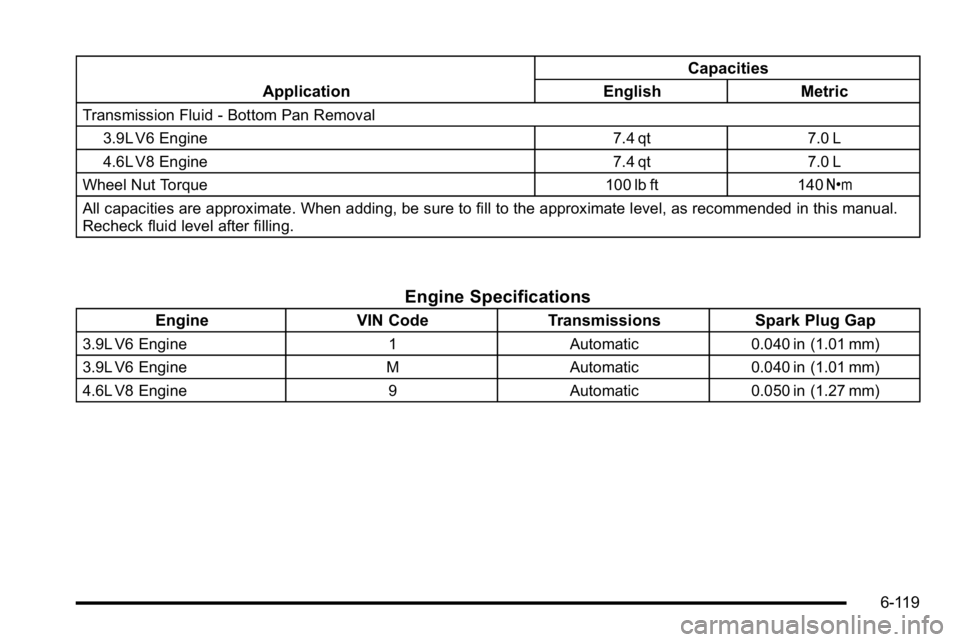
ApplicationCapacities
English Metric
Transmission Fluid - Bottom Pan Removal
3.9L V6 Engine 7.4 qt 7.0 L
4.6L V8 Engine 7.4 qt 7.0 L
Wheel Nut Torque 100 lb ft 140 Y
All capacities are approximate. When adding, be sure to fill to the approximate level, as recommended in this manual.
Recheck fluid level after filling.
Engine Specifications
Engine VIN CodeTransmissions Spark Plug Gap
3.9L V6 Engine 1Automatic 0.040 in (1.01 mm)
3.9L V6 Engine MAutomatic0.040 in (1.01 mm)
4.6L V8 Engine 9Automatic 0.050 in (1.27 mm)
6-119
Page 427 of 474
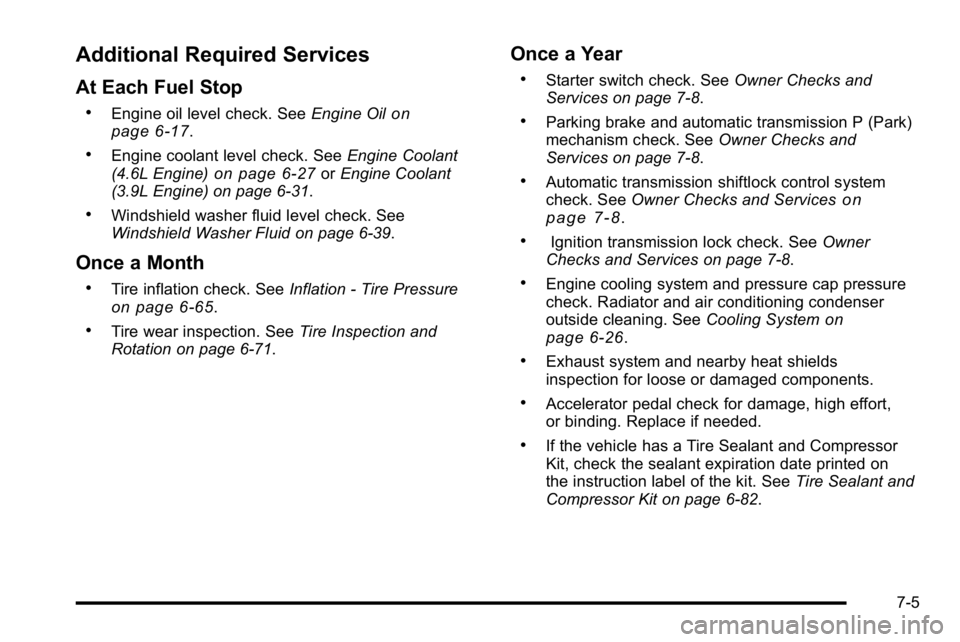
Additional Required Services
At Each Fuel Stop
.Engine oil level check. SeeEngine Oilon
page 6‑17.
.Engine coolant level check. See Engine Coolant
(4.6L Engine)on page 6‑27or Engine Coolant
(3.9L Engine) on page 6‑31.
.Windshield washer fluid level check. See
Windshield Washer Fluid on page 6‑39.
Once a Month
.Tire inflation check. See Inflation - Tire Pressureon page 6‑65.
.Tire wear inspection. See Tire Inspection and
Rotation on page 6‑71.
Once a Year
.Starter switch check. See Owner Checks and
Services on page 7‑8.
.Parking brake and automatic transmission P (Park)
mechanism check. See Owner Checks and
Services on page 7‑8.
.Automatic transmission shiftlock control system
check. See Owner Checks and Serviceson
page 7‑8.
.Ignition transmission lock check. See Owner
Checks and Services on page 7‑8.
.Engine cooling system and pressure cap pressure
check. Radiator and air conditioning condenser
outside cleaning. See Cooling System
on
page 6‑26.
.Exhaust system and nearby heat shields
inspection for loose or damaged components.
.Accelerator pedal check for damage, high effort,
or binding. Replace if needed.
.If the vehicle has a Tire Sealant and Compressor
Kit, check the sealant expiration date printed on
the instruction label of the kit. See Tire Sealant and
Compressor Kit on page 6‑82.
7-5
Page 428 of 474
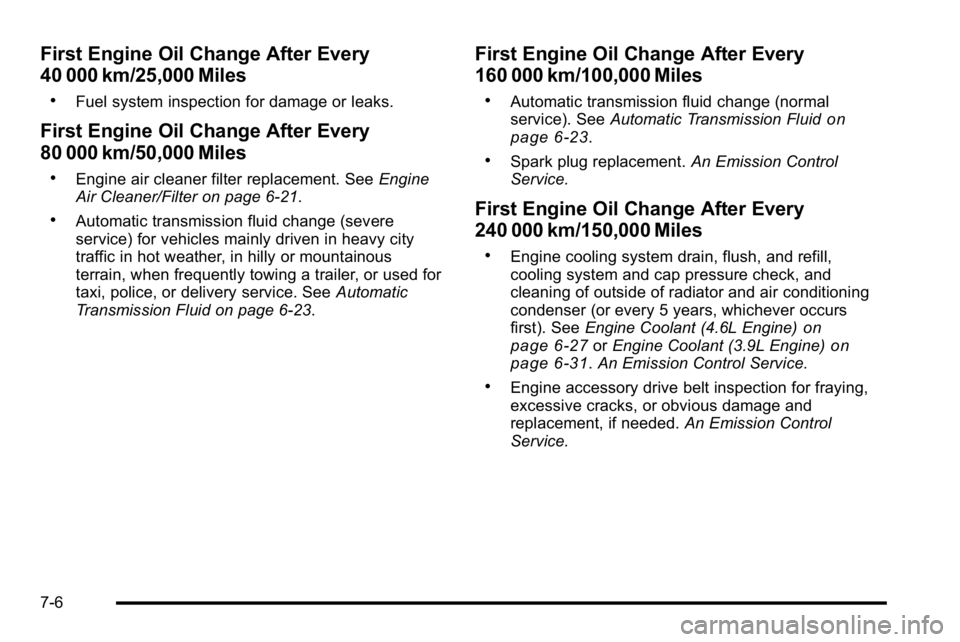
First Engine Oil Change After Every
40 000 km/25,000 Miles
.Fuel system inspection for damage or leaks.
First Engine Oil Change After Every
80 000 km/50,000 Miles
.Engine air cleaner filter replacement. SeeEngine
Air Cleaner/Filter on page 6‑21.
.Automatic transmission fluid change (severe
service) for vehicles mainly driven in heavy city
traffic in hot weather, in hilly or mountainous
terrain, when frequently towing a trailer, or used for
taxi, police, or delivery service. See Automatic
Transmission Fluid on page 6‑23.
First Engine Oil Change After Every
160 000 km/100,000 Miles
.Automatic transmission fluid change (normal
service). See Automatic Transmission Fluidon
page 6‑23.
.Spark plug replacement. An Emission Control
Service.
First Engine Oil Change After Every
240 000 km/150,000 Miles
.Engine cooling system drain, flush, and refill,
cooling system and cap pressure check, and
cleaning of outside of radiator and air conditioning
condenser (or every 5 years, whichever occurs
first). See Engine Coolant (4.6L Engine)
on
page 6‑27or Engine Coolant (3.9L Engine)on
page 6‑31. An Emission Control Service.
.Engine accessory drive belt inspection for fraying,
excessive cracks, or obvious damage and
replacement, if needed. An Emission Control
Service.
7-6
Page 430 of 474
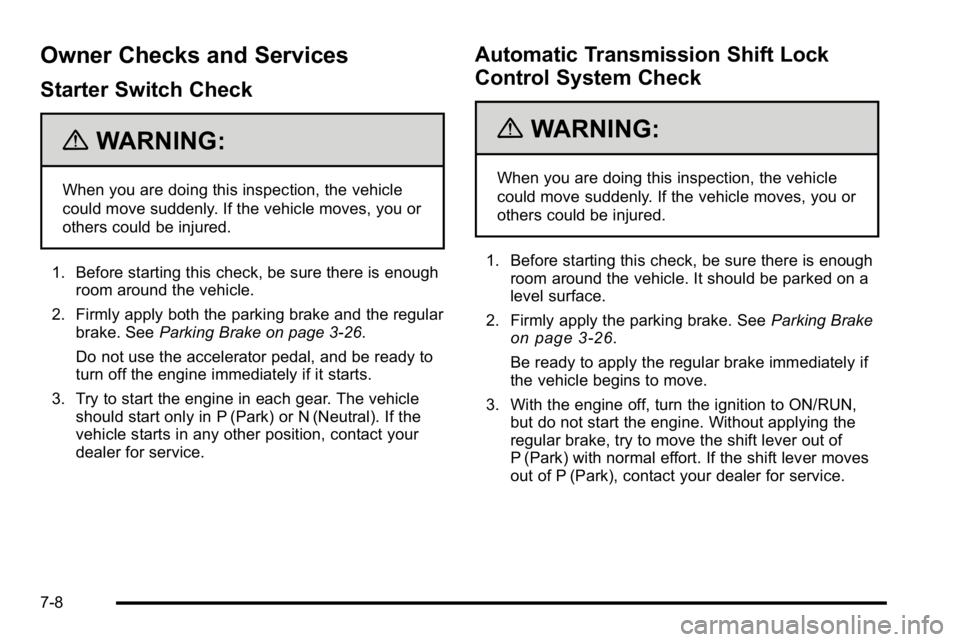
Owner Checks and Services
Starter Switch Check
{WARNING:
When you are doing this inspection, the vehicle
could move suddenly. If the vehicle moves, you or
others could be injured.
1. Before starting this check, be sure there is enough room around the vehicle.
2. Firmly apply both the parking brake and the regular brake. See Parking Brake on page 3‑26.
Do not use the accelerator pedal, and be ready to
turn off the engine immediately if it starts.
3. Try to start the engine in each gear. The vehicle should start only in P (Park) or N (Neutral). If the
vehicle starts in any other position, contact your
dealer for service.
Automatic Transmission Shift Lock
Control System Check
{WARNING:
When you are doing this inspection, the vehicle
could move suddenly. If the vehicle moves, you or
others could be injured.
1. Before starting this check, be sure there is enough room around the vehicle. It should be parked on a
level surface.
2. Firmly apply the parking brake. See Parking Brake
on page 3‑26.
Be ready to apply the regular brake immediately if
the vehicle begins to move.
3. With the engine off, turn the ignition to ON/RUN, but do not start the engine. Without applying the
regular brake, try to move the shift lever out of
P (Park) with normal effort. If the shift lever moves
out of P (Park), contact your dealer for service.
7-8