change time BUICK LUCERNE 2011 Owner's Guide
[x] Cancel search | Manufacturer: BUICK, Model Year: 2011, Model line: LUCERNE, Model: BUICK LUCERNE 2011Pages: 450, PDF Size: 3.63 MB
Page 265 of 450
Black plate (11,1)Buick Lucerne Owner Manual - 2011
While driving on a surface with reduced traction, try
your best to avoid sudden steering, acceleration,
or braking, including reducing vehicle speed by shifting
to a lower gear. Any sudden changes could cause the
tires to slide. You may not realize the surface is slippery
until the vehicle is skidding. Learn to recognize warning
clues—such as enough water, ice, or packed snow on
the road to make a mirrored surface —and slow down
when you have any doubt.
Remember: Antilock brakes help avoid only the
braking skid.
Driving at Night
Night driving is more dangerous than day driving
because some drivers are likely to be impaired —by
alcohol or drugs, with night vision problems, or by
fatigue.
Night driving tips include:
.Drive defensively.
.Do not drink and drive.
.Reduce headlamp glare by adjusting the inside
rearview mirror.
.Slow down and keep more space between you and
other vehicles because headlamps can only light
up so much road ahead.
.Watch for animals.
.When tired, pull off the road.
.Do not wear sunglasses.
.Avoid staring directly into approaching headlamps.
.Keep the windshield and all glass on your vehicle
clean —inside and out.
.Keep your eyes moving, especially during turns or
curves.
No one can see as well at night as in the daytime.
But, as we get older, these differences increase.
A 50-year-old driver might need at least twice as much
light to see the same thing at night as a 20-year-old.
5-11
Page 279 of 450
Black plate (25,1)Buick Lucerne Owner Manual - 2011
5. Remove the key from the ignition.
6. Secure the vehicle to the dolly.
7. Release the parking brake.
Towing a Trailer
{WARNING:
The driver can lose control when pulling a trailer if
the correct equipment is not used or the vehicle is
not driven properly. For example, if the trailer is
too heavy, the brakes may not work well—or
even at all. The driver and passengers could
be seriously injured. The vehicle may also be
damaged; the resulting repairs would not be
covered by the vehicle warranty. Pull a trailer only
if all the steps in this section have been followed.
Ask your dealer for advice and information about
towing a trailer with the vehicle.
Notice: Pulling a trailer improperly can damage the
vehicle and result in costly repairs not covered by
the vehicle warranty. To pull a trailer correctly,
follow the advice in this section and see your dealer
for important information about towing a trailer with
the vehicle. The vehicle can tow a trailer if it is equipped with
the proper trailer towing equipment. To identify the
trailering capacity of the vehicle, read the information
in
“Weight of the Trailer” that appears later in this
section. Trailering is different than just driving the
vehicle by itself. Trailering means changes in handling,
acceleration, braking, durability and fuel economy.
Successful, safe trailering takes correct equipment,
and it has to be used properly.
The following information has many time-tested,
important trailering tips and safety rules. Many of
these are important for the safety of the driver and
the passengers. So please read this section carefully
before pulling a trailer.
Load-pulling components such as the engine,
transmission, axles, wheel assemblies and tires are
forced to work harder against the drag of the added
weight. The engine is required to operate at relatively
higher speeds and under greater loads, generating
extra heat. The trailer also adds considerably to wind
resistance, increasing the pulling requirements.
5-25
Page 294 of 450
Black plate (8,1)Buick Lucerne Owner Manual - 2011
Many service stations will not have an 85% ethanol
fuel (E85) pump available. The U.S. Department
of Energy has an alternative fuels website
(www.afdc.energy.gov/afdc/locator/stations/) that
can help you find E85 fuel. Those stations that do have
E85 should have a label indicating ethanol content.
Do not use the fuel if the ethanol content is greater
than 85%.
At a minimum, E85 should meet ASTM Specification
D 5798. By definition, this means that fuel labeled E85
will have an ethanol content between 70% and 85%.
Filling the fuel tank with fuel mixtures that do not meet
ASTM specifications can affect driveability and could
cause the malfunction indicator lamp to come on.
To ensure quick starts in the wintertime, the E85 fuel
must be formulated properly for your climate according
to ASTM specification D 5798. If you have trouble
starting on E85, it could be because the E85 fuel is not
properly formulated for your climate. If this happens,
switching to gasoline or adding gasoline to the fuel
tank can improve starting. For good starting and heater
efficiency below 0°C (32°F), the fuel mix in the fuel tank
should contain no more than 70% ethanol. It is best
not to alternate repeatedly between gasoline and E85.If you do switch fuels, it is recommended that you add
as much fuel as possible
—do not add less than 11 L
(3 gal) when refueling. You should drive the vehicle
immediately after refueling for at least 11 km (7 mi) to
allow the vehicle to adapt to the change in ethanol
concentration.
E85 has less energy per liter (gallon) than gasoline, so
you will need to refill the fuel tank more often when
using E85 than when you are using gasoline. See
Filling the Tank on page 6‑9.
Notice: Some additives are not compatible with
E85 fuel and can harm the vehicle's fuel system.
Do not add anything to E85. Damage caused by
additives would not be covered by the vehicle
warranty.
Notice: This vehicle was not designed for fuel that
contains methanol. Do not use fuel containing
methanol. It can corrode metal parts in the fuel
system and also damage plastic and rubber parts.
That damage would not be covered under the
vehicle warranty.
6-8
Page 304 of 450
Black plate (18,1)Buick Lucerne Owner Manual - 2011
Engine Oil
To ensure proper engine performance and long life,
careful attention must be paid to engine oil. Following
these simple, but important steps will help protect your
investment:
.Always use engine oil approved to the proper
specification and of the proper viscosity grade. See
“Selecting the Right Engine Oil”in this section.
.Check the engine oil level regularly and maintain
the proper oil level. See“Checking Engine Oil”and
“When to Add Engine Oil” in this section.
.Change the engine oil at the appropriate time. See
Engine Oil Life System on page 6‑22.
.Always dispose of engine oil properly. See “What
to Do with Used Oil” in this section.
Checking Engine Oil
It is a good idea to check the engine oil level at each
fuel fill. In order to get an accurate reading, the vehicle
must be on level ground. The engine oil dipstick handle
is a yellow loop. See Engine Compartment Overview
on
page 6‑14for the location of the engine oil dipstick.
Obtaining an accurate oil level reading is essential: 1. If the engine has been running recently, turn off the engine and allow several minutes for the oil to
drain back into the oil pan. Checking the oil level
too soon after engine shutoff will not provide an
accurate oil level reading.
2. Pull out the dipstick and clean it with a paper towel or cloth, then push it back in all the way. Remove it
again, keeping the tip down, and check the level.
6-18
Page 308 of 450
Black plate (22,1)Buick Lucerne Owner Manual - 2011
Engine Oil Life System
When to Change Engine Oil
This vehicle has a computer system that indicates when
to change the engine oil and filter. This is based on
engine revolutions and engine temperature, and not on
mileage. Based on driving conditions, the mileage at
which an oil change is indicated can vary considerably.
For the oil life system to work properly, the system must
be reset every time the oil is changed.
When the system has calculated that oil life has been
diminished, it indicates that an oil change is necessary.
A CHANGE ENGINE OIL SOON message comes on.
SeeDIC Warnings and Messages
on page 4‑49.
Change the oil as soon as possible within the next
600 miles (1 000 km). It is possible that, if driving under
the best conditions, the oil life system might indicate
that an oil change is not necessary for up to a year. The
engine oil and filter must be changed at least once a
year and, at this time, the system must be reset. Your
dealer has trained service people who will perform this
work and reset the system. It is also important to check
the oil regularly over the course of an oil drain interval
and keep it at the proper level. If the system is ever reset accidentally, the oil must be
changed at 3,000 miles (5 000 km) since the last oil
change. Remember to reset the oil life system
whenever the oil is changed.
How to Reset the Engine Oil Life
System
Reset the system whenever the engine oil is changed
so that the system can calculate the next engine oil
change. Always reset the engine oil life to 100% after
every oil change. It will not reset itself. To reset the
system:
1. Display the OIL LIFE REMAINING on the DIC.
2. Press and hold the SET/RESET button on the DIC for more than five seconds. The oil life will change
to 100%.
If the CHANGE ENGINE OIL SOON message comes
back on when the vehicle is started, the engine oil life
system has not been reset. Repeat the procedure.
6-22
Page 310 of 450
Black plate (24,1)Buick Lucerne Owner Manual - 2011
To reinstall the cover:1. Align the two hinges located on the inboard side of the cover.
2. Push the cover slightly down and towards the engine to engage the tabs in the hinges and align
the two screws.
3. Tighten the two screws on the top of the engine air cleaner/filter cover.
{WARNING:
Operating the engine with the air cleaner/filter off
can cause you or others to be burned. The air
cleaner not only cleans the air; it helps to stop
flames if the engine backfires. Use caution when
working on the engine and do not drive with the
air cleaner/filter off.
Notice: If the air cleaner/filter is off, dirt can easily
get into the engine, which could damage it. Always
have the air cleaner/filter in place when you are
driving.
Automatic Transmission Fluid
When to Check and Change Automatic
Transmission Fluid
A good time to check the automatic transmission fluid
level is when the engine oil is changed.
Change the fluid and filter at the intervals listed in
Scheduled Maintenance
on page 7‑3and be sure
to use the transmission fluid listed in Recommended
Fluids and Lubricants on page 7‑8.
How to Check Automatic Transmission
Fluid (3.9L Engine)
Because this operation can be a little difficult, you
may choose to have this done at the dealer service
department.
If you do it yourself, be sure to follow all the instructions
here, or you could get a false reading on the dipstick.
Notice: Too much or too little fluid can damage
the transmission. Too much can mean that some
of the fluid could come out and fall on hot engine
parts or exhaust system parts, starting a fire. Too
little fluid could cause the transmission to overheat.
Be sure to get an accurate reading if checking the
transmission fluid.
6-24
Page 328 of 450
Black plate (42,1)Buick Lucerne Owner Manual - 2011
Brake Adjustment
Every time the brakes are applied, with or without the
vehicle moving, the brakes adjust for wear.
Replacing Brake System Parts
The braking system on a vehicle is complex. Its many
parts have to be of top quality and work well together if
the vehicle is to have really good braking. The vehicle
was designed and tested with top-quality brake parts.
When parts of the braking system are replaced—for
example, when the brake linings wear down and new
ones are installed —be sure to get new approved
replacement parts. If this is not done, the brakes might
not work properly. For example, if someone puts in
brake linings that are wrong for the vehicle, the balance
between the front and rear brakes can change —for the
worse. The braking performance expected can change
in many other ways if the wrong replacement brake
parts are installed.
Battery
Refer to the replacement number on the original battery
label when a new battery is needed.
{DANGER:
Battery posts, terminals, and related accessories
contain lead and lead compounds, chemicals
known to the State of California to cause cancer
and reproductive harm. Wash hands after
handling.
The battery is under the rear seat cushion. To access
the battery, see “Removing the Rear Seat Cushion”
under Rear Underseat Fuse Block
on page 6‑110.
Access to the battery is not necessary to jump start the
vehicle. See Jump Starting on page 6‑44.
6-42
Page 357 of 450
Black plate (71,1)Buick Lucerne Owner Manual - 2011
After the tires have been rotated, adjust the front
and rear inflation pressures as shown on the Tire
and Loading Information label. SeeInflation - Tire
Pressure
on page 6‑64and Loading the Vehicleon
page 5‑18
.
Reset the Tire Pressure Monitor System. See Tire
Pressure Monitor Operation
on page 6‑66.
Make certain that all wheel nuts are properly
tightened. See “Wheel Nut Torque” under
Capacities and Specifications
on page 6‑116.
{WARNING:
Rust or dirt on a wheel, or on the parts to
which it is fastened, can make wheel nuts
become loose after time. The wheel could
come off and cause an accident. When you
change a wheel, remove any rust or dirt from
places where the wheel attaches to the
vehicle. In an emergency, you can use a
cloth or a paper towel to do this; but be
sure to use a scraper or wire brush later,
if needed, to get all the rust or dirt off. See
Changing a Flat Tire
on page 6‑88. Lightly coat the center of the wheel hub with
wheel bearing grease after a wheel change or tire
rotation to prevent corrosion or rust build-up. Do
not get grease on the flat wheel mounting surface
or on the wheel nuts or bolts.
When It Is Time for New Tires
Various factors, such as maintenance, temperatures,
driving speeds, vehicle loading, and road conditions
influence when you need new tires.
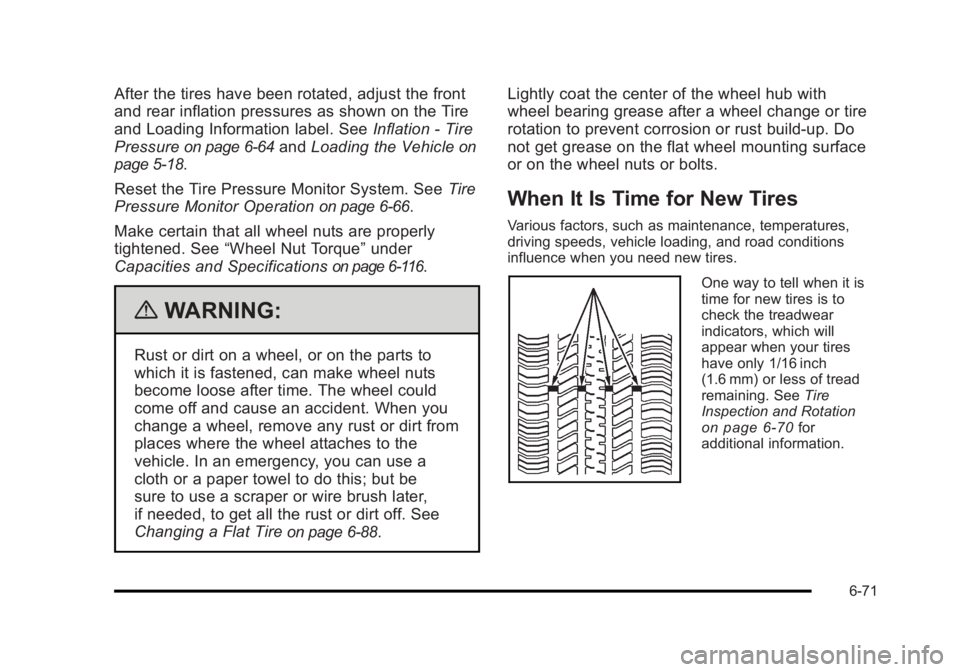
One way to tell when it is
time for new tires is to
check the treadwear
indicators, which will
appear when your tires
have only 1/16 inch
(1.6 mm) or less of tread
remaining. See
Tire
Inspection and Rotation
on page 6‑70for
additional information.
6-71
Page 386 of 450
Black plate (100,1)Buick Lucerne Owner Manual - 2011
To clean:1. Saturate a lint-free, clean white cloth with water or club soda.
2. Wring the cloth to remove excess moisture.
3. Start on the outside edge of the soil and gently rub toward the center. Continue cleaning, using a clean
area of the cloth each time it becomes soiled.
4. Continue to gently rub the soiled area until the cleaning cloth remains clean.
5. If the soil is not completely removed, use a mild soap solution and repeat the cleaning process that
was used with plain water.
If any of the soil remains, a commercial fabric cleaner
or spot lifter may be necessary. When a commercial
upholstery cleaner or spot lifter is to be used, test a
small hidden area for colorfastness first. If the locally
cleaned area gives any impression that a ring formation
may result, clean the entire surface.
After the cleaning process has been completed, a paper
towel can be used to blot excess moisture from the
fabric or carpet.Leather
Leather, and lighter colored leather in particular, will
need more frequent cleaning to prevent the buildup of
dust, dirt, and colors transferred from other items so
that these do not become permanent stains.
To remove dust, a soft cloth dampened with water can
be used. If a more thorough cleaning is necessary, a
soft cloth dampened with a mild soap solution can be
used. Your dealer has a GM approved leather cleaner
available that provides superior cleaning performance
when used regularly on finished automotive leathers.
Allow the leather to dry naturally. Do not use heat,
steam, spot lifters or spot removers, or shoe polish on
leather. Many commercial leather cleaners and coatings
that are sold to preserve and protect leather may
permanently change the appearance and feel of the
leather and are not recommended. Do not use silicone
or wax-based products, or those containing organic
solvents to clean the vehicle's interior because they
can alter the appearance by increasing the gloss in a
non-uniform manner.
6-100
Page 409 of 450
Black plate (5,1)Buick Lucerne Owner Manual - 2011
Once a Year
.Starter switch check. SeeOwner Checks and
Services on page 7‑6.
.Automatic transmission shiftlock control function
check. See Owner Checks and Serviceson
page 7‑6.
.Ignition transmission lock check. See Owner
Checks and Services on page 7‑6.
.Parking brake and automatic transmission P (Park)
mechanism check. See Owner Checks and
Services on page 7‑6.
.Accelerator pedal check for damage, high effort,
or binding. Replace if needed.
.If the vehicle has a Tire Sealant and Compressor
Kit, check the sealant expiration date printed on
the instruction label of the kit. See Tire Sealant and
Compressor Kit on page 6‑80.
.Underbody flushing service.
.Hood/Decklid/Liftgate/Liftglass Support Gas Strut
Service: Visually inspect gas strut, if equipped, for
signs of wear, cracks, or other damage. Check the
hold open ability of the gas strut. Contact your
dealer if service is required.
First Engine Oil Change After Every
40 000 km/25,000 Miles
.Passenger compartment air filter replacement
(or every 24 months, whichever occurs first).
More frequent replacement may be needed if
you drive in areas with heavy traffic, areas with
poor air quality, or areas with high dust levels.
Replacement may also be needed if you notice
reduced air flow, windows fogging up, or odors.
Your dealer can help you determine when it is the
right time to replace the filter.
First Engine Oil Change After Every
80 000 km/50,000 Miles
.Engine air cleaner filter replacement. See Engine
Air Cleaner/Filter on page 6‑23.
.Automatic transmission fluid change (severe
service) for vehicles mainly driven in heavy city
traffic in hot weather, in hilly or mountainous
terrain, when frequently towing a trailer, or used
for taxi, police, or delivery service. See Automatic
Transmission Fluid on page 6‑24.
.Evaporative control system inspection. Check
all fuel and vapor lines and hoses for proper
hook‐up, routing, and condition. Check that the
purge valve, if the vehicle has one, works properly.
7-5