service BUICK LUCERNE 2011 Manual Online
[x] Cancel search | Manufacturer: BUICK, Model Year: 2011, Model line: LUCERNE, Model: BUICK LUCERNE 2011Pages: 450, PDF Size: 3.63 MB
Page 354 of 450
Black plate (68,1)Buick Lucerne Owner Manual - 2011
TPMS Malfunction Light and Message
The TPMS will not function properly if one or more of
the TPMS sensors are missing or inoperable. When
the system detects a malfunction, the low tire pressure
warning light flashes for about one minute and then
stays on for the remainder of the ignition cycle. A DIC
warning message also displays. The malfunction light
and DIC warning message come on at each ignition
cycle until the problem is corrected. Some of the
conditions that can cause these to come on are:
.One of the road tires has been replaced with the
spare tire. The spare tire does not have a TPMS
sensor. The malfunction light and the DIC message
should go off after the road tire is replaced and
the sensor matching process is performed
successfully. See "TPMS Sensor Matching
Process" later in this section.
.The TPMS sensor matching process was not done
or not completed successfully after rotating the
tires. The malfunction light and the DIC message
should go off after successfully completing the
sensor matching process. See "TPMS Sensor
Matching Process" later in this section.
.One or more TPMS sensors are missing or
damaged. The malfunction light and the DIC
message should go off when the TPMS sensors
are installed and the sensor matching process is
performed successfully. See your dealer for
service.
.Replacement tires or wheels do not match the
original equipment tires or wheels. Tires and
wheels other than those recommended could
prevent the TPMS from functioning properly. See
Buying New Tires on page 6‑72.
.Operating electronic devices or being near facilities
using radio wave frequencies similar to the TPMS
could cause the TPMS sensors to malfunction.
If the TPMS is not functioning properly, it cannot detect
or signal a low tire condition. See your dealer for
service if the TPMS malfunction light and DIC message
comes on and stays on.
6-68
Page 355 of 450
Black plate (69,1)Buick Lucerne Owner Manual - 2011
TPMS Sensor Matching Process
Each TPMS sensor has a unique identification code.
The identification code needs to be matched to a new
tire/wheel position after rotating the vehicle’s tires or
replacing one or more of the TPMS sensors. Also, the
TPMS sensor matching process should be performed
after replacing a spare tire with a road tire containing
the TPMS sensor. The malfunction light and the DIC
message should go off at the next ignition cycle. The
sensors are matched to the tire/wheel positions, using a
TPMS relearn tool, in the following order: driver side
front tire, passenger side front tire, passenger side rear
tire, and driver side rear. See your dealer for service or
to purchase a relearn tool.
There are two minutes to match the first tire/wheel
position, and five minutes overall to match all four tire/
wheel positions. If it takes longer, the matching process
stops and must be restarted.
The TPMS sensor matching process is:1. Set the parking brake.
2. Turn the ignition to ON/RUN with the engine off.
3. Press the Remote Keyless Entry (RKE) transmitter's lock and unlock buttons at the same
time for approximately five seconds. The horn
sounds twice to signal the receiver is in relearn
mode and TIRE LEARNING ACTIVE message
displays on the DIC screen. 4. Start with the driver side front tire.
5. Place the relearn tool against the tire sidewall,
near the valve stem. Then press the button to
activate the TPMS sensor. A horn chirp confirms
that the sensor identification code has been
matched to this tire and wheel position.
6. Proceed to the passenger side front tire, and repeat the procedure in Step 5.
7. Proceed to the passenger side rear tire, and repeat the procedure in Step 5.
8. Proceed to the driver side rear tire, and repeat the procedure in Step 5. The horn sounds two times to
indicate the sensor identification code has been
matched to the driver side rear tire, and the TPMS
sensor matching process is no longer active. The
TIRE LEARNING ACTIVE message on the DIC
display screen goes off.
9. Turn the ignition to LOCK/OFF.
10. Set all four tires to the recommended air pressure level as indicated on the Tire and Loading
Information label.
6-69
Page 359 of 450
Black plate (73,1)Buick Lucerne Owner Manual - 2011
GM recommends replacing tires in sets of four.
This is because uniform tread depth on all tires
will help keep your vehicle performing most like
it did when the tires were new. Replacing less
than a full set of tires can affect the braking
and handling performance of your vehicle. See
Tire Inspection and Rotation
on page 6‑70for
information on proper tire rotation.
{WARNING:
Tires could explode during improper service.
Attempting to mount or dismount a tire could
cause injury or death. Only your dealer or
authorized tire service center should mount or
dismount the tires.
{WARNING:
Mixing tires could cause you to lose
control while driving. If you mix tires of
different sizes, brands, or types (radial and
bias-belted tires), the vehicle may not handle
properly, and you could have a crash. Using
tires of different sizes, brands, or types may
also cause damage to your vehicle. Be sure
to use the correct size, brand, and type of
tires on all wheels. It is all right to drive with
your compact spare temporarily, as it was
developed for use on your vehicle. See
Compact Spare Tire
on page 6‑97.
6-73
Page 361 of 450
Black plate (75,1)Buick Lucerne Owner Manual - 2011
SeeBuying New Tireson page 6‑72andAccessories
and Modificationson page 6‑3for additional
information.
Uniform Tire Quality Grading
Quality grades can be found where applicable
on the tire sidewall between tread shoulder and
maximum section width. For example:
Treadwear 200 Traction AA
Temperature A
The following information relates to the system
developed by the United States National
Highway Traffic Safety Administration (NHTSA),
which grades tires by treadwear, traction, and
temperature performance. This applies only to
vehicles sold in the United States. The grades are
molded on the sidewalls of most passenger car
tires. The Uniform Tire Quality Grading (UTQG)
system does not apply to deep tread, winter-type
snow tires, space-saver, or temporary use
spare tires, tires with nominal rim diameters
of 10 to 12 inches (25 to 30 cm), or to some
limited-production tires. While the tires available on General Motors
passenger cars and light trucks may vary with
respect to these grades, they must also conform
to federal safety requirements and additional
General Motors Tire Performance Criteria (TPC)
standards.
All Passenger Car Tires Must Conform to Federal
Safety Requirements In Addition To These
Grades.
Treadwear
The treadwear grade is a comparative rating
based on the wear rate of the tire when tested
under controlled conditions on a specified
government test course. For example, a tire
graded 150 would wear one and a half (1½) times
as well on the government course as a tire
graded 100. The relative performance of tires
depends upon the actual conditions of their use,
however, and may depart significantly from the
norm due to variations in driving habits, service
practices and differences in road characteristics
and climate.
6-75
Page 365 of 450
Black plate (79,1)Buick Lucerne Owner Manual - 2011
A rear blowout, particularly on a curve, acts much like
a skid and may require the same correction you would
use in a skid. In any rear blowout remove your foot from
the accelerator pedal. Get the vehicle under control by
steering the way you want the vehicle to go. It may be
very bumpy and noisy, but you can still steer. Gently
brake to a stop, well off the road, if possible.
{WARNING:
Driving on a flat tire will cause permanent damage
to the tire. Re-inflating a tire after it has been
driven on while severely underinflated or flat may
cause a blowout and a serious crash. Never
attempt to re-inflate a tire that has been driven on
while severely underinflated or flat. Have your
dealer or an authorized tire service center repair
or replace the flat tire as soon as possible.
{WARNING:
Lifting a vehicle and getting under it to do
maintenance or repairs is dangerous without the
appropriate safety equipment and training. If a
jack is provided with the vehicle, it is designed
only for changing a flat tire. If it is used for
anything else, you or others could be badly
injured or killed if the vehicle slips off the jack.
If a jack is provided with the vehicle, only use it for
changing a flat tire.
This vehicle may come with a jack and spare tire or a
tire sealant and compressor kit. To use the jack and
spare tire, see Changing a Flat Tire
on page 6‑88.
To use the tire sealant and compressor kit, see Tire
Sealant and Compressor Kit
on page 6‑80.
6-79
Page 392 of 450
Black plate (106,1)Buick Lucerne Owner Manual - 2011
Chemical Paint Spotting
Some weather and atmospheric conditions can create a
chemical fallout. Airborne pollutants can fall upon and
attack painted surfaces on the vehicle. This damage
can take two forms: blotchy, ring-shaped discolorations,
and small, irregular dark spots etched into the paint
surface.
Although no defect in the paint job causes this, we will
repair, at no charge to the owner, the surfaces of new
vehicles damaged by this fallout condition within
12 months or 20 000 km (12,000 mi) of purchase,
whichever occurs first.
Vehicle Identification
Vehicle Identification Number (VIN)
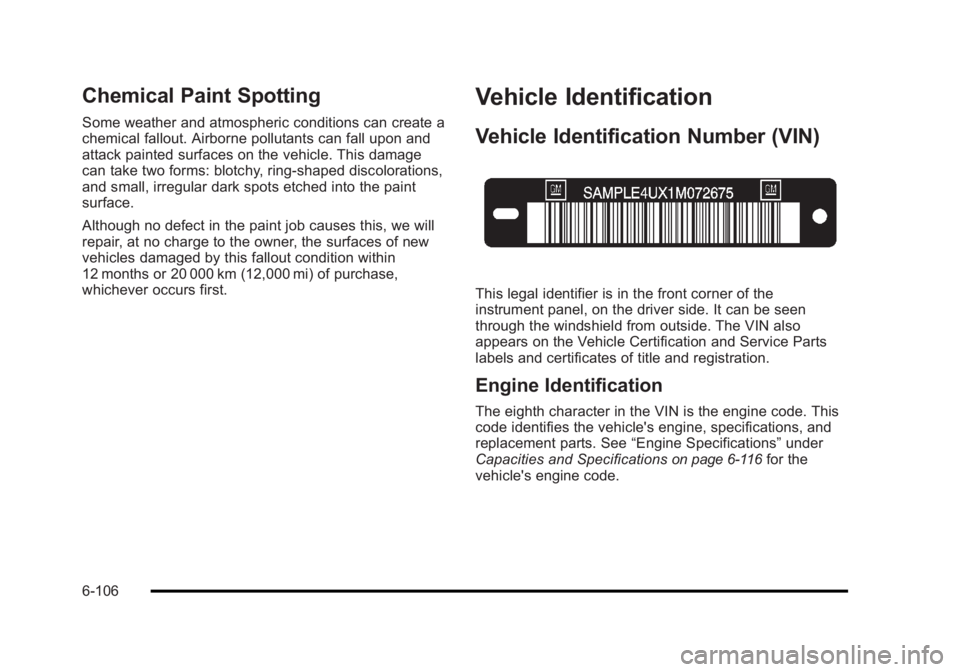
This legal identifier is in the front corner of the
instrument panel, on the driver side. It can be seen
through the windshield from outside. The VIN also
appears on the Vehicle Certification and Service Parts
labels and certificates of title and registration.
Engine Identification
The eighth character in the VIN is the engine code. This
code identifies the vehicle's engine, specifications, and
replacement parts. See“Engine Specifications”under
Capacities and Specifications
on page 6‑116for the
vehicle's engine code.
6-106
Page 393 of 450
Black plate (107,1)Buick Lucerne Owner Manual - 2011
Service Parts Identification Label
This label, on the spare tire cover, has the following
information:
.Vehicle Identification Number (VIN).
.Model designation.
.Paint information.
.Production options and special equipment.
Do not remove this label from the vehicle.
Electrical System
Add-On Electrical Equipment
Notice: Do not add anything electrical to the vehicle
unless you check with your dealer first. Some
electrical equipment can damage the vehicle and
the damage would not be covered by the vehicle's
warranty. Some add-on electrical equipment can
keep other components from working as they
should. Add-on equipment can drain the vehicle battery, even if
the vehicle is not operating.
The vehicle has an airbag system. Before attempting to
add anything electrical to the vehicle, see
Servicing
Your Airbag-Equipped Vehicle
on page 2‑68and
Adding Equipment to Your Airbag-Equipped Vehicleon
page 2‑69.
Power Windows and Other Power
Options
Circuit breakers in the rear fuse block protect the power
windows and other power accessories. When the
current load is too heavy, the circuit breaker opens and
closes, protecting the circuit until the problem is fixed or
goes away.
6-107
Page 394 of 450
Black plate (108,1)Buick Lucerne Owner Manual - 2011
Fuses and Circuit Breakers
The wiring circuits in your vehicle are protected from
short circuits by a combination of fuses and circuit
breakers. This greatly reduces the chance of fires
caused by electrical problems.
Look at the silver-colored band inside the fuse. If the
band is broken or melted, replace the fuse. Be sure you
replace a bad fuse with a new one of the identical size
and rating.
You will find a fuse puller clipped in both of the fuse
blocks. Snap the wide end of the fuse puller at the side
indentations and pull the fuse out.The MaxiFuses are located in two fuse blocks, one
located in the engine compartment on the passenger's
side and the other under the rear seat on the driver's
side. If a MaxiFuse should blow, have your vehicle
serviced by your dealer immediately.
Underhood Fuse Block
The underhood fuse block is located on the passenger
side of the engine compartment. Remove the fuse cover
and secondary service cover to access the fuse block.
Notice:
Spilling liquid on any electrical component
on the vehicle may damage it. Always keep the
covers on any electrical component.
6-108
Page 405 of 450
Black plate (1,1)Buick Lucerne Owner Manual - 2011
Section 7 Maintenance Schedule
Maintenance Schedule. . . . . . . . . . . . . . . . . . . . . . . . . . . . 7-2
Introduction . . . . . . . . . . . . . . . . . . . . . . . . . . . . . . . . . . . . . 7-2
Scheduled Maintenance . . . . . . . . . . . . . . . . . . . . . . . . 7-3
Owner Checks and Services . . . . . . . . . . . . . . . . . . . . 7-6 Recommended Fluids and Lubricants . . . . . . . . . . . 7-8
Maintenance Replacement Parts . . . . . . . . . . . . . . 7-10
Engine Drive Belt Routing . . . . . . . . . . . . . . . . . . . . . . 7-11
Maintenance Record . . . . . . . . . . . . . . . . . . . . . . . . . . . 7-12
7-1
Page 406 of 450
Black plate (2,1)Buick Lucerne Owner Manual - 2011
Maintenance Schedule
Introduction
Notice:Maintenance intervals, checks, inspections,
recommended fluids, and lubricants are necessary
to keep this vehicle in good working condition.
Damage caused by failure to follow scheduled
maintenance might not be covered by the vehicle
warranty.
As the vehicle owner, you are responsible for the
scheduled maintenance in this section. We recommend
having your dealer perform these services. Proper
vehicle maintenance helps to keep the vehicle in good
working condition, improves fuel economy, and reduces
vehicle emissions for better air quality.
Because of all the different ways people use vehicles,
maintenance needs vary. The vehicle might need
more frequent checks and services. Please read the
information under Scheduled Maintenance. To keep the
vehicle in good condition, see your dealer.
The maintenance schedule is for vehicles that:
.carry passengers and cargo within recommended
limits on the Tire and Loading Information label.
See Loading the Vehicle on page 5‑18.
.are driven on reasonable road surfaces within legal
driving limits.
.use the recommended fuel. See Gasoline Octaneon page 6‑6.
{WARNING:
Performing maintenance work on a vehicle can be
dangerous. In trying to do some jobs, you can be
seriously injured. Do your own maintenance work
only if you have the required know-how and the
proper tools and equipment for the job. If you
have any doubt, see your dealer to have a
qualified technician do the work. See Doing Your
Own Service Work on page 6‑4.
At your dealer, you can be certain that you will receive
the highest level of service available. Your dealer has
specially trained service technicians, uses genuine
replacement parts, as well as, up‐to‐date tools and
equipment to ensure fast and accurate diagnostics.
The proper replacement parts, fluids, and lubricants to
use are listed in Recommended Fluids and Lubricants
on page 7‑8andMaintenance Replacement Partson
page 7‑10. We recommend the use of genuine parts
from your dealer.
7-2