check oil BUICK PARK AVENUE 1993 User Guide
[x] Cancel search | Manufacturer: BUICK, Model Year: 1993, Model line: PARK AVENUE, Model: BUICK PARK AVENUE 1993Pages: 340, PDF Size: 18.17 MB
Page 257 of 340
What to Do with Used Oil:
A CAUTION:
Used engine oil contains things that have cause
skin cancer in laboratory animals. Don't let used
oil stay on your skin for very long. Clean your
skin and nails with soap and water, or a good
hand cleaner. Wash or properly throw away
clothing or rags containing used engine
0"
Used oil can be a real threat to the environment. Don't
ever dispose of
it by pouring it on the ground, into
sewers,
or into streams or bodies of water. Instead,
recycle
it by taking it to a place that collects used oil. If
you have a problem properly disposing of your used oil,
ask your dealer, a service station or a local recycling
center for help.
I
Air Cleaner
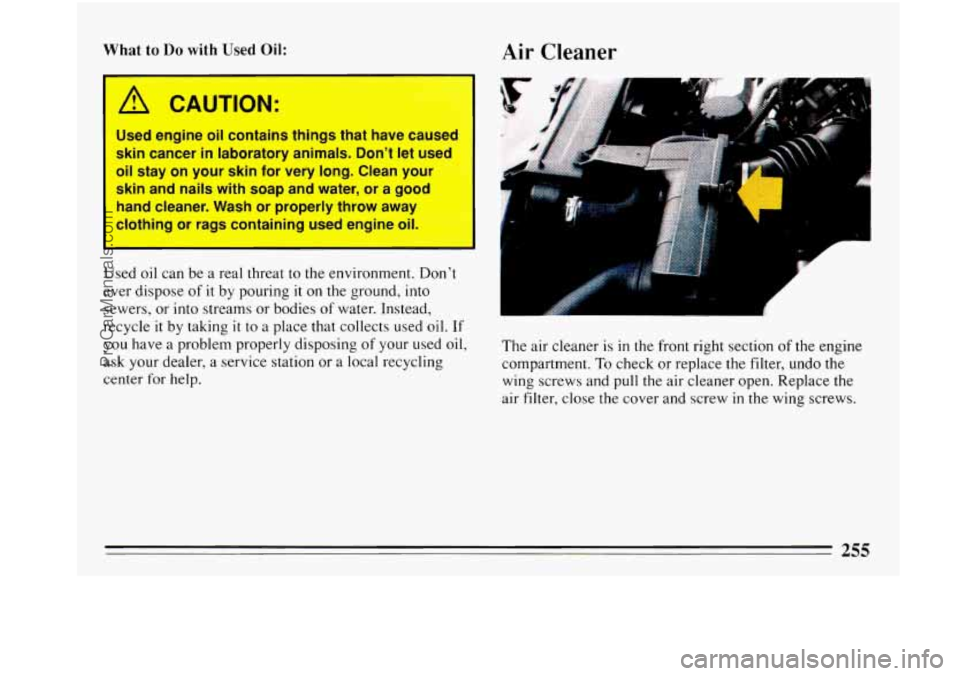
The air cleaner is in the front right section of the engine
compartment. To check or replace the filter, undo the
wing screws and pull the air cleaner open. Replace the
air filter, close the cover and screw
in the wing screws.
ProCarManuals.com
Page 258 of 340
Refer to the Maintenance Schedule to determine when
to replace the air filter.
See “Scheduled Maintenance Services’’ in the Index.
A CAUTION:
Operating the engine with the air cleaner off can
cause you or others to be burned. The air cleaner
not only cleans the air, it stops flame
if the
engine backfires.
If it isn’t there, and the engine
backfires, you could be burned. Don’t drive with
it off, and be careful working on the engine with
the air cleaner off.
: NOTICE:
I If the air clean
i damaging engine fire. And, dirt can easily get
into your engine, which will damage
it. Always
’ have the air cleaner in place when you’re driving.
Automatic Transaxle Fluid
When to Check and Change:
A good time to check your automatic transaxle fluid
level is when the engine oil is changed. Refer to the
Maintenance Schedule to determine when to change
your fluid. See “Scheduled Maintenance Services” in
the Index.
How to Check:
Because this operation can be a little difficult, you may
choose to have this done at a Buick dealership Service Department.
If
you do it yourself, be sure to follow all the
instructions here, or
you could get a false reading on the
dipstick.
transaxle. Too much can mean that some of the
fluid could come out and fall on hot engine parts,
starting a fire. Be sure to get an
a
if you check your transaxle fluid.
ProCarManuals.com
Page 260 of 340
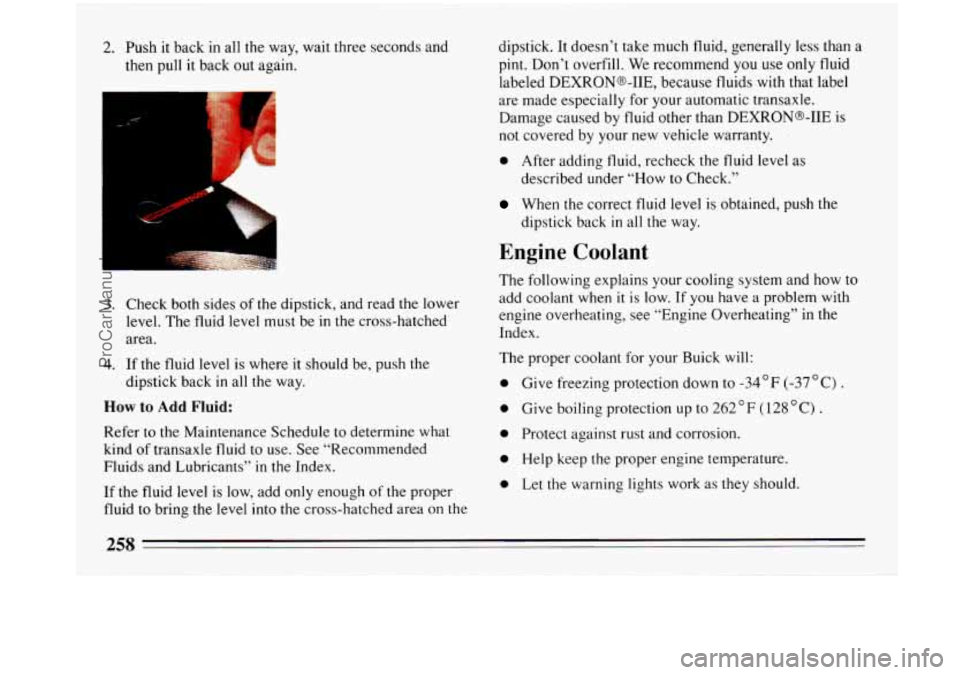
2. Push it back in all the way, wait three seconds and
then pull it back out again.
3. Check both sides of the dipstick, and read the lower
level. The fluid level must be in the cross-hatched
area.
4. If the fluid level is where it should be, push the
dipstick back
in all the way.
How to Add Fluid:
Refer to the Maintenance Schedule to determine what
kind of transaxle fluid to use. See “Recommended
Fluids and Lubricants” in the Index.
If the fluid level is low, add only enough of the proper
fluid to bring the level
into the cross-hatched area on the dipstick, It
doesn’t take much fluid, generally less than a
pint. Don’t overfill. We recommend
you use only fluid
labeled DEXRONWIE, because
fluids with that label
are made especially for your automatic transaxle.
Damage caused by fluid other than DEXRONB-IIE is
not covered by your new vehicle warranty.
0 After adding fluid, recheck the fluid level as
described under “How to Check.”
When the correct fluid level is obtained, push the
dipstick back
in all the way.
Engine Coolant
The following explains your cooling system and how to
add coolant when
it is low. If you have a problem with
engine overheating, see “Engine Overheating” in the
Index.
The proper coolant for your Buick will:
0 Give freezing protection down to -34°F (-37 “C) .
0 Give boiling protection up to 262 F ( 128 ” C) .
0 Protect against rust and corrosion.
0 Help keep the proper engine temperature.
0 Let the warning lights work as they should.
ProCarManuals.com
Page 296 of 340
Introduction
IMPORTANT:.
KEEP ENGINE OIL
AT THE PROPER
LEVEL AND CHANGE AS RECOMMENDED
I I Protection I
Plan
Have you purchased the GM Protection Plan? The
Plan supplements your
new vehicle warranties. See
your Buick dealer for details.
A Word About Maintenance
We at General Motors want to help you keep your
vehicle
in good working condition. But we don’t know
exactly how you’ll drive it. You may drive very short
distances only a few times a week. Or you may drive
long distances all the time
in very hot, dusty weather.
You may use your vehicle in making deliveries. Or you
may drive it to work, to do errands or in many other
ways.
Because
of all the different ways people use their GM
vehicles, maintenance needs vary. You may
even need
more frequent checks and replacements than
you will
find
in the schedules in this part. So please read this part
and
note how you drive. If you have any questions on
how to keep your vehicle in good condition, see your
Buick dealer, the place many GM owners choose
to
have their maintenance work done. Your dealer can be
relied upon to use proper parts and practices.
ProCarManuals.com
Page 301 of 340
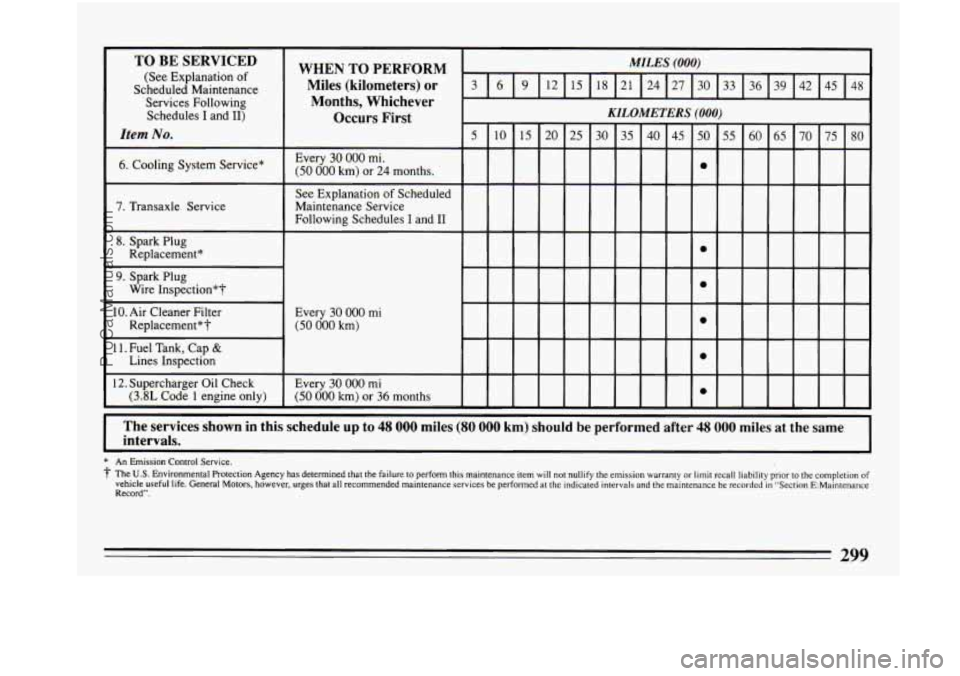
TO BE SERVICED
(See Explanation of
Scheduled Maintenance
Services Following
Schedules I and
11)
WHEN TO PERFORM
Miles (kilometers) or
Months, Whichever
Occurs First
Ztem No.
Every 30 000 mi. 6' '''ling System Service* (50 000 km) or 24 months.
I
7. Transaxle Service See Explanation
of Scheduled
Maintenance Service Following Schedules
I and I1
I
8* Spark
Replacement*
9. Spark Plug
I Wire Inspection*?
Replacement"?
1 1. Fuel Tank, Cap &
Lines Inspection Every
30 000 mi
(50 000 km) 25
30 35 40 45 50 55 60 65 70 75
a
a
a
a
a
a
The services
shown in this schedule up to 48 000 miles (80 000 km) should be performed after 48 000 miles at the same
intervals.
* An Emission Control Service.
f The U.S. Environmental Protection Agency has determined that the failure to perform this maintenance item will not nullify the emission warranty or limit recall liability prior to the completion of
Record". vehicle
useful life. General Motors, however, urges that all recommended maintenance services be performed at the indicated intervals and the maintenance be recorded in "Section E:Maintenance
12. Supercharger Oil Check Every 30 000 mi
(3.8L Code 1 engine only) (50 000 km) or 36 months
MILES (000) ..
6 9 12 15 18
KILOMETERS (000)
ProCarManuals.com
Page 303 of 340
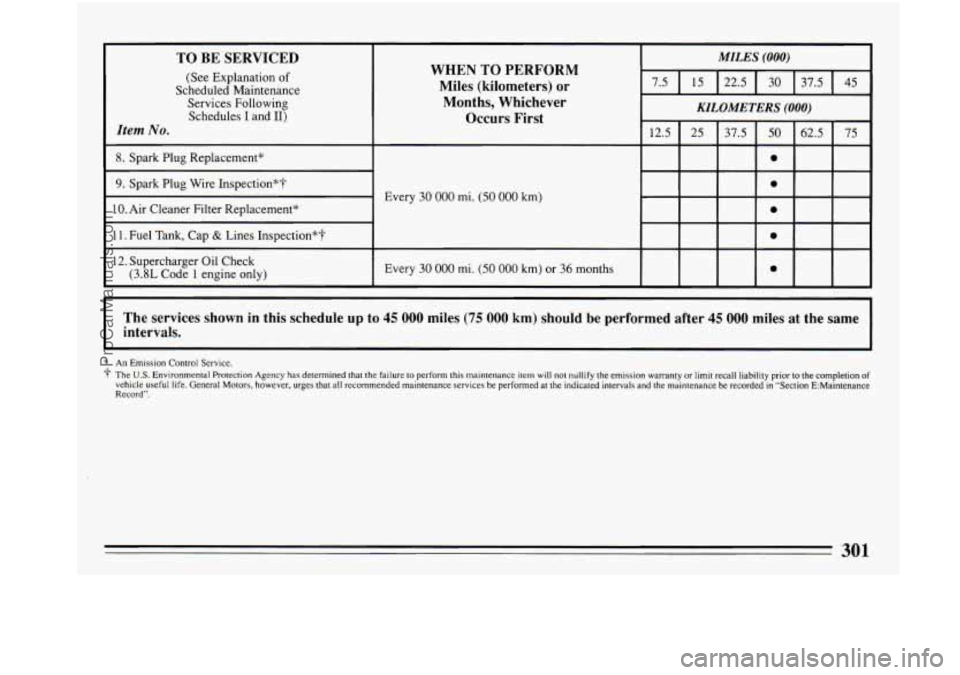
TO BE SERVICED
(See Explanation of
Scheduled Maintenance Services Following Schedules
I and 11)
Item No.
8. Spark Plug Replacement*
9. Spark Plug Wire Inspection”?
10. Air Cleaner Filter Replacement*
1 1. Fuel Tank, Cap & Lines Inspection*?
12. Supercharger Oil Check I
(3.8L Code 1 engine only)
WHEN TO PERFORM
Miles (kilometers) or
Months, Whichever
Occurs First
Every 30 000 mi. (50 000 km)
I MILES (000)
The services shown in this schedule up to 45 000 miles (75 000 km) should be performed after 45 000 miles at the Same
intervals. I
ProCarManuals.com
Page 304 of 340
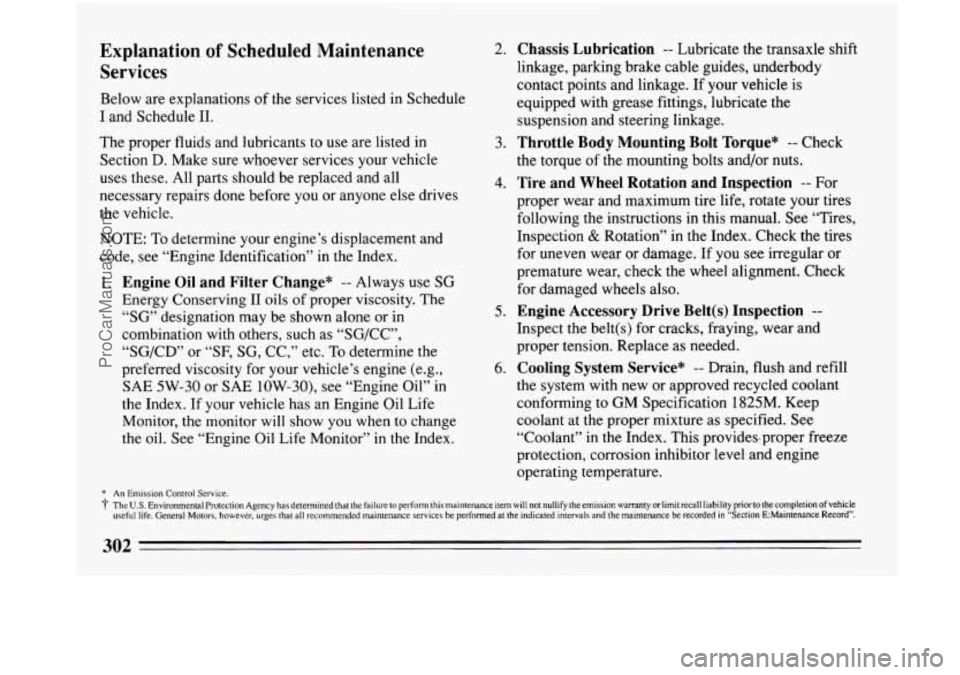
Explanation of Scheduled Maintenance
Services
Below are explanations of the services listed in Schedule
I and Schedule
11.
The proper fluids and lubricants to use are listed in
Section
D. Make sure whoever services your vehicle
uses these. All parts should be replaced and all
necessary repairs done before you or anyone else drives
the vehicle.
NOTE: To determine your engine’s displacement and
code, see “Engine Identification” in the Index.
1. Engine Oil and Filter Change* -- Always use SG
Energy Conserving I1 oils of proper viscosity. The
“SG” designation may be shown alone or in
combination with others, such as “SG/CC”,
“SG/CD” or
“SF, SG, CC,” etc. To determine the
preferred viscosity for your vehicle’s engine (e.g.,
SAE
5W-30 or SAE 10W-30), see “Engine Oil” in
the Index. If your vehicle has an Engine
Oil Life
Monitor,
the monitor will show you when to change
the oil. See “Engine Oil Life Monitor” in the Index.
* An Emission Control Service.
2.
3.
4.
5.
6.
Chassis Lubrication -- Lubricate the transaxle shift
linkage, parking brake cable guides, underbody
contact points and linkage. If your vehicle is
equipped with grease fittings, lubricate the
suspension and steering linkage.
Throttle Body Mounting Bolt Torque” -- Check
the torque
of the mounting bolts and/or nuts.
Tire and Wheel Rotation and Inspection -- For
proper wear and maximum tire life, rotate your tires
following the instructions in this manual. See “Tires,
Inspection
& Rotation” in the Index. Check the tires
for uneven wear or damage. If you see irregular or
premature wear, check the wheel alignment. Check
for damaged wheels also.
Engine Accessory Drive Belt(s) Inspection --
Inspect the belt(s) for cracks, fraying, wear and
proper tension. Replace as needed.
Cooling System Service* -- Drain, flush and refill
the system with new or approved recycled coolant
conforming to GM Specification
1825M. Keep
coolant at the proper mixture
as specified. See
“Coolant” in the Index. This provides.proper freeze
protection, corrosion inhibitor level and engine
operating temperature.
The U.S. Environmental Protection Agency has determined that the failure to perform this maintenance item will not nullify the emission warranty or limit recall liability prior to the completion of vehicle
useful life. General Motors, however, urges that all recommended maintenance services be performed at the indicated intervals and the maintenance be recorded in “Section E:Maintenance Record”.
302
ProCarManuals.com
Page 305 of 340
Inspect hoses and replace if they are cracked,
swollen or deteriorated. Tighten screw-type hose
clamps. Clean the outside of the radiator and air
conditioning condenser. Wash the pressure cap and
neck.
To help ensure proper operation, we recommend a
pressure test of both the cooling system and the
pressure cap.
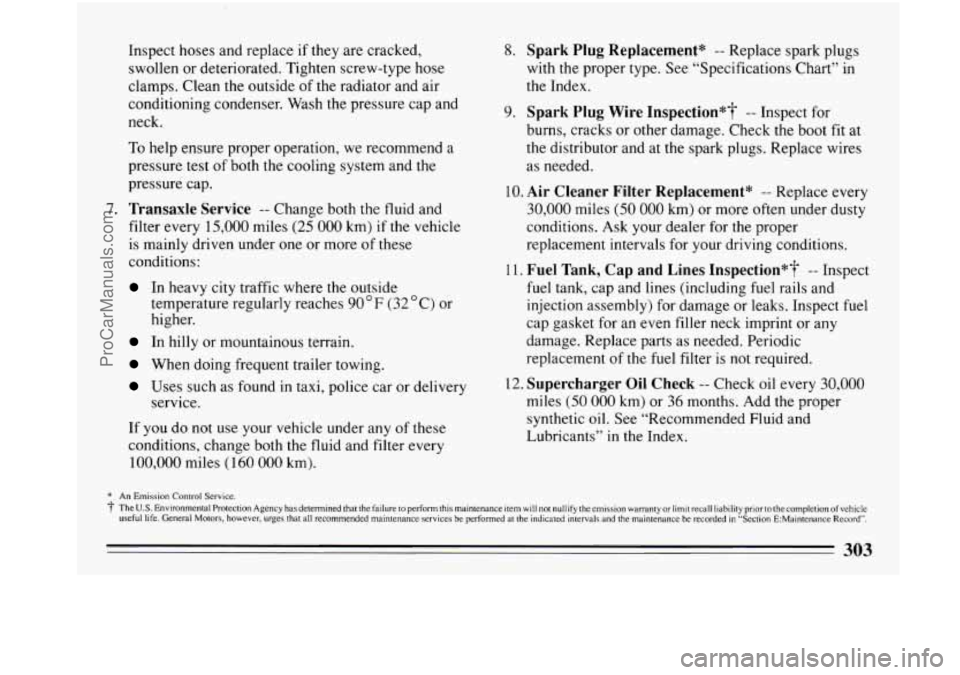
7. Transaxle Service -- Change both the fluid and
filter every 15,000 miles (25
000 km) if the vehicle
is mainly driven under
one or more of these
conditions:
In heavy city traffic where the outside
temperature regularly reaches
90 OF (32 “C) or
higher.
In hilly or mountainous terrain.
When doing frequent trailer towing.
Uses such as found in taxi, police car or delivery
If you do
not use your vehicle under any of these
conditions, change both the fluid and filter every
100,000 miles
( 160 000 km).
service.
8. Spark
Plug Replacement* -- Replace spark plugs
with the proper type. See “Specifications Chart” in
the Index.
9. Spark Plug Wire Inspection*? -- Inspect for
burns, cracks or other damage. Check the boot fit at
the distributor and at the spark plugs. Replace wires
as needed.
10.
Air Cleaner Filter Replacement* -- Replace every
30,000 miles (50 000 km) or more often under dusty
conditions. Ask your dealer for the proper
replacement intervals for your driving conditions.
11.
Fuel Tank, Cap and Lines Inspection*? -- Inspect
fuel tank, cap and lines (including
fuel rails and
injection assembly) for damage or leaks. Inspect fuel
cap gasket for an even filler neck imprint or any
damage. Replace parts as needed. Periodic
replacement of the fuel filter
is not required.
12.
Supercharger Oil Check -- Check oil every 30,000
miles (50 000 km) or 36 months. Add the proper
synthetic
oil. S.ee “Recommended Fluid and
Lubricants’’ in the Index.
* An Emission Control Service.
? The U.S. Environmental Protection Agency has determined that the failure to perform this maintenance item will not nullify the emission warranty or limit recall liability prior to the completion of vehicle
useful life. General Motors, however, urges that all recommended maintenance services be performed at the indicated intervals and the maintenance be recorded in ‘‘Section E:Maintenance Record’‘.
303
ProCarManuals.com
Page 306 of 340
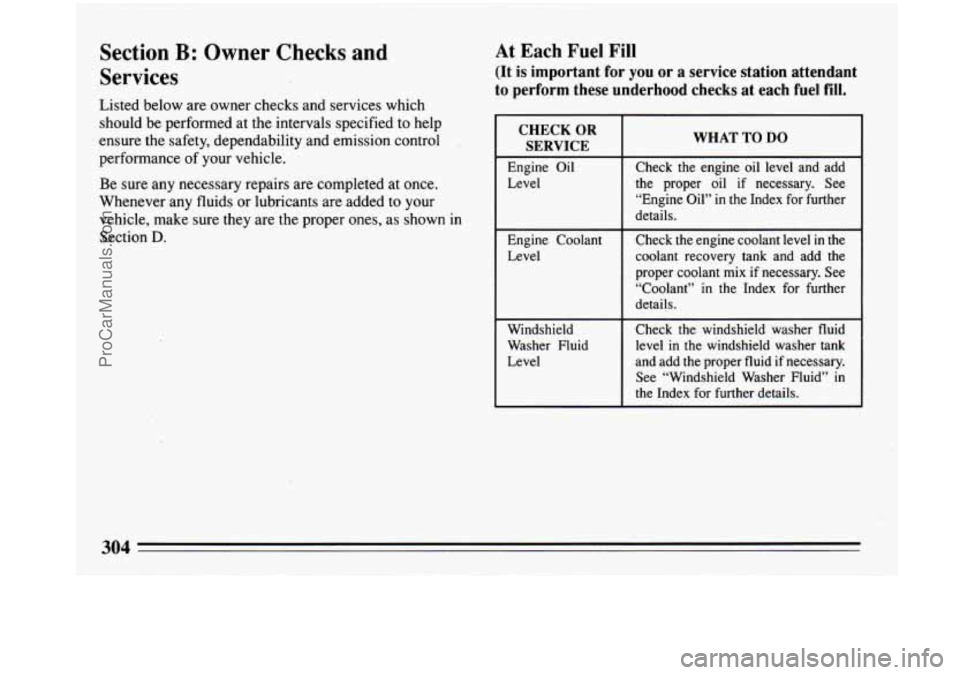
Section B: Owner Checks and
Services
Listed below are owner checks and services which
should be performed
at the intervals specified to help
ensure the safety, dependability and emission control
.
performance of your vehicle.
Be sure any necessary repairs are completed at once.
Whenever any fluids or lubricants are added to your
vehicle, make sure they are the proper ones, as shown
in
Section D.
At Each Fuel Fill
(It is important for you or a service station attendant
to perform these underhood checks at each fuel
fill.
CHECK OR
SERVICE
Engine Oil
Level
Engine Coolant
Level
Windshield
Washer Fluid Level
WHAT TO DO
Check the engine oil level and add
the proper oil if necessary. See
“Engine Oil”
in the Index for further
details.
Check the engine coolant level
in the
coolant recovery tank and add the
proper coolant mix
if necessary. See
“Coolant” in the Index
for further
details.
Check the windshield washer fluid
level in the windshield washer tank
and add the proper fluid
if necessary.
See “Windshield Washer Fluid” in
the Index for further details.
304
ProCarManuals.com
Page 311 of 340
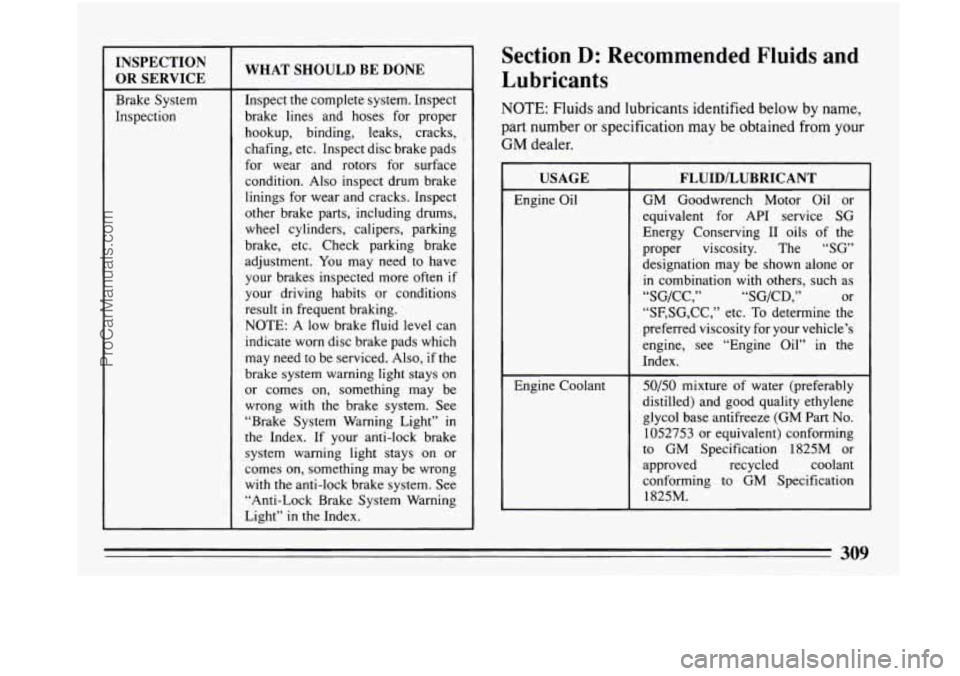
INSPECTION
OR SERVICE
Brake System
Inspection
WHAT SHOULD BE DONE
Inspect the complete system. Inspect
brake lines and hoses for proper
hookup, binding, leaks, cracks, chafing, etc. Inspect disc brake pads
for wear and rotors for surface
condition. Also inspect drum brake
linings for wear and cracks. Inspect
other brake parts, including drums,
wheel cylinders, calipers, parking
brake, etc. Check parking brake
adjustment.
You may need to have
your brakes inspected more often
if
your driving habits or conditions
result
in frequent braking.
NOTE: A low brake fluid level can
indicate worn disc brake pads which
may need
to be serviced. Also, if the
brake system warning light stays on
or comes
on, something may be
wrong with
the brake system. See
“Brake System Warning Light”
in
the Index. If your anti-lock brake
system warning light stays on or
comes on, something may be wrong
with
the anti-lock brake system. See
“Anti-Lock Brake System Warning
Light”
in the Index.
Section D: Recommended Fluids and
Lubricants
NOTE: Fluids and lubricants identified below by name,
part number or specification may be obtained from your
GM dealer.
USAGE
Engine Oil
Engine Coolant
FLUID/LUBRICANT
GM Goodwrench Motor Oil or
equivalent for API service SG
Energy Conserving I1 oils of the
proper viscosity. The
“SG”
designation may be shown alone or
in combination with others, such as
“SG/CC,” “SG/CD,”
or
“SF,SG,CC,” etc. To determine the
preferred viscosity for your vehicle’s
engine, see “Engine Oil” in the
Index.
50/50 mixture of water (preferably
distilled) and good quality ethylene
glycol base antifreeze (GM
Part No.
1052753 or equivalent) conforming
to GM Specification 1825M or
approved recycled coolant
conforming to GM Specification
1825M.
ProCarManuals.com