brake BUICK PARK AVENUE 1993 Service Manual
[x] Cancel search | Manufacturer: BUICK, Model Year: 1993, Model line: PARK AVENUE, Model: BUICK PARK AVENUE 1993Pages: 340, PDF Size: 18.17 MB
Page 215 of 340
I
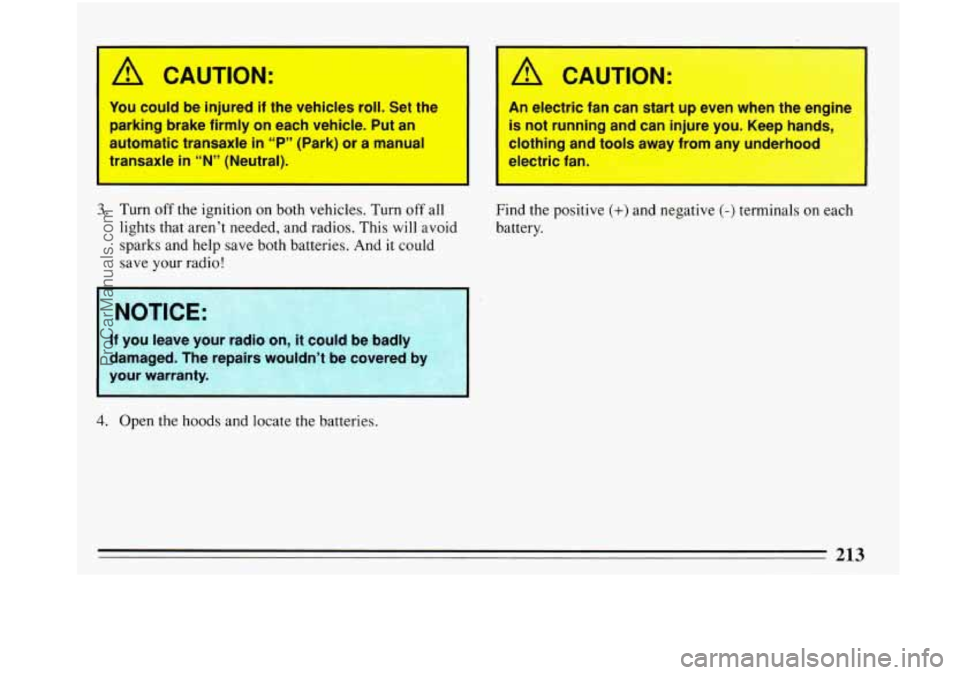
A CAUTION:
You could be injured if the vehicles roll. Set the
parking brake firmly on each vehicle. Put an
automatic transaxle
in “P” (Park) or a manual
transaxle
in “N” (Neutral).
3. Turn off the ignition on both vehicles. Turn off all
lights that aren’t needed, and radios. This will avoid
sparks and help save both batteries. And it could
save your radio!
A CAUTION:
An electric fan can start up even when the engine
is not running and can injure you. Keep hands,
clothing anA
tools away from any underhood
electric fan
1 NOTICE:
3
If you leave your ram0 or ’t could be baaly
damaged. The repairs wouldn’t be covered b)
your warranty.
Find the positive (+) and negative (-) terminals on eact
battery.
4. Open the hoods and locate the batteries.
213
ProCarManuals.com
Page 220 of 340
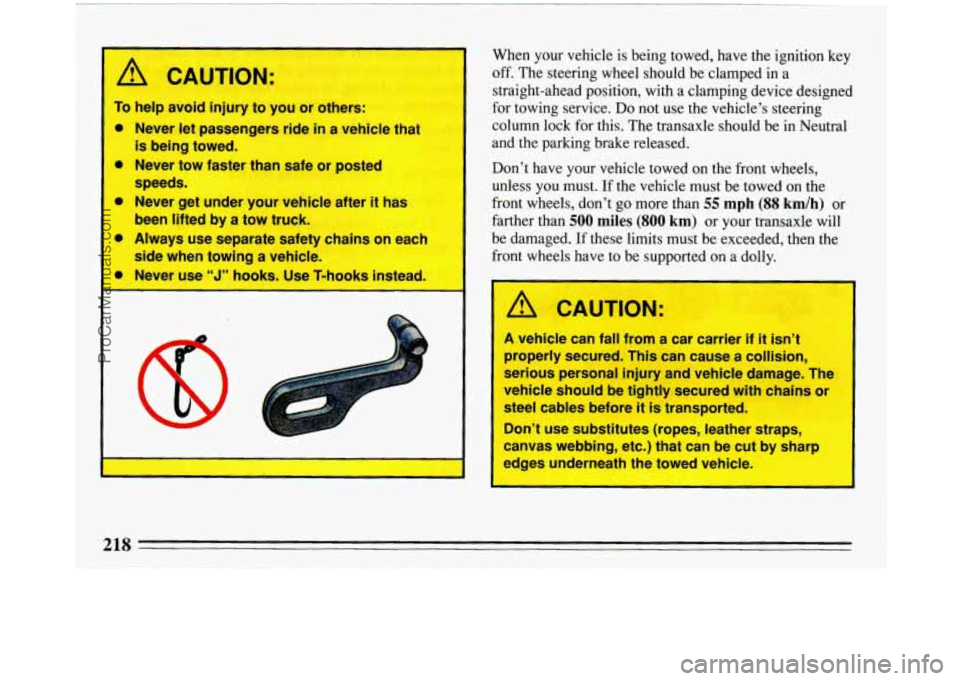
r /r CAUTION:
To help avoid injury to you or others:
0 Never let passengers ride in a vehicle that
0 Never tow faster than safe or posted
0 Never get under your vehicle after it has
0 Always use separate safety chains on each
is being towed.
speeds.
been lifted by
a tow truck.
side when ?owing
a vehicle.
V
t
When your vehicle is being towed, have the ignition key
off. The steering wheel should be clamped in a
straight-ahead position, with a clamping device designed
for towing service.
Do not use the vehicle’s steering
column lock for this. The transaxle should be in Neutral
and the parking brake released.
Don’t have
your vehicle towed on the front wheels,
unless you must.
If the vehicle must be towed on the
front wheels, don’t go more than
55 mph (88 kdh) or
farther than
500 miles (SO0 km) or your transaxle will
be damaged. If these limits must be exceeded, then the
front wheels have to be supported on a dolly.
A CAUTION:
A vehicle can fall from a car carrier if it isn’t
properly secured. This can cause a collision,
serious personal injury and vehicle damage. The
vehicle should be tightly secured with chains or
steel cables before it is transported.
Don’t use substitutes (ropes, leather straps,
canvas webbing, etc.) that can be cut by sharp
edges underneath the towed vehicle.
218
ProCarManuals.com
Page 230 of 340
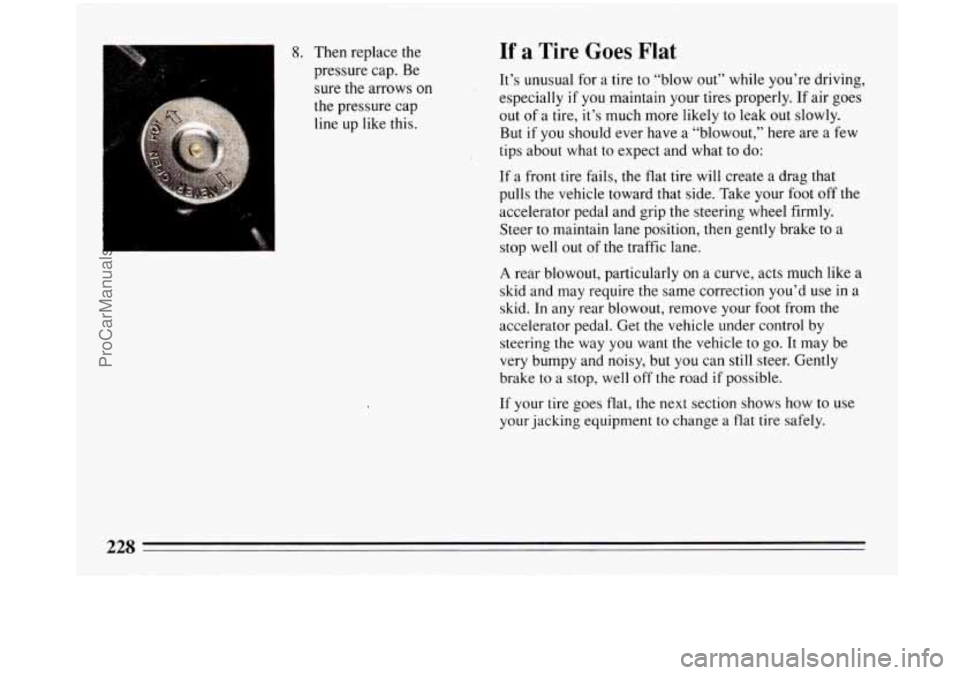
8. Then replace the
pressure cap. Be
sure the arrows
on
the pressure cap
line up like this.
If a Tire Goes Flat
It’s unusual for a tire to “blow out” while you’re driving,
especially
if you maintain your tires properly. If air goes
out of a tire, it’s much more likely to leak out slowly.
But if you should ever have
a “blowout,” here are a few
tips about what to expect and what
to do:
If a front .tire fails, the flat tire will create a drag that
pulls the vehicle toward that side. Take your foot
off the
accelerator pedal and grip the steering wheel firmly.
Steer to maintain lane position, then gently brake to a
stop well out
of the traffic lane.
A rear blowout, particularly on a curve, acts much like a
skid and may require the same correction you’d use in
a
skid. In any rear blowout, remove your foot from the
accelerator pedal. Get the vehicle under control by
steering the way you want the vehicle to
go. It may be
very bumpy and noisy, but you can still steer. Gently
brake to
a stop, well off the road if possible.
If your tire goes flat, the next section shows how to use
your jacking equipment
to change a flat tire safely.
ProCarManuals.com
Page 231 of 340
Changing a Flat Tire
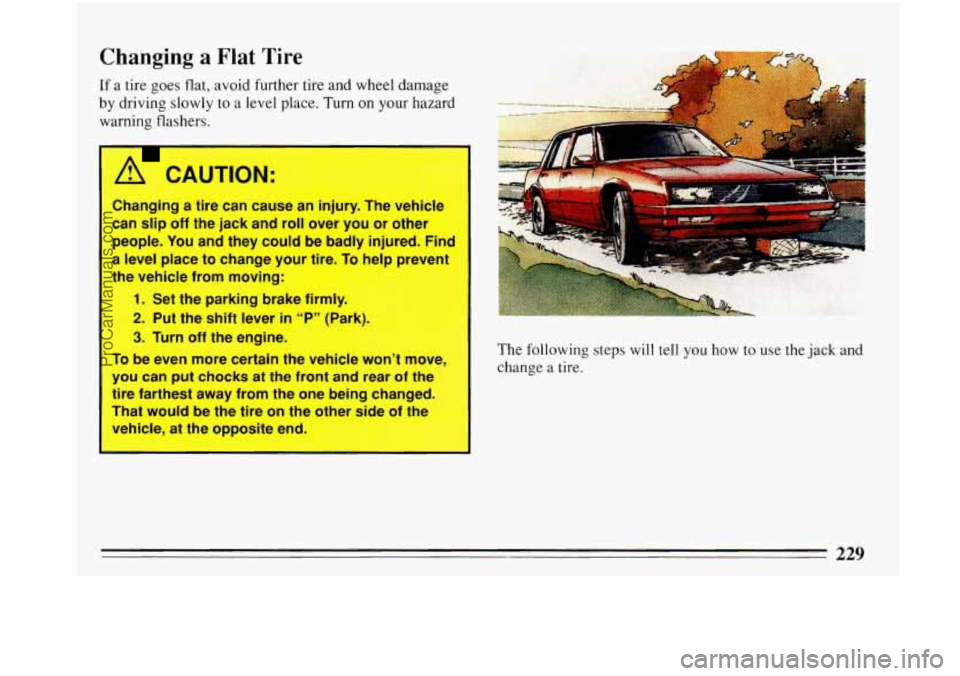
If a tire goes flat, avoid further tire and wheel damage
by driving slowly to a level place. Turn on your hazard
warning flashers.
A CAUTION:
Changing a tire can cause an injury. The vehicle
can
slip off the jack and roll over you or other
people. You and they could be badly injured. Find
a level place to change your tire. To help prevent
the vehicle from moving:
1. Set the parking brake firmly.
2. Put the shift lever in “P” (Park).
3. Turn off the engine.
I To be even more certain the vehicle won’t move,
you can
put chocks at the front and rear of the
tire farthest away from the one being changed.
That would be the tire on the other side of the
vehicle, a’ *?e opposite end.
- 2. I.
The following steps will tell you how to use the jack and
change a tire.
ProCarManuals.com
Page 239 of 340

Don’t try to put a wheel cover on your compact spare
tire.
It won’t fit. Store the wheel cover in the trunk until
you have the
flat tire repaired or replaced.
I NOTICE:
Now put all the equipment back in the trunk.
WHEEL WRENCH
A CAU I ION:
Storing a jack, a tire or other equilpment in the
passenger compartment of the vehicle could
cause injury. In a sudden stop or collision, loose
equipment cowtd strike someone. Store all these
in the proper
place.
Compact Spare Tire
Although the compact spare was fully inflated when
your vehicle was new, it can lose air after a time. Check
the inflation pressure regularly. It should be
60 psi (420
kPa). The compact spare is made to go up to 3,000 miles
(5000 km), so you can finish your trip and have your
full-size tire repaired
or replaced where you want. Of
course, it’s best to replace your spare with a full-size tire
as soon as you can. Your spare will last longer and be in
good shape
in case you need it again.
Your anti-lock brake system warning light may come on
when
you are driving with a compact spare. See
“Anti-Lock Brake System Warning Light’’ in the Index.
237
ProCarManuals.com
Page 243 of 340
I
I
Here you will find information about the care of your Buick . This part begins with service and fuel information. and
then it shows how to check important fluid and lubricant levels
. There is also technical information about your
vehicle. and a section devoted to its appearance care
.
Part 6 includes:
ServiceTips
......................................................................
Engineoil ....................................................................... \
242
Fuel
........................................................................\
..... 243
Hood Release 248
251
AirFilter
........................................................................\
. 255
Automatic Transaxle Fluid
...........................................................
Enginecoolant .................................................................... 258
PowerSteeringFluid
............................................................... 261
Windshield Washer Fluid
............................................................ 262
Brakes
........................................................................\
... 263
Battery
........................................................................\
... 265
266
268
270
278
Vehicle Identification Number (VIN)
.................................................. 286
Fuses .and Circuit Breakers
........................................................... 287
Capacities and Specifications
.......................................................... 292
.....................................................................
256
BulbReplacement
.................................................................
LoadingYourVehicle ...............................................................
Tires ........................................................................\
....
Appearancecare ..................................................................
241
ProCarManuals.com
Page 252 of 340
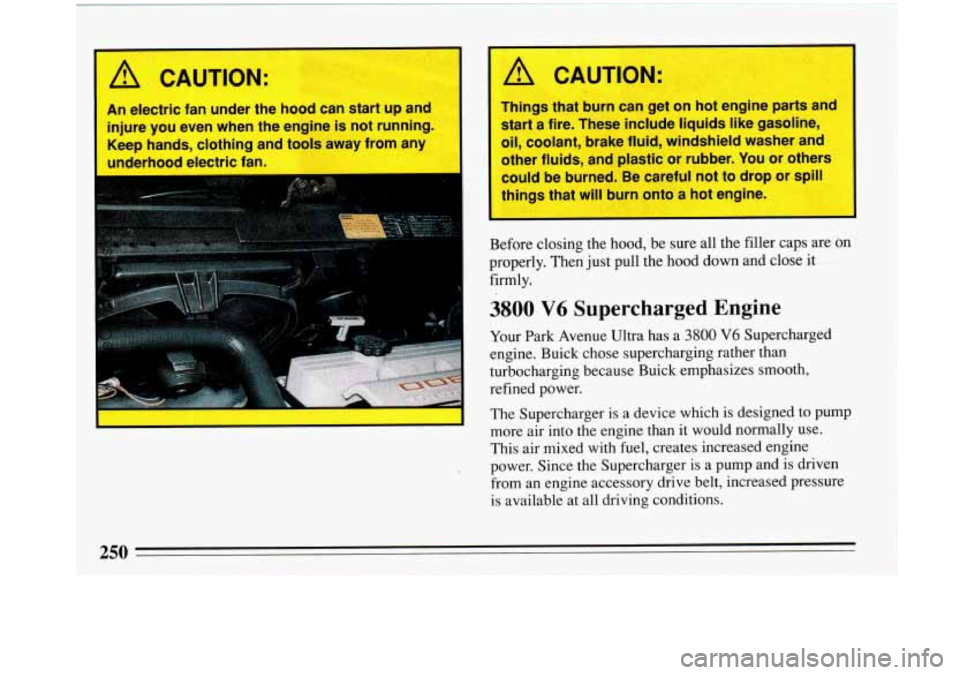
A CAUTION:
An electric fan under the hood can start up and
injure you even when the engine is not running.
Keep hands, clothing and tools away from any
I underhood electric fan. I
A CAUTION:
1
Things that burn can get on hot engine parts and
start a fire. These include liquids like gasoline,
oil, coolant, brake fluid, windshield washer and
other fluids, and plastic or rubber.
You or others
could be burned. Be careful not to drop or spill
things that will burn onto
a hot engine.
-- I
Before closing the hood, be sure all the filler caps are on
properly. Then just pull the hood down and close it
firmly.
3800 V6 Supercharged Engine
Your Park Avenue Ultra has a 3800 V6 Supercharged
engine. Buick chose supercharging rather than
turbocharging because Buick emphasizes smooth,
refined power.
The Supercharger is a device which is designed
to pump
more air into the engine than it would normally use.
This air mixed with fuel, creates increased engine
power. Since the Supercharger is a pump and
is driven
from an engine accessory drive belt, increased pressure
is available at all driving conditions.
250
ProCarManuals.com
Page 259 of 340
Wait at least 30 minutes before checking the transaxle
fluid level if you have been driving:
When outside temperatures are above 90°F (32 C).
At high speed for quite a while.
In heavy traffic -- especially in hot weather.
0 While pulling a trailer.
To get the right reading, the fluid should be at normal
operating temperature, which is
1 80 F to 200 F
(82OC to 93OC).
Get
the vehicle warmed up by driving about 15 miles
(24 km) when outside temperatures .are above
50 F
(10OC). If it’s colder than 50°F (lO°C), you may have
to drive longer.
To check the fluid level:
Park your vehicle on a level place.
0 Place the shift lever in “P’ (Park) with the parking
brake applied.
0 With your foot on the brake pedal, move the shift
lever through each gear range, pausing for about three seconds
in each range. Then, position the shift
lever
in “P’ (Park).
0 Let the engine run at idle for three to five minutes.
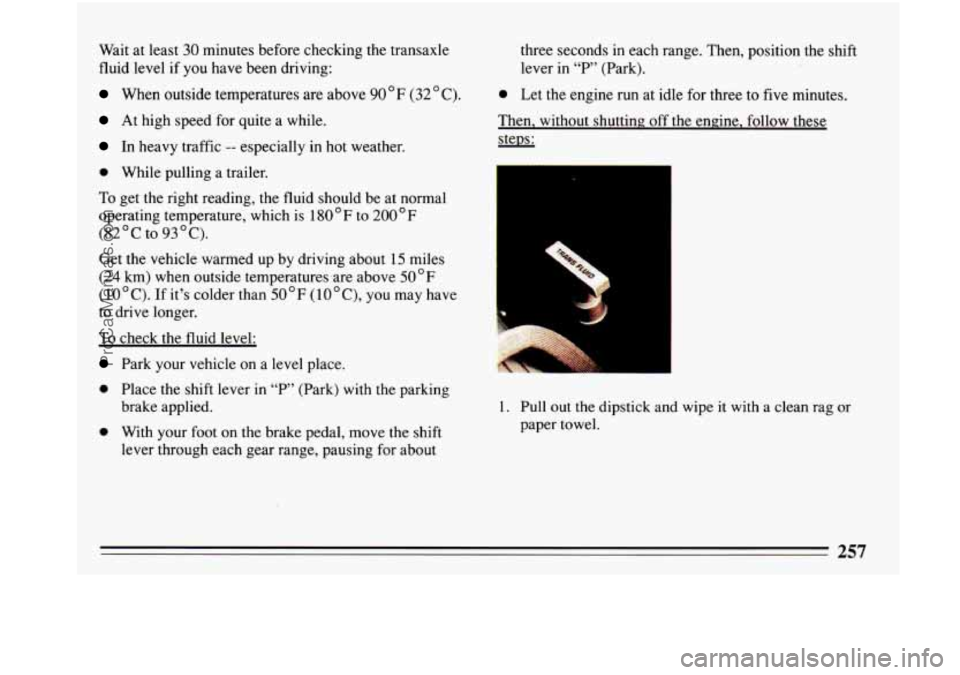
Then, without shutting off the engine, follow these
steps:
1. Pull out the dipstick and wipe it with a clean rag or
paper towel.
ProCarManuals.com
Page 265 of 340
0
0
0
0
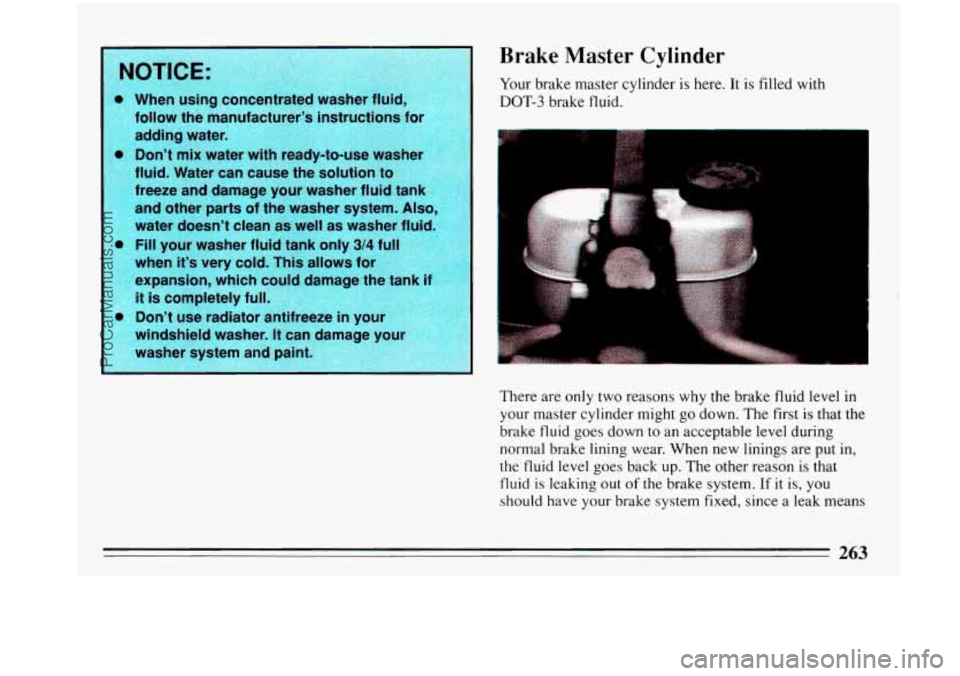
Brake Master Cylinder
Your brake master cylinder is here. It is filled with
DOT-3 brake fluid.
There are only two reasons why the brake fluid level in
your master cylinder might
go down. The first is that the
brake fluid goes down to an acceptable level during
normal brake lining wear. When new linings are put in,
the fluid level goes back
up. The other reason is that
fluid
is leaking out of the brake system. If it is, you
should have your brake system fixed, since a leak means
ProCarManuals.com
Page 266 of 340
that sooner or later your brakes won’t work well, or
won’t work at all.
So, it isn’t a good idea to “top off’
your brake fluid. Adding brake fluid won’t correct
a
leak. If you add fluid when your linings are worn, then
you’ll have
too much fluid when you get new brake
linings. You should add
(or remove) brake fluid, as
necessary, only when work is done
on the brake
hydraulic system.
I-
A CAUTION:
If you have too much brake fluid, it can spill on
the engine. The fluid will burn
if the engine is hot
enough. You or others could be burned, and your
vehicle could be damaged. Add brake fluid only
when work is done on the brake hydraulic
system.
When your brake fluid falls to a low level, your brake
warning light will come on and a chime will sound.
What to Add:
When you do need brake fluid, use only DOT-3 brake
fluid
-- such as Delco Supreme 11 @ (GM part
No.1052535). Use new brake fluid from a sealed
container only.
Replacing Brake System Parts
The braking system on a modern vehicle is complex. Its
many parts have to be
of top quality and work well
together if the vehicle is to have really good braking.
Vehicles we design and test have top-quality GM brake
parts in them, as your Buick does when it is new. When
you replace parts of your braking system
-- for example,
when your brake linings wear down and you have to
have new ones put
in -- be sure you get new genuine
GM replacement parts.
If you don’t, your brakes may no
longer work properly. For example,
if someone puts in
brake linings that are wrong for your vehicle, the
ProCarManuals.com