brake BUICK PARK AVENUE 1993 Workshop Manual
[x] Cancel search | Manufacturer: BUICK, Model Year: 1993, Model line: PARK AVENUE, Model: BUICK PARK AVENUE 1993Pages: 340, PDF Size: 18.17 MB
Page 267 of 340
balance between your front and rear brakes can change,
for the worse. The braking performance you’ve come to
expect can change
in many other ways if someone puts
in the wrong replacement brake parts.
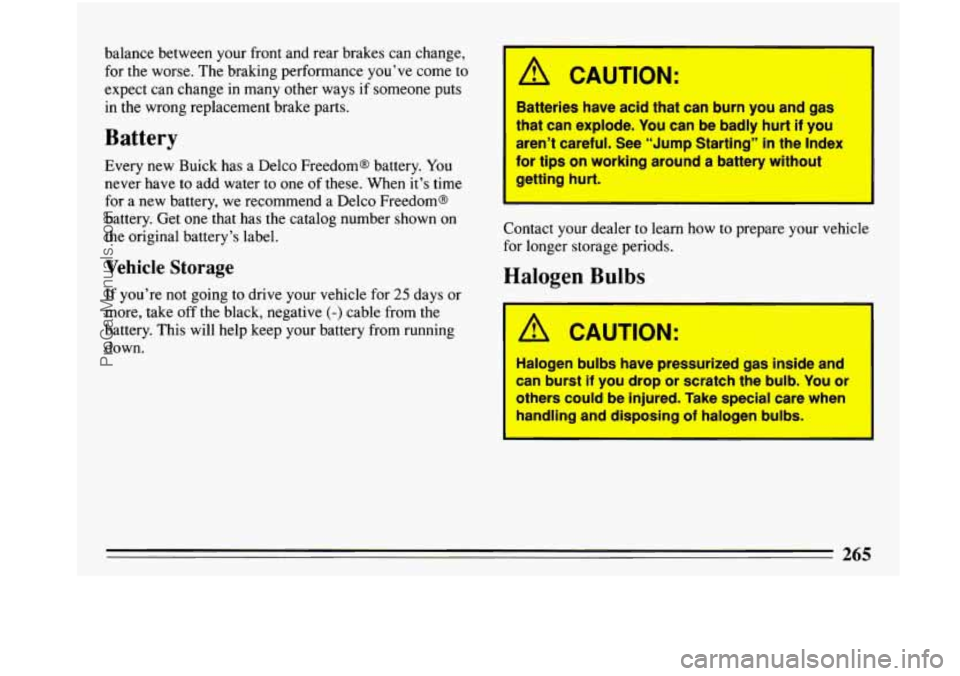
Battery
Every new Buick has a Delco Freedom@ battery. You
never have to add water to one of these. When it’s time
for a new battery, we recommend a Delco Freedoms
battery. Get one that has the catalog number shown on
the original battery’s label.
Vehicle Storage
If you’re not going to drive your vehicle for 25 days or
more, take
off the black, negative (-) cable from the
battery. This will help keep your battery from running
down.
I
A CAUTION:
Batteries have acid that can burn you and gas
that can explode. You can be badly hurt if you
aren’t careful. See “Jump Starting’’ in the Index
for tips on working around
a battery without
getting hurt.
I
Contact your dealer to learn how to prepare your vehicle
for longer storage periods.
Halogen Bulbs
Halogen bulbs have pressurized gas inside and
can burst
if you drop or scratch the bulb. You or
others could be injured. Take special care when
handling and disposing of halogen bulbs.
ProCarManuals.com
Page 278 of 340
In most cases, you will not need to have your wheels
aligned again. However, if
you notice unusual tire wear
or your vehicle pulling one way or the other, the
alignment may need to be reset.
If you notice your
vehicle vibrating when driving on a smooth road, your
wheels may need to be rebalanced.
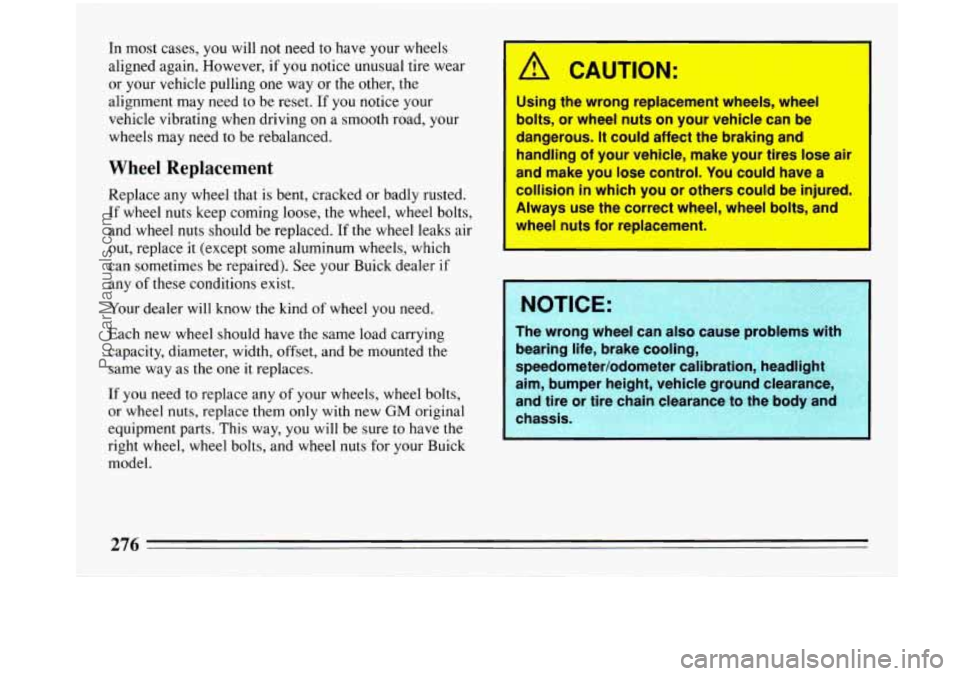
Wheel Replacement
Replace any wheel that is bent, cracked or badly rusted.
If wheel nuts keep coming loose, the wheel, wheel bolts,
and wheel nuts should be replaced.
If the wheel leaks air
out, replace it (except some aluminum wheels, which
can sometimes be repaired). See your Buick dealer if
any
of these conditions exist.
Your dealer will know the kind
of wheel you need.
Each new wheel should have the same load carrying
capacity, diameter, width, offset, and be mounted
the
same way as the one it replaces.
If
you need to replace any of your wheels, wheel bolts,
or wheel nuts, replace them
only with new GM original
equipment parts. This way, you will be sure
to have the
right wheel, wheel bolts, and wheel nuts for your Buick
model.
A CAUTION:
Using the wrong replacement wheels, wheel
bolts, or wheel nuts on your vehicle can be
rngerous. It could affect the braking and
.. ~ndling of your vehicle, make your tires lose air
and make you lose control. You could have a
collision
in which you or others could be injured.
- ..ways use the correct wheel, wheel bolts, ~ d
I wheel nuts
for replacement.
I
1: NOTICE:
The wrong wheel can atso cause Droblems with
bearing life, brake cooling,
speedometer/odometer calibration, headllgb,,
aim, bumper height, vehicle ground clearance
and tire or tire chain clearance to the body an(
chassis.
ProCarManuals.com
Page 289 of 340
Fuses and Circuit Breakers
The wiring circuits in your car are protected from short
circuits by a combination of fuses and circuit breakers.
This greatly reduces the chance of fires caused by
electrical problems.
If you ever have a problem on the road and don’t have a
spare fuse, you can “borrow” one of the correct value.
Just pick some feature
of your car that you can get along
without
-- like the radio or cigarette lighter -- and use its
fuse,
if it is of the value you need. Replace it as soon as
you can.
tl R
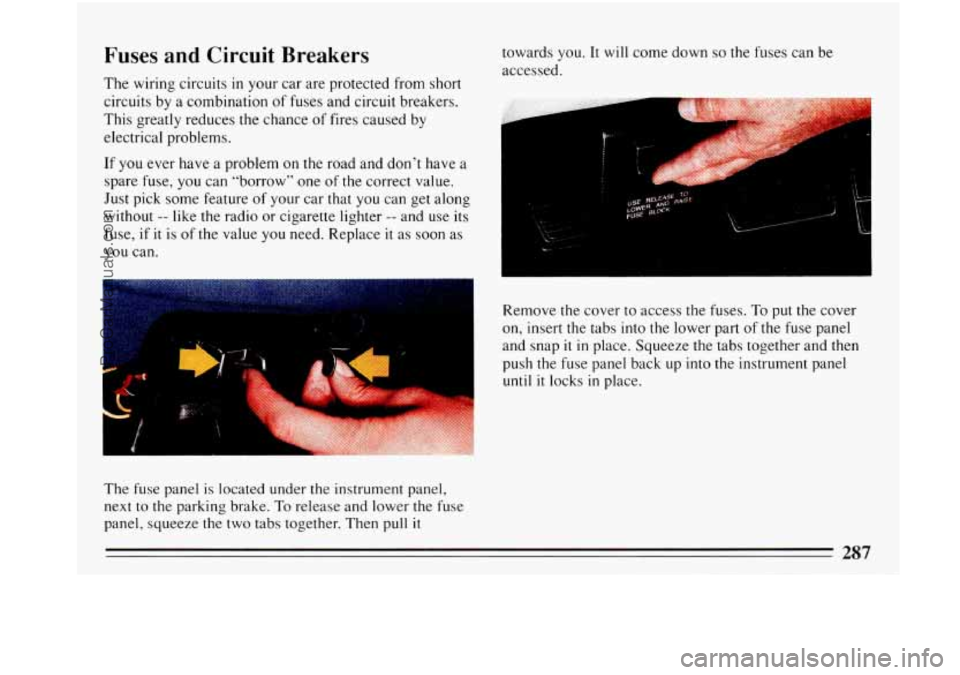
towards you. It will come down so the fuses can be
accessed.
Remove the cover to access the fuses.
To put the cover
on, insert the tabs into the lower part of the fuse panel
and snap
it in place. Squeeze the tabs together and then
push the fuse panel back up into the instrument panel
until it locks in place.
The fuse panel
is located under the instrument panel,
next to the parking brake.
To release and lower the fuse
panel, squeeze
the two tabs together. Then pull it
287
ProCarManuals.com
Page 290 of 340
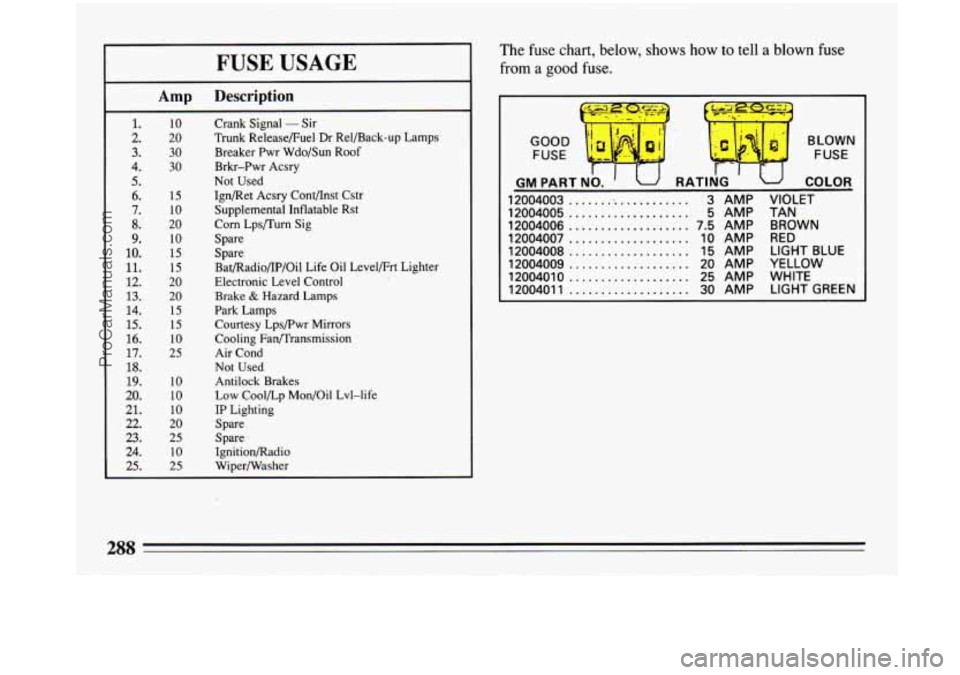
FUSE USAGE
Amp Description
1.
2.
3.
4.
5. 6.
7.
8.
9.
10.
11. 12.
13.
14.
15.
16. 17.
18.
19.
20.
21.
22.
23.
24.
25.
10
20
30
30
15
10
20
10
15
15
20
20
15
15
10
25
10
10
10
20
25
10
25
Crank Signal - Sir
Trunk Release/Fuel.Dr Rel/Back-up Lamps
Breaker Pwr Wdo/Sun Roof
Brkr-Pwr Acsry
Not Used
Ign/Ret Acsry ContDnst Cstr
Supplemental Inflatable Rst
Corn Lps/Turn Sig
Spare
Spare
Bat/Radio/IP/Oil Life Oil Level/Frt Lighter
Electronic Level Control
Brake
& Hazard Lamps
Park Lamps
Courtesy Lps/Pwr Mirrors
Cooling Fan/Transmission
Air Cond
Not Used
Antilock Brakes
Low Cool/Lp Mon/Oil Lvl-life
IP Lighting
Spare
Spare
IgnitionBadio
Wiperwasher
The fuse chart, below, shows how to tell a blown fuse
from a
good fuse.
GOOD
FUSE 1 BLOWN .r, ' \' gJ
'TI r
FUSE
GM PART NO. ' RATING ' COLOF
12004003 .................... 3 AMP VIOLET
12004005
................... 5 AMP TAN
12004006
................... 7.5 AMP BROWN
12004007
................... 10 AMP RED
12004008
................... 15 AMP LIGHT
BLUE
12004009
................... 20 AMP YELLOW
12004010
................... 25 AMP WHITE
1200401
1 ................... 30 AMP LIGHT
GREEN
ProCarManuals.com
Page 304 of 340
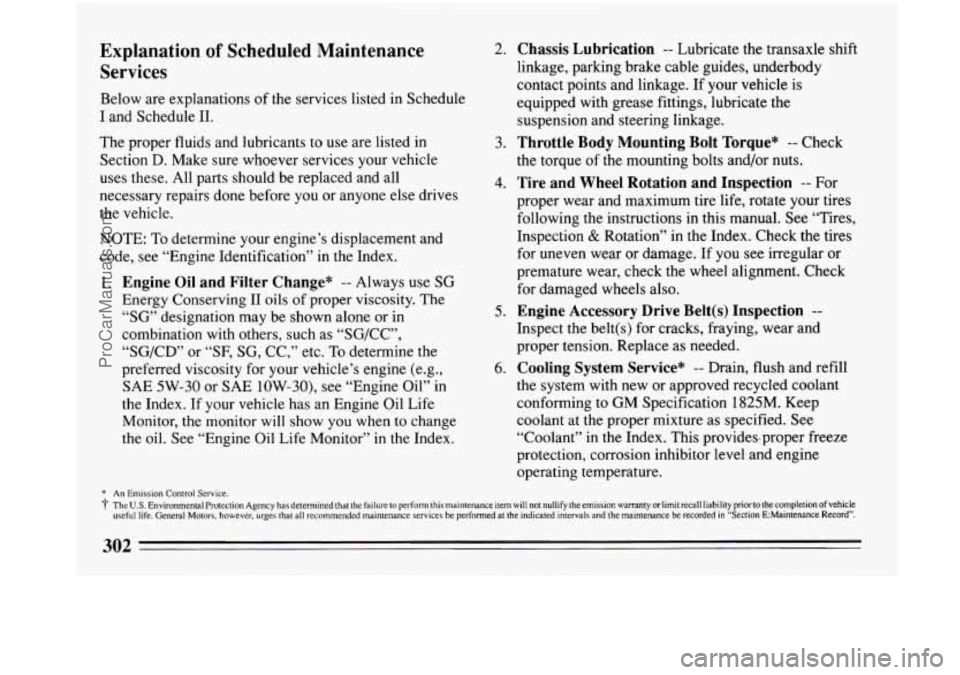
Explanation of Scheduled Maintenance
Services
Below are explanations of the services listed in Schedule
I and Schedule
11.
The proper fluids and lubricants to use are listed in
Section
D. Make sure whoever services your vehicle
uses these. All parts should be replaced and all
necessary repairs done before you or anyone else drives
the vehicle.
NOTE: To determine your engine’s displacement and
code, see “Engine Identification” in the Index.
1. Engine Oil and Filter Change* -- Always use SG
Energy Conserving I1 oils of proper viscosity. The
“SG” designation may be shown alone or in
combination with others, such as “SG/CC”,
“SG/CD” or
“SF, SG, CC,” etc. To determine the
preferred viscosity for your vehicle’s engine (e.g.,
SAE
5W-30 or SAE 10W-30), see “Engine Oil” in
the Index. If your vehicle has an Engine
Oil Life
Monitor,
the monitor will show you when to change
the oil. See “Engine Oil Life Monitor” in the Index.
* An Emission Control Service.
2.
3.
4.
5.
6.
Chassis Lubrication -- Lubricate the transaxle shift
linkage, parking brake cable guides, underbody
contact points and linkage. If your vehicle is
equipped with grease fittings, lubricate the
suspension and steering linkage.
Throttle Body Mounting Bolt Torque” -- Check
the torque
of the mounting bolts and/or nuts.
Tire and Wheel Rotation and Inspection -- For
proper wear and maximum tire life, rotate your tires
following the instructions in this manual. See “Tires,
Inspection
& Rotation” in the Index. Check the tires
for uneven wear or damage. If you see irregular or
premature wear, check the wheel alignment. Check
for damaged wheels also.
Engine Accessory Drive Belt(s) Inspection --
Inspect the belt(s) for cracks, fraying, wear and
proper tension. Replace as needed.
Cooling System Service* -- Drain, flush and refill
the system with new or approved recycled coolant
conforming to GM Specification
1825M. Keep
coolant at the proper mixture
as specified. See
“Coolant” in the Index. This provides.proper freeze
protection, corrosion inhibitor level and engine
operating temperature.
The U.S. Environmental Protection Agency has determined that the failure to perform this maintenance item will not nullify the emission warranty or limit recall liability prior to the completion of vehicle
useful life. General Motors, however, urges that all recommended maintenance services be performed at the indicated intervals and the maintenance be recorded in “Section E:Maintenance Record”.
302
ProCarManuals.com
Page 307 of 340
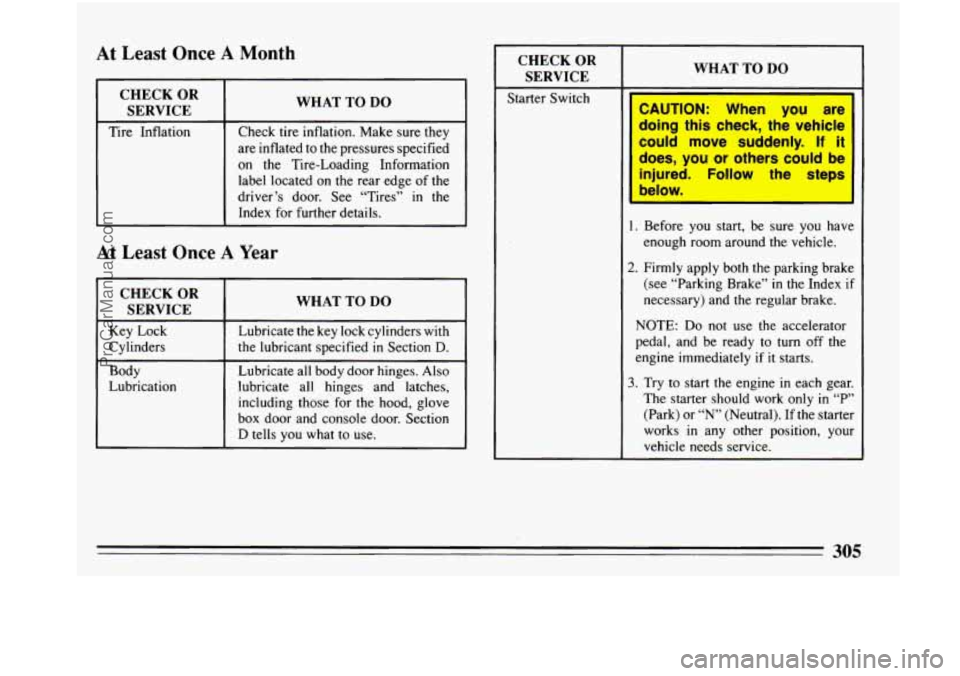
At Least Once A Month
WHAT TO DO
Tire Inflation Check
tire inflation. Make sure they
are inflated to
the pressures specified
on the Tire-Loading Information
label located
on the rear edge of the
driver’s door. See “Tires” in the
Index for further details.
At Least Once A Year
CHECK OR
SERVICE
I WHAT TO DO
Key Lock Lubricate the key lock cylinders with
Cylinders the lubricant specified in Section D.
Body Lubricate all body door hinges. Also
Lubrication lubricate all hinges and latches,
including those’ for the hood, glove
box door and console door. Section
D tells you what to use.
CHECK OR
SERVICE I WHAT TO DO
Starter Switch
I
1. Before you start, be sure you have
enough room around the vehicle.
2. Firmly apply both the parking brake
(see “Parking Brake”
in the Index if
necessary) and the regular brake.
NOTE:
Do not use the accelerator
pedal, and be ready to turn
off the
engine immediately
if it starts.
3. Try to start the engine in each gear.
The starter should work only
in “P”
(Park) or “N” (Neutral). If the starter
works in any other position, your
vehicle needs service.
ProCarManuals.com
Page 308 of 340
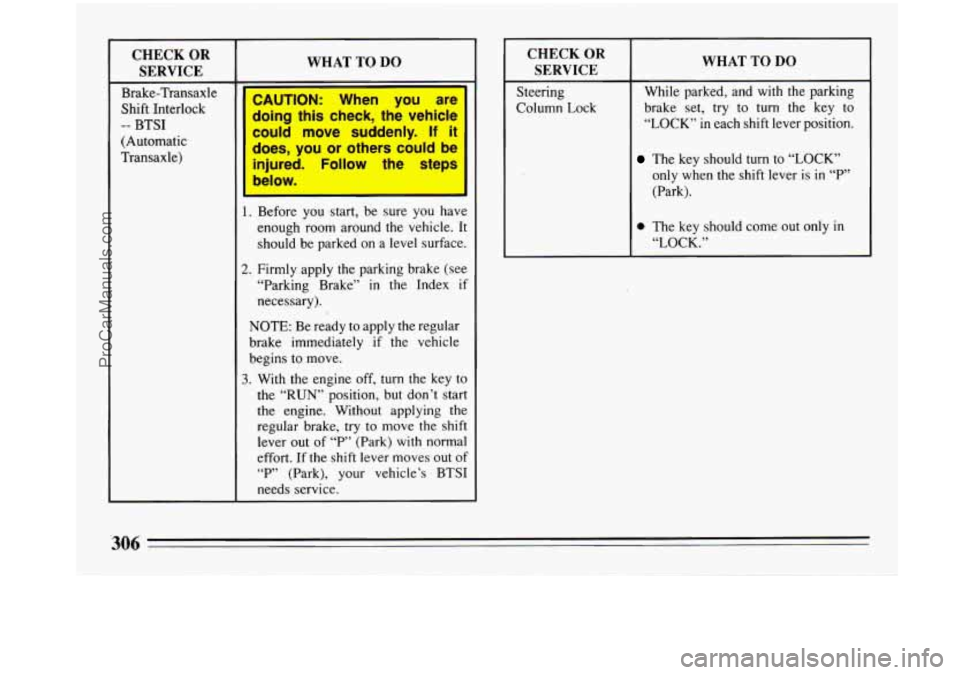
CHECK OR SERVICE
Brake-Transaxle
Shift Interlock
(Automatic
Transaxle)
-- BTSI
WHAT TO DO
I‘
injured. Follow the steps
below.
1. Before you start, be sure you have
enough room around the vehicle. It
should be parked on
a level surface.
2. Firmly apply the parking brake (see
“Parking Brake”
in the Index if
necessary).
NOTE: Be ready to apply the regular
brake immediately
if the vehicle
begins to move.
3. With the engine off, turn the key to
the
“RUN” position, but don’t start
the engine. Without applying the
regular brake,
try to move the shift
lever out of
“P’ (Park) with normal
effort. If the shift lever moves out
of
“P” (Park), your vehicle’s BTSI
needs service.
CHECK OR
SERVICE
Steering
Column Lock
WHAT TO DO
~ ~~
While parked, and with the parking
brake set, try to
turn the key to
“LOCK”
in each shift lever position.
The key should turn to “LOCK”
only when the shift lever
is in “P”
(Park).
0 The key should come out only in
“LOCK.”
ProCarManuals.com
Page 309 of 340
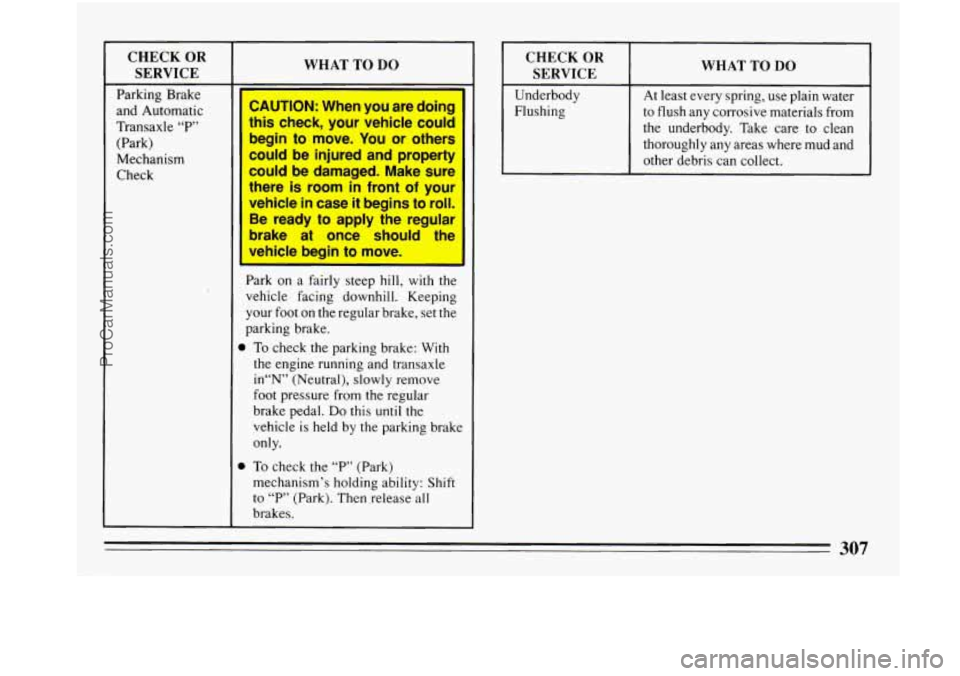
CHECK OR
SERVICE
Parking Brake
and Automatic
Transaxle
“P”
(Park)
Mechanism
Check
WHAT TO DO
CAUTION: When you are doing
this check, your vehicle could
begin to mowe. You or others
could be injured and property
could
be damaged. Make sure
there is room
in front of your
vehicle in case it begins to roll.
Be ready to apply the regular
brake at once should the
vehicle begin to move.
Park on a fairly steep hill, with the
vehicle facing downhill. Keeping
your foot on
the regular brake, set the
parking brake.
0 To check the parking brake: With
the engine running and transaxle
in“N” (Neutral), slowly remove
foot pressure from the regular
brake pedal.
Do this until the
vehicle is held by the parking brake
only.
To check the “P” (Park)
mechanism’s holding ability: Shift
to “P” (Park). Then release all
brakes.
CHECK OR
SERVICE
I WHAT TO DO
Underbody At least every spring, use plain water
Flushing to flush any corrosive materials from
the underbody. Take care to clean
thoroughly any areas where mud and
other debris can collect.
ProCarManuals.com
Page 311 of 340
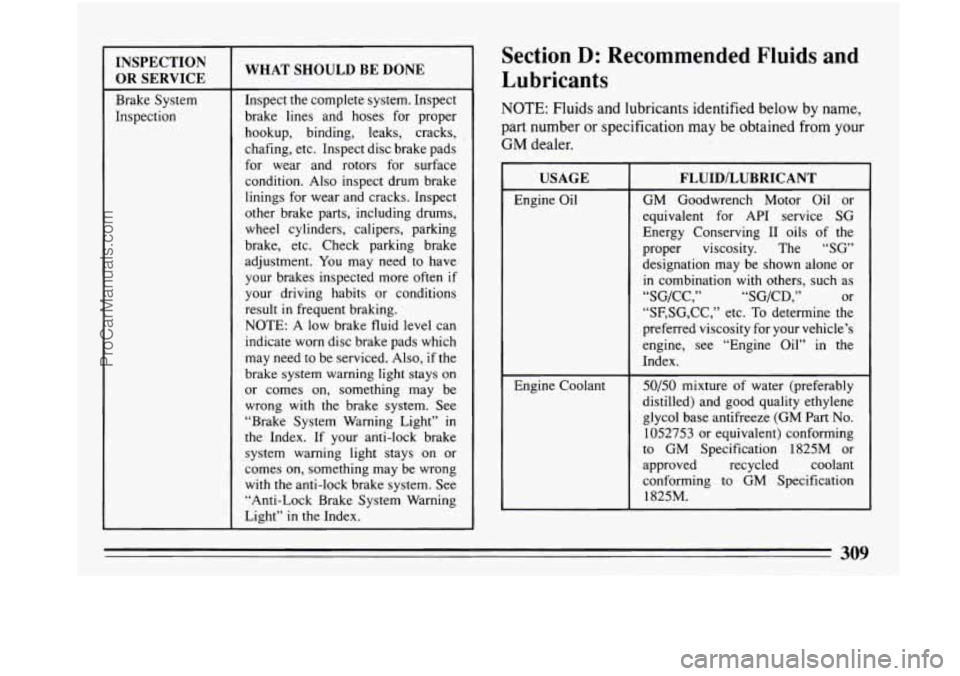
INSPECTION
OR SERVICE
Brake System
Inspection
WHAT SHOULD BE DONE
Inspect the complete system. Inspect
brake lines and hoses for proper
hookup, binding, leaks, cracks, chafing, etc. Inspect disc brake pads
for wear and rotors for surface
condition. Also inspect drum brake
linings for wear and cracks. Inspect
other brake parts, including drums,
wheel cylinders, calipers, parking
brake, etc. Check parking brake
adjustment.
You may need to have
your brakes inspected more often
if
your driving habits or conditions
result
in frequent braking.
NOTE: A low brake fluid level can
indicate worn disc brake pads which
may need
to be serviced. Also, if the
brake system warning light stays on
or comes
on, something may be
wrong with
the brake system. See
“Brake System Warning Light”
in
the Index. If your anti-lock brake
system warning light stays on or
comes on, something may be wrong
with
the anti-lock brake system. See
“Anti-Lock Brake System Warning
Light”
in the Index.
Section D: Recommended Fluids and
Lubricants
NOTE: Fluids and lubricants identified below by name,
part number or specification may be obtained from your
GM dealer.
USAGE
Engine Oil
Engine Coolant
FLUID/LUBRICANT
GM Goodwrench Motor Oil or
equivalent for API service SG
Energy Conserving I1 oils of the
proper viscosity. The
“SG”
designation may be shown alone or
in combination with others, such as
“SG/CC,” “SG/CD,”
or
“SF,SG,CC,” etc. To determine the
preferred viscosity for your vehicle’s
engine, see “Engine Oil” in the
Index.
50/50 mixture of water (preferably
distilled) and good quality ethylene
glycol base antifreeze (GM
Part No.
1052753 or equivalent) conforming
to GM Specification 1825M or
approved recycled coolant
conforming to GM Specification
1825M.
ProCarManuals.com
Page 312 of 340
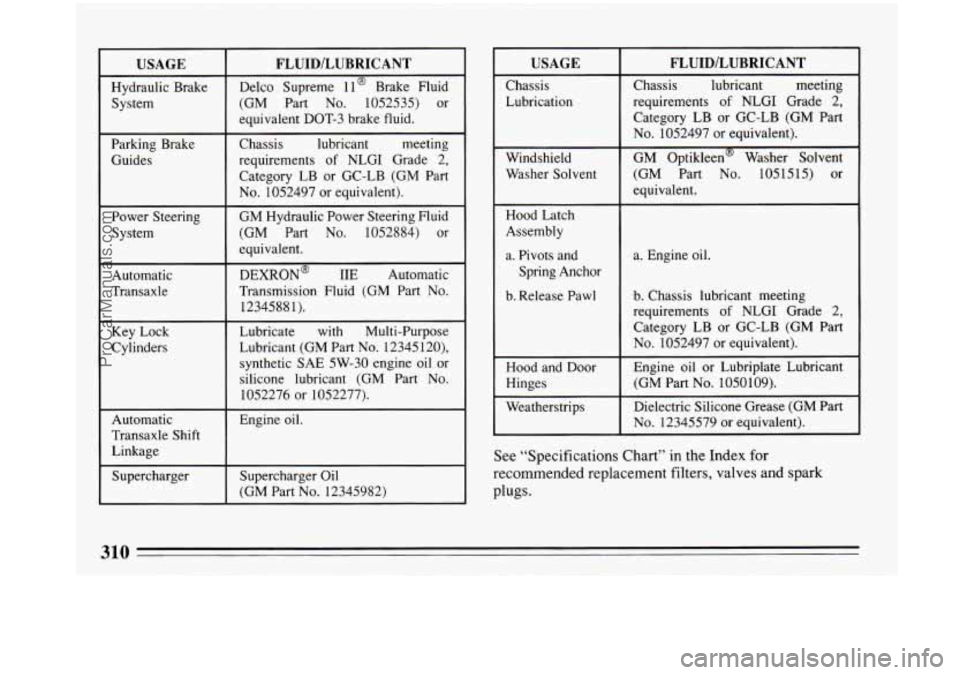
USAGE FLUID/LUBRICANT
Hydraulic Brake
System Delco
Supreme 1 l@ Brake Fluid
(GM Part
No. 1052535) or
equivalent DOT-3 brake fluid.
Parking Brake
Category LB or GC-LB (GM Part requirements
of NLGI Grade 2,
Guides Chassis
lubricant meeting
No. 1052497 or equivalent).
Power Steering GM
Hydraulic Power Steering Fluid
System (GM Part
No. 1052884) or
Automatic DEXRON@ IIE
Automatic
Transaxle Transmission Fluid (GM Part
No.
equivalent.
1234588 1).
Key Lock Lubricate with Multi-Purpose
Cylinders Lubricant
(GM Part
No. 12345120),
synthetic
SAE 5W-30 engine oil or
silicone lubricant (GM Part
No.
1052276 or 1052277).
Automatic
Transaxle Shift Engine
oil.
Linkage Supercharger Supercharger
Oil
(GM
Part No. 12345982)
USAGE
Chassis
Lubrication
Windshield Washer Solvent
Hood Latch
Assembly
a. Pivots and Spring Anchor
b. Release Pawl
Hood and Door
Hinges
Weatherstrips
FLUIDlLUBRICANT
Chassis lubricant meeting
requirements
of NLGI Grade 2,
Category LB or GC-LB (GM Part
No. 1052497 or equivalent).
GM Optikleen@ Washer Solvent
(GM Part No. 1051515) or
equivalent.
a. Engine oil.
b. Chassis lubricant meeting
requirements
of NLGI Grade 2,
Category LB or GC-LB (GM Part
No. 1052497 or equivalent).
Engine oil or Lubriplate Lubricant
(GM Part
No. 1050109).
Dielectric Silicone Grease (GM Part
No. 12345579 or equivalent).
See “Specifications Chart” in the Index for
recommended replacement filters, valves and spark
plugs.
ProCarManuals.com