lock BUICK PARK AVENUE 1993 Service Manual
[x] Cancel search | Manufacturer: BUICK, Model Year: 1993, Model line: PARK AVENUE, Model: BUICK PARK AVENUE 1993Pages: 340, PDF Size: 18.17 MB
Page 147 of 340
SCAN
When you press SCAN, the radio will go to the next
station and pause and keep doing that until
you press
SCAN again. SC will appear in the display.
Pushbuttons
The five pushbuttons let you return to favorite stations.
You can set the pushbuttons for up to ten stations (5 AM
and 5 FM).
Tune in the desired station.
Push the SET button.
Within 5 seconds, push one of the five pushbuttons.
SET will disappear from the display when the station
is set.
Whenever you press that button, the preset station will
return.
Clock
To set the clock:
Press the SET button.
Within 5 seconds, press and hold SCAN until the
correct hour appears on the display.
Press and hold SEEK until the correct minute
appears
on the display.
To Adjust The Tone
Use the levers next to the display to set the bass,
midrange, and treble until
you get the sound you want.
The
60 and 250 levers adjust the bass; 1K is midrange;
3.5K and 10 K control the treble.
We suggest you start with the center lever
(1K) in the
midpoint position, then move the others up or down
until you get the amount of bass and treble you like.
To Play A Cassette
Your tape player is built to work best with tapes that are
30 to 45 minutes long on each side. Tapes longer than
that are
so thin they may not work well in this player.
With the radio on, press a tape into the slot marked
AUTO REVERSE (the tape side goes in first).
Once the tape is playing, use the upper and lower knobs
for volume, balance, and fade just as you did for the
radio. The arrow
in the graphic display above the word
TAPE indicates which side
of the tape is being played.
When the end of the tape is reached, it
will
automatically reverse and play the other side of the tape.
. -,
145
ProCarManuals.com
Page 150 of 340
SCAN Clock
When you press SCAN, the radio will go to the next
station and pause and keep doing that until
you press
SCAN again. SC will appear in the display.
Pushbuttons
The five pushbuttons let you return to favorite stations.
You can set the pushbuttons for up to ten stations
(5 AM
and
5 FM).
0 Tune in the desired station.
0 Press the SET pushbutton. (Note: The display will
shQw SET for about
5 seconds.)
0 Within 5 seconds, push one of the five pushbuttons.
SET will disappear from the display when the station
is set.
Whenever you press that pushbutton again, the preset
station will return. To
set the clock:
0 Press the SET pushbutton.
Within 5 seconds, press and hold SCAN until the
correct hour appears on the display.
0 Press and hold SEEK 4 or until the correct minute
appears on the display.
To Adjust The Tone
BASS adjusts the bass response up or down. TREB
adjusts the treble response up or down. If the station is
weak or noisy, adjust the TREBLE.down to reduce the
noise. Pressing either button in the center will set the
bass or treble
level to a factory preset level.
To Play A Cassette
Your tape player is built to work best with tapes that are
30 to 45 minutes long on each side. Tapes longer than
that are
so thin they may not work well in this player.
With the radio on, press a tape into the
slot marked
AUTO REVERSE (the tape side goes in first).
ProCarManuals.com
Page 153 of 340
SCAN
When you press SCAN, the radio will go to the next
station and pause and keep doing that until you press
SCAN again. SC will appear in the display.
Pushbuttons
The five pushbuttons let you return to favorite stations.
You can set the pushbuttons for up to ten stations (5 AM
and 5 FM).
Tune in the desired station.
Press the SET pushbutton.
0 Within 5 seconds, push one of the five pushbuttons.
SET will disappear from the display when the station
is set.
Whenever
you press that button, the preset station will
return.
Clock
To set the clock:
0 Press the SET pushbutton.
0 Within 5 seconds, press and hold SCAN until the
correct hour appears on the display.
0 Press and hold SEEK or 4 until the correct minute
appears on the display.
To Adjust The Tone
Use the levers next to the display to set the bass,
midrange, and treble until you get the sound you like.
The
60 and 250 levers adjust the bass; 1K is midrange;
-3.5K and 10 K control the treble.
We suggest
you start with the center lever (1K) in the
midpoint position, then move the others up or down
until you get the amount
of bass and treble you like.
To Play A Compact Disc
Before you begin, please note: DO NOT use mini-discs
that are called singles. They won’t eject.
Use full-size
compact discs only.
If the disc player is very hot or if you’re driving on a
very rough road, the disc may come out, or just not play.
ERR will appear
in the display. As soon as things get
back to normal, the disc should play again.
Press PWR to turn the system on.
ProCarManuals.com
Page 155 of 340
Press the PWR button or turn the ignition key off to stop
the disc player. The disc stays in the player and will
resume playing at the point where it stopped.
EJECT
Press EJCT, the disc will eject and the radio will play.
The disc will start at track
1 when you reinsert it.
As a feature to protect the disc,
if you turn the ignition off
with the disc partway out of the slot (after eject), it will be
drawn back into the player in about 30 seconds. The disc
will play at track
1 when the radio is turned on again.
Anti-Theft Feature
Delco-Loc I1 is a security feature for the compact disc
player. It can be used or ignored.
If ignored, the system
plays normally. If it is used, your player won’t be usable
if it’s ever stolen, because it won’t turn on.
The instructions below tell you how to enter your
personal secret code into the system. If your vehicle loses
battery power for any reason, you must unlock the system
with the secret code again before the system will
turn on.
Be sure to read through the entire procedure and become
familiar with
the appropriate buttons and knobs before
starting.
Step
1. Write clown any 6-digit number and keep it in a
safe place. Step
2. Turn
the ignition to the ACC or RUN position.
Step
3. Press PWR to turn the radio off.
Step 4. Press preset 1 and 4 buttons together. Hold them
until
“---” shows on the display (at least 5 seconds).
You are now ready to enter your secret code. If you
pause more than
15 seconds between steps you may
have to start over.
Step
5. Press SET and “000” will appear on the display.
Step 6. Press SEEK and hold
it until the first digit of
your code appears.
Step 7. Rotate the tune knob right or left to make the
next two numbers agree
with your code.
Step
8. Press AM-FM knob and “000” will appear. Now
you are ready to enter the second three digits of the code
according to steps
6 and 7.
Step 9. Press the AM-FM knob. The display will show
“rEP” for
5 seconds, and then “OOO” will appear indicating
that some steps are to
be repeated for verification.
Step
10. Repeat steps 6,7, and 8.
Step 11. Press the AM-FM knob. If the display shows
“SEC”, the verification process was successful and the
system
is SECURE. If the display shows “---”, the
verification steps were not successful and the entire
sequence must be started again.
ProCarManuals.com
Page 156 of 340
To Unlock The System After a Power Loss
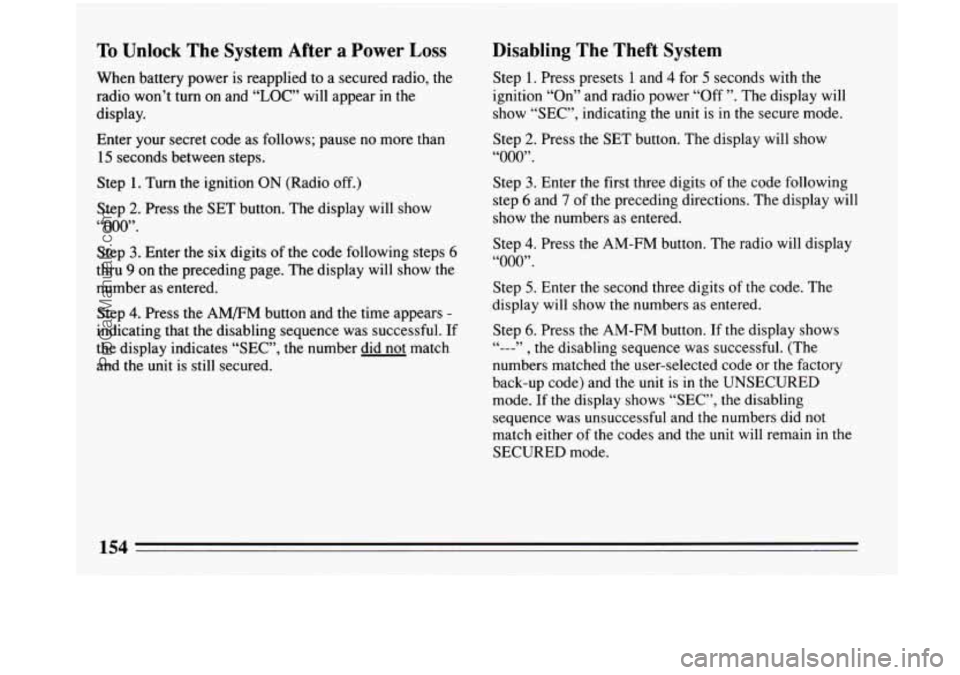
When battery power is reapplied to a secured radio, the
radio won’t turn on and
“LOC” will appear in the
display.
Enter your secret code as follows; pause no more than
15 seconds between steps.
Step
1. Turn the ignition ON (Radio off.)
Step 2. Press the SET button. The display will show
“000”.
Step 3. Enter the six digits of the code following steps 6
thru 9 on the preceding page. The display will show the
number as entered.
Step
4. Press the AM/FM button and the time appears -
indicating that the disabling sequence was successful. If
the display indicates “SEC”, the number did not match
and the unit is still secured.
Disabling The Theft System
Step 1. Press presets 1 and 4 for 5 seconds with the
ignition “On” and radio power “Off
”. The display will
show
“SEC”, indicating the unit is in the secure mode.
Step
2. Press the SET button. The display will show
“000”.
Step 3. Enter the first three digits of the code following
step
6 and 7 of the preceding directions. The display will
show the numbers as entered.
Step
4. Press the AM-FM button. The radio will display
“000”.
Step 5. Enter the second three digits of the code. The
display will show the numbers as entered.
Step
6. Press the AM-FM button. If the display shows
“ --- ” , the disabling sequence was successful. (The
numbers matched the user-selected code or the factory
back-up code) and the unit is in the UNSECURED
mode.
If the display shows “SEC”, the disabling
sequence was unsuccessful and the numbers did not
match either
of the codes and the unit will remain in the
SECURED mode.
ProCarManuals.com
Page 174 of 340
---
1 A CAUTION:
“Riding” your brakes can cause them to overheat
to the point
that they won’t work well. You might
not be able to stop your vehicle
in time to avoid
an accident.
If you “ride” your brakes, they will I
get so hot they will require a lot of pedal force to
slow you down. Avoid “riding” the brakes.
‘I
E:
e brakes weafs them out much faster
You would need costly brake replacement much
sooner than normal, and
it also reduces fuel
If you keep pace with the traffic and allow realistic
following distances,
you will eliminate a lot of
unnecessary braking. That means better braking and
longer brake life.
If your engine ever stops while you’re driving, brake
normally but don’t pump your brakes. If
you do, the pedal
may get harder to push down.
If your engine
stops,
you will still have some power brake assist.
But you will use it when you brake. Once the power
assist is used up, it may take longer to stop and the
brake pedal will be harder to push.
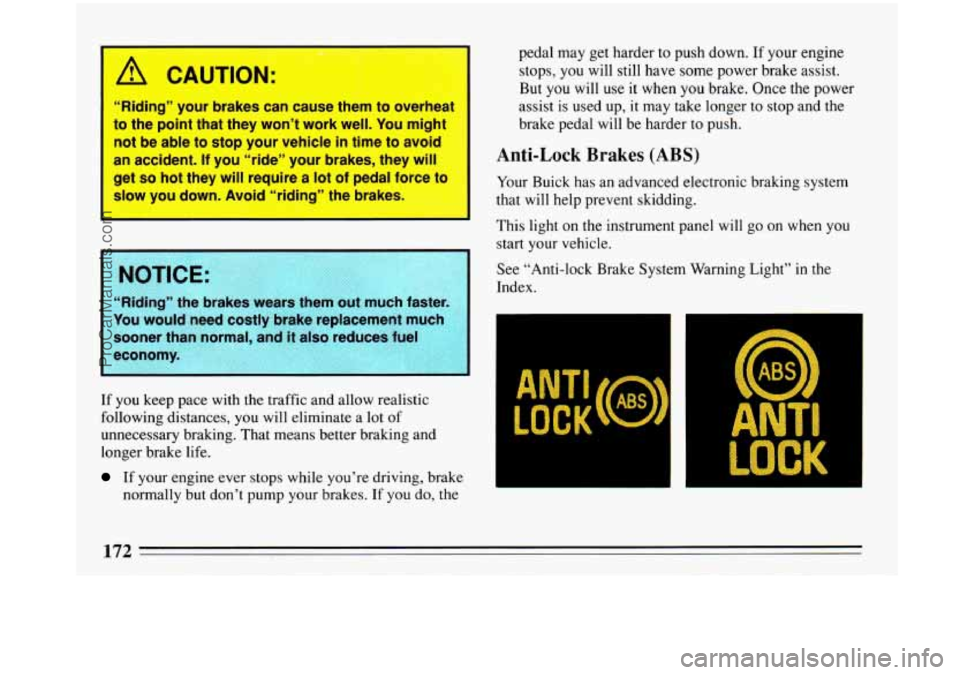
Anti-Lock Brakes (ABS)
Your Buick has an advanced electronic braking system
that will help prevent skidding.
This light on the instrument panel will
go on when you
start your vehicle.
See “Anti-lock Brake System Warning Light” in the
Index.
ANTI
LOCK ANTI
LOCK
ProCarManuals.com
Page 175 of 340
KK
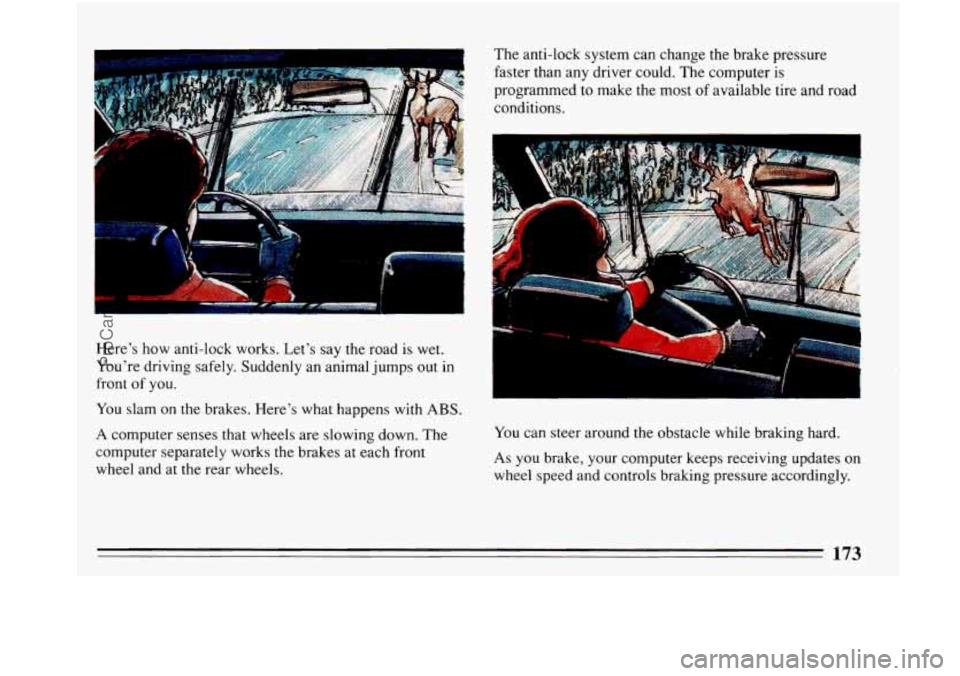
Here’s how anti-lock works. Let’s say the road is wet.
You’re driving safely. Suddenly an animal jumps out in
front of you.
You slam
on the brakes. Here’s what happens with ABS.
A computer senses that wheels are slowing down. The
computer separately works the brakes at each front
wheel and at the rear wheels. You
can steer around the obstacle while braking hard. As you brake, your computer keeps receiving updates on
wheel speed and controls braking pressure accordingly.
ProCarManuals.com
Page 176 of 340
I CAUTION:
Anti-lock doesn’t change the time you need to
get your foot
up to the brake pedal. If you get too
close to the vehicle in front of you, you won’t
have time to
apply your brakes ifethat vehicle
suddenly
stows or stops. Always leave enough
room up ahead to stop, even though you have
antblock brakes.
To Use Anti-Lock:
Don’t pump the brakes. Just hold the brake pedal down
and let anti-lock work for
you.
When you start your vehicle and begin to drive away,
you may hear a momentary motor or clicking noise. And
you may even notice that your brake pedal moves a little
while this is going on. This is the ABS system testing
itself. You may also hear this during a hard stop.
Traction Control System (Option)
Your vehicle may have a traction control system that
limits wheel spin. This is especially useful
in slippery
road conditions. The traction control system works at
low speeds only, such as when you accelerate from a stop. It
applies brake pressure
to an individual wheel
that the system senses is about to spin.
You may feel the system working, or you may notice
some noise, but this is normal.
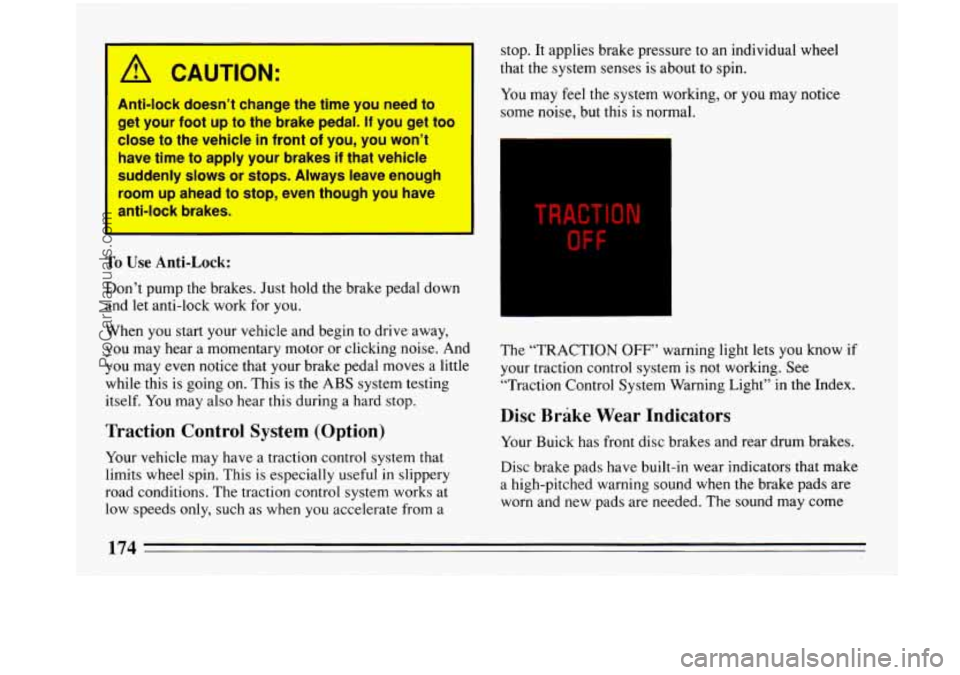
TRACTION
OFF
The “TRACTION OFF” warning light lets you know if
your traction control system is not working. See
“Traction Control System Warning Light” in the Index.
Disc Brake Wear Indicators
Your Buick has front disc brakes and rear drum brakes.
Disc brake pads have built-in wear indicators that make
a high-pitched warning sound when the brake pads are
worn and new pads are needed. The sound may come
174
ProCarManuals.com
Page 178 of 340
Braking in Emergencies
Use your anti-lock braking system when you need to.
With anti-lock, you ‘can steer and brake at the same time.
In many emergencies, steering can help you more than
even the very best braking.
Steering
Power Steering
If you lose power steering assist because the engine
stops
or the system fails to function, you can steer but it
.will take much more effort.
Steering Tips
Driving on Curves
It’s important to take curves at a reasonable speed.
A lot of the “driver lost control” accidents mentioned on
the news happen on curves. Here’s
why:
Experienced driver or beginner, each.of us is subject to
the same laws of physics when driving on curves. The
traction of the tires against the road surface makes it
possible for the vehicle to changejts path when you
turn
the front wheels. If there’s no traction, inertia will keep
the vehicle going in the same direction. If you’ve ever
tried to steer a vehicle on wet ice, you’ll understand this. The
traction you can get in a curve depends on the
condition of your tires and the road surface, the angle
at
which the curve is banked, and your speed. While
you’re in a curve, speed is the one factor you can
control.
Suppose you’re steering through a sharp curve. Then
you suddenly accelerate.
Those two control systems
-- steering .and acceleration --
can overwhelm those places where the tires meet the
road and make you lose control.
What should you do
if this ever happens? Let up on the
.accelerator pedal, steer the vehicle the way you want it
to go, and slow down.
Speed limit signs near curves
warn that you should
adjust your speed. Of course,
the posted speeds are
based on good weather and road conditions. Under less
favorable conditions you’ll want to go slower.
If you need to reduce your speed as you approach a
curve, do it before you enter the curve, while your front
wheels are straight ahead.
Try to adjust
your speed so you can “drive” through the
curve. Maintain a reasonable, steady speed. Wait to
accelerate until you are out of the curve, and then
accelerate gently into the straightaway.
176 I
ProCarManuals.com
Page 179 of 340
When you drive into a curve at night, it’s harder to see
the road ahead of you because it bends away from the
straight beams of your lights. This is one good reason to
drive slower.
Steering in Emergencies
There are timi% when steering can be more effective
than braking. For example,
you come over a hill and
find a truck stopped in your lane, or a car suddenly pulls
out from nowhere, or a child darts out from between
parked cars and stops right
in front of you. You can
avoid these problems by braking
-- if you can stop in
time. But sometimes you can’t; there isn’t room. That’s
the time for evasive action
-- steering around the
problem.
Your Buick can perform very well
in emergencies like
these. First apply your brakes. It is better to remove as
much speed as you can from a possible collision. Then
steer around the problem, to the left or right depending
on the space available.
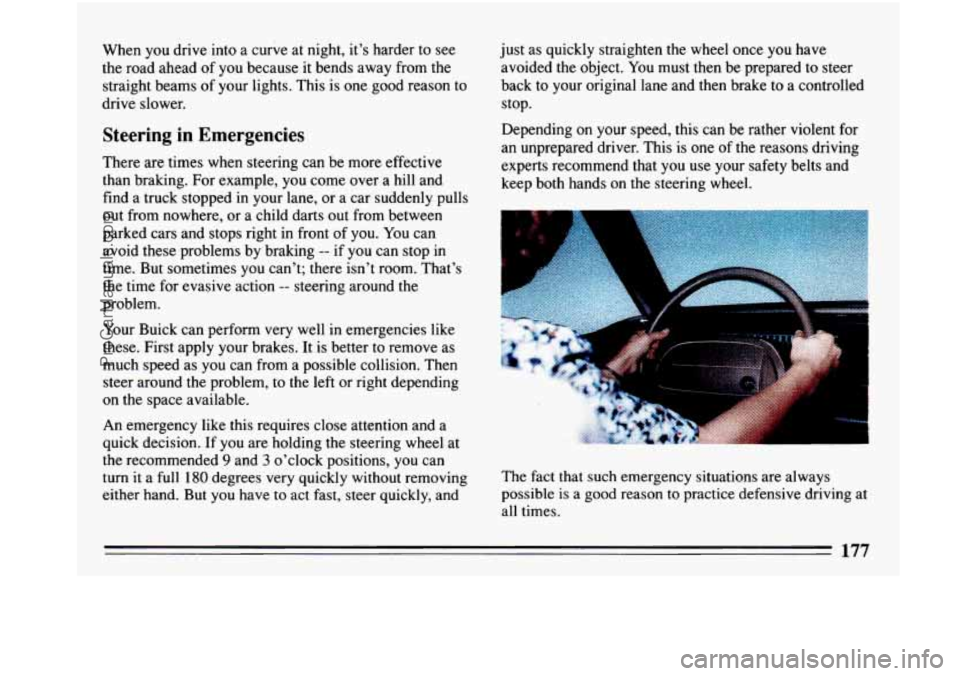
An emergency like this requires close attention and a
quick decision. If you are holding the steering wheel at
the recommended 9 and 3 o’clock positions, you can
turn it a full 180 degrees very quickly without removing
either hand. But you have
to act fast, steer quickly, and just as
quickly straighten the wheel once you have
avoided the object. You must then be prepared to steer
back
to your original lane and then brake to a controlled
stop.
Depending on your speed, this can be rather violent for
an unprepared driver. This is one of the reasons driving
experts recommend
that you use your safety belts and
keep both hands on the steering wheel.
I
D
The fact that such emergency situations are always
possible
is a good reason to practice defensive driving at
all times.
177
ProCarManuals.com