lock BUICK PARK AVENUE 1993 Workshop Manual
[x] Cancel search | Manufacturer: BUICK, Model Year: 1993, Model line: PARK AVENUE, Model: BUICK PARK AVENUE 1993Pages: 340, PDF Size: 18.17 MB
Page 183 of 340
vehicle is skidding. Learn to recognize warning clues --
such as enough water, ice or packed snow on the road to
make a “mirrored surface”
-- and slow down when you
have any doubt.
Remember: Any anti-lock braking system (ABS) helps
avoid only the braking skid. Steer the way
you want to
go-
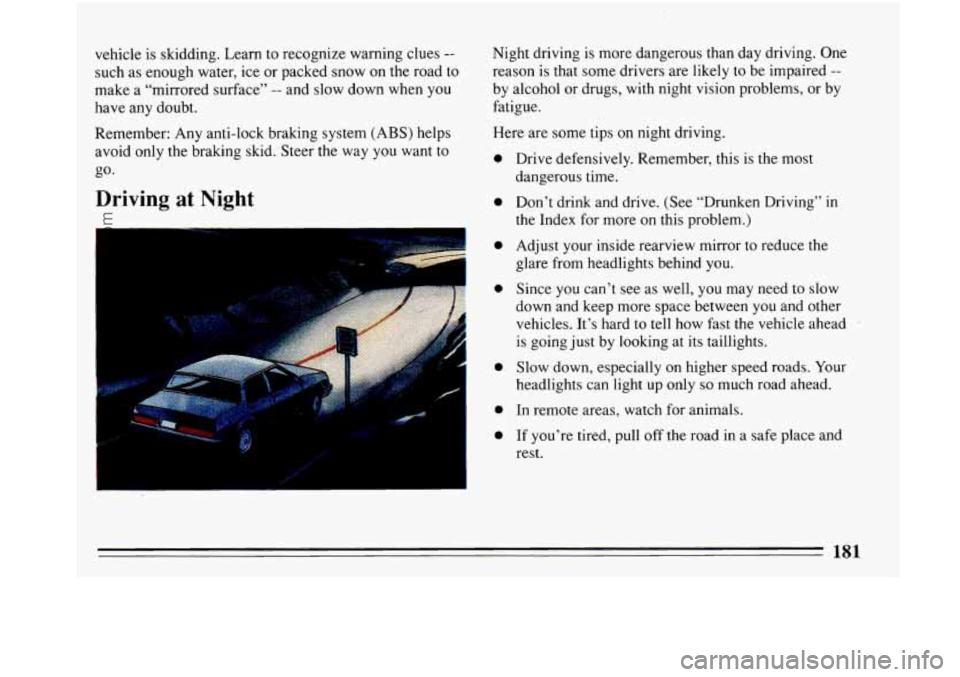
Driving at Night
...,.
.. -
Night driving is more dangerous than day driving. One
reason
is that some drivers are likely to be impaired --
by alcohol or drugs, with night vision problems, or by
fatigue.
Here are some tips on night driving.
0
0
0
c
0
0
0
Drive defensively. Remember, this is the most
dangerous time.
Don’t drink and drive. (See “Drunken Driving” in
the Index for more on this problem.)
Adjust your inside rearview mirror to reduce the
glare from headlights behind you.
Since you can’t see as well, you may need to slow
down and keep more space between you and other
vehicles. It’s hard
to tell how fast the vehicle ahead .
is going just by looking at its taillights.
Slow down, especially on higher speed roads. Your
headlights can light up only
so much road ahead.
In remote areas, watch for animals.
If you’re tired, pull off the road in a safe place and
rest.
ProCarManuals.com
Page 184 of 340
Night Vision
No one can see as well at night as in the daytime. But as
we get older these differences increase. A 50-year-old
driver may require at least twice as much light to see the
same thing at night as a 20-year-old.
What you do in the daytime can also affect your night
vision. For example,
if you spend the day in bright
sunshine
you are wise to wear sunglasses. Your eyes will
have less trouble adjusting to night.
But if you’re driving, don’t wear sunglasses at night.
They may cut down
on glare from headlights, but they
also make a lot of things invisible that should remain
visible
- such as parked cars, obstacles, pedestrians, or
even trains blocking railway crossings. You may want to
put on your sunglasses after you have pulled into a
brightly-lighted service
or refreshment area. Eyes
shielded from that glare may adjust more quickly to
darkness back
on the road. But be sure to remove your
sunglasses before you leave the service area.
You can be temporarily blinded by approaching lights. It
can take
a second or two, or even several seconds, for
your eyes to readjust
to the dark. When you are faced
with severe glare (as from a driver who doesn’t lower
the high beams, or a vehicle with misaimed headlights),
slow down a little. Avoid staring directly into the
approaching lights. If there is a line of opposing traffic, make occasional glances over
the line of headlights to
make certain that one
of the vehicles isn’t starting to
move into your lane. Once
you are past the bright lights,
give your eyes time to readjust before resuming speed.
High Beams
If the vehicle approaching you has its high beams on,
signal by flicking yours to high and then back to low
beam. This is the usual signal to lower the headlight
beams. If the other driver still doesn’t lower the beams,
resist the temptation to put your high beams
on. This
only makes two half-blinded drivers.
On a freeway, use your high beams
only in remote areas
where you won’t impair approaching drivers. In some
places, like cities, using high beams is illegal.
When you follow another vehicle on a freeway or
highway, use low beams. True, most vehicles now have
day-night mirrors that enable the driver to reduce glare.
But outside mirrors are not of this type and high beams
from behind can bother the driver ahead.
A Few More Night Driving Suggestions
Keep your windshield and all the glass on your vehicle
clean
-- inside and out. Glare at night is made much
worse by dirt on the glass. Even the inside of the glass
can build up a film caused by dust. Tobacco smoke also
ProCarManuals.com
Page 198 of 340
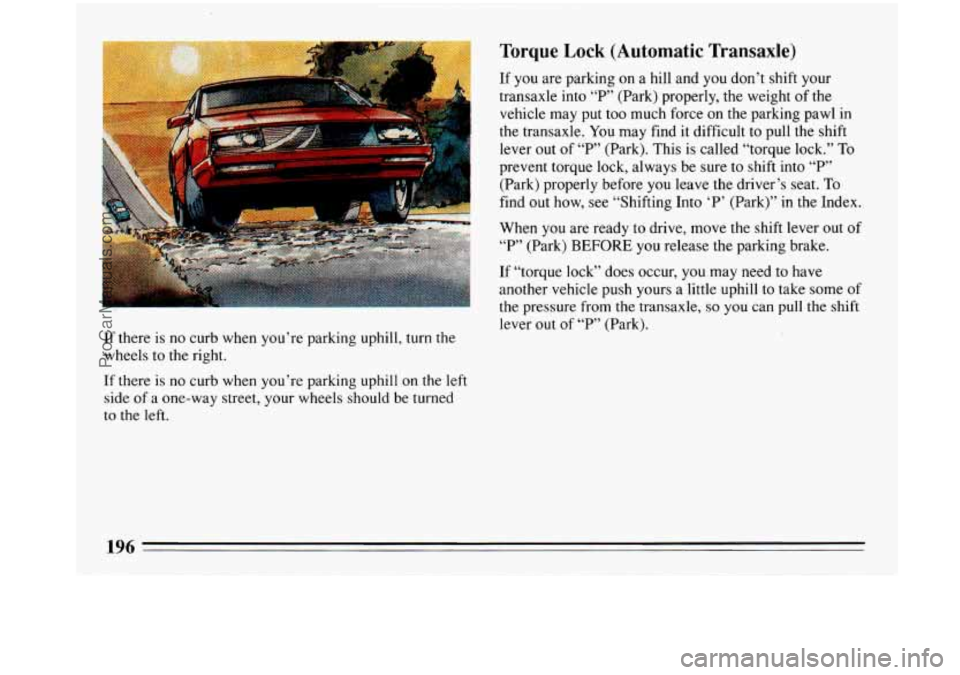
If there is no curb when you’re parking uphill, turn the
wheels to the right.
If there is no curb when you’re parking uphill on the left
side of
a one-way street, your wheels should be turned
to
the left.
Torque Lock (Automatic Transaxle)
If you are parking on a hill and you don’t shift your
transaxle into
“P” (Park) properly, the weight of the
vehicle may put too much force on the parking pawl in
the transaxle. You may find it difficult to pull the shift
lever out
of “F‘” (Park). This is called “torque lock.” To
prevent torque lock, always be sure to shift into “P”
(Park) properly before
you leave the driver’s seat. To
find out how, see “Shifting Into ‘P’ (Park)” in the Index.
When
you are ready to drive, move the shift lever out of
“P” (Park) BEFORE you release the parking brake.
If “torque lock” does occur,
you may need to have
another vehicle push yours a little uphill to take some of
the pressure from the transaxle, so you can pull the shift
lever out of “P” (Park).
ProCarManuals.com
Page 200 of 340
Driving on Snow or Ice
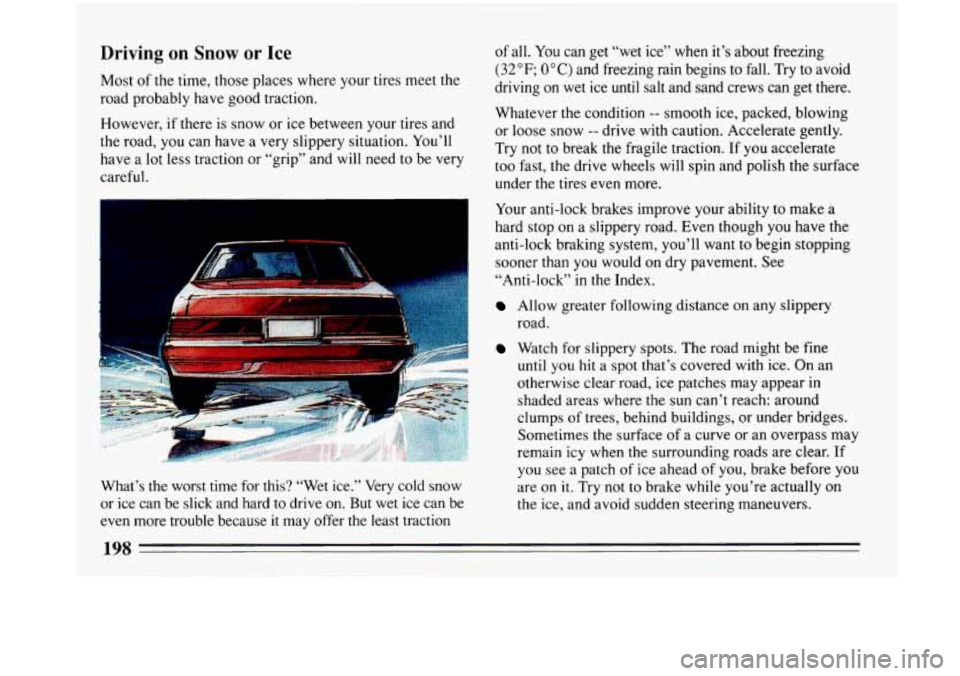
Most of the time, those places where your tires meet the
road probably have good traction.
However, if there is snow or ice between
your tires and
the road,
you can have a very slippery situation. You’ll
have a lot less traction or “grip” and will need to be very
careful.
c
What’s the worst time for this? “Wet ice.” Very cold snow
or ice can be slick and hard to drive on. But wet ice can be
even more trouble because
it may offer the least traction
of all. You can get “wet ice” when it’s about freezing
(32°F; 0°C) and freezing rain begins to fall. Try to avoid
driving on wet ice until salt and sand crews can get there.
Whatever the condition
-- smooth ice, packed, blowing
or loose snow
-- drive with caution. Accelerate gently.
Try
not to break the fragile traction. If you accelerate
too fast, the drive wheels will spin and polish the surface
under the tires even more.
Your anti-lock brakes improve your ability to make a
hard stop on a slippery road. Even though
you have the
anti-lock braking system, you’ll want to begin stopping
sooner than you would on dry pavement. See
“Anti-lock” in the Index.
Allow greater following distance on any slippery
Watch for slippery spots. The road might be fine
until
you hit a spot that’s covered with ice. On an
otherwise clear road, ice patches may appear
in
shaded areas where the sun can’t reach: around
clumps of trees, behind buildings, or under bridges.
Sometimes the surface of a curve or an overpass may
remain icy
when the surrounding roads are clear. If
you see a patch of ice ahead
of you, brake before you
are on
it. Try not to brake while you’re actually on
the ice, and avoid sudden steering maneuvers. road.
ProCarManuals.com
Page 202 of 340
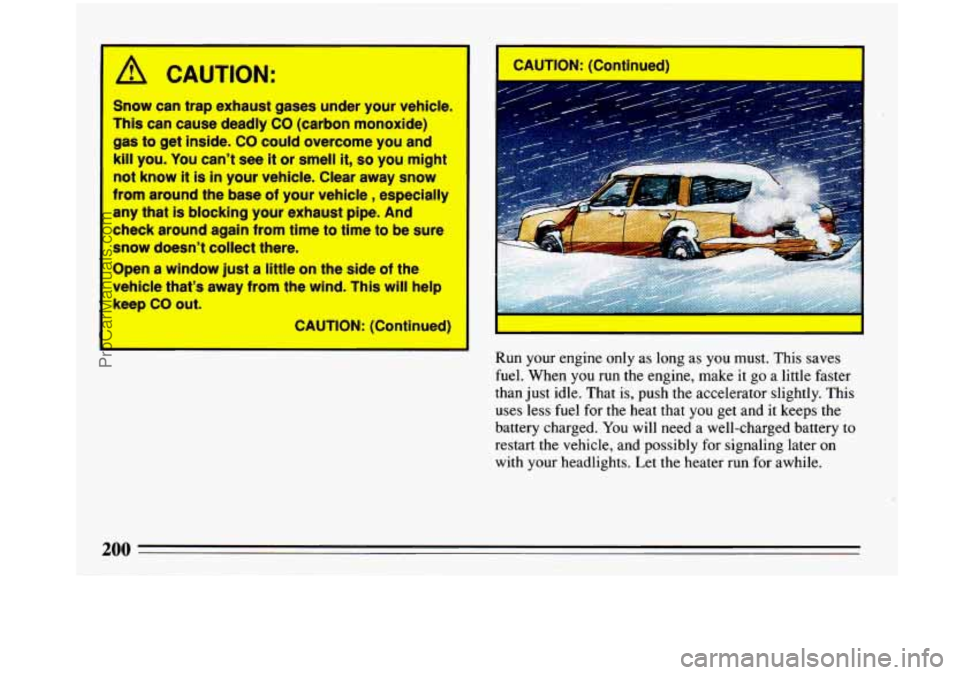
A CAUTION:
Snow can trap exhaust gases under your vehicle.
This can cause deadly
CO (carbon monoxide)
gas to get inside. CO could overcome you and
kill you. You can’t see it or smell it, so you might
not know it is in your vehicle. Clear away snow
from around the base of your vehicle, especially
any that
is blocking your exhaust pipe. And
check around again from time to time to be sure
snow doesn’t collect there.
Open
a window just a little on the side of the
vehicle that’s away from the wind. This will help
keep CO out.
CAUTION: (Continued)
LCAUTION:
Run your engine only as long as you must. This saves
fuel. When you run the engine, make it go a little faster
than just idle. That is, push the accelerator slightly. This
uses less fuel for the heat that you get and it keeps the
battery charged. You will need a well-charged battery
to
restart the vehicle, and possibly for signaling later on
with your headlights. Let the heater run for awhile.
ProCarManuals.com
Page 206 of 340
Total Weight on Your Vehicle’s Tires
Be sure your vehicle’s tires are inflated to the limit for
cold tires.
You’ll find these numbers on the Certification
label at the rear edge of the driver’s door (or see “Tire
Loading” in the Index). Then be sure you don’t go over
the
GVW limit for your vehicle.
Hitches
It’s important to have the correct hitch equipment.
Crosswinds, large trucks going by, and rough roads are
a
few reasons why you’ll need the right hitch. Here are
some rules to follow:
0
0 If you’ll be pulling a trailer that, when loaded, will
weigh more than
2,000 pounds (900 kg), be sure to
use a properly mounted, weight-distributing hitch
and sway control
of the proper size. This equipment
is very important for proper vehicle loading and
good handling
when you’re driving.
Will
you have to make any holes in the body of your
vehicle when you install a trailer hitch? If you do,
then be sure to seal the holes later when you remove
the hitch. If you don’t seal them, deadly carbon
monoxide (CO) from your exhaust can get into your
vehicle (see “Carbon Monoxide” in the Index). Dirt
and water can, too.
0 The bumpers on your vehicle are not intended for
hitches.
Do not attach rental hitches or other
bumper-type hitches to them. Use only
a
frame-mounted hitch that does not attach to the
bumper.
Safety Chains
You should always attach chains between your vehicle
and your trailer. Cross the safety chains under the
tongue of the trailer
so that the tongue will not drop to
the road if it becomes separated from the hitch.
Instructions about
safety chains may be provided by the
hitch manufacturer or by the trailer manufacturer.
Follow the manufacturer’s recommendation for
attaching safety chains. Always leave
just enough slack
so you can turn with your rig. And, never allow safety
chains to drag on
the ground.
Trailer Brakes
If your trailer weighs more than 1,000 pounds (450 kg)
loaded, then
it needs its own brakes -- and they must be
adequate. Be sure to read and follow the instructions for
the trailer brakes
so you’ll be able to install, adjust and
maintain them properly. Because you have anti-lock
brakes, do not try to tap into your vehicle’s brake
system.
If you do, both brake systems won’t work well,
or at all.
ProCarManuals.com
Page 220 of 340
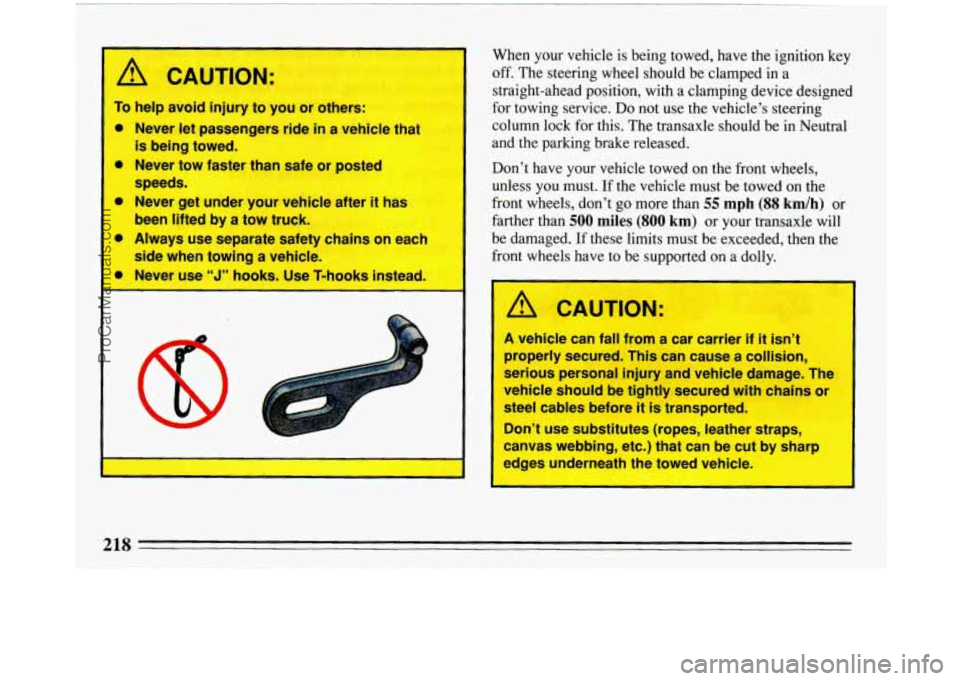
r /r CAUTION:
To help avoid injury to you or others:
0 Never let passengers ride in a vehicle that
0 Never tow faster than safe or posted
0 Never get under your vehicle after it has
0 Always use separate safety chains on each
is being towed.
speeds.
been lifted by
a tow truck.
side when ?owing
a vehicle.
V
t
When your vehicle is being towed, have the ignition key
off. The steering wheel should be clamped in a
straight-ahead position, with a clamping device designed
for towing service.
Do not use the vehicle’s steering
column lock for this. The transaxle should be in Neutral
and the parking brake released.
Don’t have
your vehicle towed on the front wheels,
unless you must.
If the vehicle must be towed on the
front wheels, don’t go more than
55 mph (88 kdh) or
farther than
500 miles (SO0 km) or your transaxle will
be damaged. If these limits must be exceeded, then the
front wheels have to be supported on a dolly.
A CAUTION:
A vehicle can fall from a car carrier if it isn’t
properly secured. This can cause a collision,
serious personal injury and vehicle damage. The
vehicle should be tightly secured with chains or
steel cables before it is transported.
Don’t use substitutes (ropes, leather straps,
canvas webbing, etc.) that can be cut by sharp
edges underneath the towed vehicle.
218
ProCarManuals.com
Page 233 of 340
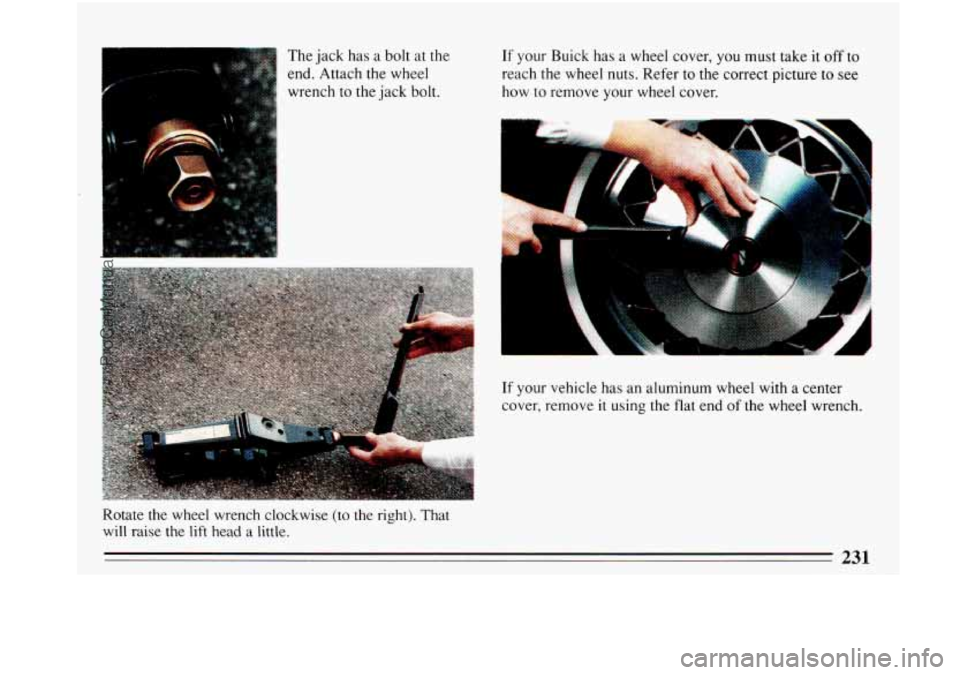
The jack has a bolt at the
end. Attach the wheel
wrench to the jack bolt. If your Buick has a wheel cover, you must take it off to
reach the wheel nuts. Refer to the correct picture to see
how to remove your wheel cover.
If your vehicle has an aluminum wheel with a center
cover, remove
it using the flat end of the wheel wrench.
Rotate the wheel wrench clockwise (to
the right). That
will raise the lift head a little.
231
ProCarManuals.com
Page 235 of 340
.,. . I
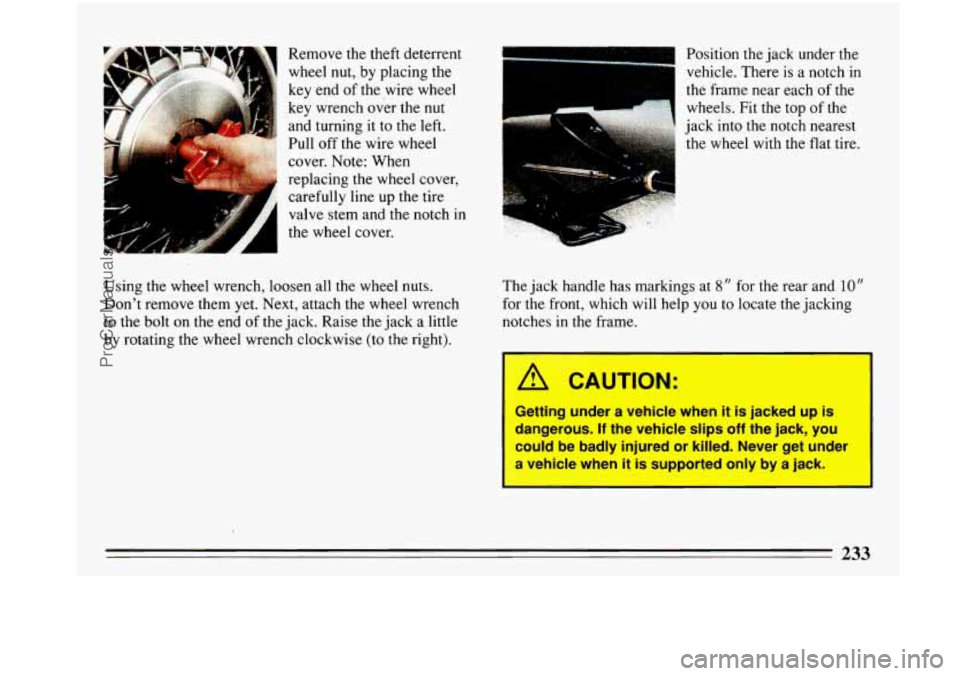
Remove the theft deterrent
wheel nut, by placing the
key end of the wire wheel
key wrench over the nut
and turning it to the left.
Pull off the wire wheel
cover. Note: When
replacing the wheel cover,
carefully line up the tire
valve stem and the notch in
the wheel cover.
I
Using the wheel wrench, loosen all the wheel nuts.
Don’t remove them yet. Next, attach the wheel wrench
to the bolt on the end
of the jack. Raise the jack a little
by rotating the wheel wrench clockwise (to the right). Position the
jack under the
vehicle. There is a notch in
the frame near each
of the
wheels. Fit the top of the
jack into the notch nearest
the wheel with the flat tire.
The jack handle has markings at
8” for the rear and 10”
for the front, which will help you to locate the jacking
notches in the frame.
1 CAUTION:
Getting under a vehicle when it is jacked up is
dangerous.
If the vehicle slips off the jack, you
could be badly injured or killed. Never get under
le when it
is supported only by a jack.
ProCarManuals.com
Page 236 of 340
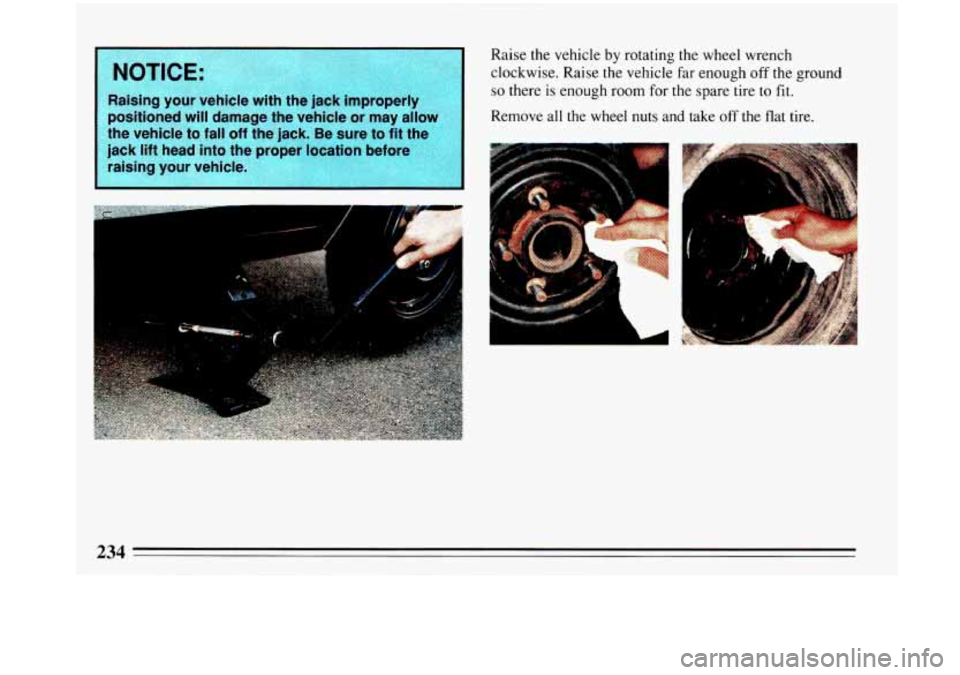
Raise the vehicle by rotating the wheel wrencn
clockwise. Raise the vehicle far enough
off the ground
so there is enough room for the spare tire to fit. Raising your vehicle with the jack improperly ~~
Remove all the wheel nuts and take off the flat tire.
ProCarManuals.com