warning lights BUICK PARK AVENUE 1993 Owners Manual
[x] Cancel search | Manufacturer: BUICK, Model Year: 1993, Model line: PARK AVENUE, Model: BUICK PARK AVENUE 1993Pages: 340, PDF Size: 18.17 MB
Page 14 of 340
!
!
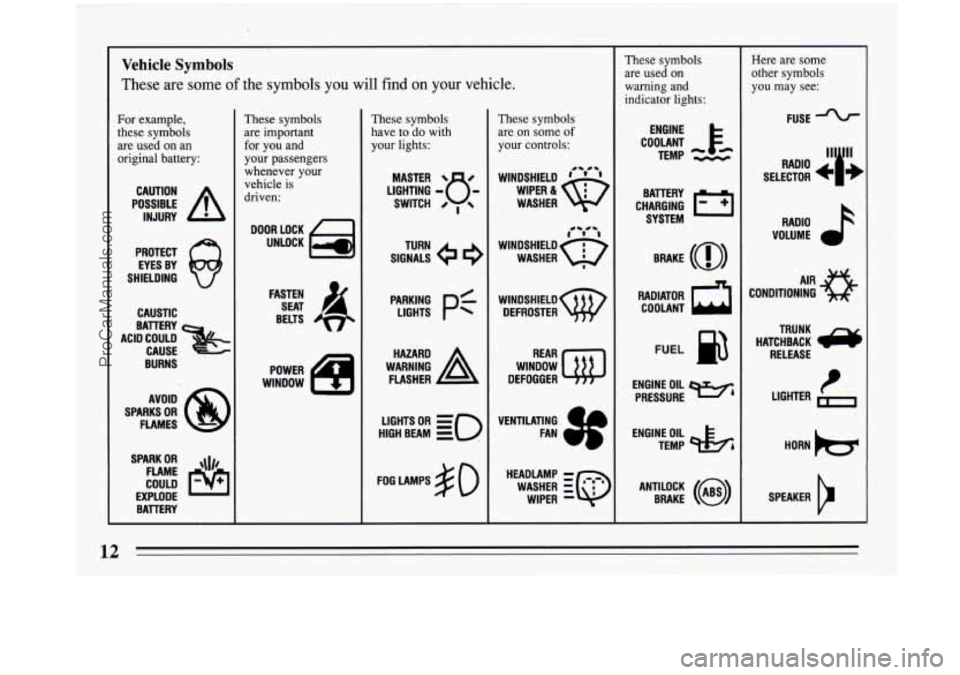
Vehicle Symbols
These are some of the symbols you will find on your vehicle.
For example,
these symbols
are used on an
original battery:
POSSIBLE A
CAUTION
INJURY
PROTECT
EYES BY
SHIELDING
CAUSTIC
ACID COULD BATTERY
CAUSE
BURNS
SPARK
OR ,\I/,
COULD FLAME
EXPLODE BATTERY
These symbols are important
for you and
your passengers
whenever your
vehicle is
driven:
DOOR LOCK
UNLOCK
FASTEN SEAT
4
BELTS
POWER
WINDOW
These symbols have to do with
your lights:
LIGHTS PC
HIGH BEAM OR = =o
FOG LAMPS $0
These symbols
are on some
of
your controls:
WINDSHIELD ' ' '
WASHER
l0 'r' -1
WINDSHIELD 6$
WASHER 8
WINDSHIELD
DEFROSTER
WINDOW
DEFOGGER
VENTILATING FAN
3f
HEADLAMP -
WIPER -
WASHER iQ
These symbols
are used on
warning and
indicator lights:
COOLANT F-
TEMP --
ENGINE
RADIATOR
a
COOLANT
FUEL
ENGINE OIL wb
PRESSURE
TEMP
OIL &4
ANTILOCK (a)
BRAKE
Here are some
other symbols
you may see:
FUSE
RADIO
>
VOLUME
HATCHBACK
e
TRUNK
RELEASE
LIGHTER
1-1
HORN )tr
SPEAKER
b
ProCarManuals.com
Page 61 of 340
Part 2 Features & Controls
Here you can learn about the many standard and optional features on your Buick. and information on starting. shifting
and braking
. Also explained are the instrument panel and the warning systems that tell you if everything is working
properly
.. and what to do if you have a problem .
Keys ........................................................................\
.... 60
DoorLocks
....................................................................... \
62
NewVehicleBreak-In .............................................................. 74
StartingtheEngine ................................................................. 76
ShiftingtheTransaxle
.............................................................. 80
Windows ........................................................................\
. 90
TiltSteeringWheel
................................................................ 90
Multi-FunctionLever
............................................................... 91
TurnandLaneChangeSignals ................................................... 91
Headlight High-Low Beam Change Signals
......................................... 91
WindshieldWiper/Washer
...................................................... 94
CruiseControl ................................................................ 96
Instrumentpanel
................................................................... 116
Speedometer and Odometer
..................................................... 117
Warning Lights and Gages
...................................................... 117
59
~ .. . ~ .. .. _.__~ ....... - ...... ... ..._- .... -
ProCarManuals.com
Page 103 of 340
I
I
To Erase Speed Memory
When you turn off the Cruise Control or the ignition, or
shift into
“P” (Park), your Cruise Control ,set speed
memory is erased.
Lights
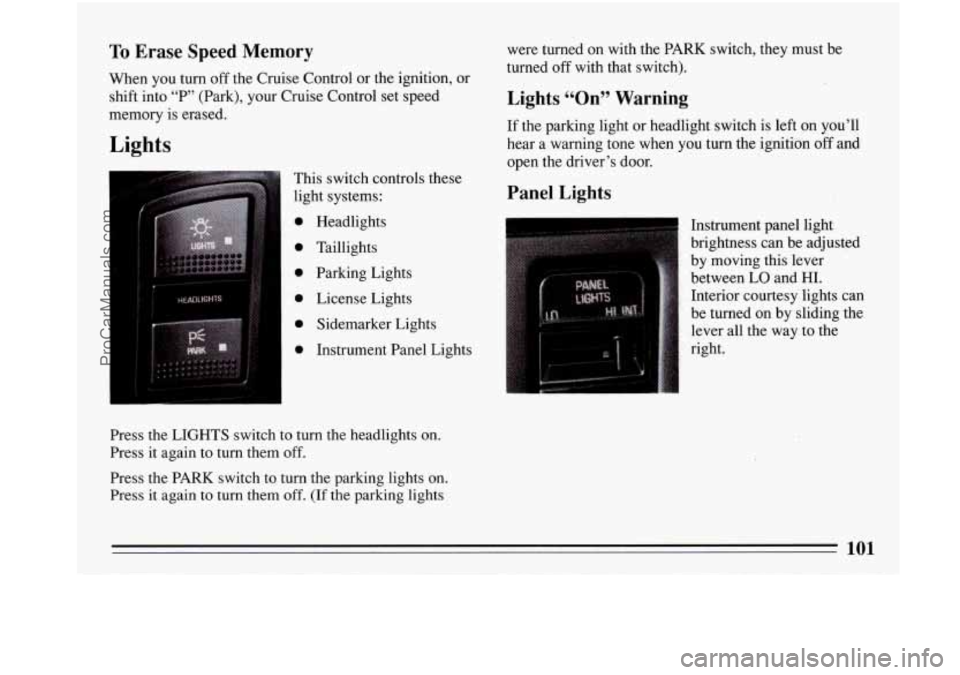
This switch controls these
light systems:
0 Headlights
0 Taillights
0 Parking Lights
0 License Lights
0 Sidemarker Lights
0 Instrument Panel Lights
Press the LIGHTS switch’to turn the headlights on.
Press it again to turn them
off.
Press the PARK switch to turn the parking lights on.
Press it again
to turn them off. (If the parking lights were turned
on with the PARK switch, they must be
turned
off with that switch).
Lights CCOn” Warning
If the parking light or headlight switch is left on you’ll
hear
a warning tone when you turn the ignition off and.
open the driver’s door.
Panel Lights
Instrument panel light
brightness can be adjusted
by moving this lever
between LO and HI.
Interior courtesy lights can
be turned on by sliding the
.lever all the way to the
right.
101
ProCarManuals.com
Page 119 of 340
Speedometer and Odometer
Your speedometer lets you see your speed in both miles
per hour (mph) and kilometers per hour (km/h). Your
odometer shows how far your vehicle has been driven,
in either miles (used in the
U.S.) or kilometers (used in
Canada).
Your Buick has a “tamper-resistant odometer.”
If you
can see very noticeable bright silver lines between the
numbers, probably someone has tried to turn it back.
The numbers may not be true.
You may wonder what happens if a car has to have a
new odometer installed. If possible, the new one has to
be set
to the same reading the old one had. If it can’t be,
then it’s set at zero, but
a label on the driver’s door must
show the old reading and when the new one was
installed.
Trip Odometer
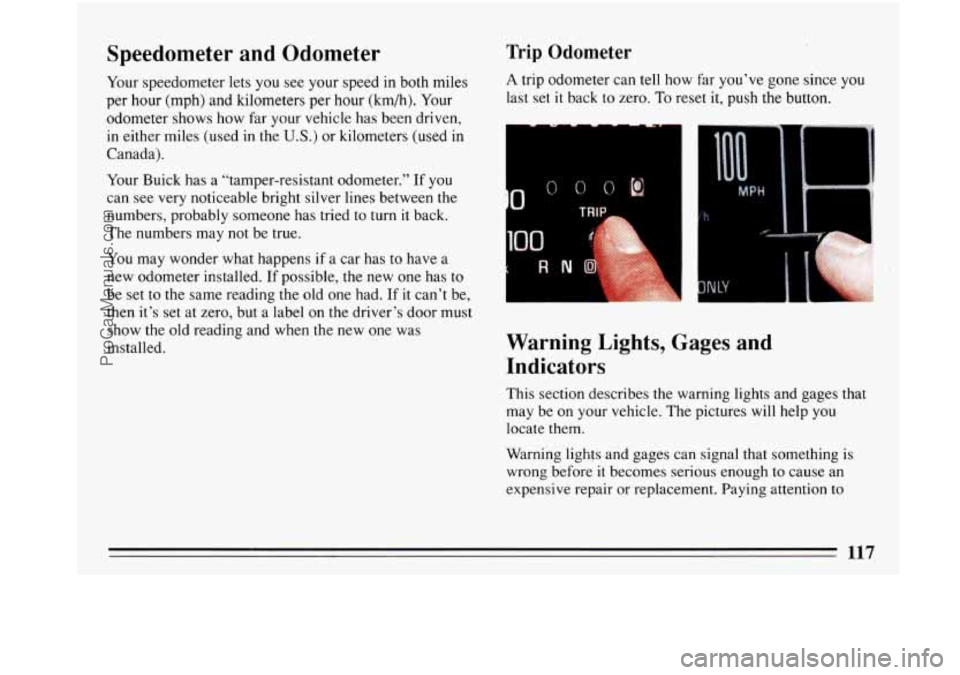
A trip odometer can tell how far you’ve gone since you
last set it back to zero. To reset it, push the button.
Warning Lights, Gages and
Indicators
This section describes the warning lights and gages that
may be on your vehicle. The pictures will help you
locate them.
Warning lights and gages can signal that something
is
wrong before it becomes serious enough to cause an
expensive repair or replacement. Paying attention
to
117
ProCarManuals.com
Page 120 of 340
your warning lights and gages could also save you or
others from injury.
Warning lights go on when there may be or is a problem
with one of your vehicle’s functions.
As you will see in
the details on the next few pages, some warning lights
come on briefly when you turn the ignition key just to
let you know they’re working.
If you are familiar with
this section, you should not be alarmed when this
happens.
Gages can indicate when there may be or
is a problem
with one of your vehicle’s functions. Often gages and
warning lights work together to let you know when
there’s a problem with your vehicle.
When one
of the warning lights comes on and stays on
when you are driving, or when one of the gages shows
there may be a problem, check the section that tells you
what to do about it. Please follow the manual’s advice.
Waiting to do repairs can be costly
-- and even
dangerous.
So please get to know your warning lights
and gages. They’re a big help.
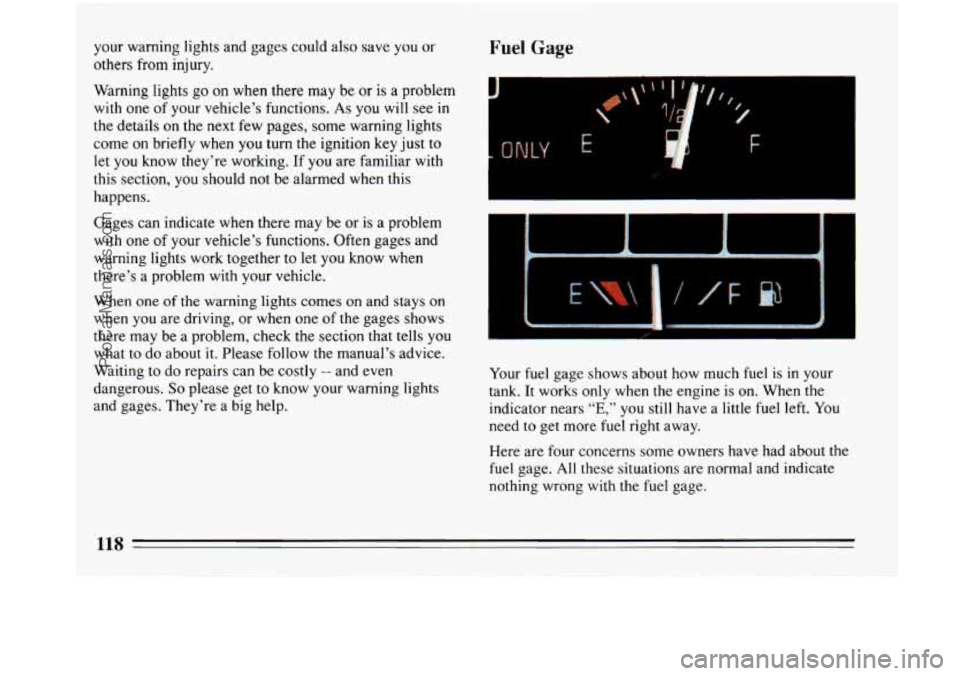
Fuel Gage
Your fuel gage shows about how much fuel is in your
tank. It works only when the engine is on. When the
indicator nears
“E,” you still have a little fuel left. You
need to
get more fuel right away.
Here are four concerns some owners have had about the
fuel gage. All these situations are normal and indicate
nothing wrong
with the fuel gage.
ProCarManuals.com
Page 168 of 340
time. A green arrow means you may drive in that lane.
Look for the signs posted to warn drivers what hours
and days these systems are in effect.
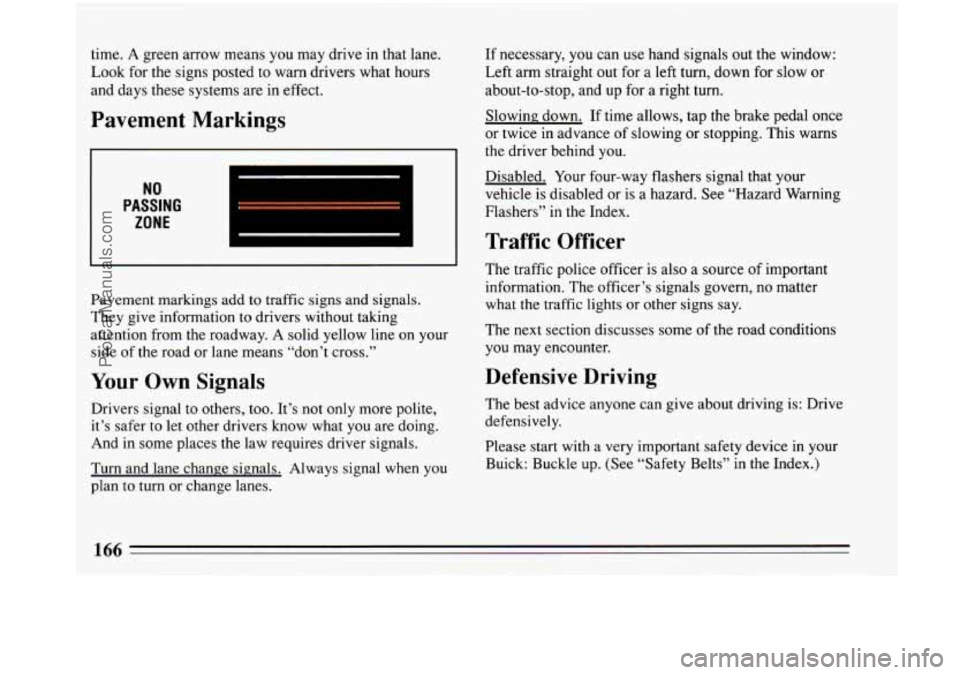
Pavement Markings
NO
PASSING
ZONE
Pavement markings add to traffic signs and signals.
They give information to drivers without taking
attention from the roadway. A solid yellow line
on your
side of the road
or lane means “don’t cross.”
Your Own Signals
Drivers signal to others, too. It’s not only more polite,
it’s safer to let other drivers know what you are doing.
And in some places the law requires driver signals.
Turn and lane change signals. Always signal when you
plan to turn or change lanes.
If necessary, you can use hand signals out the window:
Left arm straight
out for a left turn, down for slow or
about-to-stop, and up for a right turn.
Slowing down. If time allows, tap the brake pedal once
or twice in advance of slowing or stopping. This warns
the driver behind you.
Disabled. Your four-way flashers signal that your
vehicle
is disabled or is a hazard. See “Hazard Warning
Flashers” in the Index.
Traffic Officer
The traffic police officer is also a source of important
information. The officer’s signals govern, no matter
what the traffic lights or other signs say.
The next section discusses some of the road conditions
you may encounter.
Defensive Driving
The best advice anyone can give about driving is: Drive
defensively.
Please start with a very important safety device in your
Buick: Buckle up. (See “Safety Belts” in the Index.)
ProCarManuals.com
Page 183 of 340
vehicle is skidding. Learn to recognize warning clues --
such as enough water, ice or packed snow on the road to
make a “mirrored surface”
-- and slow down when you
have any doubt.
Remember: Any anti-lock braking system (ABS) helps
avoid only the braking skid. Steer the way
you want to
go-
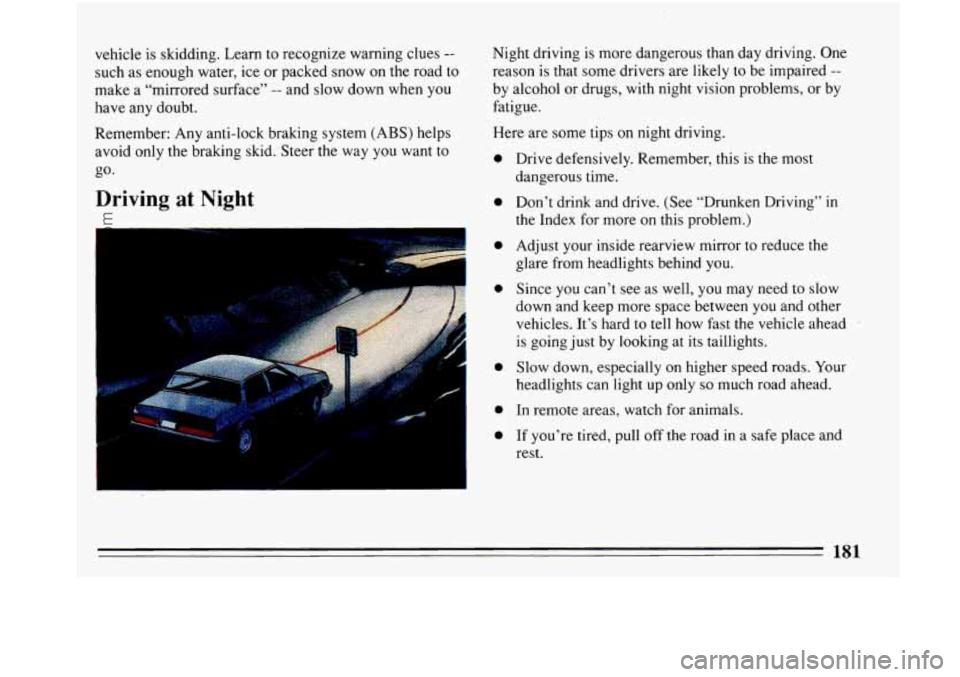
Driving at Night
...,.
.. -
Night driving is more dangerous than day driving. One
reason
is that some drivers are likely to be impaired --
by alcohol or drugs, with night vision problems, or by
fatigue.
Here are some tips on night driving.
0
0
0
c
0
0
0
Drive defensively. Remember, this is the most
dangerous time.
Don’t drink and drive. (See “Drunken Driving” in
the Index for more on this problem.)
Adjust your inside rearview mirror to reduce the
glare from headlights behind you.
Since you can’t see as well, you may need to slow
down and keep more space between you and other
vehicles. It’s hard
to tell how fast the vehicle ahead .
is going just by looking at its taillights.
Slow down, especially on higher speed roads. Your
headlights can light up only
so much road ahead.
In remote areas, watch for animals.
If you’re tired, pull off the road in a safe place and
rest.
ProCarManuals.com
Page 189 of 340
Tips on Driving in Fog
If you get caught in fog, turn your headlights on low
beam, even
in daytime. You’ll see -- and be seen --
better.
Don’t
use your high beams. The light will bounce off
the water droplets that make up fog and reflect back at
you.
Use your defogger. In high humidity, even a light
buildup of moisture on the inside of the glass will cut
down on your already limited visibility.
Run your
windshield wipers and washer occasionally. Moisture
can build up on the outside glass, and what seems to be
fog may actually be moisture
on the outside of your
windshield.
Treat dense fog as an emergency. Try to find a place
IO
pull off the road. Of course you want to respect
another’s property, but you might need
to put something
between you and moving vehicles
-- space, trees,
telephone poles, a private driveway, anything that
removes
you from other traffic.
If visibility is near zero and
you must stop but are
unsure whether you are away from the road, turn your
lights on, start your hazard warning flashers, and sound
your horn at intervals or when you hear approaching
traffic. Pass
other vehicles in fog only if you
can see far enough
ahead to pass safely. Even then, be prepared to delay
your pass if you suspect the fog is worse up ahead.
If
other vehicles try to pass you, make it easy for them.
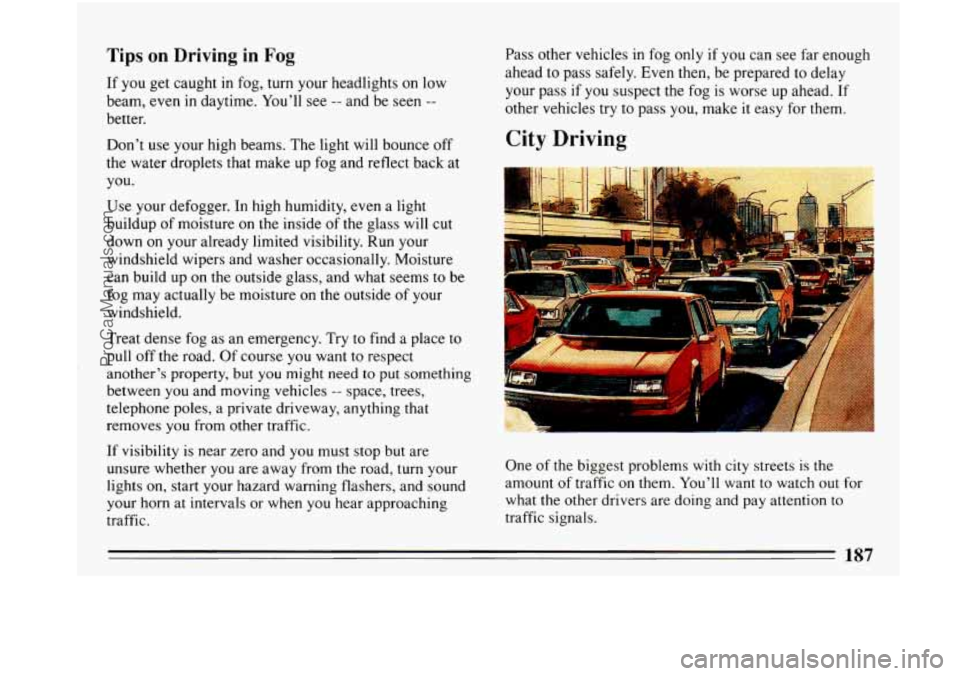
City Driving
L
One of the biggest problems with city streets is the
amount
of traffic on them. You’ll want to watch out for
what
the other drivers are doing and pay attention to
traffic signals.
187
ProCarManuals.com
Page 192 of 340
braking before moving onto the exit ramp.
Unfortunately, not all deceleration
lanes are long enough
-- some are too short for all the braking. Decide when to
start braking. If you must brake on the through lane, and
if there is traffic close behind
you, you can allow a little
extra time and flash your brake lights (in addition to
your turn signal) as extra warning that you are about to
slow down and exit.
The exit ramp can be curved, sometimes quite sharply.
The exit speed is usually posted. Reduce your speed
according to your speedometer, not to your sense of
motion. After driving for any distance at higher speeds,
you may tend
to think you are going slower than you
actually are. For example,
40 mph (65 km/h) might
seem like only
20 mph (30 km/h). Obviously, this could
lead to serious trouble on a ramp designed for
20 mph
(30 km/h)!
Driving a Long Distance
Although most long trips today are made on freeways,
there are still many made on regular highways.
Long-distance driving on freeways and regular
highways
is the same in some ways. The trip has to be
planned and
the vehicle prepared, you drive at
higher-than-city speeds, and there are longer turns
behind the wheel. You’ll enjoy your trip more
if you and your vehicle
are in good shape. Here are some tips for a
successful long trip.
Before Leaving on a Long Trip
Make sure you’re ready. Try to be well rested. If you
must start when you’re not fresh -- such as after a day’s
work
-- don’t plan to make too many miles that first part
of the journey. Wear comfortable clothing and shoes you
can easily drive
in.
Is your vehicle ready for a long trip? If you keep it
serviced and maintained, it’s ready to go. If it needs
service, have it done before starting out. Of course,
you’ll find experienced and able service experts in
Buick dealerships all across North America. They’ll be
ready and willing to help if
you need it.
Here are some things you can check before a trip:
Windshield Washer Fluid: Is the reservoir full? Are
all windows clean inside and outside?
0 Wiper Blades: Are they in good shape?
Fuel, Engine Oil, Other Fluids: Have you checked
Lights: Are they all working? Are the lenses clean?
Tires: They are vitally important to a safe,
all levels?
trouble-free trip. Is
the tread good enough
for
ProCarManuals.com
Page 208 of 340
the trailer lights will also flash, telling other drivers
you’re about to turn, change lanes or stop.
When towing a trailer, the green arrows
on your
instrument panel will flash for turns even
if the bulbs on
the trailer are burned out. Thus, you may think drivers
behind you are seeing your signal when they are not. It’s
important to check occasionally to be sure the trailer
bulbs are still working.
Your vehicle has bulb warning lights. When you plug
trailer lights into your vehicle’s lighting system, its bulb warning lights may not
let you know if one of your
lights goes
out. So, when you have trailer lights plugged
in, be sure
to check your vehicle and trailer lights from
time to time to be sure they’re-all working. Once
you
disconnect the trailer lights, the bulb warning lights
again can
tell you if one of your vehicle lights is out.
Driving On Grades
Reduce speed and shift to a lower gear before you start
down a long
or steep downgrade. If you don’t shift
down, you might have to use your brakes
so much that
they would get hot and no longer work well. On
a long uphill grade, shift down to
“D or 3” (Drive)
and reduce your speed to around
45 mph (70 km/h) to
reduce the possibility of engine and transaxle
overheating.
Parking on Hills
You really should not park your vehicle, with a trailer
attached,
on a hill. If something goes wrong, your rig
could start to move. People can be injured, and both
your vehicle and the trailer can be damaged.
But
if you ever have to park your rig on a hill, here’s
how to do it:
1. Apply your regular brakes, but don’t shift into “F’”
(Park) yet.
2. Have someone place chocks under the trailer wheels.
3. When the wheel chocks are in place, release the
regular brakes until the chocks absorb the load.
4. Reapply the regular brakes. Then apply your parking
brake, and
then shift to “P’ (Park).
5. Release the regular brakes.
ProCarManuals.com