light BUICK PARK AVENUE 1994 Repair Manual
[x] Cancel search | Manufacturer: BUICK, Model Year: 1994, Model line: PARK AVENUE, Model: BUICK PARK AVENUE 1994Pages: 324, PDF Size: 17.01 MB
Page 190 of 324
Run your engine only as long as you must. This saves
fuel. When you run the engine, make it go a little faster
than just idle. That is, push the accelerator slightly. This
uses less fuel
for the heat that you get and it keeps the
battery charged.
You will need a well-charged battery to
restart the vehicle, and possibly for signaling later
on
with your headlights. Let the heater run for awhile.
Then, shut the engine off and close the window almost
all the way to preserve the heat. Start the engine again
and repeat this only when
you feel really uncomfortable
from the cold. But
do it as little as possible. Preserve the
fuel as long as you can. To help keep warm, you can get
out of the vehicle and do some fairly vigorous exercises
every half hour or
so until help comes.
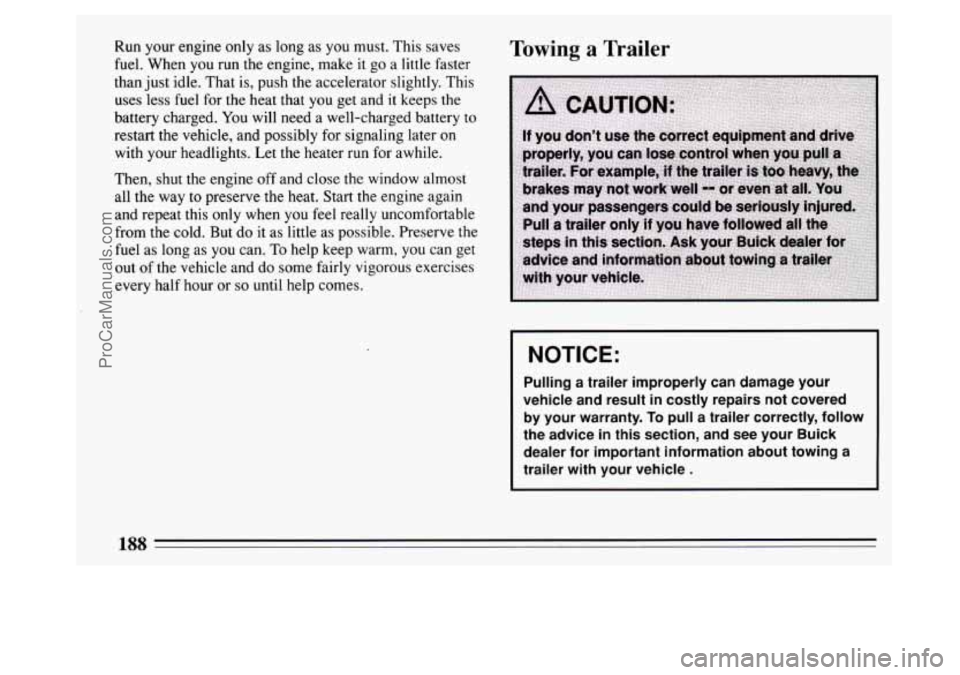
Towing a Trailer
NOTICE:
Pulling a trailer improperly can damage your
vehicle and result in costly repairs not covered
by your warranty.
To pull a trailer correctly, follow
the advice in this section, and see your Buick
dealer for important information about towing
a
trailer with your vehicle .
188
ProCarManuals.com
Page 194 of 324
the trailer brakes so you’ll be able to install, adjust and
maintain them properly. Because you have anti-lock
brakes, do not try
to tap into you vehicle’s brake system.
If
you do, both brake systems won’t work well, or at all.
Driving with a Trailer
Towing a trailer requires a certain amount of experience.
Before setting out for the open road, you’ll want to get
to know your rig. Acquaint yourself with the feel of
handling and braking with the added weight of the
trailer. And always keep in mind that the vehicle you are
driving is now a good deal longer and not nearly
so
responsive as your vehicle is by itself.
Before you start, check the trailer hitch and platform,
safety chains, electrical connector, lights, tires and
mirror adjustment. If the trailer has electric brakes, start
your vehicle and trailer moving and then apply the
trailer brake controller by hand to be sure the brakes are
working. This lets you check your electrical connection
at the same time.
During your trip, check occasionally to be sure that the
load is secure, and that the lights and any trailer brakes
are still working.
Following Distance
Stay at least twice as far behind the vehicle ahead as you
would when driving your vehicle without a trailer. This
can help you avoid situations that require heavy braking
and sudden turns.
Passing
You’ll need more passing distance up ahead when
you’re towing a trailer. And, because you’re a good deal
longer, you’ll need
to go much farther beyond the
passed vehicle before you can return to your lane.
Backing Up
Hold the bottom of the steering wheel with one hand.
Then, to move the trailer to the
left, just move that hand
to the left.
To move the trailer to the right, move your
hand to the right. Always back up slowly and,
if
possible, have someone guide you.
Making Turns
When you’re turning with a trailer, make wider turns
than normal.
Do this so your trailer won’t strike soft
shoulders, curbs, road signs, trees, or other objects.
Avoid jerky or sudden maneuvers. Signal well in
advance.
192
ProCarManuals.com
Page 195 of 324
Turn Signals When Towing a Trailer
When you tow a trailer, your vehicle has to have a
different turn signal flasher and extra wiring. The green
arrows on your instrument panel
will flash whenever
you signal a turn or lane change. Properly hooked up,
the trailer lights
will also flash, telling other drivers
you’re about to turn, change lanes or stop.
When towing a trailer, the green arrows on your
instrument panel will flash for turns even
if the bulbs on
the trailer are burned out. Thus, you may
think drivers
behind you are seeing your signal when they are not. It’s
important to check occasionally to be sure the trailer
bulbs are still working.
Your vehicle has bulb warning lights. When you plug
trailer lights into your vehicle’s lighting system, its bulb
warning lights may not
let you know if one of your
lights goes out.
So, when you have trailer lights plugged
in, be sure to check your vehicle and trailer lights from
time to time to be sure they’re all working. Once you
disconnect the trailer lights, the bulb warning lights
again can tell you
if one of your vehicle lights is out.
Driving On Grades
Reduce speed and shift to a lower gear before you start
down a long or steep downgrade. If you don’t shift down,
you might have to use your brakes
so much that
they would get hot and no longer work well.
On a long uphill grade, shift down to “D or 3” (Drive)
and reduce your speed to around
45 mph (70 km/h) to
reduce the possibility of engine and transaxle
overheating.
Parking on Hills
You really should not park your vehicle, with a trailer
attached,
on a hill. If something goes wrong, your rig
could start to move. People can be injured, and both
your vehicle and the trailer can be damaged.
But
if you ever have to park your rig on a hill, here’s
how
to do it:
1. Apply your regular brakes, but don’t shift into “P”
(Park) yet.
2. Have someone place chocks under the trailer wheels.
3. When the wheel chocks are in place, release the
regular brakes until the chocks absorb the load.
4. Reapply the regular brakes. Then apply your parking
brake, and the shift to
“P” (Park).
5. Release the regular brakes.
193
ProCarManuals.com
Page 198 of 324
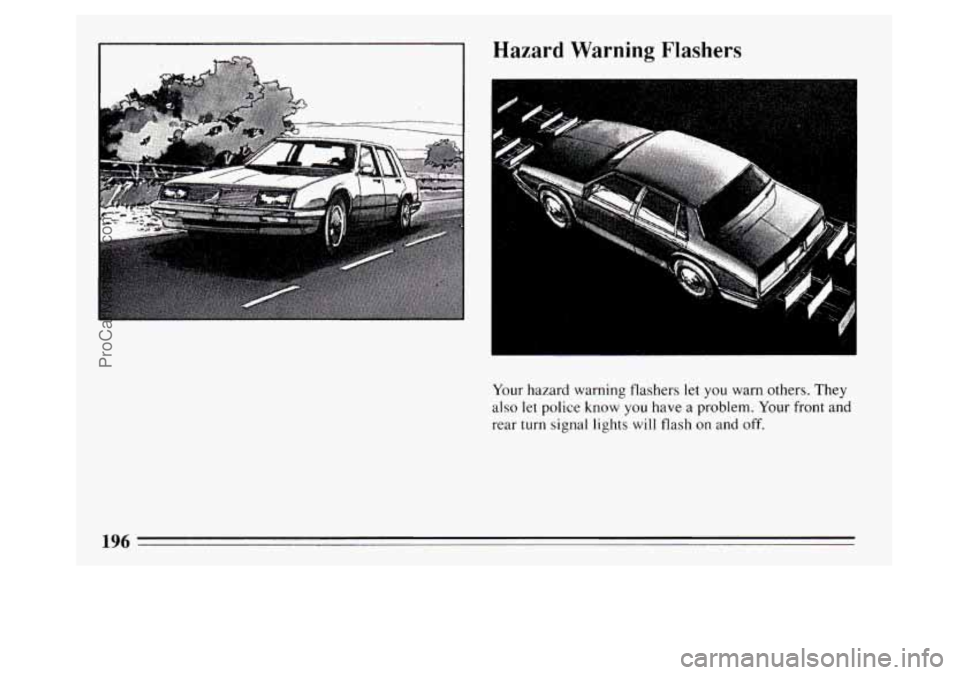
Hazard Warning Flashers
Your hazard warning flashers let you warn others. They
also let police
know you have a problem. Your front and
rear turn signal lights
will flash on and off.
196
ProCarManuals.com
Page 199 of 324
e I
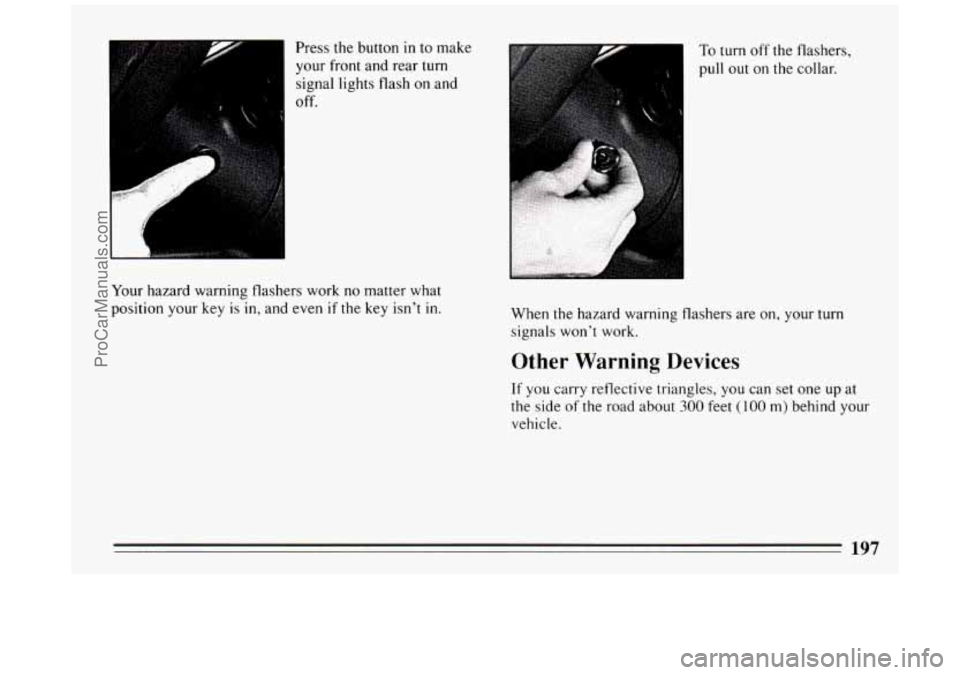
Press the button in to make
your front and rear turn
signal lights flash
on and
off.
I
Your hazard warning flashers work no matter what
position your key is in, and even
if the key isn’t in.
To turn off the flashers,
pull
out on the collar.
When
the hazard warning flashers are on, your turn
signals won’t work.
Other Warning Devices
If you carry reflective triangles, you can set one up at
the side of the road about
300 feet (100 m) behind your
vehicle.
197
ProCarManuals.com
Page 201 of 324
You could be injured if the vehicles roll. Set the
parking brake firmly
on each vehicle. Put an
automatic transaxle
in “P” (Park) or a manual
transaxle in “N” (Neutral).
3. Turn off the ignition on both vehicles. Turn off the
radios and all lights that aren’t needed. This
will
avoid sparks and help save both batteries. It could
save your radio!
NOTICE:
If you leave your radio on, it could be badly
damaged. The repairs wouldn’t be covered by
your warranty.
4. Open the hoods and locate the batteries. Find the positive
(+) and negative (-) terminals
on
each battery.
199
ProCarManuals.com
Page 209 of 324
Engine Overheating
You will find a warning light about a hot engine on your
Buick instrument panel and if you have the optional
gage cluster, a coolant temperature gage. You will also
find a low coolant warning light.
If Steam Is Coming From Your Engine
NOTICE:
If your engine catches fire because you keep
driving with no coolant, your vehicle can be
badly damaged. The costly repairs would not be
covered by your warranty.
If NO Steam Is Coming From Your Engine
If you get the overheat warning but see or hear no
steam, the problem may not be too serious. Sometimes
the engine can get a little too hot when you:
Climb a long hill on a hot day.
Stop after high speed driving.
0 Idle for long periods in traffic.
0 Tow a trailer.
207
ProCarManuals.com
Page 228 of 324
NOTICE:
Spinning your wheels can destroy parts of your
vehicle as well as the tires.
If you spin the wheels
too fast while shifting your transaxle back and
forth, you can destroy your transaxle.
Rocking your vehicle to get it out:
First, turn your steering wheel left and right. That will
clear the area around your front wheels. You should turn
your traction control system off. (See “Traction Control
System” in
the Index.) Then shift back and forth
between
“R” (Reverse) and a forward gear, spinning the
wheels as little as possible. Release the accelerator pedal
while you shift, and press lightly on the accelerator
pedal when the transaxle is in gear. If that doesn’t get
you out after a few tries,
you may need to be towed out.
If
you do need to be towed out, see “Towing Your Car”
in the Index.
226
ProCarManuals.com
Page 239 of 324
3800 Supercharged (L67) Engine
(Option)
Your Park Avenue Ultra has a 3800 Supercharged
engine. Buick chose supercharging rather than
turbocharging because Buick emphasizes smooth,
refined power.
The Supercharger is a device which is designed to pump
more air into the engine than it would normally use.
This air mixed with fuel, creates increased engine
power. Since
the Supercharger is a pump and is driven
from an engine accessory drive belt, increased pressure
is available at all driving conditions.
The powertrain control module (PCM), works with a
vacuum control to regulate the increased pressure
required during specific driving conditions. When this
increased pressure or boost is not desired, such as during
idling and light throttle cruising, the excess air that the
Supercharger is pumping
is routed through a bypass. All
of these controls, working together provide high
performance character and
fuel efficiency in the 3800
V6 Supercharged Buick engine.
The power steering pump uses a remote reservoir
mounted on the throttle and cruise control cable bracket.
See “Maintenance Schedule’’ in
the Index for when you
should check the fluid.
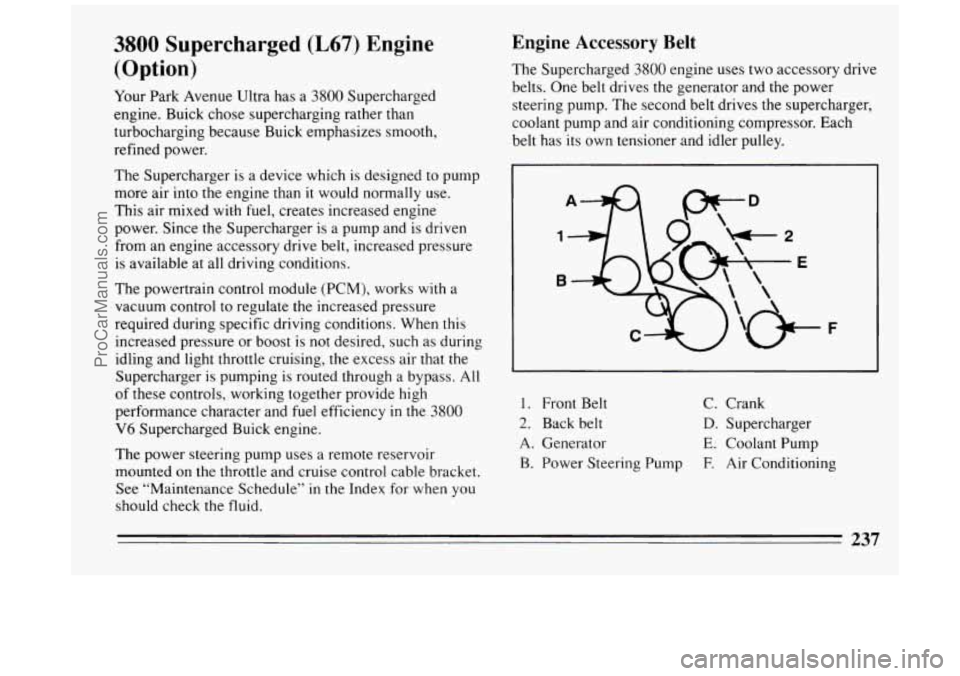
Engine Accessory Belt
The Supercharged 3800 engine uses two accessory drive
belts. One belt drives the generator and the power
steering pump. The second belt drives the supercharger,
coolant pump and air conditioning compressor. Each
belt has its own tensioner and idler pulley.
1. Front Belt
C. Crank
2. Back belt D. Supercharger
A. Generator
E. Coolant Pump
B. Power Steering Pump E Air Conditioning
237
ProCarManuals.com
Page 240 of 324
Supercharger Oil
Unless you are technically qualified and have the proper
tools, you should
let your dealer or a qualified service
center perform this maintenance.
When to Check: Check oil level every 30,000 miles
(50,000 km) or every 36 months.
What Kind of Oil to Use: See “Recommended Fluids and
Lubricants”
in the Index. Use only the recommended oil.
How to Check and Add Oil: Check oil only when the
engine is cold. Allow the engine to cool
2 to 3 hours after
running.
1. Remove the wiring harness shield.
2. Clean the area around the oil fill plug before
removing
it.
3. Remove the oil fill plug using a 3/16 allen wrench.
4. The oil level is correct when it just reaches the
bottom
of the threads of the inspection hole.
5. Replace the oil plug with the O-ring in place. Torque
to 10 Nom (88 lb. in.).
6. Replace the wiring harness shield.
Engine Oil
CHECK
OIL LEVEL
If the “CHECK OIL
LEVEL” light on the
instrument panel
comes on,
it means
you need to check
your engine oil level
right away.
For more information, see “CHECK
OIL LEVEL” light
in the Index. You should check your engine oil level
regularly; this is an added reminder.
238
ProCarManuals.com