light BUICK PARK AVENUE 1994 Manual PDF
[x] Cancel search | Manufacturer: BUICK, Model Year: 1994, Model line: PARK AVENUE, Model: BUICK PARK AVENUE 1994Pages: 324, PDF Size: 17.01 MB
Page 244 of 324

Engine Oil Additives
Don’t add anything to your oil. Your Buick dealer is
ready to advise if you think something should be added.
When to Change Engine Oil
See if any one of these is true for you:
Most trips are less than 4 miles (6 km).
It’s below freezing outside and most trips are less
than
10 miles (16 km).
The engine is at low speed most of the time (as in
door-to-door delivery, or in stop-and-go traffic).
0 You tow a trailer often.
Most trips are through dusty places.
If any one of these is true for your vehicle, then you
need to change your oil and filter every
3,000 miles
(5 000 km) or 3 months -- whichever comes first. (See
“Change Oil Soon” in the Index.) If
none of
them is true, change the oil every 7,500 miles
(12 500 km) or 12 months -- whichever comes first.
Change the filter at the first oil change and at every
other oil change after that.
If the optional “Change Oil Soon” light comes on you
will need to change your oil sooner than either mileage
specified. Depending upon driving habits, the “Change
Oil Soon’’ light may come on
as early as 2,000 miles or
less from the last time the oil life monitor was reset (See
“Oil Life Monitor” in the Index.)
Always reset the oil
life monitor after every oil change.
Engine Coolant Heater (Engine Block
Heater)
An engine coolant heater can be a big help if you have
to park outside in very cold weather,
0°F (- 18 “C) or
colder. If your vehicle has this option, see “Engine
Coolant Heater” in the Index.
242
ProCarManuals.com
Page 249 of 324

Engine Coolant
The following explains your cooling system and how to
add coolant when
it is low. If you have a problem with
engine overheating, see “Engine Overheating” in the
Index.
The proper coolant for your Buick will:
0 Give freezing protection down to -34°F (-37 “C).
0 Give boiling protection up to 262°F (128 “C).
0 Protect against rust and corrosion.
0 Help keep the proper engine temperature,
Let the warning lights work as they should.
What to Use
Use a mixture of one-half clean water (preferably
distilled) and one-half antifreeze that meets “GM
Specification 1825-M,” which won’t damage aluminum
parts.
You can also use a recycled coolant conforming to
GM Specification 1825-M with a complete coolant flush
and refill. If you use this mixture,
you don’t need to add
anything else.
I NOTICE:
If you use an improper coolant mix, your engine
could overheat and be badly damaged. The
repair cost wouldn’t be covered by your
warranty. Too much water in the mix can freeze
and crack the engine, radiator, heater core and
other parts.
247
ProCarManuals.com
Page 250 of 324

Adding Coolant
The coolant recovery tank is located at the left of the
engine compartment.
To Check Coolant
When your engine is cold, the coolant level should be at
“FULL COLD’ or a little higher. When your engine is
warm, the level should be up to
“FULL HOT” or a little
higher.
COOLANT
LOW
If this light comes on, it means you’re low on engine
coolant.
To Add Coolant
If you need more coolant, add the proper mix at the
coolant recovery tank.
248
ProCarManuals.com
Page 254 of 324
Brakes
Brake Master Cylinder
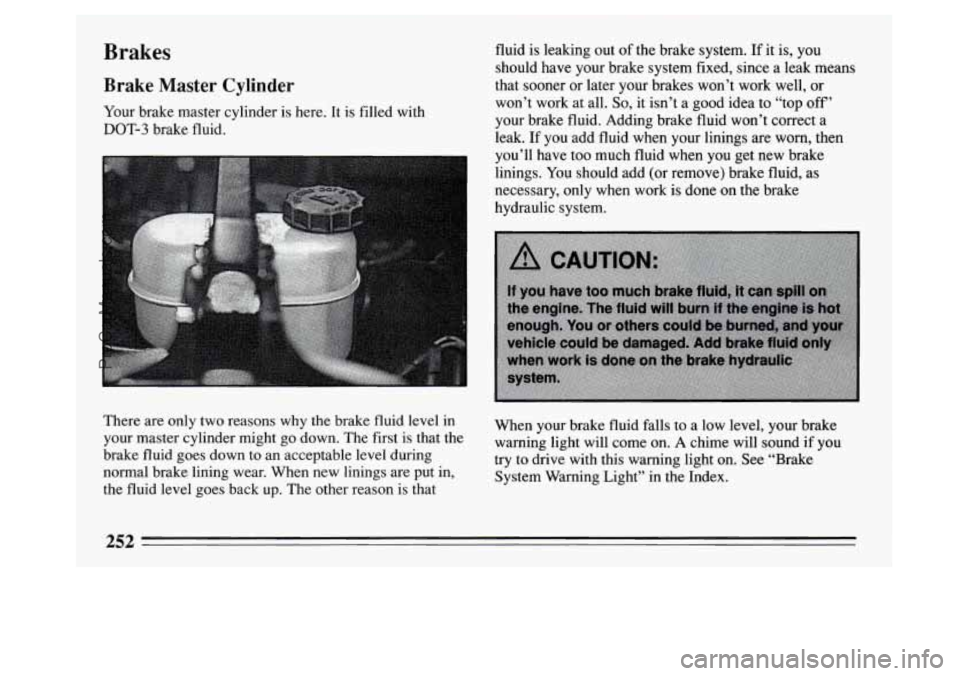
Your brake master cylinder is here. It is filled with
DOT-3 brake fluid. fluid is leaking
out of the brake system. If it is, you
should have your brake system fixed, since a leak means
that sooner or later your brakes won’t work well, or
won’t work at all.
So, it isn’t a good idea to “top off’
your brake fluid. Adding brake fluid won’t correct a
leak. If you add fluid when your linings are worn, then
you’ll have too much fluid when you get new brake
linings.
You should add (or remove) brake fluid, as
necessary, only when work is done on the brake
hydraulic system.
There are only two reasons why the brake fluid level
in
your master cylinder might go down. The first is that the
brake fluid goes down to an acceptable level during
normal brake lining wear. When new linings are put in,
the fluid level goes back up. The other reason is that When
your brake fluid falls to a low level, your brake
warning light will come on. A chime will sound if you
try to drive with this warning light on. See “Brake
System Warning Light” in the Index.
252
ProCarManuals.com
Page 256 of 324
I 1 Brake Adiustment
I NOTICE:
I
Continuing to drive with worn-out brake pads
could result in costly brake repair.
- - __-- - - - -- tJ-----------
I Every time you apply the brakes moderately, with or
Some driving conditions or climates may cause a brake
squeal when the brakes are first applied or
lightly
applied. This does not mean something is wrong with
your brakes.
Your rear drum brakes don’t have wear indicators, but
if
you ever hear a rear brake rubbing noise, have the rear
brake linings inspected. Also, the rear brake drums
should be removed and inspected each time the tires are
removed for rotation or changing. When you have the
front brakes replaced, have the rear brakes inspected,
too.
Brake linings
should always be replaced as complete
axle sets.
Brake Pedal Travel
See your dealer if the brake pedal does not return to
normal height, or if there is a rapid increase
in pedal
travel. This could be a sign
of brake trouble. without the vehicle moving,
your brakes adjust for wear.
Replacing Brake System Parts
The braking system on a modern vehicle is complex. Its
many parts have to be of top quality and work well
together
if the vehicle is to have really good braking.
Vehicles we design and test have top-quality
GM brake
parts
in them, as your Buick does when it is new. When
you replace parts of your braking system
-- for example,
when your brake linings wear down and you have
to
have new ones put in -- be sure you get new genuine
GM replacement parts. If you don’t, your brakes may no
longer work properly. For example,
if someone puts in
brake linings that are wrong for your vehicle, the
balance between your front and rear brakes can change,
for the worse. The braking performance you’ve come to
expect can change
in many other ways if someone puts
in the wrong replacement brake parts.
254
ProCarManuals.com
Page 259 of 324
Turn the bulb socket 1/4
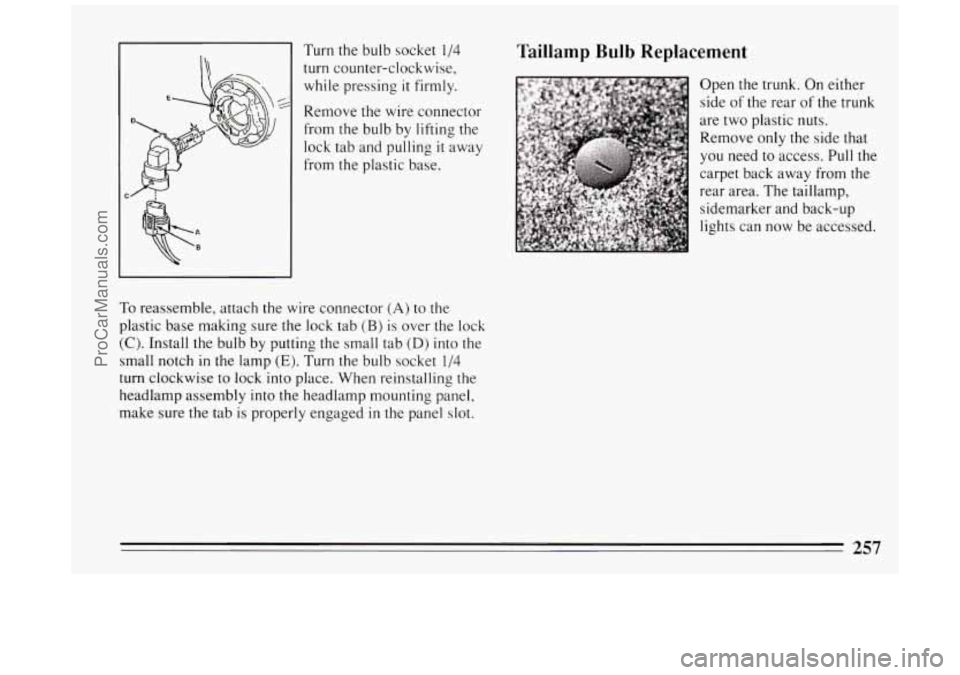
turn counter-clockwise,
while pressing
it firmly.
Remove
the wire connector
from the bulb by lifting
the
lock tab and pulling it away
from the plastic base.
To reassemble, attach the wire connector (A) to the
plastic base making sure the lock tab
(B) is over the lock
(C). Install the bulb by putting the small tab (D) into the
small notch
in the lamp (E). Turn the bulb socket 1/4
turn clockwise to lock into place. When reinstalling the
headlamp assembly
into the headlamp mounting panel,
make sure
the tab is properly engaged in the panel slot.
Taillamp Bulb Replacement
Open the trunk. On either
side
of the rear of the trunk
are two plastic nuts.
Remove only the side that
you need
to access. Pull the
carpet back away from the
rear area. The taillamp,
sidemarker and back-up
lights can now be accessed.
257
ProCarManuals.com
Page 260 of 324
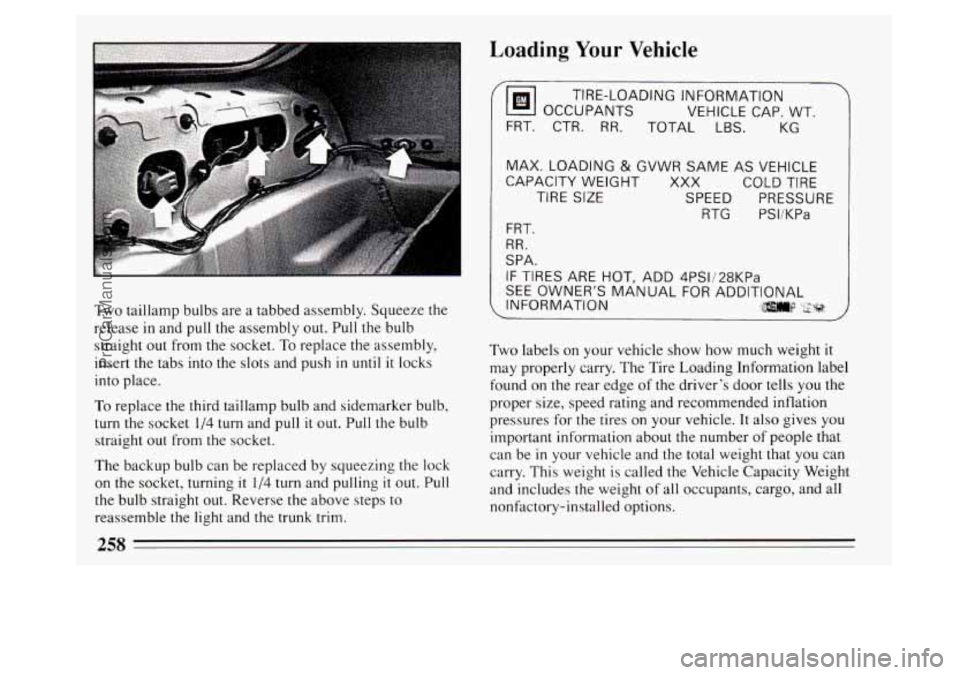
Two taillamp bulbs are a tabbed assembly. Squeeze the
release
in and pull the assembly out. Pull the bulb
straight out from the socket. To replace the assembly,
insert the tabs into the slots and push
in until it locks
into place.
To replace the third taillamp bulb and sidemarker bulb,
turn the socket 1/4 turn and pull it out. Pull the bulb
straight out from the socket.
The backup bulb can be replaced by squeezing the lock
on the socket, turning it
1/4 turn and pulling it out. Pull
the bulb straight out. Reverse the above steps to
reassemble the light and the trunk trim.
Loading Your Vehicle
%I OCCUPANTS
VEHICLE CAP. WT.
TIRE-LOADING INFORMATION
FRT. CTR.
RR. TOTAL LBS. KG
MAX. LOADING
& GVWR SAME AS VEHICLE
CAPACITY WEIGHT XXX
COLD TIRE
TIRE
SIZE SPEED PRESSURE
RTG PSliKPa
FRT.
RR.
SPA.
IF TIRES ARE HOT, ADD 4PS1/28KPa
SEE OWNER'S MANUAL FOR ADDITIONAL
( INFORMATION \]]!mlp ,j;;f&ip
Two labels on your vehicle show how much weight it
may properly carry. The Tire Loading Information label
found on the rear edge of the driver's door tells
you the
proper size, speed rating and recommended inflation
pressures for the tires on your vehicle.
It also gives you
important information about the number of people that
can be
in your vehicle and the total weight that you can
carry. This weight is called the Vehicle Capacity Weight
and includes the weight
of all occupants, cargo, and all
nonfactory-installed options.
ProCarManuals.com
Page 268 of 324
In most cases, you will not need to have your wheels
aligned again. However, if you notice unusual tire wear
or your vehicle pulling one way or the other,
the
alignment may need to be reset. If you notice your
vehicle vibrating when driving on a smooth road, your
wheels may need to be rebalanced.
Wheel Replacement
Replace any wheel that is bent, cracked or badly rusted.
If wheel nuts keep coming loose, the wheel, wheel bolts,
and wheel nuts should be replaced. If the wheel leaks
air, replace
it (except some aluminum wheels, which can
sometimes be repaired). See your Buick dealer if any
of
these conditions exist.
Your dealer
will know the kind of wheel you need.
Each new wheel should have the same load carrying
capacity, diameter, width, offset, and be mounted the
same way as the one it replaces.
If
you need to replace any of your wheels, wheel bolts,
or wheel nuts, replace them only with new GM original
equipment parts. This way, you will be sure to have the
right wheel, wheel bolts, and wheel
nuts for your Buick
model.
I NOTICE:
The wrong wheel can also cause problems with
bearing life, brake cooling,
speedometerlodometer calibration, headlight
aim, bumper height, vehicle ground clearance,
and tire or tire chain clearance to the body and
chassis.
266
ProCarManuals.com
Page 271 of 324
Use solvent-type cleaners in a well-ventilated area
only. If
you use them, don’t saturate the stained area.
0 If a ring forms after spot cleaning, clean the entire
area immediately or
it will set.
Using Foam-Type Cleaner on Fabric
0 Vacuum and brush the area to remove any loose dirt.
0 Always clean a whole trim panel or section. Mask
surrounding trim along stitch or welt lines.
0 Mix Multi-Purpose Powdered Cleaner following the
directions on the container label.
0 Use suds only and apply with a clean sponge.
0 Don’t saturate the material.
0 Don’t rub it roughly.
0 As soon as you’ve cleaned the section, use a sponge
to remove the suds.
0 Rinse the section with a clean, wet sponge.
0 Wipe off what’s left with a slightly damp paper towel
or cloth.
0 Then dry it immediately with a blow dryer or a heat
lamp.
I NOTICE:
I
Be careful with a hair dryer or heat lamp. You
could scorch the fabric.
Wipe with a clean cloth.
Using Solvent-Type Cleaner on Fabric
First, see if you have to use solvent-type cleaner at all.
Some spots and stains will clean off better
with just
water and mild soap.
If you need to use a solvent:
0 Gently scrape excess soil from the trim material with
a clean, dull knife or scraper. Use very little cleaner,
light pressure and clean cloths (preferably
cheesecloth). Cleaning should start at the outside of
the stain, “feathering” toward
the center. Keep
changing to a clean section of the cloth.
When you clean a stain from fabric, immediately dry
the area with an air hose, hair dryer, or heat lamp to
help prevent a cleaning ring. (See the previous
NOTICE.)
269
ProCarManuals.com
Page 272 of 324
Special Cleaning Problems
Greasy or Oily Stains
Such as grease, oil, butter, margarine, shoe polish,
coffee with cream, chewing gum, cosmetic creams,
vegetable oils, wax crayon, tar and asphalt.
0 Carefully scrape off excess stain.
Follow the solvent-type instructions described
earlier.
Shoe polish, wax crayon, tar and asphalt will stain if
left on
a vehicle seat fabric. They should be removed
as soon as possible. Be careful, because the cleaner
will dissolve them and may cause them to spread.
Non-Greasy Stains
Such as catsup, coffee (black), egg, fruit, fruit juice,
milk, soft drinks, wine, vomit, urine and blood.
Carefully scrape off excess stain, then sponge the
soiled area with cool water.
If a stain remains, follow the foam-type instructions
described earlier.
If an odor lingers after cleaning vomit or urine,
treat
the area with a waterbaking soda solution:
1 teaspoon (5 ml) of baking soda to 1 cup (250 ml)
of lukewarm water.
If needed, clean lightly with solvent-type cleaner.
Combination Stains
Such as candy, ice cream, mayonnaise, chili sauce and
unknown stains.
0 Carefully scrape off excess stain, then clean with
cool water and allow to dry.
If a stain remains, clean it with solvent-type cleaner.
Cleaning Vinyl
Use warm water and a clean cloth.
Rub with a clean, damp cloth to remove dirt. You
Things like tar, asphalt and shoe polish will stain if
may
have to do
it more than once.
you don’t get them off quickly. Use a clean cloth and
a solvent-type vinyl cleaner.
Cleaning Leather
Use a soft cloth with lukewarm water and a mild soap or
saddle soap.
270
ProCarManuals.com