belt BUICK PARK AVENUE 1996 Owners Manual
[x] Cancel search | Manufacturer: BUICK, Model Year: 1996, Model line: PARK AVENUE, Model: BUICK PARK AVENUE 1996Pages: 388, PDF Size: 20.04 MB
Page 3 of 388
The 1996 Buick Park Avenue Owner’s Manual
Seats and Restraint Systems ............................................................. 1-1
Features and Controls .................................................................. 2-1
Comfort Controls and Audio Systems ..................................................... 3-1
This section tells you how to use your seats and safety belts properly. It also explains “SRS” system.
This section explains how to start and operate your Buick.
This section tells you how to adjust the ventilation and comfort controls and how to operate your
audio system.
Here you’ll find helpful information and tips about the road and how to drive under different conditions.
YourDrivingandtheRoad .............................................................. 4-1
ProblemsontheRoad .................................................................. 5-1
This section tells you what to do if you have a problem while driving, such as a flat tire or
overheated engine, etc.
Here the manual tells you how to keep your Buick’ running properly
and looking good.
This section tells you when to perform vehicle maintenance and what fluids and lubricants to use.
ServiceandAppearanceCare ............................................................ 6-1
Maintenanceschedule .................................................................. 7-1
Customer Assistance Information ........................................................ 8-1
This section tells you how to contact Buick for assistance and how to get service publications. It also
gives you information
on “Reporting Safety Defects” on page 8-7.
Index ........................................................................\
........ 9-1
Here’s an alphabetical listing of almost every subject in this manual. You can use it to quickly find
something you want
to read.
i
ProCarManuals.com
Page 12 of 388
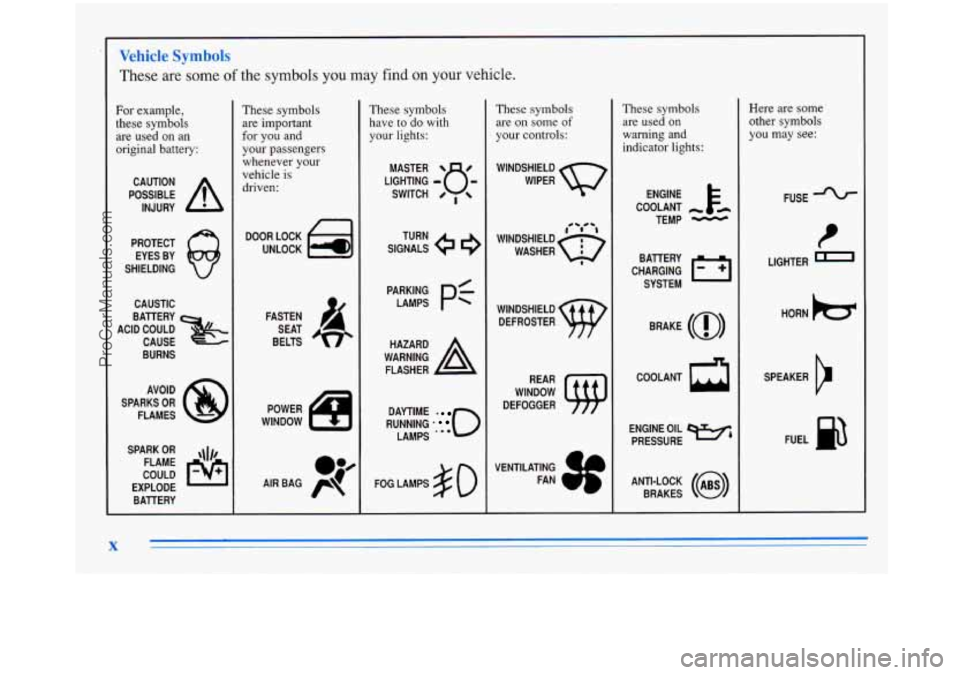
Vehicle Symbols
These are some of the symbols you may find on your vehicle.
For example,
these symbols
are used on an
original battery:
POSSIBLE A
CAUTION
INJURY
PROTECT EYES BY
SHIELDING
CAUSTIC
BURNS AVOID
SPARKS
OR
FLAMES
SPARK
OR ,\I/,
COULD FLAME
EXPLODE BATTERY
These symbols
are important
for you and
your passengers
whenever your
vehicle is driven:
DOOR LOCK
UNLOCK
FASTEN SEAT
BELTS
POWER
WINDOW
These symbols
have to do with
your lights:
SIGNALS e e
TURN
WARNING
A
HAZARD
FLASHER
RUNNING
0
DAYTIME -
LAMPS '**
FOG LAMPS $0
These symbols
are on
some of
your controls:
WINDSHIELD
WIPER
WINDSHIELD DEFROSTER
WINDOW
DEFOGGER
VENTILATING FAN
These symbols are used
on
warning and
indicator lights:
COOLANT
TEMP
-
CHARGING I-1
BATTERY
SYSTEM
BRAKE
(0)
ENGINE OIL e,
PRESSURE
ANTI-LOCK
(@)
BRAKES
Here are some
other symbols you may see:
FUSE
I
LIGHTER I
HORN h=r
SPEAKER
b
FUEL n3
X
ProCarManuals.com
Page 13 of 388
Section 1 Seats and Restraint Systems
Here you’ll find information about the seats in your
Buick and how to use your safety belts properly. You
can also learn about some things you should
not do with
air bags and safety belts.
Seats and Seat Controls
This part tells you about the seats -- how to adjust them,
and also about memory seats, reclining seatbacks and
head restraints.
Manual Seat
You may have a manual seat on the passenger side of
your Park Avenue. Move the lever under the front seat
to unlock it. Slide the seat
to where you want it. Then
release the lever and try to move the seat with your
body, to make sure the seat is locked into place.
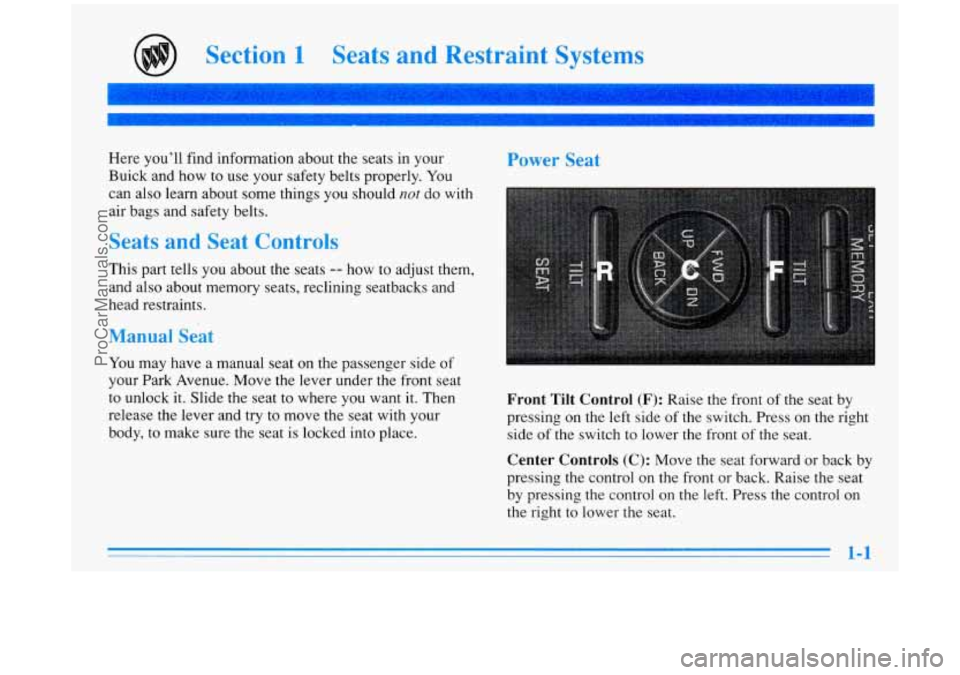
Power Seat
Front Tilt Control (F): Raise the front of the seat by
pressing on the left side of the switch. Press on the right
side of the switch to lower the front of the seat.
Center Controls (C): Move the seat forward or back by
pressing the control on the front or back. Raise the seat
by pressing the control on the left. Press the control on
the right to lower the seat.
1-1
ProCarManuals.com
Page 17 of 388
I
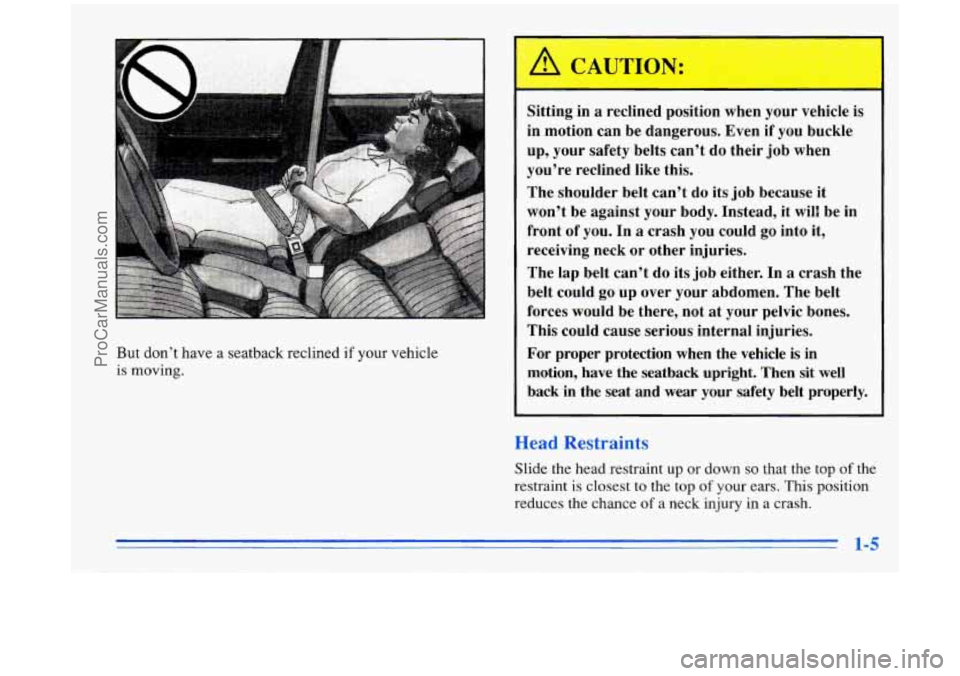
Sitting in a reclined position when your vehicle is
in motion can be dangerous. Even if you buckle
up, your safety belts can’t do their job when
you’re reclined like this.
The shoulder belt can’t do its job because it
won’t be against your body. Instead, it
will be in
front
of you. In a crash you could go into it,
receiving neck or other injuries.
The lap belt can’t do its job either. In
a crash the
belt could
go up over your abdomen. The belt
forces would be there, not at your pelvic bones.
This could cause serious internal injuries.
For proper protection when the vehicle is in
motion, have the seatback upright. Then sit well
back in the seat and wear your safety belt properly.
But don’t
have a seatback reclined if your vehicle
is
moving.
ead Restrain’-
Slide the head restraint up or down so that the top of the
restraint is closest to the top
of your ears. This position
reduces the chance
of a neck injury in a crash.
ProCarManuals.com
Page 18 of 388
Safety Belts: They’re for Everyone
This part of the manual tells you how to use safety belts
properly. It also tells you some things you should not do
with safety belts.
And
it explains the Supplemental Restraint System
(SRS), or air bag system.
A CAUTIOI..
r -
Don’t let anyone ride where he or she can’t wear
a safety belt properly.
If you are in a crash and
you’re not wearing
a safety belt, your injuries
can be much worse.
You can hit things inside the
vehicle or be ejected from
it. You can be seriously
injured or killed. In the same crash, you might
not be if
you are buckled up. Always fasten your
safety belt, and check that your passengers’ belts
are fastened properly too.
1
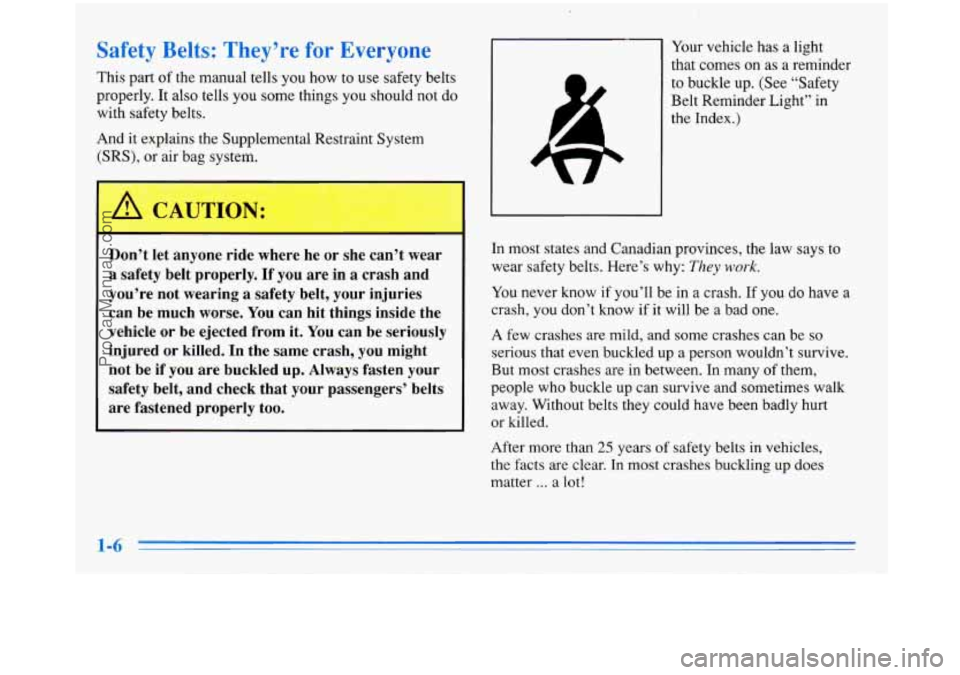
Your vehicle has a light
that comes on as a reminder
to buckle up. (See “Safety
Belt Reminder Light” in
the Index.)
In most states and Canadian provinces, the law says to
wear safety belts. Here’s why:
They work.
You never know if you’ll be in a crash. If you do have a
crash, you don’t know if it will be a bad one.
A few crashes are mild, and some crashes can be
so
serious that even buckled up a person wouldn’t survive.
But most crashes are in between.
In many of them,
people who buckle up can survive and sometimes walk
away. Without belts they could have been badly hurt
or killed.
After more than
25 years of safety belts in vehicles,
the facts are clear. In most crashes buckling up does
matter
... a lot!
ProCarManuals.com
Page 19 of 388
Why Safety Belts Work
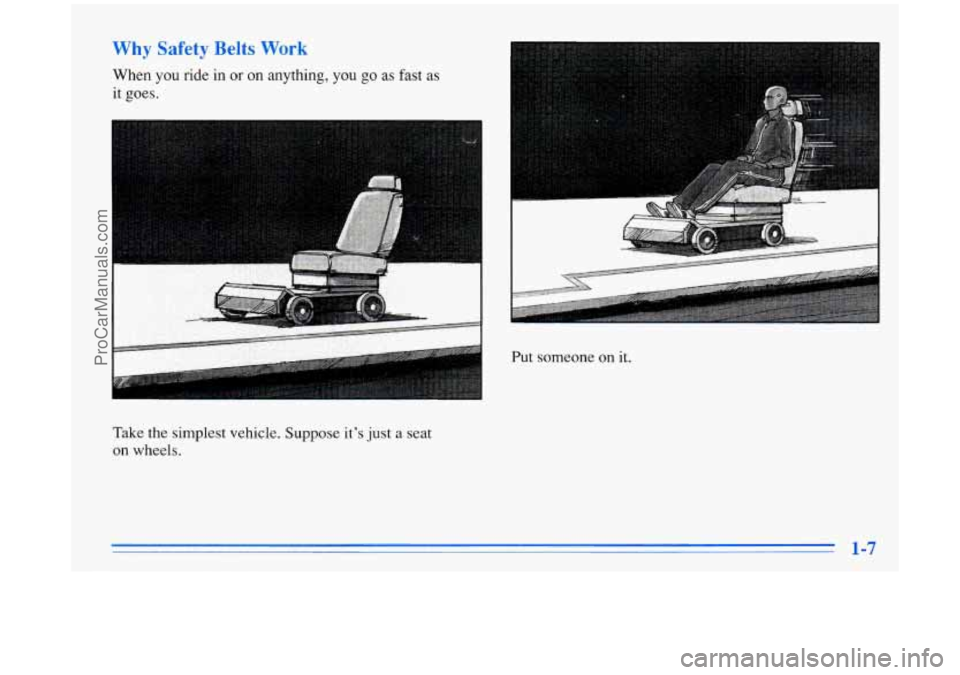
When you ride in or on anything, you go as fast as
it goes.
Put someone
on it.
Take the simplest vehicle. Suppose it’s
just a seat
on wheels.
1-7
ProCarManuals.com
Page 21 of 388
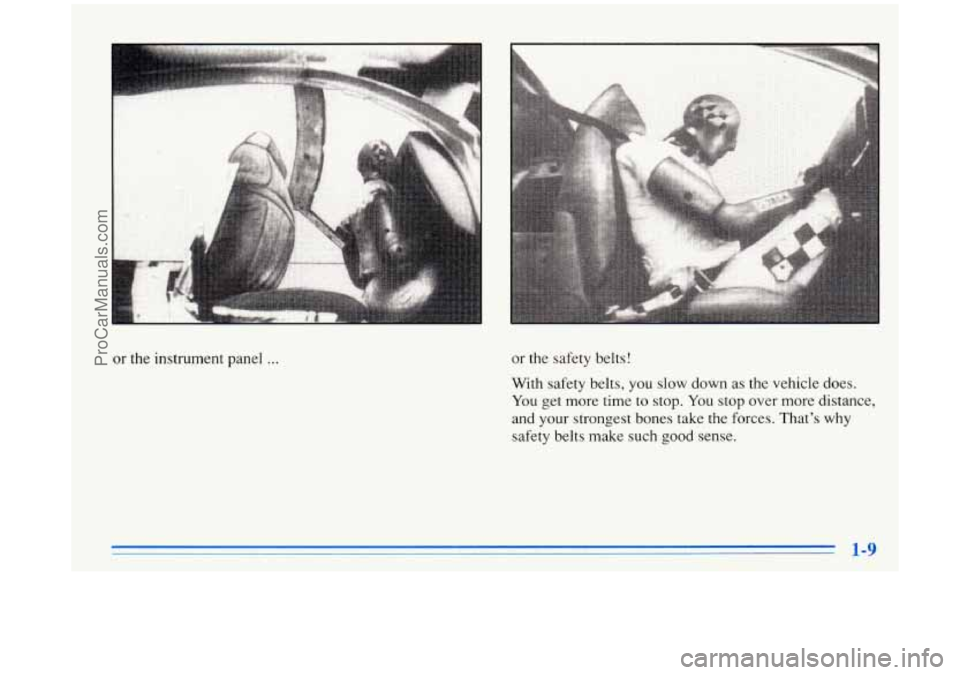
or the instrument panel ... or the safety belts!
With safety belts, you slow down as the vehicle
does.
You get more time to stop. You stop over more distance,
and your strongest bones take the forces. That’s why
safety belts make such good sense.
ProCarManuals.com
Page 22 of 388
Here Are Questions Many People Ask Q: If I’m a good driver, and I never drive far from
About Safety Belts -- and the Answers home, why should I wear safety belts?
A:
Q:
A:
Won’t I be trapped in the vehicle after an
accident if I’m wearing a safety belt?
You could be -- whether you’re wearing a safety
belt or not. But you can unbuckle a safety belt,
even if you’re upside down. And your chance
of
being conscious during and after an accident, so
you can unbuckle and get out, is much greater if
you are belted.
If my vehicle has air bags, why should I have to
wear safety
belts?
Air bags are in many vehicles today and will
be in most
of them in the future. But they are
supplemental systems only;
so they work with
safety belts -- not instead of them. Every air bag
system ever offered for sale has required the use of
safety belts. Even if you’re in a vehicle
that has air
bags, you still have to buckle up
to get the most
protection. That’s true
not only in frontal collisions,
but especially in side and other collisions.
A: You may be an excellent driver, but if you’re in an
accident
-- even one that isn’t your fault -- you
and your passengers can be hurt. Being a good
driver doesn’t protect you from things beyond your
control, such as bad drivers.
Most accidents occur within
25 miles (40 km) of
home. And the greatest number of serious injuries
and deaths occur at speeds
of less than 40 mph
(65 b/h).
Safety belts are for everyone.
1-10
ProCarManuals.com
Page 23 of 388
How cu ear Safety Be,,, +erly
Adult
This part is only for people of adult size.
Be aware that there are special things to know about
safety belts and children. And there are different rules for
smaller children and babies.
If a child will be riding in
your Buick, see the part of this manual called “Children.”
Follow those rules for everyone’s protection.
First, you’ll want to know which restraint systems your
vehicle has.
We’ll start with the driver position.
This part describes the driver’s restraint system.
Lap-S----Ider Belt
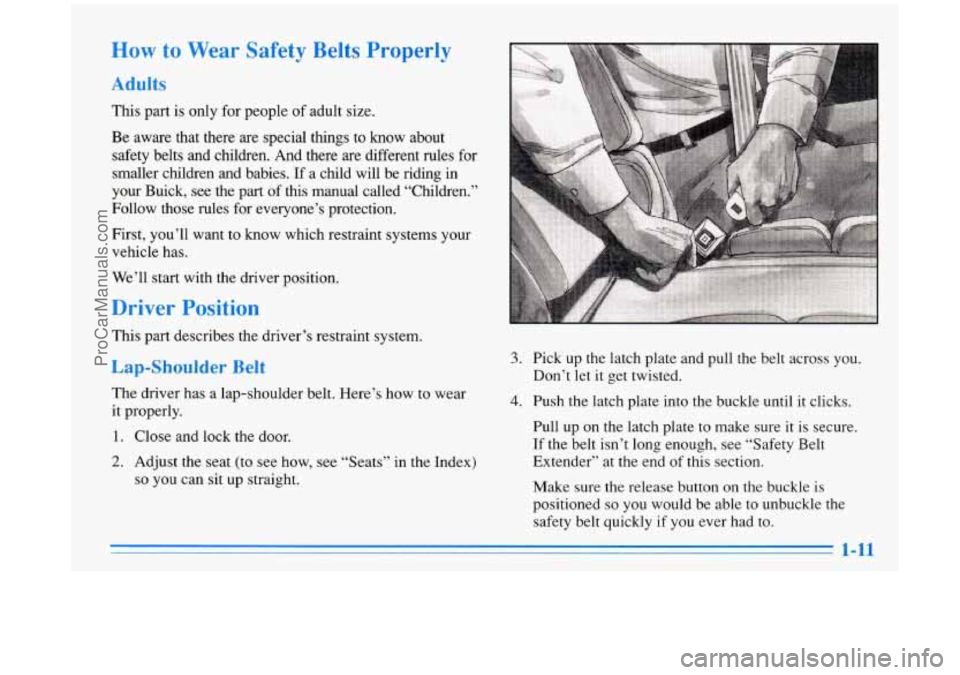
The driver has a lap-shoulder belt. Here’s how to wear
it properly.
1. Close and lock the door.
2. Adjust the seat (to see how, see “Seats” in the Index)
so you can sit up straight.
3. Pick up the latch plate and pull the belt across you.
Don’t let
it get twisted.
4. Push the latch plate into the buckle until it clicks.
Pull up on the latch plate to make sure
it is secure.
If the belt isn’t long enough, see “Safety Belt
Extender” at the end of this section.
Make sure
the release button on the buckle is
positioned
so you would be able to unbuckle the
safety belt quickly
if you ever had to.
1-11
ProCarManuals.com
Page 24 of 388
.#!
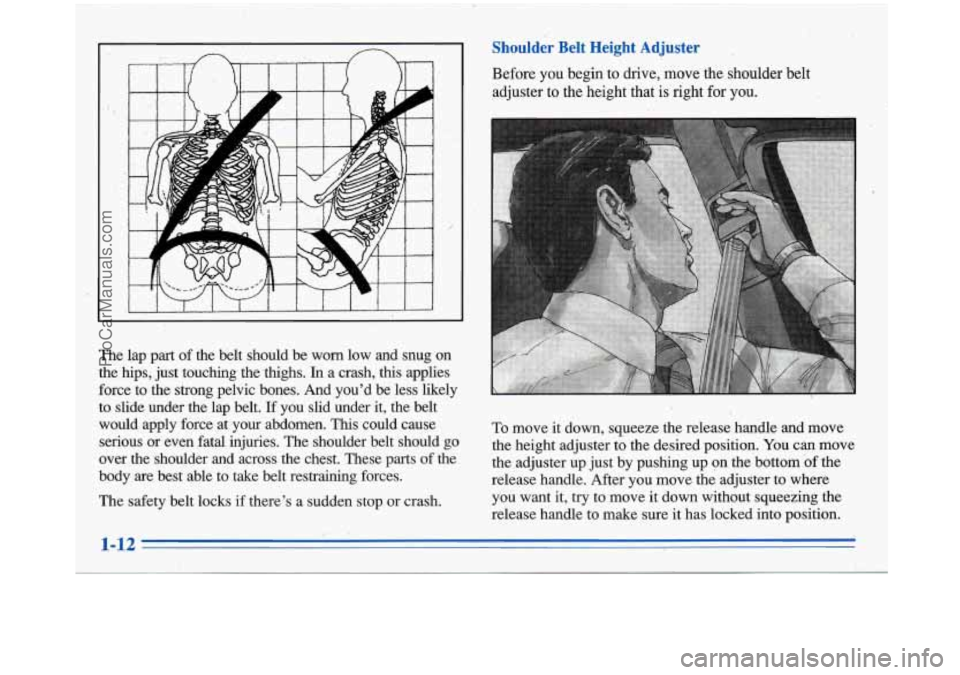
The lap part of the belt should be worn. low and snug on
the hips, just touching the thighs. In a crash,' this applies
force to the strong pelvic bones. And you'd be less likely
to slide under the lap belt.
If you slid under it, the belt
would apply force at -your abdomen.
This could cause
serious or even fatal injuries. The shoulder belt should go
over the 'shoulder and across the chest. These parts of the
body are best able to take belt restraining forces.
The safety belt locks if there's a sudden stop or crash.
Shoulder Belt Height Adjuster . .:
Before you begin to drive, move the shoulder belt
adjuster to the height that is right
for you.
,.
. -I.
To move it down, squeeze the release handle and move
the height adjuster to the desired position. You can move
the adjuster up just by pushing
up on the bottom of the
release handle. After you move the adjudter to where
you want
it, try to move it down without squeezing the
release handle to make sure it
has locked into position.
ProCarManuals.com