light BUICK PARK AVENUE 1996 Owners Manual
[x] Cancel search | Manufacturer: BUICK, Model Year: 1996, Model line: PARK AVENUE, Model: BUICK PARK AVENUE 1996Pages: 388, PDF Size: 20.04 MB
Page 6 of 388
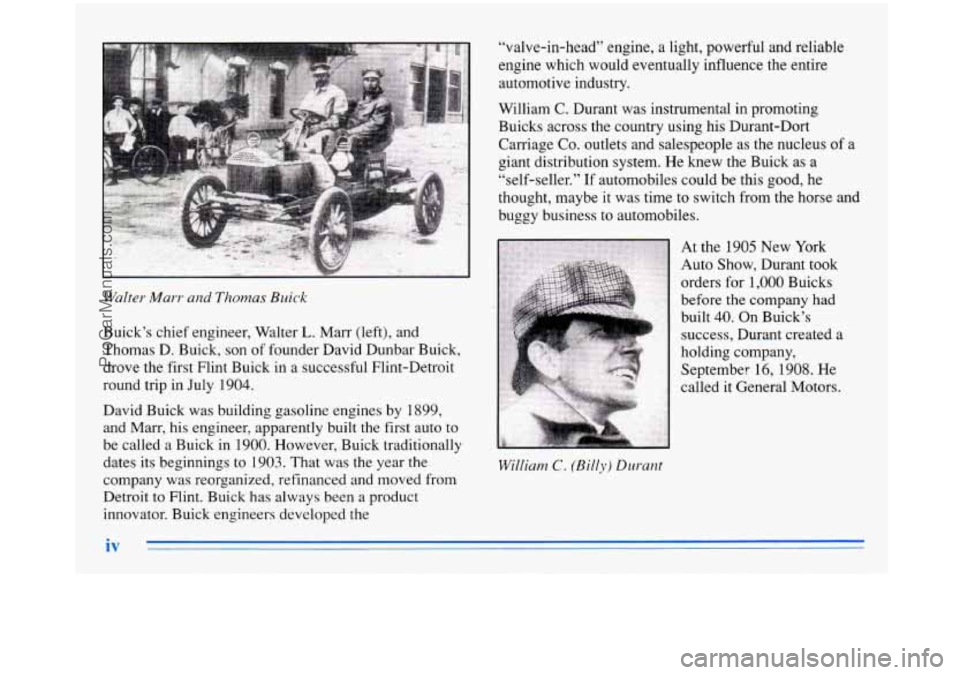
Walter Maur and Thomas Buick
Buick’s chief engineer, Walter L. Marr (left), and
Thomas D. Buick, son of founder David Dunbar Buick,
drove the first Flint Buick in a successful Flint-Detroit
round trip in July 1904.
David Buick was building gasoline engines by 1899,
and Marr, his engineer, apparently built the first auto to
be called a Buick in 1900. However, Buick traditionally
dates its beginnings to 1903. That was the year the
company was reorganized, refinanced and moved from
Detroit to Flint. Buick has always been a product
innovator. Buick engineers developed the “valve-in-head” engine, a
light, powerful and reliable
engine which would eventually influence the entire
automotive industry.
William C. Durant was instrumental in promoting
Buicks across the country using his Durant-Dort
Carriage
Co. outlets and salespeople as the nucleus or a
giant distribution system. He knew the Buick as a
“self-seller.”
If automobiles could be this good, he
thought, maybe
it was time to switch from the horse and
buggy business to automobiles.
1.
At the 1905 New York
Auto Show, Durant took
orders for 1,000 Buicks
before the company had
built
40. On Buick’s
success, Durant created
a
holding company,
September 16, 1908. He
called it General Motors.
William C. (Billy) Duvant
ProCarManuals.com
Page 12 of 388
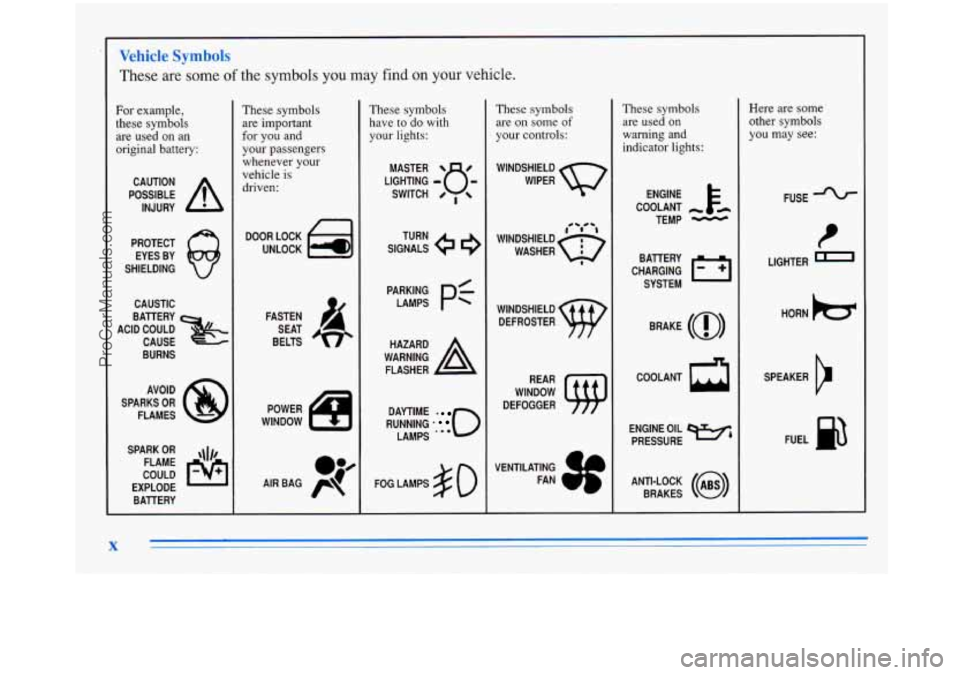
Vehicle Symbols
These are some of the symbols you may find on your vehicle.
For example,
these symbols
are used on an
original battery:
POSSIBLE A
CAUTION
INJURY
PROTECT EYES BY
SHIELDING
CAUSTIC
BURNS AVOID
SPARKS
OR
FLAMES
SPARK
OR ,\I/,
COULD FLAME
EXPLODE BATTERY
These symbols
are important
for you and
your passengers
whenever your
vehicle is driven:
DOOR LOCK
UNLOCK
FASTEN SEAT
BELTS
POWER
WINDOW
These symbols
have to do with
your lights:
SIGNALS e e
TURN
WARNING
A
HAZARD
FLASHER
RUNNING
0
DAYTIME -
LAMPS '**
FOG LAMPS $0
These symbols
are on
some of
your controls:
WINDSHIELD
WIPER
WINDSHIELD DEFROSTER
WINDOW
DEFOGGER
VENTILATING FAN
These symbols are used
on
warning and
indicator lights:
COOLANT
TEMP
-
CHARGING I-1
BATTERY
SYSTEM
BRAKE
(0)
ENGINE OIL e,
PRESSURE
ANTI-LOCK
(@)
BRAKES
Here are some
other symbols you may see:
FUSE
I
LIGHTER I
HORN h=r
SPEAKER
b
FUEL n3
X
ProCarManuals.com
Page 16 of 388
The light on top of the switch will turn orange for low or
red for high. Push the switch rearward to stop the seat
from warming.
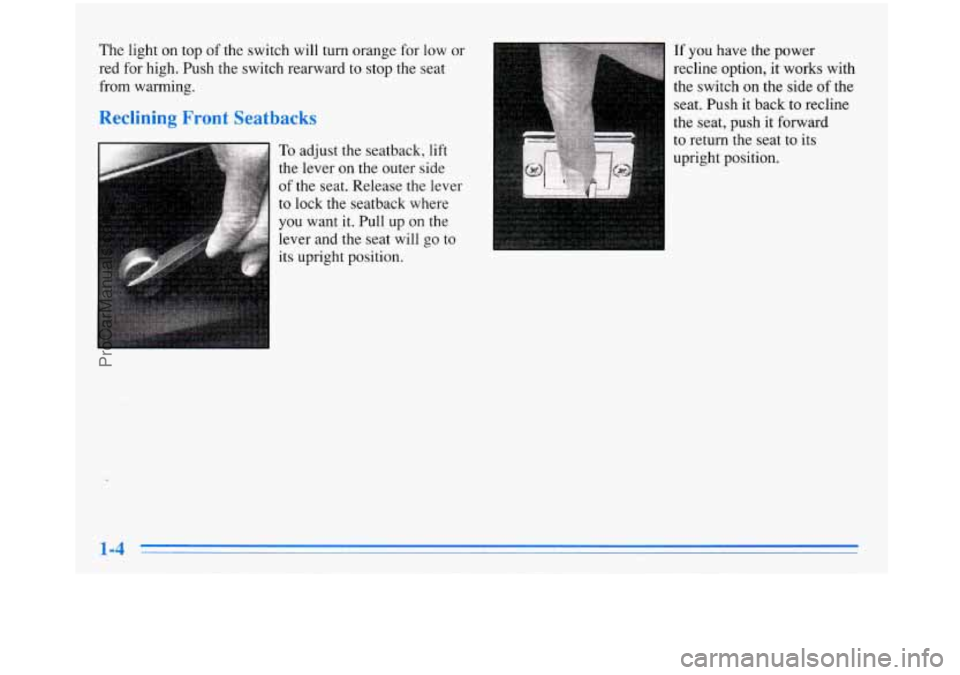
Reclining Front Seatbacks
To adjust the seatback, lift
the lever on the outer side
of the seat. Release the lever
to lock the seatback where
you want
it. Pull up on the
lever and the seat will
go to
its upright position. If
you have the power
recline option, it works with
the switch on the side
of the
seat. Push it back
to recline
the seat, push it forward
to return the seat to its
upright position.
ProCarManuals.com
Page 18 of 388
Safety Belts: They’re for Everyone
This part of the manual tells you how to use safety belts
properly. It also tells you some things you should not do
with safety belts.
And
it explains the Supplemental Restraint System
(SRS), or air bag system.
A CAUTIOI..
r -
Don’t let anyone ride where he or she can’t wear
a safety belt properly.
If you are in a crash and
you’re not wearing
a safety belt, your injuries
can be much worse.
You can hit things inside the
vehicle or be ejected from
it. You can be seriously
injured or killed. In the same crash, you might
not be if
you are buckled up. Always fasten your
safety belt, and check that your passengers’ belts
are fastened properly too.
1
Your vehicle has a light
that comes on as a reminder
to buckle up. (See “Safety
Belt Reminder Light” in
the Index.)
In most states and Canadian provinces, the law says to
wear safety belts. Here’s why:
They work.
You never know if you’ll be in a crash. If you do have a
crash, you don’t know if it will be a bad one.
A few crashes are mild, and some crashes can be
so
serious that even buckled up a person wouldn’t survive.
But most crashes are in between.
In many of them,
people who buckle up can survive and sometimes walk
away. Without belts they could have been badly hurt
or killed.
After more than
25 years of safety belts in vehicles,
the facts are clear. In most crashes buckling up does
matter
... a lot!
ProCarManuals.com
Page 30 of 388
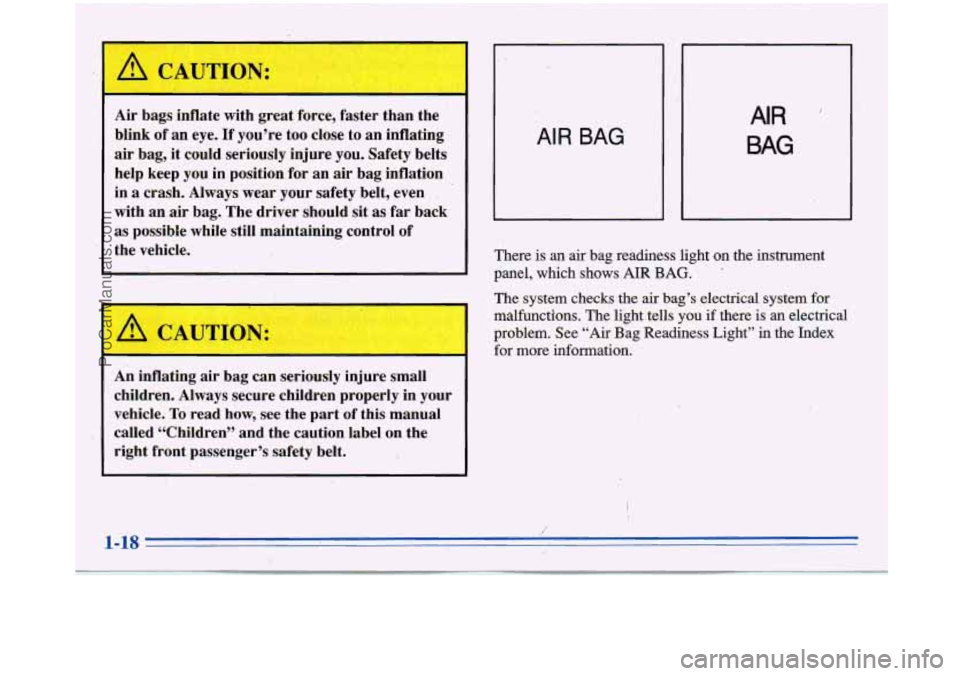
‘! CAUTION:
‘Air bags inflate with great force, faster than the
blink of an eye.
If you’re too close to an inflating
air bag, it could seriously. injure you. Safety belts
help keep you in position for an air bag inflation
in
a crash. Always wear your safety belt, even -
with an air bag. The driver should sit as far back
as possible while still maintaining control of
the vehicle.
An inflating air bag can seriously injure small
children. Always secure children properly in your
vehicle.
To read how, see, the part of this manual
called “Children” and the caution label on the
right front passenger’s safety belt.
/I LAUTION: ‘I
AIR BAG
AIR
BAG
There is an air bag readiness light on the instrument
panel, which shows
AIR BAG.
The system checks the air bag’s electrical system for
malfunctions. The light tells you if there is an electrical
problem. See
“Air Bag Readiness Light” in the Index
for more information.
-
ProCarManuals.com
Page 56 of 388
Safety Belt Extender
If the vehicle’s safety belt will fasten around you, you
should use it.
But if a safety belt isn’t long enough to fasten, your
dealer will order you an extender. It’s free. When you go
in to order it, take the heaviest coat you will wear,
so the
extender will be long enough for you. The extender will
be just for you, and just for the seat in your vehicle that
you choose. Don’t let someone else use it, and use it
only for the seat it is made to fit. To wear it, just attach it
to the regular safety belt.
Checking Your Restraint Systems
Now and then, make sure the safety belt reminder light
and all your belts, buckles, latch plates, retractors and
anchorages are working properly.
Look for any other
loose or damaged safety belt system parts. If you see
anything that might keep a safety belt system from
doing its job, have
it repaired.
Torn or frayed safety belts may not protect you in a
crash. They can rip apart under impact forces.
If a belt is
torn or frayed, get a new one right away.
Also look for any opened or broken air bag covers, and
have them repaired or replaced. (The air bag system
does not need regular maintenance.)
Replacing Restraint System Parts
After
a Crash
If you’ve had a crash, do you need new belts?
After a very minor collision, nothing may be necessary.
But
if the belts were stretched, as they would be if worn
during a more severe crash, then you need new belts.
If belts are cut or damaged, replace them. Collision
damage also may mean you will need to have safety belt
or seat parts repaired or replaced. New parts and repairs
may be necessary even
if the belt wasn’t being used at
the time of the collision.
If your seat adjuster won’t work after
a crash, the special
part of the safety belt that goes through the seat to the
adjuster may need to be replaced.
If an air bag inflates, you’ll need to replace air bag
system parts. See the part on the air bag system earlier in
this section.
ProCarManuals.com
Page 64 of 388
Should interference to this system occur, try this:
0 Check to determine if battery replacement is necessary.
See the instructions on battery replacement.
Check the distance. You may be too far from your
vehicle. This product has a maximum range.
0 Check the location. Other vehicles or objects may be
blocking the signal.
See your Buick dealer or a qualified technician
for service.
Changes or modifications to this system by other than an
authorized service facility could void authorization to
use this equipment.
The driver’s door will unlock when
UNLOCK is
pressed.
If pressed again within five seconds, all doors
will unlock. Pressing any button will also illuminate the
interior lamps (see “Illuminated Entry” in the Index).
All doors will lock when
LOCK is pressed.
The trunk will unlock when the trunk open symbol is
pressed, but only when the ignition is in the
LOCK or
OFF position. The trunk symbol will also work when
the ignition
is on, but only while in PARK (P).
When the button with the horn symbol on the key
transmitter is pressed, the horn will sound and the
headlamps and taillamps will flash for up to two
minutes. This can be turned
off by pressing the instant
alarm button again, unlocking the vehicle with a key
or
by turning the ignition on.
If only the instant alarm button works, the transmitter
needs to be resynchronized to the receiver.
Do this by
pressing and holding both the LOCK and
UNLOCK
buttons for about eight seconds; you must be within
range of the vehicle.
Once the transmitter has been resynchronized, the horn
will chirp and the exterior lamps will flash once. The
system should now operate properly.
mal Choice Fer
Each key transmitter can be programmed to the driver’s
preference for memory door locks, security feedback,
delayed locking
and perimeter lighting. See each feature
in the Index.
The transmitters can also be programmed to move
the
driver’s seat and outside mirrors to a set memory position
when the
key transmitter’s UNLOCK button is pressed.
2-8
ProCarManuals.com
Page 72 of 388
Parking at Night
Park in a lighted spot, close all windows and lock your
vehicle. Remember to keep your valuables out of sight.
Put them in a storage area, or take them with you.
Parking Lots
If you park in a lot where someone will be watching
your vehicle, it’s best to lock it
up and take your keys.
But what if you have to leave your ignition key? What
if
you have to leave something valuable in your vehicle?
Put your valuables in a storage area, like your trunk
or glove box.
0 Lock the glove box.
0 Lock all the doors except the driver’s.
0 Then take the door key with you.
Universal Theft-Deterrent (Option)
SECURITY
If your Buick has this
option, it has a
theft-deterrent alarm
system. With this system,
the SECURITY light will
flash as you open the door
(if your ignition
is OFF).
This light reminds you to activate the theft-deterrent
system. Here’s how to do it:
1. Open the door.
2. Lock the door with the power door lock switch or the
Remote Keyless Entry transmitter. The SECURITY
light should come
on and stay on.
3. Close all doors. The SECURITY light should go off
after approximately 30 seconds. The alarm is not
armed until
the SECURITY light goes off.
,2-16
-
ProCarManuals.com
Page 73 of 388
If a door or the trunk is opened without the key or the
Remote Keyless Entry transmitter, the alarm will go off.
It will also go off if the trunk lock is damaged. Your
vehicle’s lamps will flash and the horn will sound for
several minutes, then will turn off to save battery power.
Remember, the theft-deterrent system won’t activate if
you lock the doors with a key or manual door lock. It
activates only if you use a power door lock switch
or
Remote Keyless Entry transmitter. You should also
remember that you can start your vehicle with the
correct ignition key if the alarm has been set off. You
must still shut off the alarm by inserting the key in the
door lock.
Here’s how to avoid setting off the alarm by accident:
If you don’t want to activate the theft-deterrent
system, the vehicle should be locked
after the doors
are closed.
How to Test the Alarm
The alarm can be tested by first having the driver’s
window down. Activate the system by locking the
doors with the power door lock switch or the Remote
Keyless Entry transmitter. Get out of the car, close the
door and wait for the SECURITY light to go out. Then
reach in through the window, unlock the door with the
manual door lock and open the door. This should set
off the alarm.
If the alarm does not sound when it should, check to
see if the horn works. The horn fuse may be blown.
To
replace the fuse, see “Fuses and Circuit Breakers” in
the Index.
To reduce the possibility of theft, always activate the
theft-deterrent system when leaving your vehicle.
Always unlock a door with a key, or use the Remote
Keyless Entry transmitter. Unlocking a door any
other way will set off the alarm.
If you set off the alarrn by accident, unlock any door
with your key.
You can also turn
off the alarm by using the Remote
Keyless Entry transmitter, if you have
it. The alarm
won’t stop if you try to unlock a door any other way.
1 2-17
ProCarManuals.com
Page 74 of 388
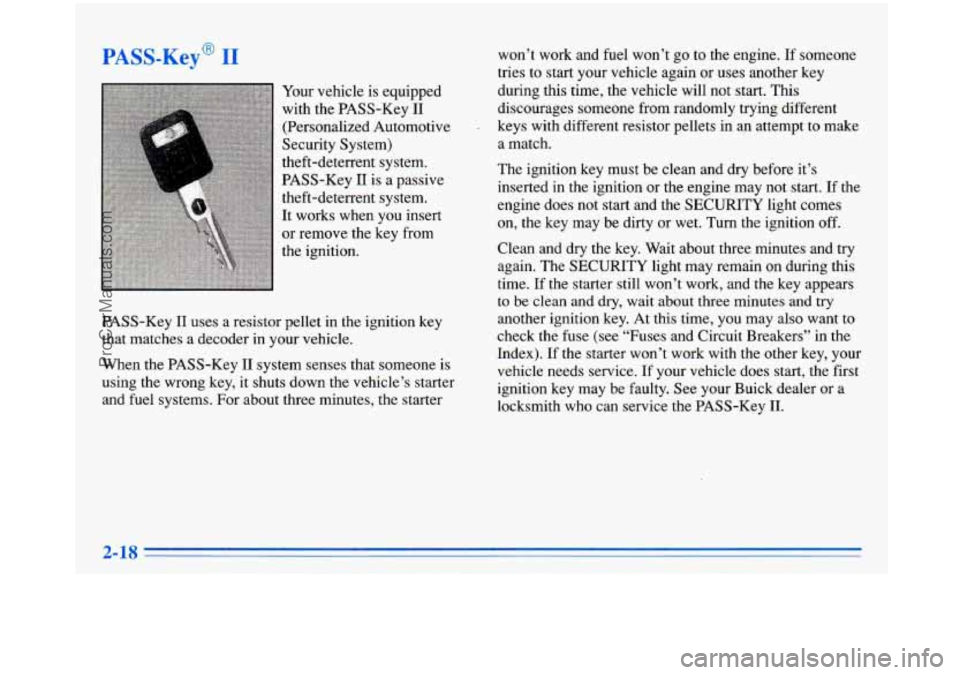
PAS7-Kej I
T
Your vehicle is equipped
with the PASS-Key
11
(Personalized Automotive
Security System)
theft-deterrent system.
PASS-Key
11 is a passive
theft-deterrent system.
It works when you insert
or remove the key from
the ignition.
PASS-Key
I1 uses a resistor pellet in the ignition key
that matches a decoder
in your vehicle.
When the PASS-Key I1 system senses that someone is
using the wrong key, it shuts down the vehicle’s starter
and fuel systems. For about three minutes, the starter won’t work and
fuel won’t go to the engine. If someone
tries to start your vehicle again or uses another key
during this time, the vehicle will not start. This
discourages someone from randomly trying different
keys with different resistor pellets in an attempt to make
a match.
The ignition key must be clean and dry before it’s
inserted in the ignition
or the engine may not start. If the
engine does not start and the SECURITY light comes
on,
the key may be dirty or wet. Turn the ignition off.
Clean and dry the key. Wait about three minutes and try
again. The SECURITY light may remain on during this
time. If the starter still won’t work, and the key appears
to
be clean and dry, wait about three minutes and try
another ignition key. At this time, you may also want to
check the fuse (see “Fuses and Circuit Breakers” in the
Index). If the starter won’t work with the other key, your
vehicle needs service. If your vehicle does start, the first
ignition key may be faulty. See your Buick dealer or a
locksmith who can service the PASS-Key
11.
ProCarManuals.com