steering BUICK PARK AVENUE 1997 Owner's Guide
[x] Cancel search | Manufacturer: BUICK, Model Year: 1997, Model line: PARK AVENUE, Model: BUICK PARK AVENUE 1997Pages: 420, PDF Size: 21.93 MB
Page 292 of 420
Radiator Pressure Cap
NOTICE:
Your radiator pressure cap is a 15 psi (105 kPa)
pressure-type cap and must be tightly installed to prevent coolant loss and possible engine damage
from overheating. Be sure the arrows on the cap
line up with the overflow tube on the radiator
filler neck.
When you replace your radiator pressure cap, an AC@
cap is recommended.
Thermostat
Engine coolant temperature is controlled by a thermostat
in the engine coolant system. The thermostat stops the
flow
of coolant through the radiator until the coolant
reaches a preset temperature.
When you replace your thermostat, an
AC@ thermostat
is recommended.
Power Steering Fluid
When to Check Power Steering Fluid
It is not necessary to regularly check power steering
fluid unless you suspect there
is a leak in the system or
you hear an unusual noise.
A fluid loss in this system
could indicate a problem. Have the system inspected
and repaired.
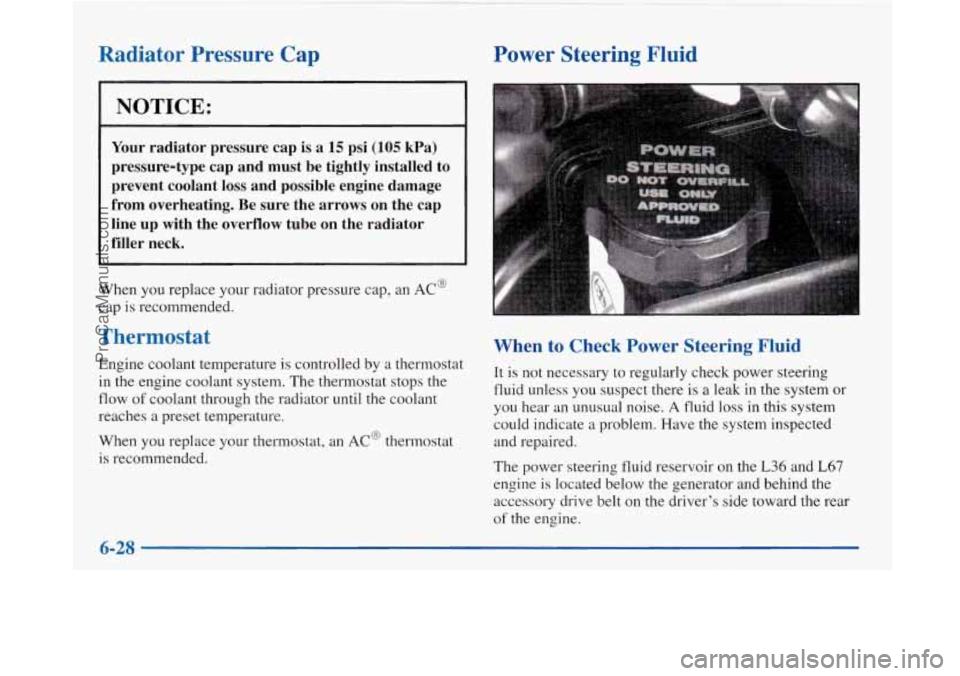
The power steering fluid reservoir on the L36 and L67
engine is located below the generator and behind the
accessory drive belt on the driver’s side toward the rear
of the engine.
6-28
ProCarManuals.com
Page 293 of 420
How To Check Power Steering Fluid
When the engine compartment is cool, wipe the cap and
the top of the reservoir clean, then unscrew the cap and
wipe the dipstick with
a clean rag. Replace the cap and
completely tighten it. Then remove the cap again and
look at the fluid level on the dipstick.
The level should be at the FULL COLD mark. If
necessary, add only enough fluid to bring the level up to
the
mark.
What to Use
To determine what kind of fluid to t~@, See
“Recommended Fluids and Lubricants” in the Index.
Always use the proper fluid. Failure to use the proper
fluid can cause leaks and damage hoses and seals.
Windshield Washer Fluid
What to Use
When you need windshield washer fluid, be sure to read
the manufacturer’s instructions before use. If you will be
operating your vehicle in an area where the temperature
may fall below freezing, use a fluid that has sufficient
protection against freezing.
Adding Washer Fluid
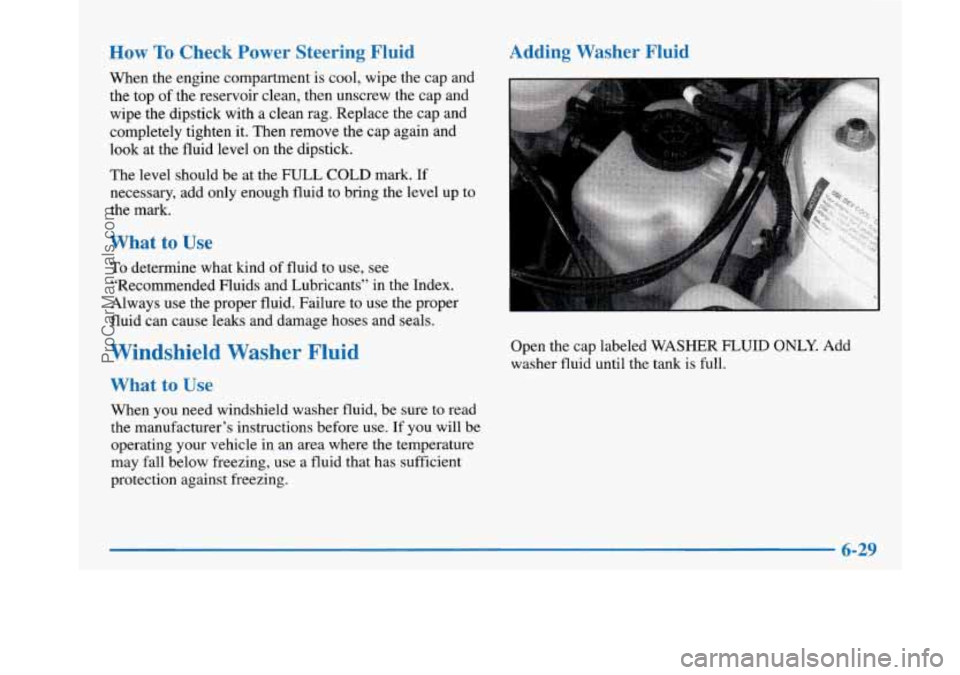
Open the cap labeled WASHER FLUID ONLY. Add
washer fluid until the tank is full.
6-29
ProCarManuals.com
Page 340 of 420
Capacities and Specifications
The following approximate capacities are given in English and metric conversions. Please refer to “Recommended
Fluids and Lubricants” in the Index for more information.
Belt Tensions
Automatically controlled by a Self-Tension idler pulley. Tension adjustment should never be necessary.
Automatic Transaxle AT (Overdrive)
When draining or replacing torque converter, more fluid may be needed.
Pan Removal and Replacement
................................................... 6 quarts (5.6 L)
After Complete Overhaul
...................................................... 11 quarts (10.4 L)
Cooling System ............................................................. 13 quarts (12.3 L)
Oil change with filter change ................................................... 5.0 quarts (4.7 L)
Park Avenue Ultra
............................................................ 19 gallons (72 L)
Engine Crankcase
FuelTank
......................,...........................................18gall\
ons (68L)
Power Steering
PumpOnly .....................................................................lpi\
nt (0.5L)
Tire Pressures, Sizes
The Tire-Loading Information label, which is located on the rear edge of the driver’s door, shows the correct
inflation pressures for your tires.
WheelNutTorque ........................................................ lOOlb-ft(140N~m)
Complete System
............................................................ 1
1/2 pints (0.7 L)
Refrigerant (R-l34a), Air Conditioning ................... See refrigerant charge label under the hood.
NOTE: All capacities are approximate. When adding, be sure to \
fill to the appropriate level, as recommended
in this manual.
ProCarManuals.com
Page 342 of 420
Vehicle Dimensions
Overall
Length ................. 206.8 inches (525.3 cm)
Width
................... 74.7 inches ( 189.7 cm)
Height
................... 58.1 inches (147.6 cm)
Wheelbase
.............. 113.8 inches (289.1 cm)
Front Tread
............... 62.7 inches (159.3 cm)
Rear Tread
............... 62.3 inches ( 15 8.2 cm)
Normal Maintenance
Replacement Parts
Air Cleaner Element .......... AC Type A- 1096C
Engine Oil Filter
................ AC Type PF-47
Fuel Filter
.................... AC Type GF-627
Spark Plugs
................... AC Type 41-921
Gap: 0.060 inch
(. 152 cm)
Windshield Wiper Blades
Type
............................ Hook Style
Length
..................... 22 inches (56 cm)
Engine Accessory Belt (L36)
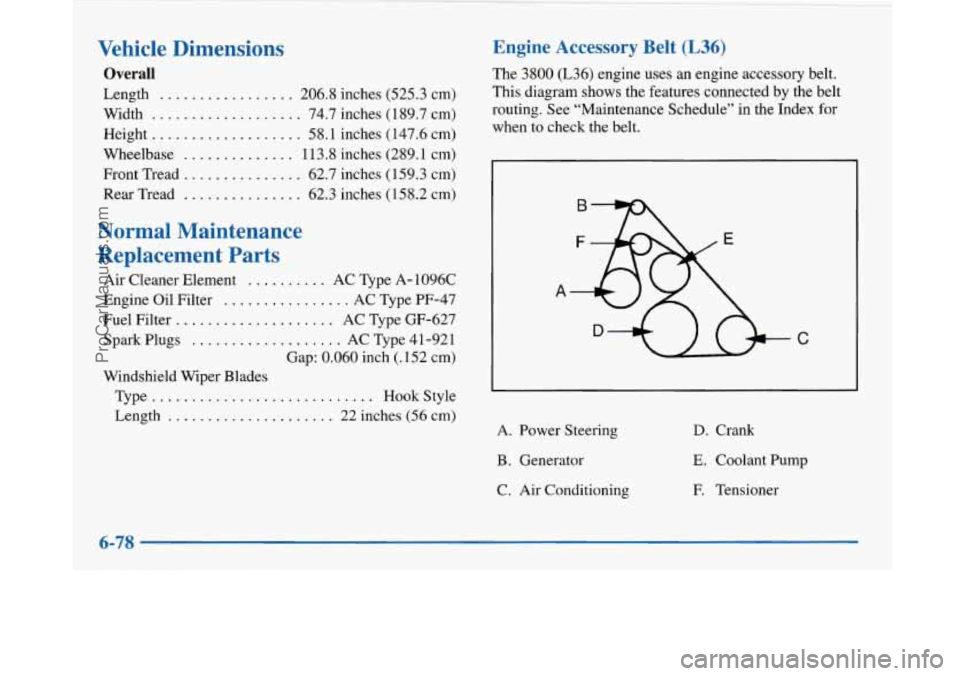
The 3800 (L36) engine uses an engine accessory belt.
This diagram shows the features connected by the belt
routing. See “Maintenance Schedule” in the Index for
when to check the belt.
A
C
A. Power Steering
B. Generator
C. Air Conditioning
D. Crank
E. Coolant Pump
F. Tensioner
6-78
ProCarManuals.com
Page 343 of 420
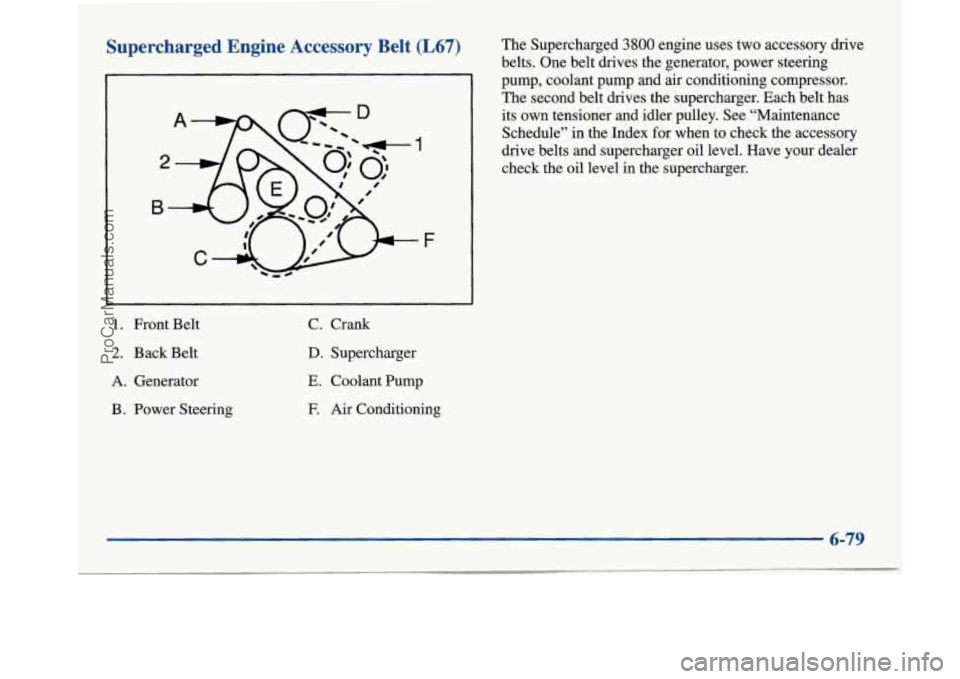
Supercharged Engine Accessory Belt (L67)
c
1. Front Belt C. Crank
2. Back Belt D. Supercharger
A. Generator E. Coolant Pump
B. Power Steering
E Air Conditioning The
Supercharged
3800 engine uses two accessory drive
belts. One belt drives the generator, power steering
pump, coolant pump and air conditioning compressor.
The second belt drives the supercharger. Each belt has
its own tensioner and idler pulley. See “Maintenance
Schedule” in the Index
for when to check the accessory
drive belts and supercharger oil level. Have your dealer
check the oil level in the supercharger.
6-79
ProCarManuals.com
Page 345 of 420
Section 7 Maintenance Schedule
This section covers the maintenance required for your Buick. Your vehicle needs these services to retain its safety,
dependability and emission control performance.
7-2
7-2 7-3
7-4
7-4
7-4
7-39
7-39
7-39
7-40 Introduction
Your Vehicle and the Environment
How This Section is Organized
Part A: Scheduled Maintenance Services
Using Your Maintenance Schedule
Selecting the Right Schedule
Part B: Owner Checks and Services
At Each Fuel Fill
At Least Once a Month
At Least Twice a Year At
Least Once a Year
Part C: Periodic Maintenance Inspections
Steering, Suspension and Front Drive Axle
Boot and Seal Inspection
Exhaust System Inspection Radiator and Heater Hose Inspection
Throttle Linkage Inspection
Brake System Inspection
Part D: Recommended Fluids and Lubricants Part E: Maintenance Record
ProCarManuals.com
Page 351 of 420
Short TripKity Maintenance Schedule
The services shown in this schedule up to 100,000 miles
(166
000 km) should be performed after 100,000 miles
(166
000 km) at the same intervals. The services shown
at 150,000 miles (240
000 km) should be performed at
the same interval after 150,000 miles (240
000 km).
See “Owner Checks and Services” and “Periodic
Maintenance Inspections” following.
Footnotes
The U.S. Environmental Protection Agency or the
California Air Resources Board has determined that the
failure to perform this maintenance item will not nullify
the emission warranty or
limit recall liability prior to the
completion of the vehicle’s useful life. We, however,
urge that all recommended maintenance services be
performed at the indicated intervals and the maintenance
be recorded.
# Lubricate the suspension, steering linkage, transaxle
shift linkage, parking brake cable guides and the
underbody contact points and linkage.
* If your vehicle has an Engine Oil Life Monitor, the
monitor will show you when to change the oil
-- usually
between
3,000 miles (5 000 km) and 7,500 miles
(12
500 km) since your last oil change. Under severe
conditions, the indicator may come on before
3,000 miles (5 000 km). Never drive your vehicle more
than
7,500 miles (12 500 km) or 12 months, (whichever
occurs first), without an oil change.
The system won’t detect dust in the oil.
So if you
drive in a dusty area be sure to change your oil every
3,000 miles (5 000 km) or sooner if the CHANGE OIL
light comes on. Remember to reset the Oil Life Monitor
when the oil has been changed. For more information,
see “Engine Oil Life Monitor” in the Index.
+ A good time to check your brakes is during tire
rotation. See “Brake System Inspection” under “Periodic
Maintenance Inspection” in Part C of this schedule.
ProCarManuals.com
Page 372 of 420
Long Tripmighway ,Maintenance Schedule I
The services shown in this schedule up to 100,000 miles
(166
000 km) should be performed after 100,000 miles
(166
000 km) at the same intervals. The services shown
at 150,000 miles
(240 000 km) should be performed at
the same interval after 150,000 miles
(240 000 km).
See “Owner Checks and Services” and “Periodic
Maintenance Inspections” following.
Footnotes
? The U.S. Environmental Protection Agency or the
California Air Resources Board has determined that the
failure to perform this maintenance item will not nullify
the emission warranty or limit recall liability prior to the
completion of the vehicle’s useful life. We, however,
urge that all recommended maintenance services be
performed at the indicated intervals and the maintenance
be recorded.
# Lubricate the suspension, steering linkage, transaxle
shift linkage, parking brake cable guides and the
underbody contact points and linkage.
* If your vehicle has an Engine Oil Life Monitor, the
monitor will show you when to change the oil
-- usually
between
3,000 miles (5 000 km) and 7,500 miles
(12 500 km) since your last oil change. Under severe
conditions, the indicator may come on before
3,000 miles (5 000 km). Never drive your vehicle more
than
7,500 miles (12 500 km) or 12 months without an
oil change.
The system won’t detect dust in the oil.
So if you
drive in a dusty area, be sure to change your oil every
3,000 miles (5 000 km) or sooner if the CHANGE OIL
light comes on. Remember to reset the Oil Life Monitor
when the oil has been changed. For more information,
see “Engine Oil Life Monitor” in the Index.
+ A good time to check your brakes is during tire
rotation. See “Brake System Inspection” under “Periodic
Maintenance Inspections” in Part
C of this schedule.
7-28
ProCarManuals.com
Page 387 of 420
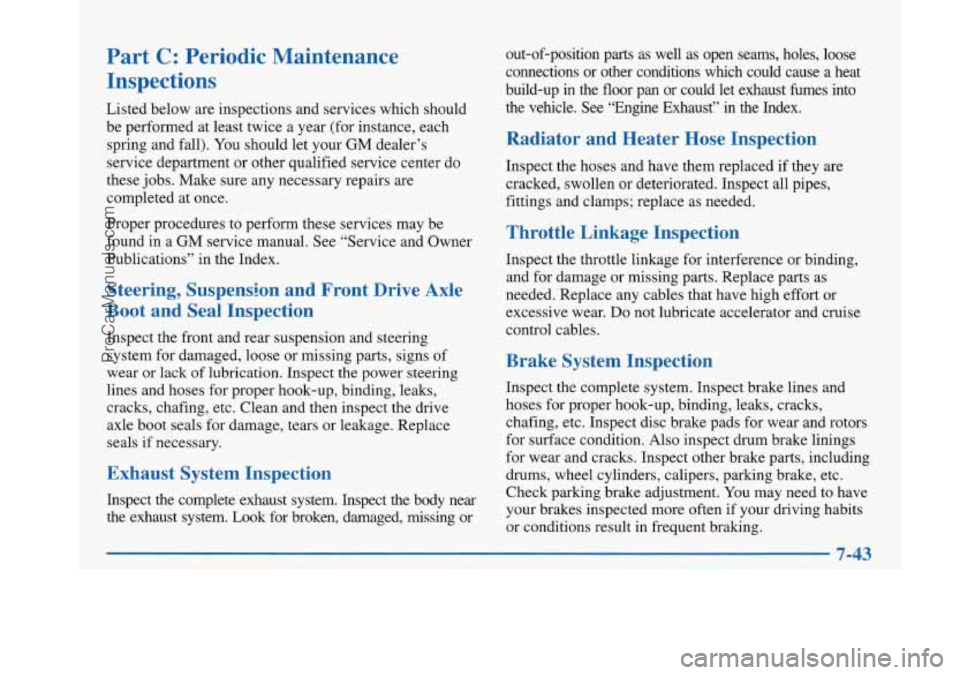
Part C: Periodic Maintenance
Inspections
Listed below are inspections and services which should
be performed at least twice a year (for instance, each
spring and fall). You should let your
GM dealer’s
service department or other qualified service center do
these jobs. Make sure any necessary repairs are
completed at once.
Proper procedures
to perform these services may be
found in a
GM service manual. See “Service and Owner
Publications” in the Index.
Steering, Suspension and Front Drive Axle
Boot and Seal Inspection
Inspect the front and rear suspension and steering
system for damaged, loose or missing parts, signs of
wear
or lack of lubrication. Inspect the power steering
lines and hoses for proper hook-up, binding, leaks,
cracks, chafing, etc. Clean and then inspect the drive
axle boot seals for damage, tears or leakage. Replace
seals
if necessary.
Exhaust System Inspection
Inspect the complete exhaust system. Inspect the body near
the exhaust system.
Look for broken, damaged, missing or out-of-position parts
as well
as open seams, holes, loose
connections or other conditions which could cause a heat
build-up
in the floor pan or could let exhaust fumes into
the vehicle. See “Engine Exhaust”
in the Index.
Radiator and Heater Hose Inspection
Inspect the hoses and have them replaced if they are
cracked, swollen or deteriorated. Inspect all pipes,
fittings and clamps; replace as needed.
Throttle Linkage Inspection
Inspect the throttle linkage for interference or binding,
and for damage or missing parts. Replace parts as
needed. Replace any cables that have high effort or
excessive wear.
Do not lubricate accelerator and cruise
control cables.
Brake System Inspection
Inspect the complete system. Inspect brake lines and
hoses for proper hook-up, binding, leaks, cracks, chafing, etc. Inspect disc brake pads for wear and rotors
for surface condition. Also inspect drum brake linings
for wear and cracks. Inspect other brake parts, including
drums, wheel cylinders, calipers, parking brake, etc.
Check parking brake adjustment. You may need to have
your brakes inspected more often
if your driving habits
or conditions result in frequent braking.
ProCarManuals.com
Page 388 of 420
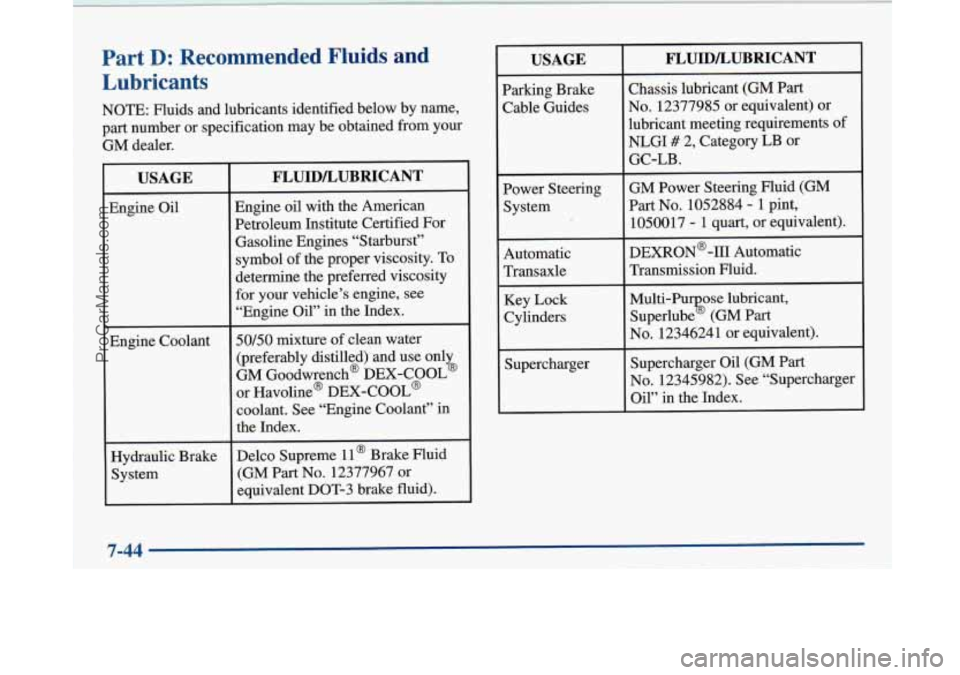
Part D: Recommended Fluids and
Lubricants
NOTE: Fluids and lubricants identified below by name,
part number or specification may be obtained from your
GM dealer.
USAGE
Engine Oil
-
Engine Coolant
Hydraulic Brake System
7-44 -
FLUIDLUBRICANT
Engine oil with the American
Petroleum Institute Certified For
Gasoline Engines “Starburst”
symbol of the proper viscosity.
To
determine the preferred viscosity
for your vehicle’s engine, see
“Engine Oil” in the Index.
50/50 mixture
of clean water
(preferably distilled) and use only
GM Goodwrench@ DEX-COOL@
or Havoline@ DEX-COOL@
coolant. See “Engine Coolant’’ in
the Index.
Delco Supreme
11@ Brake Fluid
(GM Part
No. 12377967 or
equivalent DOT-3 brake fluid).
USAGE
Parking Brake
Cable Guides
FLUID/LUBRICANT
Chassis lubricant (GM Part
No. 12377985 or equivalent) or
lubricant meeting requirements
of
NLGI # 2, Category LB or
GC-LB.
Power Steering
System
Automatic
Transaxle
Key Lock
Cylinders
Supercharger GM
Power Steering Fluid (GM
Part
No. 1052884 - 1 pint,
1050017
- 1 quart, or equivalent).
DEXRON@-111 Automatic
Transmission Fluid.
Multi-Purgse lubricant,
Superlube (GM Part
No. 12346241 or equivalent).
~
Supercharger Oil (GM Part
No. 12345982). See “Supercharger
Oil’’ in the Index.
ProCarManuals.com