light BUICK PARK AVENUE 1997 Manual PDF
[x] Cancel search | Manufacturer: BUICK, Model Year: 1997, Model line: PARK AVENUE, Model: BUICK PARK AVENUE 1997Pages: 420, PDF Size: 21.93 MB
Page 225 of 420
Backing Up
Hold the bottom of the steering wheel with one hand.
Then, to move the trailer to the left, just move that hand
to the left.
To move the trailer to the right, move your
hand to the right. Always back up slowly and, if
possible, have someone guide you.
Making Turns
I NOTICE:
Making very sharp turns while trailering could
cause the trailer to come in contact with the
vehicle. Your vehicle could be damaged. Avoid
making very sharp turns while trailering.
When you’re turning with a trailer, make wider turns than
normal.
Do this so your trailer won’t strike soft shoulders,
curbs, road signs, trees or other objects. Avoid jerky or
sudden maneuvers. Signal well in advance.
Turn Signals When Towing a Trailer
The green arrows on your instrument panel will flash
whenever you signal a turn or lane change. Properly
hooked up, the trailer lamps will also flash, telling other
drivers you’re about to turn, change lanes or stop.
When towing a trailer, the green arrows on your
instrument panel will flash for turns even if the bulbs on
the trailer are burned out. Thus, you may think drivers
behind you are seeing your signal when they are not. It’s
important to check occasionally
to be sure the trailer
bulbs are still working.
Your vehicle has bulb warning lights. When you plug a
trailer lighting system into your vehicle’s lighting
system, its bulb warning lights may not let you know if
one of your lamps goes out.
So, when you have a trailer
lighting system plugged in, be sure to check your
vehicle and trailer lamps from time to time to be sure
they’re all working. Once you disconnect the trailer
lamps, the bulb warning lights again can tell you if
one of your vehicle lamps is out.
ProCarManuals.com
Page 232 of 420
3. Turn off the ignition on both vehicles. Turn off the
radios and all lamps that aren’t needed. This will
avoid
sparks and help save both batteries. It could
save your radio
!
NOTICE:
If you leave your radio on, it could be badly
damaged. The repairs wouldn’t be covered by
your warranty.
4. Open the hoods and locate the batteries.
A CAUTION:
An electric fan can start up even when the engine
is not running and can injure you. Keep hands,
clothing and tools away from any underhood
electric fan.
5. Find the positive (+) and negative (-) terminals on
each battery.
A CAUTION:
Using a match near a battery can cause battery
gas to explode, People have been hurt doing this,
and some have been blinded, Use a flashlight if
you need more light.
Be sure the battery has enough water. You don’t
need
to add water to the Delco Freedom@ battery
installed in every new
GM vehicle. But if a
battery has filler caps, be sure the right amount
of fluid is there.
If it is low, add water to take care
of
that first. If you don’t, explosive gas could
be present.
’ Battery fluid contains acid that can burn you.
Don’t get
it on you. If you accidentally get it in
your eyes or on your skin, flush the place with
water and get medical help immediately.
5-4
ProCarManuals.com
Page 240 of 420
Engine Overheating
You will find a warning light about a hot engine, as well
as a coolant temperature gage,
on your Buick instrument
panel.
If your vehicle is equipped with the optional
Driver Information Center, an Engine Coolant Low
warning will appear
on the display.
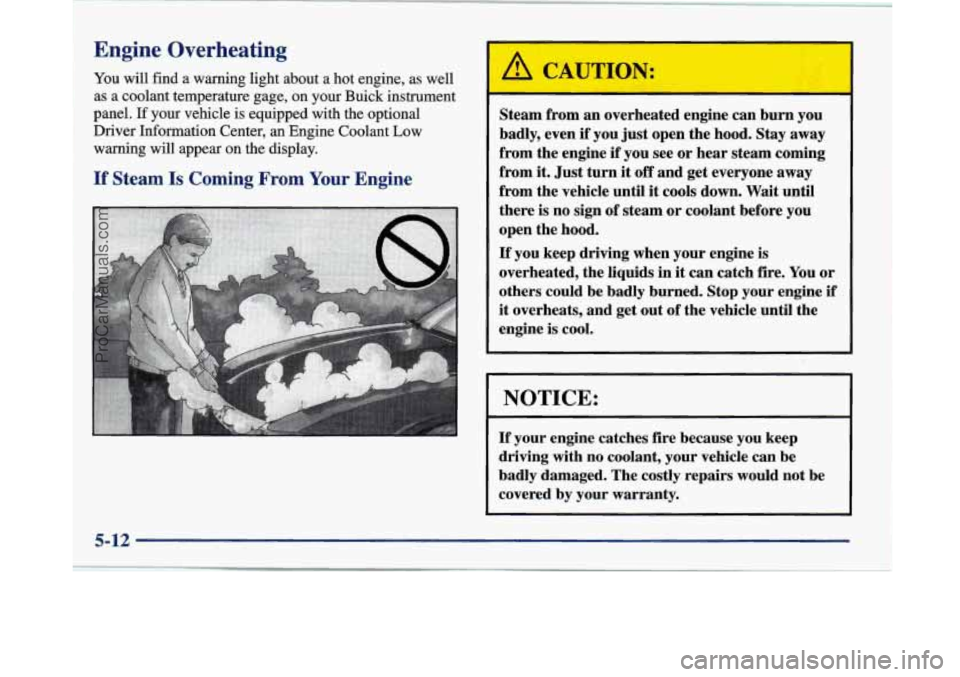
If Steam Is Coming From Your Engine
Steam from an overheated engine can burn you
badly, even
if you just open the hood. Stay away
from the engine if you see or hear steam coming
from it. Just turn
it off and get everyone away
from the vehicle until
it cools down. Wait until
there
is no sign of steam or coolant before you
open the hood.
If you keep driving when your engine is
overheated, the liquids in it can catch fire. You or
others could be
badly burned. Stop your engine if
it overheats, and get out of the vehicle until the
engine is cool.
NOTICE:
If your engine catches fire because you keep
driving with no coolant, your vehicle can be
badly damaged. The costly repairs would not be
covered
by your warranty.
5-12
ProCarManuals.com
Page 262 of 420
1 NOTICE:
Spinning your wheels can destroy parts of your
vehicle as well
as the tires. If you spin the wheels
too fast while shifting your transaxle back and
forth, you can destroy your transaxle.
For information about using tire chains on your vehicle,
see “Tire Chains” in the Index.
Rocking Your Vehicle To Get It Out
First, turn your steering wheel left and right. That will
clear the area around your front wheels. If your vehicle
has traction control, you should turn the system off. (See
“Traction Control System” in the Index.) Then shift
back and forth between REVERSE (R) and a forward
gear, spinning the wheels as little as possible. Release
the accelerator pedal while you shift, and press lightly
on the accelerator pedal when the transaxle is in gear. If
that doesn’t get you out after a few tries, you may need
to be towed out.
If you do need to be towed out, see
“Towing Your Vehicle” in the Index.
ProCarManuals.com
Page 276 of 420
Your Park Avenue Ultra has a 3800 Supercharged
engine. Buick chose supercharging rather than
turbocharging because Buick emphasizes smooth,
refined power.
The supercharger
is a device which is designed to pump
more air into the engine than it would normally use.
This air mixed with fuel creates increased engine power.
Since the supercharger is a pump and is driven from an
engine accessory drive belt, increased pressure is
available at all driving conditions.
The Powertrain Control Module (PCM) works with a
vacuum control to regulate the increased pressure
required during specific driving conditions. When this increased pressure or boost is not desired, such as during
idling and light throttle cruising, the excess air that the
supercharger is pumping is routed through a bypass. All
of these controls working together provide high
performance character and fuel efficiency in the
3800
V6 Supercharged Buick engine.
The power steering pump and reservoir are mounted on
the rear (driver’s side) of the engine block. See
“Maintenance Schedule” in the Index for when you
should check the fluid.
Engine Oil
3 \
c
.
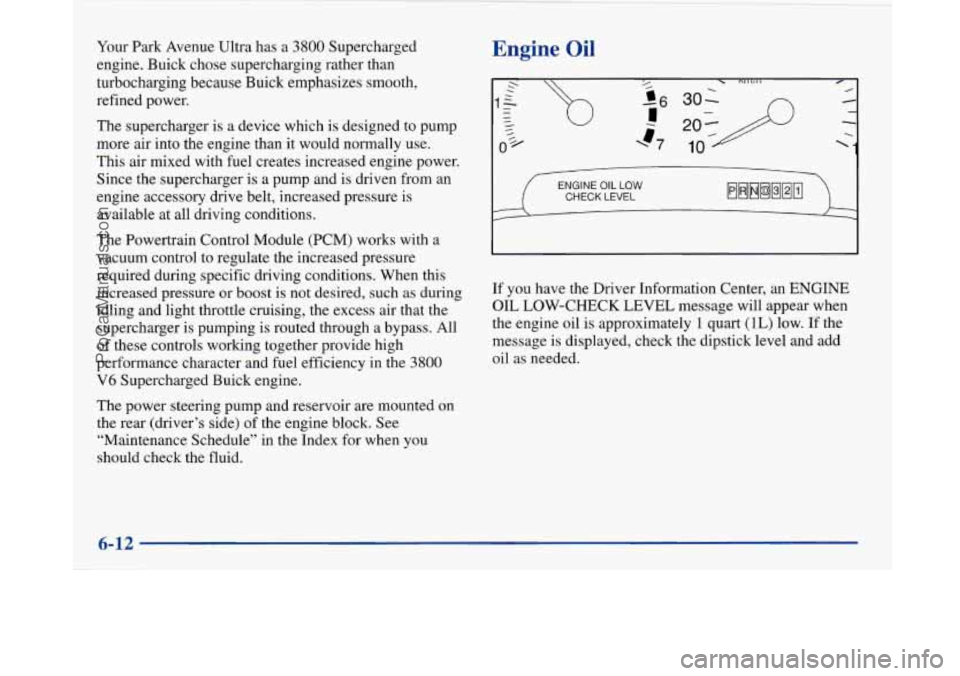
If you have the Driver Information Center, an ENGINE
OIL LOW-CHECK LEVEL message will appear when
the engine oil is approximately
1 quart (IL) low. If the
message is displayed, check the dipstick level and add
oil as needed.
6-12
ProCarManuals.com
Page 288 of 420
Engine Coolant
The cooling s stem in your vehicle is filled with
DEX-COOL engine coolant. This coolant is designed
to remain in your vehicle for
5 years or 150,000 miles
(240
000 km) whichever occurs first, if you add only
DEX-COOL’ extended life coolant.
2
The following explains your cooling system and how
to add coolant when it
is low. If you have a problem
with engine overheating, see “Engine Overheating” in
the Index.
A 50/50 mixture of water and DEX-COOL@
coolant will:
Give freezing protection down to -34°F (-37°C).
Give boiling protection up to 265 OF ( 129 O C).
Protect against rust and corrosion.
0 Help keep the proper engine temperature.
0 Let the warning lights and gages work as
they should.
NOTICE:
When adding coolant, it is important that you use
only
DEX-COOL@ (silicate-free) coolant.
If coolant other than DEX-COOL is added to the
system, premature engine, heater core or
radiator corrosion may result. In addition, the
engine coolant will require change sooner
-- at
30,000 miles (50 000 km) or 24 months,
whichever occurs first. Damage caused by the use
of coolant other than DEX-COOL@ is not.
covered by your new vehicle warranty.
6-24
ProCarManuals.com
Page 295 of 420
There are only two reasons why the brake fluid level in the
reservoir might go down. The first is that the brake fluid
goes down to
an acceptable level during normal brake
lining wear. When new linings
are put in, the fluid level
goes back up. The other reason is that fluid is leaking out
of the brake system.
If it is, you should have your brake
system
fixed, since a leak means that sooner or later your
brakes won’t work well, or won’t work at
all.
So, it isn’t a good idea to “top off’ your brake fluid.
Adding brake fluid won’t correct a leak.
If you add fluid
when your linings are worn, then you’ll have too much
fluid when you get new brake linings. You should add
(or remove) brake fluid, as necessary, only when work is
done on the brake hydraulic system. When
your brake fluid falls
to a low level, your brake
warning light will come on. A chime will sound if you
try to drive with this warning light on. See “Brake
System Warning Light” in the Index.
What to Add
When you do need brake fluid, use only DOT-3 brake
fluid
-- such as Delco Supreme 11 @ (GM Part
No. 12377967). Use new brake fluid from a sealed
container only.
Always clean the brake fluid reservoir cap and the area
around the cap before removing it.
This will help keep
dirt from entering the reservoir.
I
With the wrong kind of fluid in your brake
system, your brakes may not work well, or they
may not even work at all. This could cause a
‘crash. Always use the proper brake fluid.
If you have’too much brake fluid, it can spill on the
engine. The fluid
will burn if’ the engine is hot
enough. You or others could be burned, and your
vehicle could be damaged. Add brake fluid
only
when work is done on the brake hydraulic system.
6-31
ProCarManuals.com
Page 297 of 420
Some driving conditions or climates may cause a brake
squeal when the brakes are first applied or lightly
applied. This does not mean something is wrong with
your brakes.
Properly torqued wheel nuts are necessary to help
prevent brake pulsation. When tires are rotated, inspect
brake pads for wear and evenly torque wheel nuts in the
proper sequence to GM specifications.
Your rear drum brakes don’t have wear indicators, but if
you ever hear a rear brake rubbing noise, have the rear
brake linings inspected.
Also, the rear brake drums should
be removed and inspected each time the tires
are removed
for rotation
or changing. When you have the front brakes
replaced, have the rear brakes inspected, too.
Brake linings should always be replaced as complete
axle sets.
See “Brake System Inspection’’ in Section
7 of this
manual under Part
C “Periodic Maintenance
Inspections”.
Brake Pedal Travel
See your dealer if the brake pedal does not return to
normal height, or if there is a rapid increase in pedal
travel. This could be a sign of brake trouble.
Brake Adjustment
Every time you apply the brakes, with or without the
vehicle moving, your brakes adjust for wear.
Replacing Brake System Parts
The braking system on a modern vehicle is complex. Its
many parts have to be of top quality and work well
together
if the vehicle is to have really good braking.
Your vehicle was designed and tested with top-quality
GM brake parts. When you replace parts of your braking
system
-- for example, when your brake linings wear
down and you have to have new ones put in
-- be sure
you get new approved GM replacement parts.
If you
don’t, your brakes may no longer work properly. For
example, if someone puts in brake linings that are wrong
for your vehicle, the balance between your front and
rear brakes can change
-- for the worse. The braking
performance you’ve come to expect can change in many
other ways if someone puts in the wrong replacement
brake parts.
6-33
ProCarManuals.com
Page 313 of 420
Check Tire Pressure System (If Equipped)
The check tire pressure system can alert you to a large
change
in the pressure of one tire. The system won’t alert
you before you drive that a tire is low or flat. You must
begin driving before the system will work properly.
The CHECK
TIRE PRESSURES message will appear
on the Driver Information Center (DIC) if pressure in
one tire becomes at least
€0 psi (69 kPa) lower or higher
than the other three tires. The warning message can be
removed from the display by pressing any DIC button.
Removing the message does not reset the system. The
check tire pressure system won’t alert you if more than
one tire is low or high, or if the system
is not calibrated
properly. It also won’t tell you which tire is low or high.
If
the anti-lock brake system warning light comes on,
the check tire pressure system may not be working
properly. See your dealer for service. (Also, see
“Anti-Lock Brake System Warning Light” in the Index.)
The check tire pressure system detects differences in tire
rotation speeds that
are caused by changes in tire
pressure. The system can alert you about a low
tire
-- but it doesn’t replace normal tire maintenance.
See “Tires” in the Index. When
the CHECK TIRE PRESSURES message appears
on the Driver Information Center, you should stop as
soon as you can and check all your tires for damage. (If
a tire is flat, see “If a Tire Goes Flat” in the Index.) Also
check the tire pressure in all four tires as soon as you
can. See “Inflation-Tire Pressure” in the Index.
Any time
you adjust a tire’s pressure or have one or
more tires repaired or replaced, you’ll need to reset
(calibrate) the check tire pressure system. You’ll also
need to reset the system whenever you rotate the tires,
buy new tires, install or remove the compact spare, and
whenever the vehicle’s battery has been disconnected.
Don’t reset the check tire pressure system without first
correcting the cause of the problem and checking and
adjusting the pressure in all four tires. If you reset the
system when the tire pressures are incorrect, the check
tire pressure system will not work properly and may not
alert you when a tire is low or high.
6-49
ProCarManuals.com
Page 317 of 420
Uniform Tire Quality Grading
The following information relates to the system
developed by the United States National Highway
Traffic Safety Administration, which grades tires by
treadwear, traction and temperature performance. (This applies only to vehicles sold in the United States.) The
grades are molded on the sidewalls of most passenger
car tires. The Uniform Tire Quality Grading system does
not apply to deep tread, winter-type snow tires,
space-saver or temporary use spare tires, tires with
nominal rim diameters of
10 to 12 inches (25 to 30 cm),
or to some limited-production tires.
While the tires available on General Motors passenger
cars and light trucks may vary with respect to these
grades, they must also conform to Federal safety
requirements and additional General Motors Tire
Performance Criteria (TPC) standards.
Treadwear
The treadwear grade is a comparative rating based on
the wear rate of the tire when tested under controlled
conditions on a specified government test course. For
example, a tire graded 150 would wear one and a half
(1 1/2) times as well on the government course as a tire
graded
100. The relative performance of tires depends
upon the actual conditions of their use, however, and
may depart significantly from the norm due to variations
in driving habits, service practices and differences in
road characteristics and climate.
Traction -- A, B, C
The traction grades, from highest to lowest, are A, B,
and C, and they represent the tire’s ability to stop on wet
pavement as measured under controlled conditions
on
specified government test surfaces of asphalt and
concrete.
A tire marked C may have poor traction
performance.
Warning: The traction grade assigned to this tire
is based
on braking (straight ahead) traction tests and does not
include cornering (turning) traction.
6-53
ProCarManuals.com