engine BUICK PARK AVENUE 1998 Workshop Manual
[x] Cancel search | Manufacturer: BUICK, Model Year: 1998, Model line: PARK AVENUE, Model: BUICK PARK AVENUE 1998Pages: 426, PDF Size: 23.59 MB
Page 296 of 426
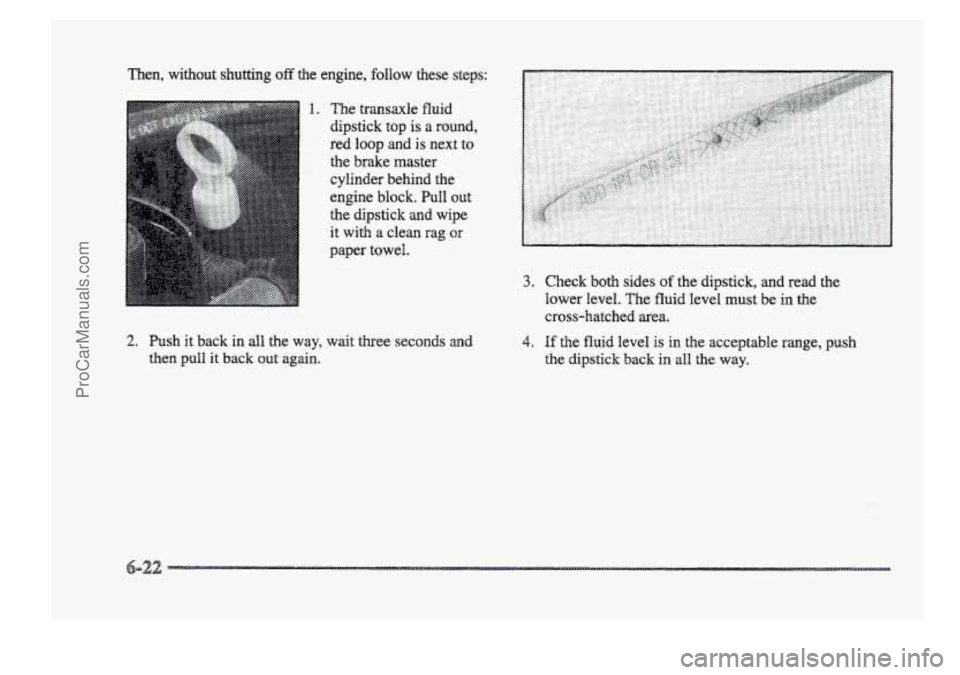
Then, without shutting off the engine, follow these steps:
1. The transaxle fluid
dipstick top is a round,
red
loop and is next to
............. ............. the brake master
cylinder behind
the
engine block. Pull out
the dipstick and wipe
it with a clean rag or
paper towel.
3. Check both sides of the dipstick, and read the
lower level. The fluid 'level
must be in the
cross-hatched area.
2. Push it back in all the way, wait thee seconds and 4. If the fluid level is in the acceptable range, push
then pull it back out again. the dipstick back in a11 the way.
ProCarManuals.com
Page 297 of 426
Refer to the Maintenance Schedule to determine what
kind
of transaxle fluid to use. See “Recommended
Fluids
md Eubricmts” in the Index.
If the fluid level is low, add only enough of the proper
fluid
to bring the level into the cross-hatched area on
the dipstick.
I. Pull out the dipstick.
2. Using a long-neck funnel, add enough fluid at the
dipstick hole
to bring it to the proper level.
It doesn’t
take much fluid, generally less than one
pint
(0.5 L). Don’t ove@Zl.
3. After adding fluid, recheck the fluid level ips
4. When the correct fluid level is obt.ained, push the
described
under “How to Check.”
dipstick back in
dl the way.
The cooling s stem in your vehicle is filled with
DEX-COOL engine coolant. This coolant is designed
to remain in your vehicle for 5 years or 150,000 miles
(240 MI0 h) whichever occurs first, if you add only
DEX-COOL“ extended life coolant,
The following explains
your coding system and
how to add coolant when it is low. If YOU have a
problem with engine overheating, see “Engine
Overheating”
in the Index.
A 50/50 mixture of water and DEX-COOL’
coolant will:
J
Give freezing protection down to -34°F (-37°C).
Give boiling protection up to 265 OF 129 ” C).
Protect against rust and corrosion.
Help keep the proper engine temperature.
Let the warning lights and gages work as
they should.
ProCarManuals.com
Page 298 of 426

NOTICE:
When adding coolant, it is importrant that you use
O~Y DEX-CQOE~ (sficate-free) COQI~~.
If coolant other than DEX-COOL is added to the
system, premature engine, heater
core or
radiator corrosion may result.
Hw addition, the
engine coolant
will require change SQB~~F -- at
30,000 des (50 000 b) or 24 months,
whichever occurs
first. Damage caused by the
use of coolant other than DEX-COOL@ is not
c~vemdl by
your new vehicle warranty.
Use a mixture of one-half clean water (preferably
distilled)
and one-half DEX-COOL’ coolant which
won’t damage aluminum pats. If you use this mixture,
YOU don’t need to add anything else.
..
..
Adding only plain water to your cooling system
can be dangerous. Blain water, or some other
liquid like alcohol,
can boil before the proper
coolant mixture
will. Your vehicle’s CQO~~
warning system is set for the proper c~~lmt
mixture. With plain water or the wrong mixture,
your engine could get too
hot but you wouldn’t
get the overheat warning. Your engine could
catch fire and
yon or others could be burned.
Use a 50/50 mixture of clean water and
DEX-CBOL@ codant.
6-24
ProCarManuals.com
Page 299 of 426
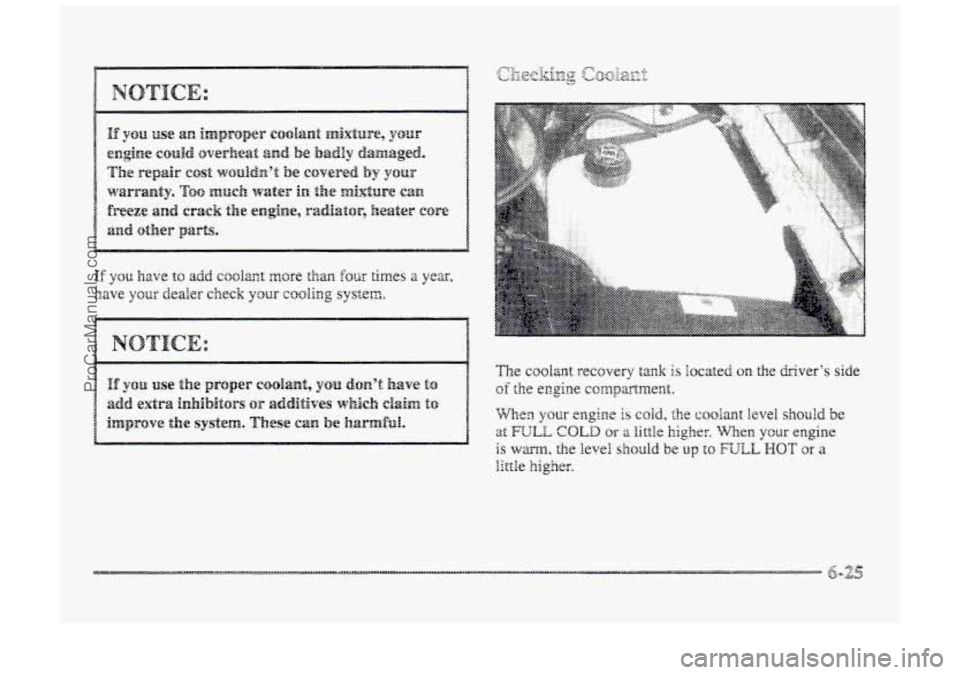
The csdant recovery tank is located QII the @river's side
of the engine compartment.
ProCarManuals.com
Page 300 of 426
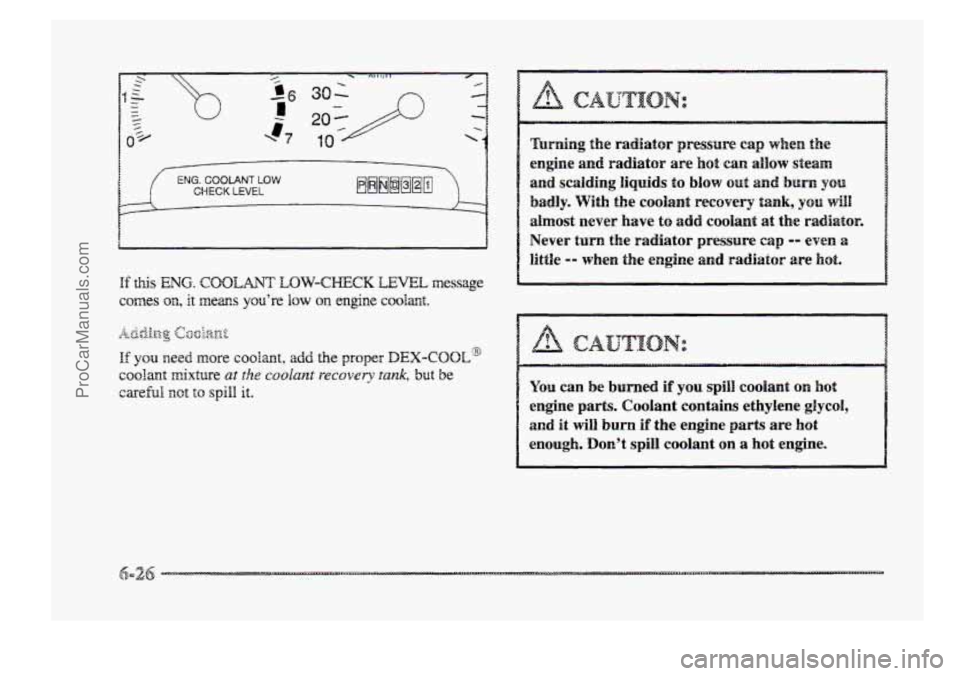
1 f ENG. COOLANT LOW CHECK LEVEL
Turning the radiator pressure cap when the
engine and radiator
are hot can allow steam
and scalding liquids to blow out and burn yon
badly. With the codant recovery tank, you will
almost never have fO add coolant at the radiator.
Never turn the radiator pressure cap -- even a
little -- when the engine sand radiator are hot.
You can be burned if you spill cooiant QPB hot
engine parts. Coolant contains ethylene glycol,
and it will burn if the engine parts are hot
enough. Don't spill coolant on a hot engine.
ProCarManuals.com
Page 301 of 426
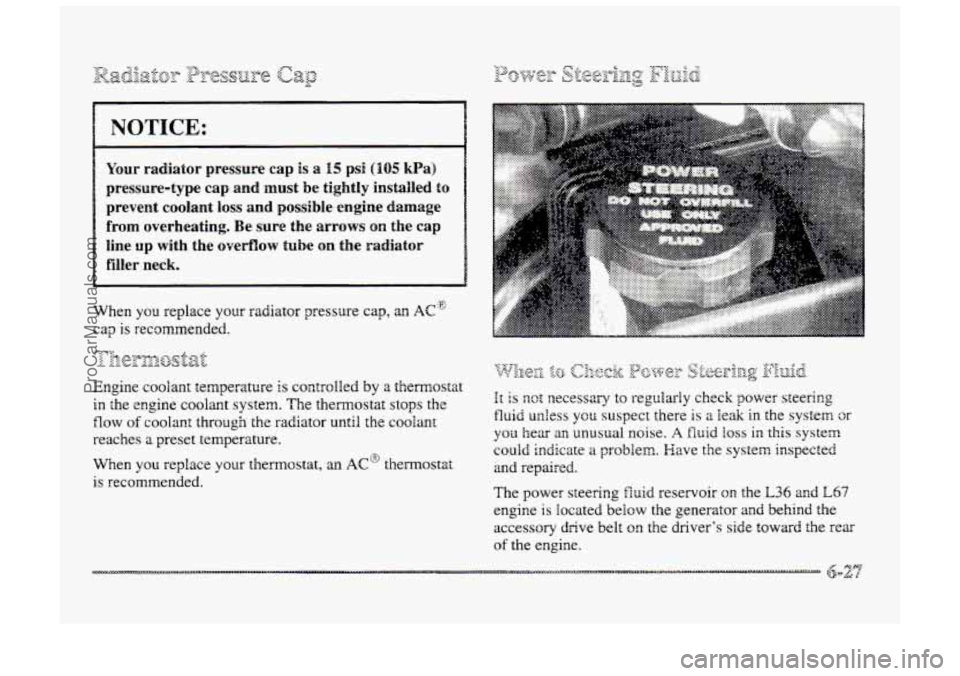
prevent coolant loss and possible engine damage
~ filler neck.
When you replace your radiator pressure cap, an AC~
.t ;trolled by a themosta
in
reaches
a preset temperature.
When you replace your themostat,
an AC@ themostat
is recommended.
ProCarManuals.com
Page 302 of 426
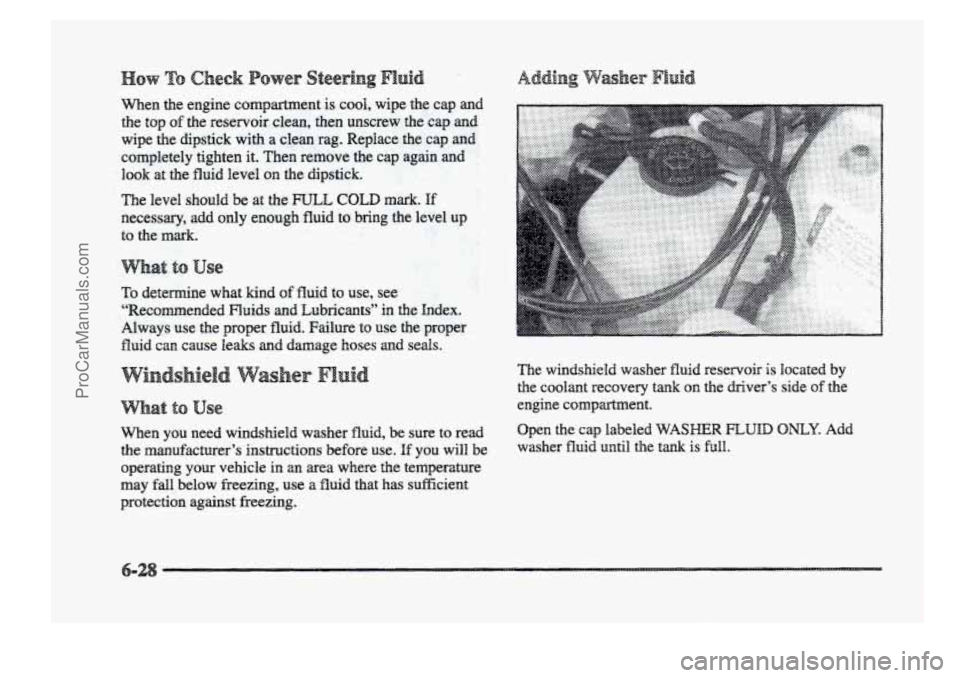
When the engine compartment is cool, wipe the cap and
the top
of the reservoir clean, then unscrew the cap and
wipe the dipstick with a clean rag. Replace the cap and
completely tighten it. Then remove the cap again and
Book at the fluid level on the dipstick.
The level should
be at the FTLL COLD mark. If
necessary, add Q~Y enough fluid to bring the level up
to the mark.
at to use
To determine what kind of fluid to use, see
“Recommended Fluids
and Lubricants” in the Index.
Always use the proper fluid. Failure
to use the proper
fluid
can cause leaks and damage hoses and seals.
What to use
When you need windshield washer fluid, be sure to read
the manufacturer’s instructions before use.
If you will be
operating
your vehicle in an area where the temperature
may
fall below keezing, use a fluid that has suffkient
protection against freezing.
The windshield washer fluid reservoir is located by
the coolant recovery tank on the driver’s side of the
engine compartment.
Open
the cap labeled WASHER ONLX Add
washer
fluid until the tank is full.
ProCarManuals.com
Page 305 of 426
NOTICE:
Using the wrong fluid can badly damage
brake system
parts. For example, just a few
drops
of minerallbased oil, such as engine
oil, in your brake system can damage brake
system
parts so badly that they’ll have to be
replaced.
Don’t let someone gut in the
If you spill brake fluid OEI your vehicle’s
painted
surfaces, the paint finish can be
damaged. Be careful
not to spill brake fluid
on your vehicle. If you do, wash it off
immediately. See “Appearance Case” in
the Index. wrong
kind of fluid.
Your vehicle has four-wheel disc brakes.
Disc
brake pads have built-in wear inchcators &at make a
high-pitched warning sound when the brake pads are
worn and new pads are needed. The sound may come and
go or be heard all the time your vehicle is moving (except
when
you are pushing on the brake pedal firmly).
The brake wear warning sound means that soon
your brakes won’t work well. That could lead to
an accident. When you hear the brake wear
warning sound, have your vehicle serviced.
NOTICE:
Continuing to drive with worn-out brake pads
could result in costly brake repair.
ProCarManuals.com
Page 337 of 426
I U 1 SAMPLE4UXWM072675 I E! I I
ENGINE A98 f 1 ASSEMBLY
CbDE A MODEL YEAR PLANT
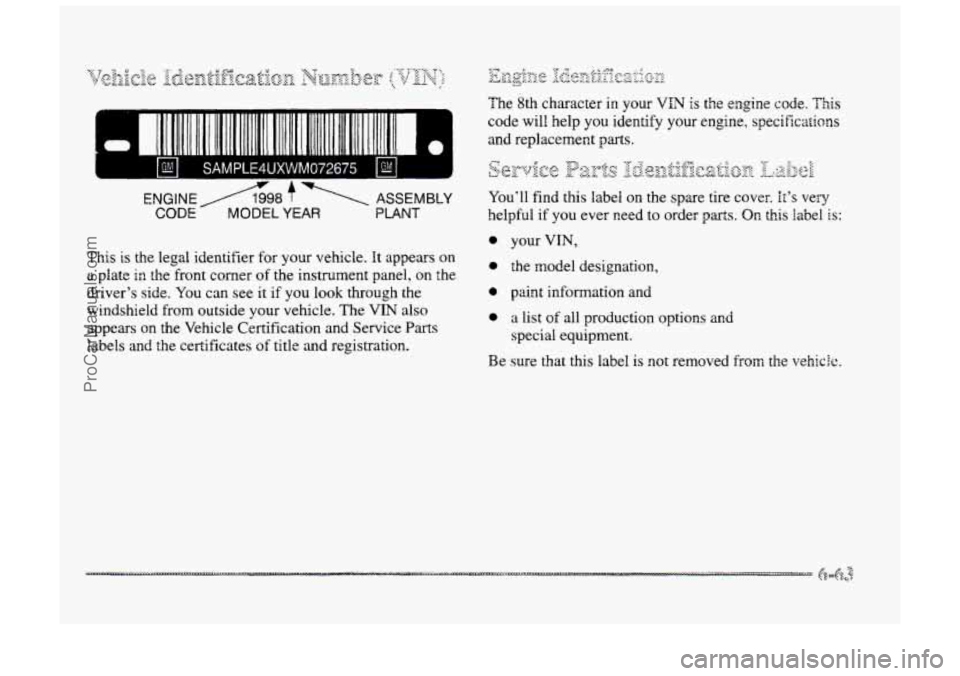
This is the legal identifier for your vehicle. It appears on
a plate in the front comer of the instrument panel, on the
driver's side. You can
see it if you look through the
windshield from outside your vehicle. The VIN
also
appears on the Vehicle Certification and Service Parts
labels and the certificates of title and registration.
Be sure that this label is
not removed from the vek-rlc?~.
ProCarManuals.com
Page 339 of 426
The wiring circuits in your vehicle are potected from
short circuits by a combination of fuses and circuit
breakers. This greatly reduces ?;he chance
of damage
caused
by electrical problems.
Look at the silver-cobred band inside the fuse. If the
band is broken or melted, replace the fuse. Be sure
you
replace a bad fuse with a new one of the identical size
and rating.
Tlere
are three fase blocks in your vehicle: the
Instrument
Pace1 Fuse Block located under the
instrument panel, the Underhood Fuse Block located
QTP
the passenger's side engine compartment and the Xear
Fuse Block, located under the rear seat.
I.
2.
3.
4.
5.
Remove the two 7 mm screws located aIsng the
front edge of the panel.
Lower the
hush panel. The fuse block is a
rectangular covered box iocated on the far right side
under the instrument panel.
Remove the cover. Now you can see the hses 2nd
replace them.
Place the wide
end of the he puller over the plastic
end of the f;crse.
Squeeze the ends over the fuse and pull it out.
Spare fuses are located in the enpty slots shown OR the
foliowing chat.
When finished, repiace the hush panei. Replace lamps,
connectors,
and HVAC duct temperature sensors if they
were removed.
ProCarManuals.com