tow BUICK REGAL 1993 User Guide
[x] Cancel search | Manufacturer: BUICK, Model Year: 1993, Model line: REGAL, Model: BUICK REGAL 1993Pages: 308, PDF Size: 16.35 MB
Page 85 of 308
Headlight High-Low Beam
rc
To change the headlights
from low beam to high or
high to low, pull the turn
signal lever all the way
toward you. Then release
it.
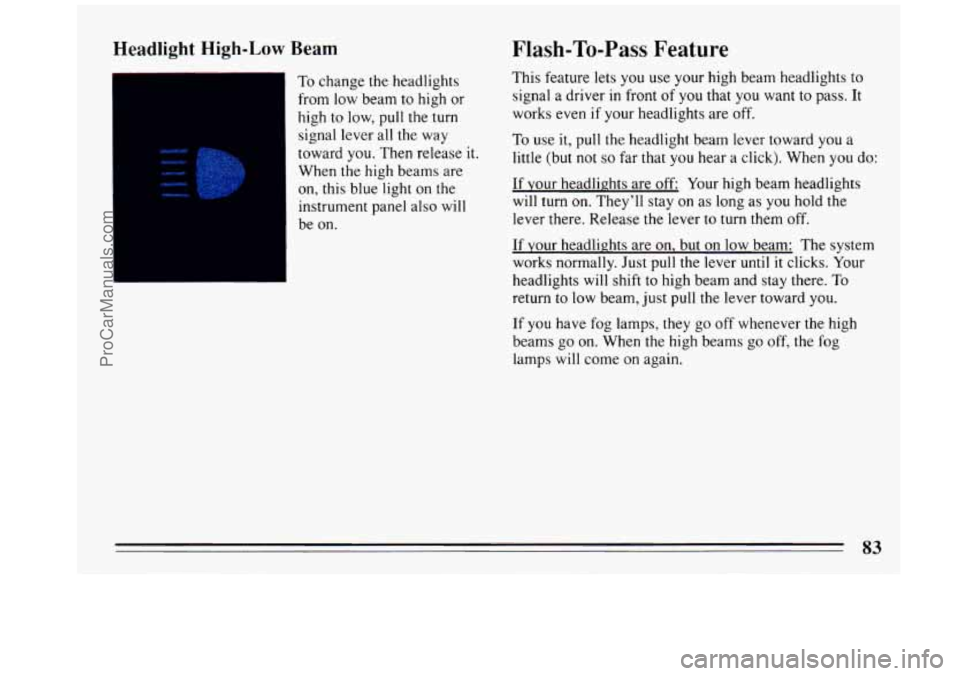
When the high beams are
on, this blue light on the
instrument panel also will
be on.
Flash-To-Pass Feature
This feature lets you use your high beam headlights to
signal a driver
in front of you that you want to pass. It
works even if your headlights are off.
To use it, pull the headlight beam lever toward you a
little (but
not so far that you hear a click). When you do:
If your headlights are off Your high beam headlights
will
turn on. They’ll stay on as long as you hold the
lever there. Release the lever
t.o turn them off.
If your headliphts are on, but on low beam: The system
works normally. Just pull the lever until
it clicks. Your
headlights will shift to high beam and stay there.
To
return to low beam, just pull the lever toward you.
If
you have fog lamps, they go off whenever the high
beams go on. When the high beams
go off, the fog
lamps will come
on again.
83
ProCarManuals.com
Page 100 of 308
Storage Armrest (Option) Rear Seat
Console and Pass-Through
(Option)
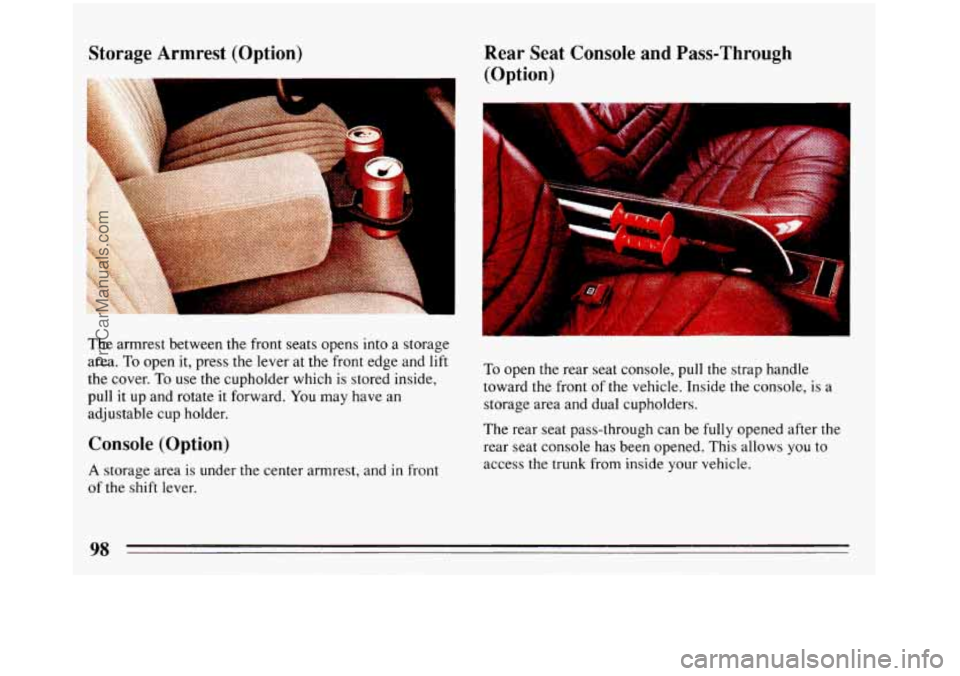
The armrest between the front seats opens into a storage
area.
To open it, press the lever at the front edge and lift
the cover.
To use the cupholder which is stored inside,
pull it up and rotate it forward.
You may have an
adjustable cup holder.
Console (Option)
A storage area is under the center armrest, and in front
of
the shift lever. To
open the rear seat console, pull the strap handle
toward the front
of the vehicle. Inside the console, is a
storage area and dual cupholders.
The rear seat pass-through can be
fully opened after the
rear seat console has been opened. This allows
you to
access the trunk from inside your vehicle.
98
ProCarManuals.com
Page 104 of 308
Brake System Warning Light
(a)(!)
BRAKE
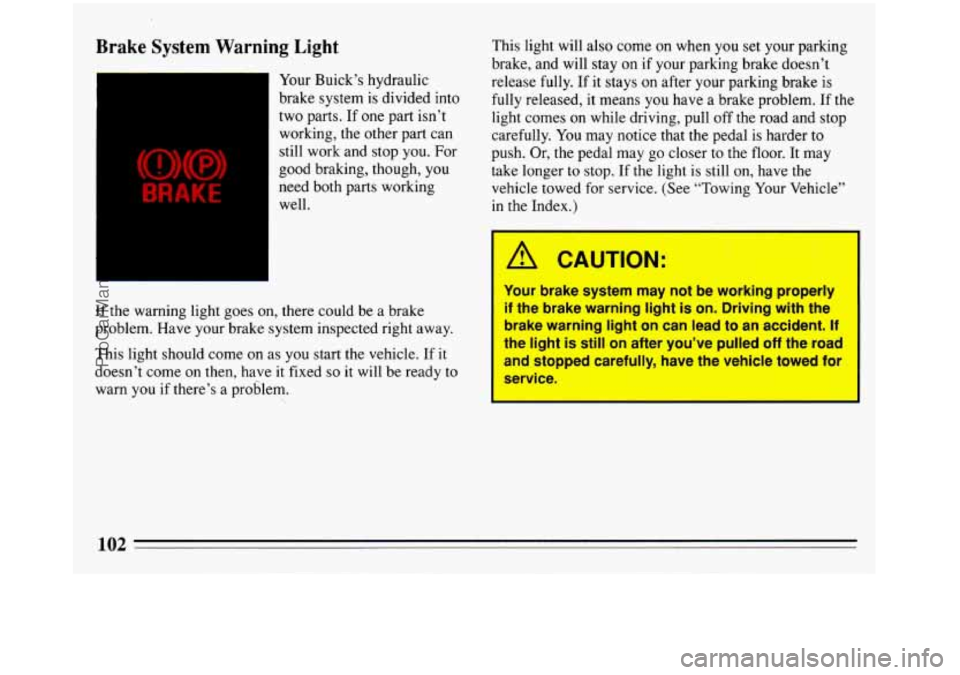
Your Buick’s hydraulic
brake system is divided into
two parts. If one part isn’t
working, the other part can
still work and stop you. For
good braking, though, you
need both parts working well.
If the warning light goes on, there could be a brake
problem. Have your brake system inspected right away.
This light should come on as you start the vehicle.
If it
doesn’t come on then, have it fixed
so it will be ready to
warn you if there’s a problem. This
light will also come on when you set your parking
brake, and will stay on if your parking brake doesn’t
release fully. If it stays
on after your parking brake is
fully released, it means you have a brake problem. If the
light comes on while driving, pull off the road and stop
carefully. You may notice that the pedal is harder
to
push. Or, the pedal may go closer to the floor. It may
take longer to stop.
If the light is still on, have the
vehicle towed for service. (See “Towing Your Vehicle”
in the Index.)
A CAUTION:
Your brake system may not be working properly
if the brake warning light is on. Driving with the
brake warning light on can lead to an accident.
If
the light is still on after you’ve pulled off the road
and stopped carefully, have the vehicle towed fo
service.
aw,Tp 1 e- c -
102
ProCarManuals.com
Page 113 of 308
Temperature Control
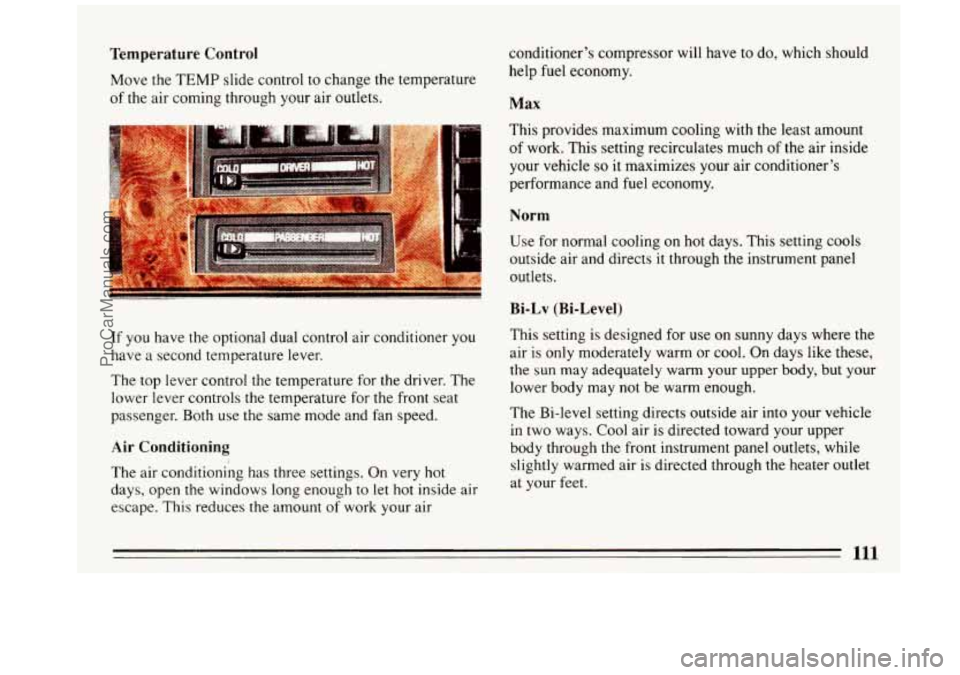
Move the TEMP slide control to change the temperature
of the air coming through your air outlets. conditioner’s
compressor will have to do, which should
help fuel economy. Max
This provides maximum cooling with the least amount
of work. This setting recirculates much of the air inside
your vehicle
so it maximizes your air conditioner’s
performance and fuel economy.
Norm
Use for normal cooling on hot days. This setting cools
outside air and directs it through the instrument panel
outlets.
Bi-Lv (Bi-Level)
If you have the optional dual control air conditioner you
have a second temperature lever.
The top lever control the temperature for the driver. The
lower lever controls the temperature for the front seat
passenger. Both use
the same mode and fan speed.
Air Conditioning
The air conditioning has three settings. On very hot
days, open
the windows long enough to let hot inside air
escape.. This reduces the amount of work your air This setting
is designed for
use on sunny days where the
air is only moderately warm or cool. On days like these,
the
sun may adequately warm your upper body, but your
lower body may not be warm enough.
The Bi-level setting directs outside air into your vehicle
in two ways.
Cool air is directed toward your upper
body through the front instrument panel outlets, while
slightly warmed air is directed through the heater outlet
at your feet.
111
ProCarManuals.com
Page 114 of 308
The air conditioner compressor operates in all Air
Conditioning positions, and
the Defrost position when
the outside temperature is above 40'F (4.5 "C).
Ventilation
For mild outside temperatures, when little heating or
cooling
is needed, press the VENT button. Air will flow
through the instrument panel outlets. Use the air outlets
to turn on, adjust and turn
off the air flow. Adjust the
TEMP lever to control the temperature.
Heating
When outside temperatures are cold, press the button
marked HTR and slide the
TEMP lever toward HOT to
send heated air through the floor outlets.
Defog
When your windshield is foggy, press the DEFOG
button to direct most of the air flow toward the
windshield. When it's
50 F ( 10 C) or warmer, the
system will provide cooled air.
Defrost
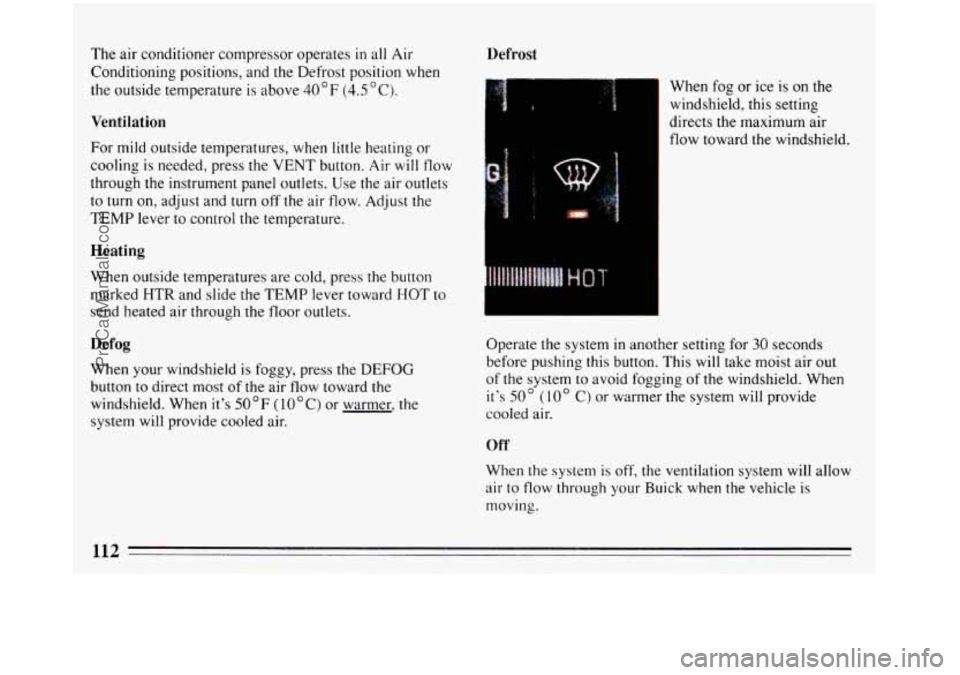
When fog or ice is on the
windshield, this setting
directs the maximum air
flow toward the windshield.
Operate the system
in another setting for 30 seconds
before pushing this button.
This will take moist air out
of the system
to avoid fogging of the windshield. When
it's
50' (10" C) or warmer the system will provide
cooled air.
Off
When the system is off, the ventilation system will allow
air to flow through your Buick when the vehicle is
moving.
112
ProCarManuals.com
Page 129 of 308
@ Part 4 Your Driving And The Road
.
..
Here you'll find information about driving on different kinds of roads and in varying weather conditions . We've also
included many other useful tips
on driving .
Part 4 includes:
Roadsigns
....................................................................... \
DefensiveDriving .................................................................
ControlofaVehicle ................................................................
BrakingTips .................................................................
SteeringTip ..................................................................
Passing .....................................................................
LossofControl ...............................................................
DrivingatNight ....................................................................
DrivingintheRain .................................................................
Driving in Fog, Mist and Haze ........................................................
CityDriving ....................................................................... \
FreewayDriving ...................................................................
DrivingonaLongTrip ............................................................
HillandMountainRoads ..........................................................
ParkingonHills ...................................................................
WinterDriving ....................................................................
TowingaTrailer ...................................................................
DrunkenDriving ..................................................................
Steering in Emergencies ........................................................
128
134
135
138
139
144
145
147
148
149
152
154
156
157
159
161
163
166
170
ProCarManuals.com
Page 137 of 308
Defensive driving really means “be ready for anything.”
On city streets, rural roads, or freeways, it means
“always expect the unexpected.’’
Assume that pedestrians or other drivers are going to be
careless and make mistakes. Anticipate what they might
do. Be ready for their mistakes.
Expect children to dash out from behind.parked cars, often followed by other children. Expect occupants in
parked cars to open doors into traffic. Watch for
movement in parked cars
-- someone may be about to
open a door.
Expect other drivers to run stop signs when you are on a
through street. Be ready to brake if necessary as
you go
through intersections. You may not have to use the
brake, but if you do, you will be ready.
If you’re driving through a shopping center parking lot
where there are well-marked lanes, directional arrows,
and designated parking areas, expect some drivers
to
ignore all these markings and dash straight toward one
part
of the lot.
Pedestrians can be careless. Watch for them. In general,
you must give way to pedestrians even if
you know you
have the right of way.
Rear-end collisions are about
the most preventable of
accidents. Yet they are common. Allow enough following distance.
It’s the best defensive driving
maneuver, in both city and rural driving. You never
know when the vehicle in front of you is going to brake
or turn suddenly.
Here’s a final bit
of information about defensive driving.
The most dangerous time for driving in the
U.S. is very
early
on Sunday morning. In fact, GM Research studies
show that the most and the least dangerous times for
driving, every week, fall on the same day. That day is
Sunday. The most dangerous time is Sunday from
3 a.m.
to
4 a.m. The safest time is Sunday from 10 a.m. to 11
a.m. Driving the same distance
on a Sunday at 3 a.m.
isn’t just a little more dangerous than
it is at 10 a.m. It’s
about 134 times more dangerous!
That leads to the next section.
Drunken Driving
Death and injury associated with drinking and driving is
a national, tragedy. It’s the number one contributor
to the
highway death toll, claiming thousands of victims every
year. Alcohol takes away three things that anyone needs
to drive a vehicle:
Judgment
0 Muscular Coordination
0 Vision
135
ProCarManuals.com
Page 160 of 308
If you are on a three-lane freeway, treat the right lane as
the slower-speed through lane, the middle lane
as the
higher-speed through lane, and the left lane as the
passing lane.
Before changing lanes, check your rearview mirrors.
Then use your turn signal.
Just before you leave the lane, glance quickly over your
shoulder
to make sure there isn’t another vehicle in your
“blind” spot.
If you are moving from an outside to a center lane on a
freeway having more than two lanes, make sure another
vehicle isn’t about to move into the same spot. Look at
the vehicles two lanes over and watch for telltale signs:
turn signals flashing, an increase in speed, or moving
toward the edge
of the lane. Be prepared to delay your
move.
Once
you are moving on the freeway, make certain you
allow a reasonable following distance. Expect
to move
slightly slower at night.
Leaving the Freeway
When you want to leave the freeway, move to the proper
lane well in advance. Dashing across lanes at the last
minute is dangerous.
If you miss your exit do not, under any
circumstances, stop and back up. Drive
on to the
next exit.
At each exit point is a deceleration lane. Ideally it
should be long enough for
you to enter it at freeway
speed (after signaling, of course) and then do your
braking before moving onto the exit ramp.
Unfortunately, not all deceleration lanes are long enough
-- some are too short for all the braking. Decide when to
start braking. If you must brake
on the through lane, and
if there is traffic close behind you, you can allow
a little
extra time and flash your brake lights (in addition to
your turn signal) as extra warning that you are about to
slow down and exit.
The
exit ramp can be curved, sometimes quite sharply.
The exit speed is usually posted. Reduce your speed
according to your speedometer, not to your sense
of
motion. After driving for any distance at higher speeds,
you may tend to think you are going slower than you
actually are. For example,
40 mph (65 km/h) might
seem like
only 20 mph (30 km/h). Obviously, this could
lead
to serious trouble on a ramp designed for 20 mph
(30 km/h)!
158
-
ProCarManuals.com
Page 164 of 308
IL
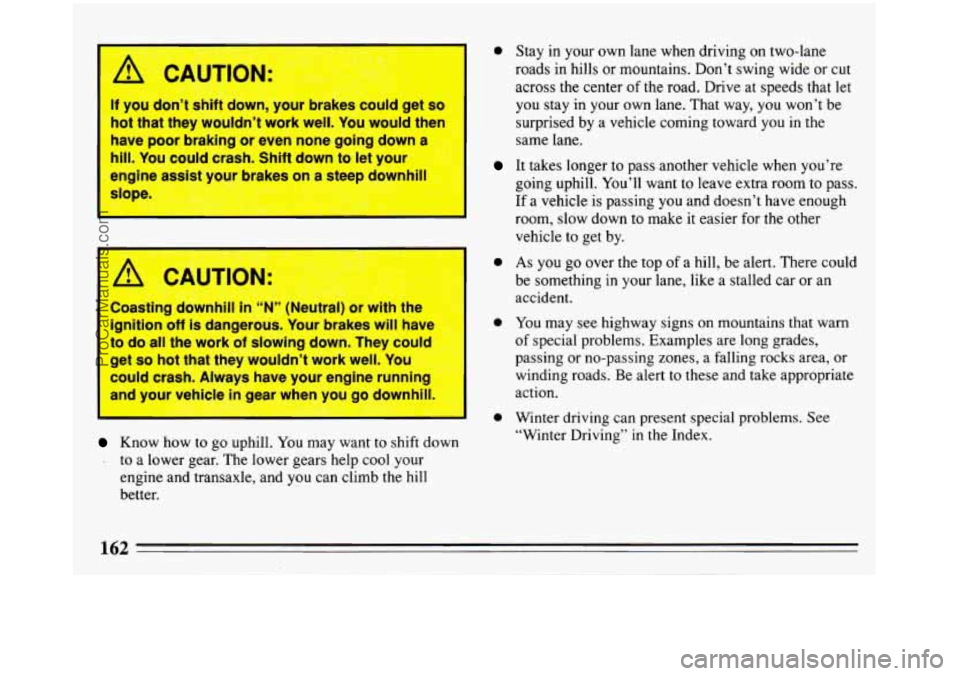
CAUTION
If you don’t shift down, Jour brakes ,auld get so
hot that they wouldn’t work well. You would then I
have poor braking or even none going down a
hill. You could crash. Shift down to let your
engirp
assist your brakes on a steep downhill
I A
CAUTION
Coasting downhill in “N” (Neutral) or with the
ignition
off is dangerous. Your brakes will have
to do
all the work of slowing down. They could I
get so hot that they wouldn’t work well.
could crash. Always have your engine runn
g
and your vel - le i gear en ya-- go downhill.
I
Know how to go uphill. You may want to shift down
. to a lower gear. The lower gears help cool your
engine and transaxle, and
you can climb the hill
better.
I
0 Stay in your own lane when driving on two-lane
roads in hills or mountains. Don’t swing wide or cut
across the center
of the road. Drive at speeds that let
you stay in your own lane. That way, you won’t be
surprised by a vehicle coming toward
you in the
same lane.
It takes longer to pass another vehicle when you’re
going uphill.
You’ll want to leave extra room to pass.
If a vehicle is passing you and doesn’t have enough
room, slow down to make it easier for the other
vehicle
to get by.
0 As you go over the top of a hill, be alert. There could
be something in your lane, like
a stalled car or an
accident.
0 You may see highway signs on mountains that warn
of special problems. Examples are long grades,
passing or no-passing zones, a falling rocks area, or
winding roads. Be alert
to these and take appropriate
action.
0 Winter driving can present special problems. See
“Winter Driving’’ in the Index.
162
ProCarManuals.com
Page 172 of 308
Then, shut the engine off and close the window almost
all the way to preserve the heat. Start the engine again
and repeat this only when you
feel really uncomfortable
from the cold. But do it as little
as possible. Preserve the
fuel as long as you can.
To help keep warm, you can get
out
of the vehicle and do some fairly vigorous exercises
every half hour
or so until help comes.
If You’re Stuck in Deep Snow
This manual explains how to get the vehicle out of deep
snow without damaging it. See “Rocking Your Vehicle”
in the Index.
Towing a Trailer
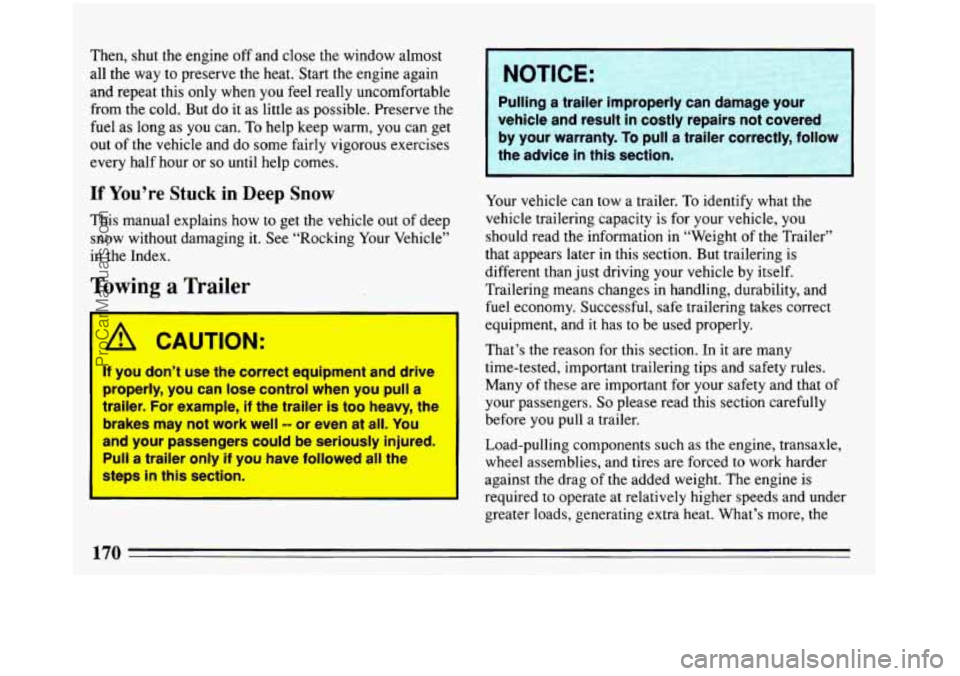
(n CAUTION:
If you don’t use the correct equipment and drive
properly, you can
lose control when you pull a
trailer. For example,
if the trailer is too heavy, the
brakes may not work well
-- or even at all. You
and your passengers could be seriously injured.
Pull a trailer only if you have followed all the
steps
in this section.
I NOTICE:
Pulling a trailer improperly can damage your
vehicle and result
in costly repairs not covered
by your warranty.
To pull a trailer correctly, follov
the advice in this section. ‘I
Your vehicle can tow a trailer. To identify what the
vehicle trailering capacity is for your vehicle, you
should read the information in “Weight
of the Trailer”
that appears later in this section. But trailering is
different than just driving your vehicle by itself.
Trailering means changes in handling, durability, and
fuel economy. Successful, safe trailering takes correct
equipment, and it has
to be used properly.
That’s the reason for this section. In
it are many
time-tested, important trailering tips and safety rules.
Many
of these are important for your safety and that of
your passengers.
So please read this section carefully
before
you pull a trailer.
Load-pulling components such as the engine, transaxle,
wheel assemblies, and tires are forced to work harder
against the drag of the added weight. The engine is
required to operate at relatively higher speeds and under
greater loads, generating extra heat. What’s more, the
170
- -
ProCarManuals.com