tow BUICK REGAL 1993 Owner's Guide
[x] Cancel search | Manufacturer: BUICK, Model Year: 1993, Model line: REGAL, Model: BUICK REGAL 1993Pages: 308, PDF Size: 16.35 MB
Page 191 of 308
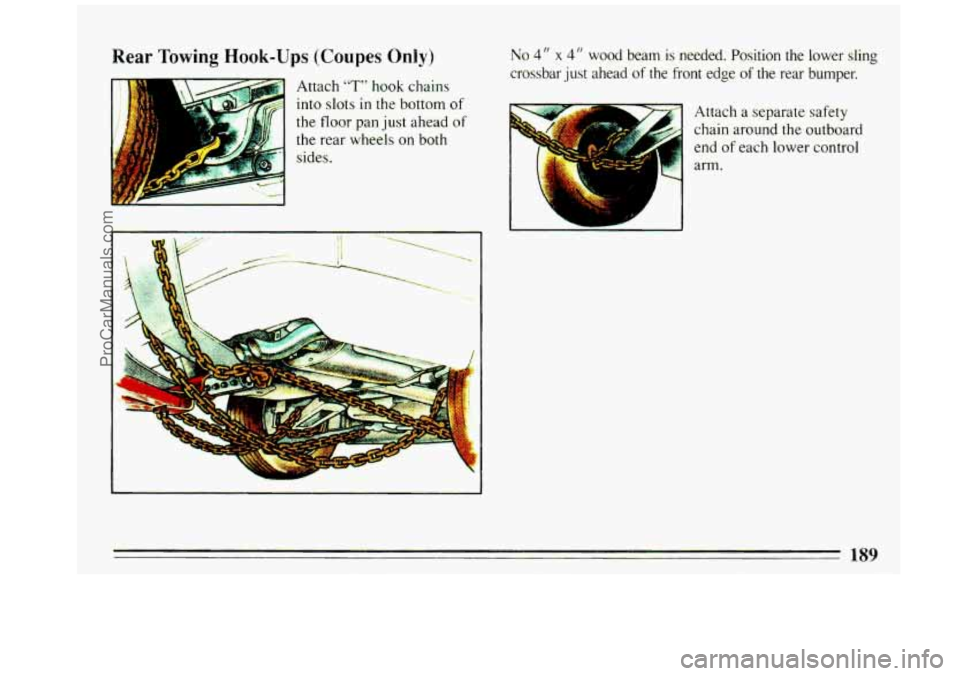
Rear Towing Hook-Ups (Coupes Only)
Attach “T” hook chains
into
slots in the bottom of
the floor pan just ahead of
the rear wheels on both
sides.
No 4 I’ x 4 I‘ wood beam is needed. Position the lower sling
crossbar just ahead
of the front edge of the rear bumper.
Attach a separate safety
chain around the outboard
end
of each lower control
arm.
I I
‘-7
189
ProCarManuals.com
Page 192 of 308
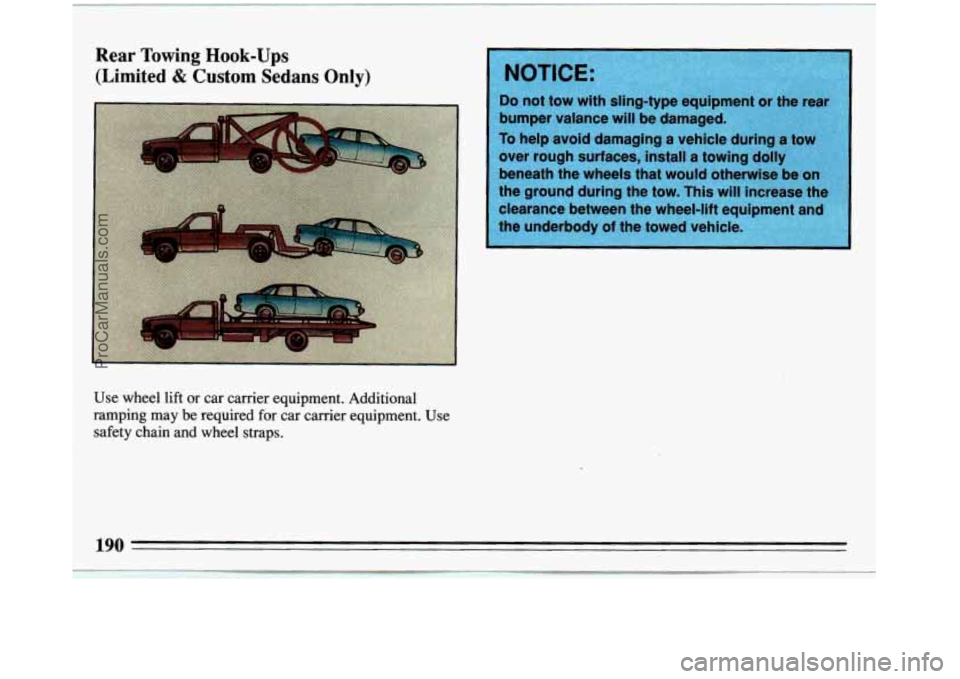
Rear Towing Hook-Ups
(Limited & Custom Sedans Only)
r'
Use wheel lift or car carrier equipment. Additional
ramping may be required for car carrier equipment. Use
safety chain and wheel straps.
190
ProCarManuals.com
Page 193 of 308
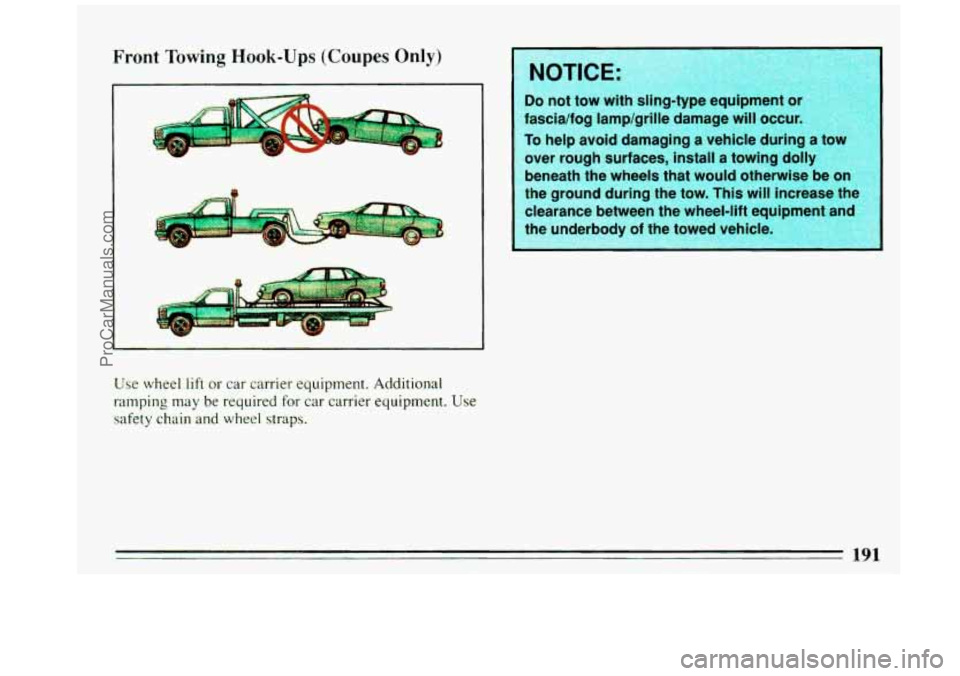
Front Towing Hook-Ups (Coupes Only)
,-
Use wheel lift or car carrier equipment. Additional
ramping
may be required for car carrier equipment. Use
safety chain and wheel straps.
over rough surfaces, install a towing dolly
beneath the wheels that would otherwise be o
the ground during the tow. This will increase the
clearance between the wheel-lift equipment an6
the underbody of the towed vehicl*
191
ProCarManuals.com
Page 194 of 308
Engine Overheating
You will find a coolant temperature gage on your
Buick's instrument panel.
You may also find a low coolant warning light
on your
Buick instrument panel.
If Steam Is Coming From Your Engine:
A CAUTION:
Steam from an overheated engine can burn you
badly, even
if you just open the hood. Stay away
from the engine
if you see or hear steam coming
from it. Just turn
it off and get everyone away
from the vehicle until it cools down. Wait
until
there is no sign of steam or coolant before
opening the hood.
'* -7ou keep driving when your engine is
overheated, the liquids
in it can catch fire. You or
others could be badly burned. Stop your engine
if it overheats, and get out of the vehicle until the
engine is cool.
If your engine catch
driving with
no coolant, your vehicle can be
badly damaged. The costly repairs
w?uld not b
covered by your warranty. ,, , 1 ,.
I If No Steam Is Coming From Your Engine:
If you get the overheat warning but see or hear no
steam,
the problem may not be too serious. Sometimes
the engine can get a little too hot when you:
0 Climb a long hill on a hot day.
0 Stop after high speed driving.
0 Idle for long periods in traffic.
Tow a trailer.
ProCarManuals.com
Page 198 of 308
Youlean be burned if you spill coolant on hot
engine parts. Coolant contains ethylene glycol
-d it wiil burn if the engine parts are hot
ough. Don't spill
coolant -on a hot engine.
,- '
.Steam and scalding liquids- from a hot 'bootin!,
system can btow o.ut and burn you badly. They
are under pressure,..and.
if you turn the. radiatr-
pre,ssure cap
- even a little - they can come brl
cooling system, including the, radiator pressye
When the coolant in the coolant recovery tank is at or cap, is hot. Wait for the cooling system'and
above "COLD," start your vehicle. radiator pressure cap to cool if:you-ever have to
If the overheat warning continues, there's one more -turn the pressure cap.
thing you can try. You can add the proper coolant mix 3
directly to the radiator, but be sure the cooling system is
cool before you do it.
- at high speed. Never turn,the cap'when the+;:.::
-, .I
I
196
ProCarManuals.com
Page 203 of 308
If a Tire Goes Flat
It’s unusual for a tire to “blow out” while you’re driving,
especially if you maintain your tires properly. If air goes
out
of a tire, it’s much more likely to leak out slowly.
But if
you should ever have a “blowout,” here are a few
tips about what to expect and what
to do:
If a front tire fails, the flat tire will create a drag that
pulls the vehicle toward that side. Take your foot off
the
accelerator pedal and grip the steering wheel firmly.
Steer
to maintain lane position, then gently brake to a
stop well out
of the traffic lane.
A rear blowout, particularly on a curve, acts much like a
skid and may require the same correction you’d use in a
skid. In any rear blowout, remove your foot fromthe
accelerator pedal. Get the vehicle under control by
steering the way you want the vehicle to go. It may be
very bumpy and noisy, but you can still steer. Gently
brake to a stop, well
off the road if possible.
If your tire goes flat, the next section shows how to use
your jacking equipment to change a flat tire safely.
Changing a Flat Tire
If a tire goes flat, avoid further tire and wheel damage
by driving slowly
to a level place. Turn on your hazard
warning flashers.
A CAUTION:
Changing a tire can cause an injury. The vehicle
can slip off the jack and roll over you or other
people. You and they could be badly injured. Find
a level place to change your tire. TO help prevent
be
! licle from moving:
. the parking brake firmly.
L. Put the shift lever in “P” (Park).
3. Turn off the engine.
To be even more certain the vehicle won’t move,
you can put chocks at the front and rear of
th
tire farthest away from the one being ehangec
That would be the tire
on the other side nG the
vehicle, at the
opposit- md. ;
201
ProCarManuals.com
Page 208 of 308
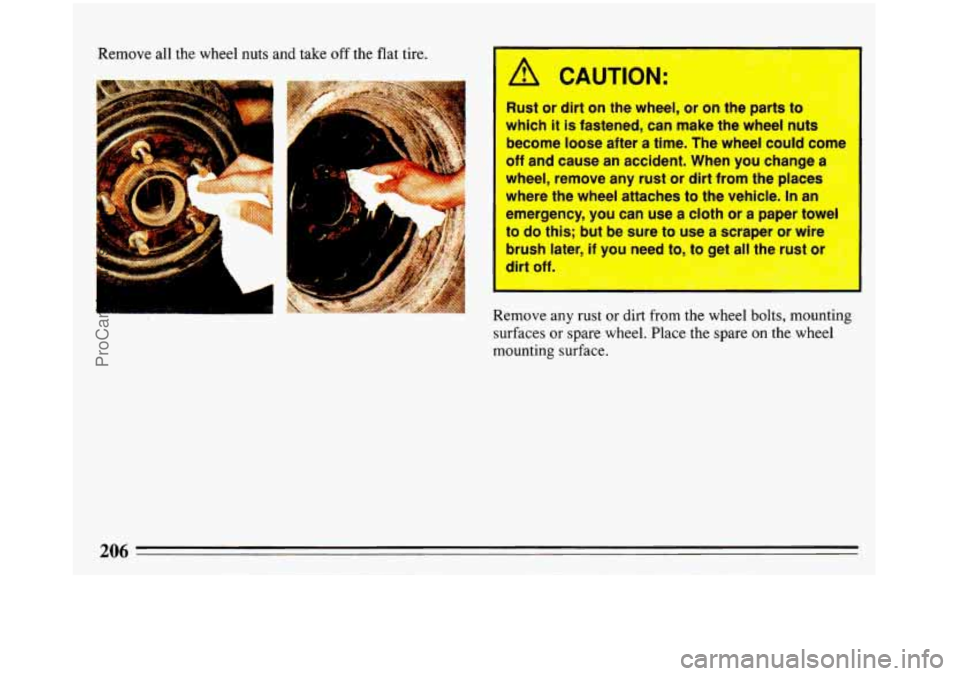
Remove all the wheel nuts and take off the flat tire.
iP
A CAUTION:
Rust or dirt on the wheel, or on rne parts to
which it is fastened, can make the wheel nuts
become loose after
a time. The wheel could come
off and cause an accident. When you change a
wheel, remove any rust or dirt from the places
where the wheel attaches to the vehicle.
In an
emergency, you can
use a cloth or a paper towel
to
do this; but be sure to use a scraper or wire
brush later,
if you need to, to get all the rust or
dirt off.
Remove any rust or dirt from the wheel bolts, mounting
surfaces
or spare wheel. Place the spare on the wheel
mounting surface.
206
ProCarManuals.com
Page 209 of 308
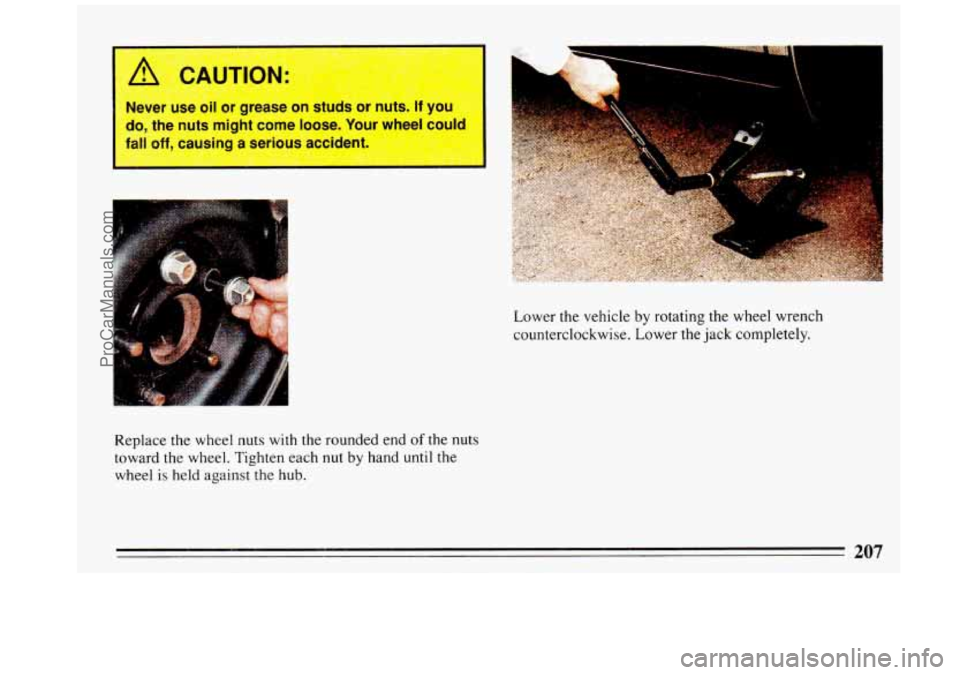
Lower the vehicle by rotating the wheel wrench
counterclockwise. Lower the jack completely.
Replace the wheel nuts with the rounded end
of the nuts
toward the wheel. Tighten each
nut by hand until the
wheel is held against the hub.
207
ProCarManuals.com
Page 213 of 308
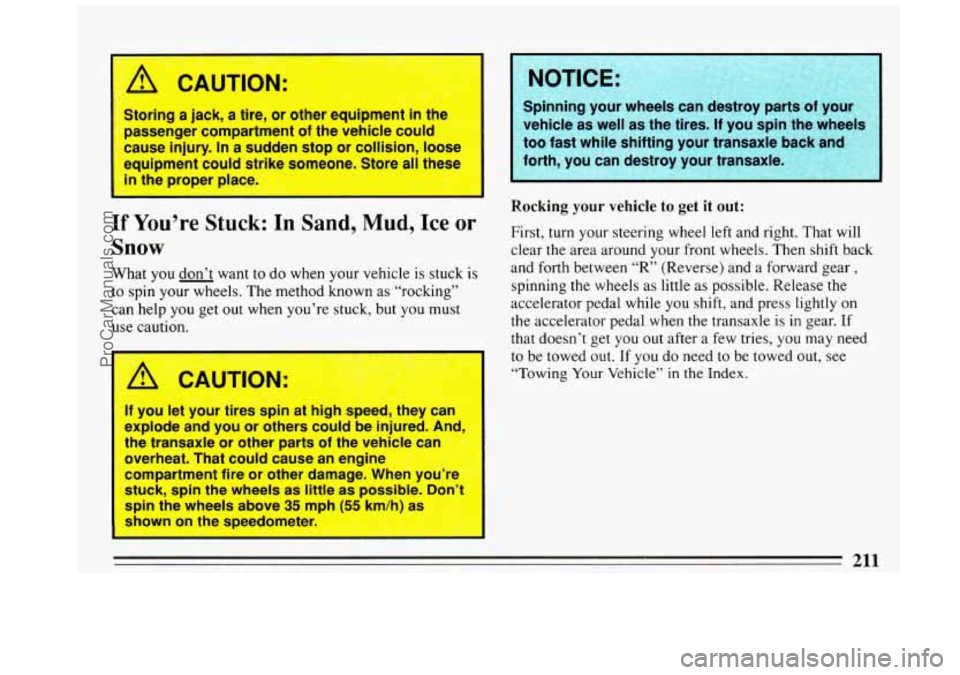
/;1 CAUTION:
I
Storing a jack, a tire, or other equipment in the
passenger compartment of the vehicle could
equipment could strike someone. Store
all the$$
in the proper place.
3use
injury. In a sudden stop or collision,
loose
!-
1
NOTICE:
Spinning your wheels can destroy parts of you1
vehicle
as well as the tires. If you spin the wheels
too fast while shifting your transaxle back and
forth, you
can destroy your transaxle
Aocking your vehicle to get it out:
If - You’re Stuck: In Sand; Mud’ Ice Or First, turn your steering wheel left and right. That will
Snow clear the area around your front wheels. Then shift back
What
you don’t want to do when your vehicle is stuck is and forth between “R” (Reverse) and a forward gear,
to spin your wheels. The method known as “rocking” spinning the wheels as little as possible. Release the
can help you get out when you’re stuck, but you must accelerator pedal while
you shift, and press lightly
on
use caution. the accelerator pedal when the transaxle is in gear. If
that doesn’t get
you out after a few tries, you may need
to be towed out. If you do need to be towed out, see
“Towing Your Vehicle”
in the Index.
IT you let your tires spin at h I speea, they can
explode and you or others could be injured. And
the transaxle or other parts of the vehicle can
overheat. That could cause an engine
compartment fire or other damage. When you’re
stuck, spin the wheels as little
as possible. Don’t
spin the wheels above
35 mph (55 km/h) as
shown on the speedometer.
211
ProCarManuals.com
Page 223 of 308
L
A
A
A
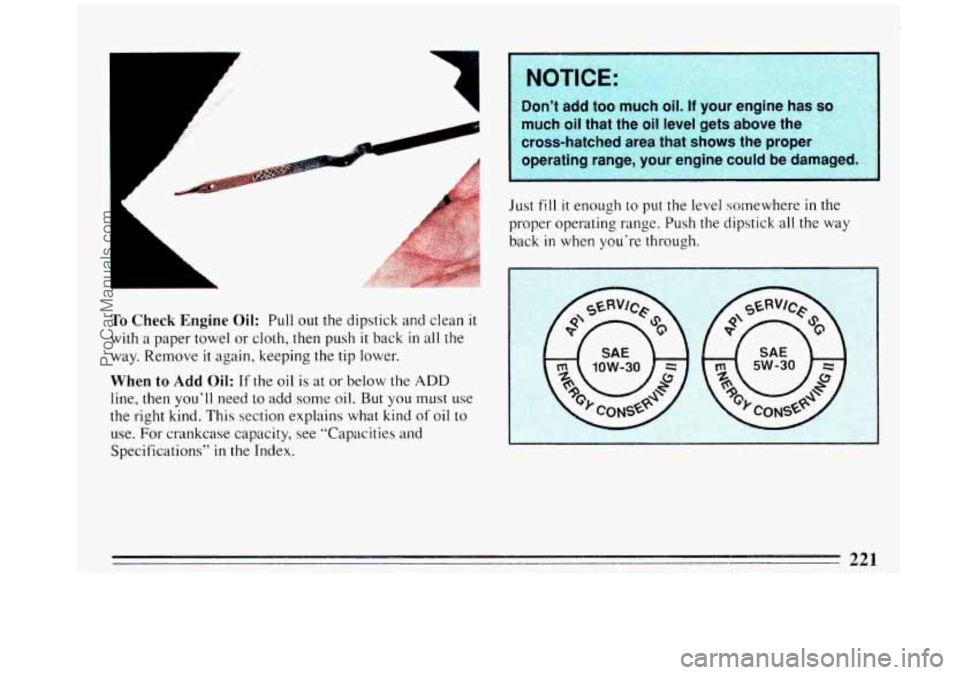
Don’t add too much oil. If your engine has so
much oil that the oil level gets above the
cross-hatched area that shows the proper
r operating range, your engine could be damaged. I il
r
Just fill it enough to put the level somewhere in the
proper operating range. Push the dipstick all
the way
back
in when you’re through. L
L
To Check Engine Oil: Pull out the dipstick and clean it
with a paper towel or cloth, then push it back in all the
way. Remove
it again, keeping the tip lower.
When to Add Oil: If the oil is at or below the ADD
line, then you’ll need to add some oil. But you must use
the right kind. This section explains what kind of
oil to
use. For crankcase capacity, see “Capacities and
Specifications”
in the Index.
I
I
22 1.
ProCarManuals.com