engine BUICK REGAL 1993 Owner's Manual
[x] Cancel search | Manufacturer: BUICK, Model Year: 1993, Model line: REGAL, Model: BUICK REGAL 1993Pages: 308, PDF Size: 16.35 MB
Page 105 of 308
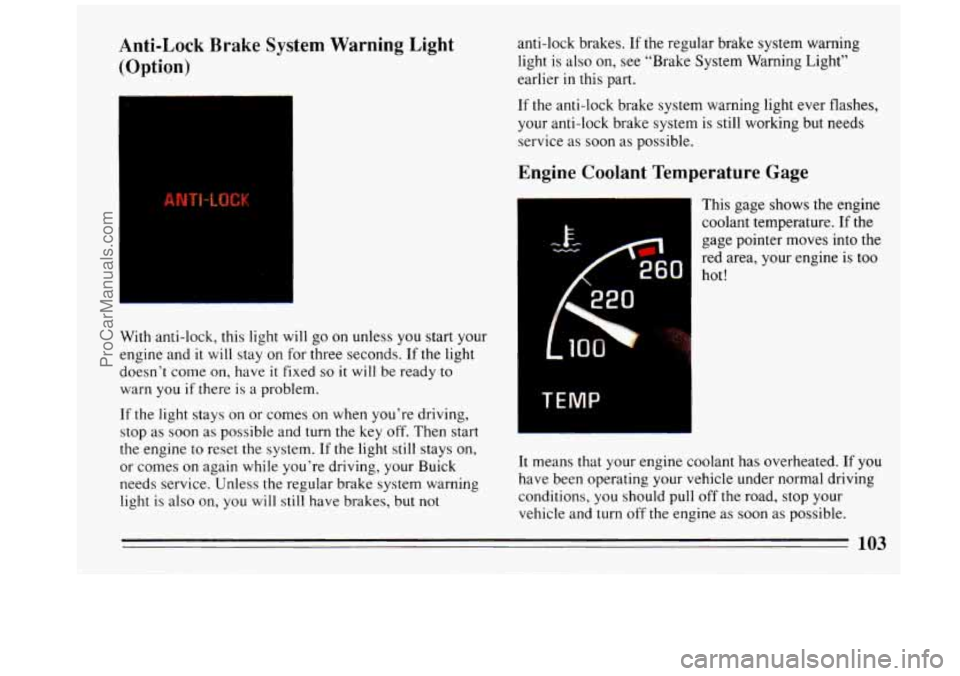
Anti-Lock Brake System Warning Light
(Option) anti-lock brakes. If the regular brake system warning
light is also on, see “Brake System Warning Light”
earlier
in this part.
With anti-lock, this light will go on unless you start your
engine and it will stay
on for three seconds. If the light
doesn’t come on, have it fixed
so it will be ready to
warn you
if there is a problem.
If the light stays on or comes on when you’re driving,
stop
as soon as possible and turn the key off. Then start
the engine to reset the system. If the light still stays on,
or comes
on again while you’re driving, your Buick
needs service. Unless the regular brake system warning
light is also
on, you will still have brakes, but not If
the anti-lock brake system warning light ever flashes,
your anti-lock brake system is still working but needs
.service as soon as possible.
Engine Coolant Temperature Gage
TEMP
This gage shows the engine
coolant temperature. If the
gage pointer moves into the
red area, your engine is too
hot
!
It means that your engine coolant has overheated. If you
have been operating your vehicle under normal driving
conditions, you should pull
off the road, stop your
vehicle and turn off the engine as soon as possible.
103
ProCarManuals.com
Page 106 of 308
HOT COOLANT CAN BURN YOU BADLY!
In “Problems on the Road,” this manual shows what to
do. See “Engine Overheating”
in the Index.
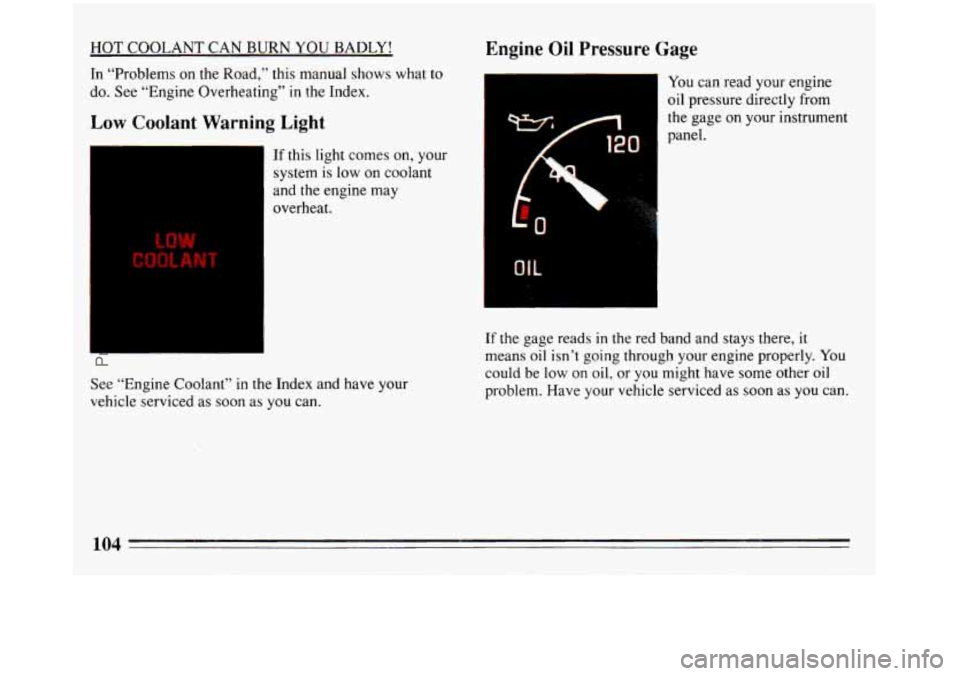
Low Coolant Warning Light
If this light comes on, your
system is low
on coolant
and the engine may
overheat.
See “Engine Coolant” in the Index and have your
vehicle serviced as soon
as you can.
Engine Oil Pressure Gage
OIL
I
You can read your engine
oil pressure directly from
the gage on your instrument
panel.
If the gage reads in the red band and stays there, it
means oil isn’t going through your engine properly.
You
could be low on oil, or you might have some other oil
problem. Have your vehicle serviced as soon as you can.
ProCarManuals.com
Page 107 of 308
Don’t keep driving if the oil pressure is low. If &I
you do, your engine can become so hot that it
catches fire. You or others could be burned.
Check your oil as soon
as possible and have
your vehicle serviced.
problems can be cost
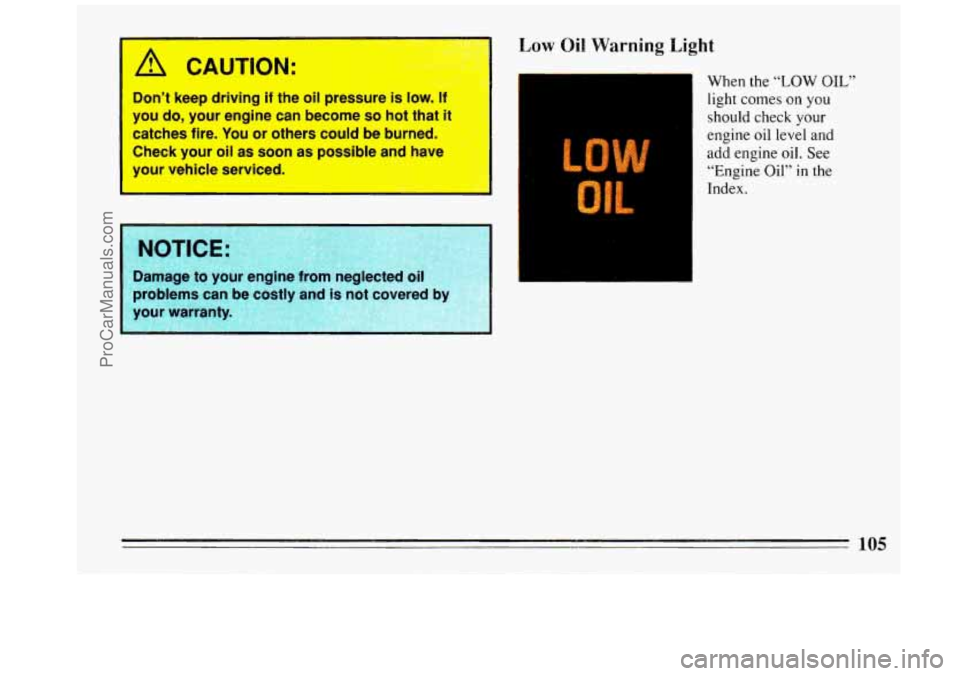
Low Oil Warning Light
LO
1L
When the “LOW OIL”
light comes on you
should check your
engine oil level and
add engine
oil. See
“Engine Oil” in
the
Index.
105
ProCarManuals.com
Page 108 of 308
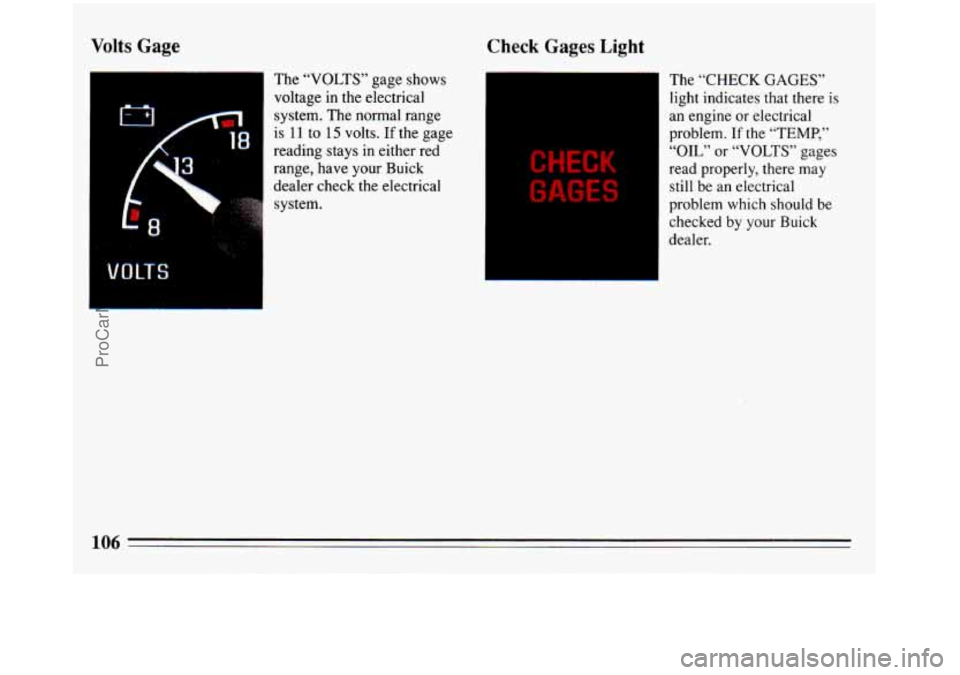
Volts Gage
The “VOLTS” gage shows
voltage in the electrical
system. The normal range
is
11 to 15 volts. If the gage
reading stays in either red
range, have your Buick
dealer check the electrical
system.
., .
VOLTS
Check Gages Light
CHECK
GAGES
The “CHECK GAGES”
light indicates that there is
an engine or electrical
problem.
If the “TEMP,”
“OIL” or “VOLTS” gages
read properly, there may
still be an electrical
problem which should be
checked by your Buick
dealer.
106
ProCarManuals.com
Page 109 of 308
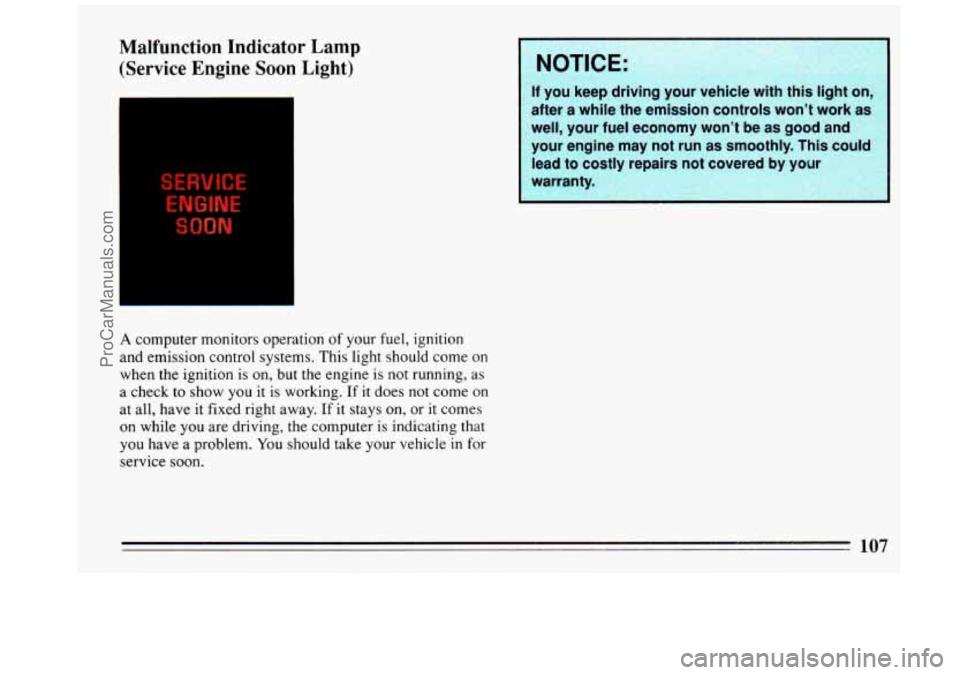
Malfunction Indicator Lamp
(Service Engine Soon Light)
A computer monitors operation of your fuel, ignition
and emission control systems. This light should come
on
when the ignition is on, but the engine is not running, as
a check
to show you it is working. If it does not come on
at all, have it fixed right away.
If it stays on, or it comes
on while you are driving, the computer is indicating that
you have a problem. You should take your vehicle in for
service soon.
NOTICE:
If you keep drivln
after a while the em-ission controls won’t work as
well, your fuel economy won’t be
as good and
your engine may not run as smoothly. This could
I
lead to costly repairs not covered by yo
warranty. I
I
107
ProCarManuals.com
Page 110 of 308
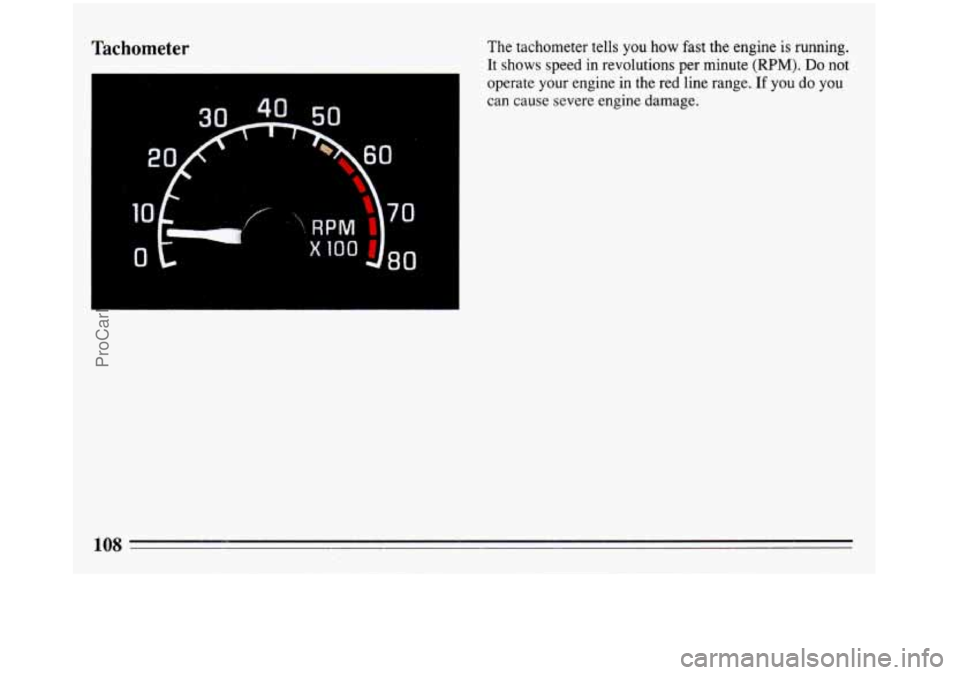
Tachometer The tachometer tells you how fast the engine is running.
It shows speed in revolutions per minute
(RPM). Do not
operate your engine in the red line range.
If you do you
can cause severe engine damage.
108
ProCarManuals.com
Page 115 of 308
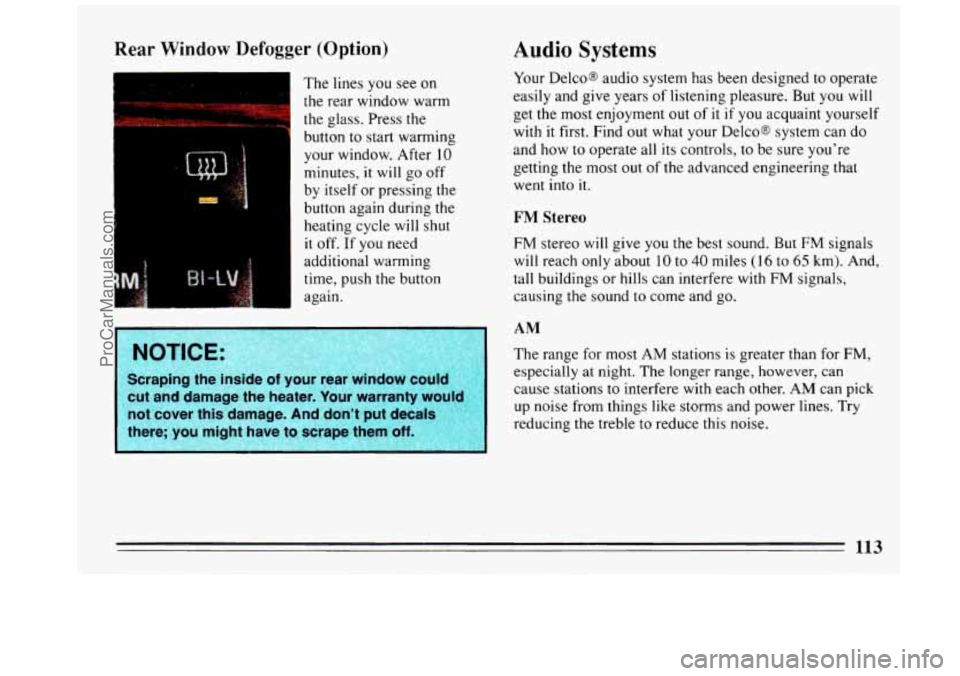
Rear Window Defogger (Option)
b
I -c
1 The lines you see on
I the rear window warm
the glass. Press the
button to start warming
your window. After
10
minutes, it will go off
by itself or pressing the
button again during the
heating cycle will shut
it
off. If you need
additional warming
time, push the button
again.
NOTICE:
Scraping the inside of your rear window could
cut and damage the heater. Your warranty would
not cover this damage.
And don’t plat decals
there; you might have to scrape them
off.
Audio Systems
Your Delcom audio system has been designed to operate
easily and give years of listening pleasure.
But you will
get the most enjoyment out
of it if you acquaint yourself
with it first. Find out what your Delcoa system can do
and how to operate all its controls, to be sure you’re
getting the most
out of the advanced engineering that
went into it.
FM Stereo
FM stereo will give you the best sound. But FM signals
will reach only about 10 to 40 miles (16 to 65 km). And,
tall buildings or hills can interfere with FM signals,
causing the sound
to come and go.
AM
The range for most AM stations is greater than for FM,
especially at night. The longer range, however, can
cause stations to interfere with each other. AM can pick
up noise from things like storms and power lines. Try
reducing the treble to reduce this noise.
113
ProCarManuals.com
Page 116 of 308
AM Stereo
This means the DelcoB system can receive C-QUAM@
stereo broadcasts. Many AM stations around the country
use C-QUAM@
to produce stereo, though some do not.
(C-QUAM@ is a registered trademark
of Motorola, Inc.)
If your Delcoa system can get C-QUAM@, your
“STEREO” light will come on when you’re receiving it.
A CAUTION:
Hearing damage from loud noise is ZIIH IOSl
undetectable until it is too late. Your hearing can
adapt
to higher volumes of sound. Sound that
seems normal can be loud and harmful
to your
hearing. Take precautions by adjusting the
volume control on your radio
to a safe sound
level before your hearing adapts to
it.
To help avoid hearing loss or damage:
Adjust the volum
Increase volume
setting.
comfortably and
clear11
;i
Before you add any sound eqi me your
vehicle
-- like a tape player, CB radio, mobile
telephone or two-way radio
-- be sure you c I
add what you want. If you can, it’s very importan
to
do it properly. Added sound equipment may
interfere with the operation
of your vehicle’s
engine, Delco@ radio or other systems, and even
damage them.
And, your vehicle’s systems may
interfere with the operation of
so
that has been added improperly.
So, before adding sound equipment, check with
your dealer and be sure to check Federal
r
covering mobile radio and telephone units
1
ProCarManuals.com
Page 142 of 308
“Riding” your brakes can cause th%m to overhed
to the point that they won’t work well. You might
not be able to stop your vehicle in time to avoid
an accident.
If you “ride” your brakes, they will
get
so hot they will require a lot of pedal force to,
SI0 lown. Avoid “rid a’’ the brak . ...4.L,::z .I_ : ,+ . ., ., ii: = ‘ :. 3 .
.. c. -.
I
“Riding” the brakes rs them out K%ch faster.
You would need costly brake replacement much
I
sooner th
economy.
I
If you keep pace with the traffic and allow realistic
following distances, you will eliminate a lot of
unnecessary braking. That means better braking and
longer brake life.
0 If your engine ever stops while you’re driving, brake
normally but don’t pump your brakes.
If you do, the
pedal may get harder to push down.
If your engine
stops, you will still have some power brake assist.
But you will
use it when you brake. Once the power
assist is used up, it may take longer to stop and the
brake pedal will be harder to push.
Anti-Lock Brakes (Option)
If your Buick has this system, your Buick has an
advanced electronic braking system that will help
prevent skidding.
If you have an anti-lock brake system (ABS), the brake
pedal will say
so. And this light on the instrument panel
will go
on when you start your vehicle.
When you start your vehicle
and begin to drive away,
you may hear a momentary motor or clicking noise. And
you may even notice that your brake pedal moves a little
while this is going on. This is the
ABS system testing
itself. If you have your foot
on the brake pedal, this
check won’t happen until the vehicle goes about
4 mph
(6 km/h) or until you take your foot off the brake pedal.
After an
ABS stop, you may hear a clicking noise the
next time the vehicle goes about 4 mph (6 km/h).
ProCarManuals.com
Page 146 of 308
That could be off the road, into the very thing you were
trying to avoid,
or into traffic.
If you don’t have anti-lock, use
a “squeeze” braking
technique. This will give
you maximum braking while
maintaining steering control. You do this by pushing on
the brake pedal with steadily increasing pressure.
In an emergency
you will probably want to “squeeze”
the brakes hard without locking the wheels. If you hear
or feel the wheels sliding, ease off the brake pedal. This
will help you retain steering control.
(If
you & have anti-lock, it’s different: see Index under
“Anti-lock Brake System.”) In
many emergencies,
steering can help
you more than even the very best
braking.
Steering
Power Steering
If you lose power steering assist because the engine
stops or the system fails to function, you can steer but
it
will take much more effort.
Steering Tips
Driving on Curves
It’s important to take curves at a r8 easonable speed.
A lot of the “driver lost control” accidents mentioned on
the news happen
on curves. Here’s why:
Experienced driver or beginner, each of us is subject to
the same laws of physics when driving on curves. The
traction of the tires against the road surface makes it
possible for the vehicle to change its path when
you turn
the front wheels. If there’s
no traction, inertia will keep
the vehicle going in the same direction. If you’ve ever
tried to steer a vehicle on wet ice,
you’ll understand this.
The traction you can get in a curve depends on the
condition of your tires and the road surface, the angle at
which the curve is banked, and your speed. While
you’re in a curve, speed
is the one factor you can
control.
Suppose you’re steering through
a sharp curve. Then
you suddenly apply the brakes. Both control systems --
steering and braking -- have to do their work where the
tires meet the road. Unless you have four-wheel
anti-lock brakes, adding the hard braking can demand
too much
of those places. You can lose control.
The same thing can happen if you’re steering through a
sharp curve and you suddenly accelerate.
Those two control systems
-- steering and acceleration --
can overwhelm those places where the tires meet the
road and make you lose control.
144
ProCarManuals.com