engine BUICK REGAL 1993 Repair Manual
[x] Cancel search | Manufacturer: BUICK, Model Year: 1993, Model line: REGAL, Model: BUICK REGAL 1993Pages: 308, PDF Size: 16.35 MB
Page 225 of 308
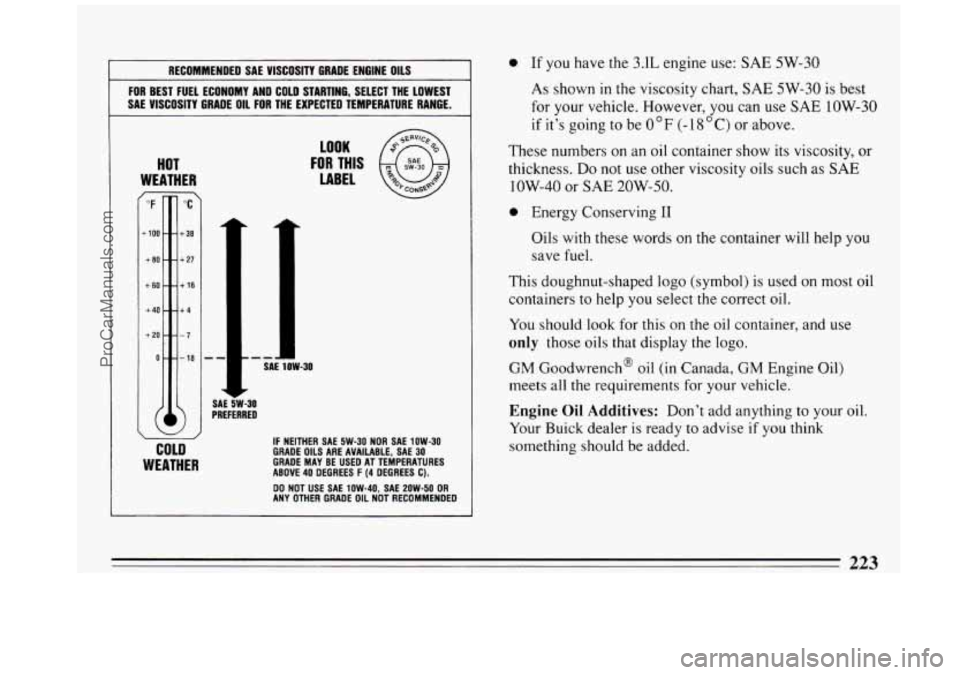
RECOMMENDED SAE VISCOSITY GRADE ENGINE OILS
FOR BEST FUEL ECONOMY AND COLD STARTING, SELECT THE LOWEST
SAE VISCOSITY GRADE
OIL FOR THE EXPECTED TEMPERATURE RANGE.
HOT
WEATHER I
"F r
k100 -
+80 -
+60 -
+40 -
+20 -
0-
- +38
- +27
. +16
- +4
- -7
- -18
1
COLD
WEATHER
-- I' -- SA SAE 5W-30 PREFERRED
IF NEITHER SAE 5W-30 NOR SAE 1OW-30 GRADE OILS ARE AVAILABLE, SAE 30 GRADE MAY BE USED AT TEMPERATURES
ABOVE 40 DEGREES F (4 DEGREES C).
ANY OTHER GRADE OIL NOT RECOMMENDED
DO NOT USE SAE 1OW-40, SAE 2OW-50 OR
0 If you have the 3.1L engine use: SAE 5W-30
As shown in the viscosity chart, SAE 5W-30 is best
for your vehicle. However, you can use
SAE 1OW-30
if it's going to be O°F (-18OC) or above.
These numbers on an oil container show its viscosity,
or
thickness. Do not use other viscosity oils such as SAE
low-40 or SAE 20W-50.
0 Energy Conserving I1
Oils with these words on the container will help you
save fuel.
This doughnut-shaped logo (symbol) is used
on most oil
containers to help you select the correct oil.
You should look for this on the oil container, and use
only those oils that display the logo.
GM Goodwrench@
oil (in Canada, GM Engine Oil)
meets all the requirements for your vehicle.
Engine Oil Additives: Don't add anything to your oil.
Your Buick dealer is ready to advise if you think
something should be added.
223
ProCarManuals.com
Page 226 of 308
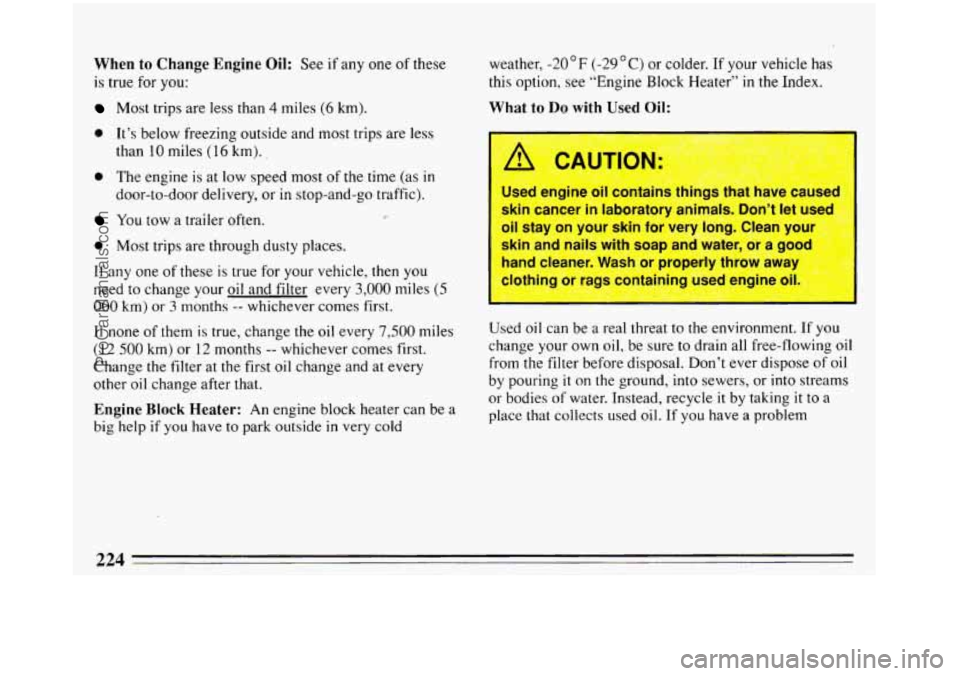
When to Change Engine Oil: See if any one of these
is true for you:
Most trips are less than 4 miles (6 km).
9 It’s below freezing outside and most trips are less
9 The engi.ne is at low speed most of the time (as in
door-to-door delivery, or in stop-and-go traffic).
You tow a trailer often. .-
9 Most trips are through dusty places.
If
any one of thes,e is true for your vehicle, then you
need to change your oil and filter every
3,000 miles (5
000 km) or 3 months -- whichever comes first.
If none of them is true, change the oil every 7,500 miles
(12
500 km) or 12 months -- whichever comes first.
Change the filter at the first
oil change and at every
other
oil change after that.
Engine Block Heater: An engine block heater can be a
big help if you have to park outside in very cold
than
10 miles (16 km).
weather,
-20 F (-29 C)
or colder. If your vehicle has
this option, see ”Engine
Block Heater” in the Index.
What to Do with Used Oil:
Used engine oil contains things that ha\, zaused
skin cancer in laboratory animals. Don’t let use6 oil stay on your skin for very long. Clean your
skin and nails with soap and water, or a good
hand cleaner. Wash
or properly throw away
4othing or rags containing used engine oil
Used oil can be a real threat to the environment. If you
change your own oil, be sure
to drain all free-flowing oil
from the filter before disposal. Don’t ever dispose of oil
by pouring
it on the ground, into sewers, or into streams
or bodies of water. Instead, recycle
it by taking it to a
place that collects used oil.
If you have a problem
224
ProCarManuals.com
Page 227 of 308
properly disposing of your used oil, ask your dealer, a
service station or a local recycling center for help.
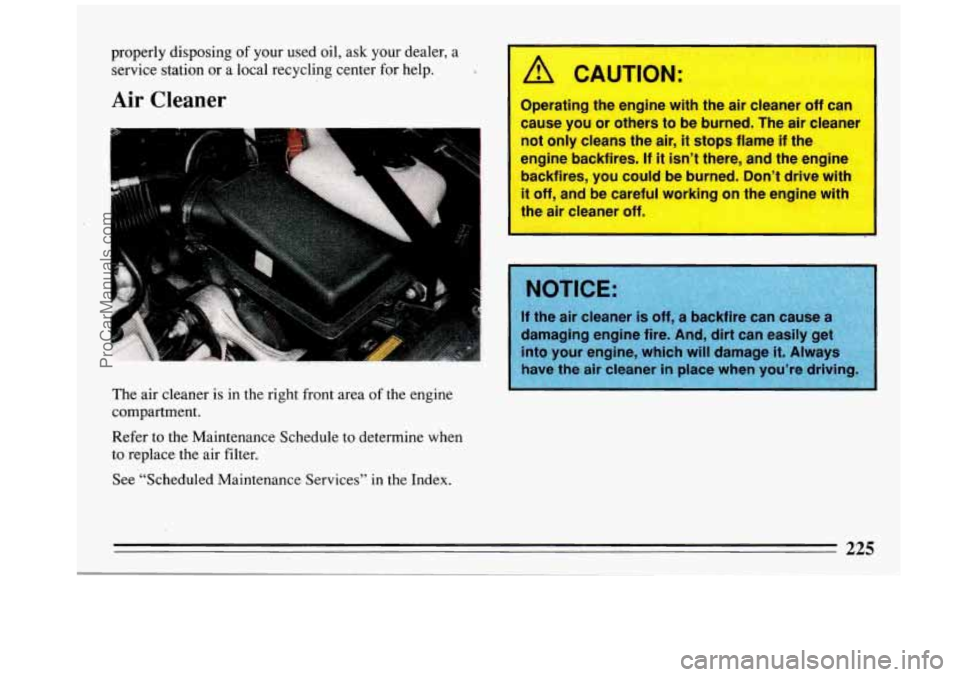
Air Cleaner
The air cleaner is in the right front area of the engine
compartment.
I A CAUTION:
Operating the engine with the air cleaner off can
cause you or others to be burned. The air cleaner
not only cleans the air,
it stops flame if the
engine backfires. If it isn’t there, and
the engine
backfires, you could be burned. Don’t drive with
it
off, and be careful working on the engine with
the air cleaner off.
I
Refer to the Maintenance Schedule to determine when
to replace the air filter.
See “Scheduled Maintenance Services’’ in the Index.
225
ProCarManuals.com
Page 228 of 308
Automatic Transaxle Fluid
When to Check and Change:
A good time to check your automatic transaxle fluid
level is when
the engine oil is changed. Refer to the
Maintenance Schedule to determine when to change
your fluid. See “Scheduled Maintenance Services” in
the Index.
How to Check:
Because this operation can be a little difficult, you may
choose to have this done at a Buick dealership Service
Department.
If you do it yourself, be sure to follow all the
instructions here, or you could get a false reading on the
dipstick.
NOTICE:
Too much or too little fluid can damage your
transaxle.
Too much can mean that some of the
fluid could come out and fall
on hot engine parts,
starting a fire. Be sure to get an accurate reading
if you check your transaxle fluid.
Wait at least 30 minutes before checking the transaxle
fluid level if you have been driving:
When outside temperatures are above 90°F (32 ” C).
At high speed for quite a while.
0 In heavy traffic -- especially in hot weather.
0 While pulling a trailer.
To get the right reading, the fluid should be at normal
operating temperature, which is
180 F to 200 F (82 C
Get the vehicle warmed up by driving about 15 miles
(24 km) when outside temperatures are above
50°F
(10°C). If it’s colder than 50°F (lO°C), you may have
to drive longer.
To check the fluid level:
Park your vehicle on a level place.
0 Place the shift lever in “F’ (Park) with the parking
0 With your foot on the brake pedal, move the shift
to
93
O C).
brake applied.
lever through each gear range, pausing for about
three seconds
in each range. Then, position the shift
lever
in “P” (Park).
0 Let the engine run at idle for three to five minutes.
226
ProCarManuals.com
Page 229 of 308
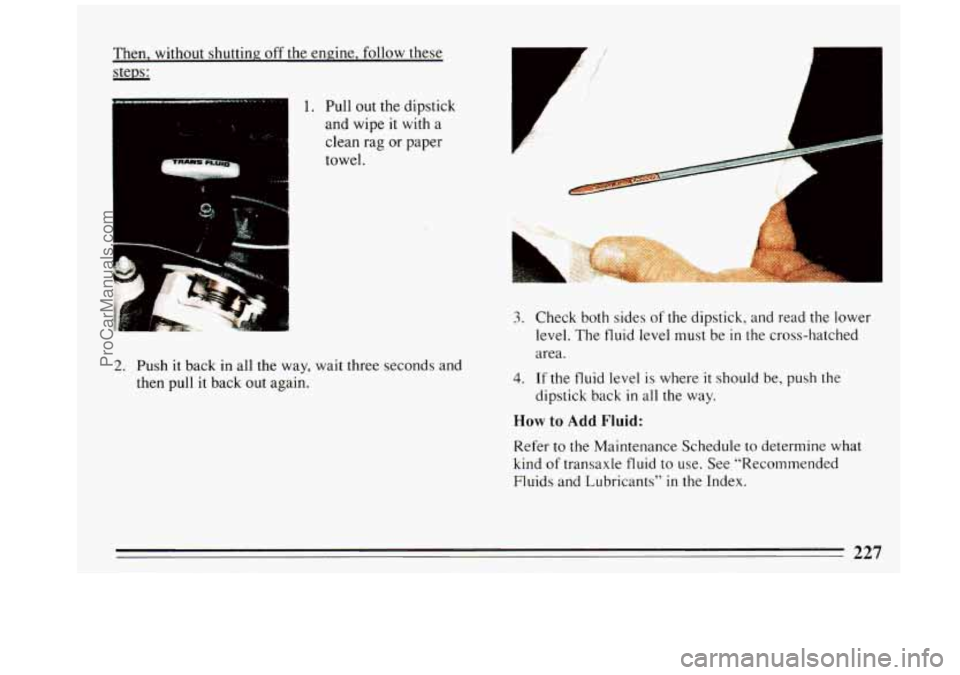
Then, without shutting off the engine, follow these
steps:
1. Pull out the dipstick
and wipe it with
a
clean rag or paper
towel.
‘i
2. Push it back in all the way, wait three seconds and
then pull it back out again.
A
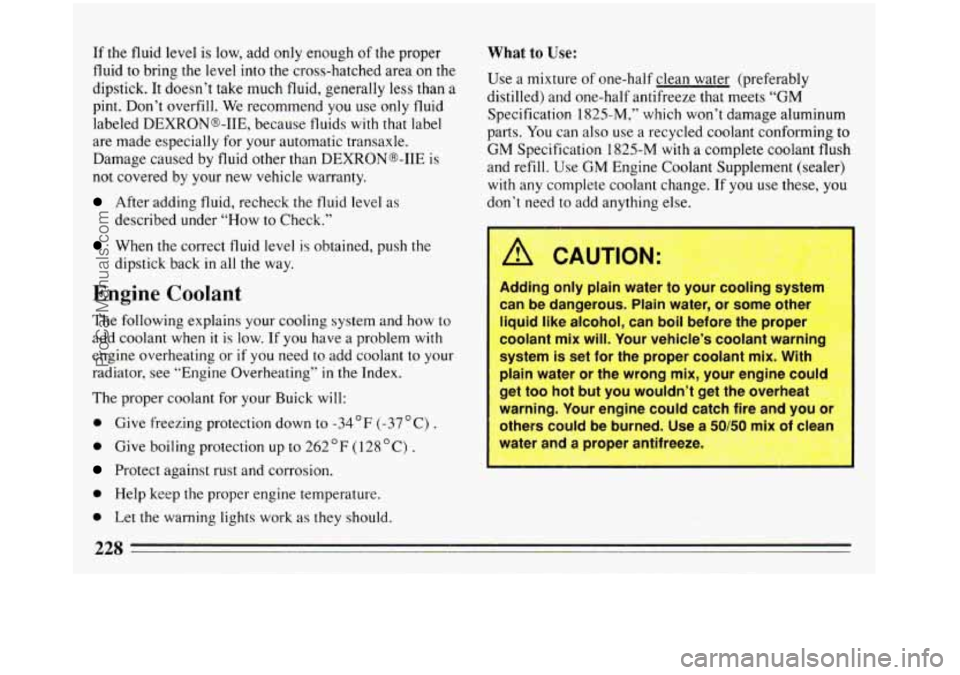
3. Check both sides of the dipstick, and read the lower
level. The fluid level must be
in the cross-hatched
area.
4. If the fluid level is where it should be, push the
dipstick back
in all the way.
How to Add Fluid:
Refer to the Maintenance Schedule to determine what
kind
of transaxle fluid to use. See “Recommended
Fluids and Lubricants’’
in the Index.
ProCarManuals.com
Page 230 of 308
If the fluid level is low, add only enough of the proper
fluid to bring the level into the cross-hatched area on the
dipstick. It doesn’t take much fluid, generally less than a
pint. Don’t overfill. We recommend you use only fluid
labeled DEXRONB-IIE, because fluids with that label
are made especially for your automatic transaxle.
Damage caused by fluid other than DEXRONB-IIE is
not covered by your new vehicle warranty.
After adding fluid, recheck the fluid level as
described under “How
to Check.”
When the correct fluid level is obtained, push the
dipstick back in all the way.
Engine Coolant
The following explains your cooling system and how to
add coolant when
it is low. If you have a problem with
engine overheat.ing or if you need to add coolant to your
radiator, see “Engine Overheating”
in the Index.
The proper coolant for your Buick will:
0 Give freezing protection down to -34OF (-37OC) .
0 Give boiling protection up to 262 OF (128 “C) .
Protect against rust and corrosion.
0 Help keep the proper engine temperature.
0 Let the warning lights work as they should.
What to Use:
Use a mixture of one-half clean water (preferably
distilled) and one-half antifreeze that meets
“GM
Specification 1825-M,” which won’t damage aluminum
parts. You can also use a recycled coolant conforming to
GM Specification 1825-M with a complete coolant flush
and refill. Use GM Engine Coolant Supplement (sealer)
with any complete coolant change. If you use these, you
don’t need to add anything else.
can be aangerous. Plain water, or some other
liquid like alcohol, can boil before the proper
coolant mix will. Your vehicle’s coolant warning
system is set for the proper coolant mix. With
plain water or the wrong mix, your engine could
get too hot but you wouldn’t get the overhe-”
warning. Your engine could catch fire and
yuu or
others could be burned. Use a 50/50 mix of clean
water and a proper antifreeze.
G:~Z.+T~:, p:.t+d+s
228
ProCarManuals.com
Page 231 of 308
NOTICE:
If you use an improper coolant mix, your engine
could overheat and be badly damaged. The
repair cost wouldn’t be covered by
your
warranty. Too much water in the mix can freeze
and crack the enqine, radiator, heater
core and
other parts.
I
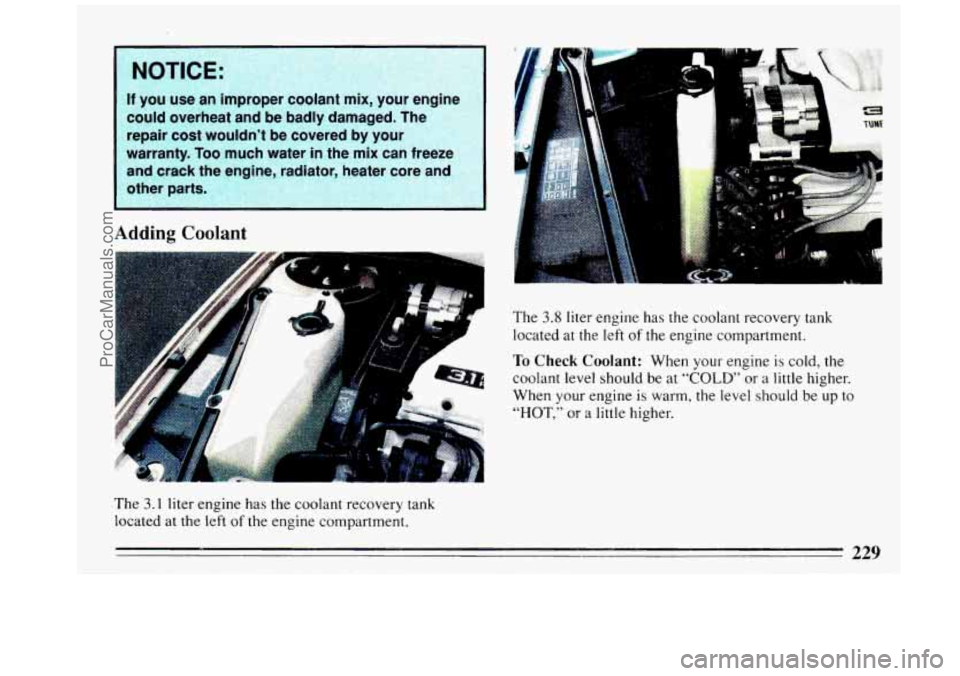
Adding Coolant
The 3.1 liter engine has the coolant recovery tank
located at the
left of the engine Compartment.
__./”
t
The 3.8 liter engine has the coolant recovery tank
located at the left of
the engine compartment.
To Check Coolant: When your engine is cold, the
coolant
level should be at “COLD” or a little higher.
When your engine is warm, the level should
be up to
“HOT,” or a little higher.
229
ProCarManuals.com
Page 232 of 308
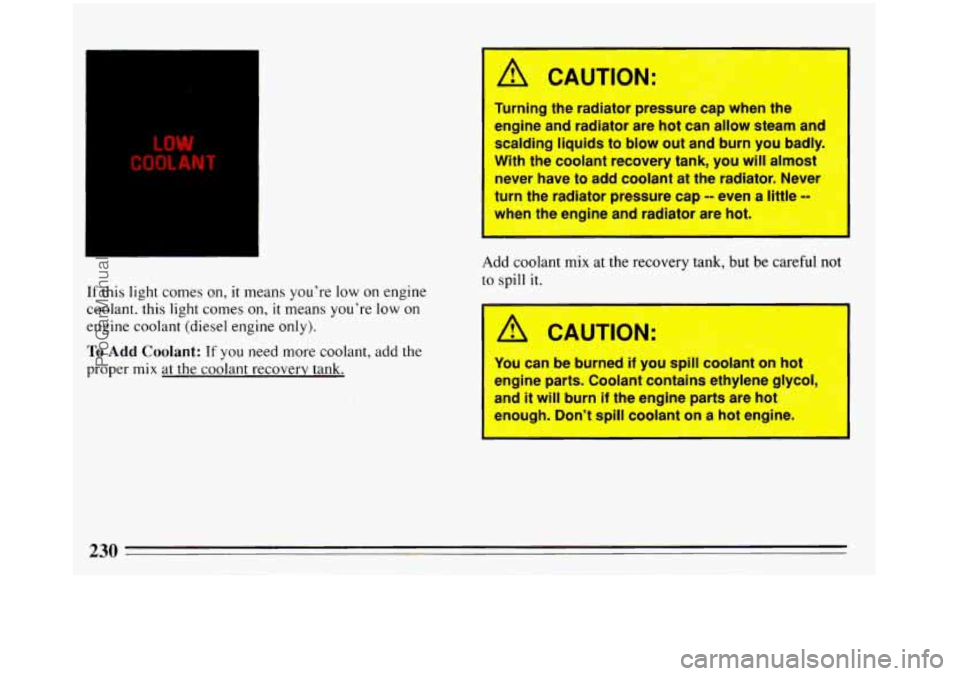
If this light comes on, it means you're low on engine
coolant. this light comes
on, it means you're low on
engine coolant (diesel engine only).
To Add Coolant: If you need more coolant, add the
proper mix at the coolant recovery tank.
A CAUTION:
Turning me raalaror pressure cap when the
--1gine and radiator are hot can allow steam ana
scalding liquids to blow out and burn you badly.
With the coolant recovery tank, you will almos'
never have to add coolant at the radiator. Never
turn the radiator pressure cap
-- even a little --
wt- -- +ha engine and radiator are hot.
Add coolant mix at the recovery tank, but be careful not
to spill it.
IU can be burned if you spill coolant on hot
gine parts. Coolant contains ethylene glycol,
and
it will burn if the engine parts are t
enough. Don't spill coolant on a hot engine.
230
ProCarManuals.com
Page 233 of 308
Radiator Pressure Cap rower Steerlng Fluid
1; NOTICE: 1
.:: Your radiator cap is a 15 psi (1 05 kPa)
:: pressure-type cap and must be tightly installed
,*to prevent coolant loss and possible engine
q:. damage from overheating. Be sure the arrows on
,. the cap line up with the overflow tube on the
8: radiator filfer neck.
When you replace your radiator pressure cap, an AC@
cap is recommended.
Thermostat
Engine coolant temperature is controlled by a thermostat
in the engine coolant system. The thermostat stops the
flow of coolant through the radiator until the coolant
reaches a preset temperature.
When you replace your thermostat, an
AC@ thermostat
is recommended.
L
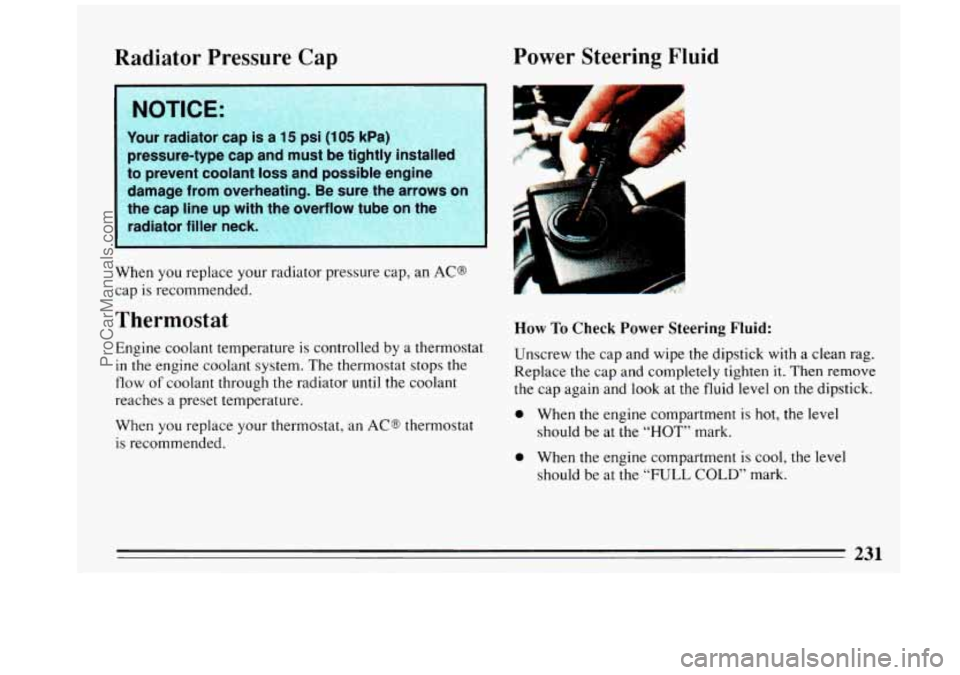
How To Check Power Steering Fluid:
Unscrew the cap and wipe the dipstick with a clean rag.
Replace the cap and completely tighten
it. Then remove
the cap again and look at the fluid level on the dipstick.
0 When the engine compartment is hot, the level
should be at the
“HOT” mark.
0 When the engine compartment is cool, the level
should be at the
“FULL COLD” mark.
231
ProCarManuals.com
Page 236 of 308
won’t work at all. So, it isn’t a good idea to “top off’
your brake fluid. Adding brake fluid won’t correct a
leak.
If you add fluid when your linings are worn, then
you’ll have too much fluid when you get new brake
linings. You should add (or remove) brake fluid,
as
necessary, only when work is done on the brake
hydraulic system.
a LAUTION:
1
If you have too much brake flui,, I. ;an sblll orl
the engine. The fluid will burn if the engine is hot
enough. You or others could be burned, and your
vehicle could be damaged. Add brake fluid only
when work is done on the brake hydraulic
-stem.
When your brake fluid falls to a low level, your brake
warning light will come on. See “Brake System Warning
Light” in the Index.
What to Add:
When you do need brake fluid, use only DOT-3 brake
fluid
-- such as Delco Supreme 11 @ (GM Part
N0.1052535). Use new brake fluid from a sealed
container only.
0
0
DOT-5 silicone brake fluid can damage
your vehicle. Don’t use it.
Don’t let someone put
in the wrong kind of
fluid. For example, just a few drops of
mineral-based oil, such as engine oil,
in
your brake system can damage brake
system parts
so badly that they’ll have to
be replaced.
Brake fluid can damage paint,
so be careful
not to spill brake fluid on your vehicle.
Replacing Brake System Parts
The braking system on a modern vehicle is complex. Its
many parts have to be
of top quality and work well
together if the vehicle is to have really good braking.
Vehicles we design and test have top-quality GM brake
parts in them, as your Buick does when
it is new. When
you replace parts of your braking system
-- for example,
when your brake linings wear down and
you have to
have new ones put in
-- be sure you get new genuine
GM replacement parts. If
you don’t, your brakes may no
longer work properly. For example, if someone puts
in
brake linings that are wrong for your vehicle, the
234
ProCarManuals.com