engine BUICK REGAL 1993 Workshop Manual
[x] Cancel search | Manufacturer: BUICK, Model Year: 1993, Model line: REGAL, Model: BUICK REGAL 1993Pages: 308, PDF Size: 16.35 MB
Page 202 of 308
I.
1
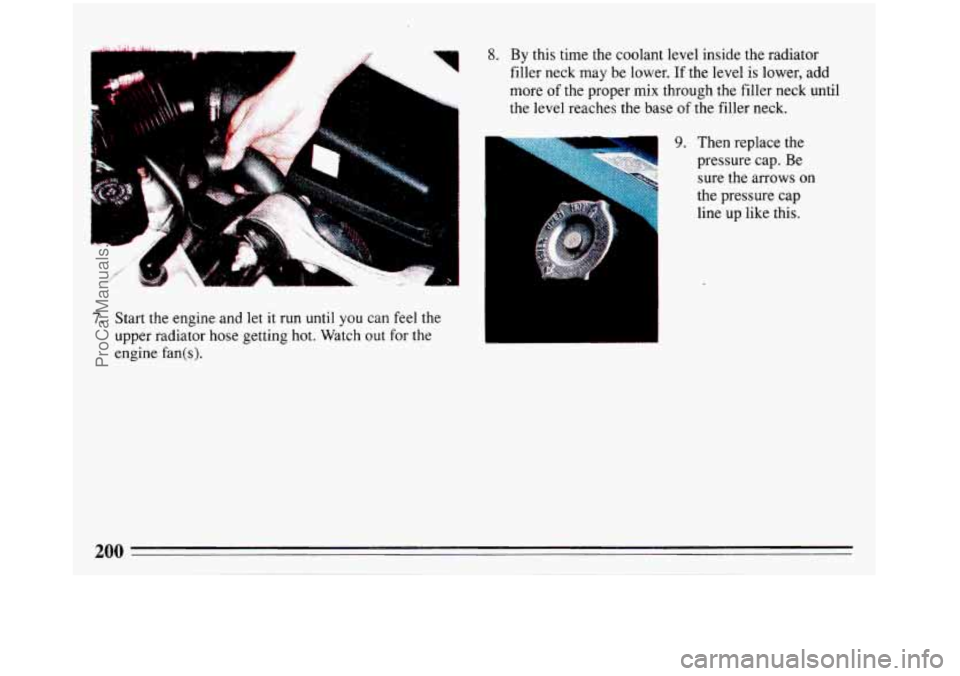
7. Start the engine and let it run until you can feel the
upper radiator hose getting hot. Watch out for the
engine fan(s).
8. By this time the coolant level inside the radiator
filler neck may be lower.
If the level is lower, add
more of the proper mix through the filler neck until
the level reaches the base
of the filler neck.
w 9. Then replace the
pressure cap. Be sure the arrows on
the pressure cap .. .L. ' .
line up like this.
200
.-
ProCarManuals.com
Page 203 of 308
If a Tire Goes Flat
It’s unusual for a tire to “blow out” while you’re driving,
especially if you maintain your tires properly. If air goes
out
of a tire, it’s much more likely to leak out slowly.
But if
you should ever have a “blowout,” here are a few
tips about what to expect and what
to do:
If a front tire fails, the flat tire will create a drag that
pulls the vehicle toward that side. Take your foot off
the
accelerator pedal and grip the steering wheel firmly.
Steer
to maintain lane position, then gently brake to a
stop well out
of the traffic lane.
A rear blowout, particularly on a curve, acts much like a
skid and may require the same correction you’d use in a
skid. In any rear blowout, remove your foot fromthe
accelerator pedal. Get the vehicle under control by
steering the way you want the vehicle to go. It may be
very bumpy and noisy, but you can still steer. Gently
brake to a stop, well
off the road if possible.
If your tire goes flat, the next section shows how to use
your jacking equipment to change a flat tire safely.
Changing a Flat Tire
If a tire goes flat, avoid further tire and wheel damage
by driving slowly
to a level place. Turn on your hazard
warning flashers.
A CAUTION:
Changing a tire can cause an injury. The vehicle
can slip off the jack and roll over you or other
people. You and they could be badly injured. Find
a level place to change your tire. TO help prevent
be
! licle from moving:
. the parking brake firmly.
L. Put the shift lever in “P” (Park).
3. Turn off the engine.
To be even more certain the vehicle won’t move,
you can put chocks at the front and rear of
th
tire farthest away from the one being ehangec
That would be the tire
on the other side nG the
vehicle, at the
opposit- md. ;
201
ProCarManuals.com
Page 213 of 308
/;1 CAUTION:
I
Storing a jack, a tire, or other equipment in the
passenger compartment of the vehicle could
equipment could strike someone. Store
all the$$
in the proper place.
3use
injury. In a sudden stop or collision,
loose
!-
1
NOTICE:
Spinning your wheels can destroy parts of you1
vehicle
as well as the tires. If you spin the wheels
too fast while shifting your transaxle back and
forth, you
can destroy your transaxle
Aocking your vehicle to get it out:
If - You’re Stuck: In Sand; Mud’ Ice Or First, turn your steering wheel left and right. That will
Snow clear the area around your front wheels. Then shift back
What
you don’t want to do when your vehicle is stuck is and forth between “R” (Reverse) and a forward gear,
to spin your wheels. The method known as “rocking” spinning the wheels as little as possible. Release the
can help you get out when you’re stuck, but you must accelerator pedal while
you shift, and press lightly
on
use caution. the accelerator pedal when the transaxle is in gear. If
that doesn’t get
you out after a few tries, you may need
to be towed out. If you do need to be towed out, see
“Towing Your Vehicle”
in the Index.
IT you let your tires spin at h I speea, they can
explode and you or others could be injured. And
the transaxle or other parts of the vehicle can
overheat. That could cause an engine
compartment fire or other damage. When you’re
stuck, spin the wheels as little
as possible. Don’t
spin the wheels above
35 mph (55 km/h) as
shown on the speedometer.
211
ProCarManuals.com
Page 215 of 308
Part 6 Service And Appearance Care
vehicle, and a section devoted to its appearance care.
Part
6 includes:
ServiceTips
...................................................................... 214
Fuel ........................................................................\
.....
HoodRelease ..................................................................... 218
EngineOil ....................................................................... \
AirCleane r.. ..................................................................... 225
Automatic Transaxle Fluid ...........................................................
Enginecoolant .................................................................... 228
Power Steering Fluid .......................... % ....................................
Windshield Washer Fluid ............................................................ 232
Brakes ........................................................................\
...
Battery ........................................................................\
.. 235
BulbReplacement ................................................................. 236
LoadingYourVehicle ...............................................................
Tires ........................................................................\
....
Appearancecare ..................................................................
Vehicle Identification Number (VIN) ..................................................
FusesandCircuitBreakers ........................................................... 257
Capacities and Specifications ......................................................... 263
ProCarManuals.com
Page 217 of 308
Fuel
Use regular unleaded gasoline rated at 87 octane or
higher. It should meet specifications ASTM D4814 in
the
U.S. and CGSB 3.5-92 in Canada. These fuels
should have the proper additives,
so you should not have
to add anything to the fuel.
In the
U.S. and Canada, it’s easy to be sure you get the
right kind of gasoline (unleaded). You’ll see
“UNLEADED” right on the pump. And only unleaded
nozzles
will fit into your vehicle’s filler neck.
Be sure the posted octane is at least
87. If the octane is
less than
87, you may get a heavy knocking noise when
you drive. If it’s bad enough, it can damage your engine.
If you’re using fuel rated at
87 octane or higher and you
still hear heavy knocking, your engine needs service.
But don’t worry
if you hear a little pinging noise when
you’re accelerating or driving
up a hill. That’s normal,
and
you don’t have to buy a higher octane fuel to get rid
of pinging. It’s the heavy, constant knock that means
you have a problem.
What about gasoline with blending materials that
contain oxygen, such as MTBE or alcohol?
MTBE is “methyl tertiary-butyl ether.” Fuel that is no
more than
15% MTBE is fine for your vehicle. Ethanol
is ethyl or
grain alcohol. Properly-blended fuel
that is no more than 10% ethanol is fine for your
vehicle.
Methanol is methyl or wood alcohol.
NOTICE:
Fuel that is more than 5% methanol is bad for
your vehicle. Don’t use it. It can corrode metal
parts in your fuel system and also damage
plastic and rubber parts. That damage wouldn’t
be covered under your warranty. And even at
5%
or less, there must be “cosolvents” and
corrosion preventers in this fuel to help avoid
these problems.
I
Gasolines for Cleaner Air
Your
use of gasoline with detergent additives will help
prevent deposits from forming in your engine and
fuel
system. That helps keep your engine in tune and your
emission control system working properly. It’s good for
your vehicle, and
you’ll be doing your part for cleaner
air.
Many gasolines are now blended with materials called
oxygenates. General Motors recommends that you use
215
ProCarManuals.com
Page 218 of 308
gasolines with these blending materials, such as MTBE
and ethanol. By doing
so, you can help clean the air,
especially
in those parts of the country that have high
carbon monoxide levels.
In addition, some gasoline suppliers are now producing
reformulated gasolines. These gasolines are specially
designed to reduce vehicle emissions. General Motors
recommends that
you use reformulated gasoline. By
doing
so, you can help clean the air, especially in those
parts of the country that have high ozone levels.
You should ask your service station operators
if their
gasolines contain detergents and oxygenates, and
if they
have been reformulated
to reduce vehicle emissions.
Fuels in Foreign Countries
If you plan on driving in another country outside the
U.S. or Canada, unleaded fuel may be hard to find. Do
not use leaded gasoline. If you use even one tankful,
your emission controls won’t work well or at all. With
continuous
use, spark plugs can get fouled, the exhaust
system can corrode, and your engine oil can deteriorate
quickly. Your vehicle’s oxygen sensor will be damaged.
All of that means costly repairs that wouldn’t be covered
by your warranty.
To check on fuel availability, ask an auto club, or
contact a major oil company that does business in the
country where you’ll be driving.
You can also write us at the following address for
advice. Just tell us where you’re going and give your
Vehicle Identification Number (VIN).
General Motors of Canada Ltd.
International Export Sales
P.O. Box 828
Oshawa, Ontario L1H 7N1, Canada
216
ProCarManuals.com
Page 221 of 308
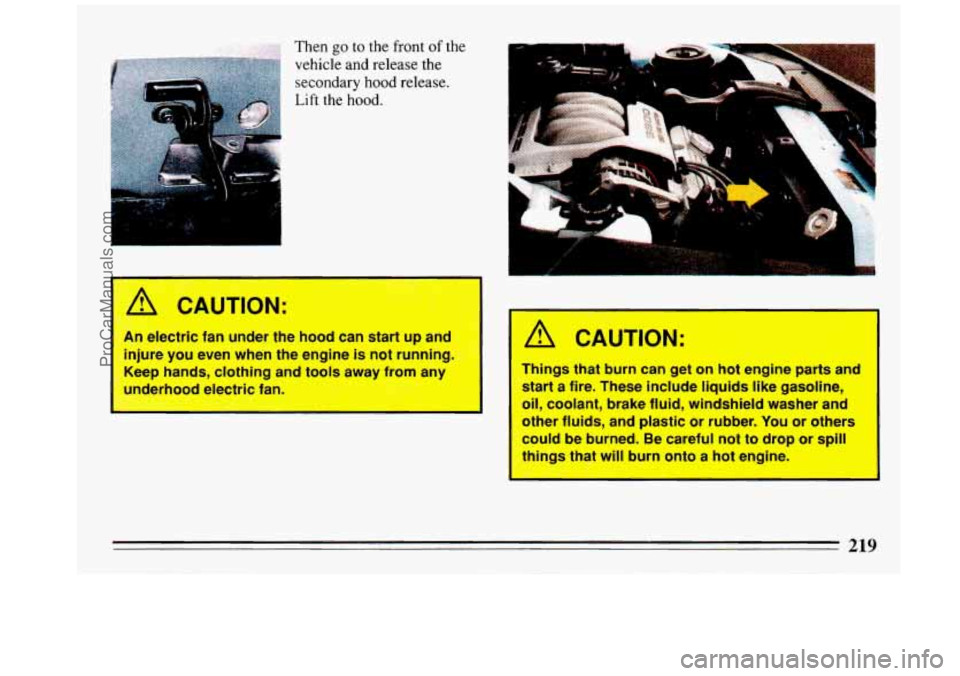
,. ;, ., ,:,’:*< ,. j ;;.*g .;,;.a> -*:~:inh Then go to the front of the
vehicle and release the
secondary hood release.
Lift the hood.
4 CAUTION:
An electric fr ~- der the hood can start up and
. jure you even when the engine is not running.
Keep hands, clothing and tools away from any
underhood electric
fr-
I
c1
A CAUTION:
Things that burn can get on hot engine parts and
start
a fire. These include liquids like gasoline,
oil, coolant, brake fluid, windshield washer and
other fluids, and plastic or rubber. You
or others
could be burned. Be careful not to drop
or spill
1 things that will burn onto a hot engine.
219
ProCarManuals.com
Page 222 of 308
Before closing the hood, be sure all the filler caps are on
properly.
Then just pull the hood down and close it firmly.
Engine Oil
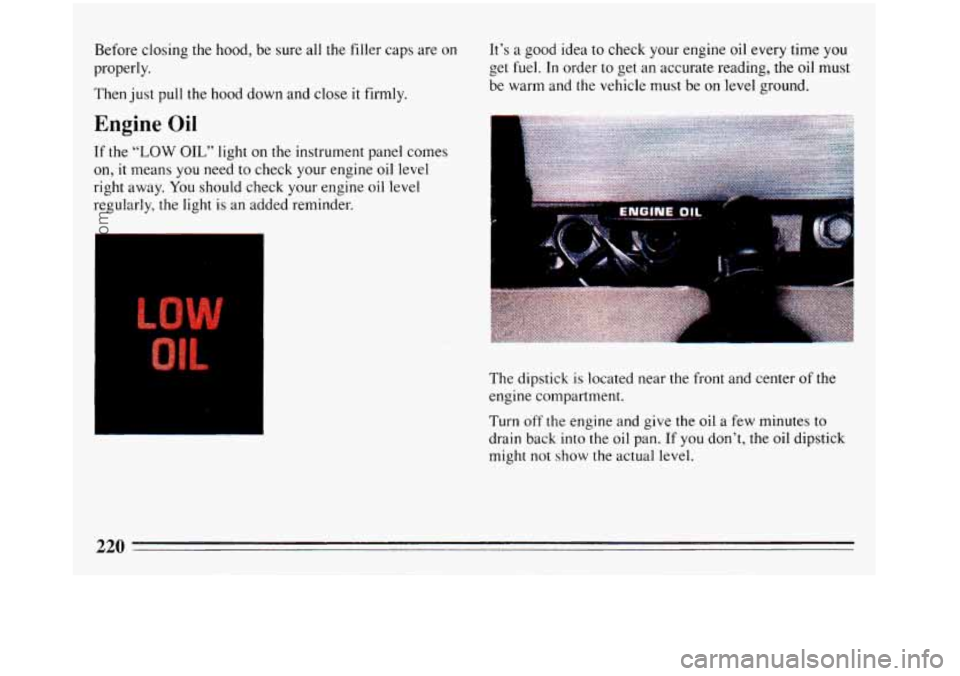
If the “LOW OIL” light on the instrument panel comes
on, it means you need to check your engine oil level
right away.
You should check your engine oil level
regularly, the light
is an added reminder. It’s
a good idea to check your engine oil every time you
get fuel.
In order to get an accurate reading, the oil must
be warm and the vehicle must be
on level ground.
The dipstick is located near the front and center
of the
engine compartment.
Turn
off the engine and give the oil a few minutes to
drain back into the oil pan. If you don’t, the oil dipstick
might not show the actual level.
ProCarManuals.com
Page 223 of 308
L
A
A
A
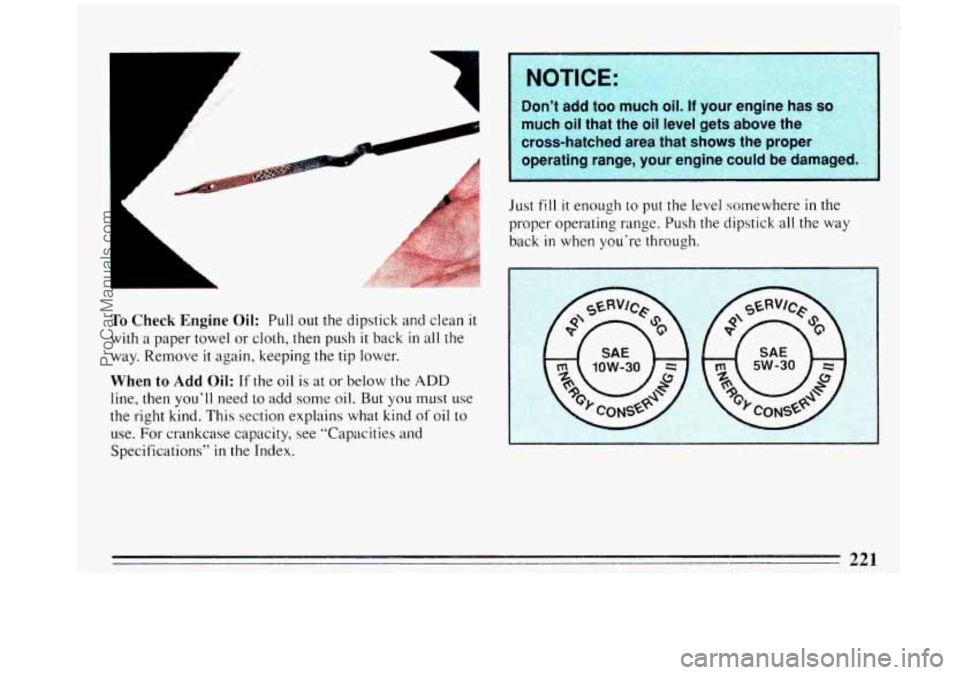
Don’t add too much oil. If your engine has so
much oil that the oil level gets above the
cross-hatched area that shows the proper
r operating range, your engine could be damaged. I il
r
Just fill it enough to put the level somewhere in the
proper operating range. Push the dipstick all
the way
back
in when you’re through. L
L
To Check Engine Oil: Pull out the dipstick and clean it
with a paper towel or cloth, then push it back in all the
way. Remove
it again, keeping the tip lower.
When to Add Oil: If the oil is at or below the ADD
line, then you’ll need to add some oil. But you must use
the right kind. This section explains what kind of
oil to
use. For crankcase capacity, see “Capacities and
Specifications”
in the Index.
I
I
22 1.
ProCarManuals.com
Page 224 of 308
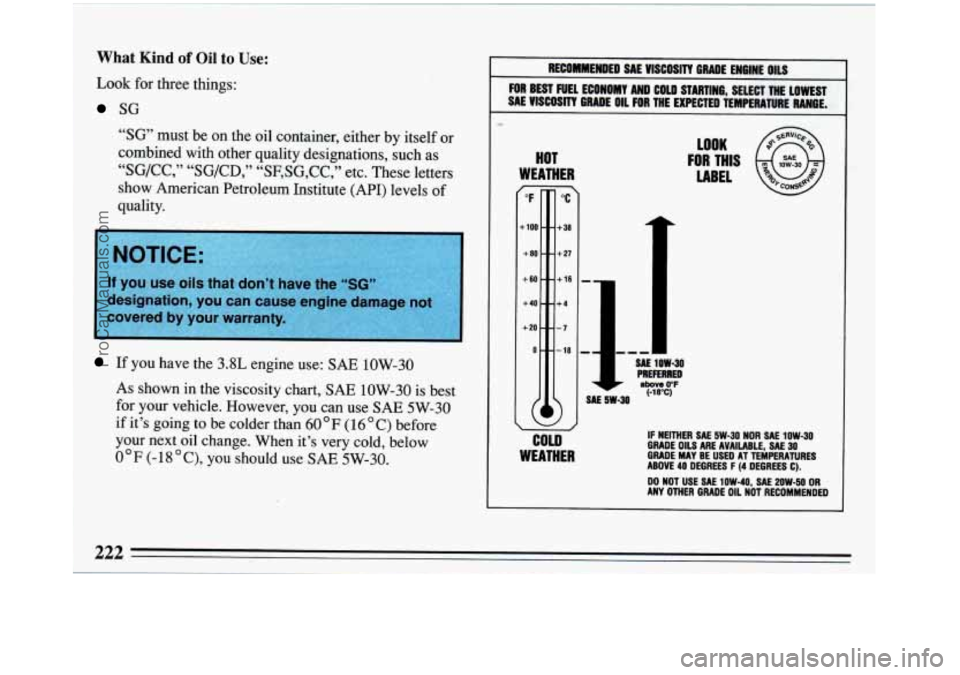
What Kind of Oil to Use:
Look for three things:
SG
“SG”
must be on the oil container, either by itself or
combined with other quality designations, such as
“SG/CC,” “SG/CD,” “SF,SG,CC,” etc. These letters
show American Petroleum Institute (API) levels of
quality.
If you have the 3.8L engine use: SAE 1OW-30
As shown in the viscosity chart,
SAE 1OW-30 is best
for your vehicle. However, you can use
SAE 5W-30
if it’s going to be colder than 60°F (16 “C) before
your next oil change. When it’s very cold, below
O°F (-18OC), you should use SAE 5W-30.
RECOMMENDED SAE VISCOSITY GRADE ENGINE OllS
FOR BEST NE1 F””””7Y AND COW STARTING, SELECT RE LOWEST
SAE VlSCOSlTT
C ~. .- - JIL FOR THE EXPECTED TEMPERATURE RANGE.
-
HOT
WEATHER 7
“F
t 100
+ 80
t 60
+ 40
+ 20
0
COLD
WEATHER
IF NEITHER SAE 5W-30 NOR SAE 1OW-30
GRADE OILS ARE AVAILABLE, SAE 30 GRADE MAY BE USED AT TEMPERATURES
ABOVE 40 DEGREES F (4 DEGREES 6).
DO NOT USE SAE 1OW-40, SAE 2 ANY OTHER GRADE OIL NOT REO IR 3ED
222
ProCarManuals.com