engine BUICK REGAL 1993 Manual PDF
[x] Cancel search | Manufacturer: BUICK, Model Year: 1993, Model line: REGAL, Model: BUICK REGAL 1993Pages: 308, PDF Size: 16.35 MB
Page 256 of 308
Fiberglass Springs Chemical Paint
Spotting
. __ - . , . , .. , x ii
&
.x .-., .i Some weather and atmospheric conditions can create a
>.. >:_ .g I:
e;
& I E
:
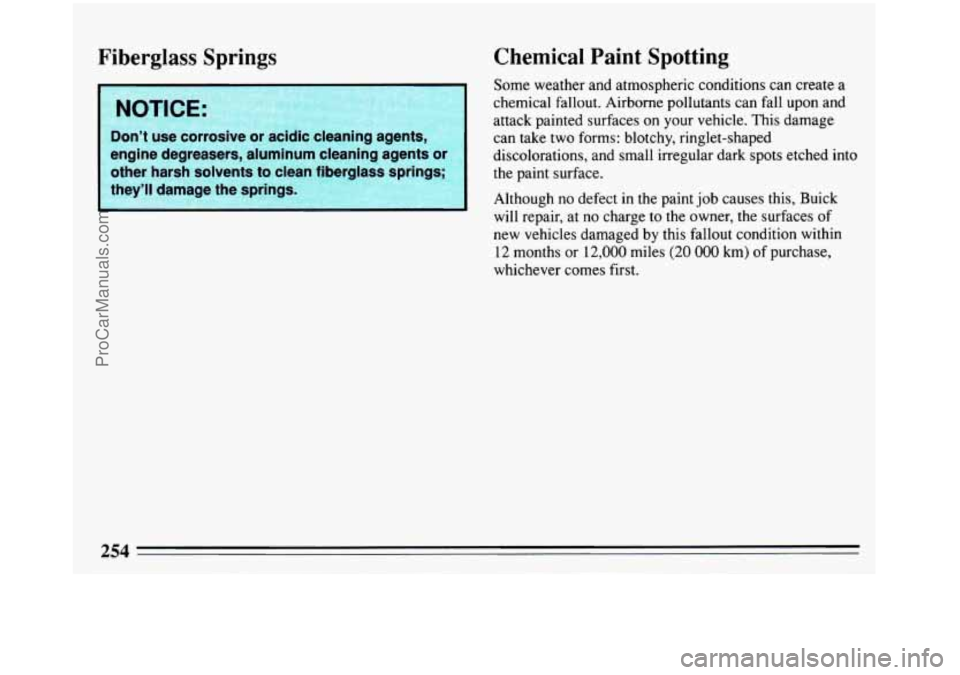
NOTICE:
engine degreasers, aluminum cleaning agents or discolorations, and small irregular dark spots etched into
chemical fallout. Airborne pollutants can fall
upon and
attack painted surfaces on your vehicle. This damage
Don’t use corrosive or acidic cleaning agents, can take two forms: blotchy, ringlet-shaped
other harsh solvents to cle rqlass Springs; 1 the paint surface.
they’ll damage the springs 8 Although no defect in the paint job causes this, Buick ;1 will repair, at no charge to-the owner, the surfaces of
new vehicles damaged by this fallout condition within
12 months or 12,000 miles (20
000 km) of purchase,
whichever comes first.
254
ProCarManuals.com
Page 258 of 308
Vehicle Identification Number (VIN) Service Parts Identification Label
I SAMPLE4UXPM072675
ENGINE A3 t ASSEMBLY I
CODE MODEL YEAR PLANT
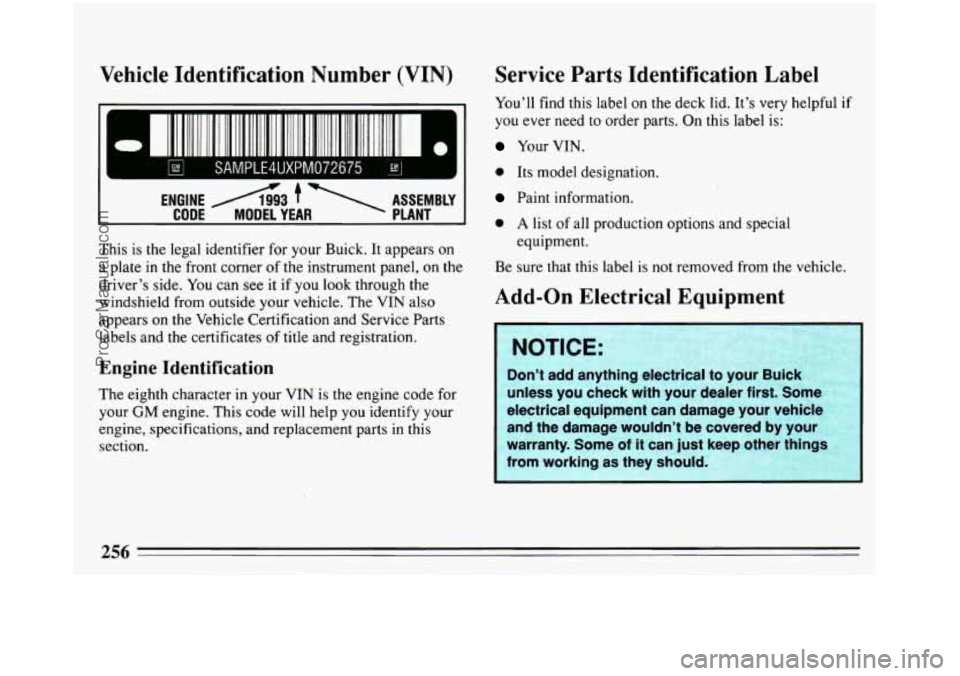
This is the legal identifier for your Buick. It appears on
a plate in the front comer
of the instrument panel, on the
driver’s side.
You can see it if you look through the
windshield from outside your vehicle. The VIN also
appears on the Vehicle Certification and Service Parts
labels and the certificates of title and registration.
Engine Identification
The eighth character in your VIN is the engine code for
your
GM engine. This code will help you identify your
engine, specifications, and replacement parts in this
section. You’ll
find this label on the deck lid. It’s very helpful
if
you ever need to order parts. On this label is:
Your VIN.
0 Its model designation.
Paint information.
0 A list of all production options and special
Be sure that this label is not removed from the vehicle.
equipment.
Add-on Electrical Equipment
I NOTICE:
Don’t add anything electrical
to your Buick
unless you check with your dealer first. Some
electrical equipment can damage your vehicle
and the damage wouldn’t be covered by your
warranty. Some of it can just keep other things
from working
as they should.
1
256
ProCarManuals.com
Page 259 of 308
Fuses and Circuit Breakers
The wiring circuits in your car are protected from short
circuits by a combination
of fuses, circuit breakers, and
fusible themdi links in the wiring itself.
This greatly
reduces the chance
of fires caused by electrical problems.
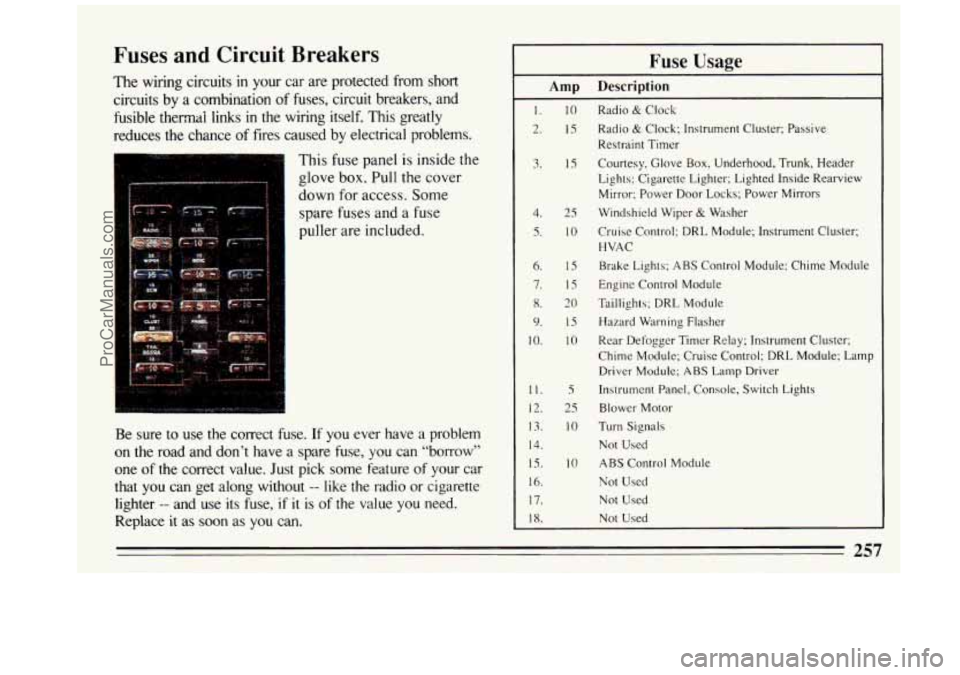
This fuse panel is inside the
glove box. Pull the cover
down for access. Some
spare fuses and
a fuse
puller are included.
Be sure
to use the correct fuse. If you ever have a problem
on the road and don’t have
a spare fuse, you can “borrow”
one of the correct value. Just pick some feature of your car
that you can get along without
-- like the radio or cigarette
lighter
-- and use its fuse, if it is of the value you need.
Replace
it as soon as you can.
Fuse Usage
Amp Description
1.
2.
3.
10
15
15
4.
5.
6.
7.
8.
9.
10.
11.
12.
13.
14.
1s.
16.
17.
18.
25
10
1s
15
20
15
10
5
25
10
10
Radio & Clock
Radio
& Clock; Instrument Cluster; Passive
Restraint Timer
Courtesy, Glove Box, Underhood, Trunk, Header
Lights; Cigarette Lighter; Lighted Inside Rearview Mirror; Power Door Locks; Power Mirrors
Windshield Wiper
& Washer
Cruise Control: DRL Module; Instrument Cluster;
HVAC
Brake Lights;
ABS Control Module; Chime Module
Engine Control Module
Taillights; DRL Module
Hazard Warning Flasher
Rear Defogger Timer Relay: Instrument Cluster;
Chime Module; Cruise Control; DRL Module; Lamp
Driver
Module; ABS Lamp Driver
Instrument Panel. Console, Switch Lights
Blower Motor
Turn Signals
Not Used ABS Control Module
Not Used Not Used
Not Used
257
ProCarManuals.com
Page 265 of 308
Capacities and Specifications
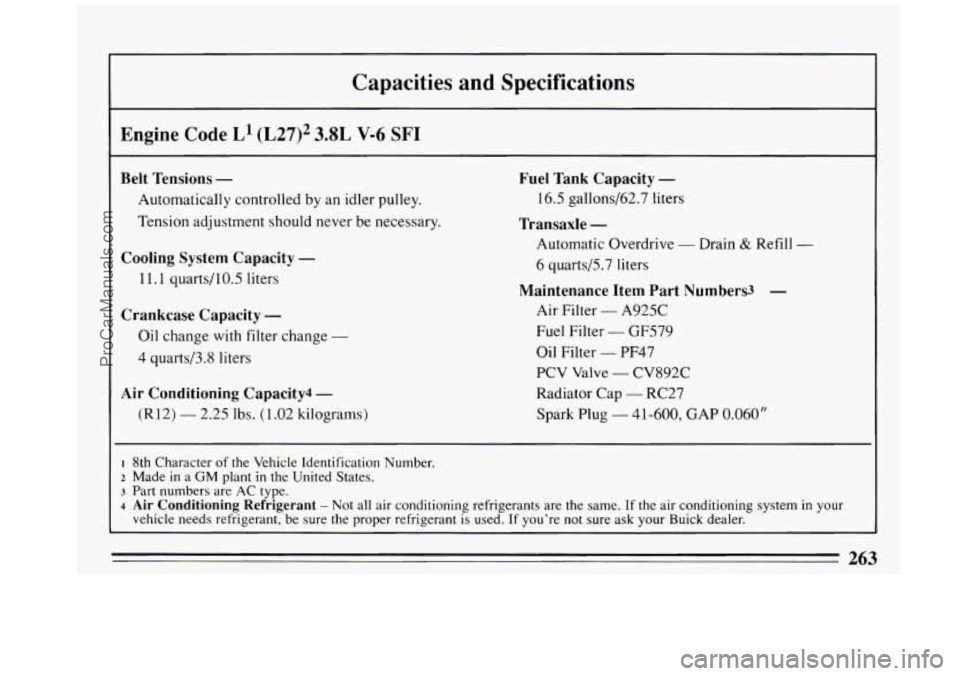
Engine Code L1 (L27)2 3.8L V-6 SF1
Belt Tensions - Fuel Tank Capacity -
Automatically controlled by an idler pulley.
16.5 gallons/62.7 liters
Tension adjustment should never be necessary.
Transaxle -
Automatic Overdrive - Drain & Refill -
6 quarts/5.7 liters
Maintenance Item Part Numbers3 -
Air Filter - A925C
Fuel Filter
- GF579
Oil Filter
- PF47
PCV Valve
- CV892C
Radiator Cap
- RC27
Spark Plug
- 41-600, GAP 0.060”
Cooling System Capacity -
11.1 quarts/l0.5 liters
Crankcase Capacity -
Oil change with filter change -
4 quarts/3.8 liters
Air Conditioning Capacity4 -
(R12) - 2.25 lbs. (1.02 kilograms)
-
4 Air Conditioning Refrigerant - Not all air conditioning refrigerants are the same. If the air conditioning system in your
vehicle needs refrigerant, be sure the proper refrigerant
is used. If you’re not sure ask your Buick dealer.
~ ~~
I 8th Character of the Vehicle Identification Number.
2 Made in a GM plant in the United States.
3 Part numbers are AC tvDe.
263
ProCarManuals.com
Page 266 of 308
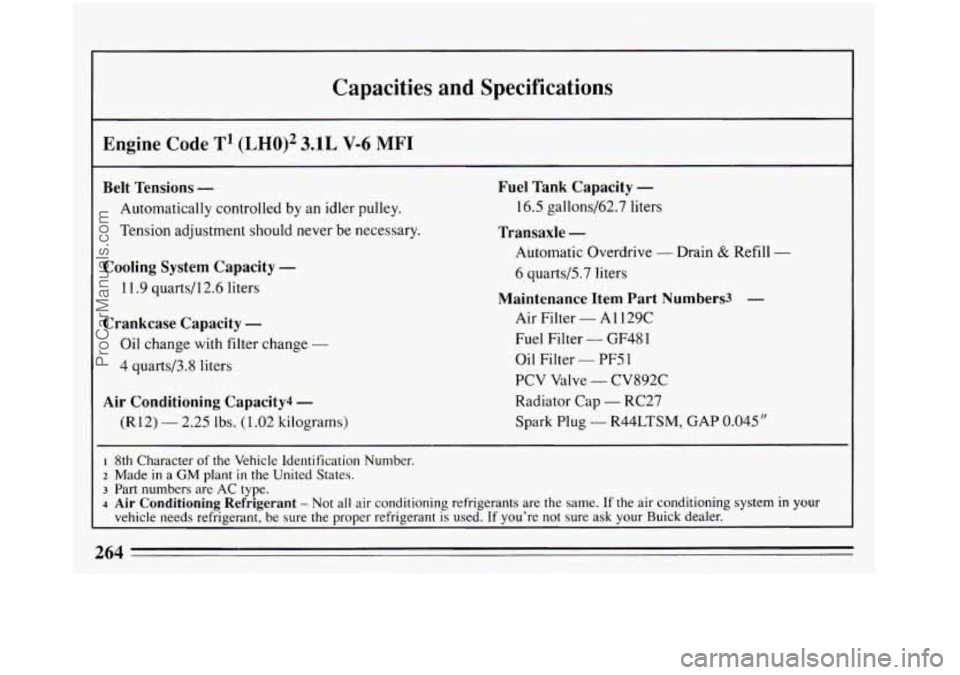
Capacities and Specifications
Engine Code T1 (LH0)2 3.1L V-6 MFI
Belt Tensions -
Automatically controlled by an idler pulley.
Tension adjustment should never be necessary.
Cooling System Capacity -
11.9 quarts/l2.6 liters
Crankcase Capacity -
Oil change with filter change -
4 quarts/3.8 liters
Air Conditioning Capacity4 -
(R12) - 2.25 Ibs. (1.02 kilograms)
Fuel Tank Capacity -
16.5 gallons/62.7 liters
1 ransaxle -
Automatic Overdrive - Drain & Refil 1-
6 quartd5.7 liters
Maintenance Item Part Numbers3 -
Air Filter - A1 129C
Fuel Filter
- GF48 1
Oil Filter - PF5 1
PCV Valve - CV892C
Radiator Cap
- RC27
Spark Plug
- R44LTSM, GAP 0.045”
~~ ~
1 8th Character of the Vehicle Identification Number.
z Made in a GM plant in the United States.
3 Part numbers are AC type.
4 Air Conditioning Refrigerant - Not all air conditioning refrigerants are the same. If the air conditioning system in your
vehicle needs refrig
nt, be sure the proper refrigerant is used. If you’re not sure ask your Buick dealer.
264
ProCarManuals.com
Page 268 of 308
IMPORTANT:
KEEP ENGINE OIL
AT THE PROPER
LEVEL AND CHANGE AI
RECOMMENDED
’/an
Have you purchased the GM Protection Plan? The
Plan supplements your new vehicle warranties. See
your Buick dealer for details.
Introduction
A Word About Maintenance
We at General Motors want to help you keep your
vehicle in good working condition. But we don’t know
exactly how
you’ll drive it. You may drive very short
distances only
a few times a week. Or you may drive
long distances all the time in very
hot, dusty weather.
You may use your vehicle in making deliveries. Or you
may drive it to work, to
do errands or in many other
ways.
Because of all
the different ways people use their GM
vehicles, maintenance needs vary. You may even need
more frequent checks and replacements
than you will
find in the schedules in this part.
So please read this part
and note how
you drive. If you have any questions on
how
to keep your vehicle in good condition, see your
Buick dealer, the place many GM owners choose to
have their maintenance work done. Your dealer can be
relied upon to use proper parts and practices.
266
-
ProCarManuals.com
Page 271 of 308
Selecting the Right Schedule
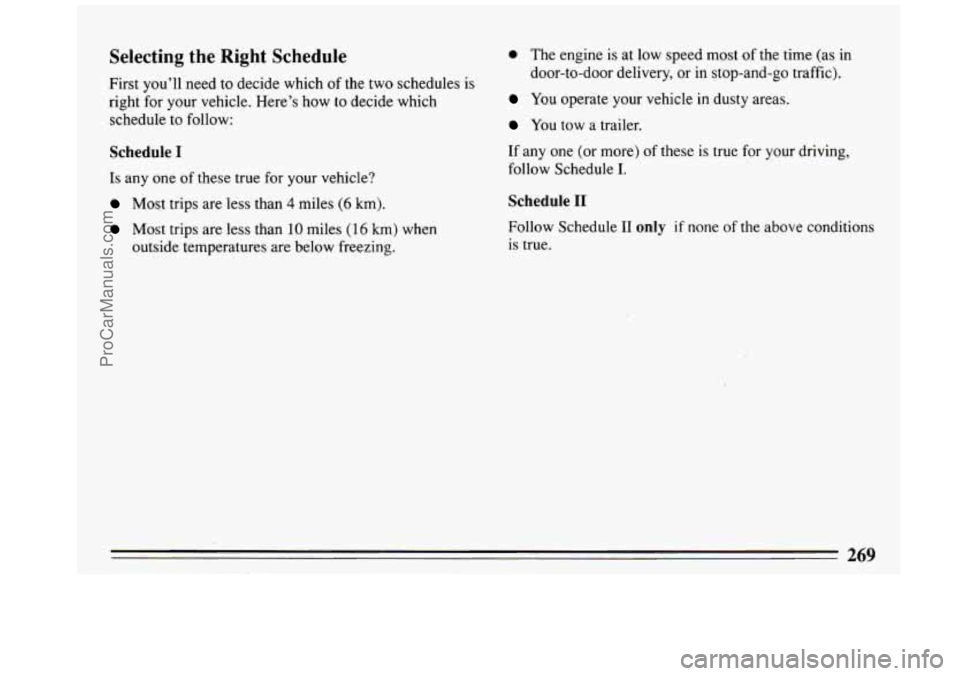
First you’ll need to decide which of the two schedules is
right for your vehicle. Here’s how to decide which
schedule
to follow:
Schedule I
Is any one of these true for your vehicle?
Most trips are less than 4 miles (6 km).
Most trips are less than 10 miles (16 km) when
outside temperatures are below freezing.
0 The engine is at low speed most of the time (as in
door-to-door delivery, or in stop-and-go traffic).
You operate your vehicle in dusty areas.
You tow a trailer.
If any one (or more) of these is true for your driving,
follow Schedule
I.
Schedule I1
Follow Schedule I1 only if none of the above conditions
is true.
269
ProCarManuals.com
Page 272 of 308
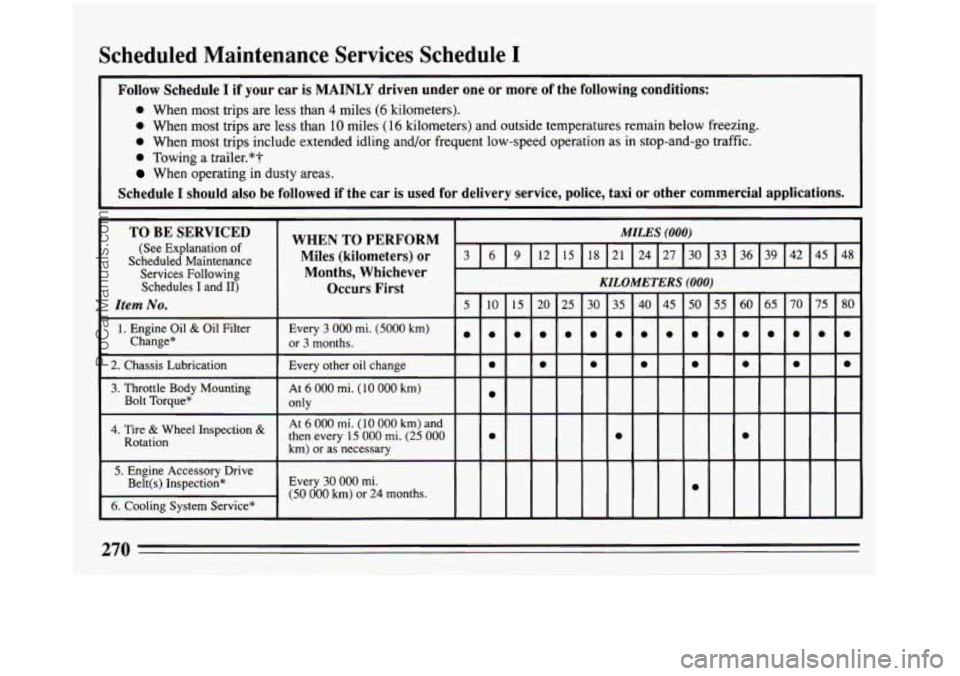
Scheduled Maintenance Services Schedule I
Follow Schedule I if your car is MAINLY driven under one or more of the following conditions: I
0 When most trips are less than 4 miles (6 kilometers).
0 When most trips are less than 10 miles (16 kilometers) and outside temperatures remain below freezing.
0 When most trips include extended idling and/or frequent low-speed operation as in stop-and-go traffic.
0 Towing a trailer.*?
When operating in dusty areas.
Schedule I should also be followed if the car is used for delivery service, police, taxi or other commercial applications.
TO BE SERVICED
(See Explanation of
Scheduled Maintenance
Services Following Schedules
I and 11)
Item No.
1. Engine Oil & Oil Filter
Change*
2. Chassis Lubrication
3. Throttle Body Mounting Bolt Torque*
4. Tire & Wheel Inspection &
Rotation
5. Engine Accessory Drive
' Belt(s) Inspection*
6. Cooling System Service*
65 70 75 80
0.00
0 0
270
ProCarManuals.com
Page 274 of 308
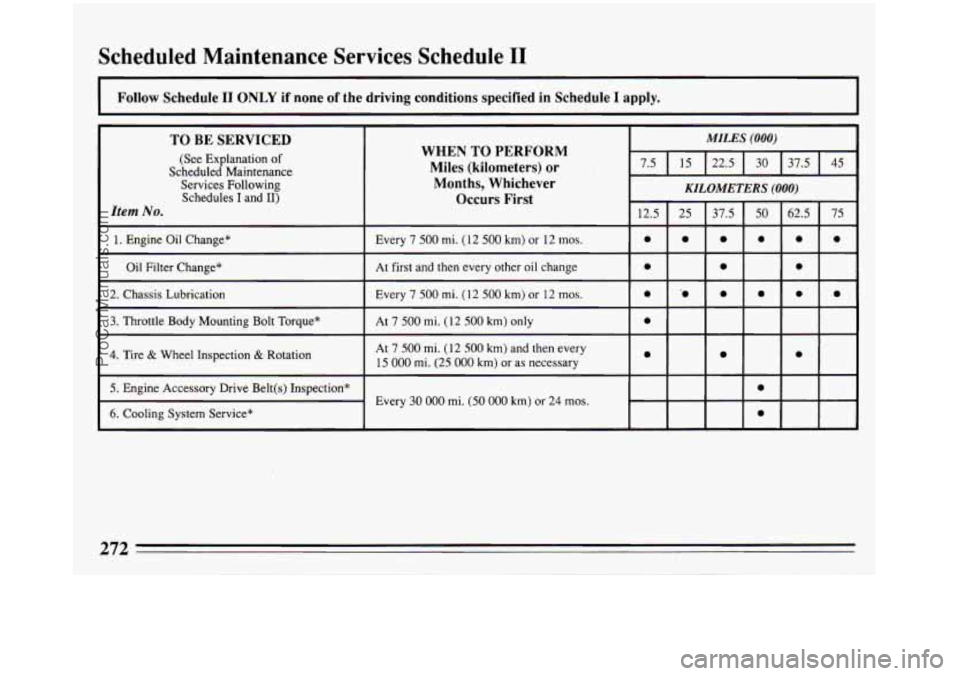
Scheduled Maintenance Services Schedule I1
IIONLY if none of the driving conditions specified in Schedule I apply.
TO BE SERVICED
(See Explanation of
Scheduled Maintenance
Services Following Schedules
I and 11)
Item No.
1. Engine Oil Change*
Oil Filter Change*
2. Chassis Lubrication
3. Throttle Body Mounting Bolt Torque*
4. Tire & Wheel Inspection & Rotation
5. Engine Accessory Drive Belt(s) Inspection*
6. Cooling System Service*
WHEN TO PERFORM
Miles (kilometers)
or
Months, Whichever
Occurs First
I MILES (000)
lm
KILOMETERS (
Every 7 500 mi. (12 500 km) or 12 mos. 1~101010 ~~
At first and then every other oil change
Every
7 500 mi. (12 500 km) or 12 mos.
At 7 500 mi. (12 SO0 km) only
At
7 500 mi. (12 SO0 km) and then every
15 000 mi. (25 000 km) or as necessary 1.1 1.1
I I I 0 Every 30 000 mi. (SO 000 km) or 24 mos. I I I
I I I 0
+
272
ProCarManuals.com
Page 276 of 308
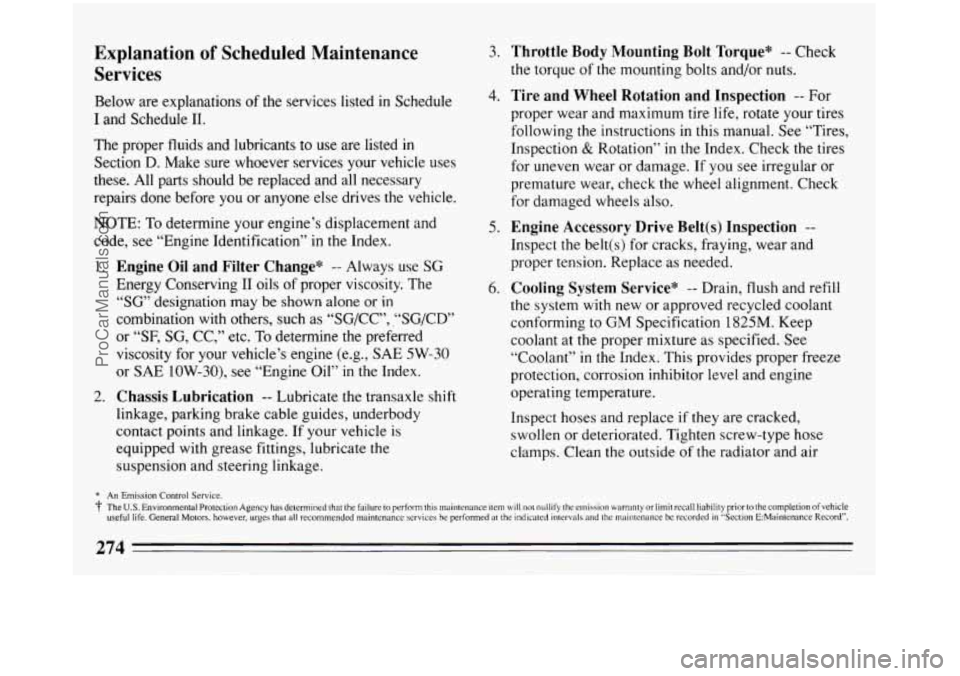
Explanation of Scheduled Maintenance
Services
Below are explanations of the services listed in Schedule
I and Schedule 11.
The proper fluids and lubricants to use are listed in
Section D. Make sure whoever services your vehicle uses
these. All parts should be replaced and all necessary
repairs done before
you or anyone else drives the vehicle.
NOTE: To determine your engine’s displacement and
code, see “Engine Identification” in the Index.
1. Engine Oil and Filter Change* -- Always use SG
Energy Conserving I1 oils of proper viscosity. The
“SG” designation may be shown alone or in
combination with others, such as “SG/CC”, ,“SG/CD”
or
“SF, SG, CC,” etc. To determine the preferred
viscosity for your vehicle’s engine (e.g., SAE 5W-30
or SAE 10W-30), see “Engine Oil”
in the Index.
2. Chassis Lubrication -- Lubricate the transaxle shift
linkage, parking brake cable guides, underbody
contact points and linkage. If your vehicle is
equipped with grease fittings, lubricate
the
suspension and steering linkage. 3.
Throttle Body Mounting
Bolt Torque* -- Check
the torque
of the mounting bolts and/or nuts.
4. Tire and Wheel Rotation and Inspection -- For
proper wear and maximum tire life, rotate your tires
following the instructions
in this manual. See “Tires,
Inspection
& Rotation” in the Index. Check the tires
for uneven wear or damage. If you see irregular or
premature wear, check the wheel alignment. Check
for damaged wheels also.
5. Engine Accessory Drive Belt(s) Inspection --
Inspect the belt(s) for cracks, fraying, wear and
proper tension. Replace as needed.
6. Cooling System Service* -- Drain, flush and refill
the system
with new or approved recycled coolant
conforming to GM Specification 1825M. Keep
coolant at the proper mixture as specified. See
“Coolant”
in the Index. This provides proper freeze
protection, corrosion inhibitor level and engine
operating temperature.
Inspect hoses and replace
if they are cracked,
swollen or deteriorated. Tighten screw-type hose
clamps. Clean the outside
of the radiator and air
* An Emission Control Service.
The
U.S. Environmental Protection Agency has determined that the failure to perform this maintenance item will not nullify the emission warranty or limit recall liability prior tothe completion of vehicle useful life. General Motors, however, urges that all recommended maintenance \
services he performed at the indicatcd intervals and the maintenance be recorded in ”Section E:Maintenance Record”.
274
ProCarManuals.com