tow BUICK REGAL 1995 User Guide
[x] Cancel search | Manufacturer: BUICK, Model Year: 1995, Model line: REGAL, Model: BUICK REGAL 1995Pages: 340, PDF Size: 17.16 MB
Page 82 of 340
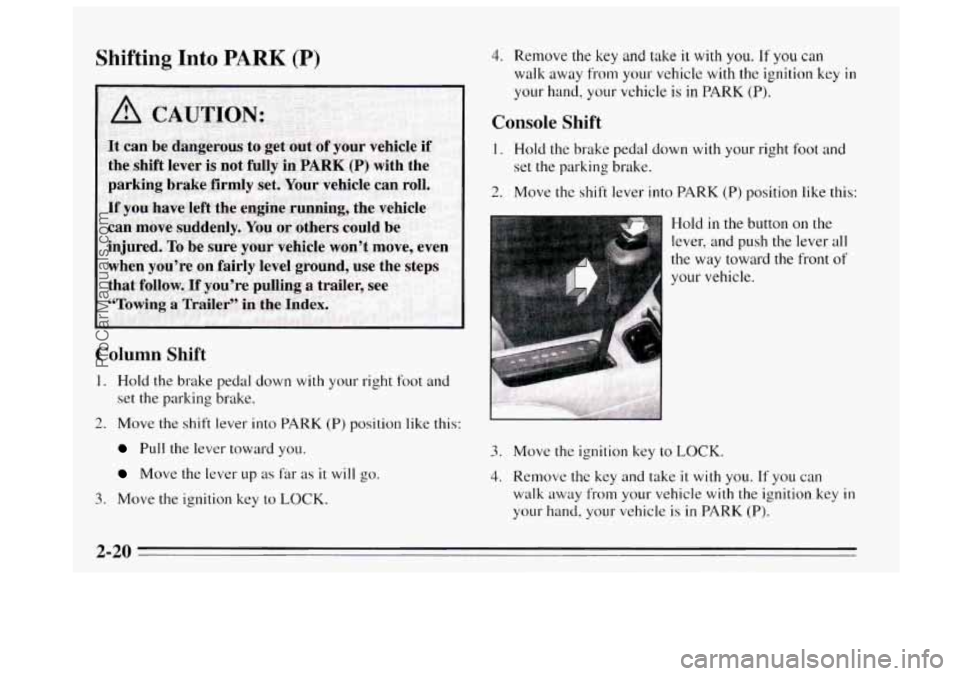
Shifting Into PARK (P)
Column Shift
1. Hold the brake pedal down with your right foot and
set the parking brake.
2. Move the shift lever into PARK (P) position like this:
Pull the lever toward you.
Move the lever up as Fir as it will go.
3. Move the ignition key to LOCK.
4. Remove the key and take it with you. If you can
walk away from your vehicle with the ignition key in
your hand, your vehicle is in PARK (P).
Console Shift
1. Hold the brake pedal down with your right foot and
set the parking brake.
2. Move the shift lever into PARK (P) position like this:
Hold
in the button on the
lever, and push the lever all
the way toward the front of
your vehicle.
3. Move the ignition key to LOCK.
4. Remove the key and take it with you. If you can
walk away from your vehicle with the ignition key in
your hand, your vehicle is in PARK (P).
2-20
ProCarManuals.com
Page 83 of 340
Leaving Your Vehicle With the Engine
Running
If you have to leave your vehicle with the engine
running, be sure your vehicle is
in PARK (P) and your
parking brake is firmly set before you leave
it. After
you’ve moved the shift lever into the PARK
(P)
position, hold the regular brake pedal down. Then, see
if you can move the shift lever away from PARK (P)
without first pulling
it toward you (or, if you have the
console shift lever, without first pushing the button).
If
you can, it means that the shift lever wasn‘t fully locked
into PARK
(P).
Torque Lock
If you are parking 011 a hill and ~OLI don’t shift YOLII-
transaxle into PARK (P) properly, the weight of the
vehicle
may put too much force on the parking pawl in
the transaxle. You may find it difficult to pull the shift
lever out
of PARK (P). This is called “torclue lock.” To
prevent torque lock, set the pmking brake and then shift
into PARK (P) properly before you leave the driver’s
seat.
To find out how, see “Shifting Into PARK (P)” in
the Index.
When you are ready to drive, move the shift lever out of
PARK (P) h
another vehicle push yours
a little uphill to take some of
the pressure from the transaxle, so you can pull the shift
lever out of
PARK (P).
2-21
ProCarManuals.com
Page 86 of 340
Power Windows
Follow the proper steps to be sure your vehicle won’t
move. See “Shifting Into
PARK (P)” in the Index.
If you are parking on a hill and if you’re pulling a
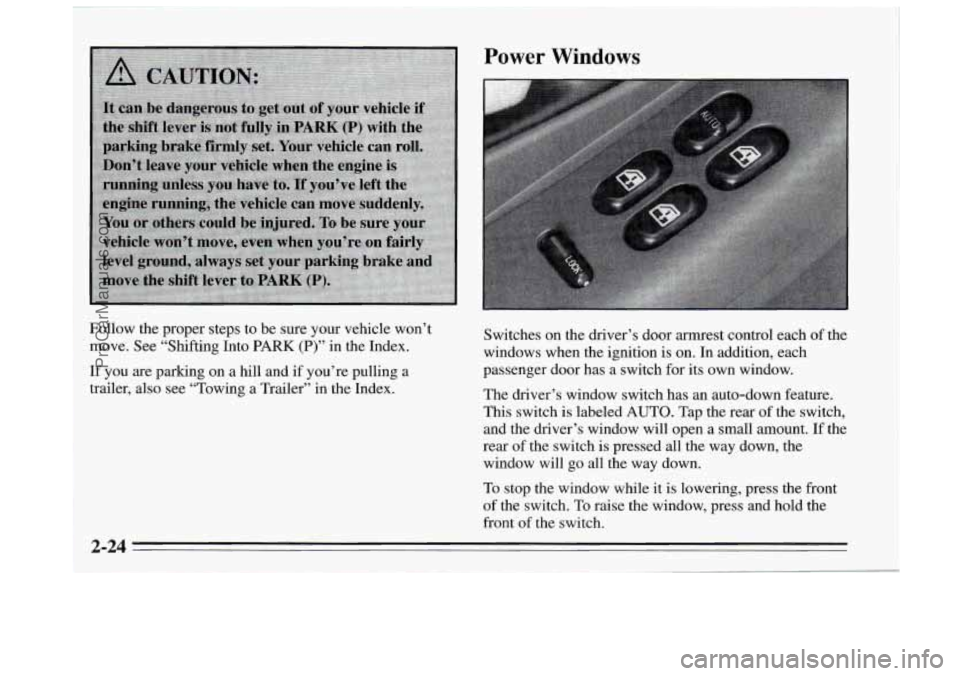
trailer, also see “Towing a Trailer” in the Index. Switches on the driver’s door armrest control each
of the
windows when the ignition is on. In addition, each
passenger door has a switch for its own window.
The driver’s window switch has an auto-down feature.
This switch is labeled
AUTO. Tap the rear of the switch,
and the driver’s window will open a small amount. If the
rear of the switch is pressed all the way down, the
window will
go all the way down.
To stop the window while it is lowering, press the front
of the switch.
To raise the window, press and hold the
front of the switch.
2-24
ProCarManuals.com
Page 88 of 340
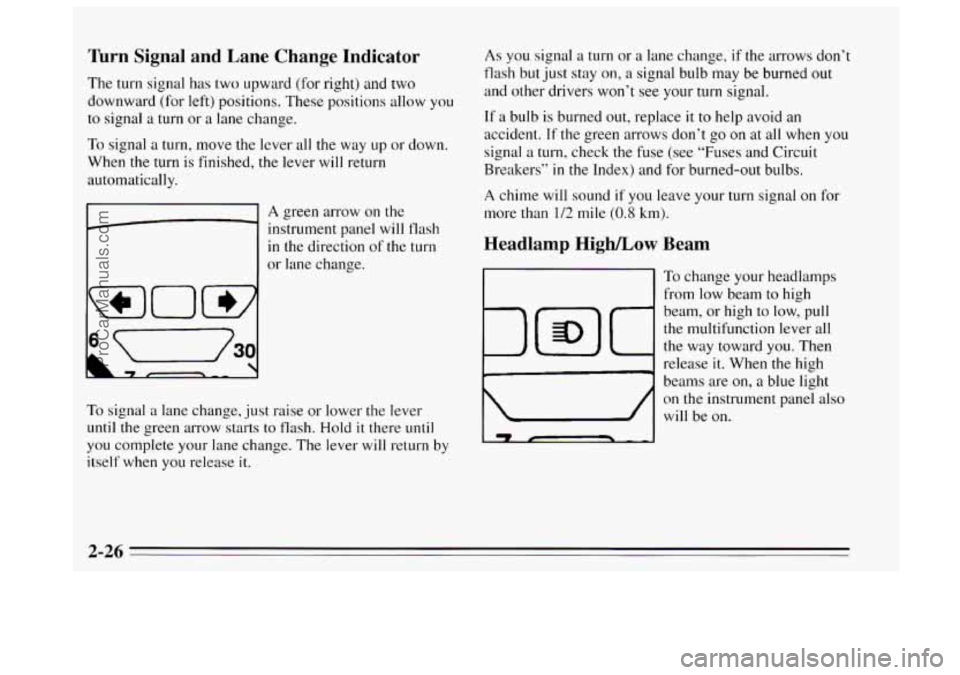
Turn Signal and Lane Change Indicator
The turn signal has two upward (for right) and two
downward (for left) positions. These positions allow you
to signal a turn or a lane change.
To signal
a turn, move the lever all the way up or down.
When
the turn is finished, the lever will return
automatically.
A green arrow on the
instrument panel will flash
in the direction of the turn
or lane change.
To signal a lane change, just raise or lower the lever
until the green arrow starts to flash. Hold it there until
you complete your lane change. The lever will return by
itself when you release it.
As you signal a turn or a lane change, if the arrows don’t
flash but just stay on, a signal bulb may be burned out
and other drivers won’t see
your turn signal.
If a bulb is burned out, replace
it to help avoid an
accident. If the green arrows don’t go on at all
when you
signal a turn, check the fuse (see
“Fuses and Circuit
Breakers”
in the Index) and for burned-out bulbs.
A chime will sound if you leave your turn signal on for
more than 1/2 mile
(0.8 km).
Headlamp High/Low Beam
bmd
To change your headlamps
from low beam to high
beam, or high to low, pull
the multifunction lever all
the way toward you. Then
release
it. When the high
beams are on,
a blue light
on the instrument panel
also
will be on.
2-26
ProCarManuals.com
Page 109 of 340
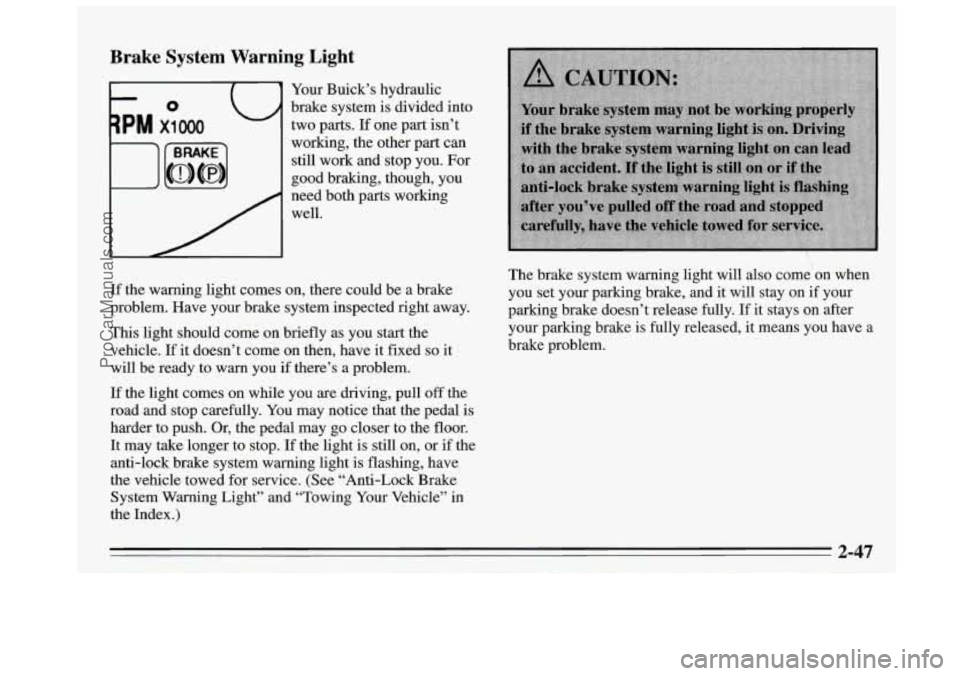
Brake System Warning Light
Your Buick’s hydraulic
brake system is divided into
two parts.
If one part isn’t
working, the other part can
still work and stop you. For
good braking, though, you
need both parts working
well.
If the warning light comes on, there could be a brake
problem. Have your brake system inspected right away.
This light should come on briefly as you start the
vehicle.
If it doesn’t come on then, have it fixed so it
will be ready to warn you if there’s a problem.
If the light comes on while you are driving, pull
off the
road and stop carefully. You may notice that the pedal is
harder to push. Or, the pedal may go closer to the floor.
It may take longer to stop. If the light is still on, or if the
anti-lock brake system warning light is flashing, have
the vehicle towed for service. (See “Anti-Lock Brake
System Warning Light” and “Towing Your Vehicle” in
the Index.
)
The brake system warning light will also come on when
you set your parking brake, and it
will stay on if your
parking brake doesn’t release fully.
If it stays on after
your parking brake is fully released, it means you have
a
brake problem.
2-47
ProCarManuals.com
Page 110 of 340
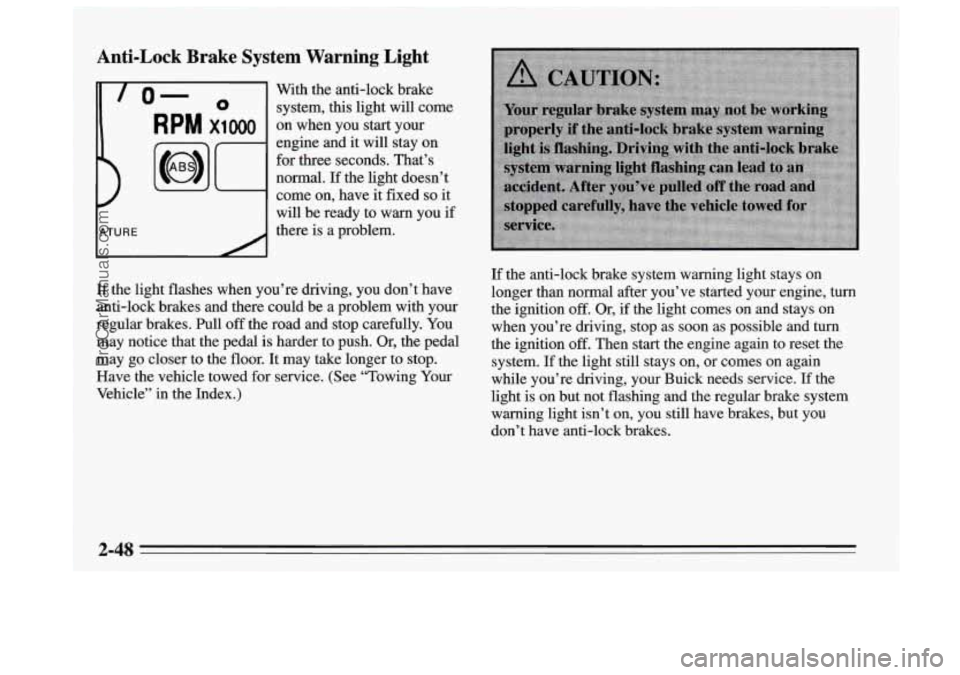
Anti-Lock Brake System Warning Light
-
lo- 0 system, this light will come
With
the anti-lock brake
RPM x1000 on when you start your
engine and it will stay on
for three seconds. That’s
normal. If the light doesn’t
come on, have it fixed
so it
will be ready to warn you
if
there is a problem.
If the light flashes when you’re driving, you don’t have
anti-lock brakes and there could be a problem with your
regular brakes.
Pull off the road and stop carefully. You
may notice that the pedal is harder to push.
Or, the pedal
may go closer to the floor. It may take longer to stop.
Have the vehicle towed for service. (See “Towing Your
Vehicle’’ in the Index.)
If the anti-lock brake system warning light stays on
longer than normal after you’ve started your engine,
turn
the ignition off. Or, if the light comes on and stays on
when you’re driving, stop as soon as possible and
turn
the ignition off. Then start the engine again to reset the
system.
If the light still stays on, or comes on again
while you’re driving, your Buick needs service. If the
light
is on but not flashing and the regular brake system
warning light isn’t
on, you still have brakes, but you
don’t have anti-lock brakes.
2-48
ProCarManuals.com
Page 118 of 340
System Controls
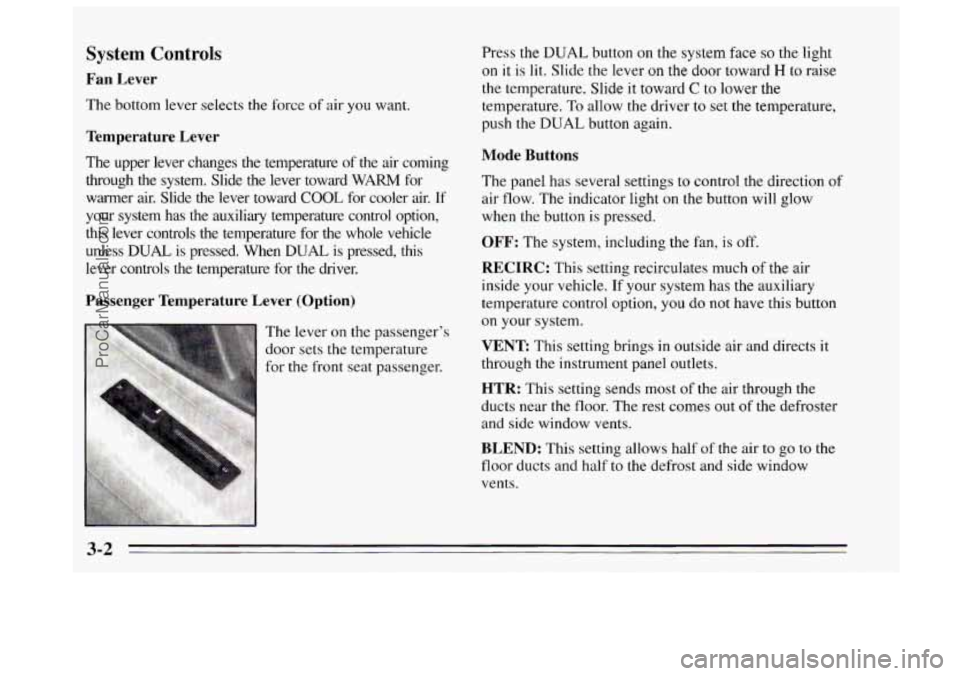
Fan Lever
The bottom lever selects the force of air you want.
Temperature Lever
The upper lever changes the temperature of the air coming
through the system. Slide the lever toward
WARM for
warmer air. Slide the lever toward
COOL for cooler air. If
your system has the auxiliary temperature control option,
this lever controls the temperature for
the whole vehicle
unless
DUAL is pressed. When DUAL is pressed, this
lever controls the temperature for the driver.
Passenger Temperature Lever (Option)
Press the DUAL button on the system face so the light
on it is lit. Slide the lever on the door toward H to raise
the temperature. Slide it toward
C to lower the
temperature. To allow the driver
to set the temperature,
push the
DUAL button again.
Mode Buttons
The panel has several settings to control the direction of
air flow. The indicator light
on the button will glow
when the button
is pressed.
OFF: The system, including the fan, is off.
RECIRC: This setting recirculates much or tne air
inside your vehicle.
If your system has the auxiliary
temperature control option, you do not have this button
on your system.
VENT This setting brings in outside air and directs it
through the instrument panel outlets.
HTR: This setting sends most of the air through the
ducts near the floor. The rest comes out of the defroster
and side window vents.
BLEND: This setting allows half of the air to go to the
floor ducts and half to
the defrost and side window
vents.
3-2
ProCarManuals.com
Page 166 of 340
Towing a Trailer
advice and information about towing a trailer
with your vehicle.
I’
~ NOTICE:
~ Pulling a trailer improperly can damage your
vehicle and result in costly repairs not covered by
~ your warranty. TO pull a trailer correctly, follow
the advice in this part, and see your Buick dealer
for important information about. towing a trailer
with your vehicle. Your
vehicle can tow a trailer.
To identify what the
vehicle trailering capacity is for your vehicle,
you
should read the information in “Weight of the Trailer”
that appears later
in this section. But traiiering is
different than just driving your vehicle by itself.
Trailering means changes
in handling, durability, and
fuel economy. Successful, safe trailering takes correct
equipment, and
it has to be used properly.
That’s the reason for this part.
In it are many
time-tested, important trailering tips and safety rules.
Many of these are important for your safety and that of
your passengers.
So please read this section carefully
before you pull
a trailer.
Load-pulling components such
as the engine, transaxle,
wheel assemblies, and tires are forced to work harder
against the drag of the added weight. The engine is
required
to operate at relatively higher speeds and under
greater loads, generating extra heat. What’s more, the
trailer adds considerably to wind resistance. increasing
the pulling requirements.
4-28
ProCarManuals.com
Page 167 of 340
If You Do Decide To Pull A Trailer
If you do, here are some important points.
0 There are many different laws, including speed limit
restrictions, having to do with trailering. Make sure
your rig will be legal, not only where you live but
also where you’ll be driving.
A good source for this
information can be state
01- provincial police.
Consider using a sway control.
You can ask a hitch dealer about sway controls.
0
0
0 Don’t tow a trailer at all during the first 1000 miles
(1 600 km) your new vehicle is driven. Your engine,
axle or other parts could be damaged.
Then, during the first 500 miles (800 km) that
you
tow a trailer, don’t drive over 50 mph (80 kmrdh) and
don’t make starts at full throttle. This helps your
engine and other parts of your vehicle wear in at the
heavier loads.
Obey speed
limit restrictions when towing a trailer.
Don’t drive faster than the maximum posted speed
for trailers (or no more than
55 mph (90 km/h)) to
save wear on your vehicle’s parts. Three
important considerations have to do with weight:
Weight of the Trailer
How heavy can a trailer safely be?
It should never weigh more than 1,000 pounds (450 kg),
unless you have the 2,000-pound (900 kg) trailer towing
option package. But even that can be too heavy.
It depends on how you plan to use your rig.
For
example, speed, altitude, road grades, outside
temperature and how much your vehicle is used to pull a
trailer are all important. And,
it can also depend on any
special equipment that you have on your vehicle.
You can ask your dealer for
OLI~ trailering information or
advice, or you can write 11s at Buick Motor Division,
Customer Assistance Center, 902
E. Hamilton Avenue,
Flint, MI 48550.
In Canada, write to General Motors of Canada Limited,
Customer Assistance Center, 1908 Colonel Sam Drive,
Oshawa, Ontario
L 1 H 8P7.
4-LY
ProCarManuals.com
Page 168 of 340
Weight of the Trailer Tongue
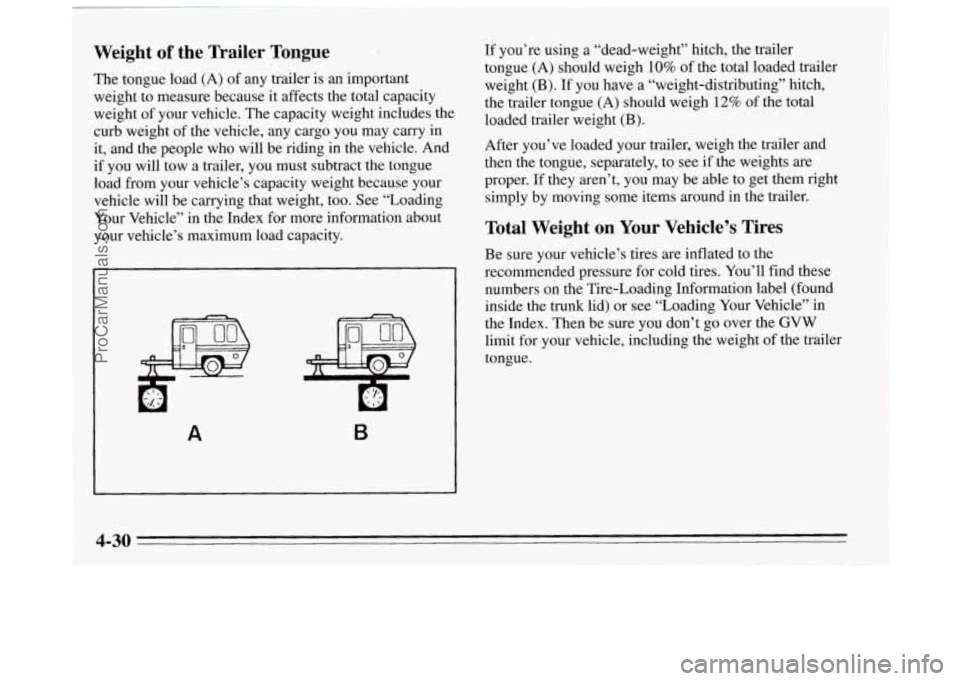
The tongue load (A) of any trailer is an important
weight to measure because it affects the total capacity
weight of your vehicle. The capacity weight includes the
curb weight of the vehicle, any cargo you may carry in
it, and the people who will be riding in the vehicle. And
if you will tow a trailer, you must subtract the tongue
load from your vehicle’s capacity weight because your
vehicle will be carrying that weight, too. See “Loading
Your Vehicle” in the Index for more information about
your vehicle’s maximum load capacity.
A B
If you’re using a “dead-weight” hitch, the trailer
tongue (A) should weigh
10% of the total loaded trailer
weight
(B). If you have a “weight-distributing” hitch,
the trailer tongue
(A) should weigh 12% of the total
loaded trailer weight (B).
After you’ve loaded your trailer, weigh the trailer and
then the tongue, separately, to see if the weights
are
proper. If they aren’t, you may be able to get them right
simply by moving some items around in the trailer.
Total Weight on Your Vehicle’s Tires
Be sure your vehicle’s tires are inflated to the
recommended pressure for cold tires. You’ll find these
numbers on the Tire-Loading Information label (found
inside the trunk lid) or see “Loading Your Vehicle” in
the Index. Then be sure you don’t go over the
GVW
limit for your vehicle, including the weight of the trailer
tongue.
4-30
ProCarManuals.com