ECU BUICK REGAL 1996 Owners Manual
[x] Cancel search | Manufacturer: BUICK, Model Year: 1996, Model line: REGAL, Model: BUICK REGAL 1996Pages: 356, PDF Size: 17.97 MB
Page 26 of 356
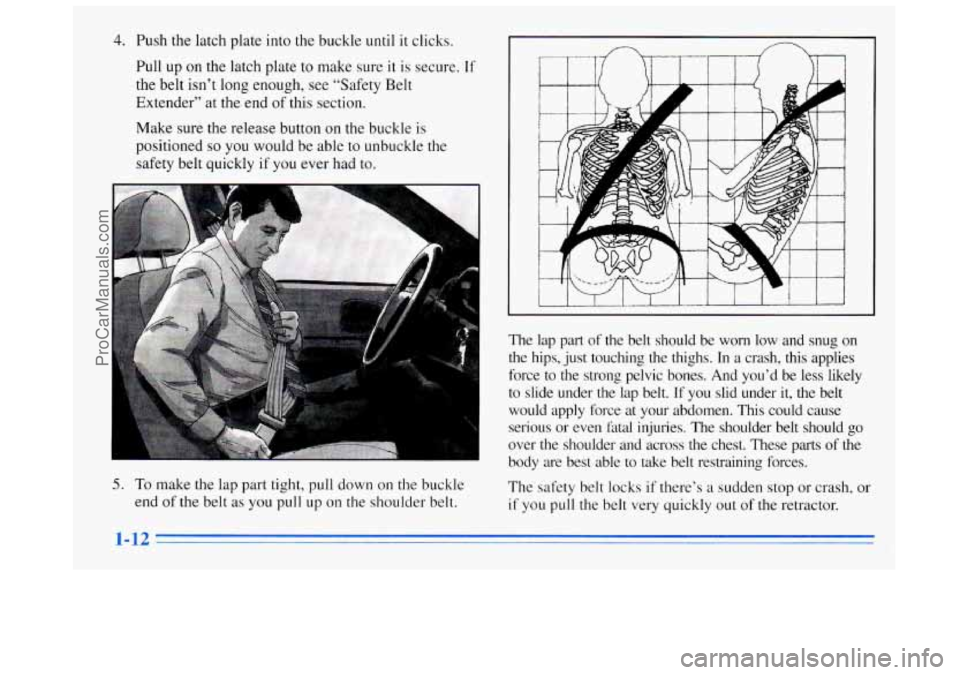
4. Push the latch plate into the buckle until it clicks.
Pull up on the latch plate to make sure
it is secure. If
the belt isn’t long enou,gh, see “Safety Belt
Extender” at the end
of this section.
Make sure the release button on the buckle is
positioned
so you would be able to unbuckle the
safety belt quickly if you ever had to.
5. To make the lap part tight, pull down on the buckle
end
of the belt as you pull up on the shoulder belt.
The lap part of the belt should be worn low and snug on
the hips, just touching the thighs. In
a crash, this applies
force to the strong pelvic bones. And you’d
be less likely
to slide under the lap belt. If
you slid under it, the belt
would apply force at your abdomen. This could cause serious or even fatal injuries.
The shoulder belt should go
over the shoulder and across the chest. These parts of the
body are best able
to take belt restraining forces.
The safety belt locks
if there’s a sudden stop or crash, or
if you pull the belt very quickly out of the retractor.
1-12
ProCarManuals.com
Page 33 of 356
A CAUTION:
Air bags inflate with great force, faster than the
blink
of an eye. If you’re too close to an inflating
air bag, it could seriously injure you. Safety belts
help keep you in position for an air bag inflation
in a crash. Always wear your safety belt, even
with an air bag. The driver should sit as
far back
as possible while still maintaining control of
the vehicle.
An inflating
air bag can seriously injure small
children. Always secure children properly in your
vehicle.
To read how, see the part of this manual
called “Children” and the caution label on the
right front passenger’s safety belt.
AIR BAG 0.
There is an air bag readiness
light
on the instrument
panel, which shows
AIR
BAG.
The system checks the air bag’s electrical system for
malfunctions. The light tells
you if there is an electrical
problem. See “Air Bag Readiness Light” in the Index
for more information.
1-19
ProCarManuals.com
Page 41 of 356
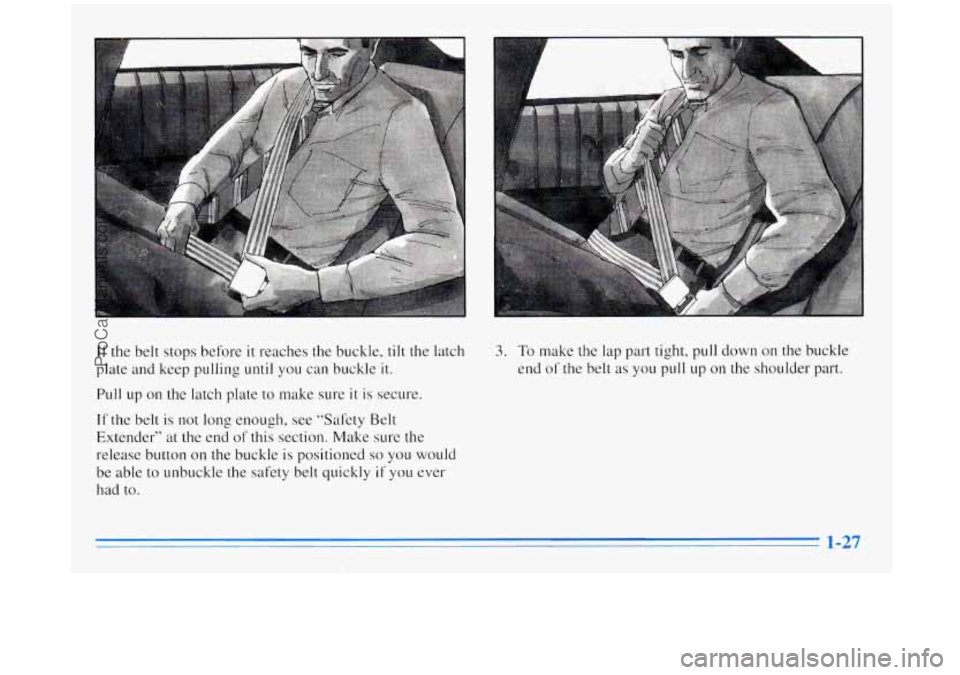
If the belt stops before it reaches the buckle, tilt the latch
plate and keep pulling
until you can buckle it.
Pull up on the latch plate to make sure it is secure.
If the belt is not long enough, see “Safety Belt
Extender” at the end
of this section. Make sure the
release button on the buckle
is positioned so you would
be able to unbuckle the safety belt quickly
if you ever
had to.
3. To make the lap part tight, pull down on the buckle
end
of the belt as you pull up on the shoulder part.
1-27
ProCarManuals.com
Page 44 of 356
hol Dc [odds
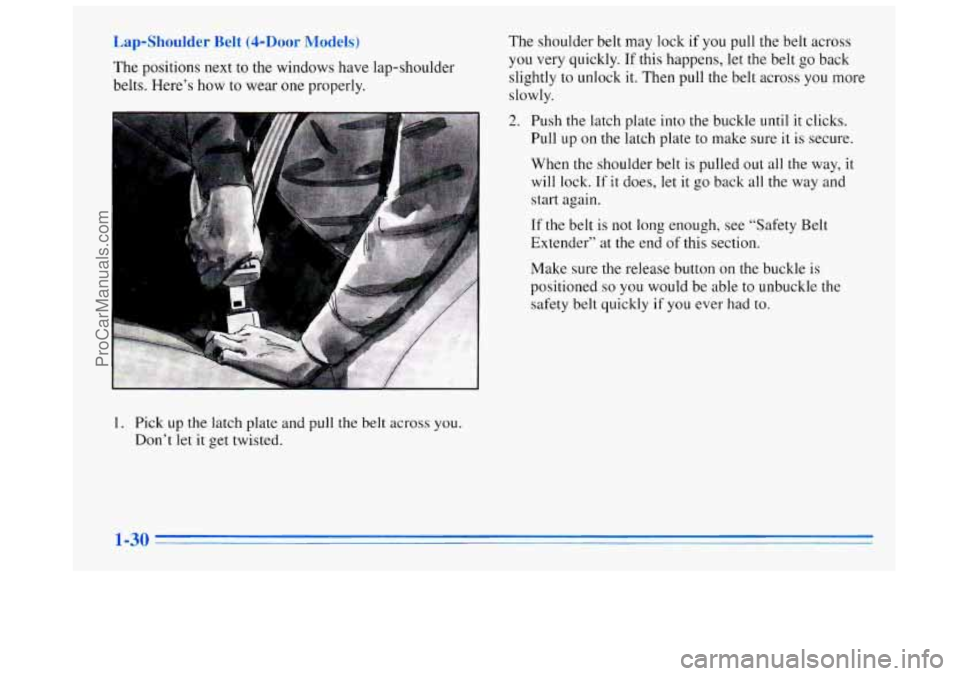
The positions next to the windows have lap-shoulder
belts. Here’s how to wear one properly. The
shoulder belt may lock if you
pull the belt across
you very quickly. If this happens, let the belt go back
slightly to unlock it. Then pull the belt across
you more
slowly.
2. Push the latch plate into the buckle until it clicks.
Pull up on the latch plate to make sure it is secure.
When the shoulder belt
is pulled out all the way, it
will lock.
If it does, let it go back all the way and
start again.
If the belt is not long enough, see “Safety Belt
Extender” at the end
of this section.
Make sure the release button
on the buckle is
positioned
so you would be able to unbuckle the
safety belt quickly
if you ever had to.
1. Pick up the latch plate and pull the belt across you.
Don’t let it get twisted.
1-30
ProCarManuals.com
Page 50 of 356
‘A
A
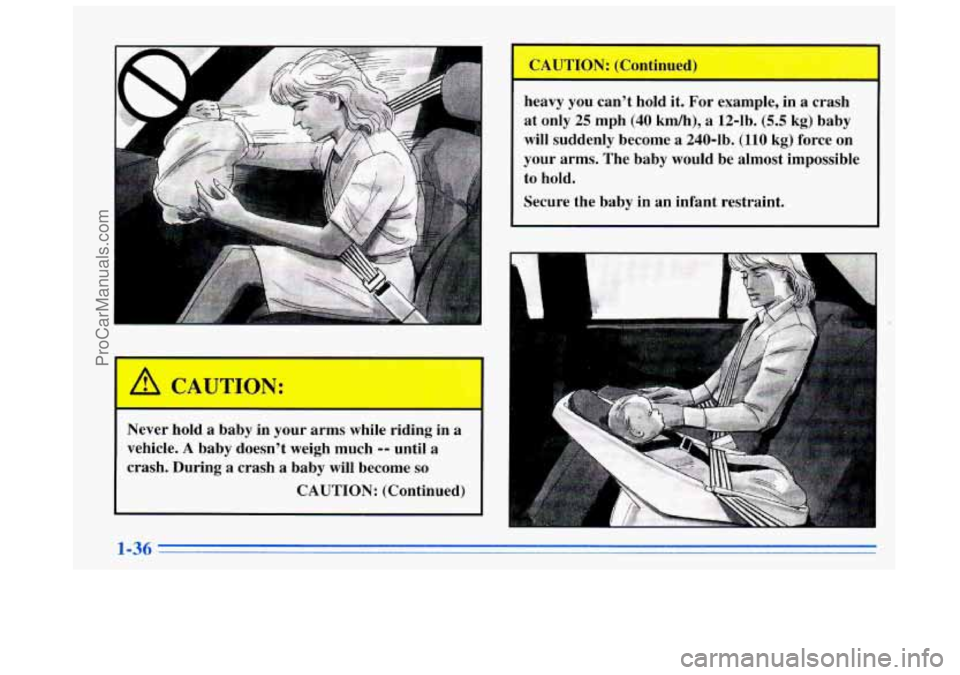
Never hold a baby in your arms while riding in a
vehicle. A baby doesn’t weigh much -- until a
crash. During
a crash a baby will become so
CAUTION: (Continued)
I
heavy you can’t hold it. For example, in a crash
at only 25 mph
(40 km/h), a 12-lb. (5.5 kg) baby
will suddenly become
a 2404b. (110 kg) force on
your arms. The baby would be almost impossible
to hold.
Secure the baby in an infant restraint.
i
ProCarManuals.com
Page 51 of 356
Child Restraints
Be sure the child restraint is designed to be used in a
vehicle. If it is, it will have a label saying that it meets
Federal Motor Vehicle Safety Standards.
Then follow the instructions for the restraint. You may
find these instructions on the restraint itself or in a
booklet, or both. These restraints use the belt system in
your vehicle, but
the child also has to be secured within
the restraint to help reduce the chance of personal injury.
The instructions that come with
the infant or child
restraint will show you how to do that.
Where to Put the Restraint
Accident statistics show that children are safer if they
are restrained in the rear rather than
the front seat. We at
General Motors therefore recommend that
you put your
child restraint
in the rear seat. Never put a rear-facing
child restraint in
the front passenger seat. Here’s why:
iAUTION:
-
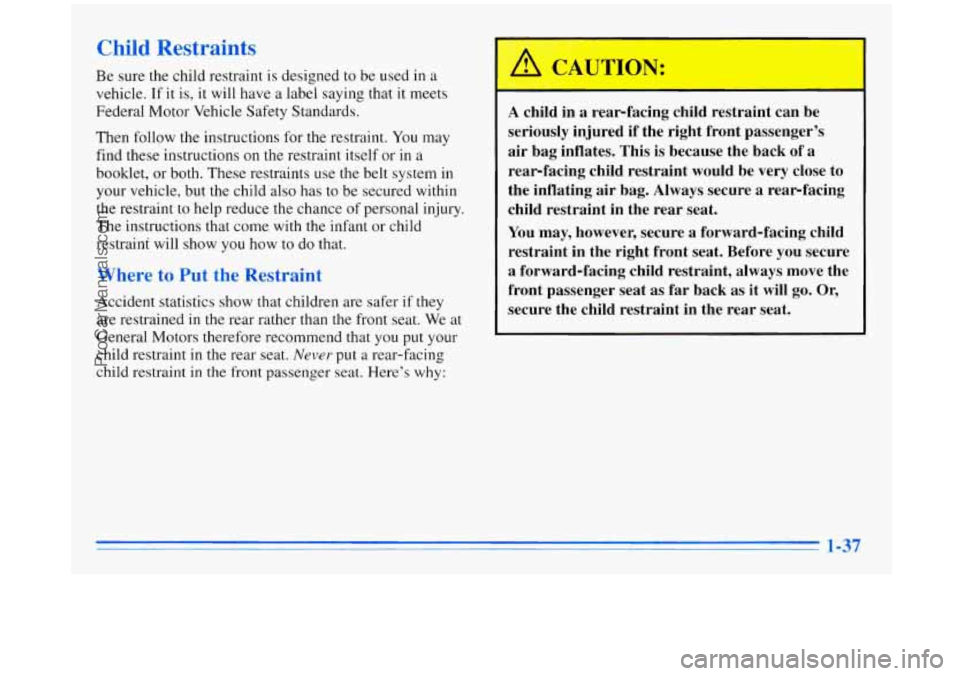
A child in a rear-facing child restraint can be
seriously injured if the right front passenger’s
air bag inflates. This is because the back
of a
rear-facing child restraint would be very close to
the inflating air bag. Always secure a rear-facing
child restraint in the rear seat.
You may, however, secure
a forward-facing child
restraint in the right front seat. Before you secure
a forward-facing child restraint, always move the
front passenger seat
as far back as it will go. Or,
secure the child restraint in the rear seat.
1-37
ProCarManuals.com
Page 52 of 356
Strap
A child in a child restraint in the center front seat
can be badly injured by the right front passenger
air bag if it inflates. Never secure a child restraint
in the center front seat. It’s always better to
secure
a child restraint in the rear seat. You may,
however, secure
a forward-facing child restraint
in the right front passenger seat, but only with
the seat moved all the
way back.
Wherever you install it, be sure to secure the child
restraint properly.
Keep in mind that an unsecured child restraint can move
around
in a collision or sudden stop and injure people in
the vehicle. Be sure to properly secure any child
restraint in your vehicle
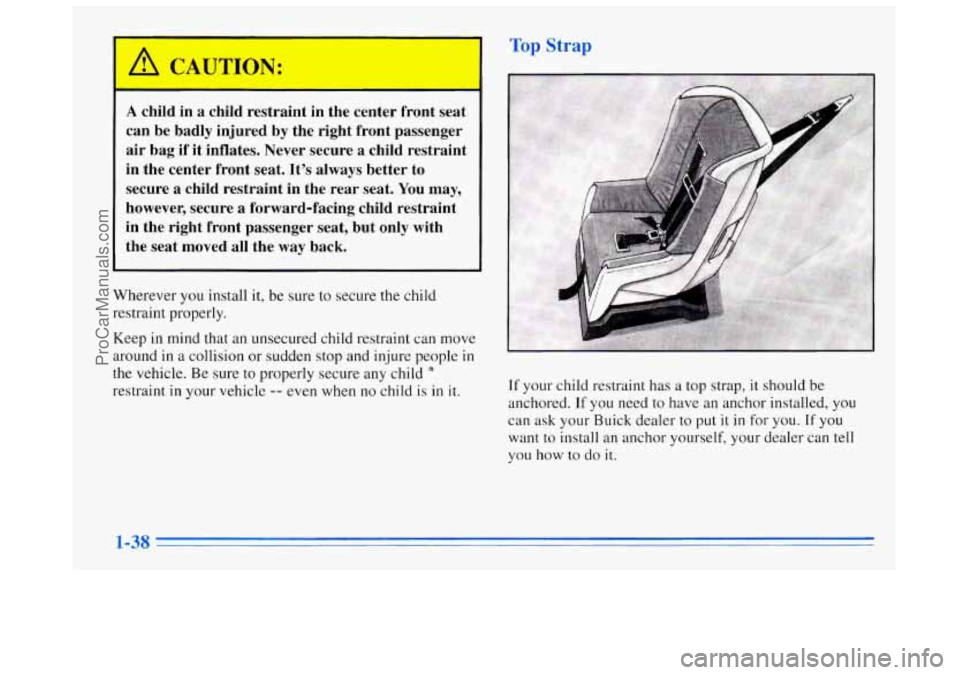
-- even when no child is in it. If your child restraint has a top strap, it should be
anchored.
If you need to have an anchor installed, you
can ask your Buick dealer to
put it in for you. If you
want to install an anchor yourself,
your dealer can tell
you how to do
it.
1-38
ProCarManuals.com
Page 53 of 356
For cars first sold in Canada, child restraints with a top
strap must be anchored according to Canadian law.
Your dealer can obtain the hardware kit and install it for
you, or you may install it yourself using the instructions
provided in the kit.
Use
the tether hardware kit available from the dealer.
The hardware and installation instructions were
specifically designed for this vehicle.
Securing a Child Restraint in a Rear
Outside
Seat Position (2-Door Models)
You’ll be using the lap-shoulder belt. See the earlier part
about the top strap
if the child restraint has one.
1. Put the restraint on the seat. Follow the instructions
for the child restraint.
2. Secure the child in the child restraint as the
instructions say.
3. Pick up the latch plate, and run the lap and shoulder
portions of the vehicle’s safety belt through or
around the restraint. The child restraint instructions
will show you how.
If you have
a four-door model, see “Securing a Child
Restraint in a Rear Outside Seat Position (4-Door
Models)’’ later
in this section.
ProCarManuals.com
Page 55 of 356
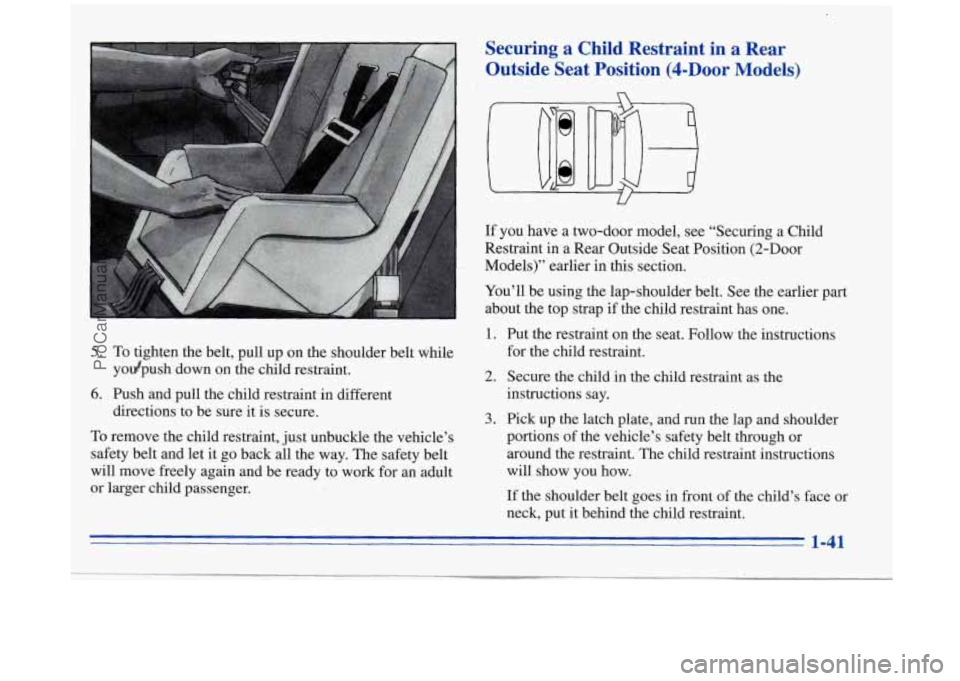
5. To tighten the belt, pull up on the shoulder belt while
6. Push and pull the child restraint in different
To remove the child restraint, just unbuckle the vehicle’s
safety belt
and let it go back all the way. The safety belt
will move freely again and be ready to work for an adult
or larger child passenger.
yodpush
down on the child restraint.
duections to be sure it is secure.
Securing a Child Restraint in a Rear
Outside Seat Position (4-DoOr Models)
If you have a two-door model, see “Securing a Child
Restraint in a Rear Outside Seat Position (2-Door
Models)” earlier in this section.
You’ll be wing the lap-shoulder belt. See the earlier part
about the top strap if the child restraint has one.
1. Put the restraint on the seat. Follow the instructions
for the child restraint.
2. Secure the child in the child restraint as the
instructions say.
3. Pick up the latch plate, and run the lap and shoulder
portions of the vehicle’s safety belt through or
around the restraint, The child restraint instructions
will show you how.
If the shoulder belt goes in front of the child’s face or
neck, put it behind the child restraint.
1-41
ProCarManuals.com
Page 57 of 356
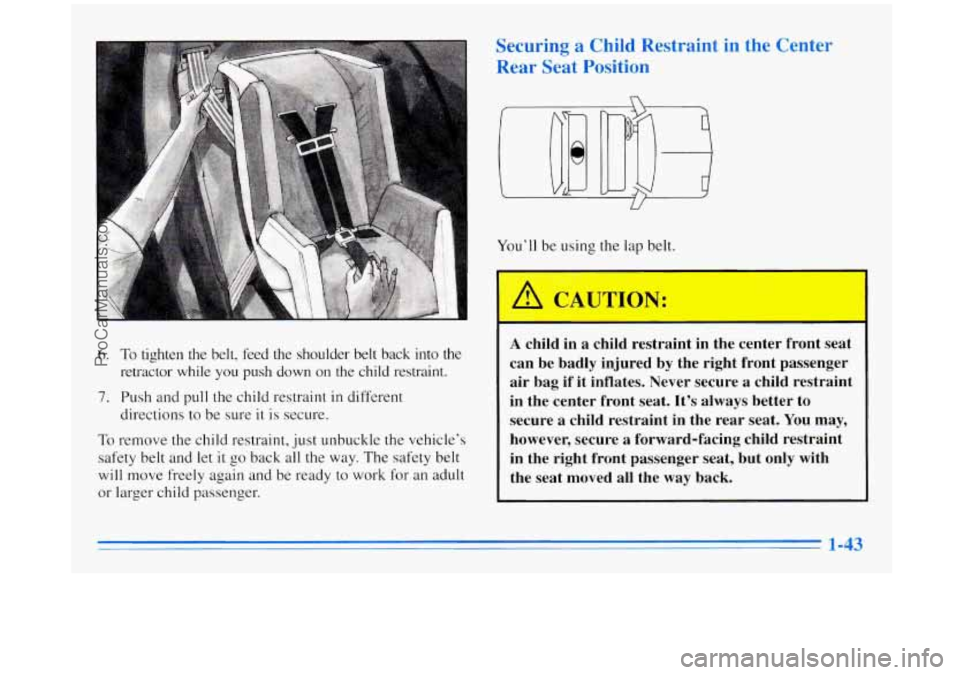
6. To tighten the belt, feed the shoulder belt back into the
retractor while you push down on the child restraint.
7. Push and pull the child restraint in different
directions to be sure
it is secure.
To remove the child restraint, just unbuckle the vehicle’s
safety belt
and let it go back all the way. The safety belt
will move freely again and be ready to work for an adult
or larger child passenger.
Securing a Child Restraint in the Center
Rear Seat Position
You’ll be using the lap belt.
I
A child in a child restraint in the center front seat
can be badly injured by the right front passenger
air bag if it inflates. Never secure
a child restraint
in the center front seat. It’s always better to
secure a child restraint in the rear seat. You
may,
however, secure a forward-facing child restraint
in the right front passenger seat, but only with
the seat moved
all the way back.
ProCarManuals.com