instrument panel BUICK REGAL 1996 User Guide
[x] Cancel search | Manufacturer: BUICK, Model Year: 1996, Model line: REGAL, Model: BUICK REGAL 1996Pages: 356, PDF Size: 17.97 MB
Page 93 of 356
If a bulb is burned out, replace it to help avoid an
accident. If the arrows don’t go on at all when you
signal a turn, check for burned-out bulbs and check the
fuse (see “Fuses and Circuit Breakers’’ in
the Index).
A chime will sound if you leave your turn signal on for
more than 1/2 mile
(0.8 km).
Headlamp High/Low Beam
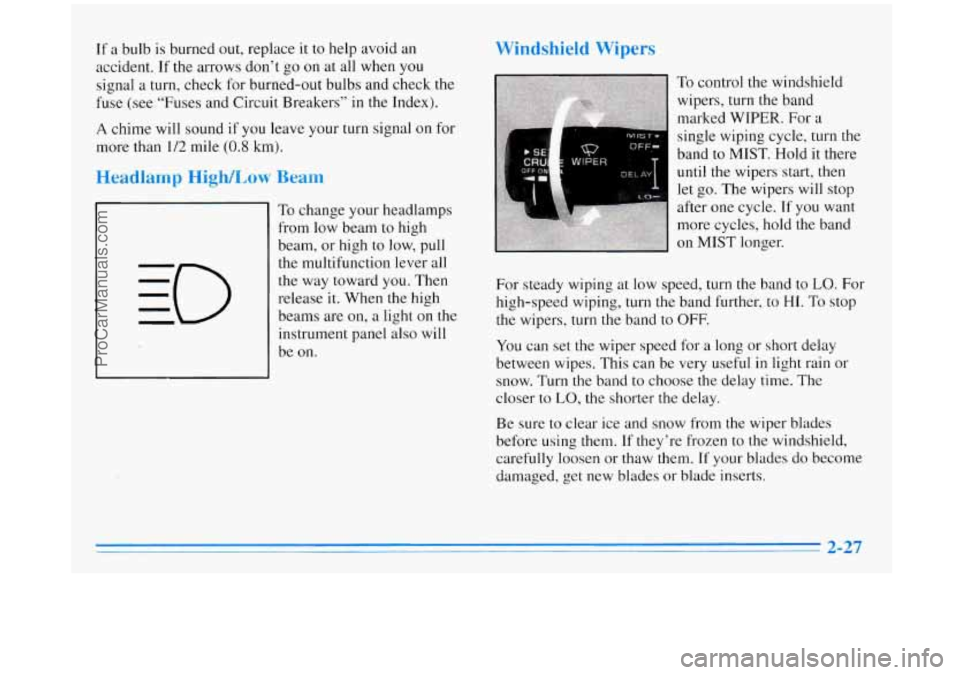
To change your headlamps
from low beam to high
beam, or high
to low, pull
the multifunction lever all
the way toward you. Then
release it. When
the high
beams are on, a light on
the
instrument panel also will
be on.
Windshield Wipers
To control the windshield
wipers, turn the band
marked WIPER.
For a
single wiping cycle, turn the
band to MIST. Hold it there
until the wipers start, then
let go. The wipers will stop
after one cycle.
If you want
more cycles, hold the band
on
MIST longer.
For steady wiping at low speed, turn the band to
LO. For
high-speed wiping, turn the band further, to
HI. To stop
the wipers, turn the band to
OFF.
You can set the wiper speed for a long or short delay
between wipes. This can be very useful in light rain or
snow. Turn the band to choose the delay time. The
closer to
LO, the shorter the delay.
Be sure
to clear ice and snow from the wiper blades
before using them.
If they’re frozen to the windshield,
carefully loosen or thaw them. If your blades do become
damaged, get new blades
or blade inserts.
ProCarManuals.com
Page 96 of 356
Resuming a Set Speed
Suppose you set your cruise control at a desired speed
and then
you apply the brake. This, of course, shuts off
the cruise control. But you don’t need to reset it.
If you leave your cruise control switch on when
you’re not using cruise, you might hit
a button
and
go into cruise when you don’t want to.
You could be startled and even lose control.
Keep the cruise control switch
OFF until you
want to use
it.
1. Move the cruise control switch to ON.
2. Get up to the speed you want.
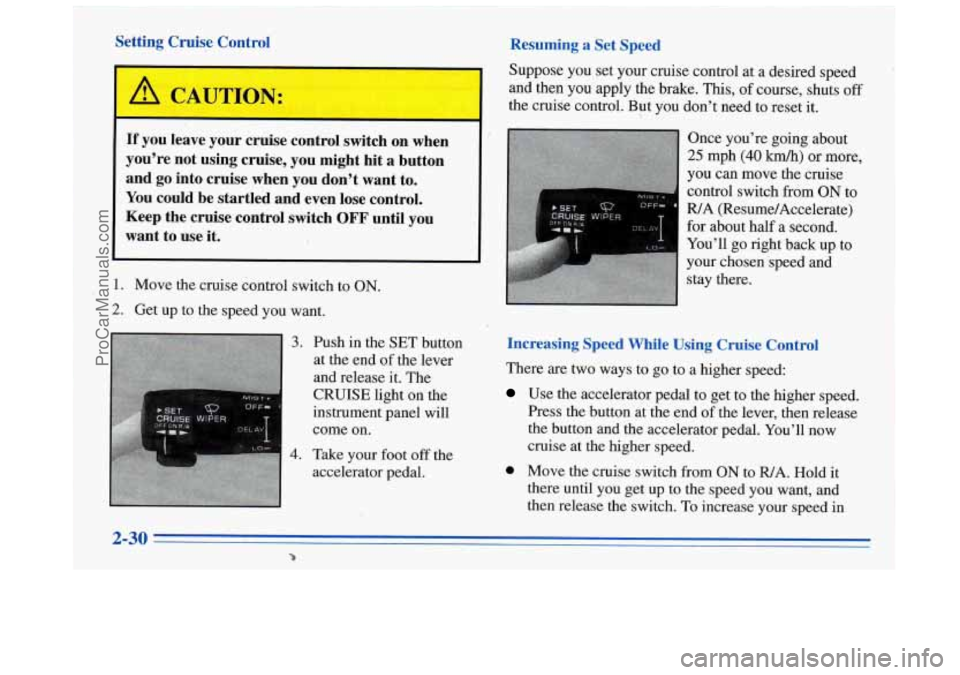
3. Push in the SET button
at the end of the lever
and release it. The
CRUISE light on the
instrument panel will
come on.
4. Take your foot off the
accelerator pedal.
WA (Resume/Accelerate)
for about half a second.
You’ll go right back up to
your chosen speed and
stay there.
Increasing Speed While Using Cruise Control
There are two ways to go ,to a higher speed:
Use the accelerator pedal to get to the higher speed.
Press the button at the end of the lever, then release
the button and the accelerator pedal. You’ll now
cruise at the higher speed.
0 Move the cruise switch from ON to WA. Hold it
there until you get up to the speed
you want, and
then release
the switch. To increase your speed in
2-30
11
ProCarManuals.com
Page 98 of 356
Lamps
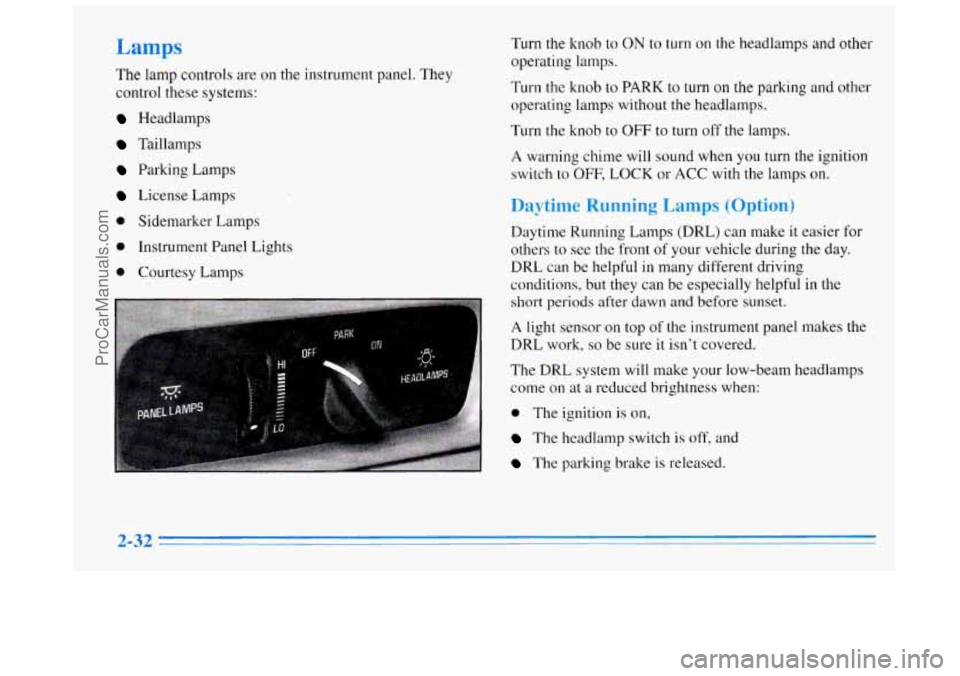
The lamp controls are on the instrument panel. They
control these systems:
Headlamps
Taillamps
Parking Lamps
License Lamps
0 Sidemarker Lamps
0 Instrument Panel Lights
0 .Courtesy Lamps Turn
the knob
to ON to turn on the headlamps and other
operating lamps.
Turn the knob to
PARK to turn on the parking and other
operating lamps without the headlamps.
Turn the knob to
OFF to turn off the lamps.
A warning chime will sound when you turn the ignition
switch to
OFF, LOCK or ACC with the lamps on.
Daytime Running Lamps (Option)
Daytime Running Lamps (DRL) can make it easier for
others to see the front
of your vehicle during the day.
DRL can be helpful in many different driving
conditions, but
they can be especially helpful in the
short periods after dawn and before sunset.
A light sensor on top of the instrument panel makes the
DRL work, so be sure it isn’t covered.
The DRL system will make your low-beam headlamps
come on at a reduced brightness when:
0 The ignition is on,
The headlamp switch is off, and
The parking brake is released.
2-32
ProCarManuals.com
Page 99 of 356
When the DRL are on, only your low-beam headlamps
will be on. The taillamps, sidemarker and other lamps
won’t be on. Your instrument panel won’t be lit
up either.
When it’s dark enough outside, your low-beam
headlamps will change to
full brightness. The other
lamps that come on with your headlamps will also
come on.
When it’s bright enough outside, the regular lamps will
go off and your low-beam headlamps change to the
reduced brightness of DRL.
To idle your vehicle with the DRL off, set the parking
brake while the ignition
is in OFF or LOCK. Then start
your vehicle. The DRL will stay off until you release the
parking brake.
As with any vehicle, you should turn on the regular
headlamp system when you need it.
Interior Lamps
Instrument Panel Brightness Control
You can brighten or dim the instrument panel lights by
moving
the PANEL LAMPS dial. If you turn the dial
past
HI, your courtesy or interior lamps will come on.
Courtesy Lamps
When any door is opened, several lamps come on. These
lamps are courtesy lamps. They make
it easy for you to
enter and leave your vehicle. You can also turn these
lamps on by moving the PANEL LAMPS dial all the
way up past
HI.
Some of the lamps have switches so you can turn them
on, even when the doors are closed. These lamps are
reading lamps.
To avoid draining your battery, be sure to
turn
of€ all reading lamps when leaving your vehicle.
ProCarManuals.com
Page 106 of 356
Ashtrays and Lighter . NOTICE: The center front ashtray may be on the instrument panel
or
on the console. To remove either ashtray, open the lid
and lift out the ashtray.
To remove the rear ashtray, open it, push down on the
snuffer and pull
out the ashtray.
Don’t hold a cigarette lighter in with your hand
while it is heating.
If you do, it won’t be able to
back away from the heating element when it’s
ready. That can make it overheat, damaging the
lighter and the heating element.
NOTICE:
Don’t put papers and other things that burn
into your ashtrays.
If you do, cigarettes or other
smoking materials could set them
on fire,
causing damage.
Sun Visors
To block out glare, you can swing down the visors. You
can also move them from side to side. The visors also
have extenders that
you can pull out for added coverage.
To use the lighter, just push it in all the way and let go.
When it’s ready, it will pop back by itself.
2-40
ProCarManuals.com
Page 113 of 356
Air Bag Readiness Light
There is an air bag readiness light on the instrument
panel, which shows
AIR BAG. The system checks the
air bag’s electrical system for malfunctions. The light
tells you if there is an electrical problem. The system
check includes
the air bag sensors, the air bag modules,
the wiring and the crash sensing
and diagnostic module.
For more information on the air bag system, see “Air
Bag” in the Index.
AIR BAG pf 0.
You will see this light flash
for a few seconds when you
turn your ignition to
RUN
or START. Then the light
should go out. This means
the system is ready.
If the air bag readiness light doesn’t come on when you
start your vehicle, or stays on, or comes on when you
are driving, your air bag system may not work properly.
Have your vehicle serviced right away.
Charging System Light
The charging system light
will come on briefly when
you turn
on the ignition, as
a check to show you it’s
working. Then it should
go out.
If it stays on, or comes on while you are driving, you
may have
a problem with the charging system. It could
indicate that you have
a loose drive belt or another
electrical problem. Have
it checked right away. Driving
while this light is on could drain your battery.
If you must drive a short distance with the light on, be
certain to turn
off all your accessories, such as the radio
and air conditioner.
ProCarManuals.com
Page 126 of 356
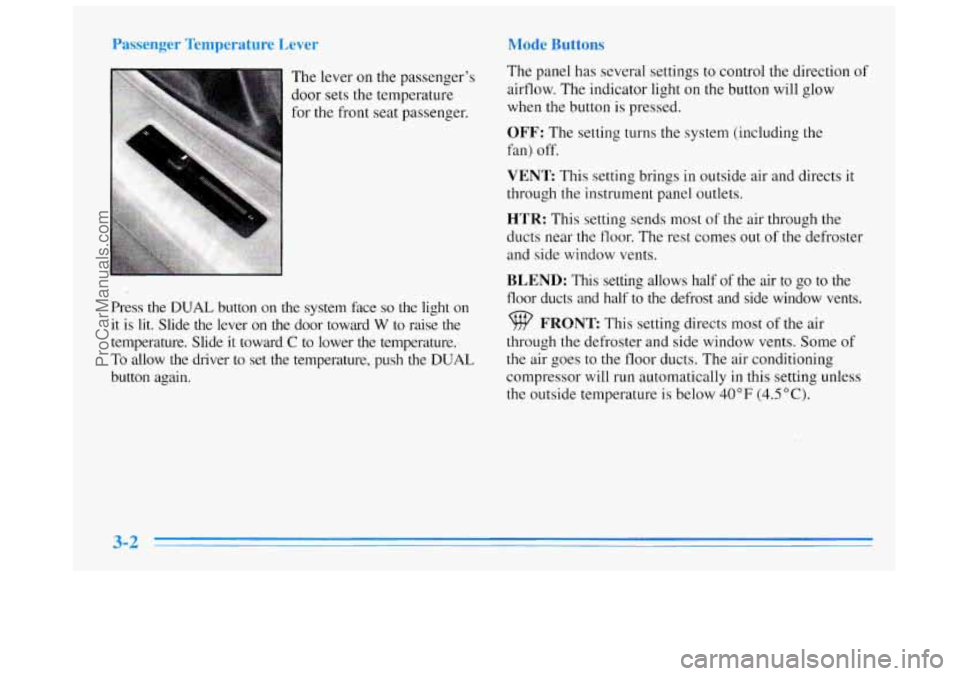
The lever on the passenger's
door sets the temperature
for the front seat passenger.
Press the
DUAL button on the system face so the light on
it is lit. Slide the lever on the door toward
W to raise the
temperature. Slide it toward
C to lower the temperature.
To allow the driver to set
the temperature, push the DUAL
button again. The
panel has several settings to control the direction
of
airflow. The indicator light on the button will glow
when
the button is pressed.
OFF: The setting turns the system (including the
fan) off.
VENT This setting brings in outside air and directs it
through the instrument panel outlets.
HTR: This setting sends most of the air through the
ducts near the
floor. The rest comes out of the defroster
and side window vents.
BLEND: This setting allows half of the air to go to the
floor ducts and half to the defrost and side window vents.
FRONT This setting directs most of the air
through the defroster and side window vents. Some
of
the air goes to the floor ducts. The air conditioning
compressor will run automatically
in this setting unless
the outside temperature is below
40°F (4.5"C).
ProCarManuals.com
Page 127 of 356
MAX: This setting recirculates much of the air inside
your vehicle and sends it through
the instrument panel
outlets. The air conditioning compressor will run
automatically
in this setting unless the outside
temperature is below 40°F (4.5"C).
NORM: This setting brings in outside air and sends
it through the instrument panel outlets. The air
conditioning compressor will run automatically
in this
setting unless the outside temperature is below 40°F
(4.5 " C).
BI-LEV: This setting brings in the outside air and
directs
it two ways. Half of the air is directed through
the instrument panel outlets. Most
of the remaining air is
directed through the floor ducts and
a little to the defrost
and side window vents. The air conditioning compressor
will run automatically in this setting unless the outside
temperature
is below 40°F (4.5"C).
Air Conditioning
On very hot days, open the windows long enough to let
hot, inside air escape. This reduces the time the
compressor has to
run, which should help fuel economy.
For quick cool-down on very hot days, use
MAX with
the temperature lever all the way to COOL.
If this
setting is used for long periods of time,
the air in your
vehicle may become too dry.
For normal cooling on hot days, use
NORM with the
temperature lever all the way to COOL. The system will
bring
in outside air and cool it.
On cool but sunny days, the sun may warm your upper
body, but your lower body may not be warm enough.
You can use BI-LEV with the temperature knob in the
middle. The system will bring
in outside air and direct it
to your upper body, while sending slightly warmed air to
your lower body. You may notice this temperature
difference more at some times than others.
3-3
ProCarManuals.com
Page 186 of 356
I
~~ ~ ~~~ ~ ~ ~~~~ ~~___~~~ ~
Making mrns
NOTICE:
Making very sharp turns while trailering could
cause the trailer to come in contact with the
vehicle. Your vehicle could be damaged. Avoid
making very sharp turns while trailering.
When you’re turning with a trailer, make wider turns than
normal. Do
this so your trailer won’t strike soft shoulders,
curbs, road signs, trees or other objects. Avoid jerky or
sudden maneuvers. Signal well in advance.
nrn Signals When Towing a Trailer
When you tow a trailer, your vehicle may need a
different turn signal flasher and/or extra wiring. Check
with your Buick dealer. The green arrows on your
instrument pariel will flash whenever you signal a turn
or lane change. Properly hooked up, the trailer lamps
will also flash, telling other drivers you’re about to turn,
change lanes or stop.
~ ~~~ ~ ~~~ ~
When towing a trailer, the green arrows on your
instrument panel will flash for turns even
if the bulbs on
the trailer
are burned out. Thus, you may think drivers
behind you are seeing your signal when they are not. It’s
important to check occasionally to be sure the trailer
bulbs are still working.
Driving On Grades
Reduce speed and shift to a lower gear before you start
down a long or steep downgrade. If you don’t shift
down, you might have to use your brakes
so much
that they would get hot and no longer work well.
On a long uphill grade, shift down and reduce your
speed to around
45 mph (70 km/h) to reduce the
possibility of engine and transaxle overheating.
If you are towing a trailer that weighs more than
1,000 lbs. (450 kg), you may prefer to drive in
THIRD
(3) instead of AUTOMATIC OVERDRIVE (a)
(or, as you need to, a lower gear).
ProCarManuals.com
Page 200 of 356
Engine Overheating
YOU will find a coolant temperature gage and a warning
light about a hot engine on your instrument panel. See
“Engine Coolant Temperature Gage” and “Engine
Coolant Temperature Warning Light” in the Index.
You also have a LOW COOLANT warning light on
your instrument panel. See “Low Coolant Light” in
the Index.
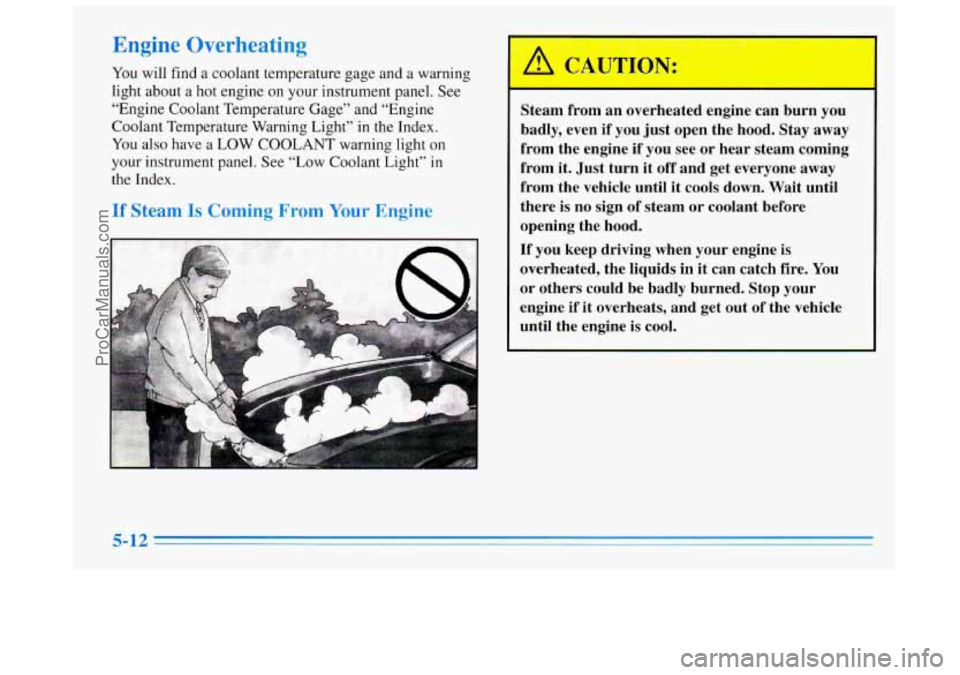
If Steam Is Coming From Your Engine
Steam from an overheated engine can burn you
badly, even
if you just open the hood. Stay away
from the engine if you see or hear steam coming
from it. Just turn it off and get everyone away
from the vehicle until it cools down. Wait until
there is
no sign of steam or coolant before
opening the hood.
If you keep driving when your engine is
overheated, the liquids in it can catch fire. You
or others could be badly burned. Stop your
engine if it overheats, and get out of the vehicle
until the engine is cool.
5-12
ProCarManuals.com