maintenance BUICK REGAL 1998 User Guide
[x] Cancel search | Manufacturer: BUICK, Model Year: 1998, Model line: REGAL, Model: BUICK REGAL 1998Pages: 388, PDF Size: 20.19 MB
Page 265 of 388

Section 6 Service and Appearance Care
Here you will find information about the care of your vehicle. This section begins with service and fuel information,
and then it shows how to check important fluid and lubricant levels. There is also technical information about your
vehicle, and a part devoted to its appearance care.
6-2
6-3
6-5 6-5
6-8
6- 12
6-
12
6- 17
6-20
6-23
6-27
6-28 6-30
6-33 6-34
6-39
6-49
6-49 Service
Fuel
Fuels in Foreign Countries
Filling Your Tank
Checking Things Under the Hood
3800 Supercharged (Code 1) Engine
Engine Oil Air Cleaner
Automatic Transaxle Fluid
Engine Coolant
Power Steering Fluid
Windshield Washer Fluid
Brakes
Battery
Bulb Replacement
Tires
Appearance Care Cleaning the Inside
of Your Vehicle 6-5
1
6-52
6-52
6-52
6-53
6-54
6-55
6-57 6-58
6-58
6-59
6-65
6-65
6-66
6-67 6-67 Cleaning the Built-in
Child Restraint
Care of Safety Belts and Built-in Child
Restraint Harness
Cleaning Glass Surfaces
Cleaning the Outside of the Windshield and
Wiper Blades
Cleaning the Outside of Your Vehicle
Cleaning Aluminum or Chrome Wheels
Cleaning Tires
Appearance Care Materials Chart
Vehicle Identification Number (VIN)
Service Parts Identification Label
Electrical System
Replacement Bulbs
Capacities and Specifications
Vehicle Dimensions
Normal Maintenance Replacement Parts
Air Conditioning Refrigerants
6- 1
ProCarManuals.com
Page 266 of 388
Service Doing Your Own Service Work
Your dealer knows your vehicle best and wants you to If you want to do some of your own service work, you’ll
be happy with it. We hope you’ll
go to your dealer for want
to use the proper Buick Service Manual. It tells
all your service needs. You’ll get genuine GM parts and
YOU much rnOre about how to service Your vehicle than
GM-trained and supported service people. this
manual can.
To order the proper service manual, see
We hope you’ll want to keep your GM vehicle all
GM.
Genuine GM parts have one of these marks: Your vehicle has an air bag system. Before attempting to
“Service and Owner Publications”
in the Index.
do your own service work, see “Servicing Your Air
Bag-Equipped Vehicle” in the Index.
Genuine
”M
F
You should keep a record with all parts receipts and list
the mileage and the date
of any service work you
perform. See “Maintenance Record” in the Index.
6-2
ProCarManuals.com
Page 267 of 388
I
You can be injured and your vehicle could be
damaged if you try to do service work on a
vehicle without knowing enough about it.
e
e
Be sure you have sufficient knowledge,
experience, the proper replacement parts
and tools before you attempt any vehicle
maintenance task.
Be sure to use the proper nuts, bolts and
other fasteners. “English” and “metric”
fasteners can be easily confused.
If you use
the wrong fasteners, parts can later break
or fall off. You could be hurt.
Adding Equipment to the Outside of
Your Vehicle
Things you might add to the outside of your vehicle can
affect the airflow around it. This may cause wind noise
and affect windshield washer performance. Check with
your dealer before adding equipment to the outside of
your vehicle.
Fuel
The 8th digit of your vehicle identification number
(VIN) shows the code letter for your engine.
You will
find the VIN at the top left of your instrument panel.
(See “Vehicle Identification Number”
in the Index.)
If you have the 3800 engine (VIN Code K), use regular
unleaded gasoline rated at
87 octane or higher. If you’re
using fuel rated at the recommended octane or higher
and you hear heavy knocking, your engine needs
service. But don’t worry
if you hear a little pinging
noise when you‘re accelerating or driving up
a hill.
That’s normal, and you don’t have to
buy a higher
octane fuel to get rid
of pinging. It’s the heavy, constant
knock that means
you have a problem.
If you have the 3800 Supercharged engine (VIN Code
l), use premium unleaded gasoline rated at 91 octane or
higher. With the 3800 Supercharged engine, in
an
emergency, you may be able to use a lower octane -- as
low as 87 -- if heavy knocking does not occur. If you
are using 9
1 or higher octane unleaded gasoline and you
hear heavy knocking, your engine needs service.
6-3
ProCarManuals.com
Page 281 of 388
then start the vehicle. If the CHANGE OIL SOON light
comes back on, the system has not reset. Repeat the
procedure.
(If you have a driver information center, the
system may be reset by depressing the DIC
RESET
button for five seconds while viewing the oil life display
on the DIC. See “Driver Information Center” in
the Index.)
What to Do with Used Oil
Did you know that used engine oil contains certain
elements that may be unhealthy for your skin and could
even cause cancer? Don’t
let used oil stay on your skin
for very long. Clean your skin and nails with soap and
water,
or a good hand cleaner. Wash or properly throw
away clothing or rags containing used engine oil. (See
the manufacturer’s warnings about the use and disposal
of oil products.)
Used oil can be a real threat to the environment.
If you
change your own oil, be sure to drain all free-flowing oil
from the filter before disposal. Don’t ever dispose of oil
by putting it in the trash, pouring it on the ground, into
sewers, or into streams
or bodies of water. Instead,
recycle it by taking it to a place that collects used oil. If
you have a problem properly disposing of your used oil,
ask your dealer, a service station or a local recycling
center for help.
Air Cleaner
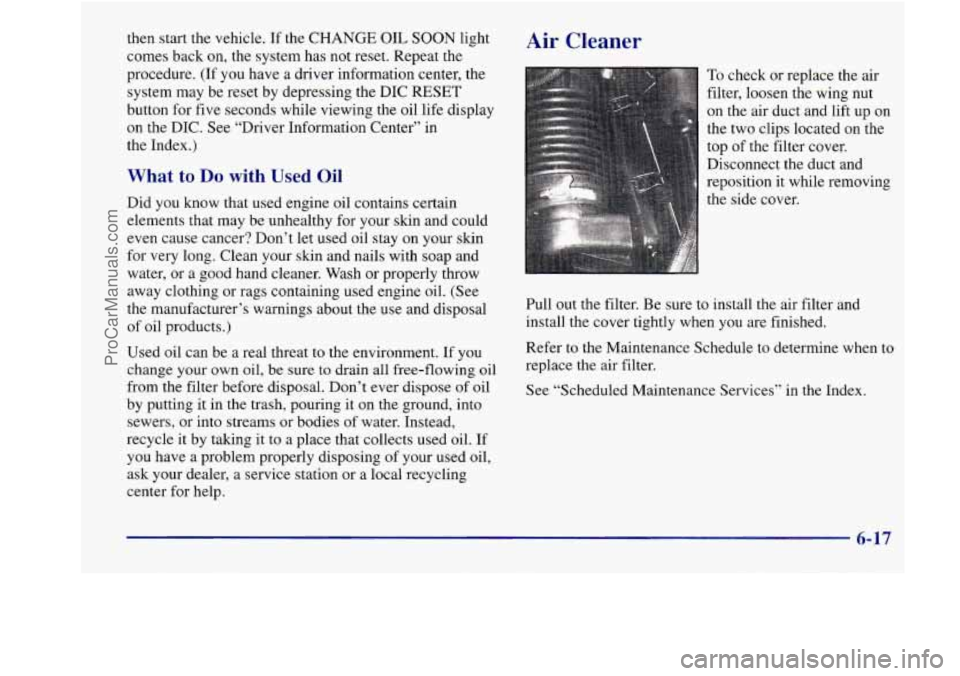
To check or replace the air
filter, loosen the wing nut
on the air duct and lift
up on
the two clips located on the
top of the filter cover.
Disconnect the duct and
reposition
it while removing
the side cover.
Pull out the filter. Be sure
to install the air filter and
install the cover tightly when you are finished.
Refer
to the Maintenance Schedule to determine when to
replace the air filter.
See “Scheduled Maintenance Services’’ in the Index.
6-17
ProCarManuals.com
Page 282 of 388
Operating the engine with the air cleaner off can
cause you or others to be burned. The air cleaner
not only cleans the air,
it stops flame if the engine
backfires.
If it isn’t there, and the engine
backfires, you could be burned. Don’t drive with
it
off, and be careful working on the engine with
the
air cleaner off.
I NOTICE:
If the air cleaner is off, a backfire can cause a
damaging engine fire. And, dirt can easily get
into your engine, which will damage it. Always
have the air cleaner in place when you’re driving.
Passenger Compartment Air Filter
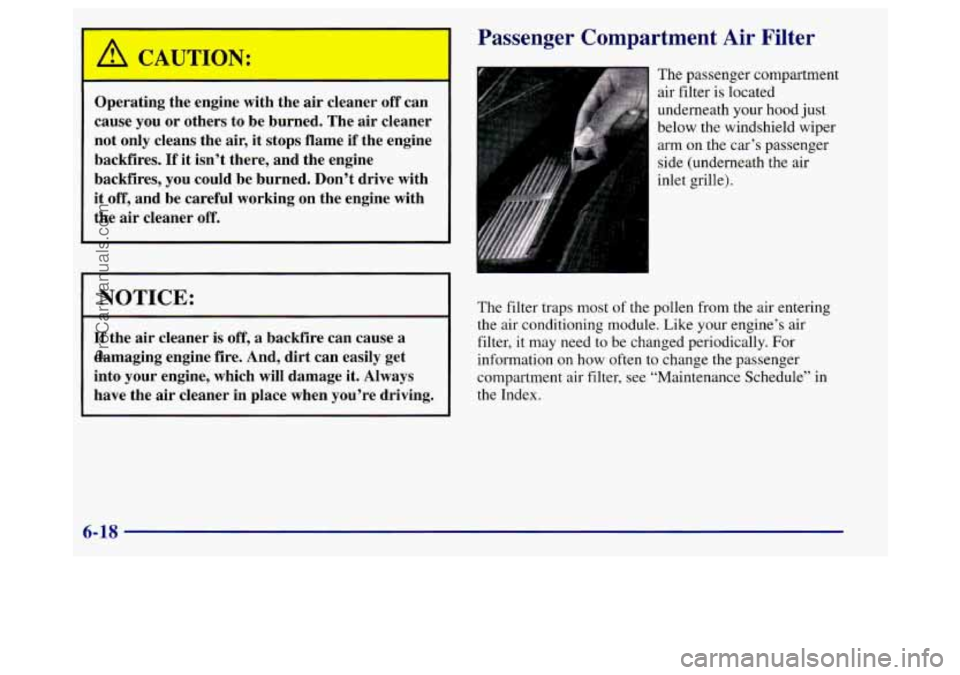
The passenger compartment
air filter is located
underneath your hood just
below the windshield wiper
arm on the car’s passenger
side (Underneath the air
inlet grille).
The filter traps
most of the pollen from the air entering
the air conditioning module. Like your engine’s air
filter, it may need to be changed periodically. For
information on how often
to change the passenger
compartment air filter, see “Maintenance Schedule” in
the Index.
6-18
ProCarManuals.com
Page 283 of 388
To change the passenger compartment air filter, use the
following steps:
1. Turn off the ignition when the windshield wipers
are in the up position.
2. Raise the hood.
3. Remove (disconnect) the windshield washer pump
hose from the fender rail and air inlet grille.
4. Reposition the hood weatherstrip from the right
side
of the vehicle (peel back halfway to center).
5. Remove (disconnect) the air inlet grille retainers.
6. Remove (disconnect) the air inlet grille.
7. Remove (disconnect) the passenger compartment
8. Then install the new air filter. For the type of filter
to use, see “Normal Maintenance Replacement
Parts” in the Index.
air
filter.
9. Reposition the air inlet grille.
10. Replace the air inlet grille retainers. 11.
Reposition the hood weatherstrip.
12. Reconnect the windshield washer pump hose to the
fender rail and air inlet grille.
13. Close the hood.
14. Return the windshield wipers to the park position.
Supercharger Oil
Unless you are technically qualified and have the proper
tools,
you should let your dealer or a qualified service
center perform this maintenance.
When to Check
Check oil level every 30,000 miles (50 000 km) or every
36 months, whichever occurs first.
What Kind of Oil to Use
See “Recommended Fluids and Lubricants” in the Index
and use only the recommended oil.
6-19
ProCarManuals.com
Page 284 of 388
How to Check and Add Oil
Check oil only when the engine is cold. Allow the
engine
to cool two to three hours after running.
~ ~ -
A CAUTION:
If you remove the supercharger oil fill plug while
the engine is hot, pressure may cause hot oil to
blow out
of the oil fill hole. You may be burned.
Do
not remove the plug until the engine cools.
1.
2.
3.
4.
Clean the area around the oil fill plug before
removing it.
Remove the oil fill plug using a
3/ 16 inch
Allen wrench.
The oil level is correct when it just reaches the
bottom of the threads of the inspection hole.
Replace the oil plug with the O-ring
in place. Torque
to
88 lb-in (10 N-m).
Automatic Transaxle Fluid
When to Check and Change
A good time to check your automatic transaxle fluid
level is when the engine oil is changed.
Change both the fluid and filter every
50,000 miles
(83 000 km) if the vehicle is mainly driven under one or
more of these conditions:
In heavy city traffic where the outside temperature
regularly reaches
90°F (32” C) or higher.
0 In hilly or mountainous terrain.
0 When doing frequent trailer towing.
0 Uses such as found in taxi, police or delivery service.
If you do not use your vehicle under any of these
conditions, the
fluid and filter do not require changing.
See “Scheduled Maintenance Services” in the Index.
6-20
ProCarManuals.com
Page 287 of 388
How to Add Fluid
Refer to the Maintenance Schedule to determine what
kind of transaxle fluid to use. See “Recommended
Fluids and Lubricants” in the Index.
If the fluid level is low, add only enough
of the proper
fluid to bring the
level into the cross-hatched area on
the dipstick.
1. Pull out the dipstick.
2. Using a long-neck funnel, add enough fluid at
the
dipstick hole to bring it to the proper level.
It doesn’t take much fluid, generally less than one
pint
(0.5 L). Don’t overfill.
NOTICE:
We recommend you use only fluid labeled
DEXRON@-111, because fluid with that label is
made especially for your automatic transaxle.
Damage caused by fluid other than
DEXRON-I11
is not covered by your new vehicle warranty.
3. After adding fluid, recheck the fluid level as
described under “How to Check.” 4.
When the correct fluid level is obtained, push the
dipstick back in all the way.
Engine Coolant
The cooling s stem in your vehicle is filled with
DEX-COOL engine coolant. This coolant is designed
to remain in your vehicle for 5 years or 150,000 miles
(240
000 km) whichever occurs first, if you add only
DEX-COOL6 extended life coolant.
J
The following explains your cooling system and how to
add coolant when it is low. If
you have a problem with
engine overheating or if you need
to add coolant to your
radiator, see “Engine Overheating”
in the Index.
A 50/50 mixture of water and DEX-COOL@
coolant will:
Give freezing protection down to -34°F (-37°C).
Give boiling protection up to 265 “F (1 29°C).
Protect against rust and corrosion.
0 Help keep the proper engine temperature.
0 Let the warning lights and gages work as they should.
6-23
ProCarManuals.com
Page 296 of 388
Brake Wear
Your vehicle has four-wheel disc brakes.
Disc brake pads have built-in wear indicators that make a
high-pitched warning sound when the brake pads are worn
and new pads are needed. The sound may come and
go or
be heard all the time your vehicle is moving (except when
you are pushing
on the brake pedal firmy).
Some driving conditions or climates may cause a brake
squeal when the brakes are first applied or lightly
applied. This does not mean something is wrong with
your brakes.
Properly torqued wheel nuts are necessary
to help
prevent brake pulsation. When tires are rotated, inspect
brake pads for wear and evenly torque wheel nuts in the
proper sequence to
GM specifications.
The brake wear warning sound means that soon
your brakes won’t work well. That could lead to
an accident. When
you hear the brake wear
warning sound, have
your vehicle serviced.
I Brake linings should always be replaced as complete
axle sets.
See “Brake System Inspection” in Section
7 of this
manual under Part
C “Periodic Maintenance
Inspections.”
I NOTICE:
Continuing to drive with worn-out brake pads
could result in costly brake repair.
Brake Pedal navel
See your dealer if the brake pedal does not return to
normal height, or if there is a rapid increase in pedal
travel. This could be a sign of brake trouble.
Brake Adjustment
Every time you apply the brakes, with or without the
vehicle moving, your brakes adjust for wear.
6-32
ProCarManuals.com
Page 308 of 388
Tire Pressure Monitor System (If Equipped)
The tire pressure monitor system can alert you to a large
change in the pressure
of one tire. The system “learns”
the pressure at each tire throughout the operating speed
range of your vehicle. The system normally takes
between
45 and 90 minutes of driving to learn the tire
pressures. This time may be longer depending on your
individual driving habits. Learning need not be
accumulated during
a single trip. Once learned, the
system will remember the tire pressures until the system
is recalibrated.
After the system has learned tire pressures with properly
inflated tires, the LOW TIRE light will come on if the
pressure in
one tire becomes 12 psi (83 kPa) lower than
the other three tires. The tire pressure monitor system
won’t alert you if the pressure
in more than one tire is
low, if the system is not properly calibrated, or if the
vehicle
is moving faster than 70 mph (1 10 kdh).
The tire pressure monitor system detects differences
in tire rotation speeds that are caused by changes
in
tire pressure. The system can alert you about a low
tire
-- but it doesn’t replace normal tire maintenance.
See “Tires” in the Index. When the LOW
TIRE light comes
on, you should stop
as soon as you can and check all your tires for damage.
(If a tire is flat, see “If
a Tire Goes Flat” in the Index.)
Also check
the tire pressure in all four tires as soon as
you can. See “Inflation
- Tire Pressure” in the Index.
The light will come on and stay on
until you turn off the
ignition or press the
RESET button.
Don’t reset the tire pressure monitor system without first
correcting the cause of the problem and checking and
adjusting the pressure in all four tires. If you reset the
system when the tire pressures are incorrect, the tire
pressure monitor system will not work properly and may
not alert you when
a tire is low.
Any time
you adjust a tire’s pressure, rotate your tires,
or have one or more tires repaired or replaced, you’ll
need to reset (calibrate) the tire pressure monitor system.
You’ll also need to reset the system whenever you buy
new tires and whenever the vehicle’s battery has been
disconnected.
To reset (calibrate) the system,
turn the ignition switch
to
RUN. Then press and hold the RESET button for
about five seconds.
6-44
ProCarManuals.com