check engine BUICK REGAL 1998 Owner's Guide
[x] Cancel search | Manufacturer: BUICK, Model Year: 1998, Model line: REGAL, Model: BUICK REGAL 1998Pages: 388, PDF Size: 20.19 MB
Page 286 of 388
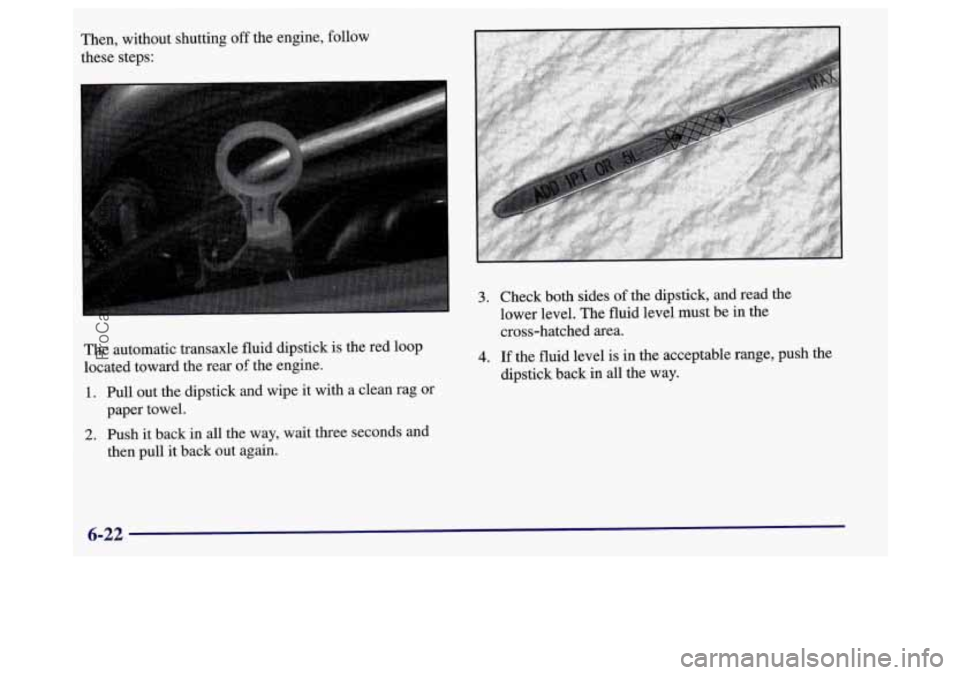
The automatic transaxle fluid dipstick is the red loop
located toward the rear
of the engine.
1. Pull out the dipstick and wipe it with a clean rag or
paper towel.
2. Push it back in all the way, wait three seconds and
then pull it back out again.
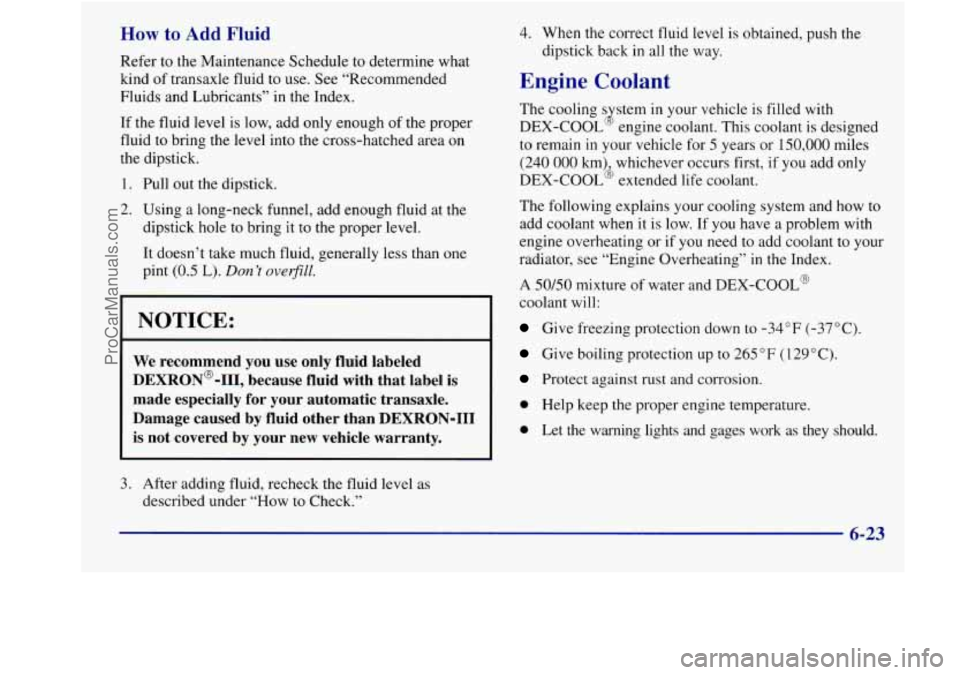
3. Check both sides of the dipstick, and read the
lower level. The fluid level must be in the
cross-hatched area.
4. If the fluid level is in the acceptable range, push the
dipstick back in
all the way.
ProCarManuals.com
Page 287 of 388
How to Add Fluid
Refer to the Maintenance Schedule to determine what
kind of transaxle fluid to use. See “Recommended
Fluids and Lubricants” in the Index.
If the fluid level is low, add only enough
of the proper
fluid to bring the
level into the cross-hatched area on
the dipstick.
1. Pull out the dipstick.
2. Using a long-neck funnel, add enough fluid at
the
dipstick hole to bring it to the proper level.
It doesn’t take much fluid, generally less than one
pint
(0.5 L). Don’t overfill.
NOTICE:
We recommend you use only fluid labeled
DEXRON@-111, because fluid with that label is
made especially for your automatic transaxle.
Damage caused by fluid other than
DEXRON-I11
is not covered by your new vehicle warranty.
3. After adding fluid, recheck the fluid level as
described under “How to Check.” 4.
When the correct fluid level is obtained, push the
dipstick back in all the way.
Engine Coolant
The cooling s stem in your vehicle is filled with
DEX-COOL engine coolant. This coolant is designed
to remain in your vehicle for 5 years or 150,000 miles
(240
000 km) whichever occurs first, if you add only
DEX-COOL6 extended life coolant.
J
The following explains your cooling system and how to
add coolant when it is low. If
you have a problem with
engine overheating or if you need
to add coolant to your
radiator, see “Engine Overheating”
in the Index.
A 50/50 mixture of water and DEX-COOL@
coolant will:
Give freezing protection down to -34°F (-37°C).
Give boiling protection up to 265 “F (1 29°C).
Protect against rust and corrosion.
0 Help keep the proper engine temperature.
0 Let the warning lights and gages work as they should.
6-23
ProCarManuals.com
Page 289 of 388
NOTICE:
If you use an improper coolant mixture, your
engine could overheat and be badly damaged.
The repair cost wouldn’t be covered by your
warranty.
Too much water in the mixture can
freeze and crack the engine, radiator, heater core
and other parts.
If you have to add coolant more than four times
a year,
have your dealer check your cooling system.
NOTICE:
If you use the proper coolant, you don’t have to
add extra inhibitors or additives which claim to
improve the system. These can be harmful.
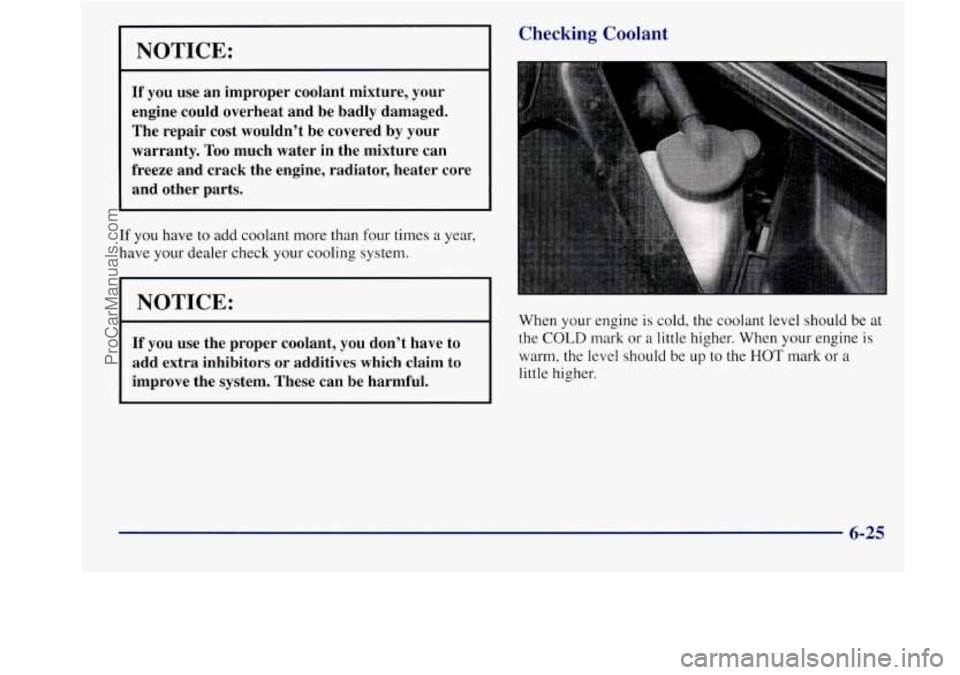
Checking Coolant
-
When your engine is cold, the coolant level should be at
the
COLD mark or a little higher. When your engine is
warm, the level should be up to the
HOT mark or a
little higher.
6-25
ProCarManuals.com
Page 291 of 388
Radiator Pressure Cap NOTICE:
Your radiator cap is a 15 psi (105 kPa)
pressure-type cap and must be tightly installed to
prevent coolant loss and possible engine damage
from overheating. Be sure the arrows on the cap line up with the overflow tube on the radiator
filler neck.
When you replace your radiator pressure cap, an AC@
cap is recommended.
Power Steering Fluid
Thermostat
Engine coolant temperature is controlled by a thermostat
in the engine coolant system. The thermostat stops the
flow
of coolant through the radiator until the coolant
reaches a preset temperature.
When you replace your thermostat, an
AC@ thermostat
is recommended.
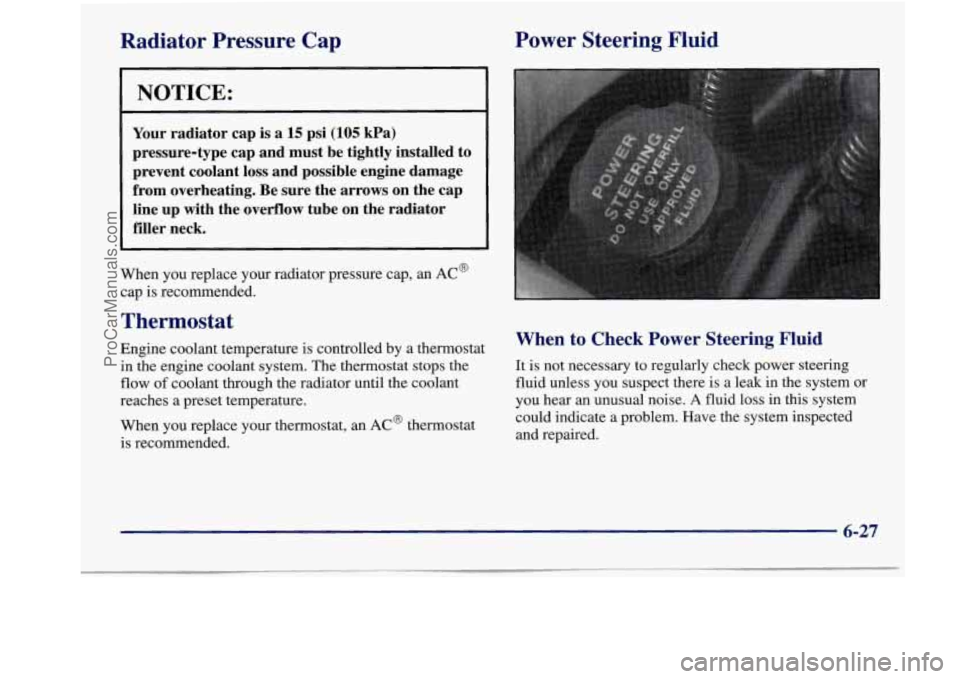
When to Check Power Steering Fluid
It is not necessary to regularly check power steering
fluid unless you suspect there is a leak in the system or
you hear an unusual noise.
A fluid loss in this system
could indicate a problem. Have the system inspected
and repaired.
6-27
ProCarManuals.com
Page 292 of 388
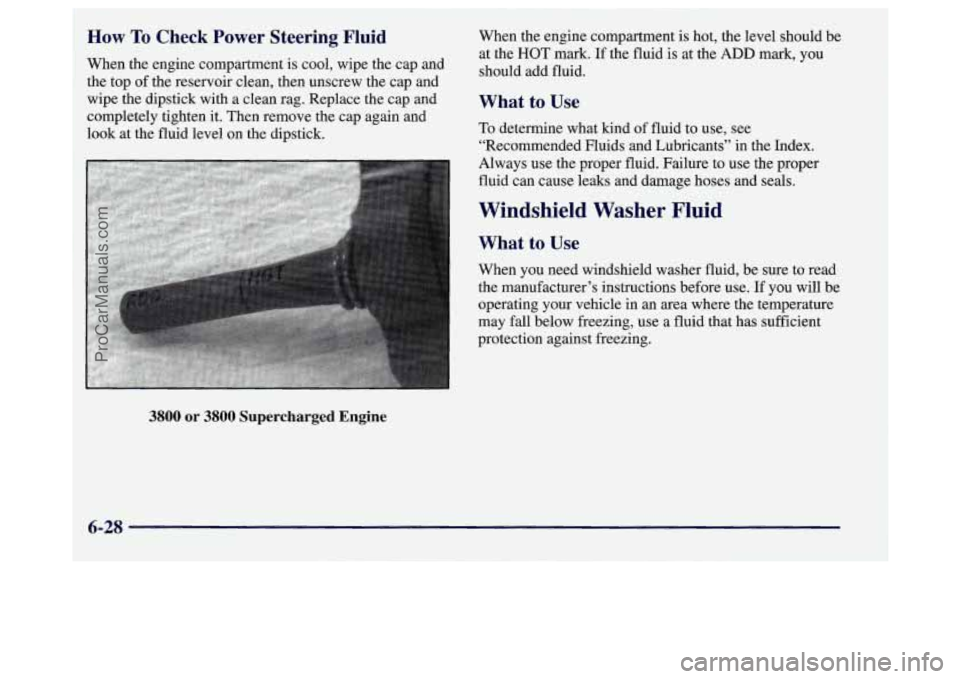
How To Check Power Steering Fluid
When the engine compartment is cool, wipe the cap and
the top
of the reservoir clean, then unscrew the cap and
wipe the dipstick with a clean rag. Replace the cap and
completely tighten it. Then remove the cap again and
look at the fluid level on the dipstick. When
the engine compartment is hot, the level should be
at the
HOT mark. If the fluid is at the ADD mark, you
should add fluid.
What to Use
To determine what kind of fluid to use, see
‘‘Recommended Fluids and Lubricants”
in the Index.
Always use the proper fluid.
Failure to use the proper
fluid can cause leaks and damage hoses. and seals.
Windshield Washer Fluid
What to Use
When you need windshield washer fluid, be sure to read
the manufacturer’s instructions before
use. If you will be
operating
your vehicle in an area where the temperature
may
fall below freezing, use a fluid that has sufficient
protection against freezing.
3800 or 3800 Supercharged Engine
6-28
ProCarManuals.com
Page 335 of 388
n
Section 7 Maintenance Schedule
This section covers the maintenance required for your vehicle. Your vehicle needs these services to retain its safety,
dependability and emission control performance.
7-2
7-2
7-3
7-4
7-4
7- 14 7- 14
7- 14
7- 15
7- 15
Introduction
Your Vehicle and the Envlronment
How This Section
is Organized
Part
A: Scheduled Maintenance Servlces
Using Your Maintenance Schedule
Part
B: Owner Checks and Services
At Each Fuel Fill
At Least Once a Month
At Least Twice a Year
At Least Once a Year
7-18
7- 18
7-18
7-18
7-18 7-18
7-19
7-20 Part C: Periodic Maintenance Inspections
Steering, Suspension and Front Drive Axle
Boot and Seal Inspection
Exhaust System Inspection
Engine Cooling System Inspection
Throttle System Inspection
Brake System Inspection
Part D: Recommended Fluids and Lubricants
Part
E: Maintenance Record
7-1
ProCarManuals.com
Page 339 of 388
I Maintenance Schedule I
The services shown in this schedule up to 100,000 miles
(166
000 km) should be performed after 100,000 miles
(166
000 km) at the same intervals. The services shown
at 150,000 miles
(240 000 km) should be performed at
the same interval after
150,000 miles (240 000 km).
See “Owner Checks and Services” and “Periodic
Maintenance Inspections” following.
Footnotes
The U.S. Environmental Protection Agency or the
California Air Resources Board has determined that the
failure
to perform this maintenance item will not nullify
the emission warranty or limit recall liability prior to the
completion of the vehicle’s useful life. We, however,
urge that all recommended maintenance services be
performed at the indicated intervals and the maintenance
be recorded.
* Your vehicle has an Engine Oil Life Monitor. This
monitor will show you when to change the engine oil
and filter
-- usually between 3,000 miles (5 000 km)
and 7,500 miles (12 500 km) since your last oil change.
Under severe conditions, the indicator may come on
before
3,000 miles (5 000 km). Never drive your vehicle
more than
7,500 miles (12 500 km) or 12 months
without an oil and filter change.
The system won’t detect dust in the oil.
So if you drive
in a dusty area, be sure to change your oil and filter
every
3,000 miles (5 000 km) or sooner if the CHANGE
OIL SOON light comes
on. Remember to reset the Oil
Life Monitor when the oil has been changed. For more
information,
see “Change Oil Soon Light” in the Index.
+ A good time to check your brakes is during tire
rotation. See “Brake System Inspection” under “Periodic
Maintenance Inspections” in Part C of this schedule.
7-5
ProCarManuals.com
Page 340 of 388
I Maintenance Schedule I
7,500 Miles (12 500 knt)
0 Check Oil Life Monitor. If engine oil and filter are changed, reset monitor.
See “Engine Oil”
in the Index.
An Emission Control Sewice. (See footnote *.)
rotation pattern and additional information. (See footnote +.)
0 Rotate tires. See “Tire Inspection and Rotation” in the Index for proper
15,000 Miles (25 000 km)
0 Check Oil Life Monitor. If engine oil and filter are changed, reset monitor.
See “Engine Oil” in the Index.
An Emission Control Sewice. (See footnote *.)
0 Inspect air cleaner filter if you are driving in dusty conditions. Replace filter
if necessary.
An Emission Control Service. (See footnote t.)
0 Replace passenger compartment air filter.
0 Rotate tires. See “Tire Inspection and Rotation” in the Index for proper
rotation pattern and additional information. (See footnote
+.)
22,500 Miles (37 500 km)
0 Check Oil Life Monitor. If engine oil and filter are changed, reset monitor.
See “Engine Oil” in the Index.
An Emission Control Service. (See footnote *.)
DATE
MILEAGE
ACTUAL I SERVICEDBY: I
DATE I
MILEAGE
ACTUAL SERVICED BY:
DATE
ProCarManuals.com
Page 341 of 388
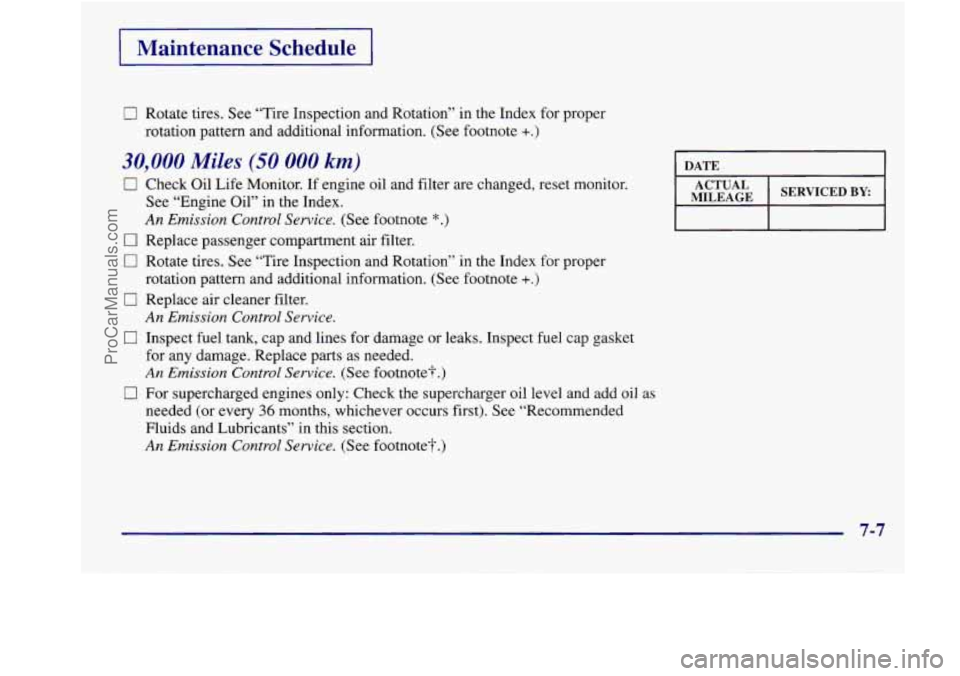
Maintenance Schedule
0 Rotate tires. See “Tire Inspection and Rotation” in the Index for proper
rotation pattern and additional information. (See footnote
+.)
30,000 Miles (50 000 km)
17 Check Oil Life Monitor. If engine oil and filter are changed, reset monitor.
See “Engine Oil” in the Index.
An Emission Control Service. (See footnote *,)
0 Replace passenger compartment air filter.
0 Rotate tires. See “Tire Inspection and Rotation” in the Index for proper
0 Replace air cleaner filter.
0 Inspect fuel tank, cap and lines for damage or leaks. Inspect fuel cap gasket
rotation
pattern and additional information. (See footnote
+.)
An Emission Control Service.
for any damage. Replace parts as needed.
An Emission Control Service. (See footnote?.)
0 For supercharged engines only: Check the supercharger oil level and add oil as
needed (or every
36 months, whichever occurs first). See “Recommended
Fluids and Lubricants” in this section.
An Emission Control Service. (See footnote?.)
DATE
7-7
ProCarManuals.com
Page 342 of 388
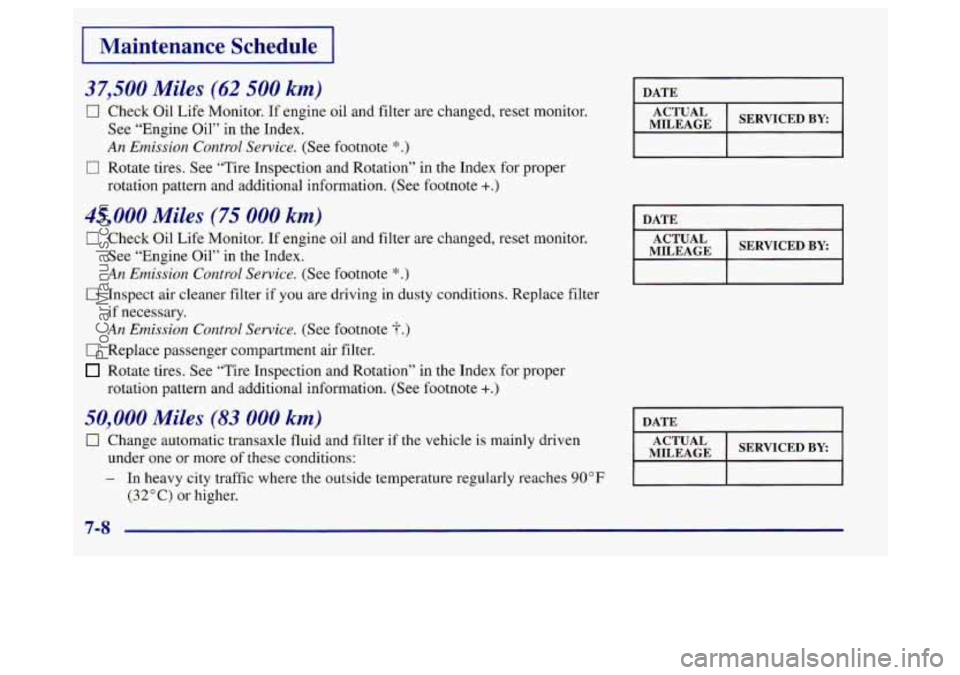
I Maintenance Schedule I
37,500 Miles (62 500 km)
0 Check Oil Life Monitor. If engine oil and filter are changed, reset monitor.
See “Engine Oil” in the Index.
An Emission Control Service. (See footnote *.)
rotation pattern and additional information. (See footnote +.)
0 Rotate tires. See “Tire Inspection and Rotation” in the Index for proper
45,000 Miles (75 000 km)
0 Check Oil Life Monitor. If engine oil and filter are changed, reset monitor.
See “Engine Oil” in the Index.
An Emission Control Service. (See footnote *.)
0 Inspect air cleaner filter if you are driving in dusty conditions. Replace filter
if necessary.
An Emission Control Service. (See footnote “f)
0 Replace passenger compartment air filter.
Rotate tires. See “Tire Inspection and Rotation” in the Index for proper
rotation pattern and additional information. (See footnote
+.)
DATE
DATE
MILEAGE
50,000 Miles (83 000 km)
0 Change automatic transaxle fluid and filter if the vehicle is mainly driven
MILEAGE under one or more of these conditions:
- In heavy city traffic where the outside temperature regularly reaches 90°F
(32°C) or higher.
7-8
ProCarManuals.com