instrument panel BUICK REGAL 2003 Owner's Manual
[x] Cancel search | Manufacturer: BUICK, Model Year: 2003, Model line: REGAL, Model: BUICK REGAL 2003Pages: 344, PDF Size: 2.21 MB
Page 1 of 344

Seats and Restraint Systems........................... 1-1
Front Seats
............................................... 1-2
Rear Seats
............................................... 1-6
Safety Belts
.............................................. 1-6
Child Restraints
.......................................1-27
Air Bag Systems
......................................1-46
Restraint System Check
............................1-54
Features and Controls..................................... 2-1
Keys
........................................................ 2-2
Doors and Locks
....................................... 2-9
Windows
.................................................2-14
Theft-Deterrent Systems
............................2-16
Starting and Operating Your Vehicle
...........2-17
Mirrors
....................................................2-31
OnStar
®System
......................................2-34
Storage Areas
.........................................2-35
Sunroof
..................................................2-36
Instrument Panel............................................. 3-1
Instrument Panel Overview
.......................... 3-2
Climate Controls
......................................3-17
Warning Lights, Gages and Indicators
.........3-26
Driver Information Center (DIC)
..................3-42
Audio System(s)
.......................................3-44Driving Your Vehicle....................................... 4-2
Your Driving, the Road, and Your Vehicle
..... 4-2
Towing
...................................................4-31
Service and Appearance Care.......................... 5-1
Service
..................................................... 5-3
Fuel
......................................................... 5-4
Checking Things Under the Hood
................. 5-8
Headlamp Aiming
.....................................5-48
Bulb Replacement
....................................5-50
Windshield Wiper Blade Replacement
.........5-55
Tires
......................................................5-56
Appearance Care
.....................................5-77
Vehicle Identication
.................................5-85
Electrical System
......................................5-86
Capacities and Specications
.....................5-92
Normal Maintenance Replacement Parts
......5-93
Maintenance Schedule..................................... 6-1
Maintenance Schedule
................................ 6-2
Customer Assistance Information.................... 7-1
Customer Assistance Information
.................. 7-2
Reporting Safety Defects
............................ 7-9
Index.................................................................1
2003 Buick Regal Owner ManualM
2003 - Regal Owner Manual
Page 4 of 344

Vehicle Damage Warnings
Also, in this book you willfind these notices:
Notice:These mean there is something that could
damage your vehicle.
A notice will tell you about something that can damage
your vehicle. Many times, this damage would not be
covered by your warranty, and it could be costly. But the
notice will tell you what to do to help avoid the
damage.
When you read other manuals, you might see CAUTION
and NOTICE warnings in different colors or in different
words.
You’ll also see warning labels on your vehicle. They use
the same words, CAUTION or NOTICE.
Vehicle Symbols
Your vehicle has components and labels that use
symbols instead of text. Symbols, used on your vehicle,
are shown along with the text describing the operation
or information relating to a specific component, control,
message, gage or indicator.
If you need helpfiguring out a specificnameofa
component, gage or indicator, reference the following
topics:
•Seats and Restraint Systems in Section 1
•Features and Controls in Section 2
•Instrument Panel Overview in Section 3
•Climate Controls in Section 3
•Warning Lights, Gages and Indicators in Section 3
•Audio System(s) in Section 3
•Engine Compartment Overview in Section 5
iv
2003 - Regal OM
Page 16 of 344
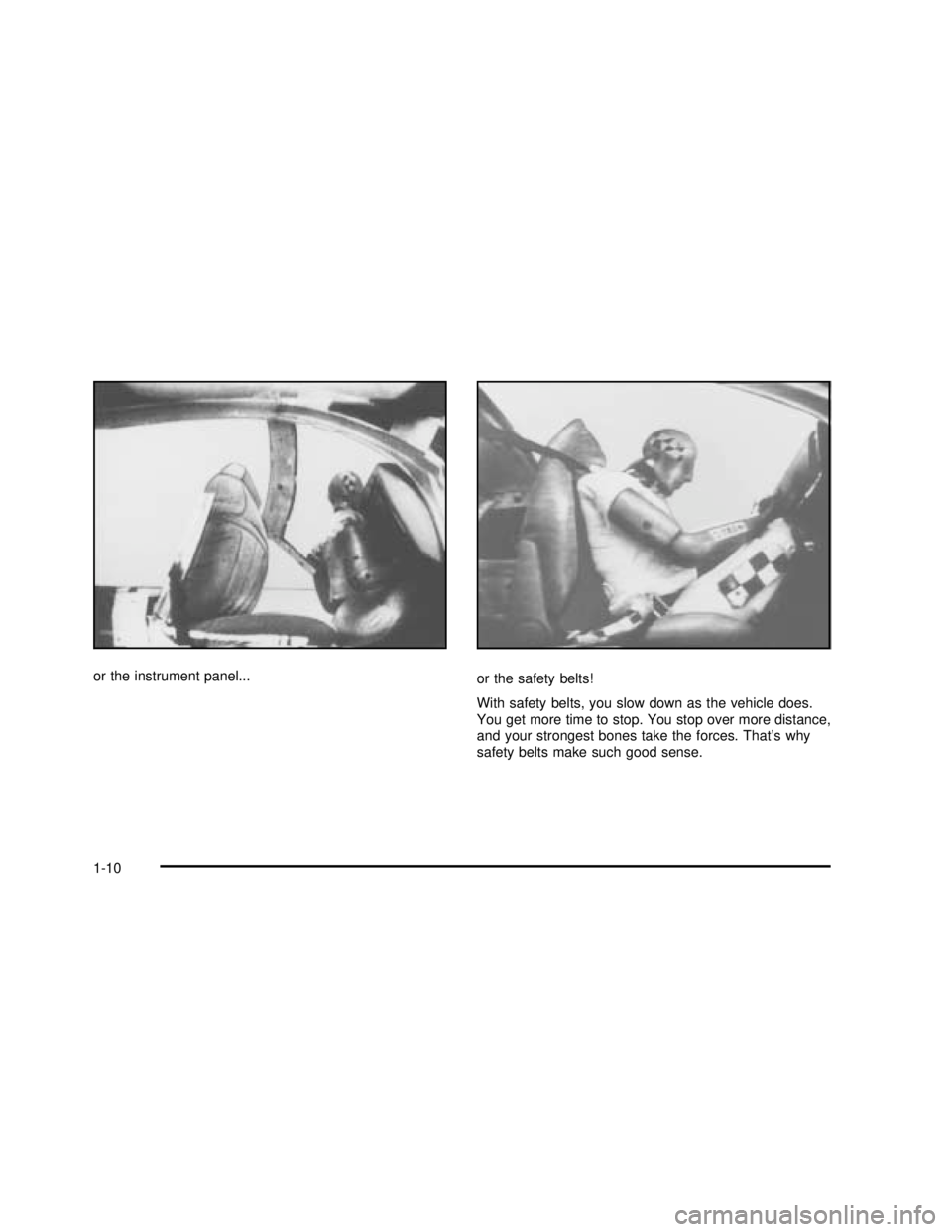
or the instrument panel...
or the safety belts!
With safety belts, you slow down as the vehicle does.
You get more time to stop. You stop over more distance,
and your strongest bones take the forces. That’s why
safety belts make such good sense.
1-10
2003 - Regal OM
Page 54 of 344

{CAUTION:
Anyone who is up against, or very close to,
any air bag when it inflates can be seriously
injured or killed. Air bags plus lap-shoulder
belts offer the best protection for adults, but
not for young children and infants. Neither the
vehicle’s safety belt system nor its air bag
system is designed for them. Young children
and infants need the protection that a child
restraint system can provide. Always secure
children properly in your vehicle. To read how,
see the part of this manual called “Older
Children” or “Infants and Young Children”.There is an air bag
readiness light on the
instrument panel, which
shows the air bag symbol.
The system checks the air bag electrical system for
malfunctions. The light tells you if there is an electrical
problem. SeeAir Bag Readiness Light on page 3-30
for more information.
1-48
2003 - Regal OM
Page 55 of 344
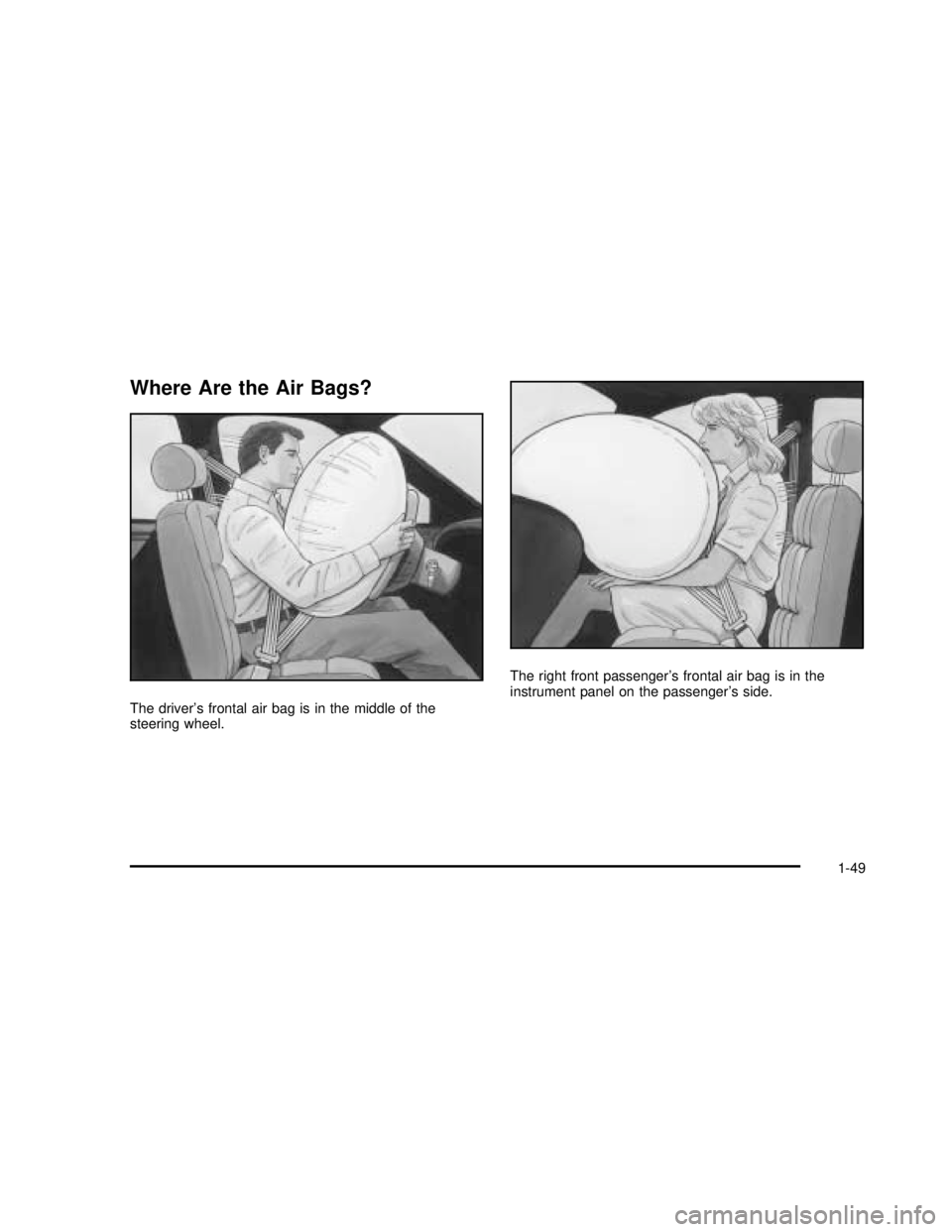
Where Are the Air Bags?
The driver’s frontal air bag is in the middle of the
steering wheel.The right front passenger’s frontal air bag is in the
instrument panel on the passenger’s side.
1-49
2003 - Regal OM
Page 57 of 344

When Should an Air Bag Inflate?
The driver’s and right front passenger’s frontal air bags
are designed to inflate in moderate to severe frontal
or near-frontal crashes. But they are designed to inflate
only if the impact speed is above the system’s
designed“threshold level.”
If the front of your vehicle goes straight into a wall that
doesn’t move or deform, the threshold level is about
12 to 18 mph (19 to 29 km/h). The threshold level can
vary, however, with specific vehicle design, so that
it can be somewhat above or below this range.
If your vehicle strikes something that will move or
deform, such as a parked car, the threshold level will be
higher. The driver’s and right front passenger’s frontal
air bags are not designed to inflate in rollovers, rear
impacts, or in many side impacts because inflation
would not help the occupant.
Your vehicle may or may not have a side impact air
bag. See Air Bag Systems in the Index. A driver’s side
impact air bag is designed to inflate in moderate to
severe side crashes involving the driver’s door. A side
impact air bag will inflate if the crash severity is
above the system’s designed“threshold level.”The
threshold level can vary with specific vehicle design. A
driver’s side impact air bag is not designed to inflate
in frontal or near-frontal impacts, rollovers or rear
impacts, because inflation would not help the occupant.In any particular crash, no one can say whether an air
bag should have inflated simply because of the damage
to a vehicle or because of what the repair costs were.
For frontal air bags, inflation is determined by the angle
of the impact and how quickly the vehicle slows down
in frontal and near-frontal impacts. For side impact
air bags, inflation is determined by the location
and severity of the impact.
What Makes an Air Bag Inflate?
In an impact of sufficient severity, the air bag sensing
system detects that the vehicle is in a crash. For
both the frontal and side impact air bags, the sensing
system triggers a release of gas from the inflator, which
inflates the air bag. The inflator, air bag and related
hardware are all part of the air bag modules. Frontal air
bag modules are located inside the steering wheel
and instrument panel. For vehicles with a driver’s side
impact air bag, the air bag moules are located in
the seatback closest to the driver’s door.
1-51
2003 - Regal OM
Page 58 of 344

HowDoes an Air Bag Restrain?
In moderate to severe frontal or near frontal collisions,
even belted occupants can contact the steering wheel or
the instrument panel. In moderate to severe side
collisions, even belted occupants can contact the inside
of the vehicle. The air bag supplements the protection
provided by safety belts. Air bags distribute the force of
the impact more evenly over the occupant’s upper
body, stopping the occupant more gradually. But the
frontal air bags would not help you in many types
of collisions, including rollovers, rear impacts, and many
side impacts, primarily because an occupant’s motion
is not toward the air bag. A side impact air bag
would not help you in many types of collisions, including
frontal or near frontal collisions, rollovers, and rear
impacts, primarily because an occupant’s motion is not
toward that air bag. Air bags should never be regarded
as anything more than a supplement to safety belts,
and then only in moderate to severe frontal or
near-frontal collisions for the driver’s and right front
passenger’s frontal air bags, and only in moderate to
severe side collisions for vehicles with a driver’s
side impact air bag.
What Will You See After an Air Bag
Inflates?
After the air bag inflates, it quickly deflates, so quickly
that some people may not even realize the air bag
inflated. Some components of the air bag module–the
steering wheel hub for the driver’s air bag, the
instrument panel for the right front passenger’s bag, the
side of the seatback closest to the door for the driver’s
side impact air bag–will be hot for a short time.
The parts of the bag that come into contact with you
may be warm, but not too hot to touch. There will
be some smoke and dust coming from the vents in the
deflated air bags. Air bag inflation doesn’t prevent
the driver from seeing or being able to steer the vehicle,
nor does it stop people from leaving the vehicle.
1-52
2003 - Regal OM
Page 59 of 344

{CAUTION:
When an air bag inflates, there is dust in the
air. This dust could cause breathing problems
for people with a history of asthma or other
breathing trouble. To avoid this, everyone in
the vehicle should get out as soon as it is safe
to do so. If you have breathing problems but
can’t get out of the vehicle after an air bag
inflates, then get fresh air by opening a
window or a door. If you experience breathing
problems following an air bag deployment, you
should seek medical attention.
In many crashes severe enough to inflate an air bag,
windshields are broken by vehicle deformation.
Additional windshield breakage may also occur from the
right front passenger air bag.
•Air bags are designed to inflate only once. After an
air bag inflates, you’ll need some new parts for
your air bag system. If you don’t get them, the air
bag system won’t be there to help protect you
in another crash. A new system will include air bag
modules and possibly other parts. The service
manual for your vehicle covers the need to replace
other parts.
•Your vehicle is equipped with a crash sensing and
diagnostic module, which records information
about the frontal air bag system. The module
records information about the readiness of the
system, when the system commands air bag
inflation and driver’s safety belt usage at
deployment. The module also records speed,
engine RPM, brake and throttle data.
•Let only qualified technicians work on your air bag
systems. Improper service can mean that an air
bag system won’t work properly. See your dealer for
service.
Notice:If you damage the covering for the driver’s
or the right front passenger’s air bag, or the air
bag covering on the driver’s seatback, the bag may
not work properly. You may have to replace the
air bag module in the steering wheel, both the air
bag module and the instrument panel for the
right front passenger’s air bag, or the air bag
module and seatback for the driver’s side impact air
bag. Do not open or break the air bag coverings.
1-53
2003 - Regal OM
Page 74 of 344

Trunk
{CAUTION:
It can be dangerous to drive with the trunk lid
open because carbon monoxide (CO) gas can
come into your vehicle. You can’t see or smell
CO. It can cause unconsciousness and even
death. If you must drive with the trunk lid open
or if electrical wiring or other cable
connections must pass through the seal
between the body and the trunk lid:
Make sure all other windows are shut.
Turn the fan on your heating or cooling
system to its highest speed and select the
control setting that will force outside air
into your vehicle. See“Climate Controls”
in the Index.
If you have air outlets on or under the
instrument panel, open them all the way.
See“Engine Exhaust”in the Index.
Trunk Lock
To unlock the trunk from the outside, insert the door key
and turn it. You can also press the trunk symbol on
your remote keyless entry transmitter.
Remote Trunk Release
Press the button located
inside of the glove box
door to release the trunk
from inside the vehicle.
The shift lever must be in
PARK (P) for the remote
trunk release button
to work.
2-12
2003 - Regal OM
Page 75 of 344

Trunk Assist Handle
Your vehicle may have an
assist handle located on
the inside of the trunk
lid toward the driver’s side
of the vehicle.
Pull down on the handle to lower the trunk lid. Then
close the trunk with your other hand. If the trunk is not
properly closed, the DOOR/TRUNK ajar warning
light will appear in the message center of your
instrument panel cluster. SeeDoor/Trunk Ajar Warning
Light on page 3-40for more information.
Notice:The trunk assist handle is not designed to
be used to tie down the trunk lid or as an anchor
point when securing items in the trunk. Improper
use of the trunk assist handle could damage it.
Emergency Trunk Release Handle
Notice:The emergency trunk release handle is not
designed to be used to tie down the trunk lid or
as an anchor point when securing items in the trunk.
Improper use of the emergency trunk release
handle could damage it.
Your vehicle may have a glow-in-the-dark emergency
trunk release handle located inside the trunk on the
latch. This handle will glow following exposure to light.
Pull the release handle up to open the trunk from
the inside.
2-13
2003 - Regal OM