steering BUICK TERRAZA 2005 Owner's Guide
[x] Cancel search | Manufacturer: BUICK, Model Year: 2005, Model line: TERRAZA, Model: BUICK TERRAZA 2005Pages: 428, PDF Size: 2.6 MB
Page 342 of 428
Tire Size
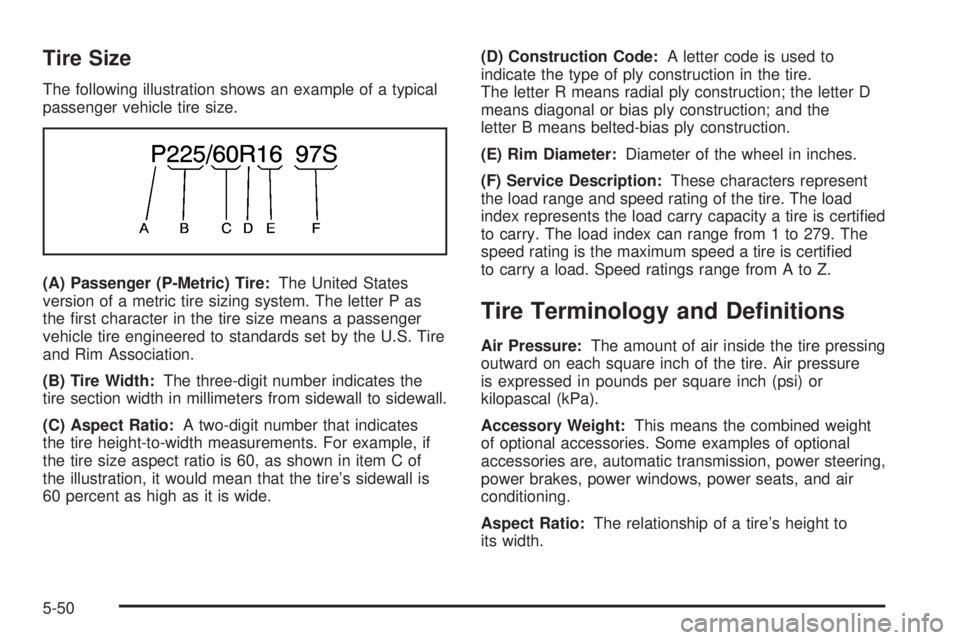
The following illustration shows an example of a typical
passenger vehicle tire size.
(A) Passenger (P-Metric) Tire:The United States
version of a metric tire sizing system. The letter P as
the rst character in the tire size means a passenger
vehicle tire engineered to standards set by the U.S. Tire
and Rim Association.
(B) Tire Width:The three-digit number indicates the
tire section width in millimeters from sidewall to sidewall.
(C) Aspect Ratio:A two-digit number that indicates
the tire height-to-width measurements. For example, if
the tire size aspect ratio is 60, as shown in item C of
the illustration, it would mean that the tire’s sidewall is
60 percent as high as it is wide.(D) Construction Code:A letter code is used to
indicate the type of ply construction in the tire.
The letter R means radial ply construction; the letter D
means diagonal or bias ply construction; and the
letter B means belted-bias ply construction.
(E) Rim Diameter:Diameter of the wheel in inches.
(F) Service Description:These characters represent
the load range and speed rating of the tire. The load
index represents the load carry capacity a tire is certied
to carry. The load index can range from 1 to 279. The
speed rating is the maximum speed a tire is certied
to carry a load. Speed ratings range from A to Z.
Tire Terminology and Denitions
Air Pressure:The amount of air inside the tire pressing
outward on each square inch of the tire. Air pressure
is expressed in pounds per square inch (psi) or
kilopascal (kPa).
Accessory Weight:This means the combined weight
of optional accessories. Some examples of optional
accessories are, automatic transmission, power steering,
power brakes, power windows, power seats, and air
conditioning.
Aspect Ratio:The relationship of a tire’s height to
its width.
5-50
Page 354 of 428
If a Tire Goes Flat
It is unusual for a tire to blowout while you’re driving,
especially if you maintain your tires properly. If air goes
out of a tire, it is much more likely to leak out slowly.
But if you should ever have a blowout, here are a
few tips about what to expect and what to do:
If a front tire fails, the at tire will create a drag that
pulls the vehicle toward that side. Take your foot off the
accelerator pedal and grip the steering wheel rmly.
Steer to maintain lane position, and then gently brake to
a stop well out of the traffic lane.
A rear blowout, particularly on a curve, acts much like a
skid and may require the same correction you would;
use in a skid. In any rear blowout, remove your foot from
the accelerator pedal. Get the vehicle under control
by steering the way you want the vehicle to go. It may
be very bumpy and noisy, but you can still steer. Gently
brake to a stop, well off the road if possible.{CAUTION:
Lifting a vehicle and getting under it to do
maintenance or repairs is dangerous without
the appropriate safety equipment and training.
The jack provided with your vehicle is designed
only for changing a at tire. If it is used for
anything else, you or others could be badly
injured or killed if the vehicle slips off the jack.
Use the jack provided with your vehicle only for
changing a at tire.
If a tire goes at, the next part shows how to use your
jacking equipment to change a at tire safely.
Changing a Flat Tire
If a tire goes at, avoid further tire and wheel damage
by driving slowly to a level place. Turn on your vehicle’s
hazard warning ashers. SeeHazard Warning Flashers
on page 3-6for more information.
5-62
Page 381 of 428
Fuses Usage
1 Trunk, Door Locks
2 Electronic Level Control
3 Rear Wiper
4 Radio Amplier
5 Interior Lamps
6 OnStar
®
7 Keyless Entry Module
8Cluster, Heating, Ventilation,
Air Conditioning
9 Cruise Switch
10 Steering Wheel Illumination
11 Power Mirror
12 Stoplamp, Turn Lamps
13 Heated Seats
14 Blank
15 Electronic Level Control
16 Heated Mirror
17Center High-Mounted Stoplamp,
Back-up Lamps
18 Blank
19 Canister Ventilation
Fuses Usage
20 Park Lamps
21 Power Sliding Door
22 Blank
23 Blank
24 Left Power Sliding Door
25 Right Power Sliding Door
Relays Usage
26 Blank
27 Blank
28 Park Lamps
29 Retained Accessory Power
30 Rear Defog
PLR Fuse Puller
Circuit
Breakers Usage
31 Power Seats
32 Power Window
5-89
Page 391 of 428
Scheduled Maintenance
Service MaintenanceIMaintenanceII
Change engine oil and lter. SeeEngine Oil on page 5-13. Reset oil life system.
SeeEngine Oil Life System on page 5-16.An Emission Control Service.••
Lubricate chassis components.See footnote #.••
Visually check for any leaks or damage.See footnote (k).••
Inspect engine air cleaner lter. If necessary, replace lter. SeeEngine Air
Cleaner/Filter on page 5-17.An Emission Control Service. See footnotes †
and (g).•
Rotate tires and check ination pressures and wear. SeeTire Inspection and
Rotation on page 5-54.••
Inspect brake system.See footnote (a).••
Check engine coolant and windshield washer uid levels and add uid as
needed.••
Perform any needed additional services. See “Additional Required Services”
in this section.••
Inspect suspension and steering components.See footnote (b).•
Inspect engine cooling system.See footnote (c).•
Inspect wiper blades.See footnote (d).•
Inspect restraint system components.See footnote (e).•
Lubricate body components.See footnote (f).•
Check transaxle uid level and add uid as needed.•
Inspect throttle system.See footnote (j).•
6-5
Page 393 of 428
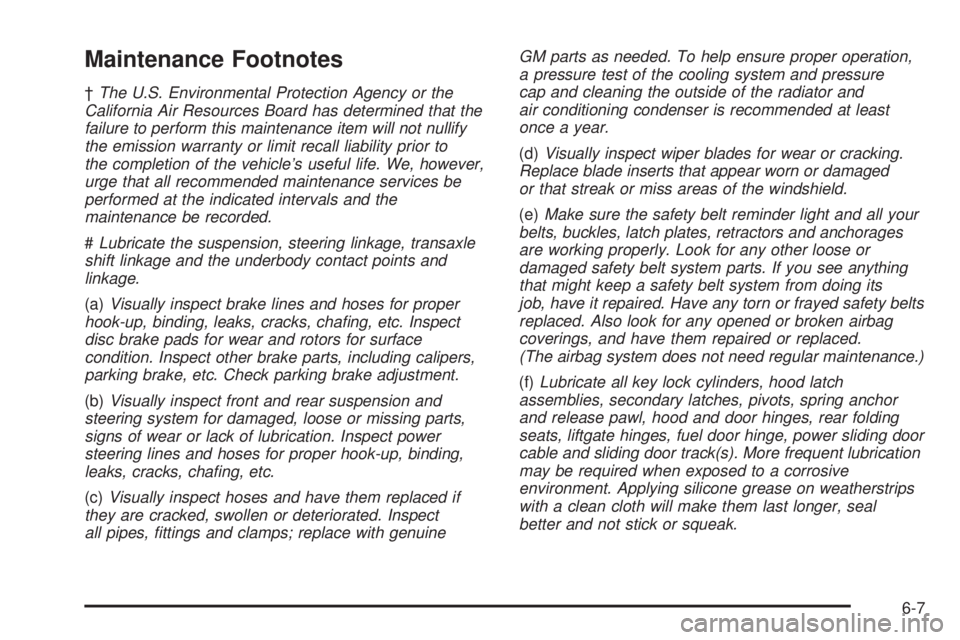
Maintenance Footnotes
†The U.S. Environmental Protection Agency or the
California Air Resources Board has determined that the
failure to perform this maintenance item will not nullify
the emission warranty or limit recall liability prior to
the completion of the vehicle’s useful life. We, however,
urge that all recommended maintenance services be
performed at the indicated intervals and the
maintenance be recorded.
#Lubricate the suspension, steering linkage, transaxle
shift linkage and the underbody contact points and
linkage.
(a)Visually inspect brake lines and hoses for proper
hook-up, binding, leaks, cracks, chang, etc. Inspect
disc brake pads for wear and rotors for surface
condition. Inspect other brake parts, including calipers,
parking brake, etc. Check parking brake adjustment.
(b)Visually inspect front and rear suspension and
steering system for damaged, loose or missing parts,
signs of wear or lack of lubrication. Inspect power
steering lines and hoses for proper hook-up, binding,
leaks, cracks, chang, etc.
(c)Visually inspect hoses and have them replaced if
they are cracked, swollen or deteriorated. Inspect
all pipes, ttings and clamps; replace with genuineGM parts as needed. To help ensure proper operation,
a pressure test of the cooling system and pressure
cap and cleaning the outside of the radiator and
air conditioning condenser is recommended at least
once a year.
(d)Visually inspect wiper blades for wear or cracking.
Replace blade inserts that appear worn or damaged
or that streak or miss areas of the windshield.
(e)Make sure the safety belt reminder light and all your
belts, buckles, latch plates, retractors and anchorages
are working properly. Look for any other loose or
damaged safety belt system parts. If you see anything
that might keep a safety belt system from doing its
job, have it repaired. Have any torn or frayed safety belts
replaced. Also look for any opened or broken airbag
coverings, and have them repaired or replaced.
(The airbag system does not need regular maintenance.)
(f)Lubricate all key lock cylinders, hood latch
assemblies, secondary latches, pivots, spring anchor
and release pawl, hood and door hinges, rear folding
seats, liftgate hinges, fuel door hinge, power sliding door
cable and sliding door track(s). More frequent lubrication
may be required when exposed to a corrosive
environment. Applying silicone grease on weatherstrips
with a clean cloth will make them last longer, seal
better and not stick or squeak.
6-7
Page 398 of 428
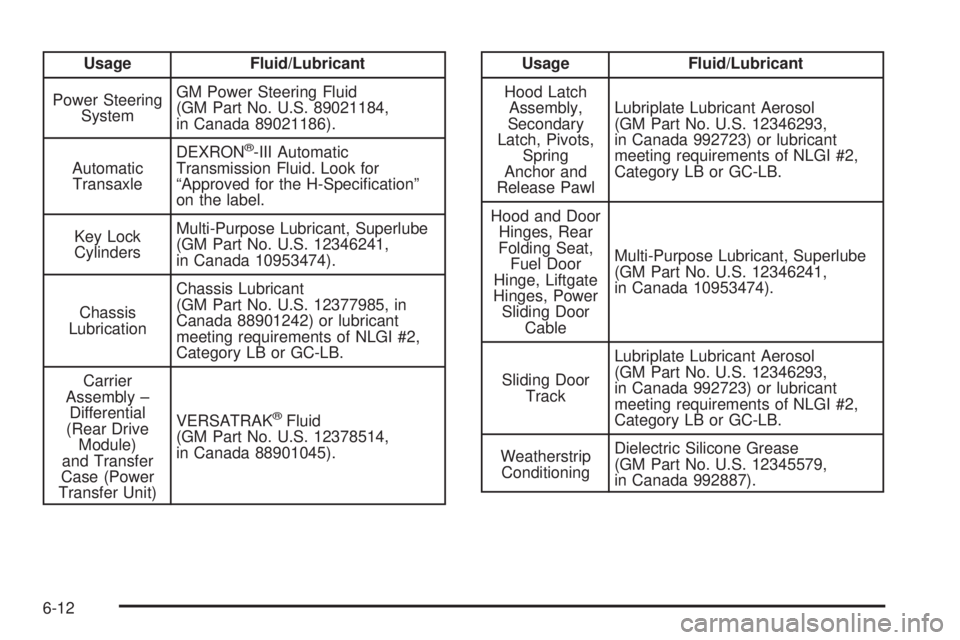
Usage Fluid/Lubricant
Power Steering
SystemGM Power Steering Fluid
(GM Part No. U.S. 89021184,
in Canada 89021186).
Automatic
TransaxleDEXRON
®-III Automatic
Transmission Fluid. Look for
“Approved for the H-Specication”
on the label.
Key Lock
CylindersMulti-Purpose Lubricant, Superlube
(GM Part No. U.S. 12346241,
in Canada 10953474).
Chassis
LubricationChassis Lubricant
(GM Part No. U.S. 12377985, in
Canada 88901242) or lubricant
meeting requirements of NLGI #2,
Category LB or GC-LB.
Carrier
Assembly –
Differential
(Rear Drive
Module)
and Transfer
Case (Power
Transfer Unit)VERSATRAK
®Fluid
(GM Part No. U.S. 12378514,
in Canada 88901045).
Usage Fluid/Lubricant
Hood Latch
Assembly,
Secondary
Latch, Pivots,
Spring
Anchor and
Release PawlLubriplate Lubricant Aerosol
(GM Part No. U.S. 12346293,
in Canada 992723) or lubricant
meeting requirements of NLGI #2,
Category LB or GC-LB.
Hood and Door
Hinges, Rear
Folding Seat,
Fuel Door
Hinge, Liftgate
Hinges, Power
Sliding Door
CableMulti-Purpose Lubricant, Superlube
(GM Part No. U.S. 12346241,
in Canada 10953474).
Sliding Door
TrackLubriplate Lubricant Aerosol
(GM Part No. U.S. 12346293,
in Canada 992723) or lubricant
meeting requirements of NLGI #2,
Category LB or GC-LB.
Weatherstrip
ConditioningDielectric Silicone Grease
(GM Part No. U.S. 12345579,
in Canada 992887).
6-12
Page 413 of 428
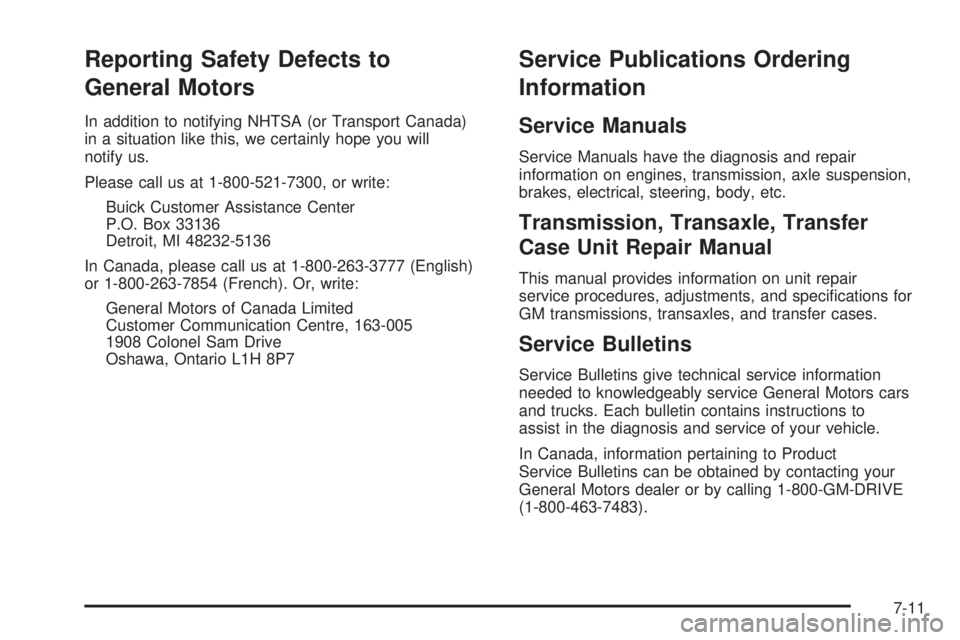
Reporting Safety Defects to
General Motors
In addition to notifying NHTSA (or Transport Canada)
in a situation like this, we certainly hope you will
notify us.
Please call us at 1-800-521-7300, or write:
Buick Customer Assistance Center
P.O. Box 33136
Detroit, MI 48232-5136
In Canada, please call us at 1-800-263-3777 (English)
or 1-800-263-7854 (French). Or, write:
General Motors of Canada Limited
Customer Communication Centre, 163-005
1908 Colonel Sam Drive
Oshawa, Ontario L1H 8P7
Service Publications Ordering
Information
Service Manuals
Service Manuals have the diagnosis and repair
information on engines, transmission, axle suspension,
brakes, electrical, steering, body, etc.
Transmission, Transaxle, Transfer
Case Unit Repair Manual
This manual provides information on unit repair
service procedures, adjustments, and specications for
GM transmissions, transaxles, and transfer cases.
Service Bulletins
Service Bulletins give technical service information
needed to knowledgeably service General Motors cars
and trucks. Each bulletin contains instructions to
assist in the diagnosis and service of your vehicle.
In Canada, information pertaining to Product
Service Bulletins can be obtained by contacting your
General Motors dealer or by calling 1-800-GM-DRIVE
(1-800-463-7483).
7-11
Page 415 of 428
A
Accessory Inator...........................................5-60
Accessory Power Outlets.................................3-23
Adding Equipment to Your Airbag-Equipped
Vehicle.......................................................1-67
Additives, Fuel................................................. 5-6
Add-On Electrical Equipment............................5-86
Air Cleaner/Filter, Engine.................................5-17
Air Conditioning..............................................3-25
Airbag
Passenger Status Indicator...........................3-35
Readiness Light..........................................3-34
Airbag Sensing and Diagnostic Module (SDM)...... 7-9
Airbag System................................................1-54
Adding Equipment to Your Airbag-Equipped
Vehicle...................................................1-67
How Does an Airbag Restrain?......................1-60
Passenger Sensing System...........................1-62
Servicing Your Airbag-Equipped Vehicle..........1-66
What Makes an Airbag Inate?......................1-60
What Will You See After an Airbag Inates?....1-61
When Should an Airbag Inate?....................1-59
Where Are the Airbags?...............................1-56
All-Wheel Drive...............................................5-41
All-Wheel Drive (AWD) System.........................2-36
All-Wheel-Drive (AWD) System.........................4-12
Antenna, Fixed Mast......................................3-114Antenna, XM™ Satellite Radio Antenna
System.....................................................3-114
Anti-Lock Brake System (ABS)........................... 4-7
Anti-Lock Brake, System Warning Light..............3-38
Appearance Care............................................5-77
Aluminum or Chrome-Plated Wheels..............5-82
Care of Safety Belts....................................5-80
Chemical Paint Spotting...............................5-84
Cleaning Exterior Lamps/Lenses....................5-81
Fabric/Carpet..............................................5-78
Finish Care.................................................5-81
Finish Damage............................................5-83
Glass Surfaces............................................5-80
Instrument Panel.........................................5-80
Interior Plastic Components...........................5-80
Leather......................................................5-80
Sheet Metal Damage...................................5-83
Tires..........................................................5-83
Underbody Maintenance...............................5-84
Vehicle Care/Appearance Materials................5-84
Vinyl..........................................................5-79
Washing Your Vehicle...................................5-81
Weatherstrips..............................................5-81
Windshield, Backglass, and Wiper Blades.......5-82
Audio System(s).............................................3-77
Audio Steering Wheel Controls....................3-112
Care of Your CD and DVD Player................3-114
Care of Your CDs and DVDs.......................3-113
1
Page 419 of 428
Engine (cont.)
Check and Service Engine Soon Light............3-40
Coolant......................................................5-21
Coolant Heater............................................2-32
Coolant Temperature Gage...........................3-39
Engine Compartment Overview......................5-12
Exhaust.....................................................2-40
Oil .............................................................5-13
Oil Life System...........................................5-16
Overheated Protection Operating Mode...........5-26
Overheating................................................5-24
Starting......................................................2-31
Entry Lighting.................................................3-17
Event Data Recorders (EDR)............................. 7-9
Exit Lighting...................................................3-18
Extender, Safety Belt.......................................1-34
Exterior Lamps...............................................3-14
F
Filter
Engine Air Cleaner......................................5-17
Finish Damage...............................................5-83
Fixed Mast Antenna.......................................3-114
Flash-to-Pass................................................... 3-8Flat Tire........................................................5-62
Flat Tire, Changing.........................................5-62
Flat Tire, Storing.............................................5-74
Fluid
Automatic Transaxle.....................................5-19
Power Steering...........................................5-32
Windshield Washer......................................5-32
Folding Tray...................................................2-51
Front Console Storage Area.............................2-50
Front Reading Lamps......................................3-19
Fuel............................................................... 5-5
Additives...................................................... 5-6
California Fuel.............................................. 5-6
Filling a Portable Fuel Container....................5-10
Filling Your Tank........................................... 5-8
Fuels in Foreign Countries.............................. 5-7
Gage.........................................................3-44
Gasoline Octane........................................... 5-5
Gasoline Specications.................................. 5-5
Low Warning Light.......................................3-44
Fuses
Fuses and Circuit Breakers...........................5-87
Instrument Panel Fuse Block.........................5-88
Underhood Fuse Block.................................5-90
Windshield Wiper.........................................5-87
5
Page 423 of 428
OnStar®System.............................................2-42
Other Warning Devices...................................... 3-6
Outlet Adjustment............................................3-28
Outside
Convex Mirror.............................................2-42
Heated Mirrors............................................2-42
Power Mirrors.............................................2-41
Overhead Console..................................2-49, 2-50
Overhead Console Switchbank..........................3-20
Overheated Engine Protection Operating Mode.....5-26
Owner Checks and Services.............................. 6-8
Owners, Canadian............................................... ii
P
Park Aid........................................................3-20
Park (P)
Shifting Into................................................2-38
Shifting Out of............................................2-39
Parking
Assist........................................................3-20
Brake........................................................2-37
Over Things That Burn.................................2-39
Passenger Airbag Status Indicator.....................3-35
Passenger Sensing System..............................1-62
Passing.........................................................4-15
PASS-Key
®III ................................................2-28
PASS-Key®III Operation..................................2-28Power
Accessory Outlets........................................3-23
Door Locks.................................................2-11
Eight-Way Seats........................................... 1-4
Electrical System.........................................5-87
Outlet 115 Volt Alternating Current.................3-24
Rear Quarter Windows.................................2-25
Retained Accessory (RAP)............................2-31
Six-Way Seats.............................................. 1-3
Sliding Door................................................2-16
Steering Fluid.............................................5-32
Windows....................................................2-25
Pretensioners, Safety Belt................................1-34
Programmable Automatic Door Locks.................2-13
Q
Questions and Answers About Safety Belts.........1-20
R
Radiator Pressure Cap....................................5-23
Radios..........................................................3-77
Care of Your CD and DVD Player................3-114
Care of Your CDs and DVDs.......................3-113
Navigation/Radio System..............................3-96
Radio with CD............................................3-77
9