wheel CADILLAC CT5 2023 Owners Manual
[x] Cancel search | Manufacturer: CADILLAC, Model Year: 2023, Model line: CT5, Model: CADILLAC CT5 2023Pages: 526, PDF Size: 6.85 MB
Page 422 of 526

Cadillac CT5 Owner Manual (GMNA-Localizing-U.S./Canada-16500419) -
2023 - CRC - 5/6/22
Vehicle Care 421
and screws, in the tread area.
The tire may lose air pressure
if the sidewall is damaged or
the tread puncture is too
large. If the Tire Pressure
Monitor System indicates the
tire pressure is low, inspect
the tire for damage and inflate
it to the recommended
pressure. If the tire is unable
to maintain the recommended
pressure, contact the nearest
authorized GM servicing
facility immediately for
inspection and repair or
replacement. To locate the
nearest GM servicing facility,
call GM Customer Assistance.
Caution
Do not drive on a deflated
self-sealing tire as this could
damage the tire. Make sure
the tire is inflated to the
recommended pressure or
have it immediately repaired
or replaced.When tire replacement is
needed replace with a
self-sealing tire, because the
vehicle does not come with a
spare tire or tire changing
equipment.
Noise Reducing Tires
(V-Series
Blackwing Only)
This vehicle may be equipped
with tires that have
noise-absorbing foam
technology to reduce road and
interior noise levels.
To maintain overall vehicle
performance, replace
damaged or worn tires with
Tire Performance Criteria
Specification (TPC Spec)
original equipment tires
equipped with noise-absorbing
foam. See Buying New Tires
0
437.
Low-Profile Tires
If the vehicle has
245/45R18 96V,
245/40R19 94V,
245/40ZR19 94Y,
255/35ZR20 97W,
275/35ZR19 (100Y),
or 305/30ZR19 (102Y) size
tires, they are classified as
low-profile tires.
Caution
Low-profile tires are more
susceptible to damage from
road hazards or curb impact
than standard profile tires.
Tire and/or wheel assembly
damage can occur when
coming into contact with
road hazards like potholes,
or sharp edged objects,
or when sliding into a curb.
The warranty does not
cover this type of damage.
Keep tires set to the correct
inflation pressure and when (Continued)
Page 425 of 526

Cadillac CT5 Owner Manual (GMNA-Localizing-U.S./Canada-16500419) -
2023 - CRC - 5/6/22
424 Vehicle Care
Passenger (P-Metric) Tire
(1) Passenger (P-Metric)
Tire
:The United States
version of a metric tire
sizing system. The letter
"P" as the first character in
the tire size means a
passenger vehicle tire
engineered to standards
set by the U.S. Tire and Rim
Association.
(2) Tire Width
:The 3-digit
number indicates the tire
section width in millimeters
from sidewall to sidewall.
(3) Aspect Ratio
:A 2-digit
number that indicates the
tire height-to-width
measurements. For
example, if the tire size aspect ratio is 75, as
shown in item (3) of the
illustration, it would mean
that the tire's sidewall is
75 percent as high as it
is wide.
(4) Construction Code
:A
letter code is used to
indicate the type of ply
construction in the tire. The
letter "R" means radial ply
construction; the letter "D"
means diagonal or bias ply
construction.
(5) Rim Diameter
:
Diameter of the wheel in
inches.
(6) Service Description
:
These characters
represent the load index
and speed rating of the
tire. The load index
represents the load
carrying capacity a tire is
certified to carry. The speed rating is the
maximum speed a tire is
certified to carry a load.
Tire Terminology and
Definitions
Air Pressure:The amount
of air inside the tire
pressing outward on each
square inch of the tire. Air
pressure is expressed
in kPa (kilopascal) or psi
(pounds per square inch).
Aspect Ratio
:The
relationship of a tire's
height to its width.
Belt
:A rubber coated layer
of cords that is located
between the plies and the
tread. Cords may be made
from steel or other
reinforcing materials.
Page 432 of 526

Cadillac CT5 Owner Manual (GMNA-Localizing-U.S./Canada-16500419) -
2023 - CRC - 5/6/22
Vehicle Care 431
significantly under-inflated tire
causes the tire to overheat
and can lead to tire failure.
Under-inflation also reduces
energy efficiency and tire
tread life, and may affect the
vehicle's handling and
stopping ability.
Please note that the TPMS is
not a substitute for proper tire
maintenance, and it is the
driver's responsibility to
maintain correct tire pressure,
even if under-inflation has not
reached the level to trigger
illumination of the TPMS low
tire pressure telltale.
Your vehicle has also been
equipped with a TPMS
malfunction indicator to
indicate when the system is
not operating properly. The
TPMS malfunction indicator is
combined with the low tire
pressure telltale. When the
system detects a malfunction,
the telltale will flash for
approximately one minute and
then remain continuouslyilluminated. This sequence will
continue upon subsequent
vehicle start-ups as long as
the malfunction exists.
When the malfunction
indicator is illuminated, the
system may not be able to
detect or signal low tire
pressure as intended. TPMS
malfunctions may occur for a
variety of reasons, including
the installation of replacement
or alternate tires or wheels on
the vehicle that prevent the
TPMS from functioning
properly. Always check the
TPMS malfunction telltale
after replacing one or more
tires or wheels on your vehicle
to ensure that the
replacement or alternate tires
and wheels allow the TPMS to
continue to function properly.
See Tire Pressure Monitor
Operation
0431.
See Radio Frequency
Statement 0496.Tire Pressure Monitor
Operation
This vehicle may have a Tire
Pressure Monitor System
(TPMS). The TPMS is designed
to warn the driver when a low
tire pressure condition exists.
TPMS sensors are mounted
onto each tire and wheel
assembly, excluding the spare
tire and wheel assembly. The
TPMS sensors monitor the air
pressure in the tires and
transmit the tire pressure
readings to a receiver located
in the vehicle.
When a low tire pressure
condition is detected, the
TPMS illuminates the low tire
pressure warning light located
on the instrument cluster.
If the warning light comes on,
Page 434 of 526

Cadillac CT5 Owner Manual (GMNA-Localizing-U.S./Canada-16500419) -
2023 - CRC - 5/6/22
Vehicle Care 433
tire pressure warning light
flashes for about one minute
and then stays on for the
remainder of the ignition cycle.
A DIC warning message also
displays. The malfunction light
and DIC warning message
come on at each ignition cycle
until the problem is corrected.
Some of the conditions that
can cause these to come
on are:
.One of the road tires has
been replaced with the
spare tire. The spare tire
does not have a TPMS
sensor. The malfunction light
and DIC message should go
off after the road tire is
replaced and the sensor
matching process is
performed successfully. See
“TPMS Sensor Matching
Process”later in this section.
.The TPMS sensor matching
process was not done or not
completed successfully after
rotating the tires. The
malfunction light and the DIC
message should go off after successfully completing the
sensor matching process.
See "TPMS Sensor Matching
Process" later in this section.
.One or more TPMS sensors
are missing or damaged. The
malfunction light and the DIC
message should go off when
the TPMS sensors are
installed and the sensor
matching process is
performed successfully. See
your dealer for service.
.Replacement tires or wheels
do not match the original
equipment tires or wheels.
Tires and wheels other than
those recommended could
prevent the TPMS from
functioning properly. See
Buying New Tires
0437.
.Operating electronic devices
or being near facilities using
radio wave frequencies
similar to the TPMS could
cause the TPMS sensors to
malfunction. If the TPMS is not functioning
properly it cannot detect or
signal a low tire pressure
condition. See your dealer for
service if the TPMS
malfunction light and DIC
message come on and stay on.
Tire Fill Alert (If Equipped)
This feature provides visual
and audible alerts outside the
vehicle to help when inflating
an underinflated tire to the
recommended cold tire
pressure.
When the low tire pressure
warning light comes on:
1. Park the vehicle in a safe, level place.
2. Set the parking brake firmly.
3. Place the vehicle in P (Park).
4. Add air to the tire that is underinflated. The turn
signal lamp will flash.
Page 435 of 526

Cadillac CT5 Owner Manual (GMNA-Localizing-U.S./Canada-16500419) -
2023 - CRC - 5/6/22
434 Vehicle Care
When the recommended
pressure is reached, the
horn sounds once and the
turn signal lamp will stop
flashing and briefly turn
solid.
Repeat these steps for all
underinflated tires that have
illuminated the low tire
pressure warning light.
{Warning
Overinflating a tire could
cause the tire to rupture
and you or others could be
injured. Do not exceed the
maximum pressure listed on
the tire sidewall. See Tire
Sidewall Labeling 0422 and
Vehicle Load Limits 0261.
If the tire is overinflated by
more than 35 kPa (5 psi), the
horn will sound multiple times
and the turn signal lamp will
continue to flash for several
seconds after filling stops. To
release and correct the
pressure, while the turn signal lamp is still flashing, briefly
press the center of the valve
stem. When the recommended
pressure is reached, the horn
sounds once.
If the turn signal lamp does
not flash within 15 seconds
after starting to inflate the
tire, the tire fill alert has not
been activated or is not
working.
If the hazard warning flashers
are on, the tire fill alert visual
feedback will not work
properly.
The TPMS will not activate the
tire fill alert properly under the
following conditions:
.There is interference from
an external device or
transmitter.
.The air pressure from the
inflation device is not
sufficient to inflate the tire.
.There is a malfunction in
the TPMS.
.There is a malfunction in the
horn or turn signal lamps.
.The identification code of
the TPMS sensor is not
registered to the system.
.The battery of the TPMS
sensor is low.
If the tire fill alert does not
operate due to TPMS
interference, move the vehicle
about 1 m (3 ft) back or
forward and try again. If the
tire fill alert feature is not
working, use a tire pressure
gauge.
TPMS Sensor Matching
Process —Auto Learn
Function
Each TPMS sensor has a
unique identification code. The
identification code needs to be
matched to a new tire/wheel
position after rotating the
tires or replacing one or more
of the TPMS sensors. When a
tire is installed, the vehicle
must be stationary for about
20 minutes before the system
recalculates. The following
relearn process takes up to
Page 436 of 526

Cadillac CT5 Owner Manual (GMNA-Localizing-U.S./Canada-16500419) -
2023 - CRC - 5/6/22
Vehicle Care 435
10 minutes, driving at a
minimum speed of 20 km/h
(12 mph). A dash (-) or pressure
value will display in the DIC.
See Driver Information Center
(DIC) (Base Level)0136 or
Driver Information Center
(DIC) (Uplevel) 0139. A warning
message displays in the DIC if
a problem occurs during the
relearn process.
Tire Inspection
We recommend that the
tires, including the spare
tire, if the vehicle has one,
be inspected for signs of
wear or damage at least
once a month.
Replace the tire if:
.The indicators at three or
more places around the
tire can be seen.
.There is cord or fabric
showing through the
tire's rubber.
.The tread or sidewall is
cracked, cut, or snagged
deep enough to show
cord or fabric.
.The tire has a bump,
bulge, or split.
.The tire has a puncture,
cut, or other damage that
cannot be repaired well
because of the size or
location of the damage.
Tire Rotation
Tires should be rotated
according to the interval
specified in the
Maintenance Schedule. See
Maintenance Schedule
0 471.
Tires are rotated to
achieve a uniform wear for
all tires. The first rotation is
the most important.
Anytime unusual wear is
noticed, rotate the tires as
soon as possible, check for proper tire inflation
pressure, and check for
damaged tires or wheels.
If the unusual wear
continues after the
rotation, check the wheel
alignment. See When It Is
Time for New Tires
0437
and
Wheel Replacement 0441.
Use this rotation pattern if
the vehicle has different
size tires on the front
and rear.
Page 437 of 526
Cadillac CT5 Owner Manual (GMNA-Localizing-U.S./Canada-16500419) -
2023 - CRC - 5/6/22
436 Vehicle Care
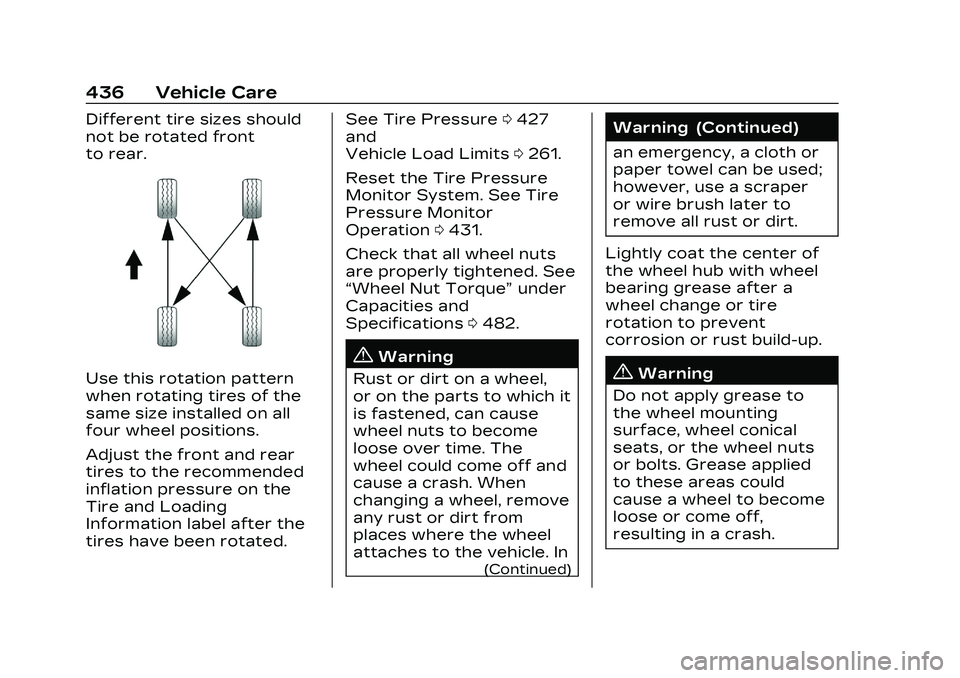
Different tire sizes should
not be rotated front
to rear.
Use this rotation pattern
when rotating tires of the
same size installed on all
four wheel positions.
Adjust the front and rear
tires to the recommended
inflation pressure on the
Tire and Loading
Information label after the
tires have been rotated.See Tire Pressure
0427
and
Vehicle Load Limits 0261.
Reset the Tire Pressure
Monitor System. See Tire
Pressure Monitor
Operation 0431.
Check that all wheel nuts
are properly tightened. See
“Wheel Nut Torque” under
Capacities and
Specifications 0482.
{Warning
Rust or dirt on a wheel,
or on the parts to which it
is fastened, can cause
wheel nuts to become
loose over time. The
wheel could come off and
cause a crash. When
changing a wheel, remove
any rust or dirt from
places where the wheel
attaches to the vehicle. In
(Continued)
Warning (Continued)
an emergency, a cloth or
paper towel can be used;
however, use a scraper
or wire brush later to
remove all rust or dirt.
Lightly coat the center of
the wheel hub with wheel
bearing grease after a
wheel change or tire
rotation to prevent
corrosion or rust build-up.
{Warning
Do not apply grease to
the wheel mounting
surface, wheel conical
seats, or the wheel nuts
or bolts. Grease applied
to these areas could
cause a wheel to become
loose or come off,
resulting in a crash.
Page 439 of 526

Cadillac CT5 Owner Manual (GMNA-Localizing-U.S./Canada-16500419) -
2023 - CRC - 5/6/22
438 Vehicle Care
Specification (TPC Spec)
system rating. When
replacement tires are
needed, GM strongly
recommends buying tires
with the same TPC Spec
rating.
GM's exclusive TPC Spec
system considers over a
dozen critical specifications
that impact the overall
performance of the vehicle,
including brake system
performance, ride and
handling, traction control,
and tire pressure
monitoring performance.
GM's TPC Spec number is
molded onto the tire's
sidewall near the tire size.
If the tires have an
all-season tread design, the
TPC Spec number will be
followed by MS for mud
and snow. See Tire
Sidewall Labeling0422 for
additional information. GM recommends replacing
worn tires in complete sets
of four. Uniform tread
depth on all tires will help
to maintain the
performance of the vehicle.
Braking and handling
performance may be
adversely affected if all the
tires are not replaced at
the same time. If proper
rotation and maintenance
have been done, all four
tires should wear out at
about the same time.
However, if it is necessary
to replace only one axle set
of worn tires, place the
new tires on the rear axle.
See Tire Rotation
0435.
{Warning
Tires could explode
during improper service.
Attempting to mount or
dismount a tire could
(Continued)
Warning (Continued)
cause injury or death.
Only your dealer or
authorized tire service
center should mount or
dismount the tires.
{Warning
Mixing tires of different
sizes (other than those
originally installed on the
vehicle), brands, tread
patterns, or types may
cause loss of vehicle
control, resulting in a
crash or other vehicle
damage. Use the correct
size, brand, and type of
tire on all wheels.
Page 440 of 526
Cadillac CT5 Owner Manual (GMNA-Localizing-U.S./Canada-16500419) -
2023 - CRC - 5/6/22
Vehicle Care 439
{Warning
Using bias-ply tires on
the vehicle may cause the
wheel rim flanges to
develop cracks after
many miles of driving.
A tire and/or wheel could
fail suddenly and cause a
crash. Use only radial-ply
tires with the wheels on
the vehicle.
Winter tires with the same
speed rating as the original
equipment tires may not be
available for H, V, W, Y and
ZR speed rated tires. Never
exceed the winter tires’
maximum speed capability
when using winter tires
with a lower speed rating.
If the vehicle tires must be
replaced with a tire that
does not have a TPC Spec
number, make sure they
are the same size, load range, speed rating, and
construction (radial) as the
original tires.
The Tire and Loading
Information label indicates
the original equipment tires
on the vehicle. See Vehicle
Load Limits
0261.
Different Size Tires
and Wheels
If wheels or tires are installed
that are a different size than
the original equipment wheels
and tires, vehicle performance,
including its braking, ride and
handling characteristics,
stability, and resistance to
rollover may be affected. If the
vehicle has electronic systems
such as antilock brakes,
rollover airbags, traction
control, electronic stability
control, or All-Wheel Drive, the
performance of these systems
can also be affected.
{Warning
If different sized wheels are
used, there may not be an
acceptable level of
performance and safety if
tires not recommended for
those wheels are selected.
This increases the chance of
a crash and serious injury.
Only use GM specific wheel
and tire systems developed
for the vehicle, and have
them properly installed by a
GM certified technician.
See Buying New Tires 0437
and
Accessories and Modifications
0 374.
Uniform Tire Quality
Grading
The following information
relates to the system
developed by the United
States National Highway
Traffic Safety
Page 442 of 526

Cadillac CT5 Owner Manual (GMNA-Localizing-U.S./Canada-16500419) -
2023 - CRC - 5/6/22
Vehicle Care 441
this tire is based on
straight-ahead braking
traction tests, and does not
include acceleration,
cornering, hydroplaning,
or peak traction
characteristics.
Temperature
The temperature grades
are A (the highest), B, and
C, representing the tire's
resistance to the
generation of heat and its
ability to dissipate heat
when tested under
controlled conditions on a
specified indoor laboratory
test wheel. Sustained high
temperature can cause the
material of the tire to
degenerate and reduce tire
life, and excessive
temperature can lead to
sudden tire failure. The
grade C corresponds to a
level of performance whichall passenger car tires must
meet under the Federal
Motor Safety Standard
No. 109. Grades B and A
represent higher levels of
performance on the
laboratory test wheel than
the minimum required by
law. Warning: The
temperature grade for this
tire is established for a tire
that is properly inflated and
not overloaded. Excessive
speed, underinflation,
or excessive loading, either
separately or in
combination, can cause
heat buildup and possible
tire failure.
Wheel Alignment and
Tire Balance
The tires and wheels were
aligned and balanced at the
factory to provide the longest
tire life and best overall
performance. Adjustments to
wheel alignment and tire balancing are not necessary
on a regular basis. Consider an
alignment check if there is
unusual tire wear or the
vehicle is significantly pulling
to one side or the other. Some
slight pull to the left or right,
depending on the crown of the
road and/or other road
surface variations such as
troughs or ruts, is normal.
If the vehicle is vibrating when
driving on a smooth road, the
tires and wheels may need to
be rebalanced. See your
dealer for proper diagnosis.
Wheel Replacement
Replace any wheel that is
bent, cracked, or badly rusted
or corroded. If wheel nuts
keep coming loose, the wheel,
wheel bolts, and wheel nuts
should be replaced. If the
wheel leaks air, replace it.
Some aluminum wheels can be
repaired. See your dealer if
any of these conditions exist.
Your dealer will know the kind
of wheel that is needed.