light CADILLAC CT6 2016 Owners Manual
[x] Cancel search | Manufacturer: CADILLAC, Model Year: 2016, Model line: CT6, Model: CADILLAC CT6 2016Pages: 397, PDF Size: 7.09 MB
Page 256 of 397
Cadillac CT6 Owner Manual (GMNA-Localizing-U.S./Canada-9235592) -
2016 - crc - 11/6/15
Driving and Operating 255
{ WarningAttempting to refuel without using
the funnel adapter may cause fuel
spillage and damage the capless
fuel system. This could cause a
fire and you or others could be
badly burned and the vehicle
could be damaged.
3. After filling the tank, remove
and clean the funnel adapter
and return it to the storage
location.
Filling a Portable Fuel
Container
{ Warning
Filling a portable fuel container
while it is in the vehicle can cause
fuel vapors that can ignite either
by static electricity or other
means. You or others could be
badly burned and the vehicle
could be damaged. Always:
(Continued) Warning (Continued) .
Use approved fuel
containers.
.
Remove the container from
the vehicle, trunk, or pickup
bed before filling.
.
Place the container on the
ground.
.
Place the nozzle inside the
fill opening of the container
before dispensing fuel, and
keep it in contact with the fill
opening until filling is
complete.
.
Fill the container no more
than 95% full to allow for
expansion.
.
Do not smoke, light
matches, or use lighters
while pumping fuel.
.
Avoid using cell phones or
other electronic devices.Trailer Towing General Towing
Information Only use towing equipment that has
been designed for the vehicle.
Contact your dealer or trailering
dealer for assistance with preparing
the vehicle for towing a trailer. Read
the entire section before towing a
trailer.
For towing a disabled vehicle, see
Towing the Vehicle 0 330 . For
towing the vehicle behind another
vehicle such as a motor home, see
Recreational Vehicle Towing 0 331 .
Driving Characteristics
and Towing Tips Driving with a Trailer
When towing a trailer:
.
Become familiar with the state
and local laws that apply to
trailer towing.
Page 261 of 397

Cadillac CT6 Owner Manual (GMNA-Localizing-U.S./Canada-9235592) -
2016 - crc - 11/6/15
260 Driving and Operating Safety Chains Always attach chains between the
vehicle and the trailer. Cross the
safety chains under the tongue of
the trailer to help prevent the tongue
from contacting the road if it
becomes separated from the hitch.
Leave enough slack so the rig can
turn. Never allow safety chains to
drag on the ground.
Trailer Brakes Does the trailer have its own
brakes? Be sure to read and follow
the instructions for the trailer brakes
so they are installed, adjusted, and
maintained properly.
Because the vehicle has antilock
brakes, do not tap into the vehicle's
brake system. If this is done, both
brake systems will not work well or
at all. Conversions and
Add-Ons Add-On Electrical
Equipment
{ WarningThe Data Link Connector (DLC) is
used for vehicle service and
Emission Inspection/Maintenance
testing. See Malfunction Indicator
Lamp (Check Engine Light)
0 132 . A device connected to the
DLC — such as an aftermarket
fleet or driver-behavior tracking
device — may interfere with
vehicle systems. This could affect
vehicle operation and cause a
crash. Such devices may also
access information stored in the
vehicle ’ s systems. CautionSome electrical equipment can
damage the vehicle or cause
components to not work and
would not be covered by the
vehicle warranty. Always check
with your dealer before adding
electrical equipment.
Add-on equipment can drain the
vehicle's 12-volt battery, even if the
vehicle is not operating.
The vehicle has an airbag system.
Before attempting to add anything
electrical to the vehicle, see
Servicing the Airbag-Equipped
Vehicle 0 86
and Adding Equipment to the
Airbag-Equipped Vehicle 0 86 .
Page 262 of 397

Cadillac CT6 Owner Manual (GMNA-Localizing-U.S./Canada-9235592) -
2016 - crc - 11/6/15
Vehicle Care 261
Vehicle Care General Information General Information . . . . . . . . . . 262
California Proposition
65 Warning . . . . . . . . . . . . . . . . . 262
California Perchlorate
Materials Requirements . . . . . 262
Accessories and
Modifications . . . . . . . . . . . . . . . . 262
Vehicle Checks Doing Your Own
Service Work . . . . . . . . . . . . . . . 263
Hood . . . . . . . . . . . . . . . . . . . . . . . . . 264
Engine Compartment
Overview . . . . . . . . . . . . . . . . . . . . 265
Engine Oil . . . . . . . . . . . . . . . . . . . . 270
Engine Oil Life System . . . . . . . 272
Automatic Transmission
Fluid . . . . . . . . . . . . . . . . . . . . . . . . 273
Engine Air Cleaner/Filter . . . . . . 273
Cooling System . . . . . . . . . . . . . . 275
Engine Coolant . . . . . . . . . . . . . . . 277
Engine Overheating . . . . . . . . . . 280
Washer Fluid . . . . . . . . . . . . . . . . . 281
Brakes . . . . . . . . . . . . . . . . . . . . . . . 282
Brake Fluid . . . . . . . . . . . . . . . . . . . 283
Battery - North America . . . . . . 284
All-Wheel Drive . . . . . . . . . . . . . . . 284 Starter Switch Check . . . . . . . . . 285
Automatic Transmission Shift
Lock Control Function
Check . . . . . . . . . . . . . . . . . . . . . . . 285
Park Brake and P (Park)
Mechanism Check . . . . . . . . . . 286
Wiper Blade Replacement . . . . 286
Windshield Replacement . . . . . 287
Headlamp Aiming Headlamp Aiming . . . . . . . . . . . . 287
Bulb Replacement Bulb Replacement . . . . . . . . . . . . 288
LED Lighting . . . . . . . . . . . . . . . . . 288
License Plate Lamp . . . . . . . . . . 288
Replacement Bulbs . . . . . . . . . . . 289
Electrical System Electrical System Overload . . . 289
Fuses and Circuit Breakers . . . 290
Engine Compartment Fuse
Block . . . . . . . . . . . . . . . . . . . . . . . . 290
Instrument Panel Fuse
Block . . . . . . . . . . . . . . . . . . . . . . . . 293
Rear Compartment Fuse
Block . . . . . . . . . . . . . . . . . . . . . . . . 295
Wheels and Tires
Tires . . . . . . . . . . . . . . . . . . . . . . . . . . 299
All-Season Tires . . . . . . . . . . . . . . 300
Winter Tires . . . . . . . . . . . . . . . . . . 300 Low-Profile Tires . . . . . . . . . . . . . 300
Summer Tires . . . . . . . . . . . . . . . . 301
Tire Sidewall Labeling . . . . . . . . 301
Tire Designations . . . . . . . . . . . . . 303
Tire Terminology and
Definitions . . . . . . . . . . . . . . . . . . 304
Tire Pressure . . . . . . . . . . . . . . . . . 306
Tire Pressure for High-Speed
Operation . . . . . . . . . . . . . . . . . . . 308
Tire Pressure Monitor
System . . . . . . . . . . . . . . . . . . . . . . 308
Tire Pressure Monitor
Operation . . . . . . . . . . . . . . . . . . . 309
Tire Inspection . . . . . . . . . . . . . . . . 312
Tire Rotation . . . . . . . . . . . . . . . . . 313
When It Is Time for New
Tires . . . . . . . . . . . . . . . . . . . . . . . . 314
Buying New Tires . . . . . . . . . . . . . 315
Different Size Tires and
Wheels . . . . . . . . . . . . . . . . . . . . . . 316
Uniform Tire Quality
Grading . . . . . . . . . . . . . . . . . . . . . 316
Wheel Alignment and Tire
Balance . . . . . . . . . . . . . . . . . . . . . 318
Wheel Replacement . . . . . . . . . . 318
Tire Chains . . . . . . . . . . . . . . . . . . . 319
If a Tire Goes Flat . . . . . . . . . . . . 320
Tire Changing . . . . . . . . . . . . . . . . 321
Compact Spare Tire . . . . . . . . . . 326
Page 275 of 397
Cadillac CT6 Owner Manual (GMNA-Localizing-U.S./Canada-9235592) -
2016 - crc - 11/6/15
274 Vehicle Care How to Inspect the Engine Air
Cleaner/Filter Do not start the engine or have the
engine running with the engine air
cleaner/filter housing open. Before
removing the engine air cleaner/
filter, make sure that the engine air
cleaner/filter housing and nearby
components are free of dirt and
debris. Remove the engine air
cleaner/filter. Lightly tap and shake
the engine air cleaner/filter (away
from the vehicle), to release loose
dust and dirt. Inspect the engine air
cleaner/filter for damage, and
replace if damaged. Do not clean
the engine air cleaner/filter or
components with water or
compressed air. To inspect or replace the engine air
cleaner/filter:
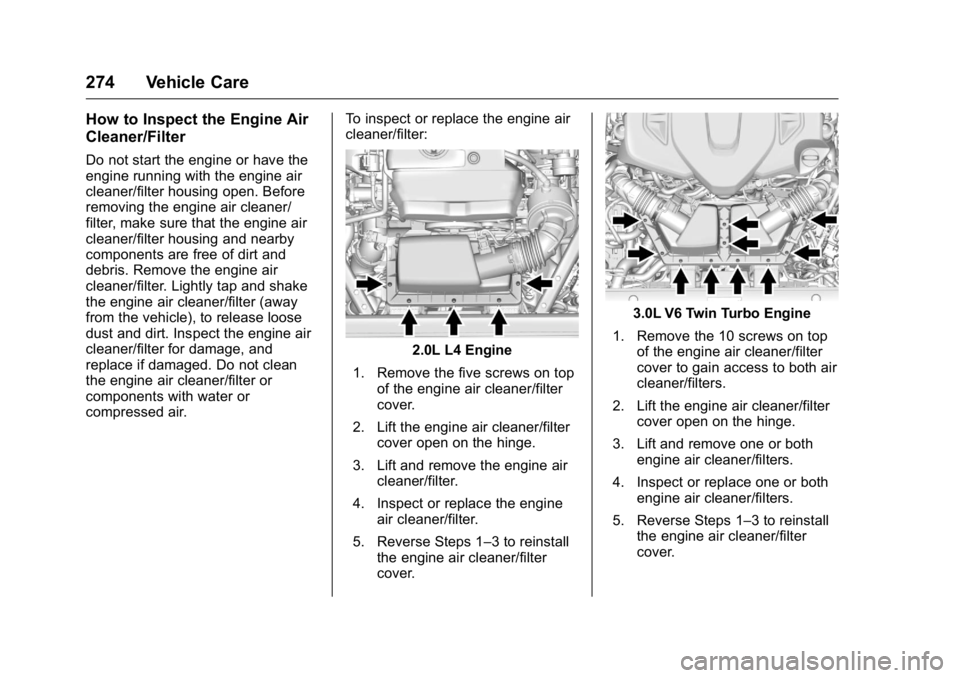
2.0L L4 Engine
1. Remove the five screws on top
of the engine air cleaner/filter
cover.
2. Lift the engine air cleaner/filter
cover open on the hinge.
3. Lift and remove the engine air
cleaner/filter.
4. Inspect or replace the engine
air cleaner/filter.
5. Reverse Steps 1 – 3 to reinstall
the engine air cleaner/filter
cover. 3.0L V6 Twin Turbo Engine
1. Remove the 10 screws on top
of the engine air cleaner/filter
cover to gain access to both air
cleaner/filters.
2. Lift the engine air cleaner/filter
cover open on the hinge.
3. Lift and remove one or both
engine air cleaner/filters.
4. Inspect or replace one or both
engine air cleaner/filters.
5. Reverse Steps 1 – 3 to reinstall
the engine air cleaner/filter
cover.
Page 281 of 397

Cadillac CT6 Owner Manual (GMNA-Localizing-U.S./Canada-9235592) -
2016 - crc - 11/6/15
280 Vehicle Care 5. Replace the pressure cap
tightly.
6. Verify coolant level after the
engine is shut off and the
coolant is cold. If necessary,
repeat coolant fill procedure
Steps 1 – 6.
If the coolant still is not at the
proper level when the system
cools down again, see your
dealer.
CautionIf the pressure cap is not tightly
installed, coolant loss and
possible engine damage may
occur. Be sure the cap is properly
and tightly secured.
Engine Overheating The vehicle has several indicators
to warn of the engine overheating.
There is an engine coolant
temperature gauge and an engine
coolant temperature warning light on the instrument cluster. See Engine
Coolant Temperature Gauge 0 128
and Engine Coolant Temperature
Warning Light 0 137 . The vehicle
may also display a message on the
Driver Information Center (DIC).
See Engine Cooling System
Messages 0 149 .
If the decision is made not to lift the
hood when this warning appears,
get service help right away. See
Roadside Service 0 364 .
If the decision is made to lift the
hood, make sure the vehicle is
parked on a level surface. Then
check to see if the engine cooling
fan is running. If the engine is
overheating, the fan should be
running. If it is not, do not continue
to run the engine. Have the vehicle
serviced.
Caution
Running the engine without
coolant may cause damage or a
fire. Vehicle damage would not be
covered by the vehicle warranty. If Steam Is Coming from the
Engine Compartment
{ WarningSteam from an overheated engine
can burn you badly, even if you
just open the hood. Stay away
from the engine if you see or hear
steam coming from it. Just turn it
off and get everyone away from
the vehicle until it cools down.
Wait until there is no sign of
steam or coolant before you open
the hood.
If you keep driving when the
engine is overheated, the liquids
in it can catch fire. You or others
could be badly burned. Stop the
engine if it overheats, and get out
of the vehicle until the engine
is cool.
If No Steam Is Coming from
the Engine Compartment
If an engine overheat warning is
displayed but no steam can be seen
or heard, the problem may not be
Page 282 of 397

Cadillac CT6 Owner Manual (GMNA-Localizing-U.S./Canada-9235592) -
2016 - crc - 11/6/15
Vehicle Care 281too serious. Sometimes the engine
can get a little too hot when the
vehicle:
.
Climbs a long hill on a hot day.
.
Stops after high-speed driving.
.
Idles for long periods in traffic.
If the overheat warning is displayed
with no sign of steam:
1. Turn the air conditioning off.
2. Turn the heater on to the
highest temperature and to the
highest fan speed. Open the
windows as necessary.
3. When it is safe to do so, pull off
the road, shift to P (Park) or
N (Neutral), and let the
engine idle.
If the engine coolant temperature
gauge is no longer in the
overheated area or the engine
coolant temperature warning light no
longer displays, the vehicle can be
driven. Continue to drive the vehicle
slowly for about 10 minutes. Keep a
safe distance from the vehicle in
front. If the warning does not come back on, continue to drive normally
and have the cooling system
checked for proper fill and function.
If the warning continues, pull over,
stop, and park the vehicle
right away.
If there is no sign of steam, idle the
engine for three minutes while
parked. If the warning is still
displayed, turn off the engine until it
cools down.
Washer Fluid What to Use When windshield washer fluid is
needed, be sure to read the
manufacturer's instructions before
use. If operating the vehicle in an
area where the temperature may fall
below freezing, use a fluid that has
sufficient protection against
freezing. Adding Washer Fluid
Open the cap with the washer
symbol on it. Add washer fluid until
the tank is full. See Engine
Compartment Overview 0 265 for
reservoir location.
Caution .
Do not use washer fluid that
contains any type of water
repellent coating. This can
cause the wiper blades to
chatter or skip.
.
Do not use engine coolant
(antifreeze) in the
windshield washer. It can
damage the windshield
washer system and paint.
(Continued)
Page 283 of 397
Cadillac CT6 Owner Manual (GMNA-Localizing-U.S./Canada-9235592) -
2016 - crc - 11/6/15
282 Vehicle Care Caution (Continued).
Do not mix water with
ready-to-use washer fluid.
Water can cause the
solution to freeze and
damage the washer fluid
tank and other parts of the
washer system.
.
When using concentrated
washer fluid, follow the
manufacturer instructions for
adding water.
.
Fill the washer fluid tank
only three-quarters full when
it is very cold. This allows
for fluid expansion if
freezing occurs, which could
damage the tank if it is
completely full.
Brakes Disc brake pads have built-in wear
indicators that make a high-pitched
warning sound when the brake pads
are worn and new pads are needed.
The sound can come and go or can be heard all the time when the
vehicle is moving, except when
applying the brake pedal firmly.
{ WarningThe brake wear warning sound
means that soon the brakes will
not work well. That could lead to
a crash. When the brake wear
warning sound is heard, have the
vehicle serviced.
CautionContinuing to drive with worn-out
brake pads could result in costly
brake repair.
Some driving conditions or climates
can cause a brake squeal when the
brakes are first applied or lightly
applied. This does not mean
something is wrong with the brakes.
Properly torqued wheel nuts are
necessary to help prevent brake
pulsation. When tires are rotated,
inspect brake pads for wear and evenly tighten wheel nuts in the
proper sequence to torque
specifications. See Capacities and
Specifications 0 358 .
Brake pads should be replaced as
complete sets.
Brake Pedal Travel See your dealer if the brake pedal
does not return to normal height,
or if there is a rapid increase in
pedal travel. This could be a sign
that brake service may be required.
Replacing Brake System Parts Always replace brake system parts
with new, approved replacement
parts. If this is not done, the brakes
may not work properly. The braking
performance expected can change
in many other ways if the wrong
replacement brake parts are
installed or if parts are improperly
installed.
Page 284 of 397

Cadillac CT6 Owner Manual (GMNA-Localizing-U.S./Canada-9235592) -
2016 - crc - 11/6/15
Vehicle Care 283
Brake Fluid The brake master cylinder reservoir
is filled with GM approved DOT 3
brake fluid as indicated on the
reservoir cap. See Engine
Compartment Overview 0 265 for
the location of the reservoir.
Checking Brake Fluid
With the vehicle in P (Park) on a
level surface, the brake fluid level
should be between the minimum
and maximum marks on the brake
fluid reservoir.
There are only two reasons why the
brake fluid level in the reservoir may
go down:
.
Normal brake lining wear. When
new linings are installed, the
fluid level goes back up. .
A fluid leak in the brake
hydraulic system. Have the
brake hydraulic system fixed.
With a leak, the brakes will not
work well.
Always clean the brake fluid
reservoir cap and the area around
the cap before removing it.
Do not top off the brake fluid.
Adding fluid does not correct a leak.
If fluid is added when the linings are
worn, there will be too much fluid
when new brake linings are
installed. Add or remove fluid, as
necessary, only when work is done
on the brake hydraulic system.
{ Warning
If too much brake fluid is added, it
can spill on the engine and burn,
if the engine is hot enough. You
or others could be burned, and
the vehicle could be damaged.
Add brake fluid only when work is
done on the brake hydraulic
system. When the brake fluid falls to a low
level, the brake warning light comes
on. See Brake System Warning
Light 0 133 .
Brake fluid absorbs water over time
which degrades the effectiveness of
the brake fluid. Replace brake fluid
at the specified intervals to prevent
increased stopping distance. See
Maintenance Schedule 0 344 .
What to Add
Use only GM approved DOT 3
brake fluid from a clean, sealed
container. See Recommended
Fluids and Lubricants 0 353 .
{ Warning
The wrong or contaminated brake
fluid could result in damage to the
brake system. This could result in
the loss of braking leading to a
possible injury. Always use the
proper GM approved brake fluid.
Page 289 of 397
Cadillac CT6 Owner Manual (GMNA-Localizing-U.S./Canada-9235592) -
2016 - crc - 11/6/15
288 Vehicle Care
Bulb Replacement For the proper type of replacement
bulbs, see Replacement
Bulbs 0 289 .
For any bulb-changing procedure
not listed in this section, contact
your dealer.
LED Lighting This vehicle has several LED lamps.
For replacement of any LED lighting
assembly not listed here, contact
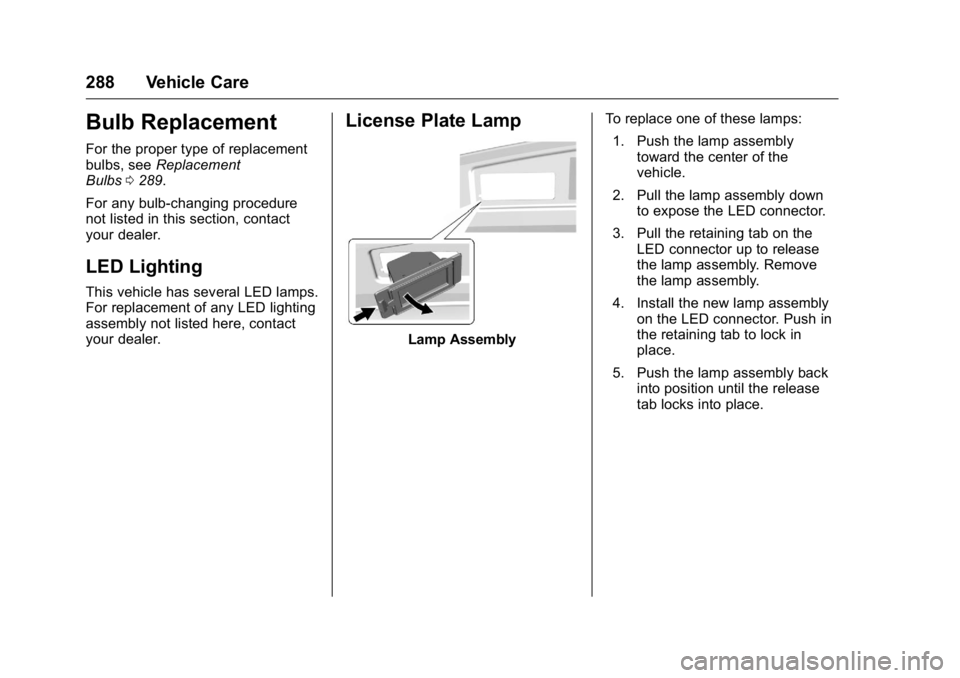
your dealer. License Plate Lamp
Lamp Assembly To replace one of these lamps:
1. Push the lamp assembly
toward the center of the
vehicle.
2. Pull the lamp assembly down
to expose the LED connector.
3. Pull the retaining tab on the
LED connector up to release
the lamp assembly. Remove
the lamp assembly.
4. Install the new lamp assembly
on the LED connector. Push in
the retaining tab to lock in
place.
5. Push the lamp assembly back
into position until the release
tab locks into place.
Page 306 of 397
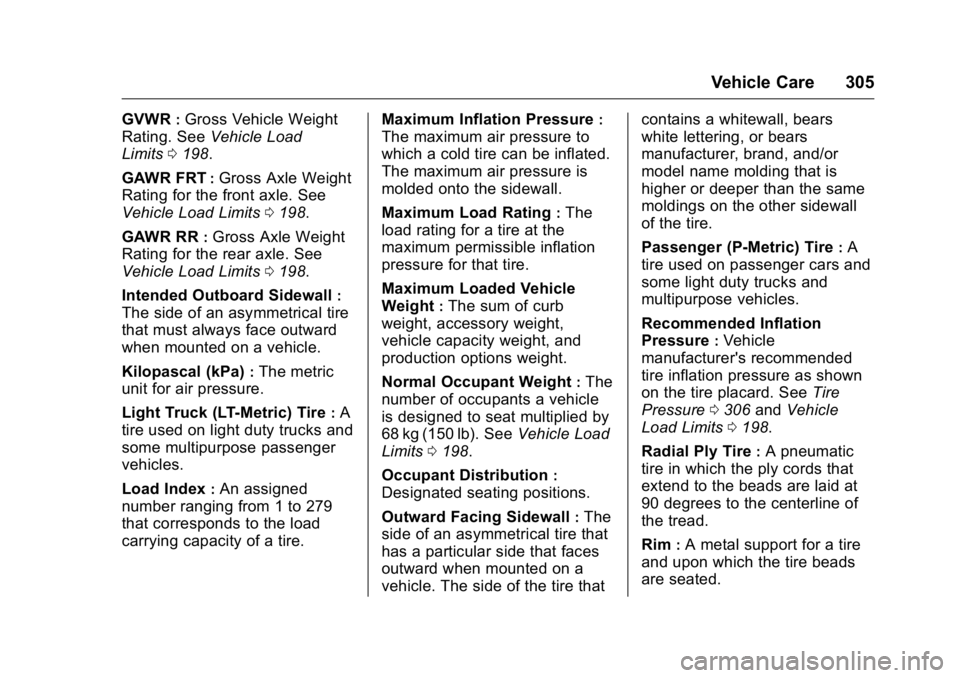
Cadillac CT6 Owner Manual (GMNA-Localizing-U.S./Canada-9235592) -
2016 - crc - 11/6/15
Vehicle Care 305GVWR :
Gross Vehicle Weight
Rating. See Vehicle Load
Limits 0 198 .
GAWR FRT :
Gross Axle Weight
Rating for the front axle. See
Vehicle Load Limits 0 198 .
GAWR RR :
Gross Axle Weight
Rating for the rear axle. See
Vehicle Load Limits 0 198 .
Intended Outboard Sidewall :
The side of an asymmetrical tire
that must always face outward
when mounted on a vehicle.
Kilopascal (kPa) :
The metric
unit for air pressure.
Light Truck (LT-Metric) Tire :
A
tire used on light duty trucks and
some multipurpose passenger
vehicles.
Load Index :
An assigned
number ranging from 1 to 279
that corresponds to the load
carrying capacity of a tire. Maximum Inflation Pressure :
The maximum air pressure to
which a cold tire can be inflated.
The maximum air pressure is
molded onto the sidewall.
Maximum Load Rating :
The
load rating for a tire at the
maximum permissible inflation
pressure for that tire.
Maximum Loaded Vehicle
Weight :
The sum of curb
weight, accessory weight,
vehicle capacity weight, and
production options weight.
Normal Occupant Weight :
The
number of occupants a vehicle
is designed to seat multiplied by
68 kg (150 lb). See Vehicle Load
Limits 0 198 .
Occupant Distribution :
Designated seating positions.
Outward Facing Sidewall :
The
side of an asymmetrical tire that
has a particular side that faces
outward when mounted on a
vehicle. The side of the tire that contains a whitewall, bears
white lettering, or bears
manufacturer, brand, and/or
model name molding that is
higher or deeper than the same
moldings on the other sidewall
of the tire.
Passenger (P-Metric) Tire :
A
tire used on passenger cars and
some light duty trucks and
multipurpose vehicles.
Recommended Inflation
Pressure :
Vehicle
manufacturer's recommended
tire inflation pressure as shown
on the tire placard. See Tire
Pressure 0 306 and Vehicle
Load Limits 0 198 .
Radial Ply Tire :
A pneumatic
tire in which the ply cords that
extend to the beads are laid at
90 degrees to the centerline of
the tread.
Rim :
A metal support for a tire
and upon which the tire beads
are seated.