heating CADILLAC CT6 2016 Owners Manual
[x] Cancel search | Manufacturer: CADILLAC, Model Year: 2016, Model line: CT6, Model: CADILLAC CT6 2016Pages: 397, PDF Size: 7.09 MB
Page 20 of 397

Cadillac CT6 Owner Manual (GMNA-Localizing-U.S./Canada-9235592) -
2016 - crc - 11/6/15
In Brief 19
Climate Controls The climate control buttons and the touch screen are used to adjust the
heating, cooling, and ventilation.
Dual and Quad Zone Climate Control Buttons
1. Driver and Passenger
Temperature Controls
2. Fan Control
3. Driver and Passenger Heated
and Ventilated Seats (If
Equipped) 4. Rear Window Defogger
5. Defrost
6. OFF (Fan)
7. Recirculation
8. AUTO (Automatic Operation) Climate Touch Screen Controls
1. Outside Temperature Display
2. Driver and Passenger
Temperature Controls
3. Fan Control
4. A/C (Air Conditioning)
5. Climate Control Selection
(Application Tray Button)
6. SYNC (Synchronized
Temperature)
7. Driver and Passenger Air
Delivery Mode Controls
8. Defog
Page 112 of 397

Cadillac CT6 Owner Manual (GMNA-Localizing-U.S./Canada-9235592) -
2016 - crc - 11/6/15
Instruments and Controls 111
Steering Wheel Controls The infotainment system can be
operated by using the steering
wheel controls. See "Steering
Wheel Controls" in the infotainment
manual.
Heated Steering Wheel
( : If equipped with a heated
steering wheel, press to turn on or
off. An indicator next to the button is
lit when the feature is turned on.
The steering wheel takes about
three minutes to start heating. Horn Press
a on the steering wheel pad
to sound the horn.
Windshield Wiper/Washer
With the ignition in ACC/
ACCESSORY or ON/RUN, move
the windshield wiper lever to select
the wiper speed.
HI : Use for fast wipes.
LO : Use for slow wipes. AUTO : Use this setting for
intermittent wipes or Rainsense ™ ,
when enabled. For intermittent
wipes, move the lever up to AUTO,
then turn the band on the wiper
lever up for more frequent wipes or
down for less frequent wipes.
If Rainsense is enabled, see
“ Rainsense ™ ” later in this section.
If the windshield wipers are in use
while driving, the exterior lamps
come on automatically if the exterior
lamp control is in AUTO. The
transition time for the lamps coming
on varies based on wiper speed.
See “ Lights On with Wipers ” under
Automatic Headlamp System 0 172 .
OFF : Use to turn the wipers off.
Page 138 of 397

Cadillac CT6 Owner Manual (GMNA-Localizing-U.S./Canada-9235592) -
2016 - crc - 11/6/15
Instruments and Controls 137
Traction Control System
(TCS)/StabiliTrak ®
Light
This light comes on briefly when the
engine is started.
If the light does not come on, have
the vehicle serviced by your dealer.
If the system is working normally,
the indicator light turns off.
If the light is on and not flashing, the
TCS and potentially the StabiliTrak
system have been disabled.
A Driver Information Center (DIC)
message may display. Check the
DIC messages to determine which
feature(s) is no longer functioning
and whether the vehicle requires
service.
If the light is on and flashing, the
TCS and/or the StabiliTrak system
is actively working. See Traction Control/Electronic
Stability Control 0 217 .
Engine Coolant
Temperature Warning
Light
On some vehicles this light comes
on briefly while starting the vehicle.
If it does not, have the vehicle
serviced by the dealer. If the system
is working normally the indicator
light goes off. For vehicles with the
reconfigurable cluster, this light may
not come on when starting the
vehicle. CautionThe engine coolant temperature
warning light indicates that the
vehicle has overheated. Driving
with this light on can damage the
engine and it may not be covered
by the vehicle warranty. See
Engine Overheating 0 280 .
The engine coolant temperature
warning light comes on when the
engine has overheated.
If this happens pull over and turn off
the engine as soon as possible. See
Engine Overheating 0 280 .
Tire Pressure Light
Page 150 of 397

Cadillac CT6 Owner Manual (GMNA-Localizing-U.S./Canada-9235592) -
2016 - crc - 11/6/15
Instruments and Controls 149TRUNK OPEN This message will display along with
a symbol when the trunk is open.
Close the trunk completely.
Engine Cooling System
Messages A/C OFF DUE TO HIGH
ENGINE TEMP This message displays when the
engine coolant becomes hotter than
the normal operating temperature.
To avoid added strain on a hot
engine, the air conditioning
compressor automatically turns off.
When the coolant temperature
returns to normal, the air
conditioning compressor turns back
on. The vehicle can continue to be
driven.
If this message continues to appear,
have the system repaired by your
dealer as soon as possible to avoid
damage to the engine. COOLANT LEVEL LOW ADD
COOLANT This message will display if the
coolant is low. See Engine
Coolant 0 277 .
ENGINE OVERHEATED —
IDLE ENGINE This message displays when the
engine coolant temperature is too
hot. Stop and allow the vehicle to
idle until it cools down.
ENGINE OVERHEATED —
STOP ENGINE This message displays and a
continuous chime sounds if the
engine cooling system reaches
unsafe temperatures for operation.
Stop and turn off the vehicle as
soon as it is safe to do so to avoid
severe damage. This message
clears when the engine has cooled
to a safe operating temperature. HIGH COOLANT
TEMPERATURE This message may display if the
coolant temperature is hot. See
Engine Overheating 0 280 .
Engine Oil Messages CHANGE ENGINE OIL SOON This message displays when the
engine oil needs to be changed.
When you change the engine oil, be
sure to reset the oil life system. See
Engine Oil Life System 0 272 , Driver
Information Center (DIC) 0 140 ,
Engine Oil 0 270 , and Maintenance
Schedule 0 344 .
ENGINE OIL HOT, IDLE
ENGINE This message displays when the
engine oil temperature is too hot.
Stop and allow the vehicle to idle
until it cools down.
ENGINE OIL LOW — ADD OIL
On some vehicles, this message
displays when the engine oil level
may be too low. Check the oil level
Page 179 of 397
Cadillac CT6 Owner Manual (GMNA-Localizing-U.S./Canada-9235592) -
2016 - crc - 11/6/15
178 Climate Controls
Climate Controls Climate Control Systems Automatic Climate Control
System (Quad Zone) . . . . . . . . 178
Automatic Climate Control
System (Dual Zone) . . . . . . . . . 185
Air Vents Air Vents . . . . . . . . . . . . . . . . . . . . . 189
Maintenance Passenger Compartment Air
Filter . . . . . . . . . . . . . . . . . . . . . . . . 190
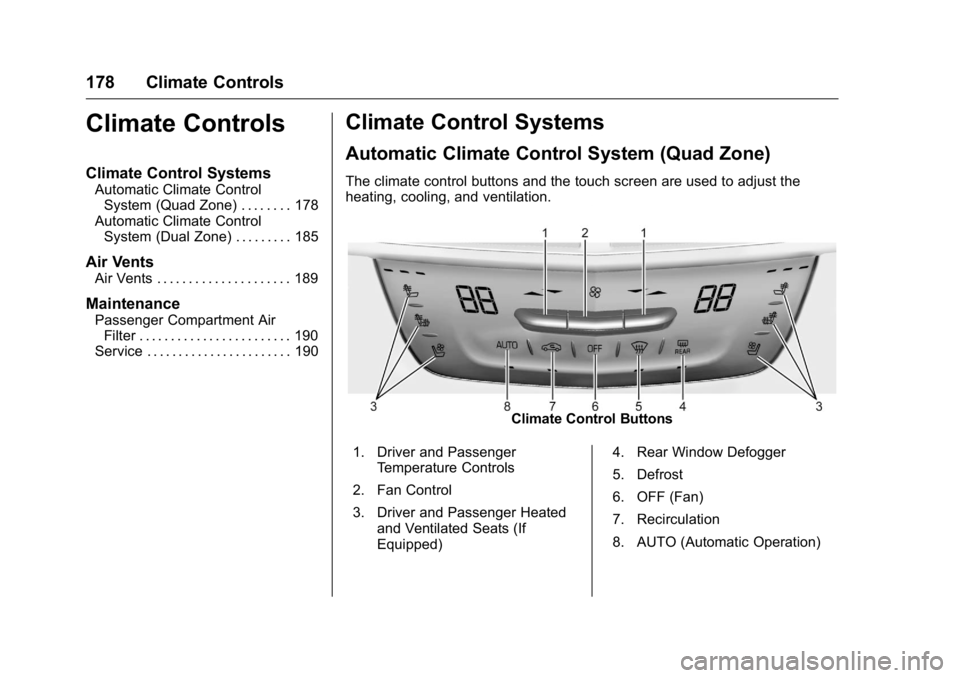
Service . . . . . . . . . . . . . . . . . . . . . . . 190 Climate Control Systems Automatic Climate Control System (Quad Zone) The climate control buttons and the touch screen are used to adjust the
heating, cooling, and ventilation.
Climate Control Buttons
1. Driver and Passenger
Temperature Controls
2. Fan Control
3. Driver and Passenger Heated
and Ventilated Seats (If
Equipped) 4. Rear Window Defogger
5. Defrost
6. OFF (Fan)
7. Recirculation
8. AUTO (Automatic Operation)
Page 186 of 397

Cadillac CT6 Owner Manual (GMNA-Localizing-U.S./Canada-9235592) -
2016 - crc - 11/6/15
Climate Controls 185
Automatic Climate Control System (Dual Zone) The climate control buttons and the touch screen are used to adjust the
heating, cooling, and ventilation.
Climate Control Buttons
1. Driver and Passenger
Temperature Controls
2. Fan Control
3. Driver and Passenger Heated
and Ventilated Seats (If
Equipped) 4. Rear Window Defogger
5. Defrost
6. OFF (Fan)
7. Recirculation
8. AUTO (Automatic Operation) Climate Touch Screen Controls
1. Outside Temperature Display
2. Driver and Passenger
Temperature Controls
3. Fan Control
4. A/C (Air Conditioning)
5. Climate Control Selection
(Application Tray Button)
6. SYNC (Synchronized
Temperature)
7. Driver and Passenger Air
Delivery Mode Controls
8. Defog
Page 197 of 397

Cadillac CT6 Owner Manual (GMNA-Localizing-U.S./Canada-9235592) -
2016 - crc - 11/6/15
196 Driving and Operating Warning (Continued)After driving through a large
puddle of water or a car/vehicle
wash, lightly apply the brake
pedal until the brakes work
normally.
Flowing or rushing water creates
strong forces. Driving through
flowing water could cause the
vehicle to be carried away. If this
happens, you and other vehicle
occupants could drown. Do not
ignore police warnings and be
very cautious about trying to drive
through flowing water.
Hydroplaning Hydroplaning is dangerous. Water
can build up under the vehicle's
tires so they actually ride on the
water. This can happen if the road is
wet enough and you are going fast
enough. When the vehicle is
hydroplaning, it has little or no
contact with the road. There is no hard and fast rule about
hydroplaning. The best advice is to
slow down when the road is wet.
Other Rainy Weather Tips Besides slowing down, other wet
weather driving tips include:
.
Allow extra following distance.
.
Pass with caution.
.
Keep windshield wiping
equipment in good shape.
.
Keep the windshield washer fluid
reservoir filled.
.
Have good tires with proper
tread depth. See Tires 0 299 .
.
Turn off cruise control.
Hill and Mountain Roads Driving on steep hills or through
mountains is different than driving
on flat or rolling terrain. Tips include:
.
Keep the vehicle serviced and in
good shape.
.
Check all fluid levels and brakes,
tires, cooling system, and
transmission. .
Shift to a lower gear when going
down steep or long hills.
{ WarningUsing the brakes to slow the
vehicle on a long downhill slope
can cause brake overheating, can
reduce brake performance, and
could result in a loss of braking.
Shift the transmission to a lower
gear to let the engine assist the
brakes on a steep downhill slope.
{ WarningCoasting downhill in N (Neutral)
or with the ignition off is
dangerous. This can cause
overheating of the brakes and
loss of steering. Always have the
engine running and the vehicle
in gear.
.
Drive at speeds that keep the
vehicle in its own lane. Do not
swing wide or cross the
center line.
Page 208 of 397

Cadillac CT6 Owner Manual (GMNA-Localizing-U.S./Canada-9235592) -
2016 - crc - 11/6/15
Driving and Operating 207
{ WarningImproper use of the heater cord
or an extension cord can damage
the cord and may result in
overheating and fire.
.
Plug the cord into a
three-prong electrical utility
receptacle that is protected
by a ground fault detection
function. An ungrounded
outlet could cause an
electric shock.
.
Use a weatherproof,
heavy-duty, 15 amp-rated
extension cord if needed.
Failure to use the
recommended extension
cord in good operating
condition, or using a
damaged heater or
extension cord, could make
(Continued) Warning (Continued) it overheat and cause a fire,
property damage, electric
shock, and injury.
.
Do not operate the vehicle
with the heater cord
permanently attached to the
vehicle. Possible heater
cord and thermostat
damage could occur.
.
While in use, do not let the
heater cord touch vehicle
parts or sharp edges. Never
close the hood on the
heater cord.
.
Before starting the vehicle,
unplug the cord, reattach
the cover to the plug, and
securely fasten the cord.
Keep the cord away from
any moving parts.
4. Before starting the engine, be
sure to unplug and store the
cord as it was before to keep it away from moving engine
parts. If you do not, it could be
damaged.
Contact your dealer for information
on how long to use the heater in
your particular area.
Shifting Into Park To shift into P (Park):
1. Hold the brake pedal down and
set the parking brake.
See Electric Parking
Brake 0 214 .
2. Move the shift lever into
P (Park) by holding in the
button on the shift lever and
pushing the lever all the way
toward the front of the vehicle.
3. Turn the ignition off.
4. Take the Remote Keyless Entry
(RKE) transmitter with you.
Page 258 of 397

Cadillac CT6 Owner Manual (GMNA-Localizing-U.S./Canada-9235592) -
2016 - crc - 11/6/15
Driving and Operating 257necessary to go much farther
beyond the passed vehicle before
returning to the lane.
Backing Up Hold the bottom of the steering
wheel with one hand. To move the
trailer to the left, move that hand to
the left. To move the trailer to the
right, move your hand to the right.
Always back up slowly and,
if possible, have someone
guide you.
Making Turns
CautionMaking very sharp turns while
trailering could cause the trailer to
come in contact with the vehicle.
The vehicle could be damaged.
Avoid making very sharp turns
while trailering.
When turning with a trailer, make
wider turns than normal. Do this so
the trailer will not strike soft
shoulders, curbs, road signs, trees, or other objects. Avoid jerky or
sudden maneuvers. Signal well in
advance.
If the trailer turn signal bulbs burn
out, the arrows on the instrument
cluster will still flash for turns. It is
important to check occasionally to
be sure the trailer bulbs are still
working.
Driving on Grades Reduce speed and shift to a lower
gear before starting down a long or
steep downgrade. If the
transmission is not shifted down, the
brakes might get hot and no longer
work well.
Vehicles can tow in D (Drive). Shift
the transmission to a lower gear if
the transmission shifts too often
under heavy loads and/or hilly
conditions.
When towing at high altitude on
steep uphill grades, consider the
following: Engine coolant will boil at
a lower temperature than at normal
altitudes. If the engine is turned off
immediately after towing at high
altitude on steep uphill grades, the vehicle may show signs similar to
engine overheating. To avoid this,
let the engine run while parked,
preferably on level ground, with the
automatic transmission in P (Park)
for a few minutes before turning the
engine off. If the overheat warning
comes on, see Engine
Overheating 0 280 .
Parking on Hills
{ WarningParking the vehicle on a hill with
the trailer attached can be
dangerous. If something goes
wrong, the rig could start to move.
People can be injured, and both
the vehicle and the trailer can be
damaged. When possible, always
park the rig on a flat surface.
If parking the rig on a hill:
1. Press the brake pedal, but do
not shift into P (Park) yet. Turn
the wheels into the curb if
facing downhill or into traffic if
facing uphill.
Page 262 of 397

Cadillac CT6 Owner Manual (GMNA-Localizing-U.S./Canada-9235592) -
2016 - crc - 11/6/15
Vehicle Care 261
Vehicle Care General Information General Information . . . . . . . . . . 262
California Proposition
65 Warning . . . . . . . . . . . . . . . . . 262
California Perchlorate
Materials Requirements . . . . . 262
Accessories and
Modifications . . . . . . . . . . . . . . . . 262
Vehicle Checks Doing Your Own
Service Work . . . . . . . . . . . . . . . 263
Hood . . . . . . . . . . . . . . . . . . . . . . . . . 264
Engine Compartment
Overview . . . . . . . . . . . . . . . . . . . . 265
Engine Oil . . . . . . . . . . . . . . . . . . . . 270
Engine Oil Life System . . . . . . . 272
Automatic Transmission
Fluid . . . . . . . . . . . . . . . . . . . . . . . . 273
Engine Air Cleaner/Filter . . . . . . 273
Cooling System . . . . . . . . . . . . . . 275
Engine Coolant . . . . . . . . . . . . . . . 277
Engine Overheating . . . . . . . . . . 280
Washer Fluid . . . . . . . . . . . . . . . . . 281
Brakes . . . . . . . . . . . . . . . . . . . . . . . 282
Brake Fluid . . . . . . . . . . . . . . . . . . . 283
Battery - North America . . . . . . 284
All-Wheel Drive . . . . . . . . . . . . . . . 284 Starter Switch Check . . . . . . . . . 285
Automatic Transmission Shift
Lock Control Function
Check . . . . . . . . . . . . . . . . . . . . . . . 285
Park Brake and P (Park)
Mechanism Check . . . . . . . . . . 286
Wiper Blade Replacement . . . . 286
Windshield Replacement . . . . . 287
Headlamp Aiming Headlamp Aiming . . . . . . . . . . . . 287
Bulb Replacement Bulb Replacement . . . . . . . . . . . . 288
LED Lighting . . . . . . . . . . . . . . . . . 288
License Plate Lamp . . . . . . . . . . 288
Replacement Bulbs . . . . . . . . . . . 289
Electrical System Electrical System Overload . . . 289
Fuses and Circuit Breakers . . . 290
Engine Compartment Fuse
Block . . . . . . . . . . . . . . . . . . . . . . . . 290
Instrument Panel Fuse
Block . . . . . . . . . . . . . . . . . . . . . . . . 293
Rear Compartment Fuse
Block . . . . . . . . . . . . . . . . . . . . . . . . 295
Wheels and Tires
Tires . . . . . . . . . . . . . . . . . . . . . . . . . . 299
All-Season Tires . . . . . . . . . . . . . . 300
Winter Tires . . . . . . . . . . . . . . . . . . 300 Low-Profile Tires . . . . . . . . . . . . . 300
Summer Tires . . . . . . . . . . . . . . . . 301
Tire Sidewall Labeling . . . . . . . . 301
Tire Designations . . . . . . . . . . . . . 303
Tire Terminology and
Definitions . . . . . . . . . . . . . . . . . . 304
Tire Pressure . . . . . . . . . . . . . . . . . 306
Tire Pressure for High-Speed
Operation . . . . . . . . . . . . . . . . . . . 308
Tire Pressure Monitor
System . . . . . . . . . . . . . . . . . . . . . . 308
Tire Pressure Monitor
Operation . . . . . . . . . . . . . . . . . . . 309
Tire Inspection . . . . . . . . . . . . . . . . 312
Tire Rotation . . . . . . . . . . . . . . . . . 313
When It Is Time for New
Tires . . . . . . . . . . . . . . . . . . . . . . . . 314
Buying New Tires . . . . . . . . . . . . . 315
Different Size Tires and
Wheels . . . . . . . . . . . . . . . . . . . . . . 316
Uniform Tire Quality
Grading . . . . . . . . . . . . . . . . . . . . . 316
Wheel Alignment and Tire
Balance . . . . . . . . . . . . . . . . . . . . . 318
Wheel Replacement . . . . . . . . . . 318
Tire Chains . . . . . . . . . . . . . . . . . . . 319
If a Tire Goes Flat . . . . . . . . . . . . 320
Tire Changing . . . . . . . . . . . . . . . . 321
Compact Spare Tire . . . . . . . . . . 326