automatic transmission CADILLAC CT6 2018 1.G User Guide
[x] Cancel search | Manufacturer: CADILLAC, Model Year: 2018, Model line: CT6, Model: CADILLAC CT6 2018 1.GPages: 445, PDF Size: 7.7 MB
Page 223 of 445
Cadillac CT6 Owner Manual (GMNA-Localizing-U.S./Canada-11292458) -
2018 - crc - 2/14/17
222 DRIVING AND OPERATING
too much gasoline. Try pushing
the accelerator pedal all the way
to the floor and holding it there
as you press ENGINE START/
STOP. Wait at least 15 seconds
between each try, to allow the
cranking motor to cool down.
When the engine starts, release
the accelerator. If the vehicle
starts briefly but then stops
again, do the same thing. This
clears the extra gasoline from the
engine. Do not race the engine
immediately after starting it.
Operate the engine and
transmission gently until the oil
warms up and lubricates all
moving parts.
Stop/Start System
{Warning
Exiting the vehicle without first
shifting into P (Park) may cause the
vehicle to move. You or others may
be injured. Because the vehicle may
have an auto engine stop/start
feature, the vehicle's engine might(Continued)
Warning (Continued)
seem to be shut off; however, once
the brake pedal is released, the
engine will start up again.
Shift to P (Park) and turn the
ignition off before exiting the
vehicle.
The vehicle has a fuel saving stop/
start system to shut off the engine
and help conserve fuel.
Auto Engine Stop/Start
When the brakes are applied and the
vehicle is at a complete stop, the
engine may turn off. When stopped,
the tachometer may display Auto
Stop, or the Auto Stop light may come
on in the instrument cluster.
See Tachometer 0134 and Auto Stop
Mode (Uplevel Cluster) 0150. When the
brake pedal is released or the
accelerator pedal is pressed, the
engine may restart.
Auto Stop may be deactivated if:
. A minimum vehicle speed is not
reached. .
The engine or transmission is not
at the required operating
temperature.
. The outside temperature is not in
the required operating range,
typically between -10 °C (14 °F)
and 50 °C (122 °F).
. The shift lever is in any gear other
than D (Drive).
. The battery has been recently
disconnected.
. The battery charge is low.
. The interior comfort level has not
reached the required level for the
climate control system or defog
settings.
See Automatic Climate Control
System (Quad Zone - Gasoline Only)
0 197 orAutomatic Climate Control
System (Dual Zone - Gasoline and
PLUG-IN) 0191.
. The Auto Stop time is greater than
two minutes.
Page 232 of 445
Cadillac CT6 Owner Manual (GMNA-Localizing-U.S./Canada-11292458) -
2018 - crc - 2/14/17
DRIVING AND OPERATING 231
Automatic Transmission
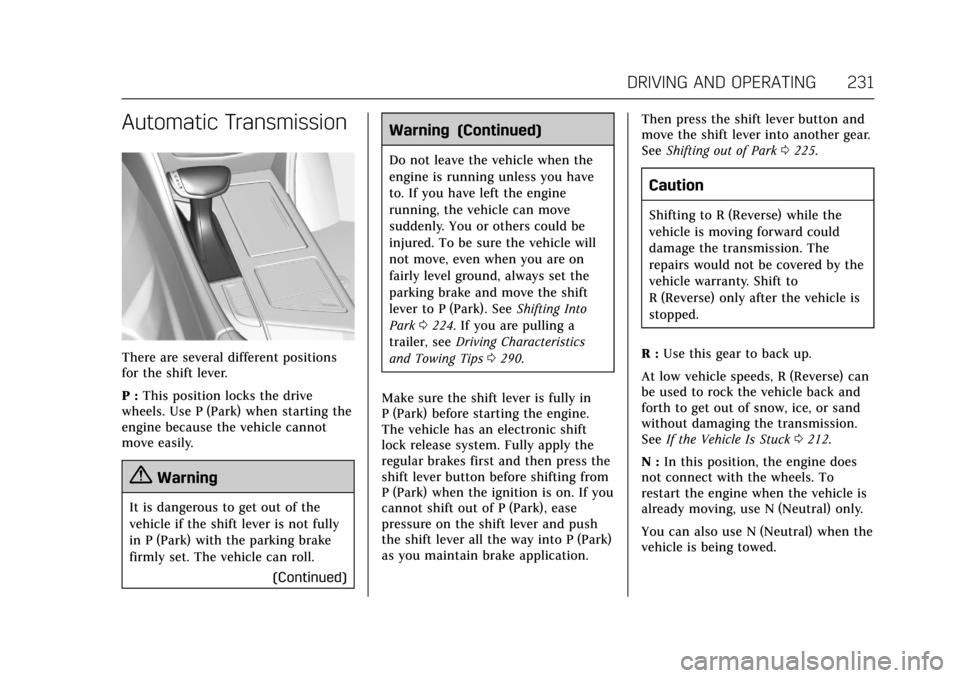
There are several different positions
for the shift lever.
P :This position locks the drive
wheels. Use P (Park) when starting the
engine because the vehicle cannot
move easily.
{Warning
It is dangerous to get out of the
vehicle if the shift lever is not fully
in P (Park) with the parking brake
firmly set. The vehicle can roll.
(Continued)
Warning (Continued)
Do not leave the vehicle when the
engine is running unless you have
to. If you have left the engine
running, the vehicle can move
suddenly. You or others could be
injured. To be sure the vehicle will
not move, even when you are on
fairly level ground, always set the
parking brake and move the shift
lever to P (Park). SeeShifting Into
Park 0224. If you are pulling a
trailer, see Driving Characteristics
and Towing Tips 0290.
Make sure the shift lever is fully in
P (Park) before starting the engine.
The vehicle has an electronic shift
lock release system. Fully apply the
regular brakes first and then press the
shift lever button before shifting from
P (Park) when the ignition is on. If you
cannot shift out of P (Park), ease
pressure on the shift lever and push
the shift lever all the way into P (Park)
as you maintain brake application. Then press the shift lever button and
move the shift lever into another gear.
See
Shifting out of Park 0225.
Caution
Shifting to R (Reverse) while the
vehicle is moving forward could
damage the transmission. The
repairs would not be covered by the
vehicle warranty. Shift to
R (Reverse) only after the vehicle is
stopped.
R : Use this gear to back up.
At low vehicle speeds, R (Reverse) can
be used to rock the vehicle back and
forth to get out of snow, ice, or sand
without damaging the transmission.
See If the Vehicle Is Stuck 0212.
N : In this position, the engine does
not connect with the wheels. To
restart the engine when the vehicle is
already moving, use N (Neutral) only.
You can also use N (Neutral) when the
vehicle is being towed.
Page 233 of 445
Cadillac CT6 Owner Manual (GMNA-Localizing-U.S./Canada-11292458) -
2018 - crc - 2/14/17
232 DRIVING AND OPERATING
{Warning
Shifting into a drive gear while the
engine is running at high speed is
dangerous. Unless your foot is
firmly on the brake pedal, the
vehicle could move very rapidly.
You could lose control and hit
people or objects. Do not shift into
a drive gear while the engine is
running at high speed.
Caution
Shifting out of P (Park) or
N (Neutral) with the engine running
at high speed may damage the
transmission. The repairs would not
be covered by the vehicle warranty.
Be sure the engine is not running at
high speed when shifting the
vehicle.
Caution
A transmission hot message may
display if the automatic
transmission fluid is too hot.
Driving under this condition can
damage the vehicle. Stop and idle
the engine to cool the automatic
transmission fluid. This message
clears when the transmission fluid
has cooled sufficiently.
D : This position is for normal driving.
If more power is needed for passing,
press the accelerator pedal down.
Downshifting the transmission in
slippery road conditions could result
in skidding. See “Skidding”underLoss
of Control 0209.
M : This mode can be entered by
moving the shift lever from D (Drive)
to M (Manual Mode). M (Manual
Mode) allows the driver to select gears
appropriate for current driving
conditions. M (Manual Mode) can be
exited by returning the shift lever to
D (Drive). See Manual Mode (Gasoline
Only) 0233. For PLUG-IN vehicles, see
Regenerative
Braking (PLUG-IN Only) 0237.Caution
Spinning the tires or holding the
vehicle in one place on a hill using
only the accelerator pedal may
damage the transmission. The
repair will not be covered by the
vehicle warranty. If the vehicle is
stuck, do not spin the tires. When
stopping on a hill, use the brakes to
hold the vehicle in place.
While in Sport Mode, the vehicle
monitors driving behavior and
automatically enables performance
shift features when spirited driving is
detected. These features maintain
lower transmission gears to increase
available engine braking and improve
acceleration response. The vehicle will
exit these features and return to
normal operation after a short period
when no spirited driving is detected.
See Driver Mode Control (Gasoline Only)
0 241.
Page 234 of 445
Cadillac CT6 Owner Manual (GMNA-Localizing-U.S./Canada-11292458) -
2018 - crc - 2/14/17
DRIVING AND OPERATING 233
Manual Mode
(Gasoline Only)
For PLUG-IN vehicles, seeRegenerative
Braking (PLUG-IN Only) 0237.
Tap Shift
Caution
Driving with the engine at a high
rpm without upshifting while using
Tap Shift, could damage the vehicle.
Always upshift when necessary
while using Tap Shift.
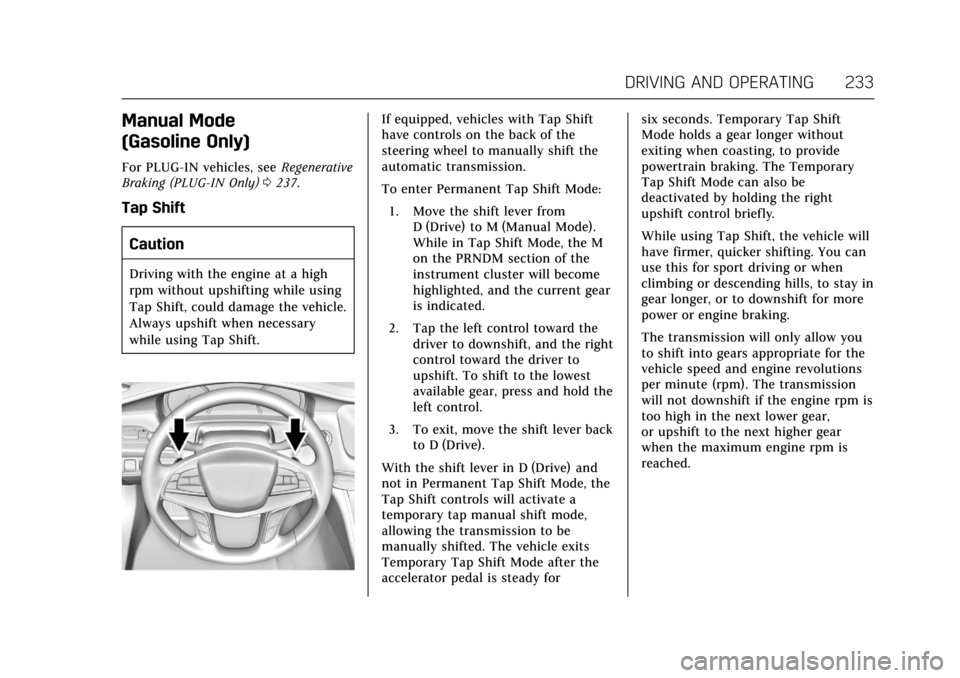
If equipped, vehicles with Tap Shift
have controls on the back of the
steering wheel to manually shift the
automatic transmission.
To enter Permanent Tap Shift Mode: 1. Move the shift lever from D (Drive) to M (Manual Mode).
While in Tap Shift Mode, the M
on the PRNDM section of the
instrument cluster will become
highlighted, and the current gear
is indicated.
2. Tap the left control toward the driver to downshift, and the right
control toward the driver to
upshift. To shift to the lowest
available gear, press and hold the
left control.
3. To exit, move the shift lever back to D (Drive).
With the shift lever in D (Drive) and
not in Permanent Tap Shift Mode, the
Tap Shift controls will activate a
temporary tap manual shift mode,
allowing the transmission to be
manually shifted. The vehicle exits
Temporary Tap Shift Mode after the
accelerator pedal is steady for six seconds. Temporary Tap Shift
Mode holds a gear longer without
exiting when coasting, to provide
powertrain braking. The Temporary
Tap Shift Mode can also be
deactivated by holding the right
upshift control briefly.
While using Tap Shift, the vehicle will
have firmer, quicker shifting. You can
use this for sport driving or when
climbing or descending hills, to stay in
gear longer, or to downshift for more
power or engine braking.
The transmission will only allow you
to shift into gears appropriate for the
vehicle speed and engine revolutions
per minute (rpm). The transmission
will not downshift if the engine rpm is
too high in the next lower gear,
or upshift to the next higher gear
when the maximum engine rpm is
reached.
Page 243 of 445
Cadillac CT6 Owner Manual (GMNA-Localizing-U.S./Canada-11292458) -
2018 - crc - 2/14/17
242 DRIVING AND OPERATING
Sport Mode
Use where road conditions or personal
preference demand a more controlled
response.
When selected, the Sport Mode
indicator light will display in the
instrument cluster.
When in Sport Mode, the vehicle will
shift automatically but may hold a
lower gear longer than it would in the
normal driving mode based on
braking, throttle input, and vehicle
lateral acceleration. SeeAutomatic
Transmission 0231. The steering,
including Active Rear Steer (if
equipped), will change to provide
more precise control.
If the vehicle is equipped with AWD,
Sport Mode sends more torque to the
rear wheels.
Snow/Ice Mode
Use when more traction is needed
during slippery conditions. Snow/Ice
Mode will use a different accelerator
pedal map in order to optimize
traction on slippery surfaces.
When selected, the Snow/Ice Mode
indicator light will display in the
instrument cluster.
This feature is not intended for use
when the vehicle is stuck in sand,
mud, ice, snow, or gravel. If the
vehicle becomes stuck, see If the
Vehicle Is Stuck 0212.
If the vehicle is equipped with AWD,
Snow/Ice Mode will provide more
torque to the front wheels.
Cruise Control
{Warning
Cruise control can be dangerous
where you cannot drive safely at a
steady speed. Do not use cruise
control on winding roads or in
heavy traffic.
Cruise control can be dangerous on
slippery roads. On such roads, fast
changes in tire traction can cause
excessive wheel slip, and you could
lose control. Do not use cruise
control on slippery roads.
With cruise control, a speed of about
40 km/h (25 mph) or more can be
maintained without keeping your foot
on the accelerator. Cruise control does
not work at speeds below about
40 km/h (25 mph).
If the Traction Control/electronic
stability control system begins to limit
wheel spin while using cruise control,
the cruise control automatically
disengages. See Traction Control/
Electronic Stability Control 0239. If a
Page 246 of 445
Cadillac CT6 Owner Manual (GMNA-Localizing-U.S./Canada-11292458) -
2018 - crc - 2/14/17
DRIVING AND OPERATING 245
Ending Cruise Control
There are four ways to end cruise
control:
.Step lightly on the brake pedal.
. Press
*.
. Shift the transmission to
N (Neutral).
. Press
J.
Erasing Speed Memory
The cruise control set speed is erased
from memory if
Jis pressed or if
the ignition is turned off.
Adaptive Cruise Control
If equipped with Adaptive Cruise
Control (ACC), it allows for selecting
the cruise control set speed and
following gap. Read this entire section
before using this system. ACC uses a
camera and radar sensors to detect
other vehicles. See Radio Frequency
Statement 0417. The following gap is
the following time (or distance)
between your vehicle and a vehicle
detected directly ahead in your path, moving in the same direction. If no
vehicle is detected in your path, ACC
works like regular cruise control.
If a vehicle is detected in your path,
ACC can speed up the vehicle or apply
limited, moderate braking to maintain
the selected following gap. To
disengage ACC, apply the brake. If the
Traction Control System (TCS) or
StabiliTrak electronic stability control
system activates while ACC is
engaged, ACC may automatically
disengage. See
Traction Control/
Electronic Stability Control 0239. When
road conditions allow ACC to be safely
used, ACC can be turned back on. ACC
will not engage if the TCS or
StabiliTrak electronic stability control
system is disabled.
{Warning
ACC has limited braking ability and
may not have time to slow the
vehicle down enough to avoid a
collision with another vehicle you
are following. This can occur when
vehicles suddenly slow or stop
(Continued)
Warning (Continued)
ahead, or enter your lane. Also see
“Alerting the Driver”in this section.
Complete attention is always
required while driving and you
should be ready to take action and
apply the brakes. See Defensive
Driving 0207.
{Warning
ACC will not detect or brake for
children, pedestrians, animals,
or other objects.
Do not use ACC when:
. On winding and hilly roads or
when the sensors are blocked
by snow, ice, or dirt. The
system may not detect a
vehicle ahead. Keep the entire
front of the vehicle clean.
(Continued)
Page 292 of 445
Cadillac CT6 Owner Manual (GMNA-Localizing-U.S./Canada-11292458) -
2018 - crc - 2/14/17
DRIVING AND OPERATING 291
.Then during the first 800 km
(500 mi) of trailer towing, do not
drive over 80 km/h (50 mph) and
do not make starts at full throttle.
. Vehicles can tow in D (Drive). Shift
the transmission to a lower gear if
the transmission shifts too often
under heavy loads and/or hilly
conditions.
. Do not use Adaptive Cruise
Control when towing.
. The Forward Automatic Braking
system should be set to Off when
towing. See Forward Automatic
Braking (FAB) 0262.
. The Front Pedestrian Braking
system should be set to Alert or
Off when towing. See Front
Pedestrian Braking (FPB) System
0 264.
. Turn off Parking Assist when
towing.{Warning
When towing a trailer, exhaust
gases may collect at the rear of the
vehicle and enter if the liftgate,
trunk/hatch, or rear-most window
is open.
When towing a trailer:
. Do not drive with the liftgate,
trunk/hatch, or rear-most
window open.
. Fully open the air outlets on
or under the instrument
panel.
. Also adjust the climate
control system to a setting
that brings in only outside air.
See “Climate Control Systems ”
in the Index.
For more information about carbon
monoxide, see Engine Exhaust
0 230.
Towing a trailer requires a certain
amount of experience. The
combination you are driving is longer
and not as responsive as the vehicle itself. Get acquainted with the
handling and braking of the rig before
setting out for the open road.
Before starting, check all trailer hitch
parts and attachments, safety chains,
electrical connectors, lamps, tires, and
mirrors. If the trailer has electric
brakes, start the combination moving
and then apply the trailer brake
controller by hand to be sure the
brakes work.
During the trip, check occasionally to
be sure that the load is secure and the
lamps and any trailer brakes
still work.
Following Distance
Stay at least twice as far behind the
vehicle ahead as you would when
driving the vehicle without a trailer.
This can help to avoid heavy braking
and sudden turns.
Passing
More passing distance is needed when
towing a trailer. The combination will
not accelerate as quickly and is longer
so it is necessary to go much farther
beyond the passed vehicle before
returning to the lane.
Page 293 of 445
Cadillac CT6 Owner Manual (GMNA-Localizing-U.S./Canada-11292458) -
2018 - crc - 2/14/17
292 DRIVING AND OPERATING
Backing Up
Hold the bottom of the steering wheel
with one hand. To move the trailer to
the left, move that hand to the left. To
move the trailer to the right, move
your hand to the right. Always back
up slowly and, if possible, have
someone guide you.
Making TurnsCaution
Making very sharp turns while
trailering could cause the trailer to
come in contact with the vehicle.
The vehicle could be damaged.
Avoid making very sharp turns
while trailering.
When turning with a trailer, make
wider turns than normal. Do this so
the trailer will not strike soft
shoulders, curbs, road signs, trees,
or other objects. Avoid jerky or sudden
maneuvers. Signal well in advance. If the trailer turn signal bulbs burn
out, the arrows on the instrument
cluster will still flash for turns. It is
important to check occasionally to be
sure the trailer bulbs are still working.
Driving on Grades
Reduce speed and shift to a lower gear
before
starting down a long or steep
downgrade. If the transmission is not
shifted down, the brakes might get hot
and no longer work well.
Vehicles can tow in D (Drive). Shift
the transmission to a lower gear if the
transmission shifts too often under
heavy loads and/or hilly conditions.
When towing at high altitude on steep
uphill grades, consider the following:
Engine coolant will boil at a lower
temperature than at normal altitudes.
If the engine is turned off immediately
after towing at high altitude on steep
uphill grades, the vehicle may show
signs similar to engine overheating. To
avoid this, let the engine run while
parked, preferably on level ground,
with the automatic transmission in
P (Park) for a few minutes before turning the engine off. If the overheat
warning comes on, see
Engine
Overheating 0321.
Parking on Hills
{Warning
Parking the vehicle on a hill with
the trailer attached can be
dangerous. If something goes
wrong, the rig could start to move.
People can be injured, and both the
vehicle and the trailer can be
damaged. When possible, always
park the rig on a flat surface.
If parking the rig on a hill: 1. Press the brake pedal, but do not shift into P (Park) yet. Turn the
wheels into the curb if facing
downhill or into traffic if facing
uphill.
2. Have someone place chocks under the trailer wheels.
3. When the wheel chocks are in place, release the regular brakes
until the chocks absorb the load.
Page 294 of 445
Cadillac CT6 Owner Manual (GMNA-Localizing-U.S./Canada-11292458) -
2018 - crc - 2/14/17
DRIVING AND OPERATING 293
4. Reapply the brake pedal. Thenapply the parking brake and shift
into P (Park).
5. Release the brake pedal.
Leaving After Parking on a Hill
1. Apply and hold the brake pedal.
2. Start the engine.
3. Shift into a gear.
4. Release the parking brake.
5. Let up on the brake pedal.
6. Drive slowly until the trailer is clear of the chocks.
7. Stop and have someone pick up and store the chocks.
Maintenance when Trailer
Towing
The vehicle needs service more often
when pulling a trailer. . Things that
are especially important in trailer
operation are automatic transmission
fluid, engine oil, axle lubricant, belts,
cooling system, and brake system. It is
a good idea to inspect these before
and during the trip. Check periodically to see that all hitch
nuts and bolts are tight.
Trailer Towing
(PLUG-IN Only)
The vehicle is neither designed nor
intended to tow a trailer.
Trailer Towing
(Gasoline Only)
Before pulling a trailer, three
important considerations have to do
with weight:
.
Weight of the trailer.
. Weight of the trailer tongue.
. Total weight on your vehicle's
tires.
Weight of the Trailer
How heavy can a trailer safely be?
It should never weigh more than
454 kg (1,000 lb). But even that can be
too heavy.
Safe trailering requires monitoring the
weight, speed, altitude, road grades,
outside temperature, the dimensions of the front of the trailer, and how
frequently the vehicle is used to pull a
trailer. Take into consideration any
special equipment on the vehicle, and
the amount of tongue weight the
vehicle can carry. See
“Weight of the
Trailer Tongue ”later in this section
for more information.
Trailer weight rating (TWR) is
calculated assuming the tow vehicle
has the driver, a front seat passenger,
and all required trailering equipment.
Weight of additional optional
equipment, passengers, and cargo in
the tow vehicle must be subtracted
from the trailer weight rating.
Ask your dealer for trailering
information or advice, or write us at
our Customer Assistance Offices. See
Customer Assistance Offices 0410.Weight of the Trailer Tongue
The tongue weight load (1) of any
trailer is very important because it is
also part of the vehicle weight. The
Gross Vehicle Weight (GVW) includes
the curb weight of the vehicle, any
cargo carried in it, and the people who
will be riding in the vehicle, as well as
trailer tongue weight. Vehicle options,
Page 297 of 445
Cadillac CT6 Owner Manual (GMNA-Localizing-U.S./Canada-11292458) -
2018 - crc - 2/15/17
296 VEHICLE CARE
Vehicle Care
General Information
General Information . . . . . . . . . . . . . 297
California Proposition65 Warning . . . . . . . . . . . . . . . . . . . . . 297
California Perchlorate Materials Requirements . . . . . . . . . . . . . . . . . . . 297
Accessories and Modifications . . . . . . . . . . . . . . . . . . . 298
Vehicle Checks
Doing Your OwnService Work . . . . . . . . . . . . . . . . . . . . 298
Hood . . . . . . . . . . . . . . . . . . . . . . . . . . . . . . 299
Engine Compartment Overview . . . . . . . . . . . . . . . . . . . . . . . . . 300
Engine Oil . . . . . . . . . . . . . . . . . . . . . . . . . 307
Engine Oil Life System . . . . . . . . . . . 309
Automatic Transmission Fluid . . . . . . . . . . . . . . . . . . . . . . . . . . . . . 310
Engine Air Cleaner/Filter . . . . . . . . . 311
Cooling System (Gasoline Only) . . . . . . . . . . . . . . . . . 312
Cooling System (PLUG-IN Only) . . . . . . . . . . . . . . . . . 316
Engine Overheating . . . . . . . . . . . . . . 321
Washer Fluid . . . . . . . . . . . . . . . . . . . . . 322
Brakes . . . . . . . . . . . . . . . . . . . . . . . . . . . . . 322
Brake Fluid . . . . . . . . . . . . . . . . . . . . . . . 323 Battery - North America . . . . . . . . . 324
All-Wheel Drive . . . . . . . . . . . . . . . . . . 326
Starter Switch Check . . . . . . . . . . . . . 326
Automatic Transmission Shift
Lock Control Function
Check . . . . . . . . . . . . . . . . . . . . . . . . . . . . 327
Park Brake and P (Park) Mechanism Check . . . . . . . . . . . . . . 327
Wiper Blade Replacement . . . . . . . 327
Windshield Replacement . . . . . . . . 328
Gas Strut(s) . . . . . . . . . . . . . . . . . . . . . . . 328
Headlamp Aiming
Headlamp Aiming . . . . . . . . . . . . . . . . 329
Bulb Replacement
Bulb Replacement . . . . . . . . . . . . . . . . 330
LED Lighting . . . . . . . . . . . . . . . . . . . . . 330
License Plate Lamp . . . . . . . . . . . . . . 330
Replacement Bulbs . . . . . . . . . . . . . . . 330
Electrical System
Electrical System Overload . . . . . . 331
Fuses and Circuit Breakers . . . . . . 331
Engine Compartment Fuse Block . . . . . . . . . . . . . . . . . . . . . . . . . . . . 332
Instrument Panel Fuse Block . . . . 335
Rear Compartment Fuse Block . . . . . . . . . . . . . . . . . . . . . . . . . . . . 337
Wheels and Tires
Tires . . . . . . . . . . . . . . . . . . . . . . . . . . . . . . . 340 All-Season Tires . . . . . . . . . . . . . . . . . . 341
Winter Tires . . . . . . . . . . . . . . . . . . . . . . 341
Low-Profile Tires . . . . . . . . . . . . . . . . . 342
Summer Tires . . . . . . . . . . . . . . . . . . . . 342
Tire Sidewall Labeling . . . . . . . . . . . 342
Tire Designations . . . . . . . . . . . . . . . . . 344
Tire Terminology and
Definitions . . . . . . . . . . . . . . . . . . . . . . 345
Tire Pressure . . . . . . . . . . . . . . . . . . . . . . 347
Tire Pressure for High-Speed Operation . . . . . . . . . . . . . . . . . . . . . . . . 349
Tire Pressure Monitor System . . . 349
Tire Pressure Monitor Operation . . . . . . . . . . . . . . . . . . . . . . . . 350
Tire Inspection . . . . . . . . . . . . . . . . . . . 353
Tire Rotation . . . . . . . . . . . . . . . . . . . . . 353
When It Is Time for New Tires . . . . . . . . . . . . . . . . . . . . . . . . . . . . . 355
Buying New Tires . . . . . . . . . . . . . . . . 355
Different Size Tires and Wheels . . . . . . . . . . . . . . . . . . . . . . . . . . 357
Uniform Tire Quality Grading . . . 357
Wheel Alignment and Tire Balance . . . . . . . . . . . . . . . . . . . . . . . . . . 359
Wheel Replacement . . . . . . . . . . . . . . 359
Tire Chains . . . . . . . . . . . . . . . . . . . . . . . 360
If a Tire Goes Flat . . . . . . . . . . . . . . . . 360
Tire Sealant and Compressor Kit . . . . . . . . . . . . . . . . . 362
Storing the Tire Sealant and Compressor Kit . . . . . . . . . . . . . . . . . 368