pressure CADILLAC CT6 2018 1.G Owner's Manual
[x] Cancel search | Manufacturer: CADILLAC, Model Year: 2018, Model line: CT6, Model: CADILLAC CT6 2018 1.GPages: 445, PDF Size: 7.7 MB
Page 304 of 445

Cadillac CT6 Owner Manual (GMNA-Localizing-U.S./Canada-11292458) -
2018 - crc - 2/15/17
VEHICLE CARE 303
1. Engine Coolant Surge Tank andPressure Cap.
See Cooling System (Gasoline
Only) 0312 orCooling System
(PLUG-IN Only) 0316.
2. Traction Power Inverter Module (TPIM).
3. High Voltage DC Cables.
4. TPIM Coolant Reservoir and Pressure Cap.
See Cooling System (Gasoline
Only) 0312 orCooling System
(PLUG-IN Only) 0316.
5. High Voltage AC Cables.
6. Engine Air Cleaner/Filter 0311.
7. Engine Oil Fill Cap. See Engine Oil
0 307.
8. Engine Cooling Fan (Out of View).
See Cooling System (Gasoline
Only) 0312 orCooling System
(PLUG-IN Only) 0316.
9. Engine Oil Dipstick. See Engine
Oil 0307.
10. Remote Positive (+) Battery Terminal. See Jump Starting -
North America 0374. 11.
Engine Compartment Fuse Block
0332.
12. Brake Fluid Reservoir (Under Cover). See Brake Fluid0323.
13. Windshield Washer Fluid Reservoir. See Washer Fluid
0 322.
14. Remote Negative (-) Battery Terminal. See Jump Starting -
North America 0374.
Page 306 of 445

Cadillac CT6 Owner Manual (GMNA-Localizing-U.S./Canada-11292458) -
2018 - crc - 2/15/17
VEHICLE CARE 305
1. Engine Coolant Surge Tank andPressure Cap.
See Cooling System (Gasoline
Only) 0312 orCooling System
(PLUG-IN Only) 0316.
2. Engine Air Cleaner/Filter 0311.
3. Engine Cooling Fan (Out of View).
See Cooling System (Gasoline
Only) 0312 orCooling System
(PLUG-IN Only) 0316.
4. Engine Oil Fill Cap. See Engine Oil
0 307.
5. Engine Oil Dipstick. See Engine
Oil 0307.
6. Remote Positive (+) Battery Terminal. See Jump Starting -
North America 0374.
7. Engine Compartment Fuse Block
0332.
8. Brake Fluid Reservoir. See Brake
Fluid 0323.
9. Windshield Washer Fluid Reservoir. See Washer Fluid
0 322. 10. Remote Negative (-) Battery
Terminal. See Jump Starting -
North America 0374.
Page 308 of 445
Cadillac CT6 Owner Manual (GMNA-Localizing-U.S./Canada-11292458) -
2018 - crc - 2/15/17
VEHICLE CARE 307
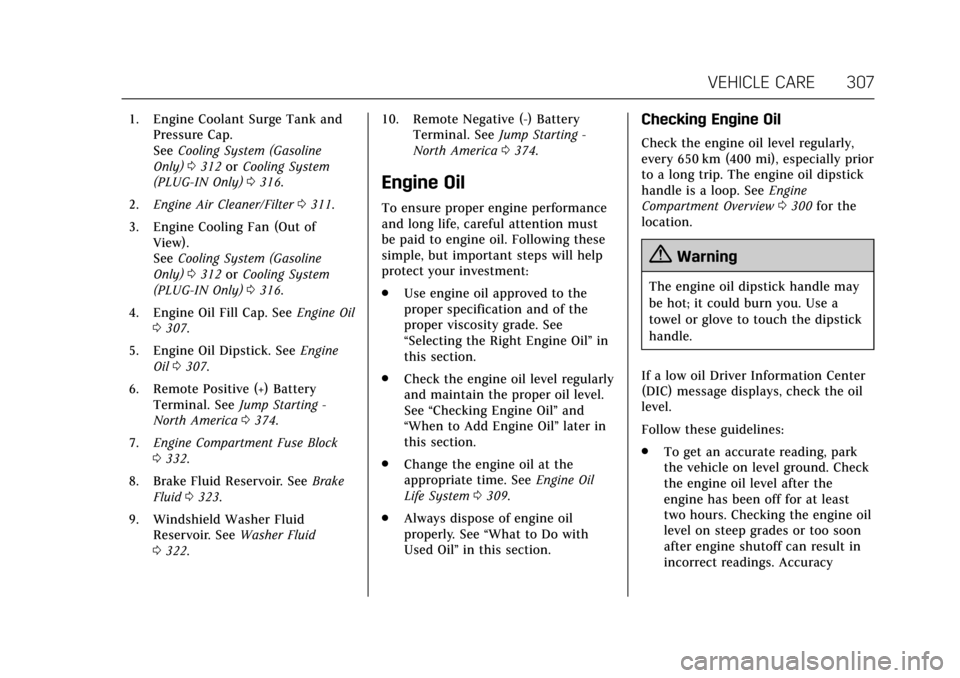
1. Engine Coolant Surge Tank andPressure Cap.
See Cooling System (Gasoline
Only) 0312 orCooling System
(PLUG-IN Only) 0316.
2. Engine Air Cleaner/Filter 0311.
3. Engine Cooling Fan (Out of View).
See Cooling System (Gasoline
Only) 0312 orCooling System
(PLUG-IN Only) 0316.
4. Engine Oil Fill Cap. See Engine Oil
0 307.
5. Engine Oil Dipstick. See Engine
Oil 0307.
6. Remote Positive (+) Battery Terminal. See Jump Starting -
North America 0374.
7. Engine Compartment Fuse Block
0332.
8. Brake Fluid Reservoir. See Brake
Fluid 0323.
9. Windshield Washer Fluid Reservoir. See Washer Fluid
0 322. 10. Remote Negative (-) Battery
Terminal. See Jump Starting -
North America 0374.
Engine Oil
To ensure proper engine performance
and long life, careful attention must
be paid to engine oil. Following these
simple, but important steps will help
protect your investment:
.
Use engine oil approved to the
proper specification and of the
proper viscosity grade. See
“Selecting the Right Engine Oil” in
this section.
. Check the engine oil level regularly
and maintain the proper oil level.
See “Checking Engine Oil” and
“When to Add Engine Oil” later in
this section.
. Change the engine oil at the
appropriate time. See Engine Oil
Life System 0309.
. Always dispose of engine oil
properly. See “What to Do with
Used Oil” in this section.
Checking Engine Oil
Check the engine oil level regularly,
every 650 km (400 mi), especially prior
to a long trip. The engine oil dipstick
handle is a loop. See Engine
Compartment Overview 0300 for the
location.
{Warning
The engine oil dipstick handle may
be hot; it could burn you. Use a
towel or glove to touch the dipstick
handle.
If a low oil Driver Information Center
(DIC) message displays, check the oil
level.
Follow these guidelines:
. To get an accurate reading, park
the vehicle on level ground. Check
the engine oil level after the
engine has been off for at least
two hours. Checking the engine oil
level on steep grades or too soon
after engine shutoff can result in
incorrect readings. Accuracy
Page 313 of 445
Cadillac CT6 Owner Manual (GMNA-Localizing-U.S./Canada-11292458) -
2018 - crc - 2/15/17
312 VEHICLE CARE
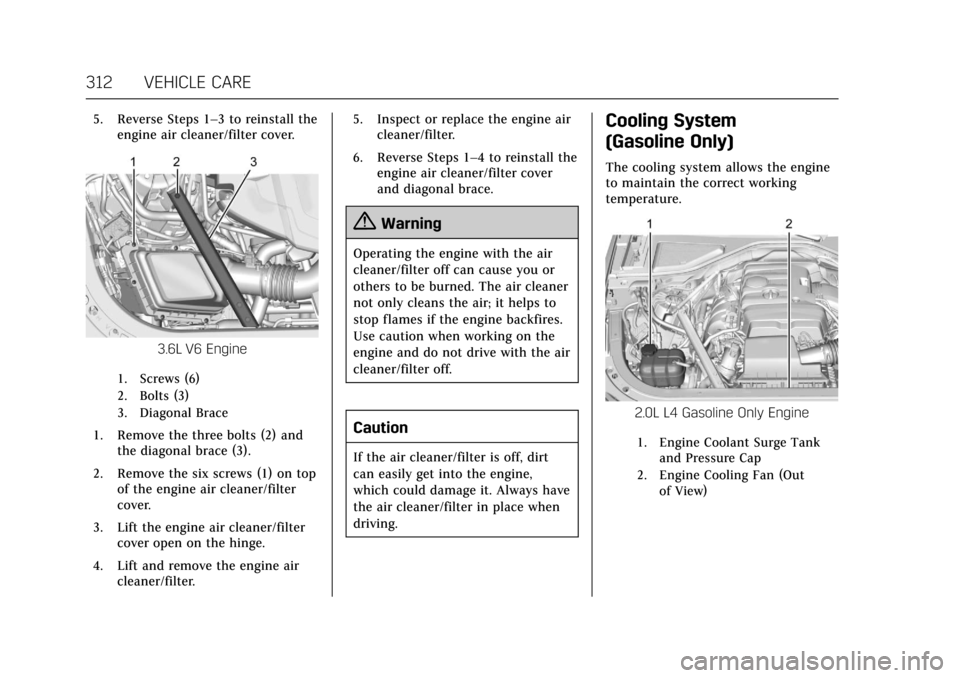
5. Reverse Steps 1–3 to reinstall theengine air cleaner/filter cover.
3.6L V6 Engine
1. Screws (6)
2. Bolts (3)
3. Diagonal Brace
1. Remove the three bolts (2) andthe diagonal brace (3).
2. Remove the six screws (1) on top of the engine air cleaner/filter
cover.
3. Lift the engine air cleaner/filter cover open on the hinge.
4. Lift and remove the engine air cleaner/filter. 5. Inspect or replace the engine air
cleaner/filter.
6. Reverse Steps 1–4 to reinstall the engine air cleaner/filter cover
and diagonal brace.
{Warning
Operating the engine with the air
cleaner/filter off can cause you or
others to be burned. The air cleaner
not only cleans the air; it helps to
stop flames if the engine backfires.
Use caution when working on the
engine and do not drive with the air
cleaner/filter off.
Caution
If the air cleaner/filter is off, dirt
can easily get into the engine,
which could damage it. Always have
the air cleaner/filter in place when
driving.
Cooling System
(Gasoline Only)
The cooling system allows the engine
to maintain the correct working
temperature.
2.0L L4 Gasoline Only Engine
1. Engine Coolant Surge Tank
and Pressure Cap
2. Engine Cooling Fan (Out of View)
Page 314 of 445
Cadillac CT6 Owner Manual (GMNA-Localizing-U.S./Canada-11292458) -
2018 - crc - 2/15/17
VEHICLE CARE 313
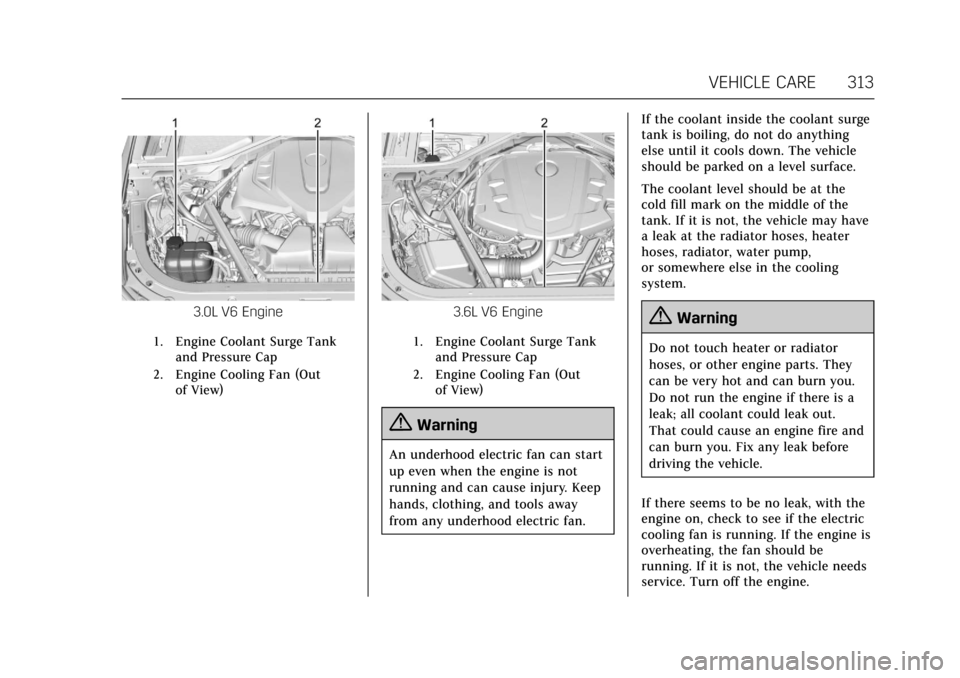
3.0L V6 Engine
1. Engine Coolant Surge Tankand Pressure Cap
2. Engine Cooling Fan (Out of View)
3.6L V6 Engine
1. Engine Coolant Surge Tank
and Pressure Cap
2. Engine Cooling Fan (Out of View)
{Warning
An underhood electric fan can start
up even when the engine is not
running and can cause injury. Keep
hands, clothing, and tools away
from any underhood electric fan. If the coolant inside the coolant surge
tank is boiling, do not do anything
else until it cools down. The vehicle
should be parked on a level surface.
The coolant level should be at the
cold fill mark on the middle of the
tank. If it is not, the vehicle may have
a leak at the radiator hoses, heater
hoses, radiator, water pump,
or somewhere else in the cooling
system.
{Warning
Do not touch heater or radiator
hoses, or other engine parts. They
can be very hot and can burn you.
Do not run the engine if there is a
leak; all coolant could leak out.
That could cause an engine fire and
can burn you. Fix any leak before
driving the vehicle.
If there seems to be no leak, with the
engine on, check to see if the electric
cooling fan is running. If the engine is
overheating, the fan should be
running. If it is not, the vehicle needs
service. Turn off the engine.
Page 316 of 445

Cadillac CT6 Owner Manual (GMNA-Localizing-U.S./Canada-11292458) -
2018 - crc - 2/15/17
VEHICLE CARE 315
3.6L V6 Engine Coolant Surge Tank
Check to see if coolant is visible in the
coolant surge tank. If the coolant
inside the coolant surge tank is
boiling, do not do anything else until
it cools down. See Engine Overheating
0 321.
The coolant surge tank is in the
engine compartment on the passenger
side of the vehicle. See Engine
Compartment Overview 0300.
How to Add Coolant to the
Coolant Surge Tank
If no problem is found, check to see if
coolant is visible in the coolant surge
tank. If coolant is visible but not at or above the indicated mark, add a 50/
50 mixture of clean, drinkable water
and DEX-COOL coolant. Be sure the
cooling system, including the coolant
surge tank pressure cap, is cool before
this is done. See
Engine Overheating
0 321.
{Warning
Spilling coolant on hot engine parts
can burn you. Coolant contains
ethylene glycol and it will burn if
the engine parts are hot enough.
{Warning
Steam and scalding liquids from a
hot cooling system are under
pressure. Turning the pressure cap,
even a little, can cause them to
come out at high speed and you
could be burned. Never turn the cap
when the cooling system, including
the pressure cap, is hot. Wait for
the cooling system and pressure
cap to cool.
Caution
Failure to follow the specific
coolant fill procedure could cause
the engine to overheat and could
cause system damage. If coolant is
not visible in the surge tank,
contact your dealer.
1. Remove the coolant surge tank
pressure cap when the cooling
system, including the coolant
surge tank pressure cap and
upper radiator hose, is no
longer hot.
Turn the pressure cap slowly
counterclockwise about
one-quarter of a turn. If you hear
a hiss, wait for that to stop. This
will allow any pressure still left
to be vented out the
discharge hose.
Page 317 of 445
Cadillac CT6 Owner Manual (GMNA-Localizing-U.S./Canada-11292458) -
2018 - crc - 2/15/17
316 VEHICLE CARE
2. Keep turning the pressure capslowly and remove it.
3. Fill the coolant surge tank with the proper mixture to the
indicated level mark.
4. With the coolant surge tank pressure cap off, start the engine
and let it run until you can feel
the upper radiator hose getting
hot. Watch out for the engine
cooling fan.
By this time, the coolant level
inside the coolant surge tank
may be lower. If the level is
lower, add more of the proper
mixture to the coolant surge
tank until the level reaches the
indicated level mark.
5. Replace the pressure cap tightly.
6. Verify coolant level after the engine is shut off and the
coolant is cold. If necessary,
repeat coolant fill procedure
Steps 1–6.
If the coolant still is not at the
proper level when the system
cools down again, see your
dealer.Caution
If the pressure cap is not tightly
installed, coolant loss and engine
damage may occur. Be sure the cap
is properly and tightly secured.
Cooling System
(PLUG-IN Only)
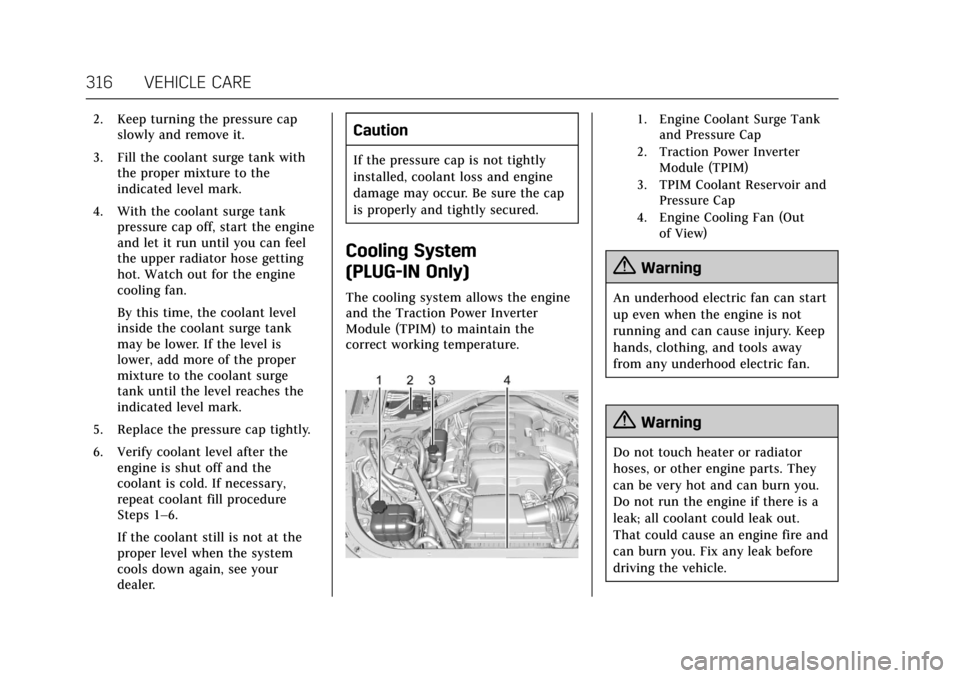
The cooling system allows the engine
and the Traction Power Inverter
Module (TPIM) to maintain the
correct working temperature.
1. Engine Coolant Surge Tank
and Pressure Cap
2. Traction Power Inverter Module (TPIM)
3. TPIM Coolant Reservoir and Pressure Cap
4. Engine Cooling Fan (Out of View)
{Warning
An underhood electric fan can start
up even when the engine is not
running and can cause injury. Keep
hands, clothing, and tools away
from any underhood electric fan.
{Warning
Do not touch heater or radiator
hoses, or other engine parts. They
can be very hot and can burn you.
Do not run the engine if there is a
leak; all coolant could leak out.
That could cause an engine fire and
can burn you. Fix any leak before
driving the vehicle.
Page 319 of 445

Cadillac CT6 Owner Manual (GMNA-Localizing-U.S./Canada-11292458) -
2018 - crc - 2/15/17
318 VEHICLE CARE
The coolant surge tank is in the
engine compartment on the passenger
side of the vehicle. SeeEngine
Compartment Overview 0300.
How to Add Coolant to the
Coolant Surge Tank
If no problem is found, check to see if
coolant is visible in the coolant surge
tank. If coolant is visible but not at or
above the indicated mark, add GM
Premix DEX-COOL coolant. Be sure
the cooling system, including the
coolant surge tank pressure cap, is
cool before this is done. See Engine
Overheating 0321.
{Warning
Spilling coolant on hot engine parts
can burn you. Coolant contains
ethylene glycol and it will burn if
the engine parts are hot enough.
{Warning
Steam and scalding liquids from a
hot cooling system are under
pressure. Turning the pressure cap,
even a little, can cause them to
come out at high speed and you
could be burned. Never turn the cap
when the cooling system, including
the pressure cap, is hot. Wait for
the cooling system and pressure
cap to cool.
Caution
Failure to follow the specific
coolant fill procedure could cause
the engine to overheat and could
cause system damage. If coolant is
not visible in the surge tank,
contact your dealer.
1. Remove the coolant surge tank
pressure cap when the cooling
system, including the coolant
surge tank pressure cap and
upper radiator hose, is no
longer hot.
Turn the pressure cap slowly
counterclockwise about
one-quarter of a turn. If you hear
a hiss, wait for that to stop. This
will allow any pressure still left
to be vented out the
discharge hose.
2. Keep turning the pressure cap slowly and remove it.
3. Fill the coolant surge tank with the proper mixture to the
indicated level mark.
4. With the coolant surge tank pressure cap off, start the engine
and let it run until you can feel
Page 320 of 445
Cadillac CT6 Owner Manual (GMNA-Localizing-U.S./Canada-11292458) -
2018 - crc - 2/15/17
VEHICLE CARE 319
the upper radiator hose getting
hot. Watch out for the engine
cooling fan.
By this time, the coolant level
inside the coolant surge tank
may be lower. If the level is
lower, add more of the proper
mixture to the coolant surge
tank until the level reaches the
indicated level mark.
5. Replace the pressure cap tightly.
6. Verify coolant level after the engine is shut off and the
coolant is cold. If necessary,
repeat coolant fill procedure
Steps 1–6.
If the coolant still is not at the
proper level when the system
cools down again, see your
dealer.
Caution
If the pressure caps are not secured
and tightened properly, coolant loss
and damage to the PLUG-IN cooling
(Continued)
Caution (Continued)
systems or vehicle may occur. Make
sure the caps are properly and
tightly secured.
PLUG-IN Coolant
The cooling system allows the TPIM
to maintain the correct working
temperature.
{Warning
An underhood electric fan can start
up even when the engine is not
running and can cause injury. Keep
hands, clothing, and tools away
from any underhood electric fan.
{Warning
Do not touch heater or radiator
hoses, or other engine parts. They
can be very hot and can burn you.
Do not run the engine if there is a
(Continued)
Warning (Continued)
leak; all coolant could leak out.
That could cause an engine fire and
can burn you. Fix any leak before
driving the vehicle.
The TPIM is cooled using a separate
coolant loop.
The TPIM is kept below a maximum
temperature. If the temperature rises
above this temperature, the electric
cooling fan will turn on to cool the
coolant.
What to Use Caution
Do not use anything other than GM
Premix DEX-COOL coolant.
Anything else can cause damage to
the PLUG-IN cooling system
components and the vehicle, which
would not be covered by the vehicle
warranty.
Page 321 of 445
Cadillac CT6 Owner Manual (GMNA-Localizing-U.S./Canada-11292458) -
2018 - crc - 2/15/17
320 VEHICLE CARE
The coolant reservoir for the TPIM is
filled with GM Premix DEX-COOL
coolant. SeeRecommended Fluids and
Lubricants 0399. If using this mixture,
nothing else needs to be added.
The coolant needs to be replaced at
the appropriate interval. See
Maintenance Schedule 0390.
Checking Coolant
The vehicle must be on a level surface
when checking the coolant level.
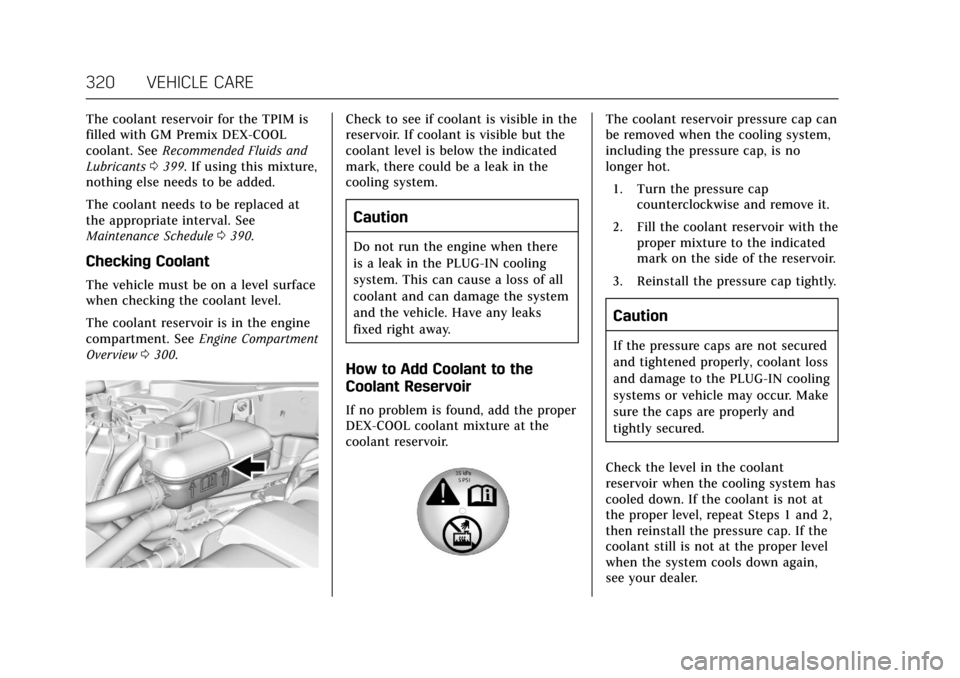
The coolant reservoir is in the engine
compartment. See Engine Compartment
Overview 0300.
Check to see if coolant is visible in the
reservoir. If coolant is visible but the
coolant level is below the indicated
mark, there could be a leak in the
cooling system.
Caution
Do not run the engine when there
is a leak in the PLUG-IN cooling
system. This can cause a loss of all
coolant and can damage the system
and the vehicle. Have any leaks
fixed right away.
How to Add Coolant to the
Coolant Reservoir
If no problem is found, add the proper
DEX-COOL coolant mixture at the
coolant reservoir.
The coolant reservoir pressure cap can
be removed when the cooling system,
including the pressure cap, is no
longer hot.
1. Turn the pressure cap counterclockwise and remove it.
2. Fill the coolant reservoir with the proper mixture to the indicated
mark on the side of the reservoir.
3. Reinstall the pressure cap tightly.
Caution
If the pressure caps are not secured
and tightened properly, coolant loss
and damage to the PLUG-IN cooling
systems or vehicle may occur. Make
sure the caps are properly and
tightly secured.
Check the level in the coolant
reservoir when the cooling system has
cooled down. If the coolant is not at
the proper level, repeat Steps 1 and 2,
then reinstall the pressure cap. If the
coolant still is not at the proper level
when the system cools down again,
see your dealer.