wheel CADILLAC CTS 2008 2.G Workshop Manual
[x] Cancel search | Manufacturer: CADILLAC, Model Year: 2008, Model line: CTS, Model: CADILLAC CTS 2008 2.GPages: 490, PDF Size: 2.59 MB
Page 298 of 490
Towing a Trailer
{CAUTION:
If you do not use the correct equipment and
drive properly, you can lose control when you
pull a trailer. For example, if the trailer is too
heavy, the brakes may not work well — or even
at all. You and your passengers could be
seriously injured. You may also damage your
vehicle; the resulting repairs would not be
covered by your warranty. Pull a trailer only if
you have followed all the steps in this section.
Ask your dealer/retailer for advice and
information about towing a trailer with your
vehicle.
Your vehicle can tow a trailer if it is equipped with the
proper trailer towing equipment. To identify the trailering
capacity of your vehicle, you should read the information
in “Weight of the Trailer” that appears later in this section.Trailering is different than just driving your vehicle by
itself. Trailering means changes in handling, acceleration,
braking, durability and fuel economy. Successful, safe
trailering takes correct equipment, and it has to be used
properly.
That is the reason for this part. In it are many
time-tested, important trailering tips and safety rules.
Many of these are important for your safety and that of
your passengers. So please read this section carefully
before you pull a trailer.
Load-pulling components such as the engine,
transmission, wheel assemblies and tires are forced to
work harder against the drag of the added weight.
The engine is required to operate at relatively higher
speeds and under greater loads, generating extra heat.
Also, the trailer adds considerably to wind resistance,
increasing the pulling requirements.
4-30
Page 303 of 490
Backing Up
Hold the bottom of the steering wheel with one hand.
Then, to move the trailer to the left, just move that hand
to the left. To move the trailer to the right, move your
hand to the right. Always back up slowly and, if possible,
have someone guide you.
Making Turns
Notice:Making very sharp turns while trailering
could cause the trailer to come in contact with the
vehicle. Your vehicle could be damaged. Avoid
making very sharp turns while trailering.
When you are turning with a trailer, make wider turns
than normal. Do this so your trailer will not strike
soft shoulders, curbs, road signs, trees or other objects.
Avoid jerky or sudden maneuvers. Signal well in
advance.
Turn Signals When Towing a Trailer
When you tow a trailer, your vehicle may need a
different turn signal asher and/or extra wiring. Check
with your dealer/retailer. The arrows on your instrument
panel will ash whenever you signal a turn or lane
change. Properly hooked up, the trailer lamps will also
ash, telling other drivers you are about to turn,
change lanes or stop.
When towing a trailer, the arrows on your instrument
panel will ash for turns even if the bulbs on the trailer
are burned out. Thus, you may think drivers behind
you are seeing your signal when they are not. It
is important to check occasionally to be sure the trailer
bulbs are still working.
4-35
Page 304 of 490
Your vehicle has bulb warning lights. When you plug a
trailer lighting system into your vehicle’s lighting
system, its bulb warning lights may not let you know if
one of your lamps goes out. So, when you have a trailer
lighting system plugged in, be sure to check your
vehicle and trailer lamps from time to time to be sure
they are all working. Once you disconnect the trailer
lamps, the bulb warning lights again can tell you if one
of your vehicle lamps is out.
Driving On Grades
Reduce speed and shift to a lower gearbeforeyou start
down a long or steep downgrade. If you do not shift
down, you might have to use your brakes so much that
they would get hot and no longer work well.
On a long uphill grade, shift down to a lower gear and
reduce your speed to around 45 mph (70 km/h) to
reduce the possibility of engine and transmission
overheating.
Parking on Hills
{CAUTION:
You really should not park your vehicle, with a
trailer attached, on a hill. If something goes
wrong, your rig could start to move. People
can be injured, and both your vehicle and the
trailer can be damaged.
But if you ever have to park your rig on a hill, here is
how to do it:
1. Apply your regular brakes, but do not shift into
PARK (P) yet.
2. Have someone place chocks under the trailer
wheels.
3. When the wheel chocks are in place, release the
regular brakes until the chocks absorb the load.
4. Reapply the regular brakes. Then apply your
parking brake, and then shift to PARK (P).
5. Release the regular brakes.
4-36
Page 307 of 490
Service............................................................5-4
Accessories and Modications..........................5-4
California Proposition 65 Warning.....................5-5
California Perchlorate Materials Requirements.....5-5
Doing Your Own Service Work.........................5-5
Adding Equipment to the Outside of the
Vehicle......................................................5-6
Fuel................................................................5-6
Gasoline Octane............................................5-7
Gasoline Specications....................................5-7
California Fuel...............................................5-7
Additives.......................................................5-8
Fuels in Foreign Countries...............................5-8
Filling the Tank..............................................5-9
Filling a Portable Fuel Container.....................5-11
Checking Things Under the Hood....................5-12
Hood Release..............................................5-12
Engine Compartment Overview.......................5-14
Engine Oil...................................................5-16
Engine Oil Life System..................................5-19
Engine Cover...............................................5-21
Engine Air Cleaner/Filter................................5-21
Automatic Transmission Fluid.........................5-25
Manual Transmission Fluid.............................5-26Hydraulic Clutch...........................................5-27
Engine Coolant.............................................5-28
Coolant Surge Tank Pressure Cap..................5-31
Engine Overheating.......................................5-31
Overheated Engine Protection
Operating Mode........................................5-33
Cooling System............................................5-34
Power Steering Fluid.....................................5-39
Windshield Washer Fluid................................5-40
Brakes........................................................5-41
Battery........................................................5-44
Jump Starting...............................................5-45
All-Wheel Drive..............................................5-50
Rear Axle.......................................................5-51
Headlamp Aiming...........................................5-52
Bulb Replacement..........................................5-55
High Intensity Discharge (HID) Lighting............5-55
Halogen Bulbs..............................................5-55
Front Turn Signal and Fog Lamps...................5-56
License Plate Lamp......................................5-56
Replacement Bulbs.......................................5-57
Windshield Wiper Blade Replacement..............5-57
Section 5 Service and Appearance Care
5-1
Page 308 of 490
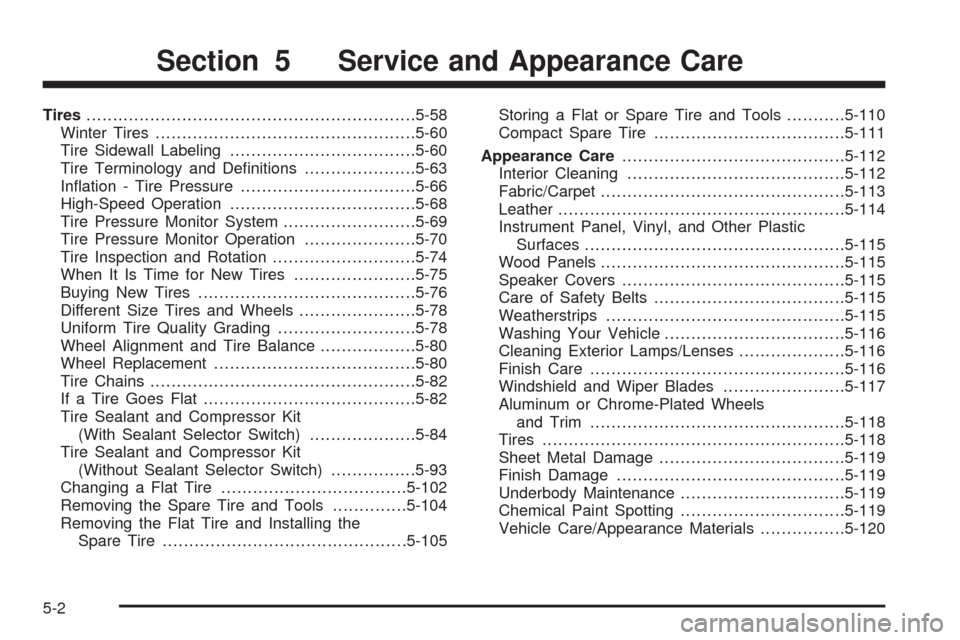
Tires..............................................................5-58
Winter Tires.................................................5-60
Tire Sidewall Labeling...................................5-60
Tire Terminology and Denitions.....................5-63
Ination - Tire Pressure.................................5-66
High-Speed Operation...................................5-68
Tire Pressure Monitor System.........................5-69
Tire Pressure Monitor Operation.....................5-70
Tire Inspection and Rotation...........................5-74
When It Is Time for New Tires.......................5-75
Buying New Tires.........................................5-76
Different Size Tires and Wheels......................5-78
Uniform Tire Quality Grading..........................5-78
Wheel Alignment and Tire Balance..................5-80
Wheel Replacement......................................5-80
Tire Chains..................................................5-82
If a Tire Goes Flat........................................5-82
Tire Sealant and Compressor Kit
(With Sealant Selector Switch)....................5-84
Tire Sealant and Compressor Kit
(Without Sealant Selector Switch)................5-93
Changing a Flat Tire...................................5-102
Removing the Spare Tire and Tools..............5-104
Removing the Flat Tire and Installing the
Spare Tire..............................................5-105Storing a Flat or Spare Tire and Tools...........5-110
Compact Spare Tire....................................5-111
Appearance Care..........................................5-112
Interior Cleaning.........................................5-112
Fabric/Carpet..............................................5-113
Leather......................................................5-114
Instrument Panel, Vinyl, and Other Plastic
Surfaces.................................................5-115
Wood Panels..............................................5-115
Speaker Covers..........................................5-115
Care of Safety Belts....................................5-115
Weatherstrips
.............................................5-115
Washing Your Vehicle..................................5-116
Cleaning Exterior Lamps/Lenses....................5-116
Finish Care................................................5-116
Windshield and Wiper Blades.......................5-117
Aluminum or Chrome-Plated Wheels
and Trim................................................5-118
Tires.........................................................5-118
Sheet Metal Damage...................................5-119
Finish Damage...........................................5-119
Underbody Maintenance...............................5-119
Chemical Paint Spotting...............................5-119
Vehicle Care/Appearance Materials................5-120
Section 5 Service and Appearance Care
5-2
Page 349 of 490

{CAUTION:
The brake wear warning sound means that
soon the brakes will not work well. That could
lead to an accident. When you hear the brake
wear warning sound, have your vehicle
serviced.
Notice:Continuing to drive with worn-out brake
pads could result in costly brake repair.
Some driving conditions or climates can cause a brake
squeal when the brakes are rst applied or lightly applied.
This does not mean something is wrong with the brakes.
Properly torqued wheel nuts are necessary to help
prevent brake pulsation. When tires are rotated, inspect
brake pads for wear and evenly tighten wheel nuts
in the proper sequence to torque specications
inCapacities and Specifications on page 5-129.
Brake linings should always be replaced as complete
axle sets.
Brake Pedal Travel
See your dealer/retailer if the brake pedal does not
return to normal height, or if there is a rapid increase
in pedal travel. This could be a sign that brake service
might be required.
Brake Adjustment
Every time you apply the brakes, with or without the
vehicle moving, the brakes adjust for wear.
Replacing Brake System Parts
The braking system on a vehicle is complex. Its many
parts have to be of top quality and work well together if
the vehicle is to have really good braking. Your vehicle
was designed and tested with top-quality brake parts.
When you replace parts of the braking system — for
example, when the brake linings wear down and you
need new ones put in — be sure you get new approved
replacement parts. If you do not, the brakes might not
work properly. For example, if someone puts in brake
linings that are wrong for your vehicle, the balance
between the front and rear brakes can change — for
the worse. The braking performance you have come to
expect can change in many other ways if someone puts
in the wrong replacement brake parts.
5-43
Page 356 of 490
All-Wheel Drive
If your vehicle is equipped with all-wheel-drive, this is an
additional system that needs lubrication.
Transfer Case
When to Check Lubricant
It is not necessary to regularly check the transfer case
uid unless you suspect there is a leak or you hear
an unusual noise. A uid loss could indicate a problem.
Have it inspected and repaired.
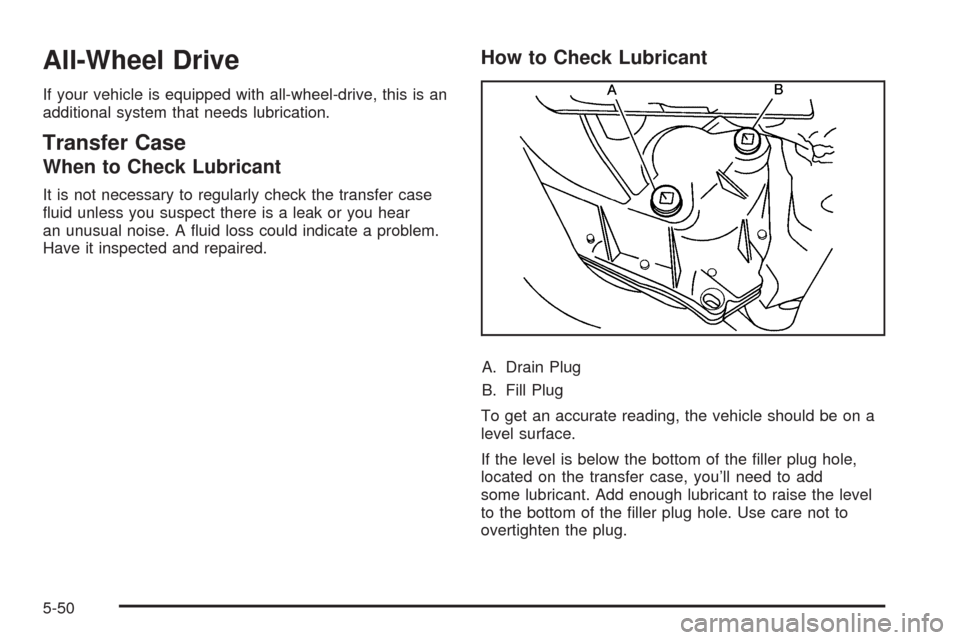
How to Check Lubricant
A. Drain Plug
B. Fill Plug
To get an accurate reading, the vehicle should be on a
level surface.
If the level is below the bottom of the ller plug hole,
located on the transfer case, you’ll need to add
some lubricant. Add enough lubricant to raise the level
to the bottom of the ller plug hole. Use care not to
overtighten the plug.
5-50
Page 365 of 490
CAUTION: (Continued)
Underinated tires pose the same
danger as overloaded tires. The
resulting accident could cause serious
injury. Check all tires frequently to
maintain the recommended pressure.
Tire pressure should be checked when
your tires are cold. SeeInflation - Tire
Pressure on page 5-66.
Overinated tires are more likely
to be cut, punctured, or broken by
a sudden impact — such as when
you hit a pothole. Keep tires at the
recommended pressure.
Worn, old tires can cause accidents. If
your tread is badly worn, or if your tires
have been damaged, replace them.
SeeHigh-Speed Operation on page 5-68for
ination pressure adjustment for high
speed driving.
Low-Prole Performance Tires
If your vehicle has 235/50ZR18 or P235/50R18
size tires, they are classied as low-prole tires.
These tires are designed for very responsive driving
on wet or dry pavement. You may also notice more
road noise with low-prole performance tires and
that they tend to wear faster.
Notice:If the vehicle has low-prole tires,
they are more susceptible to damage from road
hazards or curb impact than standard prole
tires. Tire and/or wheel assembly damage can
occur when coming into contact with road
hazards like, potholes, or sharp edged objects,
or when sliding into a curb. The vehicle
warranty does not cover this type of damage.
Keep tires set to the correct ination pressure
and, when possible avoid contact with curbs,
potholes, and other road hazards.
Summer Performance Tires
Many General Motors high performance models
come factory-equipped with tires that are optimized
for maximum dry and wet road performance while
still retaining satisfactory tread life, excellent
durability, and low noise levels. In severe winter
climates where snowfall may be signicant, these
tires may be found to provide less traction.
5-59
Page 366 of 490

Winter Tires
If you expect to drive on snow or ice covered roads
often, you may want to get winter tires for your vehicle.
All season tires provide good overall performance on
most surfaces but they may not offer the traction
you would like or the same level of performance
as winter tires on snow or ice covered roads.
Winter tires, in general, are designed for increased
traction on snow and ice covered roads. With winter
tires, there may be decreased dry road traction,
increased road noise, and shorter tread life. After
switching to winter tires, be alert for changes in
vehicle handling and braking.
See your dealer/retailer for details regarding winter tire
availability and proper tire selection. Also, seeBuying
New Tires on page 5-76.
If you choose to use winter tires:
Use tires of the same brand and tread type on all
four wheel positions.
Use only radial ply tires of the same size, load
range, and speed rating as the original equipment
tires.
Winter tires with the same speed rating as your original
equipment tires may not be available for H, V, W, Y,
and ZR speed rated tires. If you choose winter tires with
a lower speed rating, never exceed the tire’s maximum
speed capability.
Tire Sidewall Labeling
Useful information about a tire is molded into its
sidewall. The examples below show a typical
passenger vehicle tire and a compact spare tire
sidewall.
(A) Tire Size
:The tire size is a combination of
letters and numbers used to dene a particular
tire’s width, height, aspect ratio, construction type,
and service description. See the “Tire Size”
illustration later in this section for more detail.Passenger (P-Metric) Tire Example
5-60
Page 369 of 490
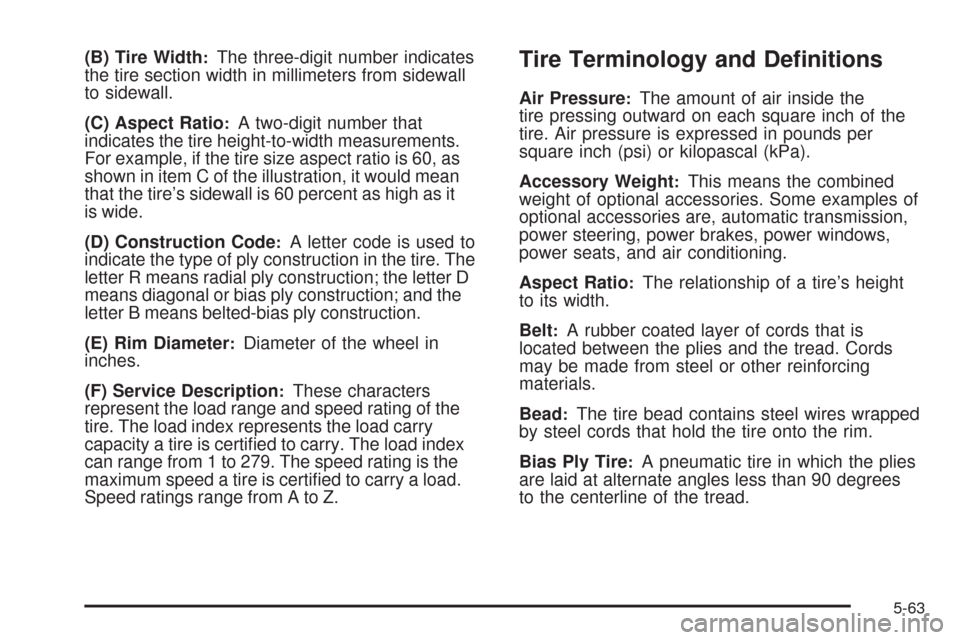
(B) Tire Width:The three-digit number indicates
the tire section width in millimeters from sidewall
to sidewall.
(C) Aspect Ratio
:A two-digit number that
indicates the tire height-to-width measurements.
For example, if the tire size aspect ratio is 60, as
shown in item C of the illustration, it would mean
that the tire’s sidewall is 60 percent as high as it
is wide.
(D) Construction Code
:A letter code is used to
indicate the type of ply construction in the tire. The
letter R means radial ply construction; the letter D
means diagonal or bias ply construction; and the
letter B means belted-bias ply construction.
(E) Rim Diameter
:Diameter of the wheel in
inches.
(F) Service Description
:These characters
represent the load range and speed rating of the
tire. The load index represents the load carry
capacity a tire is certied to carry. The load index
can range from 1 to 279. The speed rating is the
maximum speed a tire is certied to carry a load.
Speed ratings range from A to Z.
Tire Terminology and Denitions
Air Pressure:The amount of air inside the
tire pressing outward on each square inch of the
tire. Air pressure is expressed in pounds per
square inch (psi) or kilopascal (kPa).
Accessory Weight
:This means the combined
weight of optional accessories. Some examples of
optional accessories are, automatic transmission,
power steering, power brakes, power windows,
power seats, and air conditioning.
Aspect Ratio
:The relationship of a tire’s height
to its width.
Belt
:A rubber coated layer of cords that is
located between the plies and the tread. Cords
may be made from steel or other reinforcing
materials.
Bead
:The tire bead contains steel wires wrapped
by steel cords that hold the tire onto the rim.
Bias Ply Tire
:A pneumatic tire in which the plies
are laid at alternate angles less than 90 degrees
to the centerline of the tread.
5-63