cooling CADILLAC CTS 2016 3.G Owner's Manual
[x] Cancel search | Manufacturer: CADILLAC, Model Year: 2016, Model line: CTS, Model: CADILLAC CTS 2016 3.GPages: 354, PDF Size: 3.56 MB
Page 270 of 354

Cadillac CTS/CTS-V Owner Manual (GMNA-Localizing-MidEast-9369309) -
2016 - crc - 7/30/15
Vehicle Care 269
surge tank pressure cap and
upper radiator hose, is no
longer hot.
Turn the pressure cap slowly
counterclockwise. If you hear a
hiss, wait for that to stop. This
will allow any pressure still left
to be vented out the
discharge hose.
2. Keep turning the pressure cap slowly and remove it. Open the
surge tank service port cap to
the lower chamber. The service
port is behind the top chamber.3. Fill the surge tank top chamberwith the proper DEX-COOL
coolant mixture to the bottom
of the fill neck. The top
chamber needs to be
completely full. Fill the surge
tank bottom chamber through
the service port to
approximately half.
4. With the coolant surge tank pressure cap off and the surge
tank service port cap open,
start the engine and let it run
until you can feel the upper
radiator hose getting hot.
Watch out for the engine
cooling fan(s).
By this time, the coolant level
inside the coolant surge tank
top chamber may be lower.
If the level is lower, add more
of the proper DEX-COOL
coolant mixture to the surge
tank top chamber until the level
reaches the bottom of the
fill neck.
5. Replace the surge tank pressure cap tightly and close
the surge tank service port cap.Caution
If the pressure cap is not tightly
installed, coolant loss and
possible engine damage may
occur. Be sure the cap is properly
and tightly secured.
Check the level in the surge tank
top and bottom chambers when the
cooling system has cooled down.
If the coolant is not at the proper
levels, repeat Steps 1–3 and
reinstall the pressure cap and close
the service port. If the coolant still is
not at the proper levels when the
system cools down again, see your
dealer.
Engine Overheating
The vehicle has an indicator to warn
of the engine overheating.
If the decision is made not to lift the
hood when this warning appears,
get service help right away.
If the decision is made to lift the
hood, make sure the vehicle is
parked on a level surface.
Page 271 of 354

Cadillac CTS/CTS-V Owner Manual (GMNA-Localizing-MidEast-9369309) -
2016 - crc - 7/30/15
270 Vehicle Care
Then check to see if the engine
cooling fan is running. If the engine
is overheating, the fan should be
running. If it is not, do not continue
to run the engine. Have the vehicle
serviced.
Caution
Running the engine without
coolant may cause damage or a
fire. Vehicle damage would not be
covered by the vehicle warranty.
If Steam Is Coming from the
Engine Compartment
{Warning
Steam from an overheated engine
can burn you badly, even if you
just open the hood. Stay away
from the engine if you see or hear
steam coming from it. Just turn it
off and get everyone away from
the vehicle until it cools down.(Continued)
Warning (Continued)
Wait until there is no sign of
steam or coolant before you open
the hood.
If you keep driving when the
engine is overheated, the liquids
in it can catch fire. You or others
could be badly burned. Stop the
engine if it overheats, and get out
of the vehicle until the engine
is cool.
If Steam Is Coming from the
Engine Compartment with No
Overheat Warning
(V-Series Only)
The V-Series hood vent is
functional, and will allow water from
rain and car washes to enter the
engine compartment and contact
hot surfaces. If steam is seen
coming from the hood vent with no
accompanying overheat warning, no
action is required.
If No Steam Is Coming from
the Engine Compartment
If an engine overheat warning is
displayed but no steam can be seen
or heard, the problem may not be
too serious. Sometimes the engine
can get a little too hot when the
vehicle:
.Climbs a long hill on a hot day.
. Stops after high-speed driving.
. Idles for long periods in traffic.
If the overheat warning is displayed
with no sign of steam: 1. Turn the air conditioning off.
2. Turn the heater on to the highest temperature and to the
highest fan speed. Open the
windows as necessary.
3. When it is safe to do so, pull off the road, shift to P (Park) or
N (Neutral) and let the
engine idle.
If the overheat warning no longer
displays, the vehicle can be driven.
Continue to drive the vehicle slowly
for about 10 minutes. Keep a safe
vehicle distance from the vehicle in
Page 272 of 354
Cadillac CTS/CTS-V Owner Manual (GMNA-Localizing-MidEast-9369309) -
2016 - crc - 7/30/15
Vehicle Care 271
front. If the warning does not come
back on, continue to drive normally
and have the cooling system
checked for proper fill and function.
If the warning continues, pull over,
stop, and park the vehicle
right away.
If there is no sign of steam, idle the
engine for three minutes while
parked. If the warning is still
displayed, turn off the engine until it
cools down.
Washer Fluid
What to Use
When windshield washer fluid is
needed, be sure to read the
manufacturer's instructions before
use. If operating the vehicle in an
area where the temperature may fall
below freezing, use a fluid that has
sufficient protection against
freezing.
Adding Washer Fluid
Open the cap with the washer
symbol on it. Add washer fluid until
the tank is full. SeeEngine
Compartment Overview 0252 for
reservoir location.
Caution
. Do not use washer fluid that
contains any type of water
repellent coating. This can
cause the wiper blades to
chatter or skip.
. Do not use engine coolant
(antifreeze) in the
windshield washer. It can
damage the windshield
washer system and paint.
(Continued)
Caution (Continued)
.Do not mix water with
ready-to-use washer fluid.
Water can cause the
solution to freeze and
damage the washer fluid
tank and other parts of the
washer system.
. When using concentrated
washer fluid, follow the
manufacturer instructions for
adding water.
. Fill the washer fluid tank
only three-quarters full when
it is very cold. This allows
for fluid expansion if
freezing occurs, which could
damage the tank if it is
completely full.
Brakes
Disc brake pads have built-in wear
indicators that make a high-pitched
warning sound when the brake pads
are worn and new pads are needed.
The sound can come and go or be
Page 285 of 354
Cadillac CTS/CTS-V Owner Manual (GMNA-Localizing-MidEast-9369309) -
2016 - crc - 7/30/15
284 Vehicle Care
Number Usage*66 Right high intensity discharge
67 Head lamp high left/ right
68 Aero shutter
69 Horn
70 Horn relay
71 Cooling fan
*72 Starter 2
*73 Brake vacuum pump
74 Starter
75 Air conditioning clutch
76 Not used
* Optional
Instrument Panel Fuse
Block
The instrument panel fuse block is
in the end of the driver side of the
instrument panel.
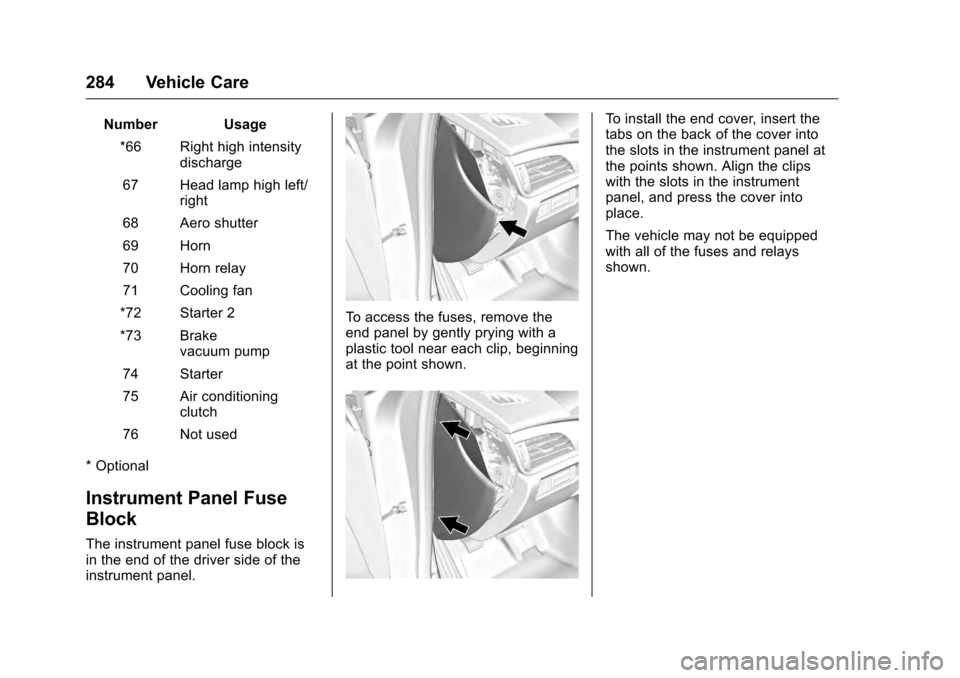
To access the fuses, remove the
end panel by gently prying with a
plastic tool near each clip, beginning
at the point shown.
To install the end cover, insert the
tabs on the back of the cover into
the slots in the instrument panel at
the points shown. Align the clips
with the slots in the instrument
panel, and press the cover into
place.
The vehicle may not be equipped
with all of the fuses and relays
shown.
Page 304 of 354

Cadillac CTS/CTS-V Owner Manual (GMNA-Localizing-MidEast-9369309) -
2016 - crc - 7/30/15
Vehicle Care 303
{Warning
If different sized wheels are used,
there may not be an acceptable
level of performance and safety if
tires not recommended for those
wheels are selected. This
increases the chance of a crash
and serious injury. Only use GM
specific wheel and tire systems
developed for the vehicle, and
have them properly installed by a
GM certified technician.
See Buying New Tires 0301 and
Accessories and Modifications
0 250.
Wheel Alignment and Tire
Balance
The tires and wheels were aligned
and balanced at the factory to
provide the longest tire life and best
overall performance. Adjustments to
wheel alignment and tire balancing
are not necessary on a regular
basis. Consider an alignment check
if there is unusual tire wear or the vehicle is significantly pulling to one
side or the other. Some slight pull to
the left or right, depending on the
crown of the road and/or other road
surface variations such as troughs
or ruts, is normal. If the vehicle is
vibrating when driving on a smooth
road, the tires and wheels may need
to be rebalanced. See your dealer
for proper diagnosis.
Wheel Replacement
Replace any wheel that is bent,
cracked, or badly rusted or
corroded. If wheel nuts keep coming
loose, the wheel, wheel bolts, and
wheel nuts should be replaced.
If the wheel leaks air, replace it.
Some aluminum wheels can be
repaired. See your dealer if any of
these conditions exist.
Your dealer will know the kind of
wheel that is needed.
Each new wheel should have the
same load-carrying capacity,
diameter, width, offset, and be
mounted the same way as the one it
replaces.
Replace wheels, wheel bolts, wheel
nuts, or Tire Pressure Monitor
System (TPMS) sensors with new
GM original equipment parts.
{Warning
Using the wrong replacement
wheels, wheel bolts, or wheel
nuts can be dangerous. It could
affect the braking and handling of
the vehicle. Tires can lose air,
and cause loss of control, causing
a crash. Always use the correct
wheel, wheel bolts, and wheel
nuts for replacement.
Caution
The wrong wheel can also cause
problems with bearing life, brake
cooling, speedometer or
odometer calibration, headlamp
aim, bumper height, vehicle
ground clearance, and tire or tire
chain clearance to the body and
chassis.
Page 330 of 354
Cadillac CTS/CTS-V Owner Manual (GMNA-Localizing-MidEast-9369309) -
2016 - crc - 7/30/15
Service and Maintenance 329
At your dealer, you can be certain
that you will receive the highest
level of service available. Your
dealer has specially trained service
technicians, uses genuine
replacement parts, as well as,
up-to-date tools and equipment to
ensure fast and accurate
diagnostics.
The proper replacement parts,
fluids, and lubricants to use are
listed inRecommended Fluids and
Lubricants 0333 andMaintenance
Replacement Parts 0334. We
recommend the use of genuine
parts from your dealer.
Rotation of New Tires
Tire rotation is not recommended if
the vehicle has different size tires
on the front and rear wheels. If tire
rotation is recommended for the
vehicle, to maintain ride, handling,
and performance of the vehicle, it is
important that the first rotation
service for new tires be performed.
Tires should be rotated every
service. See Tire Rotation 0299.Maintenance
Schedule
When the Change Engine Oil
Soon Message Displays
Change engine oil and filter. See
Engine Oil 0259. An Emission
Control Service.
When the CHANGE ENGINE OIL
SOON message displays, service is
required for the vehicle as soon as
possible, within the next 1 000 km/
600 miles. If driving under the best
conditions, the engine oil life system
may not indicate the need for
vehicle service for up to one year.
The engine oil and filter must be
changed at least once a year and
the oil life system must be reset.
Your dealer has trained service
technicians who will perform this
work and reset the system. If the
engine oil life system is reset
accidentally, service the vehicle
within 5 000 km/3,000 miles since
the last service. Reset the oil life
system whenever the oil is changed.
See Engine Oil Life System 0261.
Every Engine Oil Change
.
Change engine oil and filter.
Reset oil life system. See
Engine Oil 0259 and Engine Oil
Life System 0261.. An Emission
Control Service.
. Engine coolant level check. See
Engine Coolant 0266.
. Engine cooling system
inspection. Visual inspection of
hoses, pipes, fittings, and
clamps and replacement,
if needed.
. Windshield washer fluid level
check. See Washer Fluid 0271.
. Windshield wiper blade
inspection for wear, cracking,
or contamination and windshield
and wiper blade cleaning,
if contaminated. See Exterior
Care 0318. Worn or damaged
wiper blade replacement. See
Wiper Blade Replacement
0 277.
. Tire inflation pressures check.
See Tire Pressure 0292.
Page 332 of 354

Cadillac CTS/CTS-V Owner Manual (GMNA-Localizing-MidEast-9369309) -
2016 - crc - 7/30/15
Service and Maintenance 331
.Engine air cleaner filter
replacement or every 20 000 km/
12,500 Miles. If driving in dusty
conditions, inspect the filter at
each oil change or more often as
needed. See Engine Air Cleaner/
Filter 0263.
Every 40 000 km/25,000 Miles
. Passenger compartment air filter
replacement (or every
24 months, whichever occurs
first). More frequent replacement
may be needed if the vehicle is
driven in areas with heavy traffic,
poor air quality, areas with high
dust levels or are sensitive to
environmental allergens. Cabin
Air Filter replacement may also
be needed if you notice reduced
airflow, windows fogging up,
or odors. Your local GM Service
location can help you determine
when it is the right time to
replace your filter.
Every 72 000 km/45,000 Miles
. Replace brake fluid (or every
three years, whichever occurs
first). .
Rear axle fluid (If equipped with
limited slip).
Every 80 000 km/50,000 Miles
. Evaporative control system
inspection. Check all fuel and
vapor lines and hoses for proper
hook-up, routing, and condition.
Every 96 000 km/60,000 Miles
. Replace spark plugs. Inspect
spark plug wires. (2.0L LTG and
3.6L LF3 Turbo Engines)
Every 156 000 km/97,500 Miles
. Replace spark plugs. Inspect
spark plug wires. (3.6L LGX and
6.2L LT4 Engines)
Every 240 000 km/150,000 Miles
. Engine cooling system drain and
refill (or every five years,
whichever occurs first). See
Cooling System 0264. An
Emission Control Service.
. Engine drive belts inspection for
fraying, excessive cracks,
or obvious damage (or every
10 years, whichever occurs
first). Replace, if needed.Severe Conditions Requiring
More Frequent Maintenance*
.Public service, military,
or commercial use vehicles to
include the following:
‐Ambulances, police cars and
emergency rescue vehicles.
‐ Civilian vehicles such as light
duty pick-up trucks, SUVs and
passenger cars that are used
in military applications.
‐ Recovery vehicles such as
tow trucks and flatbed single
vehicle carriers or any vehicle
that is consistently used in
towing trailers or other loads.
‐ High use commercial vehicles
such as courier delivery
vehicles, private security patrol
vehicles or any vehicles that
operate on a 24 hour basis.
‐ Any vehicle consistently
operated in a high sand or
dust environment such as
those used on oil pipelines
and similar applications.
Page 339 of 354

Cadillac CTS/CTS-V Owner Manual (GMNA-Localizing-MidEast-9369309) -
2016 - crc - 7/30/15
338 Technical Data
Vehicle Data
Capacities and Specifications
The following approximate capacities are given in metric and English conversions. SeeRecommended Fluids and
Lubricants 0333 for more information.
Application Capacities
Metric English
Air Conditioning Refrigerant For the air conditioning system refrigerant type and charge amount, see the refrigerant label under thehood. See your dealer for more information.
Cooling System– Engine
2.0L L4 Engine 8.8 L9.3 qt
3.6L V6 Engine (LGX) 10 L10.7 qt
3.6L V6 Engine (LF3) 12.8 L13.5 qt
6.2L V8 Engine (V-Series) 12.2 L12.9 qt
Engine Oil with Filter 2.0L L4 Engine RWD 4.7 L5.0 qt
2.0L L4 Engine AWD 5.7 L6.0 qt
3.6L V6 Engine (LGX) RWD 5.2 L5.5 qt
3.6L V6 Engine (LF3) 6.6 L7.0 qt
6.2L V8 Engine (V-Series) 9.5 L10.0 qt
Page 347 of 354

Cadillac CTS/CTS-V Owner Manual (GMNA-Localizing-MidEast-9369309) -
2016 - crc - 7/30/15
346 Index
Coolant (cont'd)Engine Temperature Gauge . . .117
Engine Temperature
Warning Light . . . . . . . . . . . . . . . 126
Cooling System . . . . . . . . . . . . . . . . . 264 Engine Messages . . . . . . . . . . . . 137
Cruise Control . . . . . . . . . . . . . . . . . . 214 Light . . . . . . . . . . . . . . . . . . . . . . . . . . 128
Messages . . . . . . . . . . . . . . . . . . . . 136
Cruise Control, Adaptive . . . . . . . . 217
Cupholders . . . . . . . . . . . . . . . . . . . . . 101
D
Danger, Warning, and Caution . . . . 2
Data Recorder Performance . . . . . . . . . . . . . . . . . . 163
Data Recorders, Event . . . . . . . . . 342
Daytime Running Lamps (DRL) . . . . . . . . . . . . . . . . . . 157
Defensive Driving . . . . . . . . . . . . . . . 180
Delayed Locking . . . . . . . . . . . . . . . . . 37
Differential, Limited-Slip . . . . . . . . 214
Distracted Driving . . . . . . . . . . . . . . . 179
Dome Lamps . . . . . . . . . . . . . . . . . . . 160
Door Ajar Light . . . . . . . . . . . . . . . . . . . . . 129
Ajar Messages . . . . . . . . . . . . . . . 137
Delayed Locking . . . . . . . . . . . . . . . . 37
Locks . . . . . . . . . . . . . . . . . . . . . . . . . . . 35 Door (cont'd)
Power Locks . . . . . . . . . . . . . . . . . . . . 37
Rear Seat Pass-Through . . . . . . . 64
Drive Belt Routing, Engine . . . . . . 341
Drive Systems
All-Wheel Drive . . . . . . . . . . 203, 274
Driver Assistance Systems . . . . . 224
Driver Information Center (DIC) . . . . . . . . . . . . . . . . . . 129
Driver Mode Control . . . . . . . . . . . . 208
Driving Assistance Systems . . . . . . . . . . 231
Characteristics andTowing Tips . . . . . . . . . . . . . . . . . 243
Competitive . . . . . . . . . . . . . . . . . . . .211
Defensive . . . . . . . . . . . . . . . . . . . . . 180
For Better Fuel Economy . . . . . . . 26
Hill and Mountain Roads . . . . . . 187
If the Vehicle is Stuck . . . . . . . . . 189
Loss of Control . . . . . . . . . . . . . . . 182
Off-Road Recovery . . . . . . . . . . . 181
Track Events and Competitive . . . . . . . . . . . . . . . . . 182
Vehicle Load Limits . . . . . . . . . . . 189
Wet Roads . . . . . . . . . . . . . . . . . . . 186
Winter . . . . . . . . . . . . . . . . . . . . . . . . 187
Dual Automatic Climate Control System . . . . . . . . . . . . . . . . 169
E
Electric Parking Brake . . . . . . . . . . 204
Electrical Equipment,
Add-On . . . . . . . . . . . . . . . . . . . . . . . 248
Electrical System
Engine Compartment FuseBlock . . . . . . . . . . . . . . . . . . . . . . . . 281
Fuses and Circuit Breakers . . . 280
Instrument Panel Fuse Block . . . . . . . . . . . . . . . . . . . . . . . . 284
Overload . . . . . . . . . . . . . . . . . . . . . 280
Rear Compartment Fuse Block . . . . . . . . . . . . . . . . . . . . . . . . 287
Engine
Air Cleaner/Filter . . . . . . . . . . . . . 263
Check and Service EngineSoon Light . . . . . . . . . . . . . . . . . . 121
Compartment Overview . . . . . . . 252
Coolant . . . . . . . . . . . . . . . . . . . . . . . 266
Coolant Temperature Gauge . . . . . . . . . . . . . . . . . . . . . . .117
Coolant Temperature Warning Light . . . . . . . . . . . . . . . 126
Cooling System . . . . . . . . . . . . . . . 264
Cooling System Messages . . . 137
Drive Belt Routing . . . . . . . . . . . . 341
Exhaust . . . . . . . . . . . . . . . . . . . . . . 199
Oil Life System . . . . . . . . . . . . . . . 261
Page 350 of 354

Cadillac CTS/CTS-V Owner Manual (GMNA-Localizing-MidEast-9369309) -
2016 - crc - 7/30/15
Index 349
Lights (cont'd)Engine Oil Pressure . . . . . . . . . . 127
Flash-to-Pass . . . . . . . . . . . . . . . . . 157
High-Beam On . . . . . . . . . . . . . . . . 128
High/Low Beam Changer . . . . . 157
Low Fuel Warning . . . . . . . . . . . . 127
Safety Belt Reminders . . . . . . . . .118
Security . . . . . . . . . . . . . . . . . . . . . . 127
Service Electric Parking
Brake . . . . . . . . . . . . . . . . . . . . . . . 123
StabiliTrak
®OFF . . . . . . . . . . . . . 125
Tire Pressure . . . . . . . . . . . . . . . . . 126
Traction Control System (TCS)/StabiliTrak
®. . . . . . . . . . 125
Traction Off . . . . . . . . . . . . . . . . . . . 125
Limited-Slip Differential . . . . . . . . . 214
Locks Automatic Door . . . . . . . . . . . . . . . . . 38
Delayed Locking . . . . . . . . . . . . . . . . 37
Door . . . . . . . . . . . . . . . . . . . . . . . . . . . . 35
Lockout Protection . . . . . . . . . . . . . . 38
Power Door . . . . . . . . . . . . . . . . . . . . . 37
Safety . . . . . . . . . . . . . . . . . . . . . . . . . . 38
Loss of Control . . . . . . . . . . . . . . . . . 182
Low Fuel Warning Light . . . . . . . . . 127
Low-Profile Tires . . . . . . . . . . . . . . . . 292 Lower Anchors and Tethers
for Children (LATCH
System) . . . . . . . . . . . . . . . . . . . . . . . . 89
Lumbar Adjustment . . . . . . . . . . . . . . 56 Front Seats . . . . . . . . . . . . . . . . . . . . . 56
M
MaintenanceRecords . . . . . . . . . . . . . . . . . . . . . . 336
Maintenance Schedule . . . . . . . . . 329 Recommended Fluids andLubricants . . . . . . . . . . . . . . . . . . . 333
Malfunction Indicator Lamp . . . . . 121
Manual Mode . . . . . . . . . . . . . . . . . . . 202
Memory Features . . . . . . . . . . . . . . . . 13
Memory Seats . . . . . . . . . . . . . . . . . . . 58
Messages Airbag System . . . . . . . . . . . . . . . . 144
Battery Voltage andCharging . . . . . . . . . . . . . . . . . . . . 135
Brake System . . . . . . . . . . . . . . . . 136
Door Ajar . . . . . . . . . . . . . . . . . . . . . 137
Engine Cooling System . . . . . . . 137
Engine Oil . . . . . . . . . . . . . . . . . . . . 138
Engine Power . . . . . . . . . . . . . . . . 138
Fuel System . . . . . . . . . . . . . . . . . . 138
Key and Lock . . . . . . . . . . . . . . . . . 139
Lamp . . . . . . . . . . . . . . . . . . . . . . . . . 139
Object Detection System . . . . . 140 Messages (cont'd)
Ride Control System . . . . . . . . . . 142
Safety Belt . . . . . . . . . . . . . . . . . . . . 145
Security . . . . . . . . . . . . . . . . . . . . . . 145
Service Vehicle . . . . . . . . . . . . . . . 145
Starting the Vehicle . . . . . . . . . . . 145
Tire . . . . . . . . . . . . . . . . . . . . . . . . . . . 146
Transmission . . . . . . . . . . . . . . . . . 146
Vehicle . . . . . . . . . . . . . . . . . . . . . . . 135
Vehicle Reminder . . . . . . . . . . . . . 146
Vehicle Speed . . . . . . . . . . . . . . . . 147
Washer Fluid . . . . . . . . . . . . . . . . . 147
Mirrors Automatic Dimming
Rearview . . . . . . . . . . . . . . . . . . . . . . 45
Convex . . . . . . . . . . . . . . . . . . . . . . . . . 43
Heated . . . . . . . . . . . . . . . . . . . . . . . . . 44
Power . . . . . . . . . . . . . . . . . . . . . . . . . . 44
Tilt in Reverse . . . . . . . . . . . . . . . . . . 44
Mirrors, Interior Rearview . . . . . . . . 45
Mode . . . . . . . . . . . . . . . . . . . . . . . . . . . 208 Driver Control . . . . . . . . . . . . . . . . . 208
Monitor System, Tire
Pressure . . . . . . . . . . . . . . . . . . . . . . 294