oil pressure CADILLAC CTS V 2017 3.G User Guide
[x] Cancel search | Manufacturer: CADILLAC, Model Year: 2017, Model line: CTS V, Model: CADILLAC CTS V 2017 3.GPages: 352, PDF Size: 3.99 MB
Page 254 of 352
Cadillac CTS/CTS-V Owner Manual (GMNA-Localizing-MidEast-10293089) -
2017 - crc - 6/22/16
VEHICLE CARE 253
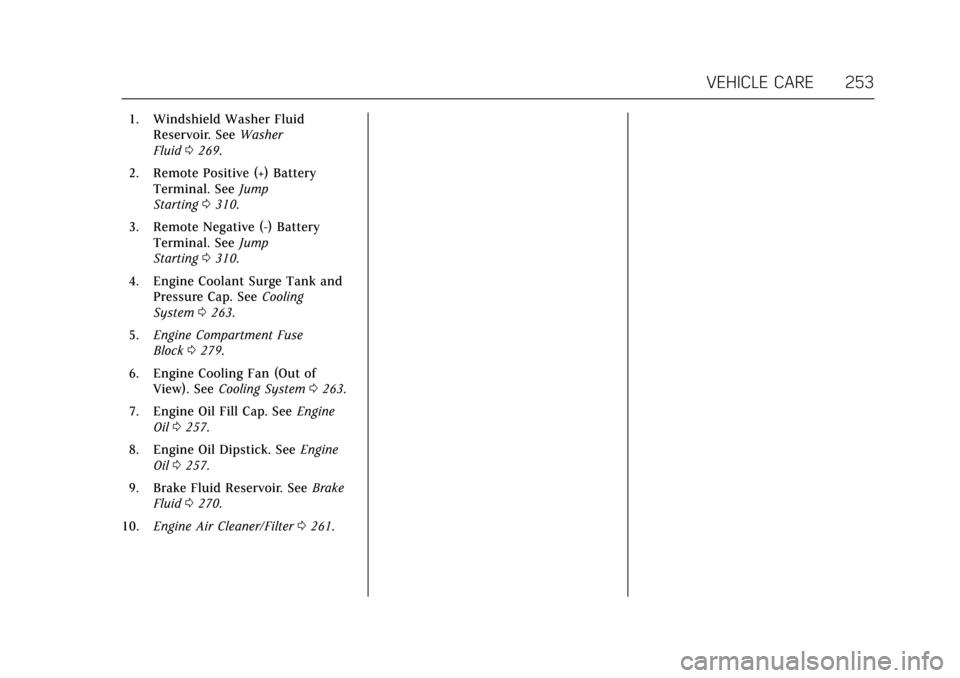
1. Windshield Washer FluidReservoir. See Washer
Fluid 0269.
2. Remote Positive (+) Battery Terminal. See Jump
Starting 0310.
3. Remote Negative (-) Battery Terminal. See Jump
Starting 0310.
4. Engine Coolant Surge Tank and Pressure Cap. See Cooling
System 0263.
5. Engine Compartment Fuse
Block 0279.
6. Engine Cooling Fan (Out of View). See Cooling System 0263.
7. Engine Oil Fill Cap. See Engine
Oil 0257.
8. Engine Oil Dipstick. See Engine
Oil 0257.
9. Brake Fluid Reservoir. See Brake
Fluid 0270.
10. Engine Air Cleaner/Filter 0261.
Page 256 of 352
Cadillac CTS/CTS-V Owner Manual (GMNA-Localizing-MidEast-10293089) -
2017 - crc - 6/22/16
VEHICLE CARE 255
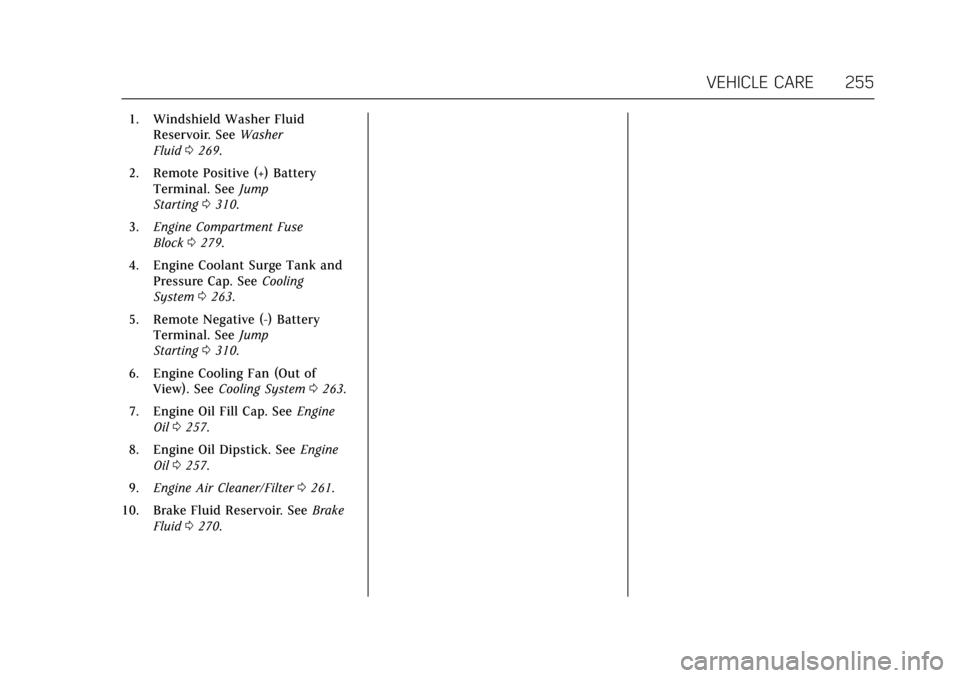
1. Windshield Washer FluidReservoir. See Washer
Fluid 0269.
2. Remote Positive (+) Battery Terminal. See Jump
Starting 0310.
3. Engine Compartment Fuse
Block 0279.
4. Engine Coolant Surge Tank and Pressure Cap. See Cooling
System 0263.
5. Remote Negative (-) Battery Terminal. See Jump
Starting 0310.
6. Engine Cooling Fan (Out of View). See Cooling System 0263.
7. Engine Oil Fill Cap. See Engine
Oil 0257.
8. Engine Oil Dipstick. See Engine
Oil 0257.
9. Engine Air Cleaner/Filter 0261.
10. Brake Fluid Reservoir. See Brake
Fluid 0270.
Page 258 of 352
Cadillac CTS/CTS-V Owner Manual (GMNA-Localizing-MidEast-10293089) -
2017 - crc - 6/22/16
VEHICLE CARE 257
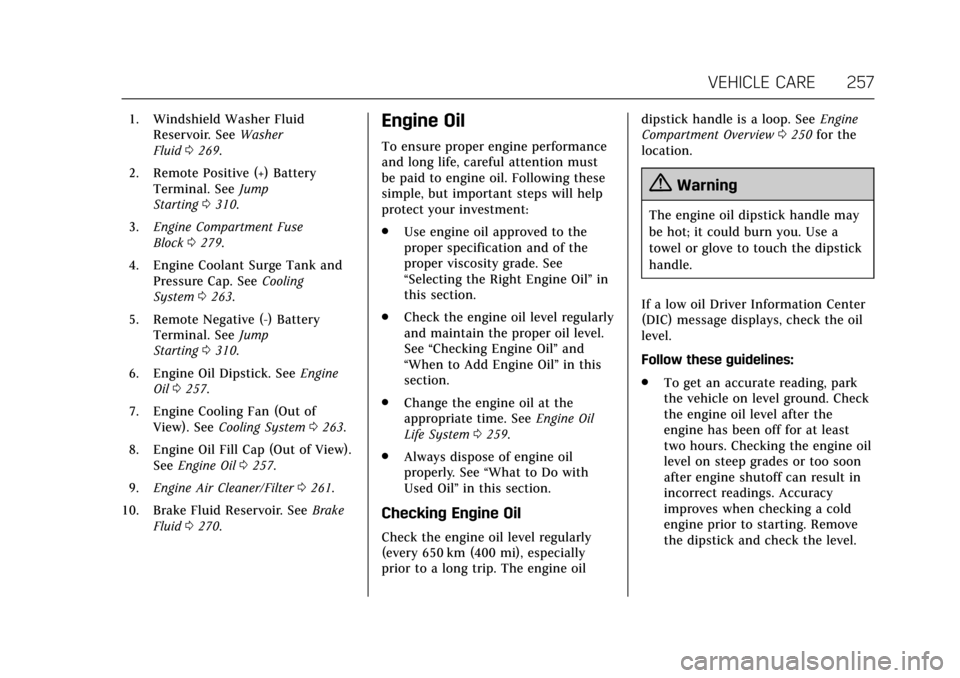
1. Windshield Washer FluidReservoir. See Washer
Fluid 0269.
2. Remote Positive (+) Battery Terminal. See Jump
Starting 0310.
3. Engine Compartment Fuse
Block 0279.
4. Engine Coolant Surge Tank and Pressure Cap. See Cooling
System 0263.
5. Remote Negative (-) Battery Terminal. See Jump
Starting 0310.
6. Engine Oil Dipstick. See Engine
Oil 0257.
7. Engine Cooling Fan (Out of View). See Cooling System 0263.
8. Engine Oil Fill Cap (Out of View). See Engine Oil 0257.
9. Engine Air Cleaner/Filter 0261.
10. Brake Fluid Reservoir. See Brake
Fluid 0270.Engine Oil
To ensure proper engine performance
and long life, careful attention must
be paid to engine oil. Following these
simple, but important steps will help
protect your investment:
.
Use engine oil approved to the
proper specification and of the
proper viscosity grade. See
“Selecting the Right Engine Oil” in
this section.
. Check the engine oil level regularly
and maintain the proper oil level.
See “Checking Engine Oil” and
“When to Add Engine Oil” in this
section.
. Change the engine oil at the
appropriate time. See Engine Oil
Life System 0259.
. Always dispose of engine oil
properly. See “What to Do with
Used Oil” in this section.
Checking Engine Oil
Check the engine oil level regularly
(every 650 km (400 mi), especially
prior to a long trip. The engine oil dipstick handle is a loop. See
Engine
Compartment Overview 0250 for the
location.
{Warning
The engine oil dipstick handle may
be hot; it could burn you. Use a
towel or glove to touch the dipstick
handle.
If a low oil Driver Information Center
(DIC) message displays, check the oil
level.
Follow these guidelines:
. To get an accurate reading, park
the vehicle on level ground. Check
the engine oil level after the
engine has been off for at least
two hours. Checking the engine oil
level on steep grades or too soon
after engine shutoff can result in
incorrect readings. Accuracy
improves when checking a cold
engine prior to starting. Remove
the dipstick and check the level.
Page 265 of 352
Cadillac CTS/CTS-V Owner Manual (GMNA-Localizing-MidEast-10293089) -
2017 - crc - 6/22/16
264 VEHICLE CARE
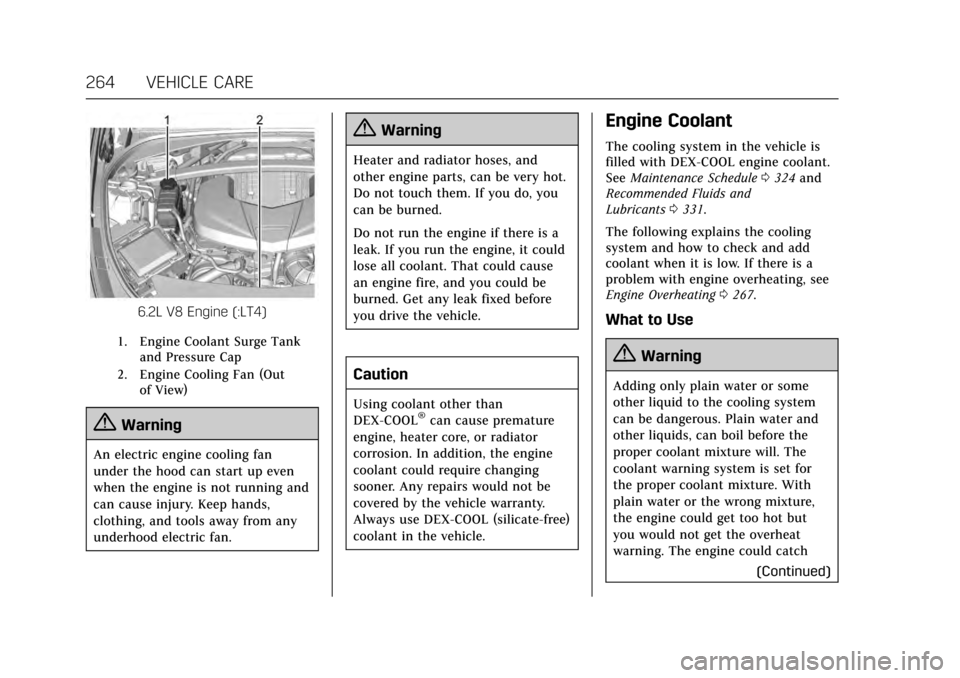
6.2L V8 Engine (:LT4)
1. Engine Coolant Surge Tankand Pressure Cap
2. Engine Cooling Fan (Out of View)
{Warning
An electric engine cooling fan
under the hood can start up even
when the engine is not running and
can cause injury. Keep hands,
clothing, and tools away from any
underhood electric fan.
{Warning
Heater and radiator hoses, and
other engine parts, can be very hot.
Do not touch them. If you do, you
can be burned.
Do not run the engine if there is a
leak. If you run the engine, it could
lose all coolant. That could cause
an engine fire, and you could be
burned. Get any leak fixed before
you drive the vehicle.
Caution
Using coolant other than
DEX-COOL®can cause premature
engine, heater core, or radiator
corrosion. In addition, the engine
coolant could require changing
sooner. Any repairs would not be
covered by the vehicle warranty.
Always use DEX-COOL (silicate-free)
coolant in the vehicle.
Engine Coolant
The cooling system in the vehicle is
filled with DEX-COOL engine coolant.
See Maintenance Schedule 0324 and
Recommended Fluids and
Lubricants 0331.
The following explains the cooling
system and how to check and add
coolant when it is low. If there is a
problem with engine overheating, see
Engine Overheating 0267.
What to Use
{Warning
Adding only plain water or some
other liquid to the cooling system
can be dangerous. Plain water and
other liquids, can boil before the
proper coolant mixture will. The
coolant warning system is set for
the proper coolant mixture. With
plain water or the wrong mixture,
the engine could get too hot but
you would not get the overheat
warning. The engine could catch
(Continued)
Page 267 of 352
Cadillac CTS/CTS-V Owner Manual (GMNA-Localizing-MidEast-10293089) -
2017 - crc - 6/22/16
266 VEHICLE CARE
If no coolant is visible in the coolant
surge tank, add coolant as follows:
How to Add Coolant to the
Coolant Surge TankCaution
This vehicle has a specific coolant
fill procedure. Failure to follow this
procedure could cause the engine to
overheat and be severely damaged.
If no problem is found, check to see if
coolant is visible in the coolant surge
tank. If coolant is visible but the
coolant level is not at the bottom of
the fill neck, add a 50/50 mixture of
clean, drinkable water and DEX-COOL
coolant at the coolant surge tank, but
be sure the cooling system, including
the coolant surge tank pressure cap, is
cool before you do it.
{Warning
Steam and scalding liquids from a
hot cooling system can blow out
and burn you badly. Never turn the
cap when the cooling system,
including the surge tank pressure
cap, is hot. Wait for the cooling
system and surge tank pressure cap
to cool.
{Warning
Adding only plain water or some
other liquid to the cooling system
can be dangerous. Plain water and
other liquids, can boil before the
proper coolant mixture will. The
coolant warning system is set for
the proper coolant mixture. With
plain water or the wrong mixture,
the engine could get too hot but
you would not get the overheat
warning. The engine could catch
fire and you or others could be (Continued)
Warning (Continued)
burned. Use a 50/50 mixture of
clean, drinkable water and
DEX-COOL coolant.
Caution
In cold weather, water can freeze
and crack the engine, radiator,
heater core, and other parts. Use
the recommended coolant and the
proper coolant mixture.
{Warning
You can be burned if you spill
coolant on hot engine parts.
Coolant contains ethylene glycol
and it will burn if the engine parts
are hot enough. Do not spill coolant
on a hot engine.
1. Remove the coolant surge tank pressure cap from the top
chamber when the cooling
Page 316 of 352
Cadillac CTS/CTS-V Owner Manual (GMNA-Localizing-MidEast-10293089) -
2017 - crc - 6/22/16
VEHICLE CARE 315
Appearance Care
Exterior Care
Locks
Locks are lubricated at the factory.
Use a de-icing agent only when
absolutely necessary, and have the
locks greased after using. See
Recommended Fluids and
Lubricants0331.
Washing the Vehicle
To preserve the vehicle's finish, wash
it often and out of direct sunlight.
Caution
Do not use petroleum-based, acidic,
or abrasive cleaning agents as they
can damage the vehicle's paint,
metal, or plastic parts. If damage
occurs, it would not be covered by
the vehicle warranty. Approved
cleaning products can be obtained
from your dealer. Follow all
manufacturer directions regarding
(Continued)
Caution (Continued)
correct product usage, necessary
safety precautions, and appropriate
disposal of any vehicle care
product.
Caution
Avoid using high-pressure washes
closer than 30 cm (12 in) to the
surface of the vehicle. Use of power
washers exceeding 8,274 kPa
(1,200 psi) can result in damage or
removal of paint and decals.
Caution
Do not power wash any component
under the hood that has this
e
symbol.
This could cause damage that
would not be covered by the vehicle
warranty. If using an automatic car wash, follow
the car wash instructions. The
windshield wiper and rear window
wiper, if equipped, must be off.
Remove any accessories that may be
damaged or interfere with the car
wash equipment.
Rinse the vehicle well, before washing
and after, to remove all cleaning
agents completely. If they are allowed
to dry on the surface, they could stain.
Dry the finish with a soft, clean
chamois or an all-cotton towel to
avoid surface scratches and water
spotting.
Finish Care
Application of aftermarket clearcoat
sealant/wax materials is not
recommended. If painted surfaces are
damaged, see your dealer to have the
damage assessed and repaired. Foreign
materials such as calcium chloride
and other salts, ice melting agents,
road oil and tar, tree sap, bird
droppings, chemicals from industrial
chimneys, etc., can damage the
vehicle's finish if they remain on
painted surfaces. Wash the vehicle as
soon as possible. If necessary, use
Page 320 of 352
Cadillac CTS/CTS-V Owner Manual (GMNA-Localizing-MidEast-10293089) -
2017 - crc - 6/22/16
VEHICLE CARE 319
Finish Damage
Quickly repair minor chips and
scratches with touch-up materials
available from your dealer to avoid
corrosion. Larger areas of finish
damage can be corrected in your
dealer's body and paint shop.
Chemical Paint Spotting
Airborne pollutants can fall upon and
attack painted vehicle surfaces
causing blotchy, ring-shaped
discolorations, and small, irregular
dark spots etched into the paint
surface. See“Finish Care”previously in
this section.
Interior Care
To prevent dirt particle abrasions,
regularly clean the vehicle's interior.
Immediately remove any soils. Note
that newspapers or dark garments
that can transfer color to home
furnishings can also permanently
transfer color to the vehicle's interior.
Use a soft bristle brush to remove
dust from knobs and crevices on the
instrument cluster. Using a mild soap
solution, immediately remove hand lotions, sunscreen, and insect
repellent from all interior surfaces or
permanent damage may result.
Your dealer may have products for
cleaning the interior. Use cleaners
specifically designed for the surfaces
being cleaned to prevent permanent
damage. Apply all cleaners directly to
the cleaning cloth. Do not spray
cleaners directly on any switches or
controls. Cleaners should be removed
quickly. Never allow cleaners to
remain on the surface being cleaned
for extended periods of time.
Cleaners may contain solvents that
can become concentrated in the
interior. Before using cleaners, read
and adhere to all safety instructions
on the label. While cleaning the
interior, maintain adequate ventilation
by opening the doors and windows.
To prevent damage, do not clean the
interior using the following cleaners
or techniques:
.
Never use a razor or any other
sharp object to remove a soil from
any interior surface. .
Never use a brush with stiff
bristles.
. Never rub any surface aggressively
or with excessive pressure.
. Do not use laundry detergents or
dishwashing soaps with
degreasers. For liquid cleaners, use
approximately 20 drops per 3.8 L
(1 gal) of water. A concentrated
soap solution will leave a residue
that creates streaks and attracts
dirt. Do not use solutions that
contain strong or caustic soap.
. Do not heavily saturate the
upholstery when cleaning.
. Do not use solvents or cleaners
containing solvents.Interior Glass
To clean, use a terry cloth fabric
dampened with water. Wipe droplets
left behind with a clean dry cloth.
Commercial glass cleaners may be
used, if necessary, after cleaning the
interior glass with plain water.
Page 325 of 352
Cadillac CTS/CTS-V Owner Manual (GMNA-Localizing-MidEast-10293089) -
2017 - crc - 6/22/16
324 SERVICE AND MAINTENANCE
At your dealer, you can be certain that
you will receive the highest level of
service available. Your dealer has
specially trained service technicians,
uses genuine replacement parts, as
well as, up-to-date tools and
equipment to ensure fast and accurate
diagnostics.
The proper replacement parts, fluids,
and lubricants to use are listed in
Recommended Fluids and Lubricants
0331 and Maintenance Replacement
Parts 0332. We recommend the use
of genuine parts from your dealer.
Rotation of New Tires
Tire rotation is not recommended if
the vehicle has different size tires on
the front and rear wheels. If tire
rotation is recommended for the
vehicle, to maintain ride, handling,
and performance of the vehicle, it is
important that the first rotation
service for new tires be performed.
Tires should be rotated every service.
See Tire Rotation 0296.Maintenance Schedule
Owner Checks and Services
At Each Fuel Stop
.
Check the engine oil level. See
Engine Oil 0257.
Once a Month
. Check the tire inflation pressures.
See Tire Pressure 0290.
. Inspect the tires for wear. See Tire
Inspection 0296.
. Check the windshield washer fluid
level. See Washer Fluid 0269.
Engine Oil Change
Change the engine oil and filter when
the CHANGE ENGINE OIL SOON
message displays, 12 000 km/7,500 mi,
or at one year, whichever comes first.
If driven under the best conditions,
the engine oil life system may not
indicate the need for vehicle service
for up to a year. The engine oil and
filter must be changed at least once a
year and the oil life system must be
reset. Your trained dealer technician
can perform this work. If the engine oil life system is reset accidentally,
service the vehicle within 5 000 km/
3,000 mi since the last service. Reset
the oil life system when the oil is
changed. See
Engine Oil Life
System 0259.
Tire Rotation and Required
Services Every 12 000 km/
7,500 mi
Rotate the tires, if recommended for
the vehicle, and perform the following
services. See Tire Rotation0296.
. Check engine oil level and oil
life percentage. If needed, change
engine oil and filter, and reset oil
life system. See Engine Oil0257
and Engine Oil Life System 0259.
. Check engine coolant level. See
Engine Coolant 0264.
. Check windshield washer fluid
level. See Washer Fluid 0269.
. Visually inspect windshield wiper
blades for wear, cracking,
or contamination. See Exterior
Care 0315. Replace worn or
damaged wiper blades. See Wiper
Blade Replacement 0274.
Page 330 of 352
Cadillac CTS/CTS-V Owner Manual (GMNA-Localizing-MidEast-10293089) -
2017 - crc - 6/22/16
SERVICE AND MAINTENANCE 329
Footnotes—Maintenance Schedule
Additional Required Services -
Severe
(1) Vehicles with different size front
and rear tires do not have tire
rotation. See Tire Rotation0296.
(2) Or every two years, whichever
comes first. More frequent passenger
compartment air filter replacement
may be needed if driving in areas with
heavy traffic, poor air quality, high
dust levels, or environmental
allergens. Passenger compartment air
filter replacement may also be needed
if there is reduced airf low, window
fogging, or odors. Your GM dealer can
help determine when to replace the
filter.
(3) Visually check all fuel and vapor
lines and hoses for proper attachment,
connection, routing, and condition.
(4) Or every two years, whichever
comes first. If driving in dusty
conditions, inspect the filter at each
oil change or more often as needed.
(5) Do not directly power wash the
transfer case output seals. High
pressure water can overcome the seals and contaminate the transfer case
fluid. Contaminated fluid will decrease
the life of the transfer case and should
be replaced.
(6)
Or every five years, whichever
comes first. See Cooling System0263.
(7) Or every 10 years, whichever
comes first. Inspect for fraying,
excessive cracking, or damage; replace,
if needed.
(8) Replace brake fluid every five
years. See Brake Fluid 0270.Special Application
Services
Severe Conditions Requiring
More Frequent Maintenance
.
Public service, military,
or commercial use vehicles to
include the following:
‐Ambulances, police cars and
emergency rescue vehicles.
‐ Civilian vehicles such as light
duty pick-up trucks, SUVs and
passenger cars that are used in
military applications.
‐ Recovery vehicles such as tow
trucks and flatbed single vehicle
carriers or any vehicle that is
consistently used in towing
trailers or other loads.
‐ High use commercial vehicles
such as courier delivery vehicles,
private security patrol vehicles
or any vehicles that operate on
a 24 hour basis.
Page 346 of 352
Cadillac CTS/CTS-V Owner Manual (GMNA-Localizing-MidEast-10293089) -
2017 - crc - 6/22/16
INDEX 345
Engine (cont'd)Oil Life System . . . . . . . . . . . . . . . . . . . . 259
Oil Messages . . . . . . . . . . . . . . . . . . . . . . 140
Oil Pressure Light . . . . . . . . . . . . . . . . . 129
Overheating . . . . . . . . . . . . . . . . . . . . . . . 267
Power Messages . . . . . . . . . . . . . . . . . . 140
Running While Parked . . . . . . . . . . . 203
Starting . . . . . . . . . . . . . . . . . . . . . . . . 19, 198
Entry Lighting . . . . . . . . . . . . . . . . . . . . . . 163
Event Data Recorders . . . . . . . . . . . . . . 340
Exit Lighting . . . . . . . . . . . . . . . . . . . . . . . . 163
Extended Parking . . . . . . . . . . . . . . . . . . . 201
Exterior Lamp Controls . . . . . . . . . . . . 157
Exterior Lamps Off Reminder . . . . . . 159
Exterior Lighting Battery Saver . . . . 164
F
Features Memory . . . . . . . . . . . . . . . . . . . . . . . . . . . . . 13
Filter, Engine Air Cleaner . . . . . . . . . . . . . . . . 261
Flash-to-Pass . . . . . . . . . . . . . . . . . . . . . . . . 159
Flashers, Hazard Warning . . . . . . . . . . 161
Flat Tire . . . . . . . . . . . . . . . . . . . . . . . . . . . . . 302
Floor Mats . . . . . . . . . . . . . . . . . . . . . . . . . . . 322
Fluid Automatic Transmission . . . . . . . . . 260
Brakes . . . . . . . . . . . . . . . . . . . . . . . . . . . . . 270
Washer . . . . . . . . . . . . . . . . . . . . . . . . . . . . 269 Forward Automatic Braking . . . . . . . . 237
Forward Collision Alert (FCA)
System . . . . . . . . . . . . . . . . . . . . . . . . . . . . . 235
Front Seats Heated and Ventilated . . . . . . . . . . . . . 60
Fuel . . . . . . . . . . . . . . . . . . . . . . . . . . . . . . . . . . 242 Additives . . . . . . . . . . . . . . . . . . . . . . . . . . 243
Economy Driving . . . . . . . . . . . . . . . . . . . 26
Filling a Portable Fuel
Container . . . . . . . . . . . . . . . . . . . . . . . . 245
Filling the Tank . . . . . . . . . . . . . . . . . . . 243
Gauge . . . . . . . . . . . . . . . . . . . . . . . . . . . . . . 118
Low Fuel Warning Light . . . . . . . . . 129
System Messages . . . . . . . . . . . . . . . . . 141
Fuses Engine Compartment Fuse
Block . . . . . . . . . . . . . . . . . . . . . . . . . . . . . 279
Fuses and Circuit Breakers . . . . . . . 278
Instrument Panel Fuse Block . . . . 282
Rear Compartment Fuse Block . . . . . . . . . . . . . . . . . . . . . . . . . . . . . 284
G
Gauges
Boost . . . . . . . . . . . . . . . . . . . . . . . . . . . . . . 119
Engine Coolant Temperature . . . . 120
Fuel . . . . . . . . . . . . . . . . . . . . . . . . . . . . . . . . 118
Odometer . . . . . . . . . . . . . . . . . . . . . . . . . . 118
Speedometer . . . . . . . . . . . . . . . . . . . . . . 118 Gauges (cont'd)
Tachometer . . . . . . . . . . . . . . . . . . . . . . . 118
Trip Odometer . . . . . . . . . . . . . . . . . . . . 118
Warning Lights and
Indicators . . . . . . . . . . . . . . . . . . . . . . . . 113
General Information Service and Maintenance . . . . . . . . 323
Towing . . . . . . . . . . . . . . . . . . . . . . . . . . . . 245
Vehicle Care . . . . . . . . . . . . . . . . . . . . . . . 248
Glove Box . . . . . . . . . . . . . . . . . . . . . . . . . . . 100
H
Halogen Bulbs . . . . . . . . . . . . . . . . . . . . . . 275
Hazard Warning Flashers . . . . . . . . . . 161
Head Restraints . . . . . . . . . . . . . . . . . . . . . . 53
Head-up Display . . . . . . . . . . . . . . . . . . . . 135
Headlamps Adaptive ForwardLighting (AFL) . . . . . . . . . . . . . . . . . . . 160
Aiming . . . . . . . . . . . . . . . . . . . . . . . . . . . . . 275
Automatic . . . . . . . . . . . . . . . . . . . . . . . . . 160
Bulb Replacement . . . . . . . . . . . . . . . . 275
Daytime Running Lamps (DRL) . . . . . . . . . . . . . . . . . . . . 159
Flash-to-Pass . . . . . . . . . . . . . . . . . . . . . . 159
High Intensity Discharge (HID) Lighting . . . . . . . . . . . . . . . . . . . 276
High-Beam On Light . . . . . . . . . . . . . . 130
High/Low Beam Changer . . . . . . . . . 159