trailer CADILLAC CTS V 2017 3.G User Guide
[x] Cancel search | Manufacturer: CADILLAC, Model Year: 2017, Model line: CTS V, Model: CADILLAC CTS V 2017 3.GPages: 352, PDF Size: 3.99 MB
Page 286 of 352
Cadillac CTS/CTS-V Owner Manual (GMNA-Localizing-MidEast-10293089) -
2017 - crc - 6/22/16
VEHICLE CARE 285
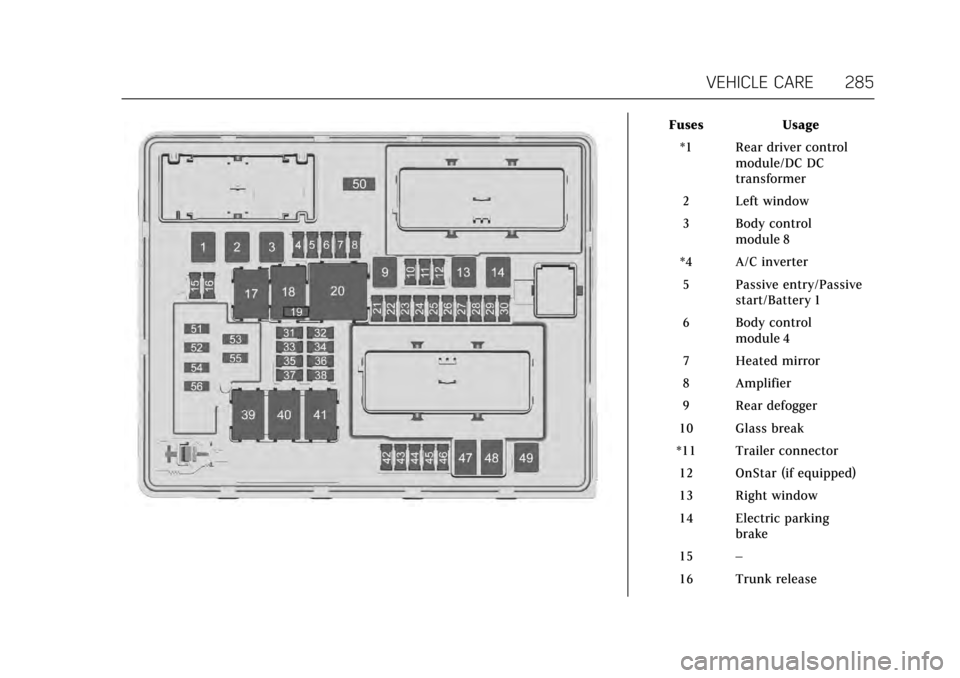
FusesUsage
*1 Rear driver control module/DC DC
transformer
2 Left window
3 Body control module 8
*4 A/C inverter 5 Passive entry/Passive start/Battery 1
6 Body control module 4
7 Heated mirror
8 Amplifier
9 Rear defogger
10 Glass break
*11 Trailer connector
12 OnStar (if equipped)
13 Right window
14 Electric parking brake
15 –
16 Trunk release
Page 287 of 352
Cadillac CTS/CTS-V Owner Manual (GMNA-Localizing-MidEast-10293089) -
2017 - crc - 6/22/16
286 VEHICLE CARE
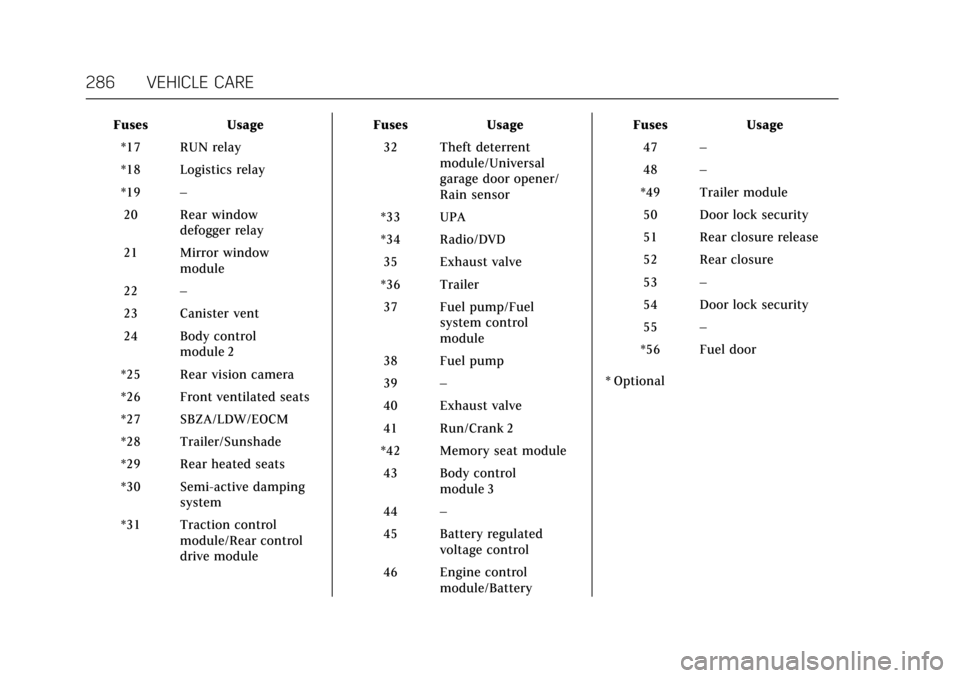
FusesUsage
*17 RUN relay
*18 Logistics relay
*19 –
20 Rear window defogger relay
21 Mirror window module
22 –
23 Canister vent
24 Body control module 2
*25 Rear vision camera
*26 Front ventilated seats
*27 SBZA/LDW/EOCM
*28 Trailer/Sunshade
*29 Rear heated seats
*30 Semi-active damping system
*31 Traction control module/Rear control
drive module Fuses
Usage
32 Theft deterrent module/Universal
garage door opener/
Rain sensor
*33 UPA
*34 Radio/DVD
35 Exhaust valve
*36 Trailer 37 Fuel pump/Fuel system control
module
38 Fuel pump
39 –
40 Exhaust valve
41 Run/Crank 2
*42 Memory seat module
43 Body control module 3
44 –
45 Battery regulated voltage control
46 Engine control module/Battery Fuses
Usage
47 –
48 –
*49 Trailer module 50 Door lock security
51 Rear closure release
52 Rear closure
53 –
54 Door lock security
55 –
*56 Fuel door
* Optional
Page 314 of 352

Cadillac CTS/CTS-V Owner Manual (GMNA-Localizing-MidEast-10293089) -
2017 - crc - 6/22/16
VEHICLE CARE 313
Caution
Improper use of the tow eye can
cause vehicle damage. Use caution
and low speeds to prevent damage
to the vehicle.
Carefully open the cover in the fascia
by using the small notch that conceals
the tow eye socket.
Install the tow eye into the socket by
turning it clockwise until it stops.
When the tow eye is removed,
reinstall the cover with the notch in
the original position.
Recreational Vehicle
Towing
Recreational vehicle towing means
towing the vehicle behind another
vehicle such as a motor home. The
two most common types of
recreational vehicle towing are known
as dinghy towing and dolly towing.
Dinghy towing is towing the vehicle
with all four wheels on the ground.
Dolly towing is towing the vehicle with two wheels on the ground and
two wheels up on a device known as a
dolly.
Here are some important things to
consider before recreational vehicle
towing:
.
What is the towing capacity of the
towing vehicle? Be sure to read the
tow vehicle manufacturer's
recommendations.
. What is the distance that will be
traveled? Some vehicles have
restrictions on how far and how
long they can tow.
. Is the proper towing equipment
going to be used? See your dealer
or trailering professional for
additional advice and equipment
recommendations.
. Is the vehicle ready to be towed?
Just as preparing the vehicle for a
long trip, make sure the vehicle is
prepared to be towed.
Dinghy Towing
Caution
If the vehicle is towed with all four
wheels on the ground, the
drivetrain components could be
damaged. The repairs would not be
covered by the vehicle warranty. Do
not tow the vehicle with all four
wheels on the ground.
The vehicle was not designed to be
towed with all four wheels on the
ground. If the vehicle must be towed,
a dolly should be used. See the
following information on dolly towing.
Page 330 of 352
Cadillac CTS/CTS-V Owner Manual (GMNA-Localizing-MidEast-10293089) -
2017 - crc - 6/22/16
SERVICE AND MAINTENANCE 329
Footnotes—Maintenance Schedule
Additional Required Services -
Severe
(1) Vehicles with different size front
and rear tires do not have tire
rotation. See Tire Rotation0296.
(2) Or every two years, whichever
comes first. More frequent passenger
compartment air filter replacement
may be needed if driving in areas with
heavy traffic, poor air quality, high
dust levels, or environmental
allergens. Passenger compartment air
filter replacement may also be needed
if there is reduced airf low, window
fogging, or odors. Your GM dealer can
help determine when to replace the
filter.
(3) Visually check all fuel and vapor
lines and hoses for proper attachment,
connection, routing, and condition.
(4) Or every two years, whichever
comes first. If driving in dusty
conditions, inspect the filter at each
oil change or more often as needed.
(5) Do not directly power wash the
transfer case output seals. High
pressure water can overcome the seals and contaminate the transfer case
fluid. Contaminated fluid will decrease
the life of the transfer case and should
be replaced.
(6)
Or every five years, whichever
comes first. See Cooling System0263.
(7) Or every 10 years, whichever
comes first. Inspect for fraying,
excessive cracking, or damage; replace,
if needed.
(8) Replace brake fluid every five
years. See Brake Fluid 0270.Special Application
Services
Severe Conditions Requiring
More Frequent Maintenance
.
Public service, military,
or commercial use vehicles to
include the following:
‐Ambulances, police cars and
emergency rescue vehicles.
‐ Civilian vehicles such as light
duty pick-up trucks, SUVs and
passenger cars that are used in
military applications.
‐ Recovery vehicles such as tow
trucks and flatbed single vehicle
carriers or any vehicle that is
consistently used in towing
trailers or other loads.
‐ High use commercial vehicles
such as courier delivery vehicles,
private security patrol vehicles
or any vehicles that operate on
a 24 hour basis.