wheel CADILLAC DEVILLE 1993 7.G User Guide
[x] Cancel search | Manufacturer: CADILLAC, Model Year: 1993, Model line: DEVILLE, Model: CADILLAC DEVILLE 1993 7.GPages: 406, PDF Size: 20.78 MB
Page 95 of 406
Downloaded from www.Manualslib.com manuals search engine 1 (First Gear)
This position gives
you even more power (but lower fuel economy)
than
“2.” You can use it on very steep hills, or in deep snow or mud. If
the selector lever is put in “1,” the transaxle won’t shift into first gear
until the vehicle
is going slowly enough.
7
..
~ If your front wheels can’t rotate, don’t try to drive. This might
~ happen if you were stuck in very deep sand or mud or were up
against
a solid object. You could damage your transaxlc.
Also, if you stop when going uphill, don’t hold your vehicle the]
j with only the accelerator pedal. This could overheat and
~ damage the transaxle.
position on a hillm
I Jse your brakes to hold your.vehic
.. .. ~ -
--
P-NG BRAKE
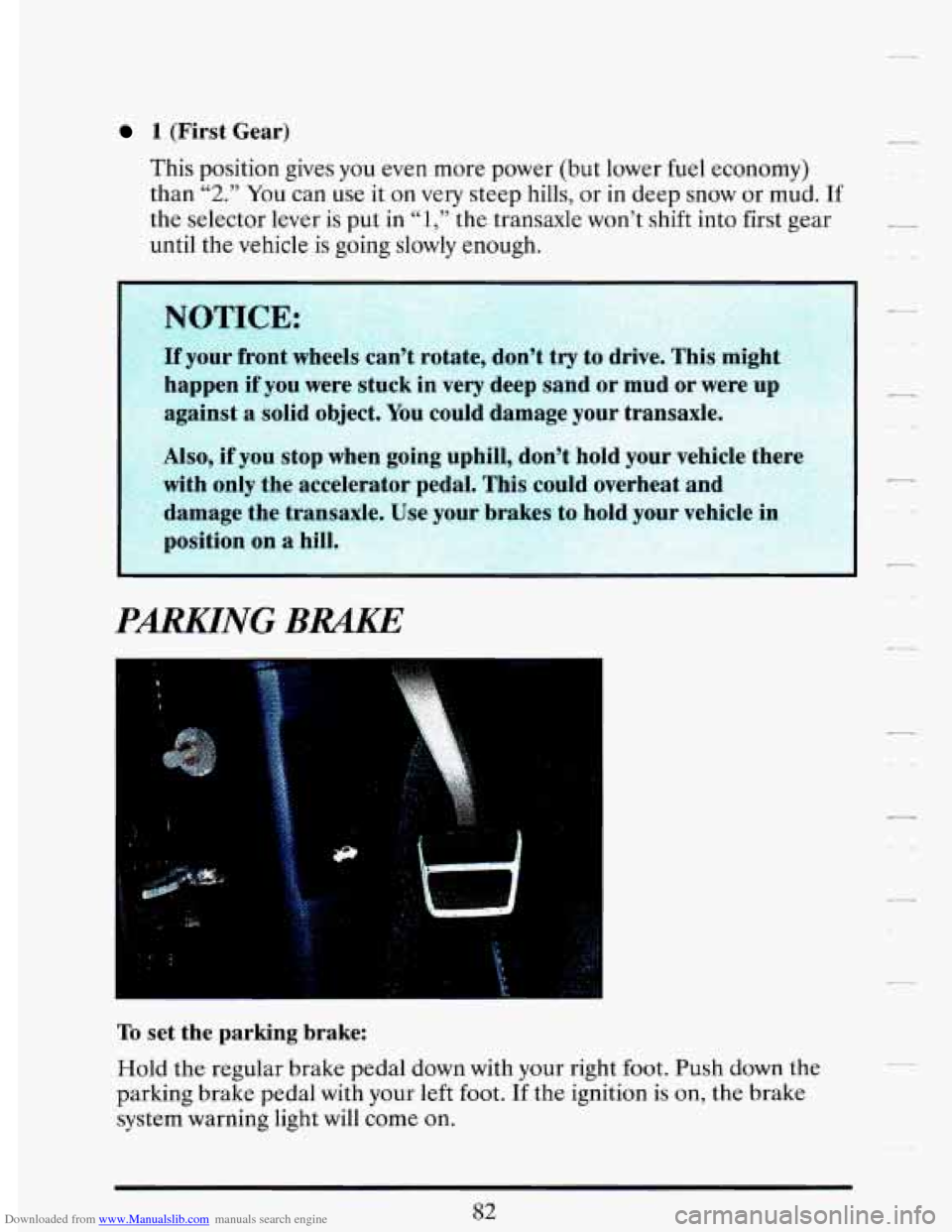
To set the parking brake:
Hold the regular brake pedal down with your right foot. Push down the
parking brake pedal with your left
foot. If the ignition is on, the brake
system warning light will come on.
Page 96 of 406
Downloaded from www.Manualslib.com manuals search engine r
r
When you move out of “P” (Park) or “N” (Neutral), if your engine is
running, your parking brake should go
off. If it doesn’t, you have a
parking brake problem and should have it fixed. In the meantime, you
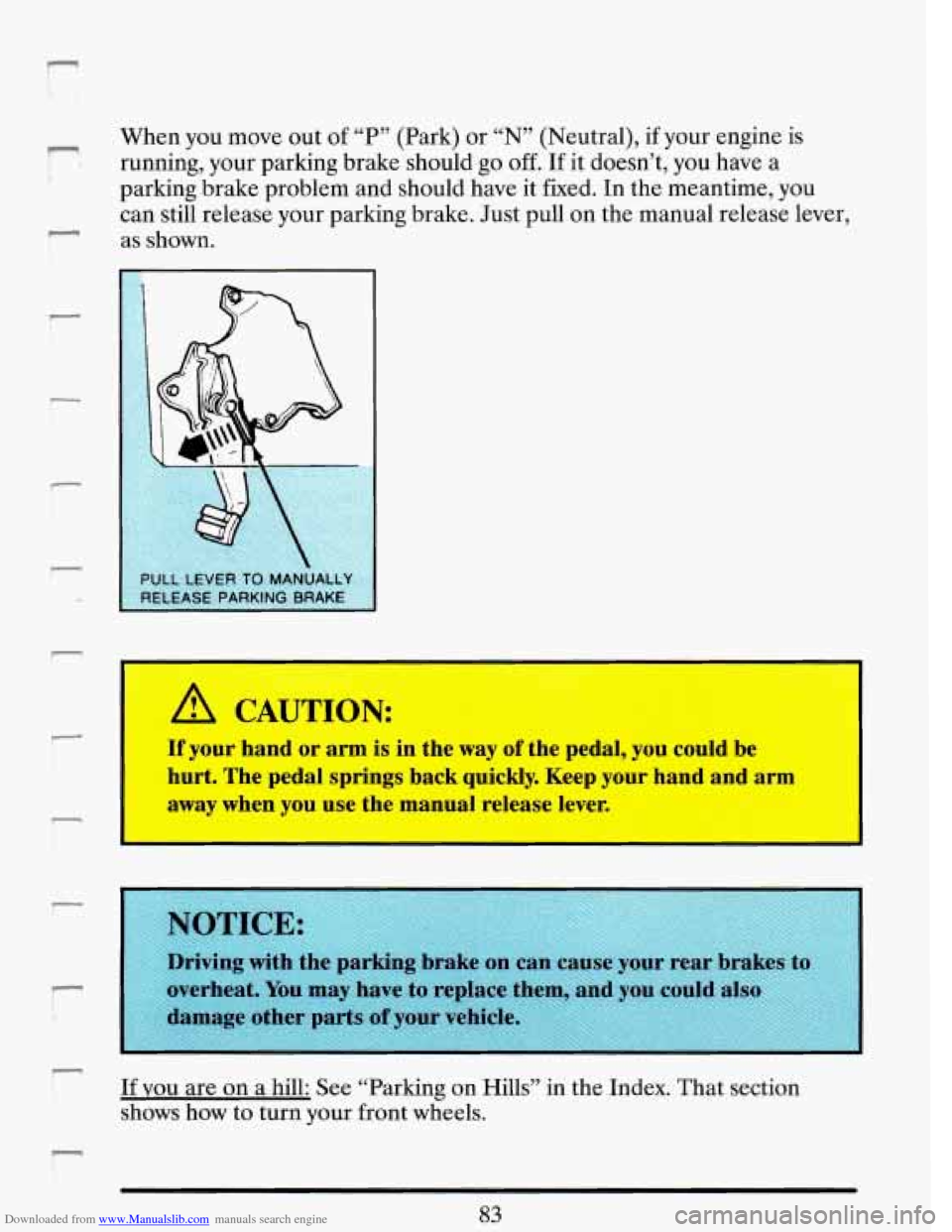
can still release your parking brake. Just pull on the manual release lever,
as shown.
-
A CAUTION:
r If your hand or arm is in the way of the pedal, you could be I
hurt. The pedal springs back quickly. Keep your hand and arm
-- se thr -1anual r -’ - - -e lever. r
r
r
* See “Parking on Hills” in the Index. That section
shows how to turn your front wheels.
Page 104 of 406
Downloaded from www.Manualslib.com manuals search engine Window Lock
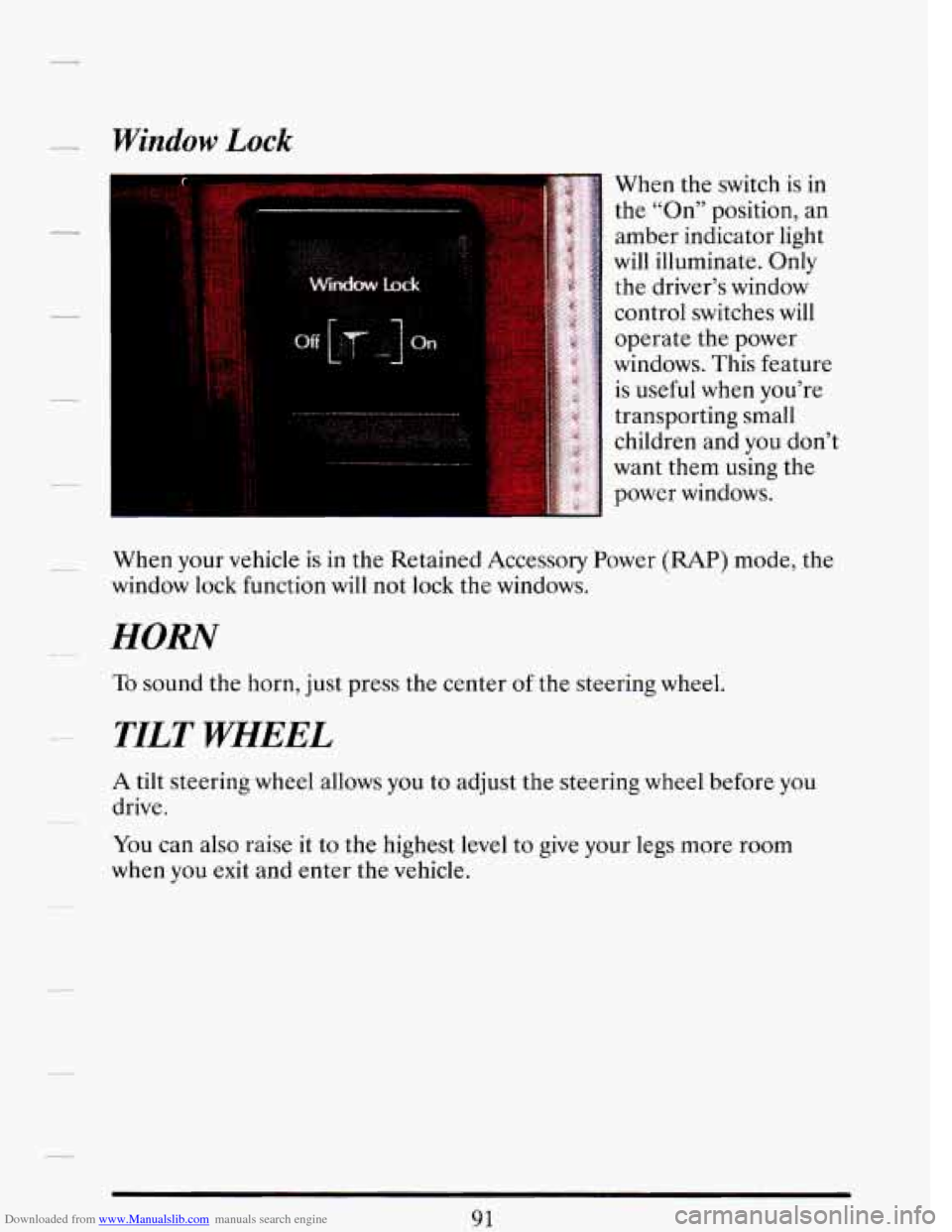
When the switch is in
the "On" position, an
amber indicator light
will illuminate.
Only
the driver's window
control switches will
operate the power
windows. This feature
~ is useful when you're
transporting small
children and you don't
want them using the
power windows.
When your vehicle is in the Retained Accessory Power
(RAP) mode, the
window lock function will not lock the windows.
HORN
To sound the horn, just press the center of the steering wheel.
TILT WHEEL
A tilt steering wheel allows you to adjust the steering wheel before you
drive.
You can also raise it to the highest level to give your legs more room
when you exit and enter the vehicle.
Page 105 of 406
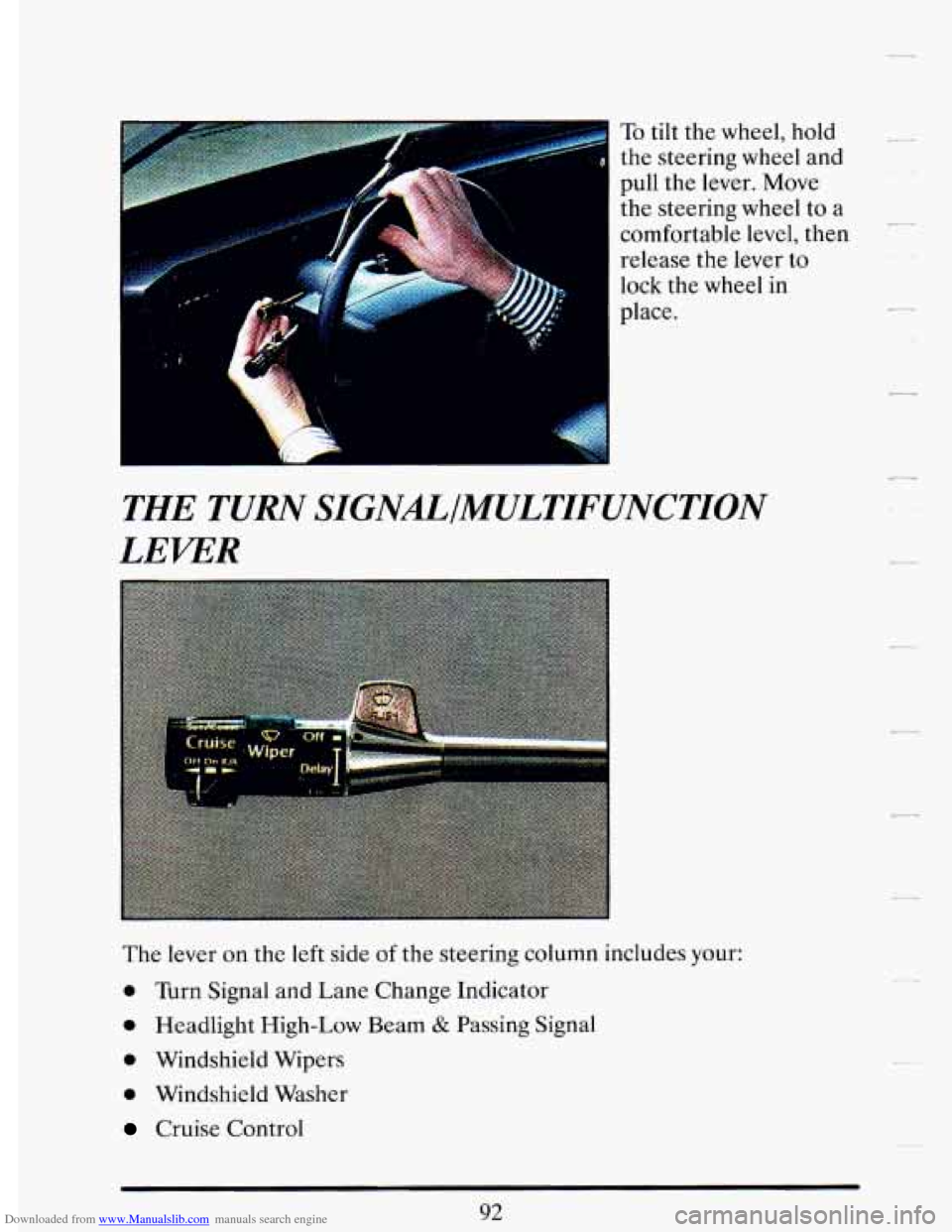
Downloaded from www.Manualslib.com manuals search engine To tilt the wheel, hold -
the steering wheel and b.
pull the lever. Move
the steering wheel to a
comfortable level, then
release the lever to
lock the wheel in
place.
-
THE TURN SIGNK/MULTIFUNCTION
LEVER
The lever on the left side of the steering column includes your:
0 Turn Signal and Lane Change Indicator
0 Headlight High-Low Beam & Passing Signal
0 Windshield Wipers
0 Windshield Washer
Cruise Control
92
Page 112 of 406
Downloaded from www.Manualslib.com manuals search engine A CAUTION:
Cruise Control can be dangerous where you can’t drive safely
at
a steady speed. So, don’t use your Cruise Control on
winding roads or in heavy traffic.
Cruise Control can be dangerous on slippery roads. On such
roads, fast changes in tire traction can cause needless wheel
spinning, and you could lose control. Don’t use Cruise
Control on slippery roads.
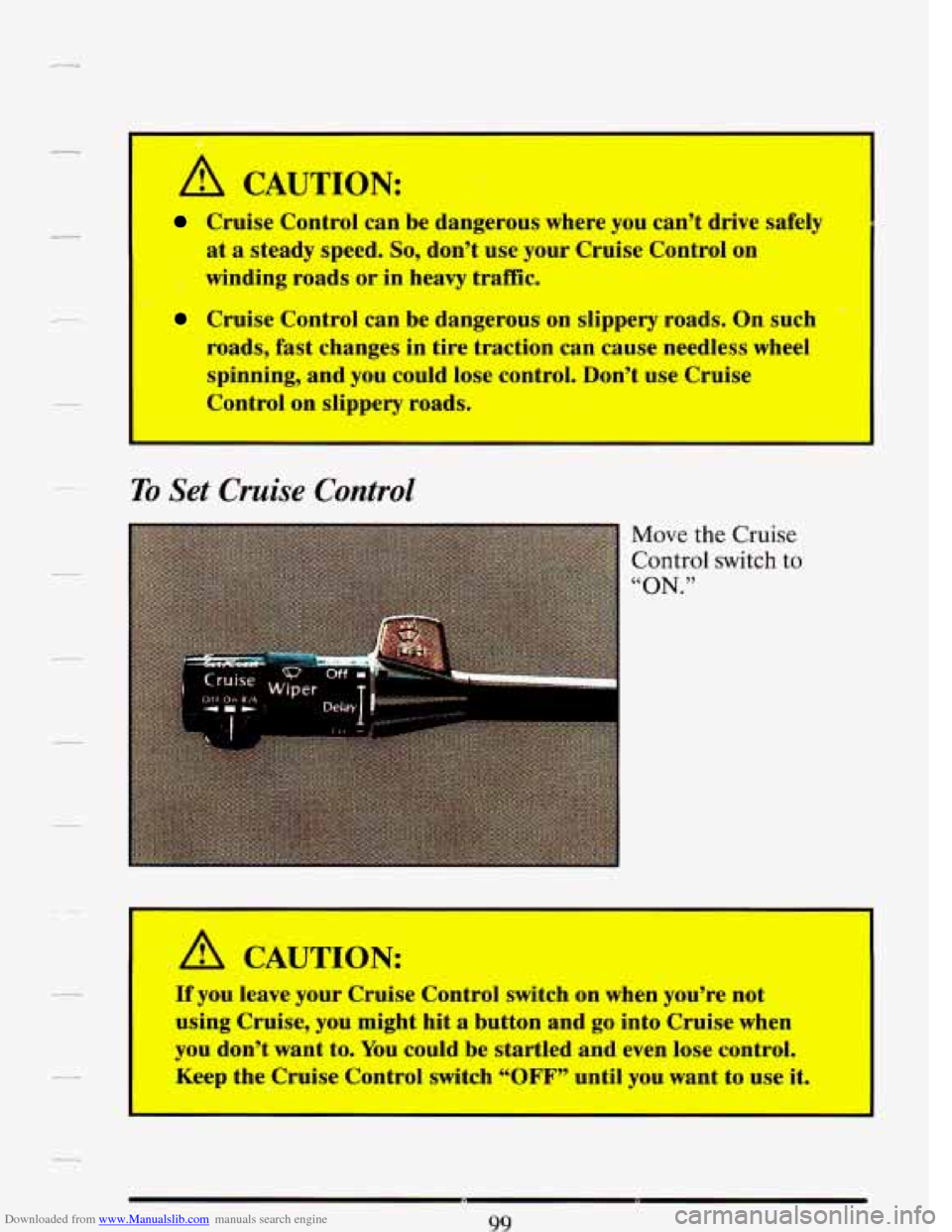
To Set Cruise Control
Move the Cruise
Control switch to
66 ON. 79
I A CAUTION:
If you leave your Cruise Control switch on when you’re not
using Cruise, you might hit
a button and go into Cruise when
you don’t want to. You could be startled and even lose control.
Keep the Cruise Control switch
“OFF” until you want to use it.
99
Page 137 of 406
Downloaded from www.Manualslib.com manuals search engine ‘f the “TRACTION OFF” warning light comes on and stays on for an
:&ended
period of time, your vehicle needs service.
A CAUTION:
If you let your tires spin at high speed when the “TRACTION
OFF” warning light is on, they can explode and you or others
could be injured. And, spinning your tires with the “TRACTION
OFF’’ warning light on can cause the transaxle to overheat or
can cause other problems. That could cause an engine fire or
other damage. When you’re stuck, spin the wheels as little as
possible. Don’t spin the wheels above
35 mph (55 km/h) as
shown
on the speedometer.
-.
I,
YOTICE: I-
Spinning your wheels when the “TRACTION OFF” warning 7
light is on can destroy parts of your vehicle as well as the tir ,
If you spin your wheels too fast while shifting your transaxlf
back
and forth, you can destroy your transaxle. when you’rt
-tuck, spin the wheels
as little as possible.
c
-.
I,
124
Page 149 of 406
Downloaded from www.Manualslib.com manuals search engine TRACTION CONTROL (OPTION)
If you have this feature, this brake only Traction Control complements
your anti-lock braking system.
Traction Control regulates tire spin during low-speed acceleration and
steady driving.
The Traction Control Brake-Only System uses the same wheel speed
sensors used by your Anti-Lock Brake System
(ABS). When wheel slip is
detected by the wheel sensors, the electronic control module sends a
signal to the brake pressure modulator to apply pressure pulses to the
brakes. Traction is then maximized and your vehicle is enabled to
accelerate or continue driving with a controlled amount of tire slip. This
low-speed system controls tire slippage and is fully functional until you
reach
a speed of 24 mph and then the traction control is gradually phased
out as your vehicle reaches
30 mph. To keep you informed of changing
road conditions the “TRACTION
ACTIVE” telltale light will illuminate
when the system
is activated.
-
Because this is a brake only Traction Control system, it is designed to
protect your vehicles powertrain components. The system
will
temporarily by disabled should the brakes or transaxle reach excessively
high temperatures and prolonged use
of traction control. The
“TRACTION
OFF” telltale light in the instrument panel informs you
when this system is not in operation.
ELECTRONIC LEVEL CONTROL
This keeps your vehicle level.
The ignition does not have to be
“ON” for the level control to work. The
system consists
of an electronic height sensor, a small electric air
compressor, and air adjustable shock absorbers mounted on the rear
of
the vehicle.
If the system has a slight leak, the air compressor will run frequently for a
few seconds each time.
For a massive air leak, the air compressor will stay on
for approximately 7
minutes. You should see your dealer for service, but you can keep driving
your Cadillac.
Page 196 of 406
Downloaded from www.Manualslib.com manuals search engine -
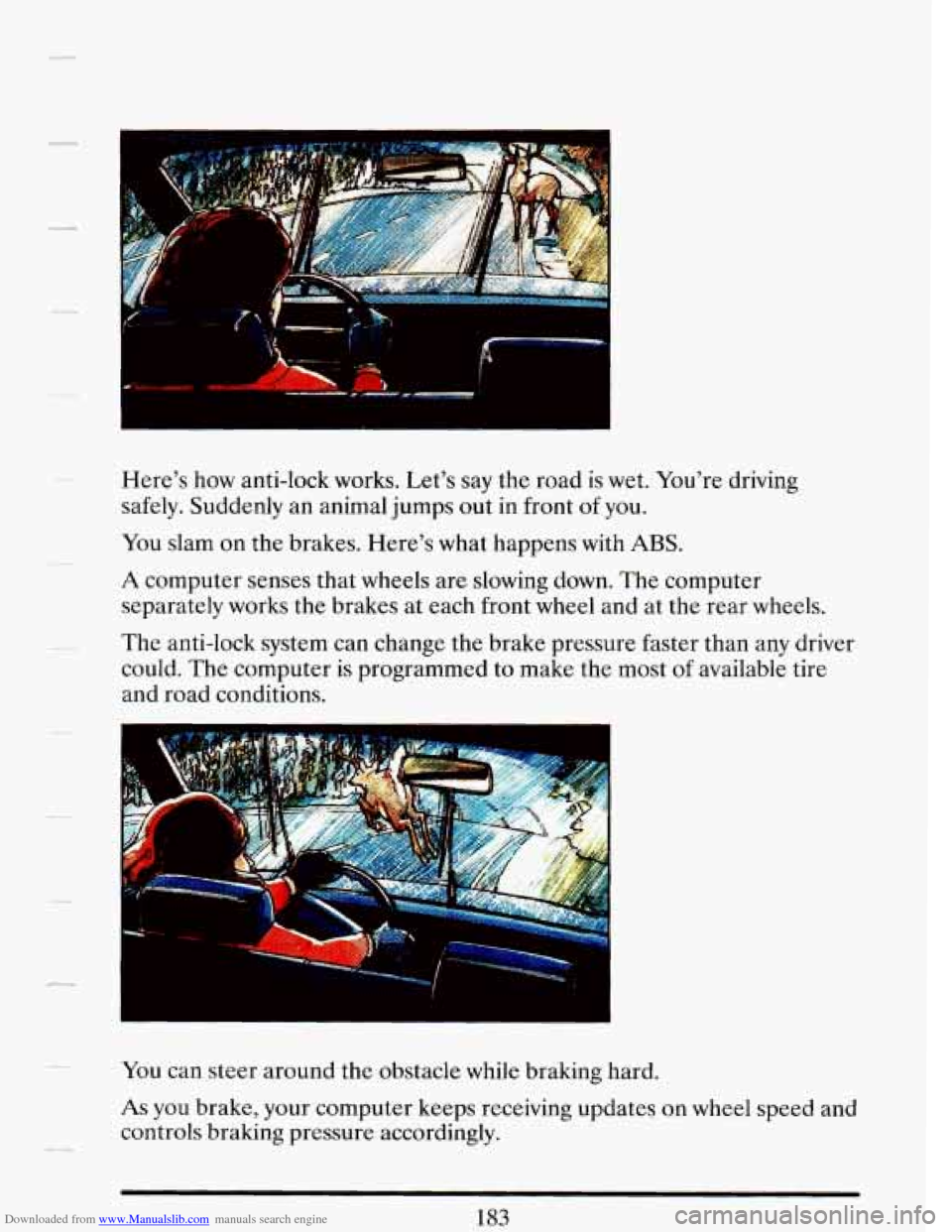
Here's how anti-lock works. Let's say the road is wet. You're driving
safely. Suddenly an animal jumps out in front
of you.
You slam on the brakes. Here's what happens with ABS.
A computer senses that wheels are slowing down. The computer
separately works the brakes at each front wheel and at the rear wheels.
The anti-lock system can change the brake pressure faster than any driver
could. The computer
is programmed to make the most of available tire
and road conditions.
-You can steer around the obstacle while braking hard.
As you brake, your computer keeps receiving updates on wheel speed and
controls braking pressure accordingly.
Page 197 of 406
Downloaded from www.Manualslib.com manuals search engine A CAUTION:
I Anti-lock doesn’t change the time you need to get your foot up to
the brake pedal.
If you get too close to the vehicle in front of
you, you won’t have time to apply your brakes if that vehicle
suddenly slows
or stops. Always leave enough room up ahead to.
stop, even
t- lug ~OU have anti-lock brakes. ..
To Use Anti-Lock:
Don’t pump the brakes. Just hold the brake pedal down and let anti-lock
work for you.
When you start your vehicle and begin to drive away,
you may hear a
momentary motor or clicking noise. And you may even notice that your
brake pedal moves a little while this is going
on. This is the ABS system
testing itself. You may also hear this during
a hard stop.
Traction Control System (Option)
Your vehicle may have a traction control system that limits wheel spin.
This is especially useful in slippery road conditions. The traction control
system works at low speeds only, such as when you accelerate from
a stop.
It applies brake pressure to an individual wheel that the system senses is
about to spin.
ITER
The “TRACTION
ACTIVE’’ light will
appear in your
information center
when your traction
control system is
working.
r
184
Page 200 of 406
Downloaded from www.Manualslib.com manuals search engine Power Steering
If you lose power steering assist because the engine stops or the system
fails to function, you can steer but it will take much more effort.
Steering Tips
Driving on Curves
It’s important to take curves at a reasonable speed.
A lot of the “driver lost control” accidents mentioned on the news
happen on curves. Here’s why:
Experienced driver or beginner, each
of us is subject to the same laws of
physics when driving on curves. The traction of the tires against the road
surface makes it possible for the vehicle to change its path when you turn
the front wheels.
If there’s no traction, inertia will keep the vehicle going
in the same direction.
If you’ve ever tried to steer a vehicle on wet ice,
you’ll understand this.
__
The traction you can get in a curve depends on the condition of your tires
and the road surface, the angle at which the curve is banked, and your
speed. While you’re in a curve, speed is the one factor you can control.
Suppose you’re steering through a sharp curve. Then you suddenly
accelerate.
Those
two control systems -- steering and acceleration -- can overwhelm
those places where the tires meet the road and make you lose control.
What should you do if this ever happens? Let up on the accelerator
pedal, steer the vehicle the way you want it to go, and slow down.
Speed limit signs near curves warn that you should adjust your speed.
Of
course, the posted speeds are based on good weather and road
conditions. Under less favorable conditions you’ll want to go slower.
If you need to reduce your speed as you approach a curve, do it before
you enter the curve, while your front wheels are straight ahead.