service CADILLAC DEVILLE 1994 7.G User Guide
[x] Cancel search | Manufacturer: CADILLAC, Model Year: 1994, Model line: DEVILLE, Model: CADILLAC DEVILLE 1994 7.GPages: 399, PDF Size: 20.97 MB
Page 97 of 399
Downloaded from www.Manualslib.com manuals search engine PASS-KEY’II
Your vehicle is equipped with the PASS-Key’II (Personalized
Automotive Security System) theft deterrent system. PASS-Key% is a
passive theft deterrent system. This means you don’t have to do anything
different to arm or disarm the system. It works when you insert or remove
the key from the ignition. PASS-Key’II uses a resistor pellet in the
ignition key that matches a decoder in your vehicle.
When the PASS-Key% system senses that someone is using the wrong
key, it shuts down the vehicle’s starter and fuel systems. For about three
minutes, the starter won’t work and fuel won’t go to the engine.
If
someone tries to start your vehicle again or uses another key during this
time, the vehicle
will not start. This discourages someone from randomly
trying different keys with different resistor pellets
in an attempt to make a
match.
The ignition key must be clean and dry before it’s inserted in the ignition
or the engine may not start.
If the engine does not start and the -
STARTING DISABLED DUE TO THEFT SYSTEM REMOVE L1
IGNITION KEY messgge is displayed the key may be dirty or wet. Turn
the ignition
off.
Clean and dry the key. Wait about three minutes and try again. The
SECURITY light
will remain on during this time. If the starter still won’t
work, and the key appears to be clean and dry, wait about three minutes
and try the other ignition key. At this time, you may also want to check
the fuses (see “Fuses and Circuit Breakers” in the Index). If the starter
won’t work with the other key, your vehicle needs service.
If your vehicle
does start, the first ignition key may be faulty. See your Cadillac dealer or
a locksmith who can service the PASS-K@II.
If you accidentally use a key that has a damaged or missing resistor pellet,
the starter won’t work, you don’t have to wait three minutes before trying
one
of the other ignition keys.
See your Cadillac dealer
or a locksmith who can service the PASS-Key@II
to have
a new key made.
Page 98 of 399

Downloaded from www.Manualslib.com manuals search engine c --
P
f
r I
r 6
r
If you’re ever driving and you get the THEFT SYSTEM PROBLEM
CAR MAY NOT RESTART message you will be able to restart your
engine if you turn it off. Your PASS-Key’II system, however, is not
working properly and must be serviced by your Cadillac dealer. Your
vehicle is not protected by the PASS-Key’II system.
If you lose or damage a PASS-Key@II ignition ke , see your Cadillac
dealer or a locksmith who can service PASS-Key I1
to have a new key
made. J
NEW VEHICLE “BREAK-IN”
NOTICE:
Your modern Cadillac doesn’t need an elaborate “break-in.” But
it
will perform better in the long run if you follow these
guidelines:
Don’t drive at any one speed -- fast or slow -- for the first 500
miles (804 km). Don’t make full-throttle starts.
Avoid making hard stops for the first
200 miles (322 km) or
i so. During this time your new brake linings aren’t yet broken
in. Hard stops with new linings can mean premature wear
and earlier replacement. Follow this “breaking-in” guideline
every time you get new brake linings.
85
Page 100 of 399

Downloaded from www.Manualslib.com manuals search engine NOTICE:
If your key seems stuck in “Lock” and you can’t turn it, be sure
it is all the
way in. If it is, then turn the steering wheel left and
right while you turn the key hard. But turn the key only with
your hand. Using a tool to force it could break the key or the
ignition switch. If none of this works, then your vehicle needs
service.
STARTING YOUR ENGINE
Move your shift lever to “P” (Park) or “N” (Neutral). Your engine won’t
start in any other position
-- that’s a safety feature. To restart when you’re
already moving, use
“N” (Neutral) only.
NOTICE:
Don’t try to shift to “P” (Park) if your Cad,illac is moving. If you
do, you
could damage the transaxle. Shift to “P” (Park) only
when your vehicle is stopped.
1. Don’tpush the accelerator pedal before starting your engine. In some
other vehicles you might need to do this, but because
of your vehicle’s
computer systems, you don’t.
2. Turn your ignition key to “Start.” When the engine starts, let go of the
key. The idle speed
will go down as your engine gets warm.
3. If it doesn’t start right away, hold your key in “Start ” for about three
seconds at a time until your engine starts. Wait about
15 seconds
between each
try to help avoid draining your battery.
87
Page 106 of 399
Downloaded from www.Manualslib.com manuals search engine @ Automatic Overdrive
This position
is for normal driving. If you need more power for
passing, and you’re:
- Going less than about 35 mph (56 km/h), push your accelerator
- Going about 35 mph (56 km/h) or more, push the accelerator all
pedal about halfway down.
the way down.
You’ll shift down to the next gear and have more power.
NOTICE:
If your vehicle seems IO start up rather slowly, or if it seems not
to shift gears as you
go faster, something may be wrong with a
transaxle system sensor. If you drive very far that way, your
vehicle can be damaged.
So, if this happens, have your vehicle
serviced right
away. Until then, you can use “2” (Second Gear)
when you are driving less than
35 mph (56 km/h) and @
(Overdrive) for higher speeds.
3 (Third Gear)
This
is like @, but you never go into Overdrive.
Here are some times you might choose
“3” instead of @:
- When driving on hilly, winding roads
- When towing a trailer, so there is less shifting between gears
- When going down a steep hill
93
Page 146 of 399
Downloaded from www.Manualslib.com manuals search engine If the warning light comes on, there could be a brake problem. Have your
brake system inspected right away.
If the light comes on while you are driving, pull off the road and stop carefully.
You may notice that the pedal is harder to push. Or, the pedal may go closer
to
the floor. It may take longer to stop. If the light is still on, have the vehicle
towed for service. (See “Towing Your Cadillac” in the Index.)
A CAUTIEON
Your brake system may not be working properly if the brake
system warning li’ght is on. Driving with the brake system
warning light
on can lead to an accident. If the light-is still on
after you’ve pulled off the road and stopped carefully, have the
vehicle
towed for service.
The brake system warning light will also come on when you set your
parking brake, and it
will stay on if your parking brake doesn’t release
fully.
If it stays on after your parking brake is fully released, it means you
have a brake problem.
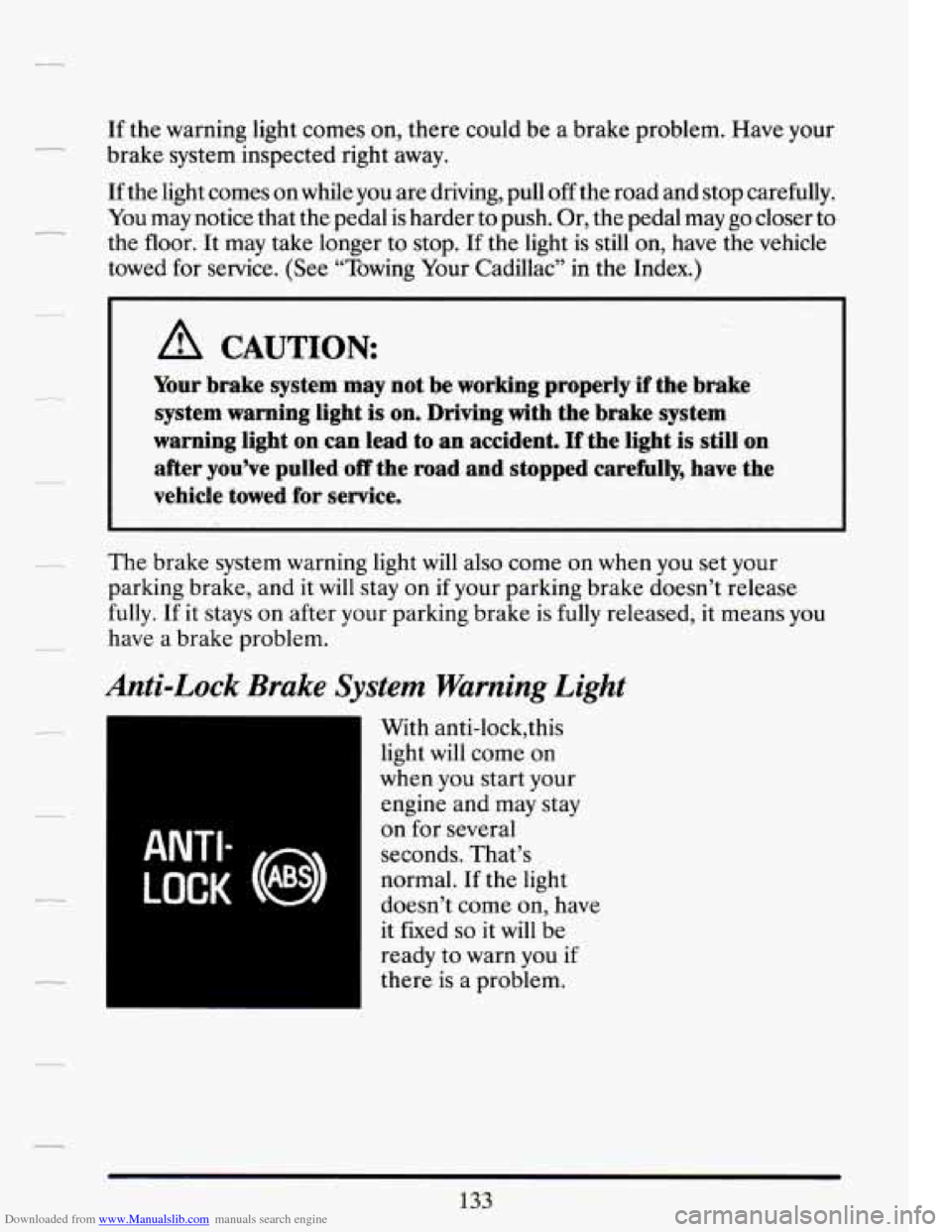
Anti-Lock Brake System Warning Light
ANTI-
LOCK (@)
With anti-lock,this
light will come on
when you start your
engine and may stay
on for several
seconds. That’s
normal.
If the light
doesn’t come on, have
it fixed
so it will be
ready to warn you if
there is a problem.
133
Page 147 of 399

Downloaded from www.Manualslib.com manuals search engine If the light stays on, turn the ignition off. Or, if the light comes on when
you’re driving, stop as
soon as possible and turn the ignition off. Then
start the engine again to reset the system. If the light still stays on, or
comes
on again while you’re driving, your Cadillac needs service. If the
regular brake system warning light isn’t on,
you still have brakes, but you
don’t have anti-lock brakes. If the regular brake system warning light is
also on, you don’t have anti-lock brakes and there’s a problem with your
regular brakes. See “Brake System Warning Light” earlier
in this part.
The anti-lock brake system warning light may also come on when you are
driving with a compact spare tire. If this happens, the light means you
won’t have anti-lock until you replace the compact spare with a full-size
tire.
If the warning light stays on after you replace the compact spare with
a full-size tire, or if it comes on again when you’re driving, your Cadillac
needs service.
Engine Temperature Warning Light (Canadian Only)
This light tells you that
your engine has
overheated. You should
stop the car and idle the
engine as soon as
possible. A warning
chime should also sound
if this light comes on. As
a check, the light should
come on for a few
seconds when
you start
your engine.
HOT COOLANT CAN BURN YOU BADLY!
In “Problems on the Road,” this manual shows what to do. See “Engine
Overheating” in the Index.
134
Page 149 of 399

Downloaded from www.Manualslib.com manuals search engine Malfinction Indicator Lamp
(Service Engine Soon)
A computer monitors operation of your fuel, ignition and emission
control systems. This light should come on when the ignition is on, but
the engine is not running,
as a check to show you it is working. If it does
not come on at all, have it fixed right away.
If it stays on, or it comes on
while you are driving, the computer is indicating that you have
a problem
You should take your vehicle in for service soon.
NOTICE:
If you keep driving your vehicle with this light on, after a \
while
the emission controls won’t work as well, your fuel economy
won’t be as good and your engine may not run
as smoothly. This
7
r
Ld
could lead to costly repairs not covered by your warranty.
136
Page 150 of 399

Downloaded from www.Manualslib.com manuals search engine Battery Charge Light (Canadian Only)
1
When you turn the key
to “Run” or “START”,
this light will come on
briefly,
to show that
your alternator and
battery charging
systems are working.
If a light stays on, you need service, and you should take your Cadillac to
the dealer at once. To save your battery until you get there, turn off all
accessories.
Fuel Gage
Your fuel gage shows about how much fuel is in your tank. It works only
when the ignition is in the
“RUN” position.
Digital Gage’
If the fuel level is within approximately one gallon (3.9 liters) of being full
the letter “F” is shown.
137
Page 156 of 399

Downloaded from www.Manualslib.com manuals search engine BATTERY VOLTS HIGH - 08
This message shows that the electrical charging system is overcharging,
(more than 16 volts).
To avoid being stranded have the electrical system
checked by your Cadillac dealership at your earliest convenience.
You can
reduce the charging overload by using the accessories. Turn on the lights,
radio, set the Climate Control
on “AUTO” and the fan speed on “HI”
and turn the rear window defogger on.
You can monitor battery voltage
on the Driver Information Center by toggling the “INFORMATION’’
button. When the engine is running, the normal range is 11.5 to 15.5
volts.
BATTERY VOLTS LOW - 06
This message will appear when the electrical system is charging less than
10 volts, or
if the battery has been drained. If this message appears
immediately after starting it is possible that the generator can still
recharge the battery.
The battery should recharge after driving a few
miles and the message should go out. If this message appears while
driving or after starting your vehicle and stays on, have
it checked
immediately to determinethe cause of this problem. To help the
generator recharge the battery quickly,
you can reduce the load on the
electrical system by turning
off your accessories. You can monitor battery
voltage on the Driver Information Center by toggling
the
“INFORMXTION” button. The normal range is 11.5 to 15.5 volts.
CHECK BRAKE FLUID - 37
This message is displayed to inform the driver that the brake reservoir
fluid level is low. Check the brake reservoir
level and add as needed.
Have the brake system serviced by a Cadillac technician as soon as
possible. If the brake warning light is on, follow the directions in that
section.
CHECK FUEL GAGE,- 39
This message will appear when your fuel supply is less than 4 gallons and
your display is turned off.
143
Page 157 of 399
Downloaded from www.Manualslib.com manuals search engine CHECK OIL LEVEL - 36
This message will appear when your engine oil is approximately a quart
low. If this message is displayed, check the
oil and add as needed.
CHECK WASHER FLUID - 25
This message will appear for a few seconds indicating that you need
washer solvent.
CHANGE OIL SOON - 40
This message will appear when your engine oil is less than 10 percent or
the mileage since the last
oil change is more than 6750 miles.
CHANGE ENGINE OIL - 82
This means that the life of your engine oil has expired and it should be
changed immediately. See engine
oil and filter recommendations in the
Maintenance Schedule. After an
oil change, the Oil Life Index must be
reset. See “Oil Life Indicator” in the index
on how to reset it.
CRUISE ENGAGED - 43
This message will appear for a few seconds when you select a speed to
cruise at.
ENGINE COOLANT HOT - 44
This message will appear when your engine coolant temperature is over
126°C (259OF). To avoid added strain on a hot engine, turn off your
Climate Control system, and stop and allow your vehicle to idle until it
cools down or the message
is removed. If it does not cool down, turn off
your engine and have it serviced before driving it again. Severe engine
damage can result from an overheated engine. See “Engine Overheating”
in the Index.
ENGINE HOT - A/C COMPRESSOR OFF - 16
This message will appear when the Climate Control is in “Auto” or
“Defrost” and the engine coolant is hotter than the normal operating
temperature.
To avoid added strain on a hot engine the air conditioning
compressor is automatically turned
off. When that happens, air
conditioned air is not delivered.
If the coolant temperature returns to
normal, the
A/C operation returns to normal.
c
-
L. J
144