service CADILLAC DEVILLE 1994 7.G Service Manual
[x] Cancel search | Manufacturer: CADILLAC, Model Year: 1994, Model line: DEVILLE, Model: CADILLAC DEVILLE 1994 7.GPages: 399, PDF Size: 20.97 MB
Page 278 of 399
Downloaded from www.Manualslib.com manuals search engine What to Do with Used Oil
Did you know that used engine oil contains certain elements that may be
unhealthy for your skin and could even cause cancer? Don’t let used oil
stay
on your skin for very long. Clean your skin and nails with soap and
water, or a good hand cleaner. Wash or properly throw away clothing or
rags containing used engine
oil. (See the manufacturer’s warnings about
the use and disposal
of oil products.)
Used oil can be a real threat to the environment. If you change your own
oil, be sure to drain all free-flowing oil from the filter before disposal.
Don’t ever dispose of oil by putting it
in the. trash, pouring it on the
ground, into sewers, or into streams or bodies of water. Instead, recycle it
by taking it to a place that collects used oil. If you have a problem
properly disposing
of your used oil, ask your dealer, a service station or a
local recycling center for help.
AIR CLEANER
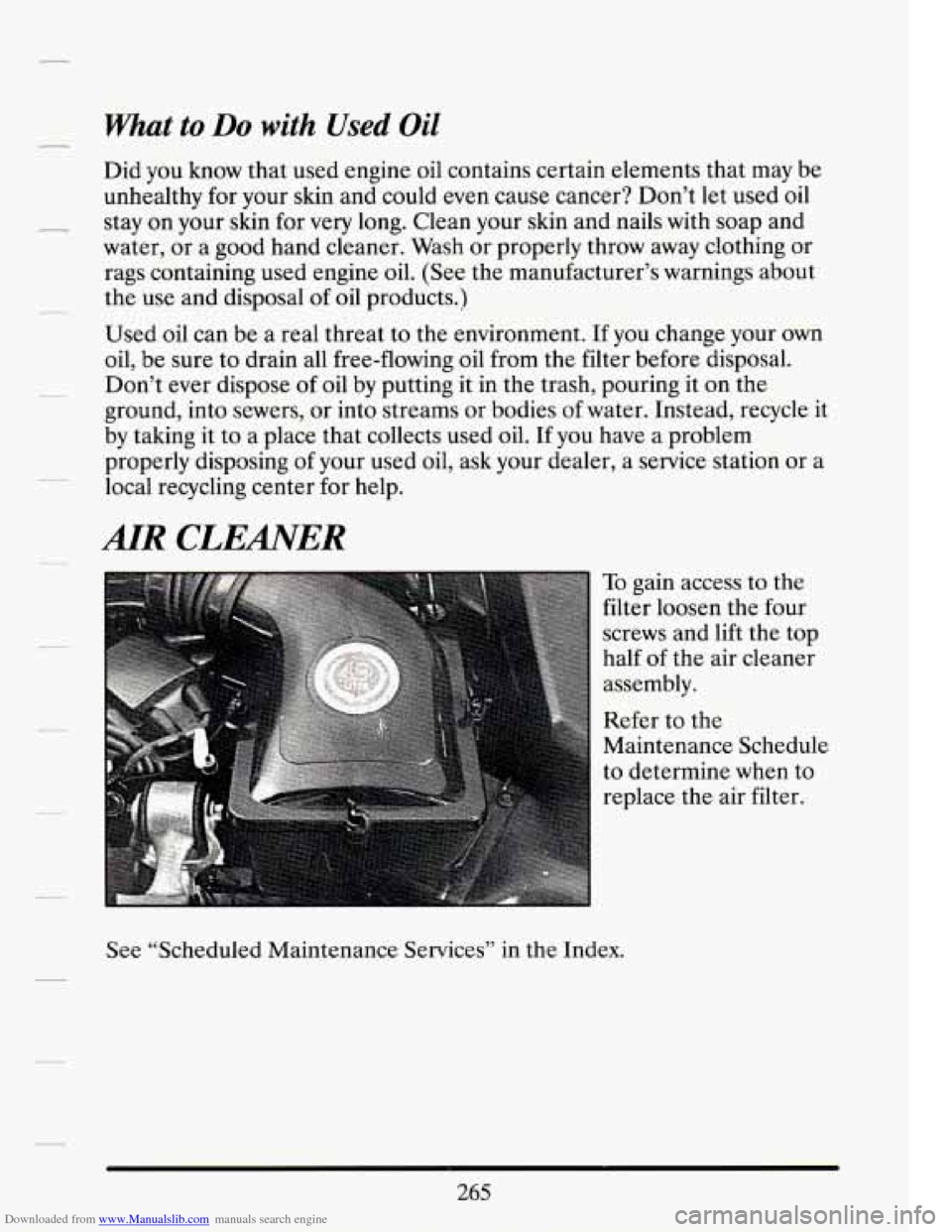
To gain access to the
filter loosen the four
screws and lift the top
half
of the air cleaner
assembly.
Refer to the
Maintenance Schedule
to determine when
to
replace the air filter.
See “Scheduled Maintenance Services’’
in the Index.
265
Page 279 of 399
Downloaded from www.Manualslib.com manuals search engine NOTICE:
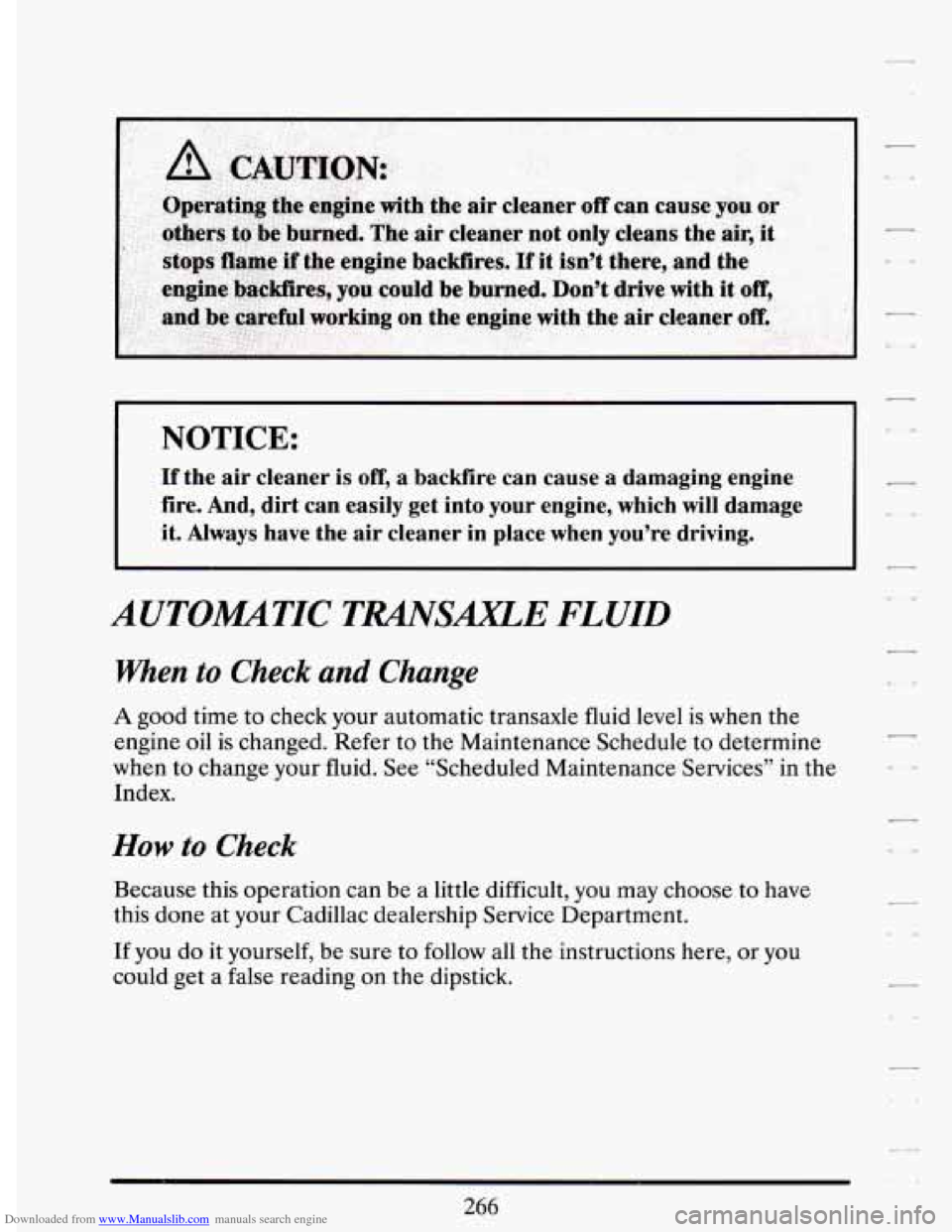
If the air cleaner is off, a backfire can cause a damaging engine
fire. And, dirt can easily get into your engine, which will damage
it. Always have the air cleaner
in place when you’re driving.
AUTOMMTIC TRANSAXLE FLUID
Men to Check and Change
A good time to check your automatic transaxle fluid level is when the
engine oil is changed. Refer to the Maintenance Schedule to determine
when to change your fluid. See “Scheduled Maintenance Services” in the
Index.
How to Check
Because this operation can be a little difficult, you may choose to have
this
done at your Cadillac dealership Service Department.
If you do it yourself, be sure to
follow all the instructions here, or you
could
get a false reading on the dipstick.
266
Page 294 of 399
Downloaded from www.Manualslib.com manuals search engine Start the engine in “P” (Park) and let it idle for 15 minutes. Then:
Put your foot on the brake pedal, shift the transaxle to @ and let it
idle for
3 minutes or more. Do not accelerate the engine. Then:
With the car in @ (Drive), turn the Electronic Climate Control to
“Auto” and let the engine idle for 3 minutes or more.
Turn your engine off.
Now your computer is programmed.
UOGEN BULBS
EXTERIOR UP HOUSINGS
I NOTICE:
Your Cadillac’s lamp housings are designed with small vents so
moisture will be removed when the lights are on, or after driving
for
a short time. If an excessive amount of moisture is present
which does not clear, see your Cadillac dealer for service.
28 1
Page 309 of 399
Downloaded from www.Manualslib.com manuals search engine The tire has a puncture, cut, or other damage that can’t be repaired
well because of the size or location of the damage.
Buying New Tires
To find out what kind and size of tires you need, look at the Tire-Loading
Information label.
The tires installed on your vehicle when it was new had a Tire
Performance Criteria Specification (TPC Spec) number
on each tire’s
sidewall. When you get
new tires, get ones with that same TPC Spec
number. That way, your vehicle
will continue to have tires that are
designed to give proper endurance, handling, speed rating, traction, ride
and other things during normal service on your vehicle.
If your tires have
an all-season tread design, the TPC number will be followed by a
“MS”
(for mud and snow).
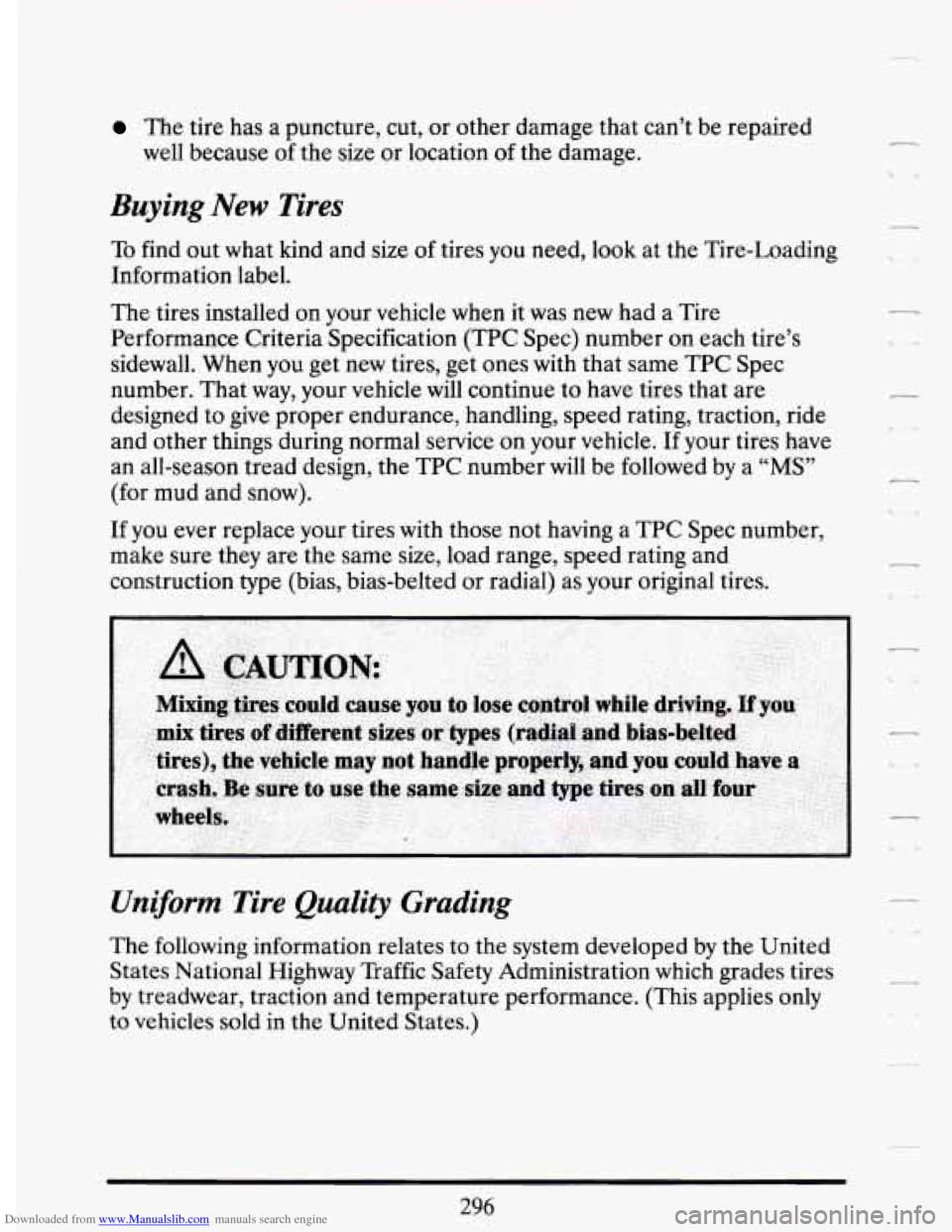
If you ever replace your tires with those not having a TPC Spec number,
make sure they are the same size, load range, speed rating and
construction type (bias, bias-belted or radial) as your original tires.
Uniform Tire Quality Grading
The following information relates to the system developed by the United
States National Highway Traffic Safety Administration which grades tires
by treadwear, traction and temperature performance. (This applies only
to vehicles sold in the United States.)
Page 310 of 399

Downloaded from www.Manualslib.com manuals search engine Treadwear
The treadwear grade is a comparative rating based on the wear rate of
the tire when tested under controlled conditions on a specified
government test course. For example, a tire graded
150 would wear one
and a half
(1 1/2) times as well on the government course as a tire graded
100. The relative performance of tires depends upon the actual
conditions
of their use, however, and may depart significantly from the
norm due to variations in driving habits, service practices and differences
in road characteristics and climate.
Traction - A, B, C
The traction grades, from highest to lowest are: A, B, and C. They
represent the tire’s ability to stop on wet pavement as measured under
controlled conditions on specified government test surfaces
sf asphalt
and concrete.
A tire marked C may have poor traction performance.
Warning: The traction grade assigned to this tire is based on braking
(straight-ahead) traction tests and does not include cornering (turning)
traction.
Temperature = A, B, C
The temperature grades are A (the highest), B, and C, representing the
tire’s resistance to the generation
of heat and its ability to dissipate heat
when tested under controlled conditions on a specified indoor laboratory
test wheel. Sustained high temperature can cause the material of the tire
to degenerate and reduce tire life, and excessive temperature can lead to
sudden tire €ailure. The grade
C corresponds to a level of performance
which all passenger car tires must meet under the Federal Motor Vehicle
Safety Standard
No. 109. Grades B and A represent higher levels of
performance
on the laboratory test wheel than the minimum required by
law.
Warning: The temperature grade for this tire
is established for a tire that
is properly inflated and not overloaded. Excessive speed, underinflation,
or excessive loading, either separately or
in combination, can cause heat
buildup and possible tire failure.
These grades are molded on the sidewalls of passenger car tires.
297
Page 321 of 399
Downloaded from www.Manualslib.com manuals search engine WHITE SIDEWaL TIRES
Your Cadillac dealer has a GM White Sidewall Tire Cleaner. You can use
a stiff brush with the cleaner.
WEATHERSTRlpS
Silicone lubricant on weatherstrips will allow them to last longer, seal
better, and not stick or squeak. Apply silicone grease with a clean cloth at
least
every six months. During very cold, damp weather more frequent
applications may be required. (See “Recommended Fluids
& Lubricants”
in the Index.)
SHEETMETAL DMGE
If your vehicle is damaged and requires sheet metal repair or
replacement, make sure the body repair shop applies anti-corrosion
material to the parts repaired or replaced to restore corrosion protection.
FOREIGNIMATERbU
Calcium chloride and other salts, ice melting agents, road oil and tar, tree
sap, bird droppings, chemicals from industrial cbimneys, and other
foreign matter can damage your vehicle’s finish
if they remain on painted
surfaces. Use cleaners that are marked safe for painted surfaces to
remove foreign matter.
FINISH DMGE
Any stone chips, fractures or deep scratches in the finish should be
repaired right away. Bare metal will corrode quickly and may develop
into a major repair expense.
308
Minor chips and scratches can be repaired with touch-up materials
available from your dealer or other service outlets. Larger areas of finish
damage can be corrected in your dealer’s body and paint shop.
Page 325 of 399
Downloaded from www.Manualslib.com manuals search engine This is the legal identifier for your Cadillac. It appears on a plate in the
front corner of the instrument panel, on the driver’s side. You can see it if
you look through the windshield from outside your vehicle. The VIN also
appears on the Vehicle Certification and Service Parts labels and the
certificates
of title and registration.
-
Engine Identification
The eighth character in your VIN is the engine code. This code will help
you identify your engine, specifications, and replacement parts.
SERVTCE PARTS IDENTIFICATION LABEL
You’ll find this label
on the spare tire cover. It’s very helpful if you ever need to order parts.
On this label
is:
your VIN,
the model designation,
paint information, and
a list of all production options and special equipment.
Be sure that this label is not removed from the vehicle.
312
Page 327 of 399

Downloaded from www.Manualslib.com manuals search engine FUSES AND CIRCUIT BREAKERS
The wiring circuits in your vehicle are protected from short circuits by a
combination
of Mini Fuses, Circuit Breakers, and Maxi Fuses. This
greatly reduces the chance of fires caused by electrical problems.
If you have a problem on the road and don’t have a spare fuse, you can
“borrow” one
of the same value. Select a feature that you can get along
without that is the same value you need
-- like the radio or cigarette
lighter
-- and use its fuse. Be sure to use a fuse with the same amperage
rating number on it (ie.
lOA, 20A, etc.) Replace it as soon as you can.
7
L
There is a fuse removal tool and some spare mini fuses in the glove box
door, just lift the cover
up.
Engine Compartment Fuse Block
To gain
cover. access,
lift the
Mmi FuseslRelay Center
The maxi fuse and relays are located next to the engine compartment fuse
block.
If a maxi fuse should blow, have your vehicle serviced by your
Cadillac dealer immediately.
314
Page 337 of 399

Downloaded from www.Manualslib.com manuals search engine The control arms and toe link are attached to the suspension support on
the inboard side, and to a suspension knuckle on the outboard side. The
hub and bearing assembly is mounted to the knuckle and
is a single,
non-serviceable unit which eliminates the need for wheel bearing
adjustment. The load leveling
(ELC) shock absorbers are attached to the
lower control arm, with
the upper end of the shock attached to the
suspension support. The springs are held in position between the lower
control arms and a pocket in the suspension support.
The suspension system also incorporates a
new damping system known as
Speed Sensing Suspension. This system controls the damping forces
in
the shock absorbers and struts, in response to various road and driving
conditions. The systems are capable of making these damping changes
extremely fast.
A computer receives inputs from vertical acceleration sensors, wheel to
body position sensors, vehicle speed sensor,
lift and dive signals. This
computer evaluates the input from these sensors, to control the damping
of each
of the struts and shocks independently to provide varied levels of
suspension control.
The system also has
the capability of providing Speed Sensitive Steering
control. This system changes your steering effort based on your vehicle
speed.
c-
Page 347 of 399
Downloaded from www.Manualslib.com manuals search engine I'
We employ technicians certified by the
National lnstltute for
AUTOMOTIVE
SERVICE
EXCELLENCE
Let us show you their credentials
Catalog Number H-31.24
Part Number 3542659-B