brake CADILLAC DEVILLE 1994 7.G Service Manual
[x] Cancel search | Manufacturer: CADILLAC, Model Year: 1994, Model line: DEVILLE, Model: CADILLAC DEVILLE 1994 7.GPages: 399, PDF Size: 20.97 MB
Page 226 of 399
Downloaded from www.Manualslib.com manuals search engine 3. Drive slowly until the trailer is clear of the chocks.
4. Stop and have someone pick up and store the chocks.
Engine Cooling When Trailering
Your cooling system may temporarily overheat during severe operating
conditions such as;
Climbing grades steeper than 4% at ambient temperatures above
90” Fahrenheit (32’Celsius) with a loaded vehicle and trailer.
Stopping after high-speed driving.
Idling for long periods in stop and go traffic.
If “ENGINE
HOT A/C COMPRESSOR OFF” message appears on the
Driver Information Center, do not be alarmed. This is a normal function
designed to reduce the load on the engine and cooling system you can
continue to drive your vehicle.
If “ENGINE COOLANT
HOT” message appears on the Driver
Information Center, pull off to the side of
the road as soon as it is safe to
do so. When the vehicle is at a complete stop, shift the transmission
selector to
P (Park) and allow the engine to idle. Do not turn off the
engine or increase engine speed above a normal idle. Within
two or three
minutes the system should cool sufficiently to allow
A/C operation to
resume. At that
time resume driving at a reduced speed. Return to
normal driving after
10 minutes if the “ENGINE COOLANT HOT”
message
is not displayed.
Maintenance when Trailer Towing
Your vehicle will need service more often when you’re pulling a trailer.
See
the Maintenance Schedule for more on this. Things that are
especially important
in trailer operation are automatic transaxle fluid
(don’t overfill), engine oil, belts, cooling system, and brake wear. Each of
these is covered
in this manual, and the Index will help you find them
quickly. If you’re trailering, it’s a good idea to review these sections
before
you start your trip.
Check periodically
to see that all hitch nuts and bolts are tight.
213
Page 237 of 399

Downloaded from www.Manualslib.com manuals search engine When the towing service arrives, let the tow operator know that this
manual contains detailed towing instructions and illustrations. The
operator may want to see them.
A CAUTION:
To he@ avoid injury to you or others:
When your vehicle is being towed, have the ignition key off. The steering
wheel should be clamped in
a straight-ahead position, with a clamping
device designed for towing service.
Do not use the vehicle’s steering
column lock for this. The transaxle-should be
in Neutral and the parking
brake released.
224
Page 249 of 399

Downloaded from www.Manualslib.com manuals search engine IFA TIRE GOES FLAT
It’s unusual for a tire to “blow out” while you’re driving, especially if you
maintain your tires properly. If air goes out of a tire, it’s much more likely
to leak out slowly. But
if you should ever have a “blowout,” here are a
few tips about what to expect and what to do:
If a front tire fails, the flat tire will create a drag that pulls
the vehicle
toward that side. Take your foot
off the accelerator pedal and grip the
steering wheel firmly. Steer to maintain lane position, then gently brake
to a stop well out of the traffic lane.
A rear blowout, particularly on a curve, acts much like a skid and may
require the same correction you’d use
in a skid. In any rear blowout,
remove your foot from the accelerator pedal. Get
the vehicle under
control by steering the way you want the vehicle to go. It may be
very
bumpy and noisy, but you can still steer. Gently brake to a stop, well off
the road if possible.
If a tire goes flat, the next section shows how to use your jacking
equipment to change a flat tire safely.
ro
t-
236
Page 258 of 399

Downloaded from www.Manualslib.com manuals search engine b__ Don’t try to put a wheel cover on your compact spare tire. It won’t fit.
Store the wheel cover in the trunk until you have the flat tire repaired or
replaced.
c_
I
I NOTICE:
~. Wheel covers won’t fit on your compact spare. If you try to put a
wheel cover on your compact spare, you
could damage the cover
or the spare.
1
L
]
COMPACT SPARE TIRE
~ Although the compact spare was fully inflated when your vehicle was
new,
it can lose air after a time. Check the inflation pressure regularly. It
should be
60 psi (420 kPa). After installing the compact spare on your
is correctly inflated. The compact spare is made to perform well at posted
speed limits for distances up
to 3,000 miles (5 000 km). The compact
~ spare is made to go up to 3,000 miles (5 000 km), so you can finish your
trip and have
your full-size. tire repaired or replaced where you want. Of
course, it’s best to replace your spare with a full-size tire as soon as you
can. Your spare will last longer and
be in good shape in case you need it
again.
Your anti-lock brake system warning light may come on when you are
Light” in the Index.
-_ vehicle, you should stop as soon as possible and make sure your spare tire
I__ driving with a compact spare. See “Anti-Lock Brake System Warning
245
Page 271 of 399

Downloaded from www.Manualslib.com manuals search engine . A CAUTION:
An electric fan under the hood can start up and injure you even
when the engine is not running. Keep hands, clothing and tools
away from any underhood electric fan.
A CAUTION:
Things that burn can get on hot engine parts and start a fire.
These include liquids like gasoline, oil, coolant, brake fluid,
windshiefd washer and other fluids, and plastic
or rubber, You
or others could be burned, Be careful not to drop or spill things
that
will burn onto a hot engine.
Fluid Usage Label
Use the fluid usage label to identify the correct fluid you want to check.
GREEN: Engine Coolant
ORANGE: Power Steering Fluid
YELLOW Engine Oil
RED: Transmission Fluid
WHITE: Brake Fluid
BLUE: Washer Fluid
.-
258
Page 280 of 399

Downloaded from www.Manualslib.com manuals search engine I NOTICE:
Too much or too little fluid can damage your transaxle. Too
much can mean that some of the fluid could come out and fall
on hot engine parts or exhaust system, starting a fire. Be sure to
get an accurate reading if you check your transaxle fluid.
Wait at least 30 minutes before checking the transaxle fluid level if you
have been driving:
When outside temperatures are above 90" F (32" C).
0 At high speed for quite a while.
In heavy traffic -- especially in hot weather.
While pulling a trailer.
To get the right reading, the fluid should be at normal operating
temperature, which is
180 " F to 200 " F (82 C to 93 C).
Get the vehicle warmed up by driving about 15 miles (24 km) when
outside temperatures are above
50 F (10 C). If it's colder than 50 F
(10 " C), you may have to drive longer.
To check thefluid level
Park your vehicle on a level place.
With the parking brake applied, place the shift lever in "P" (Park).
With your foot on the brake pedal, move the shift lever through each
gear range, pausing for about three seconds in each range. Then,
position the shift lever in "P" (Park).
Let the engine run at idle for three to five minutes.
Page 289 of 399
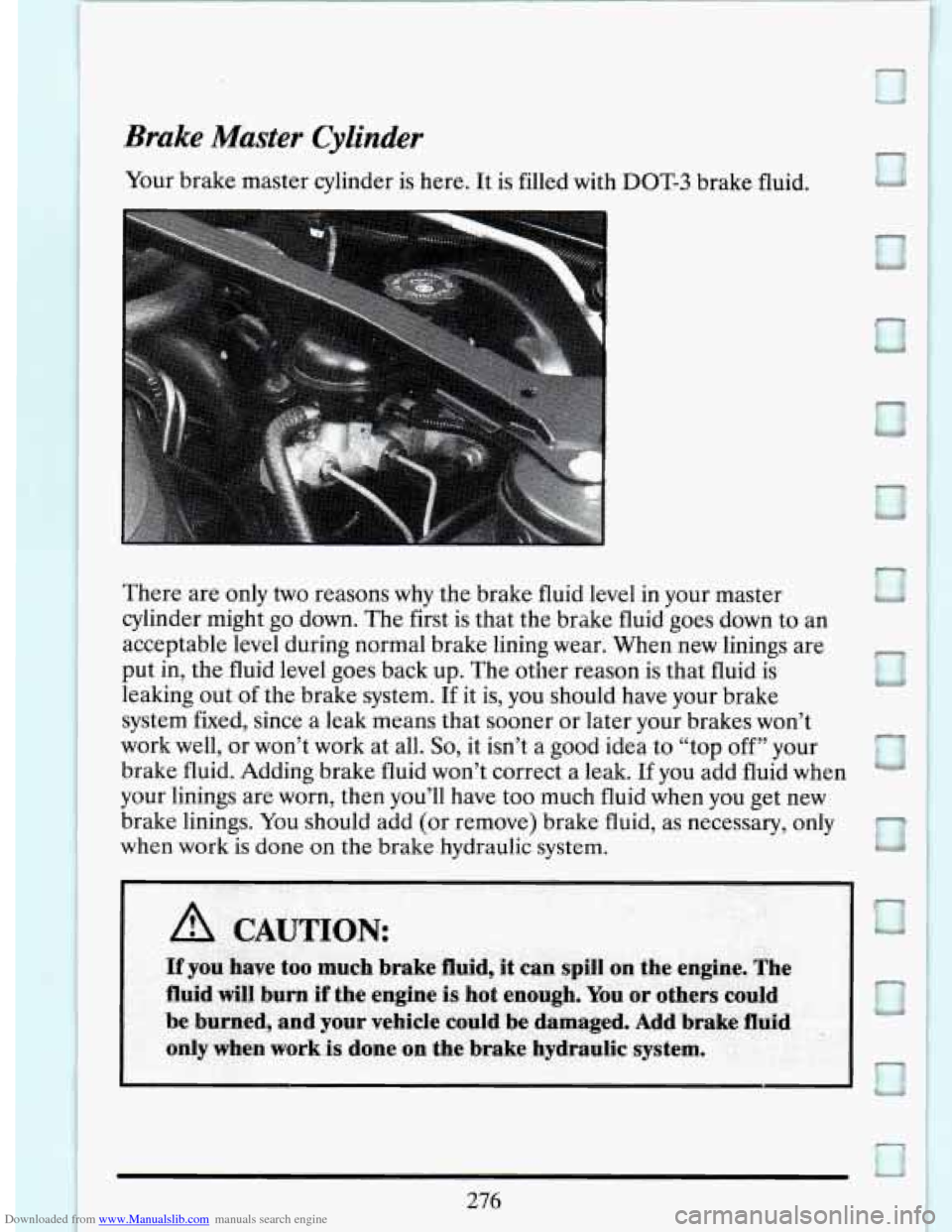
Downloaded from www.Manualslib.com manuals search engine Brake Master
Your brake master
Cylinder
cylinder is here.
It is
filled with DOT-3 brake
fluid.
There are only
two reasons why the brake flul,
leve your master
cylinder might go down. The first is that the brake fluid-goes down to an
acceptable level during normal brake lining wear. When new linings are
put in, the fluid level goes back up. The other reason is that fluid is
leaking out
of the brake system. If it is, you should have your brake
system fixed, since a leak means that sooner or later your brakes won’t
work well, or won’t work at all.
So, it isn’t a good idea to “top off” your
brake fluid. Adding brake fluid won’t correct a leak.
If you add fluid when
your linings are worn, then you’ll have too much fluid when you get new
brake linings.
You should add (or remove) brake fluid, as necessary, only
when work is done
on the brake hydraulic system.
A CAUTION
If you have too much brake fluid, it can spiIl on the engine. The
fluid will burn if the engine is hot enough. You or others could
be burned, and your vehicle could be damaged. Add brake fluid
only when work
is done on the brake hydraulic system.
276
,-
LA!
,-
c. .Y
-,
Cr
Page 290 of 399

Downloaded from www.Manualslib.com manuals search engine When your brake fluid falls to a low level, the “CHECK BRAKE
FLUID” message will display on the Driver Information Center and your
brake warning light will come on. See “Brake System Warning Light”
in
the Index.
To Check Brake Fluid
Remove the cap.
__ ”
The fluid level must be
//- to the “MAX FILL?
‘1
line at the base of the
MAX FILL neck as shown.
/’ /. . ./ -- .-
When your brake fluid falls to a low level, your brake warning light will
come on. See “Brake System Warning Light” in the Index.
Mat to Add
When you do need brake fluid, use only DOT-3 brake fluid -- such as
- Delco Supreme ll@ (GM Part No.1052535). Use new brake fluid from a
sealed container only, and always clean
the brake fluid reservoir cap
before removing it.
277
Page 291 of 399

Downloaded from www.Manualslib.com manuals search engine NOTICE
0 Donst let someone put in the wrong kind of fluid. For
example,
just a few drops of mineral-based oil, such as
engine oil, in
your brake system can damage brake system
parts
so ba.dly that they’ll have to be replaced.
Brake fluid can damage paint, so be careful not to spill- brake
fluid on your vehicle.
If yondo, wash it off immediately.,See
“Appearance Care” in the Index
Brake- Wear
Your Cadillac has four-wheel disc brakes.
Disc brake pads have built-in wear indicators that make a high-pitched
warningsound when-.the brake pads are worn and new pads are needed.
The soundmay come and-go;
or be heard all the time your vehicle is
moving (except when yoware pushing on the brake pedal firmly).
NOTICE:
Continuing to drive with worn-out brakepads couM result in
costly brake:repair.
278
Page 292 of 399
Downloaded from www.Manualslib.com manuals search engine r
i i
r I
r
I‘
n I i
r
r’
!
Some driving cond.itions or climates may cause a brakesqueal when the
brakes are..first applied
or lightly applied. This does-not-mean something
is wrong with your brakes.
Brake linings should always be replaced as complete axle sets.
Brake Pedal Travel
See your dealer if the brake pedal does not return to normal,height, or if
these is a rapid increase in pedal travel. This could
be a sign of brake
trouble.
Brake Adjustment
Every time you make a moderate brake stop, your disc brakes adjust for
wear.
If you rarely make a moderate or heavier s.top, then your brakes
might not adjust correctly.
If you drive in that way; then -- very carefully,--
make a
few moderate brake stops about every 1000 miles (1600 km), so
your brakes will adjust prsperly.
Replacing Brake System. Parts
The braking system on a modern vehicle is complex. Its many parts have
to be of top quality and work well together if the vehicle is to have really
good braking. Vehicles
we design and test have top-quality GM brake
parts in them, as your Cadillac does when it
is new. When you replace
parts of your braking system
-- for example, when your brake linings wear
down and you have to have new ones put
in -- be sure you get new
genuine
GM replacement parts. If you don’t, your brakes may no longer
work properly. For example, if someone puts in brake linings that are
wrong for your vehicle, the balance-.between your front and rear brakes
can change, for the worse. The. braking performance you’ve come to
expect can change in many other ways itsomeone puts in the wrong
replacement
brake parts.
279