brake CADILLAC DEVILLE 1997 7.G Service Manual
[x] Cancel search | Manufacturer: CADILLAC, Model Year: 1997, Model line: DEVILLE, Model: CADILLAC DEVILLE 1997 7.GPages: 386, PDF Size: 21.61 MB
Page 238 of 386
Downloaded from www.Manualslib.com manuals search engine Trailer- Wiring Harness
If your vehicle is equipped with the 3,666-&. (1 360 kg)
trailer towing package option, you will have a wiring
harness located under the trunk trim. The harness is a
five wire harness, with connector.
These trailer-wiring harness color codes should be
followed when connecting it to your trailer:
0 WHITE: Direct trailer ground for trailer lamps.
0 BROWN: Parking lamps.
0 YELLOW Left turn and stoplamps.
0 GREEN: Right turn and stoplamps.
BLUE: Auxiliary circuit.
Driving with a Trailer
Towing a trailer requires a certain amount of experience.
Before setting out for the open road, you’ll want to get
to know your rig. Acquaint yourself with the feel
of
handling and braking with the added weight of the
trailer. And always keep in mind that the vehicle you are driving is now a good deal longer and not nearly as
responsive as your vehicle
is by itself.
Before you
start, check the trailer hitch and platform
(and attachments), safety chains, electrical connector,
lamps, tires and mirror adjustment.
If the trailer has
electric brakes, start your vehicle and trailer moving and
then apply the trailer brake controller by hand to be sure
the brakes are working. This lets you check your
electrical connection at the same time.
During your trip, check occasionally to be sure that the
load is secure, and that the lamps and any trailer brakes are still working.
Following Distance
Stay at least twice as far behind the vehicle ahead as you
would when driving your vehicle without a trailer. This can help you avoid situations that require heavy braking and sudden turns.
4-37
Page 239 of 386

Downloaded from www.Manualslib.com manuals search engine Passing
You’ll need more passing distance up ahead when
you’re towing
a trailer. And, because you’re a good deal
longer, you’ll need to go much farther beyond the
passed vehicle before you can return to your lane.
Backing Up
Hold the bottom of the steering wheel with one hand.
Then, to move the trailer to the left, just move that hand
to the left.
To move the trailer to the right, move your
hand to the right. Always back up slowly and, if
possible, have someone guide you.
Making Turns
NOTICE:
Making very sharp turns while trailering could
cause the trailer to come in contact with the
vehicle.
Your vehicle could be damaged. Avoid
making very sharp turns while trailering.
When you’re turning with a trailer, make wider turns
than normal.
Do this so your trailer won’t strike soft
shoulders, curbs, road signs, trees or other objects. Avoid
jerky or sudden maneuvers. Signal well
in advance.
Turn Signals When Towing a Trailer
When you tow a trailer, your vehicle may need a
different turn signal flasher and/or extra wiring. Check
with your Cadillac dealer. The green arrows on your
instrument panel will flash whenever you signal a turn or lane change. Properly hooked up, the trailer lamps
will also flash, telling other drivers you’re about to turn,\
change lanes or stop.
When towing a trailer, the green arrows on your
instrument panel will flash for turns even if the bulbs on
the trailer
are burned out. Thus, you may think drivers
behind you
are seeing your signal when they are not. It’s
important to check occasionally to be sure the trailer
bulbs are still working.
Driving On Grades
Reduce speed and shift to a lower gear before you start
down a long or steep downgrade. If you don’t shift
down, you might have to use your brakes
so much that
they would get hot and no longer work well.
On a long uphill grade, shift down and reduce your
speed to around
45 mph (70 km/h) or less to reduce the
possibility of engine and transaxle overheating.
Page 240 of 386
Downloaded from www.Manualslib.com manuals search engine Parking on Hills
You really should not park your vehicle, with a trailer
attached, on a hill.
If something goes wrong, your rig
could start to move. People can be injured, and both
your vehicle and the trailer can be damaged.
But if you ever have to park your rig on a hill, here’s
how to do it:
1. Apply your regular brakes, but do not shift into
PARK (P).
2. Have someone place chocks under the trailer wheels.
3. When the wheel chocks are in place, release the
regular brakes until the chocks absorb the load.
4. Reapply the regular brakes. Then shift into
PARK (P) firmly and apply your parking brakes.
5. Release the regular brakes.
When You Are Ready to Leave After
Parking on a Hill
1. Apply your regular brakes and hold the pedal down
while you:
0 Start your engine;
Shift into a gear; and
0 Be sure the parking brake has released.
2. Let up on the brake pedal.
3. Drive slowly until the trailer is clear of the chocks.
4. Stop and have someone pick up and store the chocks.
Maintenance When Trailer Towing
Your vehicle will need service more often when you’re
pulling a trailer. See the Maintenance Schedule for more
on
this. Things that are especially important in trailer
operation are automatic transaxle fluid (don’t overfill),
engine oil, belt, cooling system and brake adjustment.
Each of these is covered in
this manual, and the Index
will help you find them quickly.
If you’re trailering, it’s
a good idea to review these sections before you start
your trip.
Check periodically to see that
all hitch nuts and bolts
are tight.
4-39
Page 254 of 386

Downloaded from www.Manualslib.com manuals search engine When your vehicle is being towed, have the ignition key
turned to the
OFF position. The steering wheel should
be clamped in a straight-ahead position, with a clamping
device designed for towing service. Do not use the
vehicle’s steering column lock
for this. The transaxle
should be
in NEUTRAL (N) and the parking
brake released.
Don’t have your vehicle towed on the drive wheels
unless you must.
If the vehicle must be towed on the
drive wheels, be sure to follow the speed and distance
restrictions later in
this section or your transaxle will be
damaged.
If these limitations must be exceeded, then the
drive wheels have to be supported on a dolly.
Front Towing
Tow Limits -- 35 mph (56 kph), 25 miles (40 km)
5-11
Page 268 of 386

Downloaded from www.Manualslib.com manuals search engine If a Tire Goes Flat
It’s unusual for a tire to “blow out” while you’re driving,
especially if you maintain your tires properly.
If air goes
out
of a tire, it’s much more likely to leak out slowly.
But if you should ever have a “blowout,” here are a few
tips about what to expect and what to do:
If a front tire fails, the flat tire will create a drag that
pulls the vehicle toward that side. Take your foot off the
accelerator pedal and grip the steering wheel firmly.
Steer to maintain lane position, and then gently brake to
a stop well out of the traffic lane.
A rear blowout, particularly on a curve, acts much like a
skid and may require the same correction you’d use in a
skid. In any rear blowout, remove your foot from the
accelerator pedal. Get the vehicle under control by
steering the way you want the vehicle to go. It may be
very bumpy and noisy, but you can still steer. Gently
brake to a stop
-- well off the road if possible.
If a tire goes flat, the next part shows how to use your
jacking equipment to change a flat tire safely.
Changing a Flat Tire
If a tire goes flat, avoid further tire and wheel damage
by driving slowly
to a level place. Turn on your hazard
Wi *
; flashers.
I-
Changing a tire can cause an injury. The vehicle
can slip
off the jack and roll over you or other
people. You and they could be badly injured.
Find
a level place to change your tire. To help
prevent the vehicle from moving:
1. Put the shift lever in PARK (P).
2. Set the parking brake firmly.
3. Turn off the engine.
To be even more certain the vehicle won’t move,
you can put blocks at the front and rear of the
tire farthest away from the one being changed.
That would be the tire on the other side of the
vehicle, at the opposite end.
Page 276 of 386

Downloaded from www.Manualslib.com manuals search engine NOTICE:
Improperly tightened wheel nuts can lead to
brake pulsation and rotor damage.
To avoid
expensive brake repairs, evenly tighten the wheel
nuts in the proper sequence and
to the proper
torque specification.
Don’t try to put
a wheel cover on your compact spare
tire. It won’t fit. Store the wheel cover in the trunk
until you have the flat tire repaired or replaced.
NOTICE:
Wheel covers won’t fit on your compact spare. If
you try to put a wheel cover on your compact
spare, you could damage the cover or the spare.
Stoe-g the Flat Tire and Tools
Storing a jack, a tire or other equipment in the
passenger compartment
of the vehicle could
cause injury. In
a sudden stop or collision, loose
equipment could strike someone. Store all these
in the proper place.
After you’ve put the compact spare tire on your vehicle,
you’ll need to store the flat tire in your trunk. Use the
following procedure to secure the flat tire in the trunk.
Put the flat tire in the trunk
so the side that faces out
when it
is on the vehicle is facing down. The full-size
tire will not fit down into the well. Place
it so the front is
in the well and the rear is out of the well.
Page 284 of 386

Downloaded from www.Manualslib.com manuals search engine $z=* ‘dc
Section 6 Service and Appearance Care
Here you will find information about the care of your Cadillac. This section begins with service and fuel information,
and then it shows how to check important fluid and lubricant levels. There is also technical information about your
6-2 6-3
6-4
6-5
6-7
6-10
6-15
6-18
6-2
1
6-25
6-27
6-30
6-3
1
6-39
6-40
6-48
6-49
6-52
vehicle, and a part
devoted to its appearance care.
Service
Fuel
Fuels in Foreign Countries
Filling Your Tank
Checking Things Under the Hood
Engine Oil
Air Cleaner
Automatic Transaxle Fluid
Engine Coolant
Windshield Washer Fluid
Brakes
Battery
Bulb Replacement
Windshield Wiper Blade Replacement
Tires
Appearance Care
Cleaning the Inside of Your Cadillac
Care
of Safety Belts 6-52
6-5 3
6-53
6-53
6-54
6-55
6-55
6-56
6-57
6-58
6-58
6-59
6-69
6-69
6-70
6-70 Cleaning Glass
Surfaces
Cleaning the Outside of the Windshield and
Wiper Blades
Weatherstrips Cleaning the Outside of Your Cadillac
Cleaning Aluminum or Chrome Wheels
(If Equipped)
Cleaning Tires
Sheet Metal Damage
Chemical Paint Spotting
Appearance Care Materials Chart
Vehicle Identification Number
(VIN)
Service Parts Identification Label
Electrical System
Replacement Bulbs
Capacities and Specifications
Air Conditioning Refrigerants
Normal Maintenance Replacement Parts
6-1
Page 290 of 386

Downloaded from www.Manualslib.com manuals search engine When you put the cap back on, turn it to the right
(clockwise) until you hear
a clicking sound. Make sure
you fully install the cap.
NOTICE:
If you need a new cap, be sure to get the right
type. Your dealer can get one
for you. If you get
the wrong type, it may not
fit or have proper
venting, and your fuel tank and emissions system
might be damaged.
Checking Thiw~s Under the Hood
A CAU I ION: I
r- - I
An electric fan under the hood can start up and
injure you even when the engine is not running.
Keep hands, clothing and tools away from any
underhood electric fan.
Things that burn can get on hot engine parts and
start a fire. These include liquids like gasoline,
oil, coolant, brake fluid, windshield washer and
other fluids, and plastic or rubber. You or others
could be burned. Be careful not to drop or spill
things that will burn onto a hot engine.
6-7
I
Page 292 of 386

Downloaded from www.Manualslib.com manuals search engine When you open the hood, you'll see:
A. Battery
B. Coolant Fill Location
C. Power Steering Fluid D. Oil
Fill Location
E. Engine Oil Dipstick Location
E Brake Master Cylinder
G. Transaxle DipstickPill
H. Air Cleaner
I. Windshield Washer Fluid
Before closing the hood, be sure all filler caps are on properly. Then pull the hood down and close
it firmly.
Page 302 of 386
Downloaded from www.Manualslib.com manuals search engine To get the right reading, the fluid should be at normal
operating temperature, which is 1
80 OF to 200 OF
(82°C to 93°C).
Get the vehicle warmed up by driving about
15 miles
(24
km) when outside temperatures are above 50°F
(10°C). If it's colder than 50°F (lO"C), you may
have to drive longer.
Checking the Fluid Level
Park your vehicle on a level place. Keep the
engine running.
With the parking brake applied, place the shift lever
in PARK
(P).
With your foot on the brake pedal, move the shift
lever through each gear range, pausing for about
three seconds in each range. Then, position the shift
lever in PARK (P).
0 Let the engine run at idle for three to five minutes. Then,
without shutting off the engine, follow
these steps:
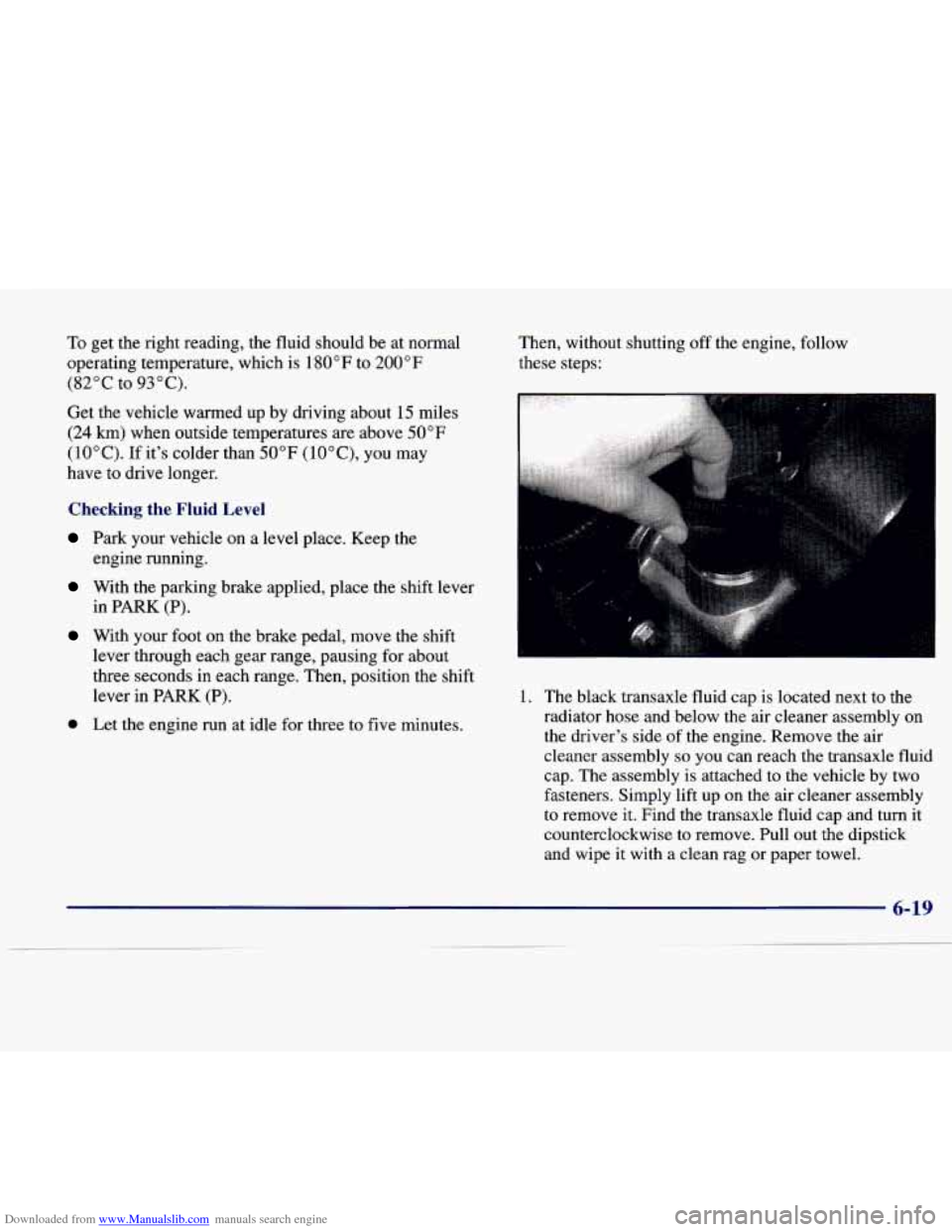
1. The black transaxle fluid cap is located next to the
radiator hose and below the air cleaner assembly on the driver's side of the engine. Remove the air
cleaner assembly
so you can reach the transaxle fluid
cap. The assembly is attached to the vehicle by two
fasteners. Simply lift up on the air cleaner assembly
to remove
it. Find the transaxle fluid cap and turn it
counterclockwise to remove. Pull out the dipstick
and wipe it with a clean rag or paper towel.