brakes CADILLAC DEVILLE 1997 7.G Owners Manual
[x] Cancel search | Manufacturer: CADILLAC, Model Year: 1997, Model line: DEVILLE, Model: CADILLAC DEVILLE 1997 7.GPages: 386, PDF Size: 21.61 MB
Page 11 of 386
Downloaded from www.Manualslib.com manuals search engine a
The electronics and computerization which were
pioneered by Cadillac in the
’70s came of age in the
’80s with Digital Fuel Injection and On-Board
Diagnostics in 1980, four wheel Anti-lock Brakes on 1986 models and Traction Control in the fall
of 1989.
The 1992 Seville STS was the first car ever to win all
three major automotive awards:
Car of the Year, Motor
Trend; Ten Best List, Car
& Driver; Car of the Year,
Automobile Magazine.
The year
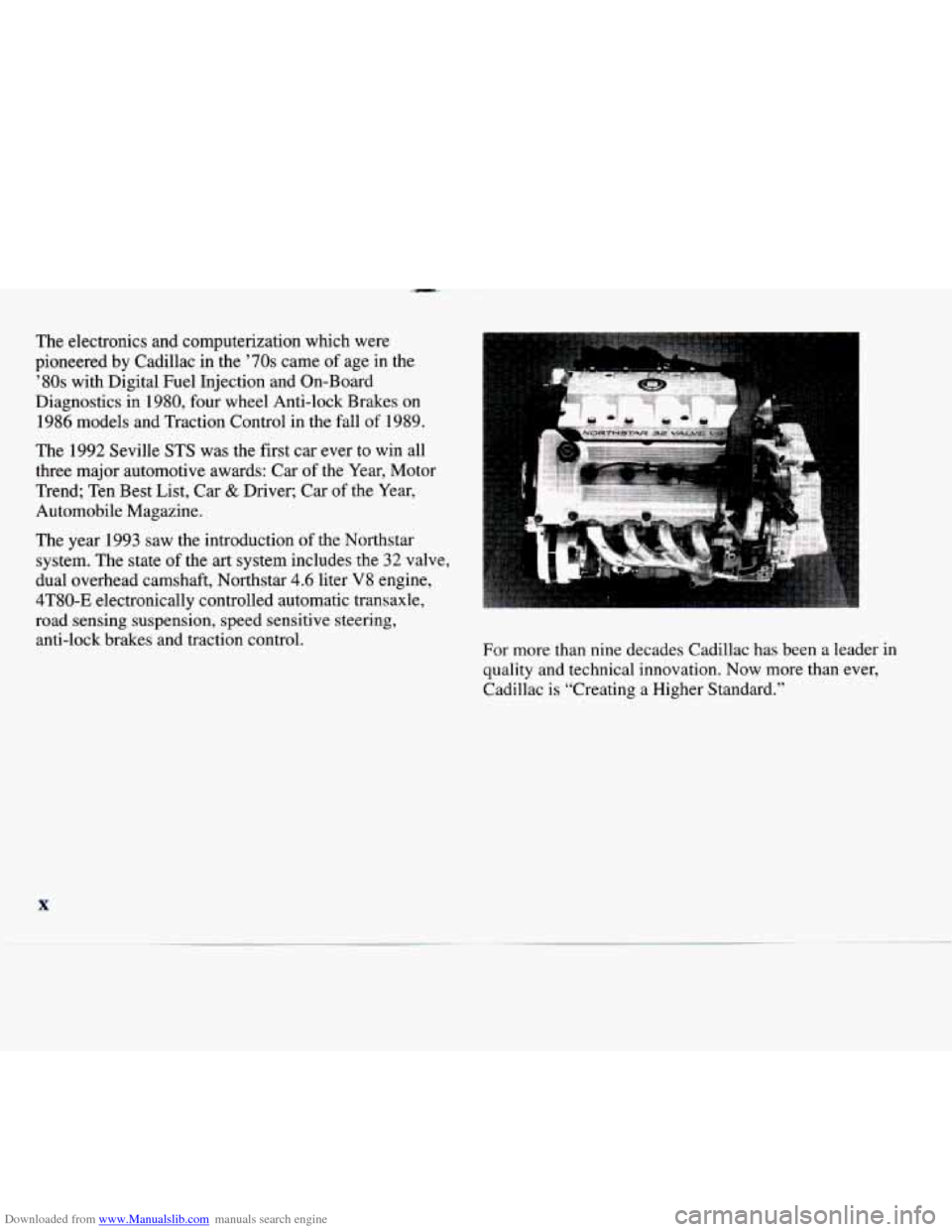
1993 saw the introduction of the Northstar
system. The state
of the art system includes the 32 valve,
dual overhead camshaft, Northstar
4.6 liter V8 engine,
4T80-E electronically controlled automatic transaxle,
road sensing suspension, speed sensitive steering, anti-lock brakes and traction control. For more than nine decades Cadillac has been a leader
in
quality and technical innovation. Now more than ever,
Cadillac is “Creating a Higher Standard.”
X
Page 14 of 386
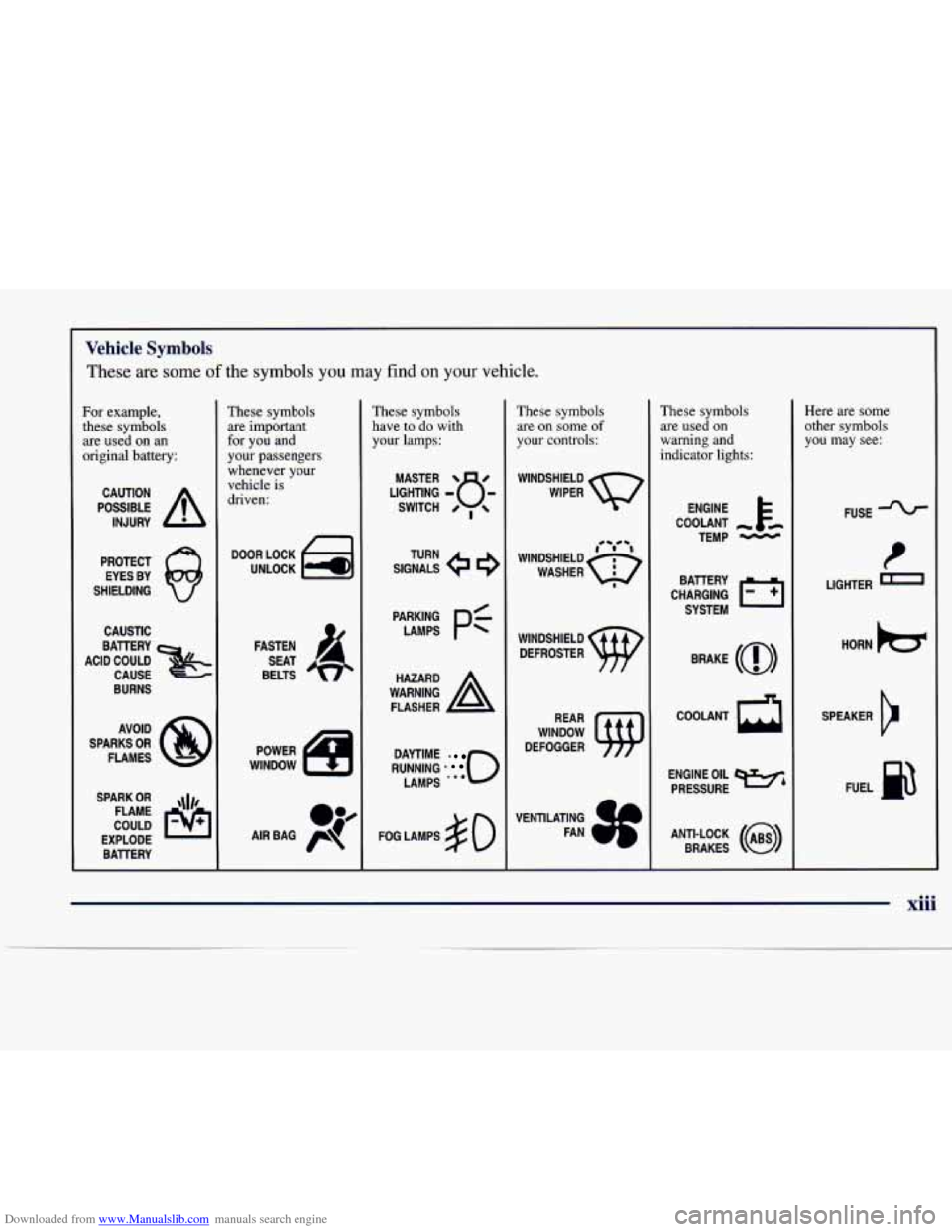
Downloaded from www.Manualslib.com manuals search engine Vehicle Symbols
These are some of the symbols you may find on your vehicle.
For example,
these symbols
are used on an
original battery:
POSSIBLE A
CAUTION
INJURY
PROTECT EYES BY
SHIELDING
CAUSTIC
BURNS AVOID
SPARKS
OR
FLAMES
SPARK
OR ,111,
COULD
FLAME
EXPLODE BATTERY
These symbols
are important
for you and
your passengers
whenever your
vehicle
is
driven:
DOOR LOCK
UNLOCK
FASTEN SEAT
BELTS
These symbols have to do with
your lamps:
SIGNALS e
TURN
WARNING
A
HAZARD
FLASHER
RUNNING
* 0
DAYTIME *
LAMPS *'*
FOG LAMPS $0
These symbols
are on some of
your controls:
WIPER Q
aa aa
WINDSHIELD
DEFROSTER
VENTILATING FAN
These symbols are used
on
warning and
indicator lights:
COOLANT
TEMP
-
CHARGING I-1
BAllERY
SYSTEM
BRAKE
(0)
CT
ENGINE OIL w,
PRESSURE
ANTI-LOCK
(@)
BRAKES
Here are some
other symbols
you may see:
FUSE
P
LIGHTER -
HORN h=r
SPEAKER
b
FUEL e3
xiii
Page 91 of 386

Downloaded from www.Manualslib.com manuals search engine Ensure the shift lever is fully in PARK (P) range before
starting the engine. Your Cadillac has a brake-transaxle
shift interlock. You have to fully
apply your regular
brakes
before you can shift from PARK (P) when the
ignition key is in the RUN position. If you cannot shift
out of
PARK (P), ease pressure on the shift lever -- push
the shift lever all the way into PARK
(P) and release the
shift lever button on the floor shift console models as
you maintain brake application. Then move the shift
lever into the gear you wish. (Press the shift lever button
before moving the shift lever on
floor shift console
models.) See “Shifting Out of PARK (P)” in this section.
REVERSE (R): Use this gear
to back up.
NOTICE:
Shifting to REVERSE (R) while your vehicle is
moving forward could damage your transaxle.
Shift to REVERSE (R) only after your vehicle
has stopped.
Also use this gear to rock your vehicle back and forth to
get out
of snow, ice or sand without damaging your
transaxle. See
“If You’re Stuck in Sand, Mud, Ice or
Snow” in the Index for additional information.
NEUTRAL (N): In this position, the engine doesn’t
connect with the wheels.
To restart when you’re
already moving, use
NEUTRAL (N) only. Also, use
NEUTRAL (N) when your vehicle is being towed.
Shifting out of PARK
(P) or NEUTRAL (N) while
your engine
is “racing” (running at high speed) is
dangerous. Unless your foot
is firmly on the
brake pedal, your vehicle could move very
rapidly. You could lose control and hit people or
objects. Don’t shift out
of PARK (P) or
NEUTRAL (N) while your engine is racing.
NOTICE: I
Damage to your transaxle caused by shifting out
of
PARK (P) or NEUTRAL (N) with the engine
racing isn’t covered by your warranty.
Page 92 of 386

Downloaded from www.Manualslib.com manuals search engine OVERDRIVE (@): This position is for normal driving.
If you need more power for passing, and you’re:
0 Going less than 35 mph (55 M), push the
accelerator pedal about halfway down.
0 Going about 35 mph (55 km/h) or more, push the
accelerator all the way down.
The transaxle will shift down to the next gear and
have more power.
NOTICE:
If your vehicle seems to start up rather slowly, or
if it doesn’t seem to shift gears as you accelerate,
something may
be wrong with a transaxle system
sensor. If you drive very far that
way, your
vehicle can
be damaged. So if this happens, have
your vehicle serviced right away. Until then, you
can use SECOND
(2) when you are driving less
than
35 mph (55 km/h) and OVERDRIVE (0)
for higher speeds. THIRD
(3): This
position is also used for normal
driving, however, it offers more power and lower fuel
economy than OVERDRIVE
(@).
Here are examples for using THIRD (3) instead of
OVERDRIVE
(a):
When driving on hilly, winding roads.
0 When towing a trailer, so there is less shifting
between gears.
0 When going down a steep hill.
SECOND
(2): This position gives you more power. You
can use
SECOND (2) on hills. It can help control your
speed as you go down steep mountain roads, but then
you would also want to use your brakes off and on.
I I
I NOTICE:
r
Don’t shift into SECOND (2) unless you are going
slower than
65 mph (105 km/h), or you can
damage your engine.
2-27
Page 93 of 386

Downloaded from www.Manualslib.com manuals search engine FIRST (1): This position gives you even more power
than
SECOND (2). You can use it on very steep hills,
or in deep snow or mud. (If the shift lever is put in
FIRST (l), the transaxle won’t shift into gear until the
vehicle
is going slowly enough.)
NOTICE:
If your front wheels can’t rotate, don’t try to
drive. This might happen
if you were stuck in
very deep sand or mud or were up against
a solid
object. You could damage your transaxle.
Also,
if you stop when going uphill, don’t hold
your vehicle there with only the accelerator
pedal. This could cause overheating and damage
the transaxle. Use your brakes to hold your
vehicle in position on
a hill.
Parking Brake
Hold the regular brake
pedal down with your right foot and push down the
parking brake pedal with
your left foot to set the
parking brake. If the ignition is on, the PARK
BRAKE indicator light should come on. If it
doesn’t, you need to have
your vehicle serviced.
If the parking brake has not been fully released and you try to drive
off with the parking brake on, the PARK
BRAKE indicator light comes on and stays on. See
“Parking Brake Indicator Light” in the Index for
more information.
When
you move out of PARK (P) or NEUTRAL (N), if
the engine
is running, the parking brake should release. If
it doesn’t, you can manually release the parking brake.
Page 94 of 386

Downloaded from www.Manualslib.com manuals search engine Reach under the driver’s side of the instrument panel
and pull on the manual release lever, which is located
above the parking brake pedal.
If the parking brake does
not release, you should either drive to the nearest service
station or have your vehicle towed.
If your hand or arm is in the way of the pedal,
you could be hurt. The pedal springs back
quickly. Keep your hand and arm
away when you
use the manual release lever.
NOTICE:
Driving with the parking brake on can cause
your rear brakes to overheat. You may have to
replace them and you could also damage other
parts
of your vehicle.
If you are towing a trailer and are parking on a hill, see
“Towing
a Trailer” in the Index. This section shows
what to
do first to keep the trailer from moving.
Page 98 of 386

Downloaded from www.Manualslib.com manuals search engine Shifting Out of PARK (P) .ng Over Things That Burn
Your Cadillac has a Brake-Transaxle Shift Interlock .- . .,..I ..a’.. . ..*.
(BTSI). You have to fully apply your regular brakes
before you can shift from PARK (P) when the ignition is
in the RUN position. See “Automatic Transaxle” in
the Index.
.... ,.., ’. i
If you cannot shift out of PARK (P), ease pressure on
the shift lever
-- push the shift lever all the way into
PARK
(P) and also release the shift lever button on floor
shift models as you maintain brake application. Then
move the shift lever into the gear you want. (Press the
shift lever button before moving the shift lever.) If you
ever hold the brake pedal down but still can’t shift out of
PARK
(P), try this:
I. Turn the key to OFF. Open and close the driver’s
door
to turn off the RAP feature.
2. Apply and hold the brake until the end of Step 4.
3. Shift to NEUTRAL (N).
m
r
4. Start the vehicle and then shift to the drive gear
you want.
5. Have the vehicle fixed as soon as you can.
Things that can burn coula touch hot exhaust
parts under your vehicle and ignite. Don’t park
over papers, leaves, dry grass or other things that
can burn.
2-33
Page 106 of 386

Downloaded from www.Manualslib.com manuals search engine Press and hold the PUSH paddle to wash the windshield.
Release the paddle when you have enough fluid. The
wipers will clear the windshield and either stop or return
to your preset speed.
LOW WASHER
FLUID will be displayed on the DIC
when the washer fluid reaches a low level.
Driving without washer fluid can be dangerous. A bad
mud splash can block your vision and you could hit
another vehicle or go
off the road. Check the washer
fluid level often.
Cruise Control
With cruise control, you can maintain a speed of about
25 mph (40 km/h) or more without keeping your foot
on the accelerator. This can help on long trips. Cruise
control does not work at speeds below about
25 mph
(40 lun/h).
Cruise control shuts off when you apply your brakes.
2-41
Page 110 of 386

Downloaded from www.Manualslib.com manuals search engine Passing Another Vehicle While Using Cruise Control
Use the accelerator pedal to increase your speed. When
you take your foot
off the pedal, your vehicle will slow
down to the cruise control speed you set earlier.
Using Cruise Control on Hills
How well your cruise control will work on hills depends
upon your speed, load and the steepness
of the hills.
When going up steep hills, you may have to step
on the
accelerator pedal to maintain your speed. When going
downhill, you may have to brake or shift to a lower gear
to keep your speed down.
Of course, applying the brakes
or downshifting into
FIRST (1) takes you out of cruise
control. Many drivers find this to be too much trouble
and don’t use cruise control on steep hills.
Ending Cruise Control
There are two ways to end cruise control:
0 Step lightly on the brake pedal.
0 Move the CRUISE switch to OFF.
Erasing Speed Memory
The cruise control set speed memory is erased when you
turn
off the cruise control or the ignition.
Lamps
The control on the
left side
of the instrument
panel controls these
lamp systems:
Headlamps
0 Taillamps
Parking Lamps
Sidemarker Lamps
0 License Plate Lamp
0 Underhood Lamp
Fog Lamps (DeVille Concours Only)
0 Instrument Panel Lights
Interior Courtesy Lamps
2-45
Page 142 of 386
Downloaded from www.Manualslib.com manuals search engine Parkine Brake Indicator Light Anti-Lock Brake System Warning Light
PARK
BRAKE
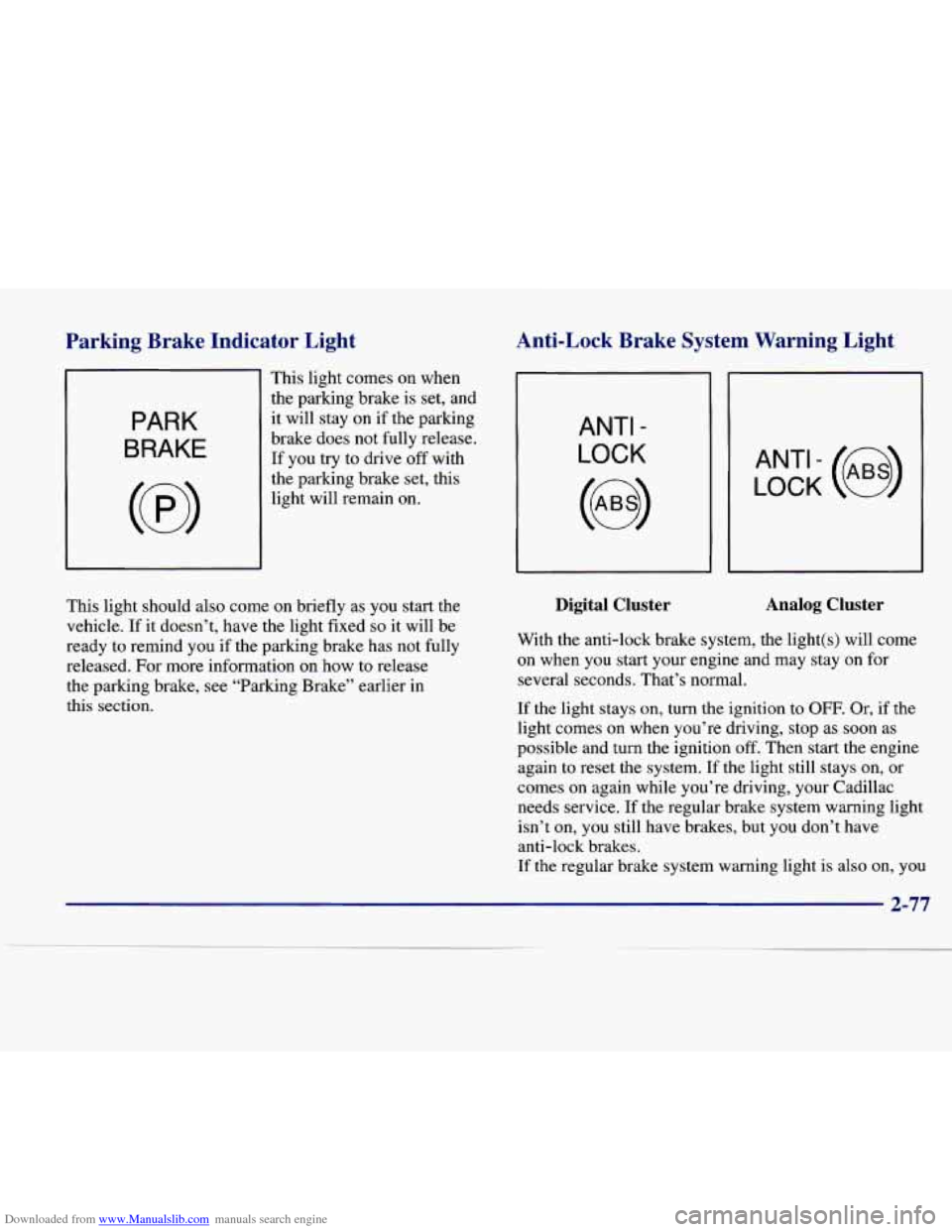
This light comes on when
the parking brake is set, and
it will stay on if the parking
brake does not fully release.
If you try to drive off with
the parking brake set, this
light will remain on.
ANTI -
LOCK
LOCK (e)
This light should also come on briefly as you start the
vehicle.
If it doesn’t, have the light fixed so it will be
ready to remind you if the parking brake has not fully
released. For more information on how to release
the parking brake, see “Parking Brake” earlier in
this section.
Digital Cluster Analog Cluster
With the anti-lock brake system, the light(s) will come
on when you start your engine and may stay on for
several seconds. That’s normal.
If the light stays on, turn the ignition to OFF. Or, if the
light comes on when you’re driving, stop as soon as
possible and turn the ignition
off. Then start the engine
again to reset the system.
If the light still stays on, or
comes on again while you’re driving, your Cadillac
needs service. If the regular brake system warning light
isn’t on, you still have brakes, but you don’t have
anti-lock brakes.
If the regular brake system warning light is also on, you
2-77