wheel CADILLAC DEVILLE 1998 7.G User Guide
[x] Cancel search | Manufacturer: CADILLAC, Model Year: 1998, Model line: DEVILLE, Model: CADILLAC DEVILLE 1998 7.GPages: 386, PDF Size: 22.36 MB
Page 89 of 386
Downloaded from www.Manualslib.com manuals search engine New Vehicle 66Break-In” Ignition Positions
NOTICE:
Your vehicle doesn’t need an elaborate
“break-in.” But it will perform better in the long
run
if you follow these guidelines:
0
e
0
Don’t drive at any one speed -- fast or
slow
-- for the first 500 miles (805 km).
Don’t make full-throttle starts.
Avoid making hard stops for the first
200 miles (322 km) or so. During this time
your new brake linings aren’t yet broken
in. Hard stops with new linings can mean
premature wear and earlier replacement.
Follow this breaking-in guideline every
time you get new brake linings.
Don’t tow
a trailer during break-in.
See “Towing
a Trailer’’ in the Index for
more information.
C
A E
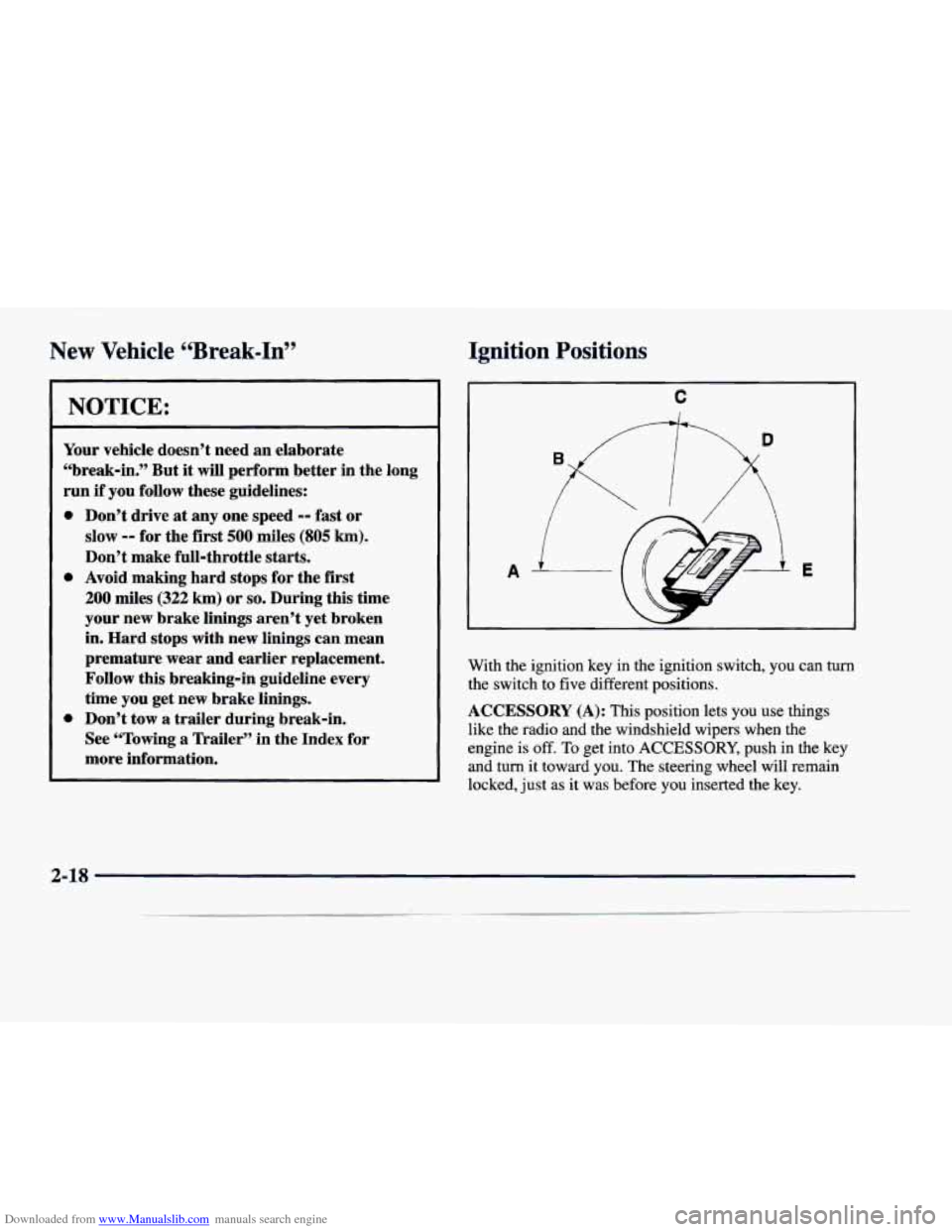
With the ignition key in the ignition switch, you can turn
the switch to five different positions.
ACCESSORY (A): This position lets you use things
like the radio and the windshield wipers when the
engine is
off. To get into ACCESSORY, push in the key
and turn it toward you. The steering wheel will remain
locked, just as it was before you inserted the key.
2-18
Page 90 of 386
Downloaded from www.Manualslib.com manuals search engine LOCK (B): Before you put the key in, the ignition will
be in LOCK. This is the only position in which you can
remove the key. This position locks the ignition, steering
wheel and transaxle. It’s a theft-deterrent feature.
NOTICE:
If your key seems stuck in LOCK and you can’t
turn
it, be sure you are using the correct key; if
so, is it all the way in? If it is, then turn the
steering wheel left and right while you turn the
key hard. But turn the key only with your hand.
Using
a tool to force it could break the key or the
ignition switch.
If none of this works, then your
vehicle needs service.
Retained Accessory Power (RAP)
The following accessories on your vehicle may be used
for up to
10 minutes after the ignition key is turned from
RUN to OFF:
Radio
Power Windows
Astroroof
Power to these accessories stops after
10 minutes or
if any door is opened. If you want power for another
10 minutes, turn the ignition key to RUN, then back
to
OFF, then to LOCK. Always leave your key in
LOCK when using RAP.
If you leave your key in
any other position than LOCK, your battery will
discharge prematurely.
OFF (C): This position lets you turn off the engine but
still turn the steering wheel. It doesn’t lock the steering
wheel like LOCK does. Use
OFF if you must have your
vehicle in motion while the engine is off (for example, if
your vehicle is being pushed).
RUN (D): This is the position for driving.
START (E): This position starts the engine.
2-19
Page 94 of 386
Downloaded from www.Manualslib.com manuals search engine Automatic l’ransaxle Operation
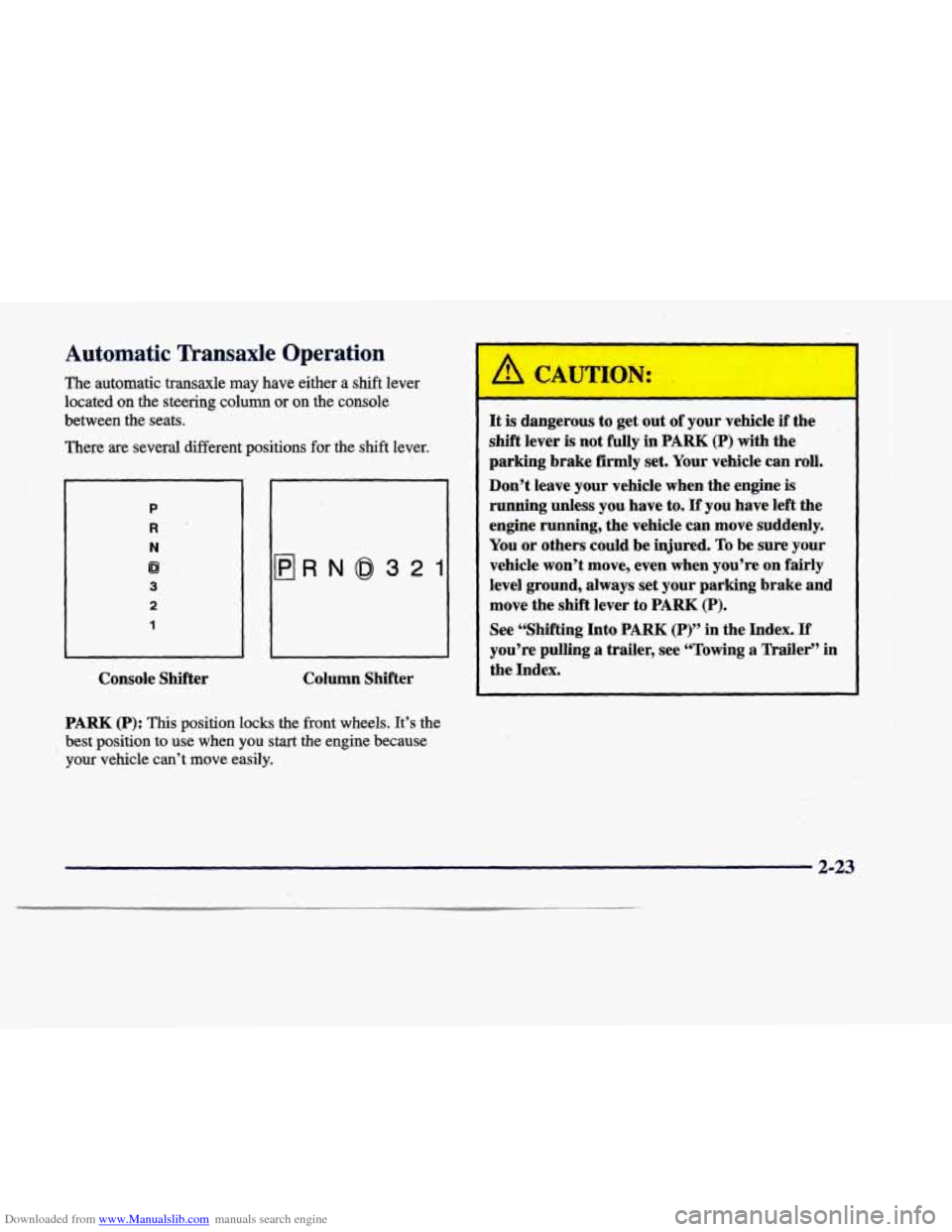
The automatic transaxle may have either a shift lever
located on the steering
column or on the console
between the seats.
There are several different positions for the shift lever.
P
R
N
8
3
2
1
Console Shifter
I
Column Shifter
PARK (P): This position locks the front wheels. It’s the
best position to use when you start the engine because
your vehicle can’t move easily.
A CAUTION:
It is dangerous to get out of your vehicle if the
shift lever is not fully in
PARK (P) with the
parking brake
firmly set. Your vehicle can roll.
Don’t leave your vehicle when the engine
is
running unless you have to. If you have left the
engine running, the vehicle can move suddenly.
You or others could be injured. To be sure your
-vehicle won’t move, even when you’re on fairly
level ground, always set your parking brake and
move the shift lever to
PARK (P).
See “Shifting Into PARK (P)” in the Index.. If
you’re pulling a trailer, see “Towing a Trailer” in
the Index.
I
2-23
Page 95 of 386
Downloaded from www.Manualslib.com manuals search engine Ensure the shift lever is fully in PARK (P) range before
starting the engine. Your vehicle has a Brake-Transaxle
Shift Interlock (BTSI). You have to fully
apply your
regular brakes
befure you can shift from PARK (P)
when the ignition key is in RUN.
If you cannot shift out
of PARK
(P), ease pressure on the shift lever -- push the
shift lever all the way into PARK (P) and release the
shift lever button on the floor shift console models as
you maintain brake application. Then move the shift
lever into the gear you wish. (Press the shift lever button
before moving the shift lever
on floor shift console
models.) See “Shifting Out
of PARK (P)” in this section.
REVERSE (R): Use this gear to back up.
NOTICE:
Shifting to REVERSE (R) while your vehicle is
moving forward could damage your transaxle.
Shift to REVERSE
(R) only after your vehicle
has stopped.
NEUTRAL (N): In this position, the engine doesn’t
connect with the wheels. To restart when you’re
already moving, use NEUTRAL (N) only. Also, use
NEUTRAL
(N) when your vehicle is being towed.
Also use this gear to rock your vehicle back and forth
to
get out of snow, ice or sand without damaging your
transaxle. See “If You’re Stuck
in Sand, Mud, Ice or
Snow” in the Index for additional information. Shifting out
of PARK
(P) or NEUTRAL (N) while
your engine
is “racing” (running at high speed) is
dangerous. Unless your foot
is firmly on the
brake pedal, your vehicle could move very
rapidly.
You could lose control and hit people or
objects. Don’t shift out
of PARK (P) or
NEUTRAL
(N) while your engine is racing.
NOTICE:
Damage to your transaxle caused by shifting out
of
PARK (P) or NEUTRAL (N) with the engine
racing isn’t covered by your warranty.
I I
2-24
Page 97 of 386
Downloaded from www.Manualslib.com manuals search engine FIRST (1): This position gives you even more power
than
SECOND (2). You can use it on very steep hills,
or
in deep snow or mud. (If the shft lever is put in
FIRST (l), the transaxle won’t shift into gear until the
vehicle is going slowly enough.)
I NOTICE:
- ~~
If your front wheels can’t rotate, don’t try to
drive. This might happen if you were stuck in
very deep sand
or mud or were up against a solid
object.
You could damage your transaxle.
Also, if you stop when going uphill, don’t hold
your vehicle there with only the accelerator
pedal. This could cause overheating and damage
the transaxle.
Use your brakes to hold your
vehicle in position on a hill.
Parking Brake
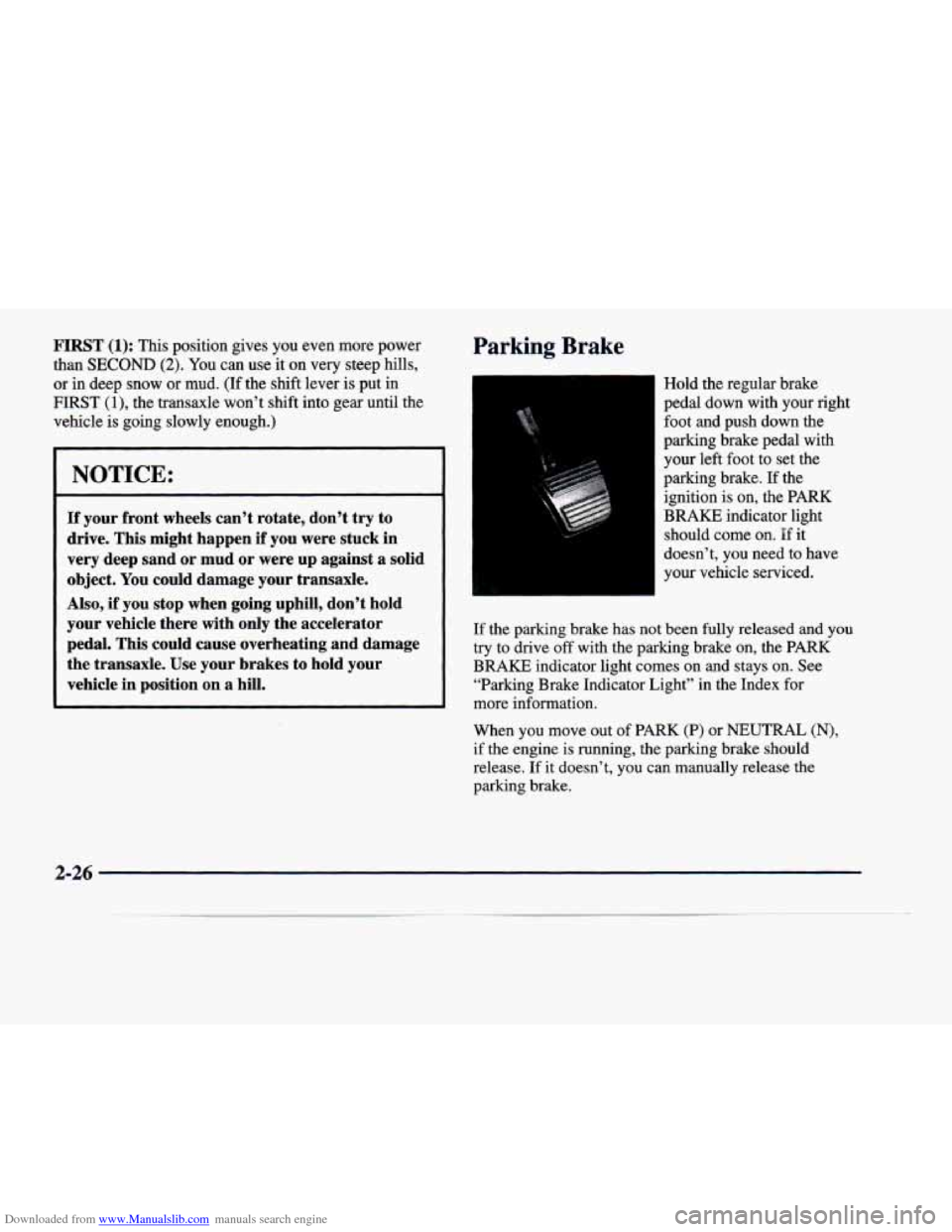
Hold the regular brake
pedal down with your right
foot and push down the
parking brake pedal with
your left foot to set the
parking brake. If the
ignition is on, the PARK
BRAKE indicator light
should come on.
If it
doesn’t, you need to have
your vehicle serviced.
If the parking brake has not been fully released and you
try to drive off with the parking brake on, the PARK
BRAKE indicator light comes on and stays on. See “Parking Brake Indicator Light” in the Index for
more information.
When you move out of PARK
(P) or NEUTRAL (N),
if the engine is running, the parking brake should
release. If it doesn’t, you can manually release the
parking brake.
2-26
Page 105 of 386
Downloaded from www.Manualslib.com manuals search engine Express-Down Window Tilt Wheel
This feature is present on the driver’s power window.
Pressing the control rearward into the second position
then releasing it will lower the window completely.
If
you want to stop the window as it is lowering, press
the control forward. Press the control forward to raise
the window.
Note that the first position on the control operates the driver’s power window
in the non-express mode.
Rear Window Lockout
Pressing the button down
will disable the rear window
controls. This is a useful
feature if you have children
. . -:
as passengers. Press the
button again to allow your
passengers to reuse their window controls.
Horn
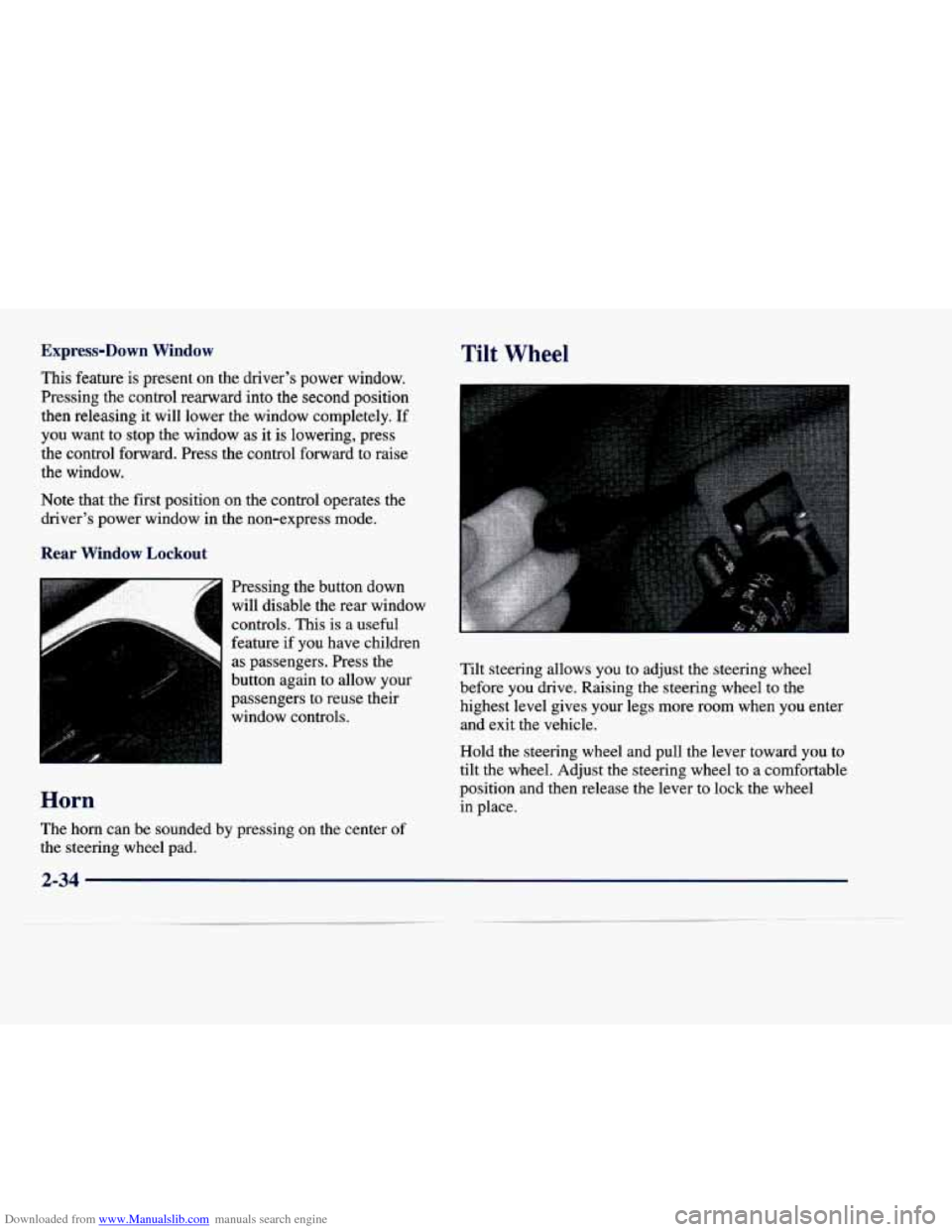
Tilt steering allows you to adjust the steering wheel
before you drive. Raising
the steering wheel to the
highest level gives your legs more room when you enter and exit the vehicle.
Hold the steering wheel and pull the lever toward you to
tilt the wheel. Adjust the steering wheel to a comfortablc
position and then release the lever to lock the wheel in place.
The horn can be sounded by pressing
on the center of
the steering wheel pad.
2-34
Page 110 of 386
Downloaded from www.Manualslib.com manuals search engine NOTICE:
Driving without washer fluid can be dangerous.
A bad mud splash can block your vision and you
could hit another vehicle or go
off the road.
Check the washer fluid level often.
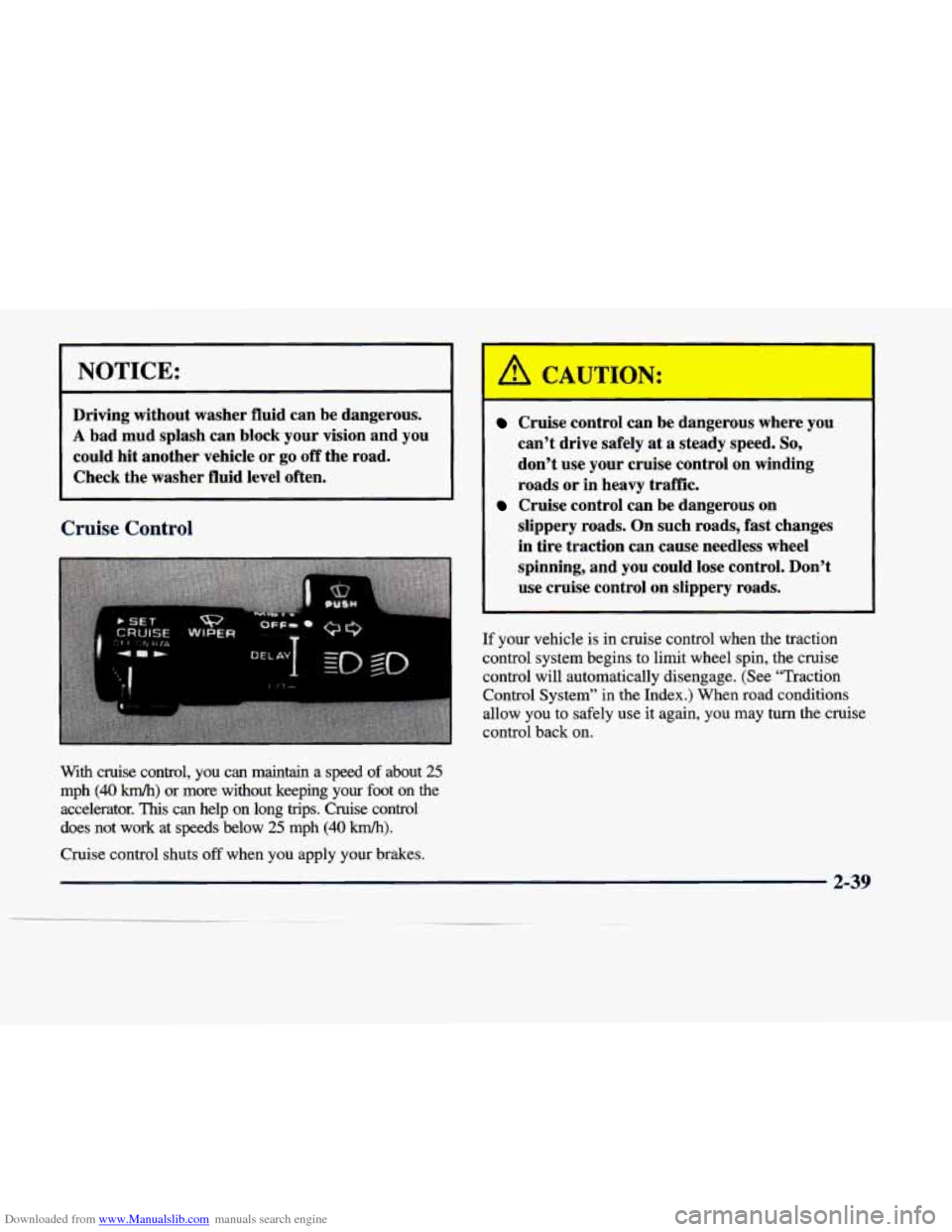
Cruise Control
A CAIJTION:
Cruise control can be dangerous where you
can’t drive safely at a steady speed.
So,
don’t use your cruise control on winding
roads or in heavy traffic.
slippery roads. On such roads, fast changes in tire traction can cause needless wheel
spinning, and you could lose control. Don’t
use cruise control on slippery roads.
Cruise control can be dangerous on
If your vehicle is in cruise control when the traction
control system begins to limit wheel spin, the cruise
control will automatically disengage. (See “Traction Control System” in
the Index.) When road conditions
allow you to safely use it again, you may turn the cruise
control back
on.
With cruise control, you can maintain a speed of about 25
mph (40 km/h) or more without keeping your foot on the
accelerator.
This can help on long trips. Cruise control
does not work at speeds below
25 mph (40 M).
Cruise control shuts off when you apply your brakes.
2-39
Page 127 of 386
Downloaded from www.Manualslib.com manuals search engine NOTICE:
Illuminated Visor Vanity Mirror
Turn the sunshade down and lift the cover to see the
mirror. Move the slide switch
up or down to brighten or
Don’t hold a cigarette lighter in with your hand
while it is heating.
If you do, it won’t be able to
dim the lamp.
lighter and the heating element. Turn the sunshade down and lift the cover to see the
(If Equipped) ready. That can make it overheat, damaging the
Illuminated Rear Seat Visor Vanity Mirror back away from the heating element when it’s
mirror. Move the slide switch up or down to brighten or
dim the lamp.
ur 7isors
awing down the visor to block out glare. It can also be Cellular Telephone (Option)
detached from the center mount and moved to the side
Your vehicle has been prewired for dealer installation of
while the auxiliary sunshade remains to block glare a Cadillac dual-mode (analog/digital) cellular telephone.
from the front.
hll the front shade from the headliner A fixed mobile or a portable hand-heid system is
and position it to your preference.
available. Either system has steering wheel telephone
The driver’s sunshade is
also equipped with a storage controls and information output through the Driver
flap that can be used for maps or toll tickets. Information Center (DIC). Voice activation and
hands-free operation are standard features. For more
information, contact your dealer.
A user’s guide is
provided with the telephone.
2-56
Page 134 of 386
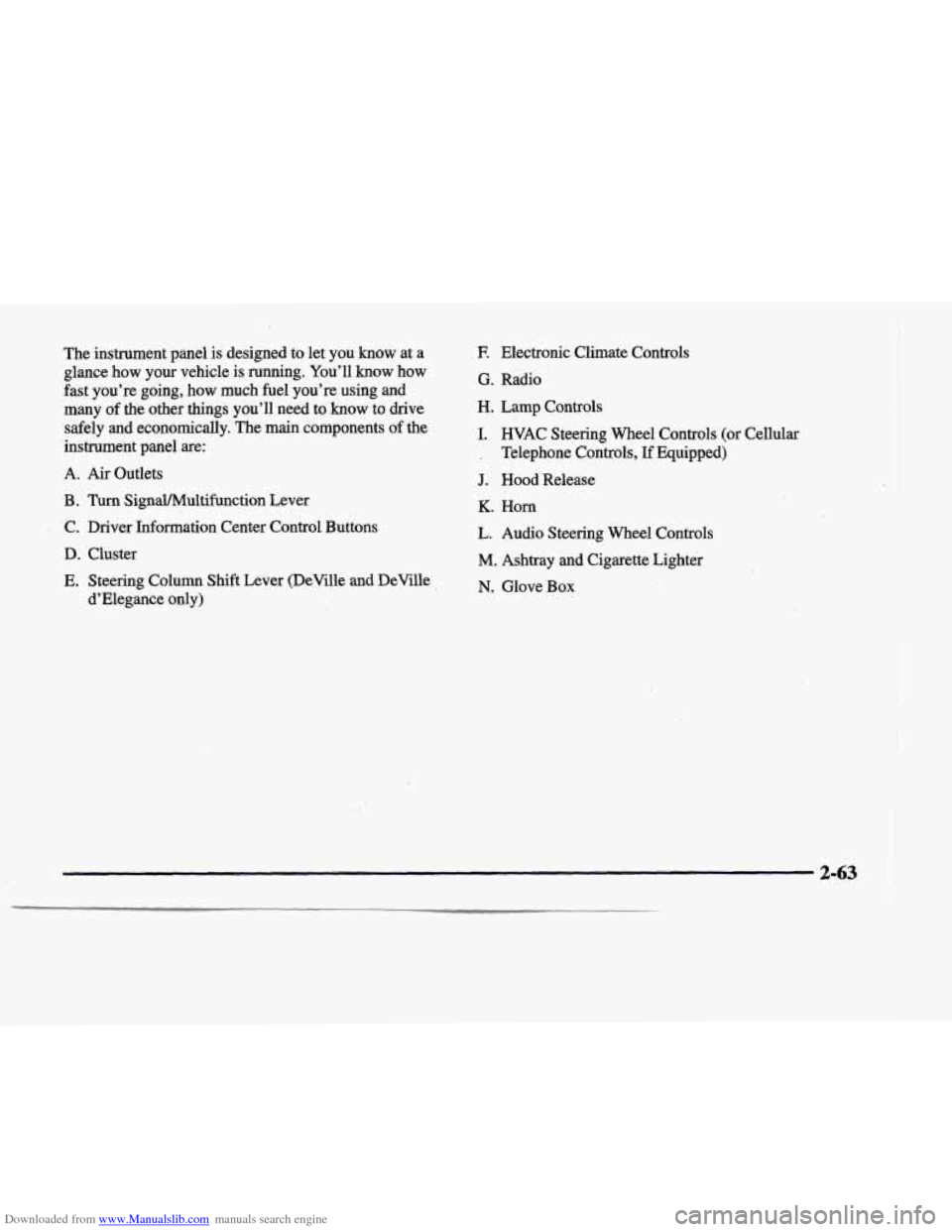
Downloaded from www.Manualslib.com manuals search engine The instrument panel is designed to let you know at a
glance
how your vehicle is running. You’ll know how
fast you’re going, how much fuel you’re using and
many of the other things you’ll need
to know to drive
safely and economically. The main components
of the
instrument panel
are:
A. Air Outlets
B . Turn SignaYMultif’unction Lever
, C. Driver Information Center Control Buttons
D. Cluster
E. Steering Column Shift Lever (DeVille and DeVille
d’Elegance only)
E Electronic Climate Controls
G. Radio
H. Lamp Controls
I. HVAC Steering Wheel Controls (or Cellular
’ , Telephone Controls, If Equipped)
J. Hood Release
K. Horn
L. Audio Steering Wheel Controls
M. Ashtray and Cigarette Lighter
N. Glove Box
2-63
Page 143 of 386
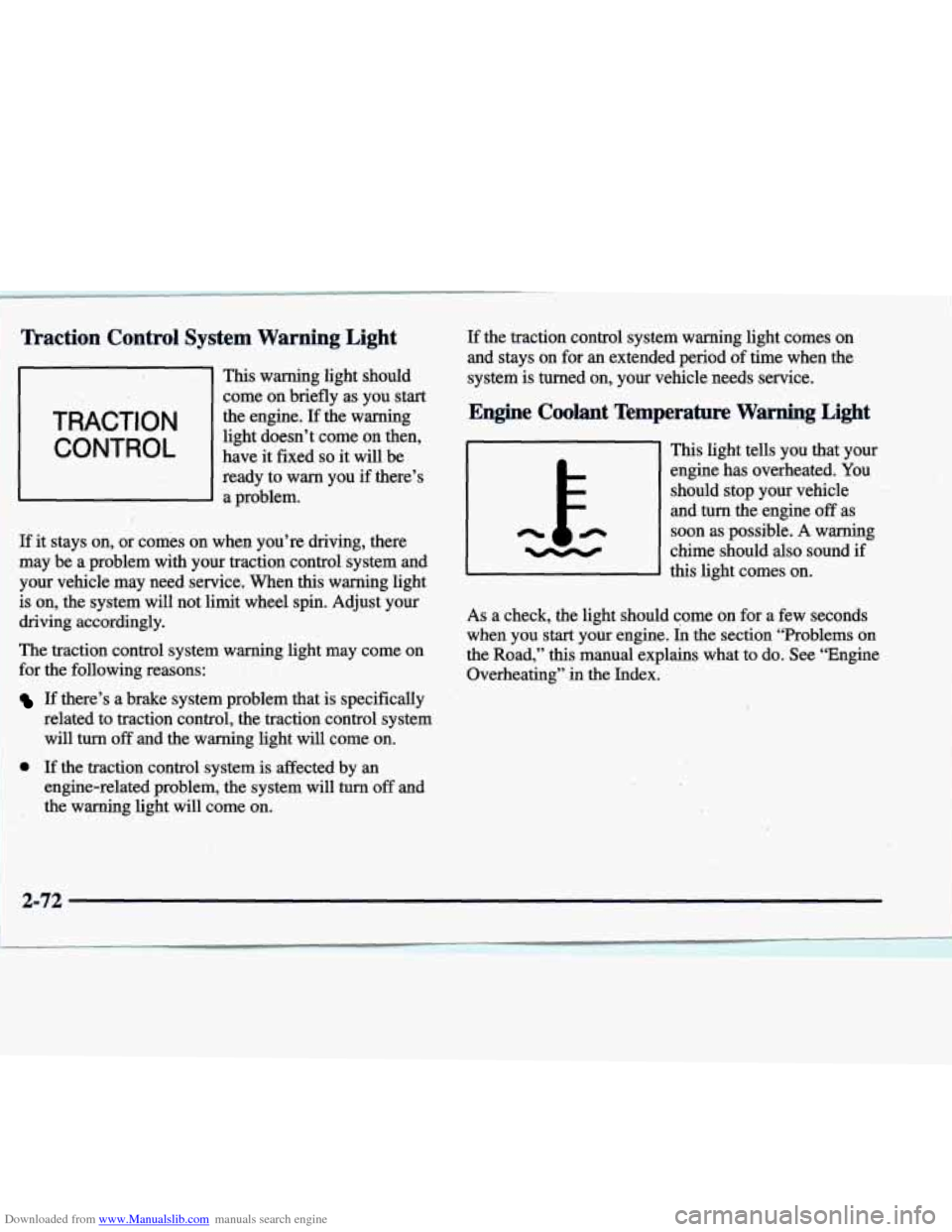
Downloaded from www.Manualslib.com manuals search engine Traction Control System Warning Light
This warning light should
come on briefly as you start
the engine.
If the warning
light doesn’t come on then,
ready to warn you if there’s TRACT^ 0 N
CONTROL have it fixed so it will be
I’ a problem.
i If it stays on, or comes on when you’re driving, there
i may be a problem with your traction control system and
your vehicle may need service. When this warning light is on, the system will not
limit wheel spin. Adjust your
driving accordingly.
The traction control system warning light may come on
for the following reasons:
1 If there’s a brake system problem that is specifically
related to traction control, the traction control system
will
turn off and the warning light will come on.
I 1 0 ‘If the traction control system is affected by an
engine-related problem, the system will turn
off and
the warning light will come on.
If the traction control system warning light comes on
and
stays on for an extended period of time when the
system
is turned on, your vehicle needs service.
Engine Coolant Temperature Warning Light
This light tells you that your
engine has overheated. You
should stop your vehicle
’ ‘3
and.turn the engine off as
soon as’possible.
A warning
chime should
also sound if
this light comes on.
As a check,
the light should come on for a few seconds
when you start your engine.
Ih the section “Problems on
the Road,” this manual explains what to do. See “Engine
Overheating”
in the Index.